I have not and will not ever go through 90,000 pages of wikileaked documents covering US military operations (January 2004-December2009). But, if the Guardian tells me its legitimate and important, I’ll begin with that understanding.

What then, when Mother Jones – more precisely Adam Weinstein – comes along and tells me not to believe Assange’s hype?

Adam Weinstein at Mother Jones dismisses the import of the Afghan War Logs on wikileaks:

“In truth, there’s not much there. I know, because I’ve seen many of these reports before – at least, thousands of similar ones from Iraq, when I was a contractor there last year. I haven’t been through everything yet, but most of what you see on WikiLeaks are military SIGACTS (significant activity reports). These are theoretically accessible by anyone in Iraq, Afghanistan, or the Tampa, Florida-based US Central Command—soldiers and contractors—who have access to the military’s most basic intranet for sensitive data, the Secret Internet Protocol Router Network (SIPRNet). Literally thousands of people in hundreds of locations could read them, and any one of them could be the source for WikiLeaks’ data.”

My question: Just because it is easy for service personnel or contractors to view the material doesn’t change the significance this leak has for the general public in its capacity to form a view of the war based on new material, does it? Weinstein counters again, “By and large, like most of the stunts pulled by Assange, this one’s long on light and short on heat, nothing we didn’t already know if you were paying attention to our wars.”

Weinstein does make the valid point that the lives of Afghan collaborators are now at risk, as their names are not redacted from the material.

Ultimately though, I fear the coverage of the leak may develop into a character dissection of Assange and “discussion” of the relative merits of new-journalism; the former will dominate and the latter could be fruitful but will probably miss the point.

I am in support of wikileaks, but mainly because I am opposed to the war. I don’t feel our media does a good enough job at getting to the realities of war for the American news consumer. We saw just last week that the mainstream media ceased using the word torture for water-boarding almost overnight. That linguistic culture shift suggests to me that the mainstream media are as subject to political pressures as any individual … so, why shouldn’t we have wikileaks mix it up? And why shouldn’t we think about the flows of information: or the definition of free media: or tactics are served when information is kept classified, hidden?

Today, 26th July 2010, Kaing Guek Eav, commonly known as Comrade Duch, who is charged with war crimes and for his part in the deaths of up to 12,000 Cambodians will face a final verdict.

In 2003, Masaru Goto photographed ten survivors of the Khmer Rouge regime.

Goto: “The Khmer Rouge regime is remembered for the deaths of an estimated 1.7 million people (from an estimated 1972 population of 7.1 million) under its regime, through execution, starvation and forced labor. Directly responsible for the death of about 750,000, the policies of the Khmer Rouge led, mainly through starvation and displacement, to the death of more than 1 million more people. In terms of the number of people killed as a proportion of the population of the country it ruled, it was one of the most lethal regimes of the 20th century.”

On 26th July 2010, Comrade Duch, the chief executioner of the Khmer Rouge will finally face justice. A verdict is due to be passed down in the trial of Duch who is charged with war crimes and crimes against humanity for his part in the deaths of up to 12,000 Cambodians.

Duch’s trial would not be possible if photographer Nic Dunlop had not tracked him down in 1999. The story is told in Nic’s book The Lost Executioner.

Dunlop says, “It’s a strange thing to think that a chance encounter eleven years ago in a remote village has led to a multi-million dollar trial involving dozens of legal experts, academics, victims, perpetrators and journalists. But it is disappointing that only one man has been tried for these crimes in more than 30 years.’

(via)

Was it an inside act of rebellion?

I have absolutely no grounds on which to make an accusation, which is why I phrase it as a question.

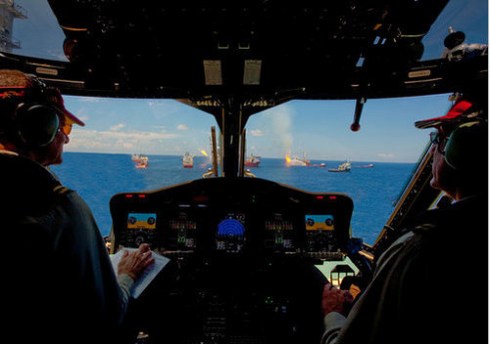
But just looking at the foolish doctoring of images, especially the helicopter cockpit image, I wonder if the culprit intended to be caught? The color of the photoshopped image is just ludicrous, literally unbelievable, unless that is Martin Parr’s Gulf of Mexico!

To me, the reworking seems suspiciously blatant. Who is the “contract photographer” doing these pig-eared photoshoppings? And, is he/she a saboteur?

Original. © BP p.l.c.

Botched photoshop. © BP p.l.c.

INTERNET MEME

Rather joyously, this image has become a meme. See the comments in the original and excellent Gawker article!

Last month, I mentioned Jane Evelyn Atwood’s TV interview and to Jane’s appeal in support of Gaile Owens‘. A campaign operated to have Gaile’s death sentence commuted to life imprisonment. Gaile will be eligible for parole in late 2011.

Jane contacted me this morning with this piece of good news. “Please be informed that Gaile Owen’s sentence has been commuted by the Governor of the State of Tennessee to a life sentence.  She will no longer be executed on September 28. Thank you for your support, thank you for helping save Gaile Owen’s life.”

Why stop here? Please inform yourself and others about domestic violence and the violence it can engender.

Family Violence Prevention Fund www.endabuse.org

National Domestic Violence Hotline http://www.ndvh.org/

An Omar Broadway Film aired on HBO last month. Omar smuggled a video camera into Northern State Prison, New Jersey and documented for six months. The film was debuted at the 2008 Tribeca Film Festival.

There are many reasons I believe in prison reform, the wasted potential is one, the wasted dollars is an other, the systematic violence is the reason to which this film speaks. Shadow and Act review it here.

Below is a video interview with Douglas Tirola, one of the directors, about how the film got made.

Image courtesy Edgar Martins/HotShoe Gallery

I’d agree with Joerg that We Need Better Critical Writing About Photography. This is pretty simple task – just cut out the jargon. Having posted On Statements last month, Joerg is only demanding the same of critics as he is of photographers.

Which brings me to Exhibit A: Photographer, Edgar Martins is talking bollocks again.

“One could argue that this work seeks to communicate ideas about how difficult it is to communicate. My images depend on photography’s inherit tendency to make each space believable, but there is a disturbing suggestion that all is not what it seems. The moment of recognition that there is something else going on, the all too crucial moment of suspended disbelief, is the highest point that one can achieve. This process of slow revelation and sense of temporal manipulation is crucial to the work. Above and beyond this, in having to shift between the various codes, the viewer becomes acutely aware of the process of looking, of the reconciliation required between sensory and cognitive understanding. As you rightly say, it is difficult to know for sure if what you are looking at is a photograph. However, they are photographs.”

Déjà vu

You might remember Edgar Martins. He’s the photographer who photoshopped images of foreclosed America for the New York Times. It was one of the more substantive photoshop kerfuffles of recent years.

I remember at the time thinking that the way Martins wiggled his way out of the controversy was skilled; he put all his energies into How can I see what I see, until I know what I know? a meditation on truth in photography, diluting his deception in M.F.A. critical theory references.

Martins confused 90% of his detractors with his busy response and sapped the energy of the remaining 10% who were looking for the next headline anyway.

He really intrigues me!

– – – – – – – – – – – –

Thanks to Alan Rapp for the tip-off.

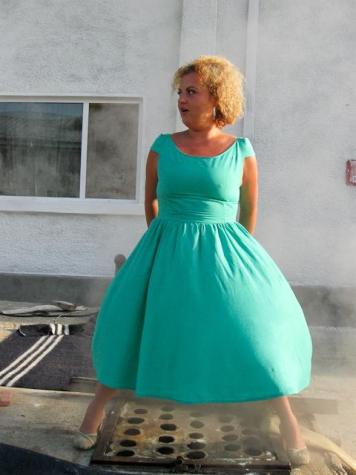
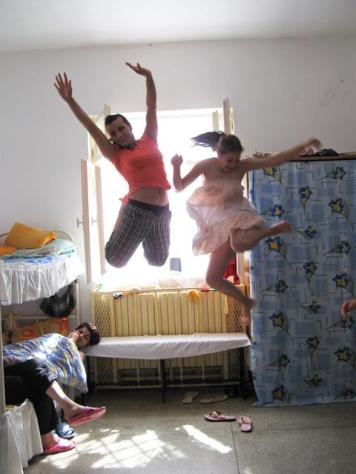
Fourteen female prisoners at Tirgsor Prison in Romania participated in a six-camera workshop led by Cosmin Bumbuţ.

The workshop was suggested by a Miss Raducanu (presumably the warden), and Cosmin Bumbuţ took up the initiative. Bumbuţ gained sponsorship from f64 and insisted that – after basic training – the women be left unsupervised with the cameras for the duration of the project.

Bumbut: “I received six Canon PowerShot cameras that I took with me to Tirgsor in July. The cameras worried me, they had so many buttons and the manual was so complex that I was skeptical that anyone could use them; I, for one, wasn’t able to. I felt very nervous.”

Over a two month period the group captured 14,000 images. 395 were chosen for the final exhibition and 95 can be seen in an online gallery at Punctum (Romanian language). Here is a Google translation.

I’ve picked out 12 images.

This is a marvelous project. I would like to see more photography used as rehabilitation in prisons. I have a colleague who uses video in an ethnological framework and the men really benefit from the novel educational approach.

This Romanian project is similar to the pinhole photography of the girls of Remann Hall here in Washington State.

Finally, it is worth saying that Bumbut was inspired by Klavdij Sluban‘s prison workshops which he has conducted across the globe.

EMAIL

prisonphotography [at] gmail [dot] com

RSS PETE BROOK ON MEDIUM

  • An error has occurred; the feed is probably down. Try again later.

Prison Photography Archives

Post Categories