DISASTER PHOTOGRAPHY

I ran across the University College Dublin’s Photography & International Conflict project this week. It operates out of UCD’s Institute for American Studies … and it’s awesome.

Or as awesome as something about war can be … or at least the best academic offering on photos and carnage since Photography and Atrocity served up at Leeds University a couple of years ago.

If you fancy going all rogue-scholar then this is the site for you: Imaging, Africa, ethics, Northern Ireland, the political economies of photography, America, Vietnam, the former Yugoslavia and well known academes of the media/photo/critic world.

Anyhoo, this is all by the by, because amongst this thinkers-paradise are some straight video interviews with leading photography editors.

SATURATION POINT

Roger Tooth, Head of Photography for the Guardian UK says (at about 18 minutes and 30 seconds):

I would have thought we are at saturation point for photojournalists, but then you have the colleges churning out thousands of graduates each year, so its all a bit worrying really. I haven’t got a clue what these people are going to do? I would have thought we’ve got enough people to go around at the moment. What I suspect they’ll do in the future, I suspect they’ll do video because that’s going to be the currency.

Well, how’s about that?! Seriously, great site and plenty of food for thought.

Found via the reliably excellent CONTACT blog, which keeps me real with all things Britski.

UPDATE

As if on cue, A Photo Editor has this interview with Vincent Laforet about his switch over to moving images.

© Bob Adelman/Magnum Photos. Washington DC. 1963. At the climax of his "I Have A Dream" speech, Martin Luther KING Jr., the final speaker at the March on Washington, raises his arm on the steps of the Lincoln Memorial, and calls out for deliverance with the electrifying words of an old Negro spiritual hymn, "Free at last! Free at last! Thank God almighty, we are free at last!"

PREAMBLE

When doing research for Wired’s Raw File piece on Dell’s acquisition of 185,000 Magnum press prints, reactions were unanimously positive.

The deal was understood as incentivised in the right ways so that Magnum, Dell’s MSD, the Harry Ransom Center, the individual photographers and – last but not least – the public would all win; the deal meant advanced archiving, preservation, research, lectures, education and access to the materials.

I leant particular weight to the feedback of Eli Reed and Susan Meiselas, two senior Magnum members, both grateful for the collection’s new lease of life.

CONTRASTING POSITIONS

I’d like to quickly bring to your attention two differing opinions I’ve come across this past week.

Firstly, Stephan Minard takes a suspicious view. Minard is the former director for stock-sales and archives of Magnum (Paris, London, New York & Tokyo) between 2008 and 2009. Here is Minard’s article (French) and here is a poor Google translation.

Minard sees the issue of the deal as “bigger than just a deal for money and posterity. It is more the sign of the incapacity of the photographers to protect a common treasure, to build a common project for the agency.”

Minard puts the Dell acquisition in the context of recent acquisitions of Magnum photographers’ works by outside parties (Capa’s “Mexican Suitcase” owned by the ICP, Henri Cartier Bresson’s archive owned by the HCB Foundation in Paris).

I think Minard deals somewhat in hyperbole and paints Dell as an unsuitable custodian. He believes Magnum has sold its ability to own and write its own history, whereas many in the industry feel the retention of all rights by the photographers has ensured exactly the opposite.

Magnum is a business and as such it would be useless hoarding sections of its past collections if in so doing they jeopardised the careers of its current and future members. Magnum is not a museum.

In the other corner, George Zimbel speaks of Michael Dell as an ever-benevolent father figure of documentary photography. Read here.

Zimbel asks a general question as applied to any number of hidden collections and obscured archives, “Where are those prints? I don’t know. No one will have to ask that question about the Magnum archive. Thank you Michael Dell.”

Zimbel knew Cornell Capa in the 1940s. Zimbel did the annual report for Xerox Corp. in 1961. When he couldn’t repeat the contract the following year, Xerox hired all of Magnum to continue the documentary approach.

Zimbel then rattles through a numbers of folk, generations and degrees of seperation to end up at the desk of a family friend Alex Gruzen, Senior Vice President Consumer Products Group at Dell Computers in Austin Texas, “I am sending Alex Gruzen a copy of my catalogue “George S. Zimbel, IVAM 2000″ to give to Michael Dell. He really values documentary photography. It’s like family.

Salman Rushdie made a statement yesterday attacking Amnesty International‘s decision to partner with Moazzam Begg and Cageprisoners, Begg’s advocacy group for Guantanamo prisoners.

Rushdie:

“Amnesty International has done its reputation incalculable damage by allying itself with Moazzam Begg and his group Cageprisoners, and holding them up as human rights advocates. It looks very much as if Amnesty’s leadership is suffering from a kind of moral bankruptcy, and has lost the ability to distinguish right from wrong. It has greatly compounded its error by suspending the redoubtable Gita Sahgal for the crime of going public with her concerns.”

Gita Sahgal was the former Head of Amnesty Internationals Gender Unit. Sahgal had described Begg as “Britain’s most famous supporter of the Taliban” and contended the partnership severely brought into question AI’s ethics. Rushdie is a long time friend of Sahgal and supports her position.

From the Times:

Amnesty’s work with Cageprisoners took it to Downing Street last month to demand the closure of Guantanamo Bay. Begg has also embarked on a European tour, hosted by Amnesty, urging countries to offer safe haven to Guantanamo detainees. This is despite concerns about former inmates returning to terrorism.

Of course, one’s thoughts on this affair depends on whether or not you think Begg is seditious as his critics state.

If we are looking for impartial perspectives then Fahad Ansari, spokesperson for Cageprisoners is probably not the best source (although he states important facts about Begg’s past). I prefer to rely on British journalist Andy Worthington who has devoted his past eight years to researching and writing responsibly on Guantanamo.

Worthington looks at every angle, but states at the outset that Sahgal and the Rupert Murdoch owned Times may have been pursuant of an “editorial policy”:

That Sahgal also chose to air her complaints in the Sunday Times, a newspaper owned by Rupert Murdoch, is also significant, particularly because the Times first attempted to smear Begg and Cageprisoners a month ago, in connection with the failed plane bomber Umar Farouk Abdulmutallab, in an article by the normally reliable Sean O’Neill, entitled, “Umar Farouk Abdulmutallab had links with London campaign group.” To me, this suggests that Sahgal may have been used as part of an ongoing attempt to vilify Begg that was part of a specific editorial policy.

The danger here is that people will dig in their heels on previously staked ground; that legitimate criticism of the illegal Guantanamo will be eclipsed by accusation and counter-assertion about the character of Begg.

One to watch ….

I am currently obsessed with Alex Webb and the way he piles everything on top of everything else. Working on a post last week, I was reminded of a commercial shoot I saw last year.

© Alex Webb/Magnum Photos. CUBA. Sancti Spiritus. 1993. Baseball fans.

@ Ben Baker. FedEx Board of Directors

Ben Baker‘s website and interview. Alex Webb‘s website

UPDATED

Since going to press, University Behind Bars has changed its name to University Beyond Bars. The new website for UBB can be found at http://www.universitybeyondbars.org/.

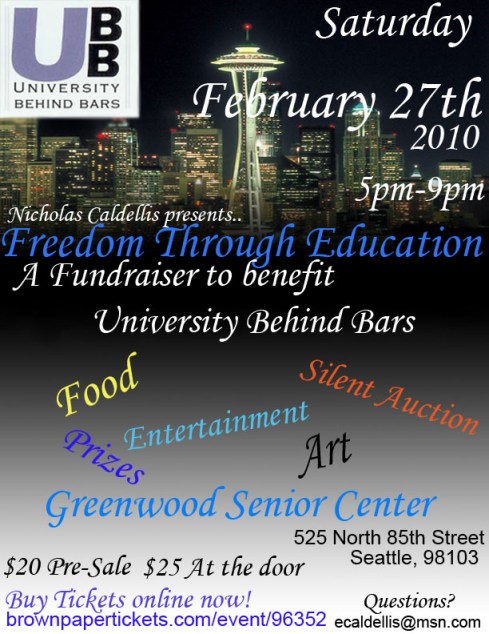
FREEDOM THROUGH EDUCATION

The Prisoners Education Network is hosting FREEDOM THROUGH EDUCATION, a fundraiser for its main program, University Behind Bars.

Greenwood Senior Center is the venue for an evening of music, fine foods and silent art auction. Many students from my art class have donated paintings and other from outside the class have made crafts for auction. Local families and a local church group have pooled resources to make this happen. If you want to know why so many different people are invested, I think it is because they share PEN’s values and mission.

Buy tickets at Brown Paper Tickets

Freedom Through Education on Facebook

BACKGROUND

The Prisoners Education Network (PEN) is five years old. I have been with PEN for nine months now. In this current quarter, the University Behind Bars (UBB) offered is widest selection of courses – including Art, Business Law, Child Development/Psychology, English Composition, Human Geography, Intro to Math, Music Theory and Sociology.

PEN is the only organisation in Washington State providing college level education and credits to prisoners.

PEN is currently expanding its UBB program to preserve its widened curriculum. All teachers are volunteers and 98% of donations go directly toward tuition fees and books. Our teachers are passionate professionals, but our students are the heart of the program. Via the correspondence course set-up, students receive credit from Ohio University. Beyond matters of credit, the students are building a shared community of learning within Washington State Reformatory at Monroe Correctional Complex.

This is the first big fundraiser of the year. It would be great to see you there, but if you can’t attend because you are in another state or on another continent, please consider donating to PEN via the website.

Thank You

© Eugenio Espino Barros. 'Orphan's Asylum, Mexico City'

Alejandro Cartagena delights again with his introduction to Eugenio Espino Barros‘ work.

Barros designed his own cameras, which might explain why his subjects look more and more like cardboard cutouts toward the edges of the picture.

His official bio states, “At the age of sixteen he built his first camera, using cardboard and using the lenses from binoculars as his camera lens.”

© Caroll Taveras, 2009

I think America has too many guns. It is not something that fits really with Prison Photography so I stay away from the topic.

But I came across Caroll Taveras‘ photographs of a quick draw competition for children in Colorado, and was compelled to post.

Via and via and via. Full gallery.

© Zoriah Miller. Model Laura Peterson's negative sandwiched with an image of devastation in Lebanon after the 34-Day Summer War.

CHANGING DIRECTION

Zoriah Miller has put aside his photojournalist work to pursue photocollage full time.

Zoriah’s statement declared photojournalism “rigid and stagnant … obsessed with rules, hiding behind “ethics” in order to produce nothing but formulaic, generic press photography.”

“What if you could create works of art that would not only stun people visually, but also educate people about a subject that they may otherwise ignore or find too depressing to pay attention to?” asks Zoriah.

Zoriah explains that he has been “shooting models and celebrities to work on creating composite images of beauty, sex and fame mixed with conflict, crisis and disasters.”

Zoriah and all models and celebrities involved in the project donated their time and the proceeds from the project will benefit refugees of conflict.

HOW TO POSITION THE WORK?

Judging by the example offered above the composite results will be incongruous mixtures of elements. Seemingly, Zoriah has traded his prior claims toward humanitarianism for the language of Dada.

Zoriah’s position is conflicted. The way in which he suggests putting images together is antagonistic, which is fine if you’re willing to argue away meaning as many agitators do, but Zoriah is trying to bring about attention to the issues surrounding the images of death which he then obscures with images of sex appeal. Do you see his problem?

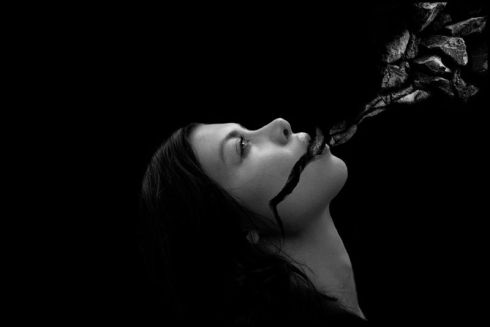
Anyone want to have a stab at throwing these two images together on photoshop?*
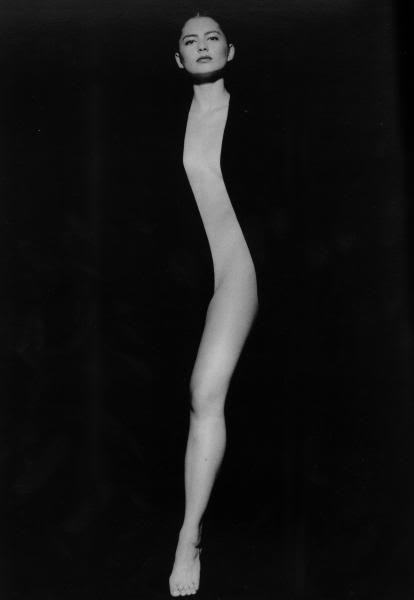
© Tono Stano, 'Sense'

© Yannis Behrakis/Reuters. A Palestinian worker repairs a bullet-ridden wall damaged during the three-week offensive Israel launched last December, at a factory in the northern Gaza Strip November 2, 2009.

If one experiments often enough fusing images together visually intriguing results will ensue. However, visual interest is cheap these days so it alone is not enough to prove an image ethical (I use that word knowingly) and/or effective.

I can see what Zoriah plans. It just doesn’t make a lot of sense.

QUICK THOUGHTS

1. Following the Haitian workshops debacle and in the face of unforgiving and acerbic name-calling, I think Zoriah argued his early corner quite well. To unleash this bizarre move is either total stupidity or unrelenting self-confidence. Either way, I would have liked to have heard and seen more works and reaction from Haiti and from his students before this.

2. Whether or not photojournalism is in a pickle – as Zoriah insists – the questionable cocktail of “sex and fame mixed with conflict, crisis and disasters” is, in my opinion, not the answer.

3. Likely, Zoriah’s future claims of being a journalist will be met only with derision.

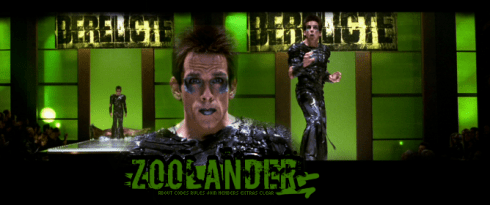
4. Zoriah’s efforts at a thanaphilic fashion photography are not without precedent. Zoolander’s poor-taste DERELICTE fashion collection, a homeless aesthetic wrapped in the glitz and lights of the catwalk was great satire. So good it inspired Vivienne Westwood and the late Alexander McQueen. Etnies also had a good go at bad taste with its Hobo Ad campaign. I suppose Vice readers have been getting off on photographs of blood stained victims for years now?…

5. The greatest problem with this issue is that is inflates the importance of photography as an agent of change. No matter how much we recognise a need to raise attention about global issues, photography is not the sole answer, nor is photojournalism. The mode of photography Zoriah suggests is an unholy marriage. Who is the audience for this hybrid approach? What does he expect audience reactions to be? It would seem to me that consumers of images are turned on and off by visual cues. It is very easy to hook them with slick tried-and-tested commercial cliches. It is one thing grabbing a viewers attention for a second or two, it is another mutating that into a long and complex engagement with the real issues.

6. As offensive as this manouver may be to some folk, it isn’t the first time (and won’t be the last) a photographer oversteps logic and accepted practice with great hopes to change the cultural landscape.

7. I suspect there’s a reason why the worlds of fashion and photojournalism are distinctly separate. I can also think of many other more subtle ways in which art and marketing has been used as part of photojournalist careerism.

8. Given the consumer climate in America it is not unlikely that Zoriah will succeed in raising substantial funds. Ultimately, it will become an issue of the project’s branding and delivery.

9. If all else fails, it’s a good start for an Onion feature, right?

What do you make of all this? The “Leave a comment” button is at the top of the post.

*NB. Zoriah is using Negative Sandwiching

Derek Zoolander launches the DERELICTE collection. Image source: http://www.uninvitedgrace.com/zoolander/

EMAIL

prisonphotography [at] gmail [dot] com

Prison Photography Archives

Post Categories