PART TWO IN A SERIES OF POSTS DISCUSSING PHOTOGRAPHERS’ ACTIONS AND RESPONSES TO THE KILLING OF FABIENNE CHERISMA IN PORT-AU-PRINCE, HAITI ON THE 19TH JANUARY 2010.

Following up on last months post about Fabienne Cherisma’s murder, it is apt to note Natasha Elkington’s Reuters Photographers blog post.

Amidst a very serious opinion piece about the hardships of childhood in Haiti and Kenya, Elkington includes a comment from the photographer of the renowned image of Fabienne Cherisma.

I spoke to the Reuters photographer in Haiti, Carlos Garcia Rawlins, who took the pictures of Fabianne to find out who shot her and why. He had no answers. By the time he got there she was already dead. She could have been shot by the police or armed security guards hired to protect property, he said. Witnesses said they didn’t know if she was targeted or hit by a stray bullet when police fired into the air to disperse a hungry mob.

What Rawlins did say is that people around her continued looting and would only stop for a moment to look at her body. “I couldn’t believe the indifference of the people around her,” he said.

Which is a different response to that of Jan Grarup.

– – –

ALSO IN THE ‘PHOTOGRAPHING FABIENNE’ SERIES

Part One: Fabienne Cherisma (Initial inquiries, Jan Grarup, Olivier Laban Mattei)

Part Three: Furthermore on Fabienne Cherisma (Michael Mullady)
Part Four: Yet more on Fabienne Cherisma (Linsmier, Nathan Weber)
Part Five: Interview with Edward Linsmier
Part Six: Interview with Jan Grarup
Part Seven: Interview with Paul Hansen
Part Eight: Interview with Michael Winiarski
Part Nine: Interview with Nathan Weber
Part Ten: Interview with James Oatway
Part Eleven: Interview with Nick Kozak
Part Twelve: Two Months On (Winiarski/Hansen)
Reporter Rory Carroll Clarifies Some Details
Part Fourteen: Interview with Alon Skuy
Part Fifteen: Conclusions


While much recent debate has been about if bloggers, indie-writers and stopgap-journos can find ways to make money, Brian Ulrich asks if many of us actually deserve to:

“It’s become fairly commonplace for one to put together a website or blog. Ask several questions of an artist by email, spellcheck and publish them.”

and

“An interview is not a questionnaire and all too many of these interviews are distilled down to a manufactured series of questions where it may even be obvious that the person asking the questions hasn’t even looked to see if those questions were answered somewhere else before. ‘What got you interested in photography?’, ‘tell me some of the inspiration behind your current project _____’, etc…. I hasten to say it but we would not stand for that sort of journalism in the printed press why should we stand for it online?”

and

“I feel we have a responsibility as publishers and broadcasters of media today. If we’re going to do it, let’s make it right, give us something we can learn from.”

[Bolding mine.]

Photographer Matt Writtle traveled to Cambodia with the charity EveryChild and gained unique access to some of the country’s provincial prisons and children incarcerated there.

Writtle narrates a slideshow and explains the unknown prospects for the boys. Of the nine youths sharing a cell, six are in for serious crimes and three for petty theft.

The common factor among the group is that none have been given legal representation and none of them are aware of their rights.

One boy, Sam Nang, didn’t know whether his brothers or sisters would be able to visit him, but given the requirements to bribe prison officers to secure a visit it was unlikely. Sam Nang and his siblings have no definable income.

Cambodia has no juvenile justice system, so youths are processed as adults. I have voiced concern about the safety of adolescents in South East Asian prisons before, specifically in the Philippines (see end of article).

In November, I penned a piece for Change.org about the Texas Department of Criminal Justice’s ban on two books that advocated for prison reform.

This week, friend Matt Kelley brought to my attention that Texas is now banning John Grisham novels. Kelley describes the sophisticated approach of the TDCJ:

The system is fairly arbitrary – prison mailroom staff look for offensive images and make the decision on the spot. Prisoners can appeal to state officials, but it’s tough to argue on behalf of a book you can’t see.

C’mon! Really? Add your name to over 500 petitioners.

Last month, spurred by Michael David Murphy‘s summary opinion piece I started writing about photographers rights.

I have talked before (and here and here) about the diminished freedoms for photographers in the UK. While the National Union of Journalists (NUJ) led many of the actions, it is the support of the whole photographic community that has driven the issue.

The half-penned piece was rendered redundant by last weekend’s “I’m A Photographer, Not a Terrorist” demonstration in Trafalgar Square, London last weekend. The event looked like a hoot (see here, here, here and here)! Nevertheless, I want to throw down a few thoughts and some links.

ONGOING CONFUSIONS

In November 2009, the UK police issued a memorandum retracting some of the misguidance it had issued; bobbies on the beat were reminded that it wasn’t illegal to take photos. Seemingly, this was more a PR exercise or simply the rank and file didn’t get the memo. Harassment continued.

This situation has totally degraded. The level of trust between the photographic community and police authorities is at an all time low (more here and here). Granted, the Guardian is my sole source here, but it covers the issue so well.

Outside of Britain, incidents have occurred in Los Angeles and elsewhere in the US. Some might say there is a certain amount of baiting employed by some journalists’ tactics (Paul Lewis outside the Gherkin in London springs to mind), but they are merely testing the communication and enforceability of new directives immediately after they’ve been announced by police authorities (in Lewis’ case, directives from New Scotland Yard).

In 2010, I hope to see less harassment of photographers. But, if hassle does continue I hope (and expect) to see its continued reporting to keep the pressure on police chiefs and politicians … particularly in the UK.

And with that I have a site recommendation. Photography is Not a Crime is a good one-stop shop for the unfortunate new genre of photog/authority face-off stories.

The watchdog is compiled by Carlos Miller a Miami multimedia journalist arrested by Miami police after photographing them against their wishes. He goes into his case at length and I still don’t think it is resolved.

Regardless of his motives, Miller’s coverage is comprehensive. As a silo for moments of confrontation and antagonism, the Photography is Not a Crime blog can be a repeated depressing look at abuses of authority.

More than the individual stories – which warrant extended consideration in themselves – it is the cumulative weight and significance of collected incidents that makes Miller’s site a cultural mirror.

Photography is Not a Crime is a must-read for photographers and other media journalists.

I have kept well away from the cyclical discussions about pay-walls, introductory charges, donation buttons, ad revenues etc.

I simply don’t have the experience of publishing industries necessary to predict the futures of words and images across all media.

It is challenging to say something succinct in a cacophony of well-informed professional and amateur content-providers.

Expect this to be my only comment, here on Prison Photography, about new media and payment for content.

THE BIZARRE HUMAN PSYCHOLOGY OF DOLLARS

Mark Tucker has an excellent post summarising the contradictions of our thinking as regard our willingness to pay for rented, mailed and theatre movies; newspapers and magazines; blogs, websites and email; and cable TV. He doesn’t mention cell phones …

Here’s what he says about blogs:

Blogs/Websites: What if old Rob Haggart or Joerg started charging fifty cents a month to read his excellent blog? Would I pay that? I don’t know — fifty cents is a lot of money! But I know, even a measly fifty cent charge, and my brain would resist it in some small way. Because the internet is free. Imagine how much time he puts into it; imagine how much time the NYTimes puts into their website. We’ll gladly pay a dollar for The Times at a coffeeshop, read two articles, and then throw it away, but no way in hell are those greedy bastards gonna charge me three dollars a month to read it nonstop, 24/7, at the comfort of my own desk. (Why does the brain work this way?)

IF, AND WHEN, IT IS GIVEN AWAY FOR FREE

I recently questioned Jonathan Worth for encouraging people to produce content for free, but only because I think many who were to do so would lose out. Jonathan and I could agree that providing content for free doesn’t always mean not getting paid as it leads to alternative opportunities and intangible benefits.

And yet, all I could worry about were those creators who were not diverse enough to plumb time and effort into an activity that didn’t return immediate funds. I suggested that it was possibly the older, less flexible creators (say those with mortgages) that will suffer most if they embrace the new culture of speculation in the creative market

Jonathan did make the clear distinction between blogging for free and creating (photographing) for free. At least for now the avenues of payment remain distinctly different.

HOW THIS RELATES …

Several friends have suggested I start making use of Google Ad-sense to at least get some money back on Prison Photography but my rapid answer that I never anticipated making money and truly don’t want to, garners only chortles and suspicion.

Maybe I am just a martyr. I feel while photographers should demand standards and rights to secure the best deal, I just don’t think bloggers have the gravitas to expect any monetary return on their efforts. The infrastructure doesn’t exist yet.

If you want to clutter your site with commercials, do it.
If you want to experiment with micro-donation, do it.
If you want to take the time to write about things you care about, do it.
If you want people to read and hear you, make it good.

Anything goes, still. The rules are unwritten.

But, don’t be so arrogant to presume that there is a magical solution to financial sustainability because your blogging activity is well-received.

Most often bloggers are relying on other income or other family members to sustain their activity. Recently, Tom White admitted his wife offers his career security. (You should read Joerg’s response and Tom’s counter response in which he also distinguishes between blogging and photography).

I have always been a firm believer that good quality abides. In the blogging industry (I called it an industry?) we are all newbies. We have come from nothing, we should probably be expected to go back to nothing. But, there is a chance that the good quality stuff will stick around. And, if the creators of the good stuff stick around also, then sustainable means may come to full order.

I’ll wait for any number of alternatives before I rely on the cents from Google Ad-sense.

Quite frankly, the web will be a better place when the mediocre disappears. Blogging is only one part of a digital revolution, or it might just be evolution, but I think the crap will be weeded out.

James Worrell‘s optimism is something I can agree with. Quoting Seth Godin, Worrell iterates that, “Every revolution destroys the average middle first and most savagely.”

What will be left, just might be worth paying for?

Schalk van Zuydam/Associated Press

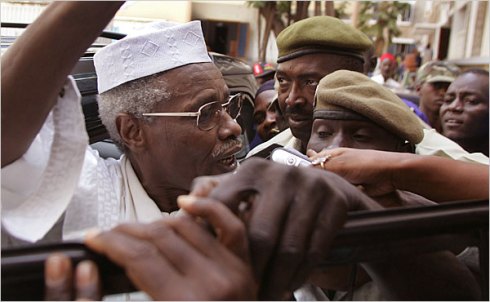
A new study by the Human Rights Data Analysis Group (HRDAG) discloses documents prepared by Hissene Habré’s own Documentation and Security Directorate (DDS) to prove he was personally aware of the deaths of political opponents. Habré has been accused of killing and systematically torturing thousands of political opponents during his rule in Chad, from 1982 to 1990.

This analysis shows that Habré received 1,265 direct communications from the agency about the status of 898 detainees. A total of 12,321 victims are mentioned in the documents, including 1,208 who died in detention.

“Our analysis of document flow encompasses more than 2,700 administrative records, which together illustrate a clear communication and command link between President Habré and his political police,” said Romesh Silva, senior demographer for HRDAG and lead author of the report. “Our findings also confirm earlier qualitative accounts of prisoner conditions and high mortality within the DDS. Perhaps most compelling is the fact that the information gathered by the DDS and Habré to document their own abuses can now be used to hold them responsible for their actions.”

It has been 10 years since his indictment, yet despite strong evidence, he will not be tried until Senegal (which agreed to host the trial in 2006) receives €27.4 million from the international community to fund the trial.

The Documentation and Security Directorate (DDS) pursued opponents and operated notorious prisons during the Habré regime. The files were discovered by chance by Human Rights Watch in 2001 at the abandoned Security Directorate’s headquarters in N’Djamena, the Chadian capital.

FURTHER RESOURCES

Copies of the HRDAG report in English and French are available at: http://www.hrdag.org/about/chad.shtml

For more information on the case against Hissène Habré, please visit:

http://www.hrw.org/en/habre-case

http://www.fidh.org/-Hissene-Habre-Case

There are SEVEN cameras in this image.

What an intriguing image. It’s got a foolish mixture of activity that confuses the viewer: slapping; parrying; a sizable unperturbed bunch of by-passers who display amusement, disappointment, indifference and camera-induced detachment.

One lady has a baby under one arm as she strikes with the other. The lady in defensive mode raises an elbow so as to not inconvenience the cameras she holds in each hand nor the pacifier on her middle finger.

The lady on the right has just been evicted by Israeli settlers. The situation is obviously tense, but who’d bet against me that without the cameras this confrontation would not have occurred?

Photograph by Ahmad Gharabli / Agence France Presse / Getty Images (Source)

EMAIL

prisonphotography [at] gmail [dot] com

Prison Photography Archives

Post Categories