PART ONE OF A SERIES OF POSTS DISCUSSING PHOTOGRAPHERS’ ACTIONS AND RESPONSES TO THE KILLING OF FABIENNE CHERISMA IN PORT-AU-PRINCE, HAITI ON THE 19TH JANUARY 2010.
“The question is not whether Fabienne will be remembered as a victim of the earthquake but whether, outside her family, she will be remembered at all.”
Rory Carroll, The Guardian, January 26th, 2010
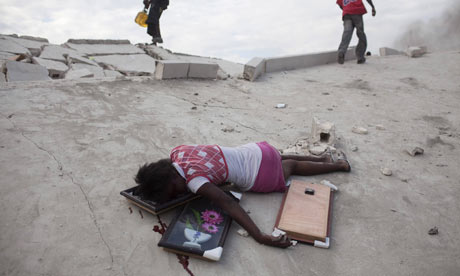
15-year-old Fabienne Cherisma lies dead after being shot in the head in Port-au-Prince. Photograph: Carlos Garcia Rawlins/Reuters.
Fifteen year-old Fabienne Cherisma was shot dead by police at approximately 4pm, January 19th, 2010.
On the 26th of January, the Guardian published an account of Fabienne’s life – her schooling, her sales acumen and her aspirations to be a nurse. The piece is not long, but it needn’t be. It is a modest effort – hopefully the first of a few – to remind us that Fabienne was a daughter, a sister, a source of love and pride for her family and, in the end, an innocent victim.
THE IMAGE THAT REMAINS, THE SYMBOL THAT EMERGES
There is a chance that Fabienne Cherisma could become a symbol of the Haitian earthquake and the problematic aftermath; that she become a tragic silhouette extending meaning far beyond the facts of her abrupt and unjust death.
This notion can be at once offensive and inevitable. If the visual rhetoric is going to play out as such, then if it is not Fabienne, it will be another victim.
What purpose could the emergence of a such a symbol serve?
Thus far Fabienne’s death is a story that has caught wide attention. It came without warning, it was unexpected. Her death – resulting not from nature’s violence but from human action – stands out from other deaths as a particular injustice; Fabienne’s killing is salt in the wounds. While tens of thousands lay obscured beneath rubble, she lay limp and exposed on a bare roof-top. The image itself is an affront.
If one believes that images fuel public awareness, thus securing donations and aid, and thus helping Haiti’s immediate future, then certain images and stories will carry that awareness and emotion.
All the accusations of media exploitation in Haiti do not discredit the positive effects a single image can – without any manipulation – have in the minds of millions. I wouldn’t call this the magic or the power of photography, I’d call it the mysterious perversion of photography. I don’t, and can’t, explain it. I merely observe it.
THE RESPONSIBLE USES OF PHOTOGRAPHY
Fears amongst those who care about media and its conduct hope that the focus can remain on Haiti and its long-term recovery. If the media deserts Haiti after a few short weeks then all accusations of disaster pornography will be upheld.
Photo-editors are now searching for the images that will maintain the humanitarian momentum on Hispanola. These images will be from committed photojournalists who stick around once press photographers have left.
It would be worthwhile to see and hear journalists’ reporting that follows up on the experiences of victims who may or may not have already appeared in coverage. I actually expect journos will follow up on the stories of the child born amid the rubble, the elderly woman rescued after 10 days and the man rescued after search and rescue was called off.
The Haitian recovery must be reported more than the initial chaos.
In the scenario of mass reproduction and circulation, the image of Fabienne’s dead body needn’t be one of mere exploitation. Nothing is so one-dimensional. Of course, this is very sensitive territory and above all the wishes of her family should prevail … in an ideal world.
That said, the history of photojournalism is replete with globally-recognised subjects whose visage was appropriated without their knowledge and/or consent. There’s no model release form in war and disaster.
Fabienne may become a symbol for the innocent victims of this disaster as Kim Phúc did for those in Vietnam. The politics of the two crises are a planet apart, but our modes of consumption are not.


Images are highly manipulable; Errol Morris asserts a caption will turn can turn the reading of a photograph 180 degrees.
The inconvenience of captions often results in the creation of symbol.
I don’t think it will be long before a symbol, a brand for Haitian plight, will rest upon a single image. Western thought demands a visual book-end to the visual dialogue.
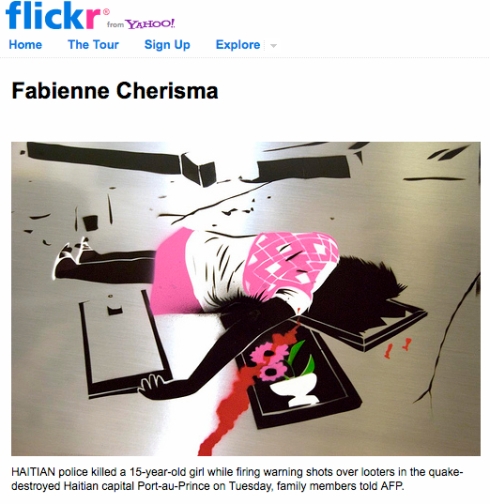
Pureevilbunny has already documented a graphic (in both senses of the word) stencil rendering of of Fabiennie’s corpse (artist not stated). The incongruous pink clothing, argyle sweater, flowers and blood are elements that shock.
THE PHOTOGRAPHIC EVIDENCES AVAILABLE
I do not want to prescribe a means of viewing images of Fabienne’s death. I am interested in informing the public about the photographers who witnessed and recorded the event.
The most widely circulated image is that atop this article by Carlos Garcia Rawlins and distributed by Reuters. It was used in the Daily Mail among others and in the Guardian’s original reporting of the killing:
Police armed with rifles shot over the heads of the people and kicked a man, part of a delayed effort to regain control of a capital which has been lawless – but largely calm – since the 12 January earthquake.
The crowd was carrying grime-covered chairs while Fabienne, who was on a roof, clutched paintings, including one of two flowers in a vase.
Photographs show her father Osam finding her body, then lifting it into a cart. Fabienne’s mother, Armante, is shown weeping and close to collapse. Osam told AFP news agency that police intentionally shot his daughter. Police were not available for comment.
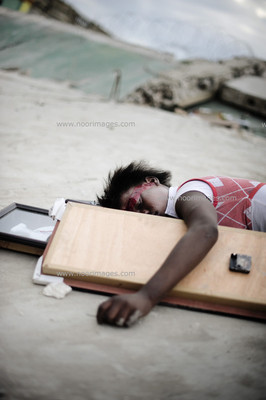
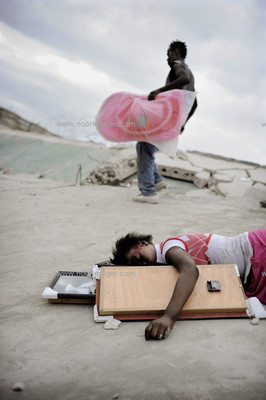
Jan Grarup of Noor images was also present. Grarup’s dispatch for the 19th and 20th January contains 136 images, nine of which include Fabienne.
© Jan Grarup / Noor Images
© Jan Grarup / Noor Images
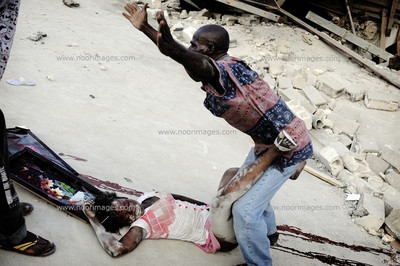
© Jan Grarup / Noor Images
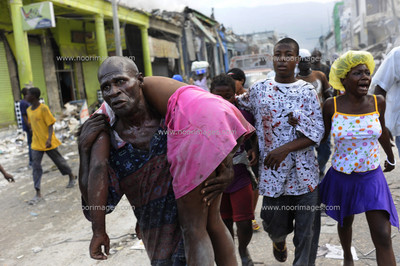
© Jan Grarup / Noor Images
Fabienne’s body is in a distinctly different position between the photographs of Garcia-Rawlins and Grarup:
© Carlos Garcia Rawlins/Reuters.
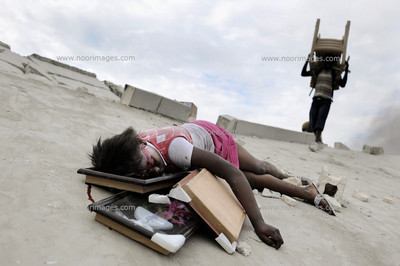
© Jan Grarup / Noor Images
Grarup was present at the scene before Garcia-Rawlins. Between their photographings, the framed pictures slid, Fabienne’s hips turned and her body rolled.
How much time was there between Fabienne’s slaying and the two photographers at the side of her body? How much time was there between the two of them photographing Fabienne? Were Grarup and Garcia-Rawlins on the roof at the same time? Did they see each other work?
Both photographers were obviously present before Osam, Fabienne’s father, carried her body away.
In the immediate aftermath, Grarup documented with a few frames a distraught Osam and family.
Olivier Laban Mattei continued documenting events. Laban Mattei’s dispatch of 28 images, is in fact only five images repeated.
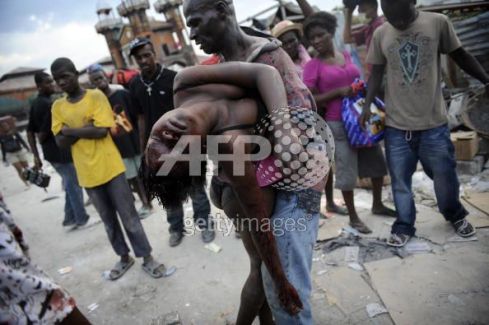
Osam Cherisma carries the body of his daughter Fabienne killed by a policeman during lootings in the Marthely Seiee street January 19, 2010 in Port-au-Prince. © Olivier Laban Mattei/AFP/Getty Images.
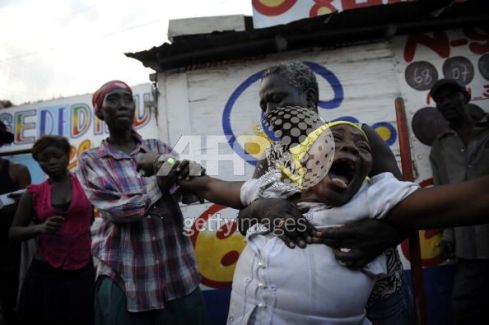
Armante Cherisma cries in front of the body of her daughter, Fabienne, 15 years old, killed by a policeman during lootings in the Marthely Seiee street January 19, 2010 in Port-au-Prince. © Olivier Laban Mattei/AFP/Getty Images.
Despite the amateurish piecing together of evidences, presented here is a basic timeline to Fabienne’s death. These images placed in sequence describe more fully her tragic death and take Fabienne’s memory beyond that (Garcia-Rawlins’) single image.
Fabienne was an innocent. Whether misdirected warning shots or deliberate targeting, her shooting was needless.
If Fabienne’s death does come to symbolise something larger, I hope it does so to benefit the survivors in Haiti; that the injustice brought upon her will only distill our resolve to avoid injustices to others.
If the shocking form of her body, face down in the broken frame, becomes symbolic it cannot be for reductive consumption, disaster cliche or political gain.
AFTER THE PHOTOGRAPHS
‘With morgues overflowing, and earthquake fatalities being bulldozed into mass graves, the Cherismas took their daughter’s body out of the city. With a borrowed $70 they rented a private bus, and drove for four hours to relatives in Zorange. They buried her in a Catholic ceremony and placed a white cross over the grave.’ (Source)
– – –
ALSO IN THE ‘PHOTOGRAPHING FABIENNE’ SERIES
Part Two: More on Fabienne Cherisma (Carlos Garcia Rawlins)
Part Three: Furthermore on Fabienne Cherisma (Michael Mullady)
Part Four: Yet more on Fabienne Cherisma (Linsmier, Nathan Weber)
Part Five: Interview with Edward Linsmier
Part Six: Interview with Jan Grarup
Part Seven: Interview with Paul Hansen
Part Eight: Interview with Michael Winiarski
Part Nine: Interview with Nathan Weber
Part Ten: Interview with James Oatway
Part Eleven: Interview with Nick Kozak
Part Twelve: Two Months On (Winiarski/Hansen)
Reporter Rory Carroll Clarifies Some Details
Part Fourteen: Interview with Alon Skuy
Part Fifteen: Conclusions



 Prison Photography