There are prisons and there are jails. The two differ.

Prisons are where sentenced offenders get sent after trial, and they are run by the state.

Jails are where offenders go before trial, and they are run by the county. All offenders, at least for a short while, will go to jail and get booked. If they can post bail they’re out until court date. If they can’t afford it, they remain until their day in court … which can sometimes be many, many months. (It should be said, some short-term sentences are served in local jails).

Across the street from the county jail in Lubbock, Texas, is a row of one-story offices housing Lubbock's bond companies. There are about a dozen bail bond companies in this city of 250,000. © Katie Hayes for NPR

THE BAIL BOND INDUSTRY

Last week, Laura Sullivan‘s sterling three-part report on the US’ broken bail system ran on NPR. Sullivan writes it LARGE: Money rules; the bond system is simple market capitalism. It favours the rich and punishes the poor.

Research shows that those who post bail serve less time post-trial. This is for many reasons, but mainly because once released, the accused can prove to the court (between arrest and trial) that they can stay straight; hold down a job; and publicly respond to their transgression in a socially-agreeable manner, in other words, attempt whatever is necessary to please the court.

However, there are half-a-million people locked-up in US jails either waiting or unable to pay bail. This is more criminal than any act these half-a-million may have committed. REMEMBER: Bail is not granted to violent or dangerous suspects, and the majority of those jailed are non-violent criminals usually for a small-victimless crimes (minor traffic infraction, petty theft).

Amounts differ to post bail differ, sometimes being as low as $50 (that’s a $10 down-payment to a bondsmen on a $500 bail).
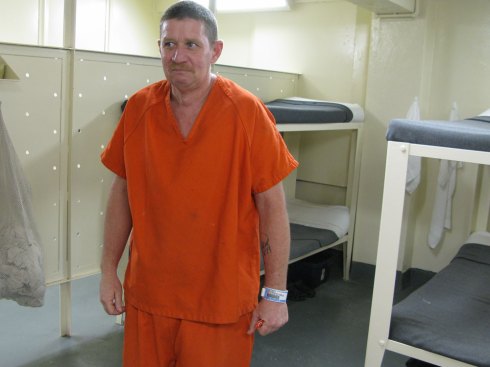
Leslie Chew, in Lubbock County Jail for theft, said his $3,500 bail was "like a million dollars to me." © Laura Sullivan for NPR

The result is that cases such as Leslie Chew’s cost the tax payer over $7,000 for 185 days of incarceration … all because he couldn’t afford the $350 down-payment for bail. His crime? Stealing $120 worth of blankets because he was suffering the cold sleeping in the back of his station wagon.

Chew is typical of many stuck in the system. But the system has alternatives. Offenders could be released on trust (a practice that used to be common) and expected to show up for court OR they could be part of pre-trial release programs using probation officers and tagging technology.

Pre-tirla release programs cost only between $2-$7/day. Compare that to $38-$115/day to house an inmate. Statistics have shown pre-trial release programs effective and offenders show up for court as regularly as those on bail.

In total the broken bail bond system costs US tax-payers $9billion/year!

WHY DOES A BROKEN SYSTEM PERSIST? WHAT ABOUT THE ALTERNATIVES?

NPR describes, ‘Ken Herzog, manager of Trammel’s Lubbock Bail Bond for over 25 years, sees an average of six people a day who need to be bonded out of jail. His bonding company currently has between 2,500 and 3,000 active accounts.’ Because they cannot secure new accounts, the bail bond industry sees pre-trial release programs as direct completion. Bail-bondsmen have organised strong lobbying groups in counties where alternative pre-trial release programs were in use.

As an example, Sullivan points to Broward County, Florida:

Bail bonding became political in Broward [and] sent shock waves through pretrial programs across the country. Here in Broward, bondsmen pushed hard for a new county ordinance that now limits the pretrial program. Now industry experts say powerful bail lobbying groups have begun using Broward as a road map of how to squash similar programs elsewhere, even though public records show the programs have saved taxpayers millions of dollars.

This gutting was all the more catastrophic because the pre-trial release program was so successful. It alleviated jail overcrowding that was deemed by a judge as unconstitutional.

Instead of building a new $70 million jail as they had proposed, county commissioners voted to expand pre-trial release, letting more inmates out on supervised release. Within a year, the jail population plunged, so much so that the sheriff closed an entire wing. It saved taxpayers $20 million a year.

And, according to court records, the defendants were still showing up for court.
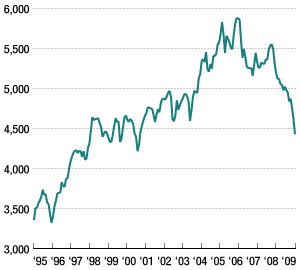
“DON’T PISS ON ME AND TELL ME IT’S RAINING”

The Broward ordinance passed and, in so doing, slashed the number of defendants eligible for the pre-trial release program by hundreds.

Who, they wondered, could possibly be against a demonstrably successful program? Follow the money:

In Broward County, 135 bail bondsmen amassed and hired a lobbyist, Rob Book:

“To be perfectly arrogant about it, I’m considered if not the best, [then] one of the best in the state,” says Book. He has been lobbying for bondsmen in Florida for more than a decade.

According to campaign records, Book and the rest of Broward’s bondsmen spread almost $23,000 across the council in the year before the bill was passed. Fifteen bondsmen cut checks worth more than $5,000 to commissioner and now-county Mayor Ken Keechl just five days before the vote.

EDITORIAL: THE UNITED STATES OF CORRUPTION

Sometimes, I am carefully worded. I work with prisoners, correctional officers, DoC administrative staff and activists weekly – I must be diplomatic.

But I have no care for the bail-bond business nor the corrupt bondsmen and bought politicians of Broward County, Florida.

Their system is self-serving. It does nothing to protect NOR serve. It is overly punitive. The bondsmen are hacks and the politicians they bought are contemptible.

I hope that the backhanded decision-making in Broward is not typical, but I fear it is not isolated. Selfish, zealous systems such as those Laura Sullivan exposed are ruled by revenge, fear-emotion and profit.

The bail-bond system of America is on this evidence devoid of progressive policy. And, when a small light of common sense policy rears its head based on solid figures and a reduced bottom-line, still well-heeled and big-footed buffoons can kick it all to shit.

DISPICABLE.

THE FULL ROSTER

Part One: Bail Burden Keeps U.S. Jails Stuffed With Inmates
Part Two: Inmates Who Can’t Make Bail Face Stark Options
Part Three: Bondsman Lobby Targets Pretrial Release Programs

All brought to you by Laura Sullivan

Thanks to Jim Johnson for alerting me on this.

Children Playing in the Ruins, Seville, 1933. 6 5/8 x 9 5/8" silver print. Circa, 1947 © Henri Cartier-Bresson.

Taliban Prisoners, Afghanistan, 2001. © Alan Chin

I have it on good authority that Alan Chin is one of the hardest working and spontaneous photojournalists in the business. He also caught this gem of a shot which for me sums up the shell-shock of war. These men may have been fighters, then prisoners,  but they were/are also naive protectors of a regional social-order based upon the most closed of religious dogmas.

For all America’s imperialist crimes over the past decade, let’s not forget that the Taliban were brutal abusers of human rights, particularly women’s rights.

Is it not the case that the vast majority of men who fight do so because they are followers and not leaders? Heroism is passe; we are all victims of circumstance, not agents of change.

Image Sources; Chin, Cartier Bresson

I am late on this one, but I thought it so important that it worth a quick post.

Last month, Amy Stein posted Bedlam Exposed. Amy put up some disturbing images by Charlie Lord. He was one of several conscientious objectors who worked at Philadelphia State Hospital, Byberry, PA in lieu of military service.

Listen to Charlie Lord talk about his experience at the Philadelphia State Hospital.

Prison Photography has long determined that there is little difference between prisons and asylums. Asylums have been referred to as sanitariums and as hospitals, but it is necessary to take a quick leap past the label and view the level of care (and security) as well as the agency of those committed.

In photographic evidences we can look to the work of Jenn Ackerman (a prison functioning as a mental health unit) and Eugene Richards (a mental health unit functioning as a prison). These thoughts are just to sow the seeds and the [in]distinctions between prisons and mental health facilities will be something I’ll return to over the coming year.

Ackerman’s Trapped:
http://www.burnmagazine.org/essays/2009/05/jenn-ackerman-trapped-epf-finalist/
http://indepth.jennackerman.com/trapped/feature.html
http://bop.nppa.org/2009/still_photography/winners/?cat=NTP&place=1st
https://prisonphotography.wordpress.com/2009/07/10/jenn-ackerman-trapped-mental-illness-in-americas-prisons/

Richards’ Procession of Them:
http://motherjones.com/environment/2009/03/out-mind-out-sight
http://motherjones.com/photoessays/2009/03/out-mind
http://www.soros.org/initiatives/photography/events/procession_20060201

Magnum has produced a three minute In Motion piece on Haiti:

The multimedia piece as a whole is disappointing. It features the photographs of Abbas, Christopher Anderson, Eve Arnold, Jonas Bendiksen, Bruce Gilden, Cristina Garcia Rodero and Alex Webb – all incredible photographers, but bundled together they compete against (and detract from) one another.

Abbas’ silvery images of Hounsis, ladies dressed in white (2000) … mix with his images of Saut D’eau (2000) … mix with his images of the Pentecostal Protestants of Jacmel … mix with Gilden’s hard-flash from Plaine du Nord (1985) … mix with Gilden’s street photography in Port-au-Prince (1990 & 1994) … mix with Eve Arnold’s quiet compositions (1956) … mix with Christopher Anderson’s menace … mix with Jonas Bendiksen’s beautiful retreated studies of Haitians in agrarian landscapes and activities … mix with Rodero‘s image of the rituals of Soukri, photos of the Carnival at Jacmel and Souvenance …

The slideshow concludes with a vertiginous volley of portraits of Restavek child servants/slaves by Paolo Pellegrin (who strangely has no credit line).

It’s all too busy and without context and frankly does nothing to describe the country of Haiti. It is in some ways just a limp, late addition to the flurry of visuals we’ve been served these past eleven days.

Magnum would have been much better promoting the recent traveling exhibition Disposable People – Contemporary Global Slavery, and making ‘In Motion’ pieces for contributors Webb and Pellegrin.

ALEX WEBB INTERVIEW

Fototapeta‘s interview with Webb is well worth reading. He talks about the cultural differences between the US and countries of Central and Southern America (with repeated references to to Haiti); about open energy and discrete action; about shooting in colour and in B&W; and about reconciling photojournalism with an inevitable personal reaction.

Webb notes his ongoing balancing act,

“I always felt to some extent that I am out one fringe of Magnum, but I was brought into Magnum particularly by Charles Harbutt, and Charles was really oriented not towards traditional photojournalism at that point. I mean at that point Marc Riboud was doing a lot of rather traditional photojournalism. Charles was encouraging a much more personal kind of vision of the world, and that influenced me much more. I have taken elements of that, which is a very personal approach, but taken them into situations that people do not associate with a totally personal approach like going somewhere else, like Haiti, where political violence takes place, therefore it is photojournalism, but I am actually taking a very personal approach inside places like Haiti.”

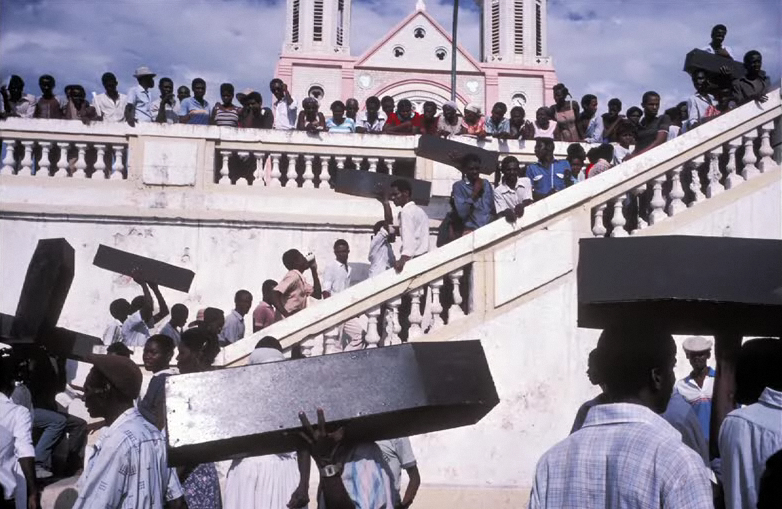
HAITI. Port-au-Prince. 1987. A memorial for victims of army violence. © Alex Webb

I picked out the image by Alex Webb (above) as my preferred image because, while it’s subject is death, it is – as a single image – actually about the bonds of a Haitian community and the composition of Webb’s craft. And they equalise one another perfectly.

I don’t wish to be misunderstood, Magnum: In Motion is a phenomenal service to the global photographic community. I can’t imagine a world nor web without it. The archive is a treasure. I guess when I believe a slideshow has fallen short I want to state it as such. I only criticise because I care.

Every so often commentaries converge as such that I’m compelled to connect the smallish number of dots. I have done it once before here.

So, recently:

SUSAN MEISELAS SPEAKS ON DOCUMENTARY PHOTOGRAPHY’S ROLE

In ‘Expanding the Circle’, Meiselas talks frankly about the approaches and collaborations necessary to reach a wider audience,

“With whom can I partner – if that seems appropriate – for the work to have an additional life. [It] could be a life of advocacy or a life tied to an issue in a particular way, whether it is targetted at policy makers or to a public. You have to keep documenting at the same time asking those questions. All the while one must continue to document and seek opportunities to create possibilities for engagement.”

Meiselas is a curator for the Moving Walls project. The exhibition features work by former Open Society fellows and prison photographers Joseph Rodriguez, Steve Liss and Andrew Lichtenstein.

It is fair to say that the Open Society’s Documentary Photography Project has a propensity for prison photography projects. The 17th round of Moving Walls fellows has just been announced, and of the seven recipients, two document the lives of the incarcerated.

Lori Waselchuk for her work at Angola’s prison hospice and Ara Oshagan for his coverage of juvenile detention in California.

© Lori Waselchuk

© Ara Oshagan

One last note on cages. Meiselas’ selection includes images from Eugene Richard’s Procession of Them produced as a book in 2008, see spreads here and listen to Richards speak on the project as part of Columbia University’s “Photography as Advocacy?” series (2006).

One task of prison photographers is to emote the isolation and hardness of incarceration. It is a difficult task. Richards, while not looking at prisons per se is a master of conveying the barbarity of the cage and the helplessness of the caged. And besides, in today’s discourses that prefer not to distinguish institutional forms, the mental health asylums of Richard’s work are prisons.

Macoleta, Steinmetz, prison weapon & prison tool typologies

James Pomerantz highlighted the work of Antonio Vega Macotela who began investigating the concept of time as that controlled by outside forces and ended up clocking over 500 hours in the Santa Martha Acatitla Jail, Mexico. Read the essay, it’s an eye-opener!

© Antonio Vega Macotela

This reminded me of Marc Steinmetz‘s work from Germany from a few years ago, which I mentioned last year.

© Marc Steinmetz

PRISONER DATABASES AND MOST-WANTED GALLERIES

iheartphotograph highlighted the institutional mugshots presented online by the Florida Department of Corrections.

This is the first example I am aware of that a state DoC has provided a publicly accessible online search of full profiles and photographs of housed inmates.

No details are excluded; vital stats, aliases, crime, date of crime, body marks, date of release.

I suppose this is the voyeuristic bridge between DOC internal databases and the ever-refreshing scrolling “news” galleries of persons recently booked. The adoption of police mugshots as “news” also came out of Florida, so there is obviously research to be done there into Florida’s culture and visual rhetoric of criminal justice.

In both these cases, the public is being drawn in – by a limited amount of information – to the mechanics of regional sheriffdom.

Most wanted lists, such as that in California that just got a flashy website overhaul, carry some logic in that they inform a public about a potential menace at large. I expect there’d be a public outcry if this service was removed. Accepting that logic, though, it is curious as to why criminal justice agencies would provide mugshots of booked and detained persons.

All told, the availability of state prisoners’ photo IDs makes sense if you consider such databases as deliberate tactic. The databases become other arms in the apparatus of the panopticon; the visage of the prisoner is policed online by the gaze of  unlimited number of people, as readily as it is policed by the prison guards’ gaze within the walls.

While mugshots have commonly been released at intervals to the media, particularly of infamous prisoners, never before has a photo-database of society’s transgressors been so accessible and searchable by the public.

We have become nodes in a network of observation and discipline.

The net has widened, and this previously exclusive net is now consolidating with the internet …


Alyse Emdur has begun a brilliant project Photograph a Recruiter that asks high school students to submit their own photos of military recruitment drives in schools.

In a modest way the project aims to offer  students an alternative national stage to the one the which involves guns and death.

It is, perhaps, a more playful means to combat predatory army and navy recruitment practices … certainly more so than the raucous and confrontational pickets in Berkeley, California last year.

(Found via iheartphotograph)

Andy Kershaw‘s view is a welcome counter to the presumptions of an unknown scenario I and others had considered:

“Most journalists were reporting breathlessly that Port-au-Prince’s main prison had collapsed. Good story. But not for the reasons we were told. The inexperience – and indeed arrogance – of every single reporter who drew our attention to the jail, missed the real significance of its destruction.

It was not that “violent criminals”, “murderers”, “gang bosses” “notorious killers” or “drug dealers” had “simply walked out the front gates”. (And just how did these escapees miraculously avoid being crushed to death in their cells?) Even if true, that was a minor detail to the people of Port-au-Prince, who had more urgent concerns.

The true significance of the prison’s implosion was that it represented for ordinary Haitians, like the wreckage of the presidential palace and the city’s former central army barracks, exquisite revenge upon the prime symbols of decades of state cruelty and oppression.

And many of the prison’s inmates were surely not the dangerous stereotypes of these lurid reports. Haiti’s jails were, notoriously, full of petty thieves and other unfortunates who shouldn’t have been in there anyway. I once had to go into that Penitentiaire Nationale, where I saw hundreds of men kept in cages, without room to lie down, shuffling around literally ankle deep in their own shit, to get out of there the son of a Haitian friend who’d been arrested so that the local police could extort money from his father for the release of his boy.”

via Colin

Currently, truth is also a large casualty in Haiti.

Kershaw’s version is as politically self-serving as most accounts coming out of Haiti, in the confusion following the earthquake citizens, aid-workers and journos are making fast assertions based on their own observations. We should expect that most of these assertions will need modifying in time.

Nevertheless, Kershaw’s is the only commentary that has countered the immediate furor and conjecture surrounding the vacated national prison.

Indeed, Kerhsaw makes it clear that the obfuscations of fact are the direct result of the typical blend of fear and uninformed judgement; judgement applied to prison populations of every nation.

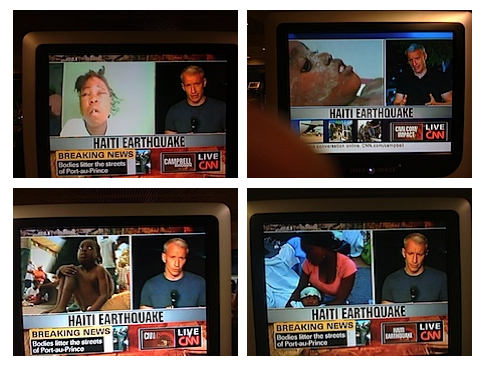
It one thing having foolish and clumsy media commentary of flash-in-the-pan (US) regional stories. It is another when CNN and Anderson Cooper use that same approach covering a humanitarian disaster.

As folk interested in media we should speak out when we see offensive framing and “reporting”.

Anderson Cooper’s bravado is only slightly more insulting than other major networks, but if we picket Cooper and his CNN editors maybe we’ll make a dent large enough that other major networks will also take note.

Michael Shaw just emailed this to concerned social media types. I am behind his sentiment:

I’m writing because I’ve just done a post at BAGnewsNotes that I think is extremely important.

It’s an appeal to readers to contact CNN, or tweet them (@andersoncooper @CNN – PLEASE STOP visually exploiting the Haitians! http://bit.ly/8R1DGc) about the way Anderson Cooper/CNN is visually exploiting the Haitians.

What Cooper has been doing is a complete affront, and it’s time we pushed back in a more systematic way.  Haiti is going through a completely sub-human experience as it is, and the humanitarian effort, and dignity for its people, should absolutely extend to the media sphere.

Thanks so much for putting your eyes on this, and being part of the response.

Here’s hoping.

EMAIL

prisonphotography [at] gmail [dot] com

Prison Photography Archives

Post Categories