On Thursday, 28th May, photographs of prison conditions and detainee custody from six facilities other than Abu Ghraib will be released to the public.

Reports over the weekend suggested a figure of 44, but the Guardian has stated over 2,000 photographs are to be made public. Images of Bagram Air base in Afghanistan are included in the cache. Critics will surely scan for similarities in detention/torture methods used in Afghanistan as in Iraq to argue against the ‘few bad apples’ logic that railroaded earlier attempts to bring military and government commanding authorities to full-accountability.

boarding

ACLU’s advocacy deserves international acclaim. Not only have they forced the release of photographic evidence they won a ruling to prevent the destruction of audio tapes that record torture scenarios.

This is an interesting counterpoint. I presume we all assume we’ll see the images in the printed press. Would we expect the tapes to play on our televisions and radios? That scenario makes me uncomfortable.

Continuing with issues of format, it will be interesting to see how the media presents the-soon-to-be-released photographic documents in contrast to the recent torture memo’s. WoWoWoW set the bar low with the tabloid inquiry “How Bad Will They Be?” and the Los Angeles Times allays fears with a dead-pan assessment, “examined by Air Force and Army criminal investigators, are apparently not as shocking as those taken at Abu Ghraib.

No doubt these images will be contested and a ‘Meaning-War’ over the images will ensue, but I think people for and against the Bush administration’s interrogation policies are not going to change their position now – whatever the evidence.”

But, I guess it depends who’s looking.

bush_rorschach_test

Lefties want more weaponry in the push for prosecution of Bush and his cronies for war crimes. The right is debilitated and otherwise occupied by the economy, stocking guns before the “Obama-ban” and the latest Meghan McCain slur.

Politicians from both parties seem to want this to go away, snarking on about how the release of yet more Un-American activities will only fuel the burning hate toward the US. This position is an insult.

Did Bush care what Iraqi’s would think when he bombed them out of house and home? Did Bush care to think how American’s would react in the face of diminished civil liberties? Yet here, politicians of both parties are scrambling to avoid the negative reactions of entrenched, fundamental opponents INSTEAD of anticipating the beneficial good-will and return to mutual trust provided by honest disclosures of a transparent and constitutional government. Why cover-up a cover-up?

Maybe, the Democrats are shy to see these documents because they may implicate their top brass?

torture

One concern I will air, is that all this could move toward some bizarre show-trial scenario, where lawyers bargain, Bush is spared, the American public settle for a conviction of Cheney, and careers and reputations lie in waste on both sides of the aisle!?!

I certainly didn’t expect the incriminating documents to flood as they have in recent weeks. I have no idea how all this is going to shake down. Obama doesn’t seem to have control of this. That doesn’t bother me. No-one can hold back the truth.

So, as wise at it’d be to remember the date, 28th May, you should bear in mind the photographs of abuse could well leak earlier…

________________________________________________

First Image lifted from Gerry May. http://www.gerrymay.com/?p=1426

Cartoon courtesy of the Nation. http://www.thenation.com/doc/20050307/duzyj

Final Image by Takomabibelot. http://www.flickr.com/photos/takomabibelot/2090273618/

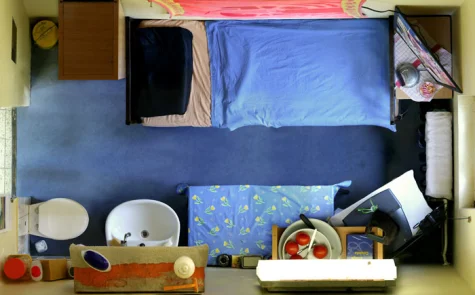
© Stephan Sahm, from the series 'My Cage is My Castle'

© Stephan Sahm, from the series 'My Cage is My Castle'

It takes something special to jolt me from my ‘prison-photo-myopia’.

The European Prize of Architectural Photography has the most cohesive group of fine art photography winners and honorable mentions I’ve seen in the past five years. The theme was “New Homeland”. Each photographer has four prints as representative works and each mini-set is a treat!

Outstanding quality.

© Jacky Longstaff

© Jacky Longstaff

You can browse the links provided below, but first see the 2009 Prize Winners Gallery.

Photographers formally recognised are Stephan Sahm, Tim Griffith, Jacky Longstaff, Freudenberger & Bachmeier, Kai-Uwe Gundlach, Frank Meyl, Szymon Necki, Menno Aden, Johanna Ahlert, Nicolas Briffod, Judith Buss, Walter Fogel, Andreas Fragel, Matthieu Gafsou, Benjamin Gerull, Juri Gottschall, Hanna Kohl, Shimizu Ken, Meike Hansen, Jonas Holthaus, Werner Huthmacher, Christian Kain, Sally-Ann Norman, Florian Profitlich, Andrew Phelps, Martin Richter, Martin Roemers, Michael Schnabel, Marcus Schwier, Michael van den Bogaard.

I was only aware of Fragel, Gafsou and Phelps previously.

© Frank Meyl

© Frank Meyl

© Matthieu Gafsou

© Matthieu Gafsou

© Marcus Schwier

© Marcus Schwier

© Kal Uwe Gundlach

© Kal Uwe Gundlach

I suppose if I were to push for a relation of any of these works to ‘Photography Within Sites of Incarceration’ I would want to begin a dialogue on Sahm’s Hamster-Pop representations of confinement. Sahm was the grand prize winner.

With Jurgen Chill winning two years ago, and the presumed associations of borders and immigration within the theme of “New Homeland”, the European Prize of Architectural Photography apparently rewards photography that emphasises the psychological impact of architectural forms on its users/subjects – in which, notions of containment and non-containment are central.

________________________________________________________

I am aware Prison Photography has been preoccupied with fine art depictions of prison space recently and I intend to redress this genre imbalance in the coming weeks with more documentary works.

chill-jurgen-zellen3

In 2007, Jürgen Chill‘s Zellen series won him the European Architectural Photography Prize in the “Favorite Places” category. Awarded every two years since 1995, the international prize is now organized by the nonprofit architekturbild.eV (since 2005). The 2007 jury – chaired by Hans Eberhard Hess, chief editor of Photo International magazine – was impressed by Chill’s strict central overhead perspective and chose four images.

Today, the 2009 prize winners are announced, so it seems like a good time to recall Chill’s intriguing images.

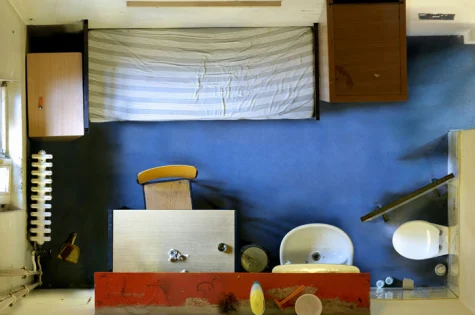
Jürgen Chill’s Zellen photographs are a unique perspective upon prison space. Of all the positions in the cell, this floating light-fixture-eye-view should be the least claustrophobic, and yet, the central (physically impossible) high vantage point is dizzying. How does the camera (let alone cameraman) take up such a position? From here, what is there left to do but fall?

Has Chill has pioneered a new photographic typology? I was fascinated by the order of each work; the order of each cell. I must presume this order is the inmates doing and not the photographers. Chill’s work is labour intensive. The reason he nor the camera falls is because each image is a stitch of over one hundred photographs, captured by a digital SLR mounted on a boom, pressed – facing downward – against the ceiling surface.

chill-jurgen-zellen2

chill-jurgen-zellen5

chill-jurgen-zellen7

Chill is aware that entering his work in the category ‘Favourite Places’ may seem careless or even cynical, especially as the inmates are not pictured. On the other hand, as he notes on his website, “the barren rooms of the inmates are highly individualized and at least temporary qualify as de facto ‘Favorite Places’.” In 2006 he stated:

A person’s favourite place is a place which can be chosen at will. The person’s freedom is presupposed. Freedom, however, is not granted to all. Those that do not have it must adjust to whatever opportunities exist and strive to create their own place. A cell is perhaps the smallest possible space for habitation that a person can have. Personal and functional items are all accommodated in the tightest space. The spaces are represented as they are found. The Spaces are represented as they are found. The proportions of the photographs mach those of the rooms. All details in the rooms are shown orthogonally from above, nothing has been altered.

________________________________________________________________

I contacted Jürgen via email to ask about the practicalities of making Zellen, and to secure his comments on the series concept.

Jürgen, please introduce your work.
My photographs are most like a map of the prison cells; like a Google Earth view of a landscape.  I try to communicate information about the individuals that have to live in perhaps the smallest possible space for habitation that a person can have – without showing this person himself. Personal and functional items are all accommodated in the tightest space.

I’m interested in how a person arranges personal and functional items in their small cell. And what kind of person can it be [based upon the visible evidence]? Is it possible to get a “picture” of a person by having a view of his private space? It’s a view and perspective that you normally would never get of these cells. So it is not really “real”, more a scenery set or something similar.

chill-jurgen-zellen6

chill-jurgen-zellen9

chill-jurgen-zellen1

Where are the cells?
The are all in Germany in big cities in the area of Nordrhein Westfalen.

Are the photographs made in the same institution?
I made 16 photographs in 6 different prisons in the cities of Bochum, Hagen, Duisburg, Gelsenkirchen, Essen and Geldern

Where were the prisoners when you took the photographs?
I had a short conversation with the prisoners in their cells; explained my project, my concept and my motivation. Some of them were really interested in my work and my kind of photography. The prisoners allowed me to spend about 45 minutes alone in their cells, while they are waited outside, in the alleyway, guarded by one or two persons from the prison.

After my work, for their permission to photograph and publish their private things and space, I gave them a small gift; a packet of coffee or cigarettes. Later I sent them all the photograph of their rooms. Some of them asked for it to have as a kind of souvenir for when they are released from prison.

How long did set up take and what equipment did you use?
Just to photograph takes about 30 minutes. With the test shoots and everything it takes about 75 minutes in one cell. The main work, the montage to one photo takes about one week. So it took a long time to make the photo series. You can see how the images were made in the youtube clip of this German television show from October, 2007.

Does the collection and order of all worldly possessions in a single space fascinate you?
It’s the combination of personal and functional items in a small space. First, the cell must contain all the functions of a house in one room: bedroom, toilet, living-room, store-room and sometimes a kitchen. Then the prisoner combines it with his personal possessions and create his private space in about 8 square metres. How does a person arrange such a small space with personal items so that it [also] keeps its basic functions ? And that arrangement exists for years. So my photographs try to draw a picture of an individual person.

chill-jurgen-zellen4

Americans, in particular, are starting to realise that they must use/waste less petrol, possessions, energy, space and give up personal largess for the benefit of community. Does the modesty of the prison cell appeal to you? Do future modes of living relate to the cell?

For me, as the artist and maker of these photographs, my intention is not to call out [to people] to give up personal largess for the benefit of community or for other kinds of social and political attitudes or activities. I just want to show the state of things in the visual of photography and try to show these things in an unusual perspective or context. Just to ask questions about it and not to give answers. That’s the viewers job.

Would you put your images into a history of visual culture that represents humans under duress and finding humanity in the smallest places/between the cracks? Or, is the Zellen series a totally modern piece, completely divided from historical context?

About historical context: I think every art work (the good ones) can not be divided from cultural and historical contexts. The Zellen series, and the new photographic series of whorehouse rooms, which I’m now working on, tells us about situations and the state of things now.

But the contemporary associations of now ( the “Zeitgeist” ) result from the past. The series Zellen was shown in a large exposition about prisons, CUSTODY/SPACES OF SURVEILLANCE in the Summer of 2008 in Frankfurt, Germany. The photographs were shown there in the historical context of humanity under surveillance; within imprisonment and [in the context of] prison architectures.

chill-jurgen-zellen8

________________________________________________

Thanks to Jürgen for his kind help and time in piecing this article together.

All Images ©  Jürgen Chill.

wsp_8x10

Yesterday, the internets celebrated Earth Day. The irony in this is that our grandparents’ generation would or could find nothing more incongruous than screen-sucked individuals posting pixels about the earth instead of actually being in its woods, lakes, deserts and mountains. I am not exempt from scorn.

Within the blogophotosphere the general tactic was to post aerial photographies. 100 eyes went to town with a series of Where Am I Now quizettes. NPR went with the easy but stunning option of Geo-Eye’s aerial images. On the aerial theme, i heart photograph posted an unintended but fitting selection of Eva-Fiore Kovacovsky’s photography. The Big Picture did not disappoint with a medley of seriously good environmental issues, opening with a shot of earth from space and Indicommons presented photochroms, albumen & photomechanical prints of nature from earth’s best collecting institutions. And, all of this buttressed by PhotoInduced‘s assertion that digital photography is the green option.

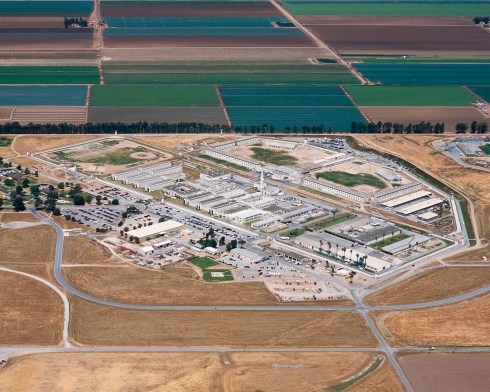
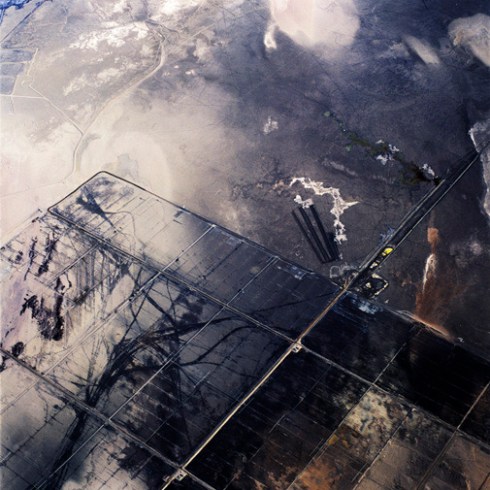
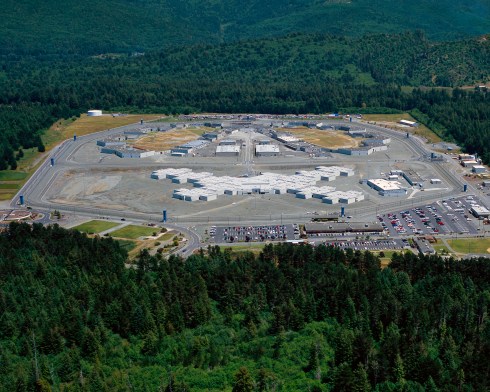
I began to think how aerial photography could tie in with prison photography. Last month, I used some official California Department of Corrections & Rehabilitation (CDCR) images for a post, and in doing so noted the fleeting resemblance of some patterns in the prison-adjacent fields to the salt-pan and tilled earthscapes of David Maisel.

Disclaimer: David, if you are reading, I respect your craft, fine art and politic. In March I camped at Owens Lake and your project formed the basis for much of our camp fire discussion. I hope you don’t think it inappropriate to juxtapose your work with standard state-sanctioned aerial photography.

Salinas Valley State Prison. Courtesy CDCR

lak_m_13

pleasant-valley

lak_m_09

California Training Facility

lak_m_18

Substance Abuse Treatment Facility at Corcoran. Courtesy CDCR

lak_m_03

vspw_8x10

lak_m_05

A CDCR image appears before the text. After the text, images are arranged alternatively beginning with a CDCR image. Any image without a prison is a David Maisel.

___________________________________________________________

David Maisel’s oeuvre is dedicated to altered environmental landscapes. Maisel’s images featured in this article are from The Lake Project which, along with Terminal Mirage, makes up his ongoing ‘Black Maps’  project recording “the impact on the land from industrial efforts such as mining, logging, water reclamation, and military testing.” Maisel’s official bio continues, “Because these sites are often remote and inaccessible, Maisel frequently works from an aerial perspective, thereby permitting images and photographic evidence that would be otherwise unattainable.” Prisons are often remote and inaccessible in California.

In all our justified concern for the environment and its invisible, gradual damages, I also want us to also to consider the invisible, gradual damages done to our social landscape. Men and women are wasted in America’s prisons.

___________________________________________________________

Prison Photography recommends Geoff Manaugh’s extended interview with Maisel at Archinect, audio interview at Lens Culture, Joerg Colberg’s interview at Seesaw Magazine and a full environmentally friendly CV from the Green Museum.

David Maisel was born in New York City in 1961. He received his BA from Princeton University, and his MFA from California College of the Arts, in addition to study at Harvard’s Graduate School of Design. Maisel was a Scholar in Residence at the Getty Research Institute in 2007 and an Artist in Residence at the Headlands Center for the Arts in 2008. He has been the recipient of an Individual Artist’s Grant from the National Endowment for the Arts, and was short-listed for the Prix Pictet in 2008. Maisel lives and works in the San Francisco area, where he has been based since 1993.

Like most other people, I can’t get enough of Roger Ballen at the moment.

Doug McClermont has treated us to a great interview with Roger Ballen. It crescendos in a battery of ‘Ballenisms’ on the evolution of man, the rejection of political correctness and the common id of all great portraits.

Sergeant F. de Bruin, Department of Prisons employee, Orange Free State, 1992 © Roger Ballen

Sergeant F. de Bruin, Department of Prisons employee, Orange Free State, 1992 © Roger Ballen

RB: But what is the most important thing in that picture?

DM: His stare?

RB: The wire. Before I saw him I found the wire. And then when I turned the corner there he was … but I associate that picture with the wire. Without the wire there’s no photograph. That’s what the picture is about, not necessarily him. The wire looks like his lips.

DM: I know there’s a formal aspect to the images, but that face has seen so much.

RB: Form makes the content! Without your ribs you’re just a deflated nothing. The forms bring out the content and create meaning in themselves. So it’s very important to see the images as formal instruments as well as the content in and of itself.

DM: But it’s also narrative.

RB: It is, you can’t separate the two.

DM: This guy has seen so much and It’s all reflected right there in his mug. There are so many stories behind those eyes… what we bring to it.

RB: You have to find your own world in that picture. A lot of what you find you can’t explain. You can’t put into words. But you have an emotional relationship. Like life.

DM: If you could have put it into words, you would have written him as a character in a book.

RB: Basically, some people see him as a monkey. The character of a buffoon and a monkey in a prison guard, whatever. There are all those masks you see in the face. The face reveals the human condition in all sorts of ways. He’s funny, he’s tragic.

DM: Like the masks of theater…

RB: He’s vicious. He’s a monkey. He’s a pompous prison guard.

DM: He seems simultaneously weak and evil to me.

RB: Behind the face is always the monkey. Remember that. I’ve been living in Africa a long time. I’ve really seen a lot about the human condition. Behind the face is the monkey. You won’t get me to change that point. I don’t care if every PC person wants to shoot me for it.

DM: In terms of evolution, you mean?

RB: It’s Freudian…

DM: The id.

RB: Yes, the monkey is the id. Each image is like someone’ s id… and then I bring mine and put it on top of it. If it’s good artwork, it’s everybody id in some way. They’re heroes of the human id. Jess and Tessie, [the drooling twins] you see who you were a million years ago…a monkey…and you were that monkey. Subconsciously, genetically in the back your mind it’s the monkey. You’re a monkey. You see it our ancestors, that’s why the picture is so strong. Simple as that, because people relate to it. They’re brutal, they’re simple, they’re drooling but we relate to them. We see ourselves as humans deep inside them. It’s Neanderthal. Half man, half monkey.

DM: Chromosomes definitely come to mind when you see that image.

RB: No, it’s not about chromosomes – that’s PC thinking – the only thing that crosses your mind is: there’s my face. There’s my id. That’s what I come from. I come from a monkey. That’s your cousin in that picture.

__________________________________________

Doug McClemont is the former Editor-in-Chief of HONCHO, Torso, Mandate, Inches and Playguy. His writing regularly appears in publications such as Publishers’ Weekly, Library Journal and Screw. He has written introductory essays for several monographs on contemporary art and is currently at work on a book of short stories entitled Little Morticians.

1

The blogo-photo-sphere has been spinning the past couple of days with the 2009 Pulitzer Prize announcements. Damon Winter took one gong for “his memorable array of pictures deftly capturing multiple facets of Barack Obama’s presidential campaign.” (Featured Photography). Patrick Farrell secured the other with his “provocative, impeccably composed images of despair after Hurricane Ike and other lethal storms caused a humanitarian disaster in Haiti.” (Breaking News Story)

Winter’s images are eye-catching, but to be honest I am suffering from ‘Obama-fatigue’. So saturated were we with so many high-quality images of the new 44th President, I now look for different material. A quick shufties through Winters website revealed all. His portraits of sports stars show a precocious willing to improvise with technique and composition. Winter has a seriously sentimental side also epitomised by his portraits of American Olympians from the 1984 Los Angeles games.

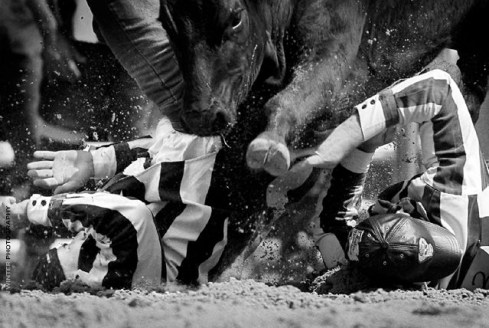
I guess, my hope is that he doesn’t become known as ‘that guy that did Obama’ … which is why I am more interested in his Angola Prison Rodeo photojournalism.

4

The rodeo featuring the prisoners of Louisiana State Penitentiary, commonly known as Angola, is an old – even traditional – event in the Louisiana calendar. Damon Winter is one of many photographers that have covered the community event. It is a raucous spectacle that brings together populations in and outside of the prison.

I still cannot reconcile this event my existing ethics which this event. There’s a charge that the rodeo is exploitative entertainment for which prisoners can suffer serious injury. Yet, I have not witnessed the rodeo-weekend first hand and I have read in the past that this is an event that provides long-term focus and short-term adulation for the prisoner-competitors. All I want to do is bring Winter’s photographs to your attention and hope they’ll compete with Obama for your attentions!

3

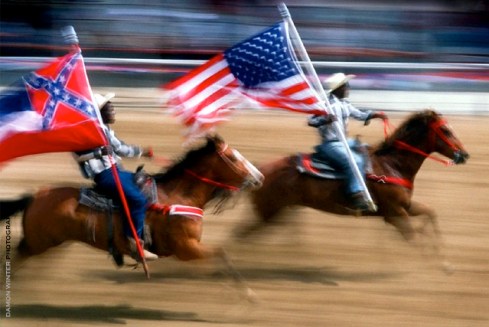
Winter’s pictures capture the strong forces and consequent risks of rodeo competition. I deliberately picked his colour images. The black & white stripes of inmates harry within Winter’s ‘red, white and blue’ palette. The star-spangled palette imbues the series with patriotism, pomp and faux-purpose. I almost feel we are subliminally less inclined to question Angola’s unique display of pseudo-gladiatorial entertainment when the games are suffused with hues of the American flag.

2

_________________________________________________________

View Damon Winter’s Obama campaign coverage for the New York Times, and listen to an audio interview with Winter about his experiences. Winter and PDN did an interview in 2008.

“I’m not interested in the political side of it at all. I don’t deny it and know it filters into the work, but I’m just not approaching it from that perspective. I’m interested in exploring inner exile and profound beauty as redemptive and liberating. There is that famous Dostoyevsky quote that ‘Beauty will redeem the world.’”

Anna Shteynshleyger, in an email to Tim Davis. April 21st, 2005

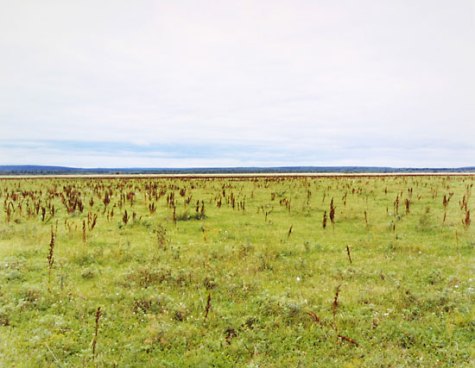
Perm (Grasses), 2001. © Anna Shteynshleyger

Perm (Grasses), 2001. © Anna Shteynshleyger

Guggenheim time again. Seven photographers were recipients of the big one. All of them are preoccupied with the passage of time. Thomas Joshua Cooper studies waves for a long time; Osamu James Nakagawa studies waves crashing in to cliffs for a long time; Suzanne Opton records the melancholy of veteran soldiers (a subject that will likely last a long time); Cheryle St. Onge makes reference to her Grandmother’s times; and Byron Wolfe has “for nearly twenty years held a deep and abiding interest in ideas about time, change, and the personal relationships one makes with a place.” Brian Ulrich‘s relation to time is that he is the hardest working man in the business and operates like there’s no time left. (I admit, that one’s a step too far).

Prison Photography‘s interest in the Guggenheim Awards for 2009 is specifically with Anna Shteynshleyger.

Siberia is Shteynshleyger’s visual record of the topography of prison labour camp sites and works. Critics and public are likely to know her more accessible work done at the Port Authority of unextraordinary people on escalators unextraordinarily unaware. Port Authority is an ordinary project; I cannot give it much time. Or perhaps Shteynshleyger’s versatility pulling the viewer from Port Authority‘s whim to the import and nonchalance of Siberia is too big of a conversion to devote the belief in both.

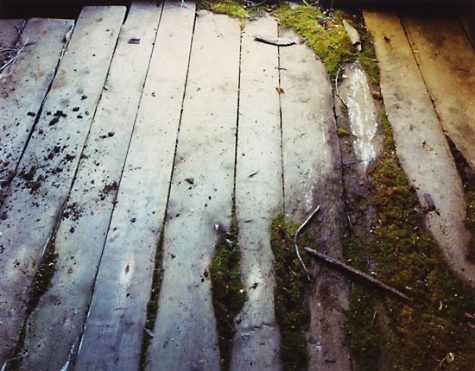
Kolyma (Floor), 2002. © Anna Shteynshleyger

Kolyma (Floor), 2002. © Anna Shteynshleyger

With steady assurance Siberia deals with time, as it deals with the site, as it deals with the intelligence of the viewer. Too often a photographer rushes to the physical clue – the visual pointer – to drive home the importance of the political statement he or she intends to make. Shteynshleyger is not interested in explanation. Without the title on the wall and without the catalogue essay her pictures are simply a competent, nay beautiful, collection of large-format colour prints. They are mostly landscapes and, in truth, landscapes that could be from any continent on earth.

Perm (Bush), 2001. © Anna Shteynshleyger

Perm (Bush), 2001. © Anna Shteynshleyger

Tim Davis wrote an excellent piece on Shteynshleyger’s Siberia citing ‘paintings of absense’ from art historical cannon, one-off expressions of ‘the sublime’ by genre painters, and the philosophy of modern cinema auteurs. Davis deliberately talks about as many things other than Shteynshleyger’s work in an attempt to position and thus explain Shteynshleyger’s work. It is a fine, fine judgement call;

Anna’s photographs of Siberia, a territory as suffused with suffering as any place on the planet, do not “bear witness” to anything. They are not documents of anyone’s journey. They are not war monuments; they are not apologies. Though her camera is pointing in the direction of historical sites of unremembered trauma, her pictures are not records of the locations of past crimes. They do not reckon with the past. They sidestep the inevitable failure of the photograph to stand for historical events. They are oblique and difficult, refusing any Spielbergian urge to heal through reliving previous horrors.

Some might argue Davis is wrong. That what he identifies as a resourceful, no-label, psuedo-documentary response to massive ideological violence is in fact a confusion of approach on Shteynshleyger’s part. But they would be wrong. William Meyer wrote a critique of Siberia beginning with the observation that many artists and photographers have sifted and surveyed Nazi concentration camps, and frequently (on the shoulders of other artists) have produced resonant work. The audience for art reflecting the holocaust and concentration camp trauma is well versed in the visual vocabulary of such. For Meyer, the Gulag is in a different position;

How many agitate on behalf of its victims? There are few memorials, few markers, few museums, few tourists. Out of sight, out of mind. But Ms. Shteynshleyger wants to show us.

Shteynshleyger is a pioneer and she is showing us how we can understand horror and how we can understand that horror passes. To me, it seems her images are as private as old men and women who hold silent testimony to past events. Just because something is understood doesn’t mean it should be said, and just because something is said does not make it understood.

Untitled (Tires), 2002. © Anna Shteynshleyger

Untitled (Tires), 2002. © Anna Shteynshleyger

It isn’t that Shteynshleyger’s work is evasive; it just seems she wants a rigorously curious audience as opposed to a docile one. She is quoted as saying;

… be it a metaphysical or cultural concern, whether it’s a critique or a celebration, art remains a practice rooted deeply in the material world. We make likenesses of what we see and transform our world in a very tangible way. Any situation can reveal a reality not apparent at first examination.

If Dostoyevsky is right and beauty is to redeem the world, beauty must either be apolitical or the most beautiful consensus-sealing political position never reached. Politics, in the common understanding of the term, can be a brutish and rude affair. If there is a message to take away from Shteynshleyger’s work it is, perhaps, that we should search for beauty more rigorously and pay more attention to understated, and dare I say it, apolitical positions.

Untitled (Perm Clouds), 2002 © Anna Shteynshleyger

Untitled (Perm Clouds), 2002 © Anna Shteynshleyger

_____________________________________________

Anna Shteynshleyger was born in Moscow, Russia in 1977. She came to the United States in 1992. Shteynshleyger received a BFA from the Maryland Institute College of Art (1999) and an MFA from Yale University (2001). In 2004 the Museum of Contemporary Art in Chicago mounted a solo exhibition of her Siberia pictures. In 2006, her (12×12 project) was exhibited at the Museum of Contemporary Art, Chicago and Art Basel Miami Beach at the Jacob Karpio gallery in Miami, FL. Other exhibitions have been mounted at Moti Hasson Gallery, NY; Murray Guy Gallery, NY; Lombard-Fried Fine Arts, NY; Artists Space, NY; Vedanta Gallery, Chicago; Thomas McCormick Gallery, Chicago; Zolla Lieberman Gallery, Chicago. Shteynshleyger’s work is in the permanent collections of the Museum of Contemporary Photography, Chicago; LaSalle Bank Photography Collection, Chicago; Yale University Libraries and the University of Maine Museum of Art. She is the recipient of an Illinois Art Council Finalist Award, Blair Dickinson Memorial Award and Guggenheim Fellowship. Shteynshleyger is currently an adjunct professor of photography at Columbia College Chicago and McHenry County College.

stick2

Coverage of aging prison populations will receive more column inches, online commentary, pixels and pingbacks in the coming years. Just as social security needs overhaul in the US and the pension age is to be raised in the UK, so too new means of fiscal policy are needed to cater for the elderly behind bars … on both sides of the pond.

Edmund Clark’s Still Life: Killing Time is a quiet meditation on the slowness, the fabric and the accoutrements of prison life for elderly inmates. It was two years in the making. This was a hard project to track down. It seems all of Edmund Clark’s promotion is done by others; by publishers, journos, gallerists and supporters. Clark has no website. Clark is as inconspicuous as his subjects.

Clark doesn’t do the commentary for the Guardian‘s Audio Slideshow (MUST SEE). In his absence, Erwin James does a great job of whispering the tragic, hard realities of the prison environment. I include and italicise Erwin’s comments below Clark’s photographs.
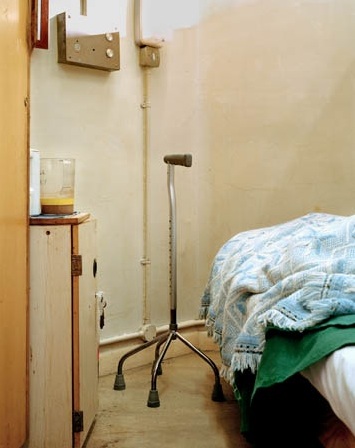
frame

“It saddens me when I see these pictures, these tokens of disablement, the accoutrements of disability; a chair lift, a walking stick, a walking frame. I think that is when I struggle with the idea that these people should be in prison. If someone is demonstrably infirm, demonstrably not functioning well through age or ill health, a prison environment (which this clearly is) is not the appropriate environment.”

It’s worth noting some background to the series. Elderly prison populations only recently became serious noticeable enough for HM Prison Service to trial different modes of containment. The E-Wing of Kingston Prison, Portsmouth was the first experiment. In 2007, upon publication of the book, Erwin James explained;

The answer was Kingston’s E wing. For eight years, this was home to up to 25 elderly men serving life for murder, rape, child sex offences and other offences of violence. The men were aged from their late 50s to over 80. Many had been in prison for more than 10 years, and several for stretches of 30 years or more. E wing as a special facility for elderly prisoners no longer exists. The only other wing dedicated to infirm and disabled prisoners now is in Norwich prison, Norfolk.

dentist

geranium1

“I think cell bars are a tough one. They offer a difficult vista. When you look through cell bars you are aware that the outside doesn’t belong to you. You’re disengaged. And when you see cell bars with a bit of colour like that – the flower and the card – it’s a bit incongruous. These old guys are still humans.”

But for James, as for myself, and particularly for Clark, this is not about sympathy or compassion for the convicted criminal. It has already been stated that these men are serious criminals. There surely must come a point though when an old man is not the physical threat he once was. Simon Norfolk – a photographer I personally consider one of Britain’s best – wrote for the foreword;

” … why are there bars on the window of a man who can’t walk without a frame. What kind of escape plan can be hatched by a man who can’t remember how to go to the toilet.”

instructions

“This picture for me epitomizes the absurdity, and moments of madness the prison system can have. We are keeping someone in prison, who has dementia. They have basic instruction about how to go to the toilet. If there were ever a case for somebody who needs not to be in prison, it would be for that person.”

The only statement I can find directly from Clark, the photographer, is worth meditation.

What you can see in the pictures is to what extent they are engaged with their routine, and on top of their regime and what sort of engagement they have with time. One man, who wore a long grey beard, coped with the passage of time, as far as I could see, by disengaging with it completely. He spent most of his time sitting in his chair … He just sat and disappeared within himself. After about a year I could go and talk to him, and this man was clever, he’d been a captain in the merchant navy and had sailed around the world. I asked him once what was the best place he’d been to and he lifted his head and said, ‘Sao Paulo, I loved Brazil …’ And then suddenly this life came out, his life was all there, hidden away. The bulldog clock on the book cover belonged to him, it was one of his prized possessions.
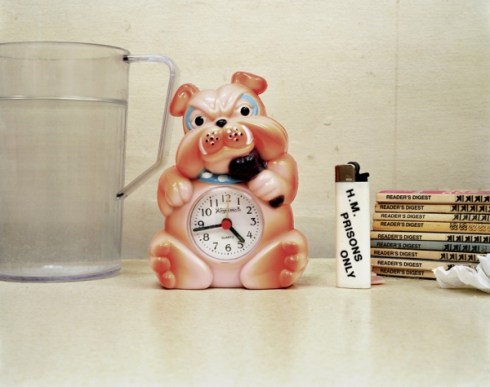
inmatestable

Apparently, Clark created this body of work spurred by reports from the USA about mandatory sentencing under “Three Strikes Laws” and the consequent swelling of America’s prison population. Clark engaged with Britain’s aging prison population in direct response to demographic disasters in American penal policy. Clark elaborates;

People subjected to it [Three Strikes Law] were swelling the ranks of the prison population, with the result that many men sentenced when young would spend the rest of their lives incarcerated. I wondered what the response in the UK was to those incarcerated for many years – the life prisoners, or ‘lifers’, who face an old age and growing infirmity in an institutional environment still ruled by the survival of the fittest.

Clark made his point by seeking out the UK’s first specialised prison facility for aged prisoners and then produced a body of work that is distinctly British. Photographs of Bond posters, a (British?) Bulldog, Red-top clippings of Diana & the Queen, and framed artwork of common birds to British gardens & allotments; these are not obvious clues to a global appreciation of prison culture. I conclude, Clark thinks globally, acts locally.
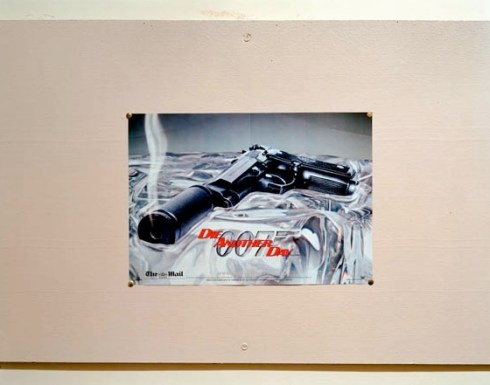
 

“If you are young and strong prison is manageable on the whole. If you feel weak or infirm or poorly it is a harder place to be and these photographs epitomize the frailty factor, the danger of getting old in prison or being old in prison … My feeling about prison is that it is not a place for old people. Prison is one environment for everybody regardless of your circumstances and so what happens is your survival depends on luck and natural resources. And if you’re old you’re not gonna have as much luck as the younger guys.”

posters

“There’s a lot of people in the system who know that prison is not a place for old, infirm, disabled people. And its not. I’m not saying that they shouldn’t be separated from society, but I am talking about prison as we know it. The common interpretation of prison is landings, wings, cells, prison officers, dogs, security; that whole encapsulation of captivity. If you are infirm there needs to be another place. We are giving extra punishment to the weak people.”
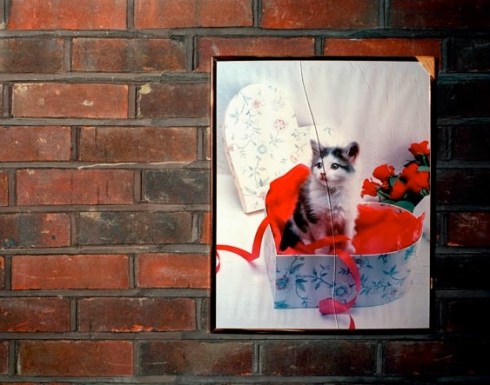
cat

medicalcell

“There is an argument for separating the old folks from the main prison wing and that is what happened here. It was an experiment. E-Wing. The danger for me is that is becomes a place … you know, they talked of the fetid atmosphere; smelly and hot. The smell of old people. As a society we don’t have a lot of respect for old people.”

Clark’s unambiguous images of mobile aids and instructions for the senile are a clear call for change. His studies of prized-possessions and personal ordering of objects play on emotional responses to depicted vulnerabilities; Clark’s works conspire as a whole (43 images in total) to shape a convincing argument that we should all care about how our prison system accommodates different demographics. The elderly demographic is only growing, only advancing … with time.

As James’ words have served me so well throughout this article I shall close with his take on public opinion.

“I am pleased society is taking this on, because prison is a robust and hostile environment, and in fact the authorities refer to all prisons as hostile environments. That’s how they’re officially termed. That’s not because everyone who goes there are dangerous, but I think prison brings out the worst in a lot of people. It can bring out the best, but often it brings out the worst. And that’s not to say they are bad characters, it’s because people in prison are defensive and they are defensive because they are frightened.”

birds1

__________________________________________________________

All images copyright of Edmund Clark.

Still Life: Killing Time, by Edmund Clark, is published by Dewi Lewis, and avaiable at PhotoEye

EMAIL

prisonphotography [at] gmail [dot] com

Prison Photography Archives

Post Categories