
Yana Payusova’s Russian Prison Series is a complex portrait with embedded cultural memes and fierce visual détournement. It is a strong and committed project. Russian Prisons Series, painted photographs of forgotten incarcerated Russian youth is Payusova’s most extensive use of photography in her many series. In response to email request, Yana replied with the detailed account below.
PP: I am particularly interested in your experience within the prisons, your ability to photograph, your understanding with the boys & men in your images and your thoughts on photography and prisons generally.
I understand you joined your mother, who was working as a social worker, in Lebedeva and Kolpino prisons, St Petersburg. What were your initial reasons & motivations for working with the young men in these institutions?
YP: I first visited the Lebedeva prison in the fall of 2003. I was able to gain access to the prisons because my mother had been working with incarcerated teenagers there for the past nine years. She belonged (my mother has retired in 2007) to an organization called Rainbow of Hope. This organization initially specialized in working with street children, either homeless (orphans or abandoned children) or homeless by choice (those avoiding abusive situations at home). Street children are a brand new, post-perestroika phenomenon for Russia. Before the breakup of the USSR, unwanted and disabled children were housed in a Soviet-style orphanage system out of sight of society. However, there were also numerous social organizations, which created public programs for children, thus filling in where the family institution was lacking. Unfortunately, today, ragged, unwashed children hanging out in front of subway stations begging for money, smoking cigarettes and sniffing glue, are a common sight.
Rainbow of Hope formed a day-center where homeless children could eat, play, attend classes, and receive medical attention. Shortly after the inception of this new program, the social workers noticed that as some of ‘their’ kids matured they relapsed into their previous street behavior. They started disregarding any kind of authority; began consuming alcohol and hard drugs; getting in trouble for breaking into cars; and various small theft. Eventually, after either several minor offences or after one serious transgression, and if the kids were fourteen or older, they wound up in prison. When my mother first started visiting the prisons, she learned that in fact, many of the teenage inmates came from similar backgrounds: alcoholic parents (often single mothers), other incarcerated family members, chaotic upbringing without any positive adult supervision, childhood exposure to psychological and physical violence.

YP: I decided to accompany my mother in one of her weekly visits to the prisons. I cannot say that I was shocked the first time I entered one of these facilities. Having grown up in the Soviet Union and having seen royal palaces in extreme decay, I did not expect a vacation spa. The security guards were grim and humorless, the environment was filthy and unkept, and the barred-windowed buildings were rundown. There was a sense of complete surveillance, barbed wire and high brick fences always visible, a near complete blockage of the city’s activity beyond the walls. There was an eerie silence broken only by occasional savage barking of guard-dogs. The atmosphere was even more depressing once inside the prison building. The entire structure had an intolerable stale stench. It was later explained to us that this was the smell of lice being burned off the prisoners’ clothes. As we walked upstairs, we caught glimpses of the adult inmates. Their faces were gray and expressionless and they stood with their hands behind their backs.
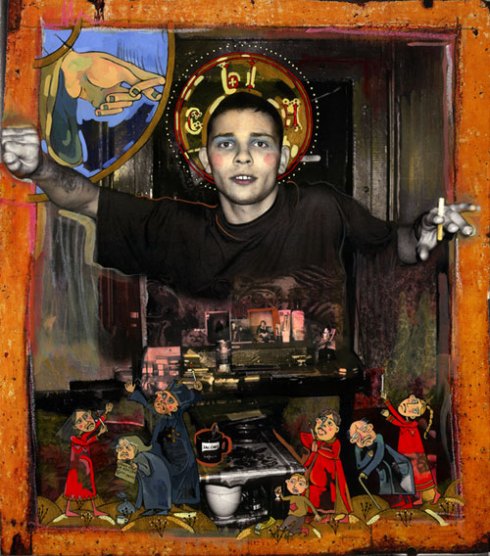
YP: However, I was truly shocked when I saw the teenage convicts in person. When we arrived they were in their cells, mostly sleeping and passing time. They were brought out in front of us into the main hallway for lineup. I was expecting to see tough guys and intimidating criminal types, but instead I saw a group of scrawny, pale, shaven-headed young boys, many of whom were covered in warts and sores. I knew that all of them had to be ages 14 to 21, but the majority seemed like they could not be older than twelve (as I later learned, an indication of malnourishment in childhood). Many had tattooed limbs and torsos. A few of the tattoos were masterfully executed, but most were crude amateur drawings. Many of the tattoos were grossly infected. Ironically, the tattoo designs displayed harsh arrogance and aggression, which was markedly missing from most of the boys’ faces. Also, many of them spoke ‘blatnaya fenya’ (special cryptolanguage used among criminals) partially out of habit and partly to show off and flaunt their connections to the criminal culture.
PP: What did you discuss/teach each other?
YP: I was supposed to conduct an English class, however, we ended up simply talking in Russian. When they got over the initial cocky boy-talk and the showing-off in front of each other, we were able to enjoy a normal conversation. I was surprised to find out that for many, it was not their first time in prison. Paradoxically, many boys seemed to either enjoy or be ambivalent to being in prison. I got a sense that it was similar to belonging to a fraternity of sorts; with its own secret lingo and rituals. I knew that I wanted to learn more about this strange place, to find out why this hellish dump was so romanticized, while being so intolerable. It all seemed like such a paradox. I knew I wanted to come back to investigate.
PP: Exactly how long did you work there? How often did you visit?
YP: After my initial visit, I began volunteering at both Lebedeva prison (SIZO 47/4) and Kolpino colony (VK g. Kolpino) on a weekly basis. We usually visited the Lebedeva prison twice a week and the Kolpino colony on the weekend. In total, I spent around eight months visiting the prisons.

PP: At what point did you decide to take your camera into the prisons? I have read the prison staff made an exception for you and allowed you to shoot 5 rolls of film. Why was this? What sort of discussion/negotiation made this possible? What was the nature of your interactions with the young men? How much of the project did you explain to them?
YP: Two weeks before I left for the States, I was able to bring my camera inside the prison to take some pictures. I was only able to shoot five or six rolls because photographing inside the prison is prohibited, but the guards made an exception since I had worked there for an entire year. The boys were completely aware of me photographing them (in fact, I gave them copies of all of the images I shot). Since so many wanted to be photographed, the boys generally had only one chance to pose. Surprisingly, most were very relaxed and confidently confronted the camera.
PP: Had you even finalized the future use of your prints in your own mind at that time?
YP: While I was photographing the boys, I had no preconception of the future project.
After I developed the film, I felt dissatisfied with the images. The black and white portraits seemed so one-dimensional and flat, they did not even begin to scratch the surface of the complexity of my experience. The pictures captured the personality of a few individuals, but the images said nothing of history, character, or story. Similar to the way in which a prism expands plain white light into the entire color spectrum, I had to find a way to render these photographs; a way that would offer perspective and a unique angle; that would give me a vocabulary and a way to begin to speak about my experience.
When I began searching for a ‘prism’, it occurred to me that the entire experience working with the prisoners had a strong religious undertone. Most of the Rainbow of Hope’s sponsorship comes from Western missionary organizations (mostly from Southern states: Texas, Alabama). The raised and donated money is used to pay teachers to conduct classes in prisons, to buy hygiene products (such as soap, toothpaste and toothbrushes), celebrating the boys’ birthdays, buying medicine, socks, slippers and gloves in the winter, etc. However, all this comes with an additional non-monetary cost. Most missionary groups wish to see how their money is spent and like to personally visit the prisons. Since I am bi-lingual, I was to accompany such groups and serve as an interpreter during missionaries’ encounters with the prison’s residents.

YP: It was always mind-boggling for me to see how these foreigners could come into a country, knowing little about its culture and history, and speak with such aplomb about all of the country’s problems and offer their solutions. Naturally, most missionaries wanted to convert the sinful prisoners to Christianity and have them ‘invite Jesus into their hearts.’ While the boys were busy playing the roles of thieves and recidivists, the missionaries enacted their wild dreams of the great saviors, who could save an entire prison full of lost souls all before lunch. One day while translating the Jesus story for the fiftieth time, I began to ponder this concept of saints and sinners. While to the missionaries, the power dynamic was crystal clear, to me it was becoming progressively ambiguous.
As a starting point, I have decided to begin thinking about my experience using the religious terminology. Since the only official religion in Russia is (and has been for quite some time) Christian Orthodoxy, it seemed only natural to start my explorations there. Russia adopted the Byzantine form of Christianity (as in the Baptism of Kievan Rus’) in 988 A.D. As centuries passed, Christian Orthodoxy has penetrated every aspect of Russia’s social and cultural life; it is closely intertwined with its traditions and folklore. Even after seventy years in which the Soviet government actively had been trying to choke all aspects of spiritual life, most Russians will define themselves as Orthodox Christians. Although, for the majority, being a Christian, involves going to church twice a year for Christmas and Easter. In fact, most boys in prisons consider themselves to be Orthodox Christians and wear gold and silver crosses around their necks (sign that one has been baptized). Their tattoos involve quite a bit of religious iconography as well.

YP: I have always been fascinated by Orthodox icons. Beautiful objects hung on the wall, commanding such reverence, have always been mysterious to me because of their cryptic visual language. Similar to the obscure language of prison tattoos, the icons offered only glimpses into the rich exegesis of their symbolism and narrative. The individual symbols could be recognized (people, buildings, trees, animals), but when examined as a whole, lacked any coherent meaning. Originally the language of the icons was designed to be simple, its objective was accessibility to the illiterate and literate alike, but the clarity was lost as centuries passed. Conceptually, icons worked well with my idea; I wanted my work to speak of the boys’ experience while demonstrating my respect and compassion for their lives.
The word ‘icon,’ derived from the Greek ‘eikon,’ means an image, any image or representation, but in a stricter sense, it means a holy image to which special veneration is given. Unfortunately, the true intention for an icon to be an object only depicting that which is worshiped, is lost. Historically, the iconodules (the defenders or lovers of icons) had to come up with convincing formulations to prove that icons were not worshiped but venerated and that such veneration was not idolatry. Today, in a sense, the object itself became the thing that people worship, this is why I anticipated that the portrayal of prisoners in an iconic form may be offensive to some Orthodox Christians. I decided to proceed with my research and found myself getting ever more deeply fascinated by what I was finding.
It is curious that most representational formulas and compositions used in icon painting today have been established several centuries ago. One can compare an icon from the thirteenth century with one from the nineteenth century and notice virtually no major differences. There will be the exact same positioning of the figures, same gestures, and colors employed. Once one becomes aware of the grammar of the icon painting and learns the key characters of the stories, reading an icon becomes no different than reading a graphic novel or even a comic. This discovery enabled me to begin using the orthodox visual language in a post-modern form. Essentially, the iconographic structuralism of the church, gave me the means to create my own visual and cerebral language so that I could begin to analyze and interpret the complexity of the boys’ experience.

PP: Alex Sweetman has said. “She took this little world of prisons and looked through it to see the totality of Russian society – its corruption, its caste system, its misery.” How accurate a reflection is this of your position?
YP: In a country like the Soviet Union, where a significant part of the population (not necessarily criminals) went through labor camps, prison sub-cultures are very well developed and complex.
Not a very long time ago, it was considered shameful to admit to ever having been convicted or to having any family member in prison even though according to statistical study, one in four adult males in the former Soviet Union has been convicted at some point in time. Today, the criminal way of life is gaining wide acceptance and even gets glorified in the media. Countless movies and soap operas are produced about the glamorous lives of criminal ‘authorities’; they are endlessly written about in books; there is even an entire song genre of ‘blatnaya pesnya’ (criminal song) that exists. With the recent appearance of the infamous ‘New-Russian’ figure, having any relations to the mafia is considered cool, glamorous and prestigious. The New-Russian character has had a similar affect on Russian boys as Barbie has had on American girls. New-Russians are considered to be young (late twenties, early thirties), cool, loaded with cash, driving expensive cars, followed by henchmen doing all the dirty work, ex-criminals, sleep with attractive women, and have no one to answer to. They are appealing role models for young boys, many of whom lack any other alternative male role models in their lives. For many, prison functions as prep school for the criminal world. It offers a glimpse of a rigidly structured autonomous community where every member has their specially designated place and function. Some scholars argue that the rest of Russian society is modeled after the world of thieves and actually compare Kremlin principles and ideologies to those of a ‘pakhan’ (criminal authority) and his gang. If a government mimics such a model, what can be asked of teenage boys?

PP: What were/are the futures of the young men? Will some of them still be institutionalized? Will some be out?
YP: Some of the boys get out of prisons and move on with their lives. It obviously is easier if one has some kind of a support system (family, relatives). Many of the boys that I knew in prison have been to prison before and did not seem to think to be in some unfortunate predicament.
For many of the boys, who grew up neglected and unwanted, this situation is novel. For the first time in their lives, they had an opportunity to belong to a group with limited membership and clear sets of rules. As opposed to the chaos of street life, prison community offers established ground rules, protection, security, stability, a plan for the future, and most importantly, a family.
Unfortunately, with the current penitentiary system in place, these young fourteen-year-old boys become the perfect recruits for the criminal world. Generally, once detained, the teenagers are sent to pretrial detention (SIZO) prisons, either the Lebedeva SIZO or the infamous St. Petersburg’s “Kresty” prison. Both of these are adult facilities, where the minors are kept in a separate section of the floor, away from the adults. Both minors and adults are held in SIZO until they are tried in court. Until recently, the prisons have been so overcrowded that it was not uncommon that minors would have to wait up to three years to receive a court trial. Fortunately today (due to recent changes in jurisdiction), the majority waits approximately six to twelve months. Unfortunately, that still leaves plenty of time for any kind of peer pressure, physical violence, and rape, to take place. Therefore even a short time in prison can mark an individual for life.



YP: A prison stay also poses some very serious health threats. Russian prisons are infamous for epidemics of tuberculosis. Stale-aired, filthy, confined spaces hardly promote good health. According to GUIN’s (The Chief Directorate of Penitentiary Facilities) statistic, nearly one in ten convicts get infected with TB; many cases are fatal. The numbers for HIV-infected prisoners and prisoners suffering from AIDS are also extremely high. Lice, scabies, cockroaches, rats and other vermin are all the everyday reality of prison life.
However, prison must offer something unique in order to compensate for all of the dreadfulness. As complex as the prison sub-culture is, there are several key elements that are important to consider. One of the most important attributes of prison culture is its rigid hierarchy. Life in prisons is regulated by the unofficial ‘vorovskye zakony’ (thieves’ law), an oral collection of rules, norms and traditions for all ‘thieves’ to follow. Some of these laws date back to pre-revolutionary Russia. The majority, however, were formed during the GULAG years and have undergone many changes over time.



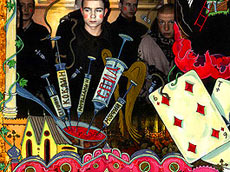
YP: For the young men with no family, prison becomes a place of acceptance and gives them a sense of purpose. Everyone aspires to become a ‘pakhan’ (criminal boss) and no one dreams of ever being an untouchable (lowest in prison hierarchy). Although the boys that I have met are far from resembling the macho superheroes they wish to be, many imitate the expected behavior. Many of the boys display a strong sense of camaraderie. I was immediately struck by an unusual display of affection among them as they constantly hang on to each other and wrap their arms around the others’ shoulders (some of that is evident in the photographs that I shot). Their community mirrors the hierarchy of an adult prison, although according to experts it is even more pronounced and cruel. Brutality and strength are the dominant forces. One is immediately able to discern the ‘bugri’ (alphas), the ‘blatnie’, and the untouchables. I was once speaking to a group of boys (8-10 people) who were all seated on a bench in front of me, when the two ‘bugri’ (alphas) came up to us. Without saying a word, all ten boys immediately got off the bench to let the ‘bugri’ sit. Apparently, the punishment for failing to show respect can be rather brutal.
Curiously, no matter how cruel the boys can be to one another, they show unusual kindness when it comes to kittens. It is not uncommon for each cell to have a pet kitten for which everyone gently cares. The cats breed inside the prison, catch rats, and have no problems moving between the bars. It was also interesting to see the ‘bugris’’ cells. The walls are covered with fake green vines, flowers, and stuffed animals (their girlfriends from the outside sent them). Hanging along side these niceties are posters depicting porn stars. Apparently, it is considered cool if one’s cell resembles a ‘normal’ room outside of prison.
PP: In a 2008 Boston Globe article said “you’d given up using photographs”. Explain that decision.
YP: I am not using photographic imagery in current projects, but it doesn’t mean that I will not do so in the future.
____________________________________________________
Yana’s CV is here. Yana won the juror’s prize at the 2005 CENTER Santa Fe awards. She is a member of the 6+ collective.
Massive thanks to Yana Payusova for her erudite, balanced and insightful words. It is a privilege for Prison Photography to host such a comprehensive account. Many, many thanks!
Please visit Yana’s website.


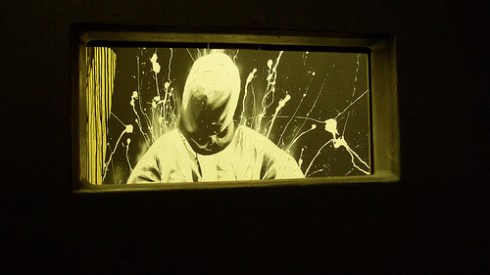
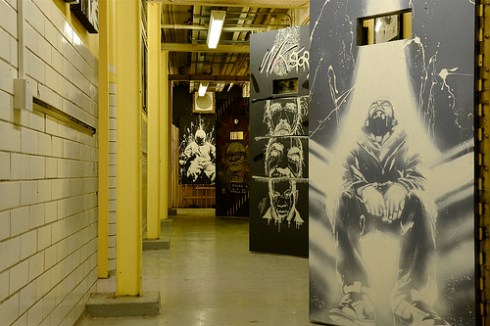
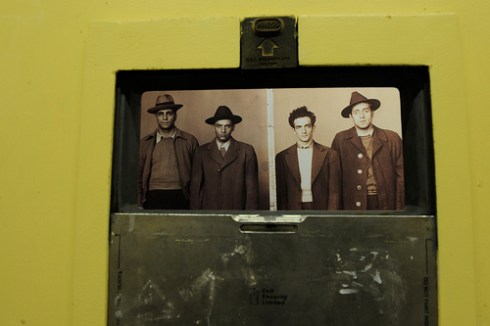

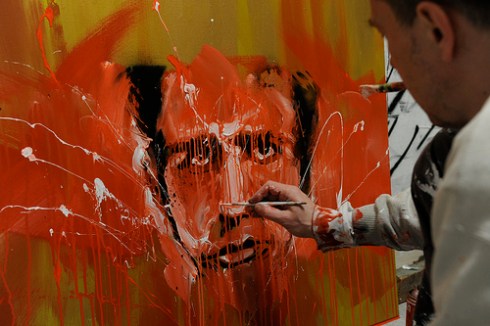





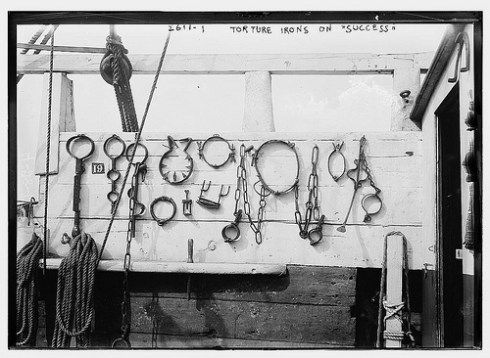
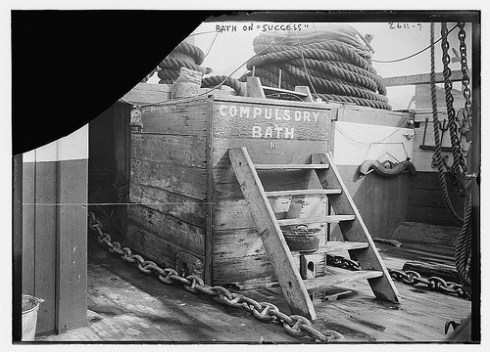
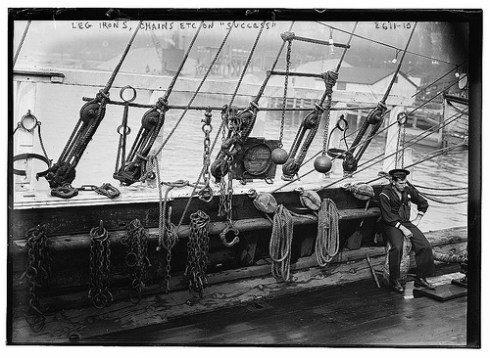 The accoutrements of abuse on display are chilling. The international seafaring exhibit was an old British and latterly Australian ship used for deportation of ‘criminals’ during Victorian times and for non-human commodities thereafter.
 When I saw the iron jacket I was terrified, but then I read



 Prison Photography