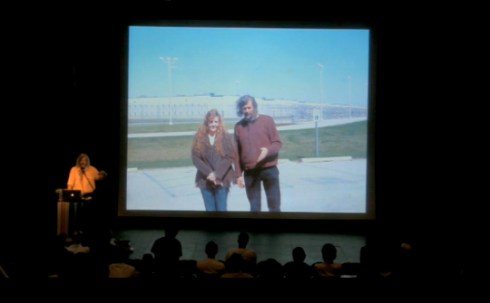
Jacob Holdt presenting at the New York Photo Festival, 2009. Screen shot from WTJ? Video.
In 2008 it was Ballen. In 2009 it was Jacob Holdt; The highlight of the New York Photo Festival.
I have been a fan of Holdt’s work for a couple of years now. Longer than some and not a fraction as long as others. Holdt has lived across the globe as an activist against racism and a harbinger of love for nearly four decades.
In 2008, Jacob Holdt was nominated for the Deutsche Borse Prize eventually losing out to Esko Männikkö. It was a shrewd shortlisting by a notoriously urbane committee at Deutsche. Holdt’s life and productive trajectory is his own, and much like Ballen does not conform to any norms of expected photographic career paths.
Any nomination – any praise – is purely a recognition of Holdt’s philosophy, his “vagabond days”, his trust in fellow humans and his rejection of stereotypes, fear and pride. Holdt does not revere photography as others may, “Photography never interested me. Photography was for me only a tool for social change.”

© Jacob Holdt
I watched Holdt’s presentation without expectation. I was, in truth, very surprised by the number of times he referred to his subjects – his friends – spending time in prison. It seemed only death trumped incarceration in terms of frequency amongst his circle of friends.

Prison Meal on Toilet © Jacob Holdt. Through a “mysterious mistake” I got locked up in this California prison with my camera and had plenty of time to follow the daily life of my co-inmates. Food was served in their cells where the only table was their toilet.
Slide after slide: “I can’t remember the number of times I have helped him get out of prison” and, “He’s in prison, now” or “He’s doing well now. He was in prison, but now he is out, has a family, and is doing well.”
Holdt described his method of finding community. Upon arrival in a new place, he would visit the police station and ask where the highest homicide rate was. He’d go to the answer.
Violence was tied up with poverty, was tied up with drugs, was tied up with deprivation, was tied up with hurt, was tied up with punishment and was tied up with prison – usually long sentencing.
Holdt’s series straddles the massive prison expansion experiment of America that began in the 1980s. Also enveloped are the crack epidemics, the racial fragmentation of urban populations and the relocation of middle classes to the suburbs. Holdt’s photographs are the mirror to racial economic inequalities.
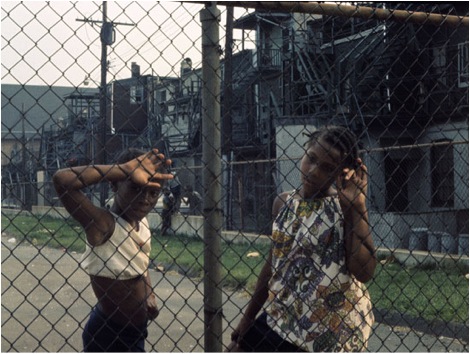
Dad in Prison © Jacob Holdt. Alphonso has often entertained my college students about how he and the other criminals in Baltimore planned to mug me when they first saw me in their ghetto. However, we became good friends, but some time later he got a 6 year prison term. Here are the daughters Alfrida and Joann seen when they told me about it at my return. Today Alphonso has found God with the help of these two daughters who are now both ministers.
Holdt doesn’t play the blame game. Just as institutions and corporations walked all over many African Americans in Philadelphia, Baltimore, New York, and states across the South, so too did people step on each other, “This is a photo of a man the night after he shot his own brother in the head.” The next night, he was out stealing again and soon after was convicted for another crime and served 16 years in prison.
Holdt only makes excuses for the failings of his friends insomuch as their mistakes are more likely – almost inevitable – set in the context of their life experience. He doesn’t jump in, drive-by, photo some ghetto-shots nor cadge some poverty-porn. Holdt involves himself directly and tries to open other avenues.
He and his team has lectured across the globe running anti-racism workshops. Holdt had ex-cons sell his anti-racism book on the streets when they were released from prisons without opportunity. He offered pushers the chance to sell his books instead of dope. Sometimes he saw the money and sometimes not, “But, it was never about the money” Holdt adds.
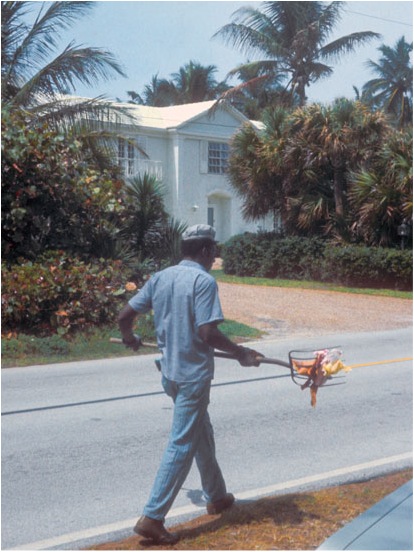
Prisoner cleaning up on Palm Beach. © Jacob Holdt
One of the most sobering facts of the talk was a double mention of Lowell Correctional Institution in Florida. It was the only facility referred to by name and twice Holdt named friends who’d spent time inside. Lowell is a women’s facility. The female prison population of America has quadrupled in the past 25 years. It is still expanding at a far faster rate than the male prison population. Women’s super-prisons are singularly an American phenomenon. Holdt dropped as an aside, “I have three friends with grandmothers in prisons.”
If he could help, he would. Holdt described a struggling young lady who he desperately wanted to get on staff of American Pictures, but in 1986 she was too strung out on crack. In 1994 he visited her in prison. In 2004 she was released. In 2007 she was still out and Holdt photographed her with her son.
He photographed mothers, lovers, father and sons behind bars. In one case, when the father was convicted the son turned to crime to keep enough money coming in to support the family. He soon joined his dad in prison.
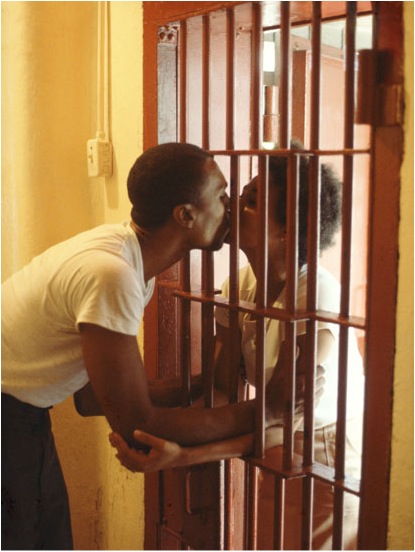
Prison Kiss © Jacob Holdt. I was visiting the friend of this inmate when his wife suddenly came on a visit.
But when it would be expected that Holdt may be too deep inside the experience of the poor Black experience, he took the chance to live amid the poor White experience.
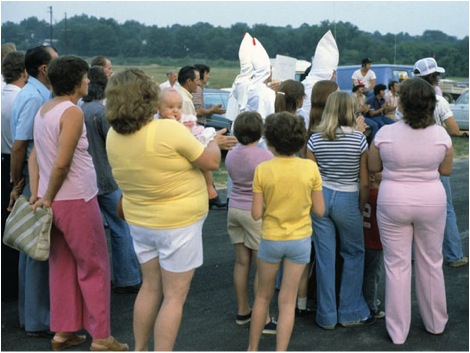
Poor whites at a Klan gathering in Alabama. © Jacob Holdt
In 2002, Holdt had the opportunity to live with the Ku Klux Klan. He became pals with the Grand Dragon and his family.
“I have spent my life photographing hurt people.” The KKK members were no different. The leader had been abused as a child, subject to incest and beatings. Holdt presumed this but it was confirmed around the time the leader was sent to prison for 130 years for murder.
Holdt moved in with Pamela, the leaders wife, to support her in her husbands absence. Also in his absence he brought the unlikeliest of people together.
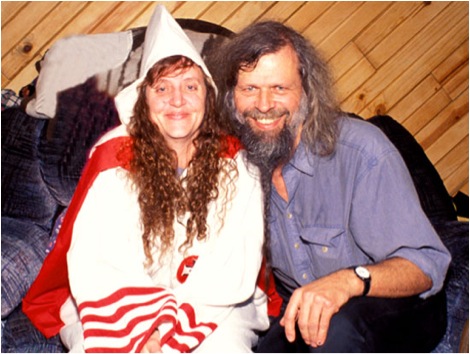
Pamela with white friend (Jacob Holdt). © Jacob Holdt

Pamela with black friend. © Jacob Holdt
During this time and only through informal discussion did Holdt learn that the man was innocent – he had voluntarily gone to prison to spare his son, the real culprit, from conviction for a hate crime.
Holdt petitioned and won his release. The former Grand Dragon was unemployed upon release and went on to sell Holdt’s anti-racism book on the streets … just as the dope-dealers of Philly had 15 years earlier.
Holdt’s presentation confirmed to me that the prison is inextricably linked with the social history of America. But this should not be surprising in a society so violent. Holdt paints a portrait of America from the 70s through to today in which the poorest people (both Black and White) held the monopoly on violence, disease, depression, addiction and struggle.
When Holdt was in Africa he showed people there his images of African-Americans suffering. Africans thought the Black communities of America would fare better in Africa, “Why don’t they come back here?”

Two unemployed Vietnam veterans at wall on 3rd St. © Jacob Holdt
Given the situations he walked into, some may think Holdt is fortunate to still be alive but having armed himself with love he made his own luck … and friends.
Check out more on Jacob Holdt here and here. Here is an article in support of his hitch-hiking activity.
Holdt’s incredible 20,000 image archive American Pictures.
WTJ? 70 minute video of his NYPF presentation.











 Prison Photography
Jacob Holdt’s America: Hitch-hiking, Poverty, Racism, Prisons, Death and Love
May 19, 2009 in Activist Art, Documentary, Historical | Tags: America, Anti-Racism, Comment, Death, Drugs Addiction, Inequality, Jacob Holdt, Love, Murder, Philosophy, Poverty, Prison, Prisons, Problems, Social, Violence | by petebrook | Leave a comment
Jacob Holdt presenting at the New York Photo Festival, 2009. Screen shot from WTJ? Video.
In 2008 it was Ballen. In 2009 it was Jacob Holdt; The highlight of the New York Photo Festival.
I have been a fan of Holdt’s work for a couple of years now. Longer than some and not a fraction as long as others. Holdt has lived across the globe as an activist against racism and a harbinger of love for nearly four decades.
In 2008, Jacob Holdt was nominated for the Deutsche Borse Prize eventually losing out to Esko Männikkö. It was a shrewd shortlisting by a notoriously urbane committee at Deutsche. Holdt’s life and productive trajectory is his own, and much like Ballen does not conform to any norms of expected photographic career paths.
Any nomination – any praise – is purely a recognition of Holdt’s philosophy, his “vagabond days”, his trust in fellow humans and his rejection of stereotypes, fear and pride. Holdt does not revere photography as others may, “Photography never interested me. Photography was for me only a tool for social change.”
© Jacob Holdt
I watched Holdt’s presentation without expectation. I was, in truth, very surprised by the number of times he referred to his subjects – his friends – spending time in prison. It seemed only death trumped incarceration in terms of frequency amongst his circle of friends.
Prison Meal on Toilet © Jacob Holdt. Through a “mysterious mistake” I got locked up in this California prison with my camera and had plenty of time to follow the daily life of my co-inmates. Food was served in their cells where the only table was their toilet.
Slide after slide: “I can’t remember the number of times I have helped him get out of prison” and, “He’s in prison, now” or “He’s doing well now. He was in prison, but now he is out, has a family, and is doing well.”
Holdt described his method of finding community. Upon arrival in a new place, he would visit the police station and ask where the highest homicide rate was. He’d go to the answer.
Violence was tied up with poverty, was tied up with drugs, was tied up with deprivation, was tied up with hurt, was tied up with punishment and was tied up with prison – usually long sentencing.
Holdt’s series straddles the massive prison expansion experiment of America that began in the 1980s. Also enveloped are the crack epidemics, the racial fragmentation of urban populations and the relocation of middle classes to the suburbs. Holdt’s photographs are the mirror to racial economic inequalities.
Dad in Prison © Jacob Holdt. Alphonso has often entertained my college students about how he and the other criminals in Baltimore planned to mug me when they first saw me in their ghetto. However, we became good friends, but some time later he got a 6 year prison term. Here are the daughters Alfrida and Joann seen when they told me about it at my return. Today Alphonso has found God with the help of these two daughters who are now both ministers.
Holdt doesn’t play the blame game. Just as institutions and corporations walked all over many African Americans in Philadelphia, Baltimore, New York, and states across the South, so too did people step on each other, “This is a photo of a man the night after he shot his own brother in the head.” The next night, he was out stealing again and soon after was convicted for another crime and served 16 years in prison.
Holdt only makes excuses for the failings of his friends insomuch as their mistakes are more likely – almost inevitable – set in the context of their life experience. He doesn’t jump in, drive-by, photo some ghetto-shots nor cadge some poverty-porn. Holdt involves himself directly and tries to open other avenues.
He and his team has lectured across the globe running anti-racism workshops. Holdt had ex-cons sell his anti-racism book on the streets when they were released from prisons without opportunity. He offered pushers the chance to sell his books instead of dope. Sometimes he saw the money and sometimes not, “But, it was never about the money” Holdt adds.
Prisoner cleaning up on Palm Beach. © Jacob Holdt
One of the most sobering facts of the talk was a double mention of Lowell Correctional Institution in Florida. It was the only facility referred to by name and twice Holdt named friends who’d spent time inside. Lowell is a women’s facility. The female prison population of America has quadrupled in the past 25 years. It is still expanding at a far faster rate than the male prison population. Women’s super-prisons are singularly an American phenomenon. Holdt dropped as an aside, “I have three friends with grandmothers in prisons.”
If he could help, he would. Holdt described a struggling young lady who he desperately wanted to get on staff of American Pictures, but in 1986 she was too strung out on crack. In 1994 he visited her in prison. In 2004 she was released. In 2007 she was still out and Holdt photographed her with her son.
He photographed mothers, lovers, father and sons behind bars. In one case, when the father was convicted the son turned to crime to keep enough money coming in to support the family. He soon joined his dad in prison.
Prison Kiss © Jacob Holdt. I was visiting the friend of this inmate when his wife suddenly came on a visit.
But when it would be expected that Holdt may be too deep inside the experience of the poor Black experience, he took the chance to live amid the poor White experience.
Poor whites at a Klan gathering in Alabama. © Jacob Holdt
In 2002, Holdt had the opportunity to live with the Ku Klux Klan. He became pals with the Grand Dragon and his family.
“I have spent my life photographing hurt people.” The KKK members were no different. The leader had been abused as a child, subject to incest and beatings. Holdt presumed this but it was confirmed around the time the leader was sent to prison for 130 years for murder.
Holdt moved in with Pamela, the leaders wife, to support her in her husbands absence. Also in his absence he brought the unlikeliest of people together.
Pamela with white friend (Jacob Holdt). © Jacob Holdt
Pamela with black friend. © Jacob Holdt
During this time and only through informal discussion did Holdt learn that the man was innocent – he had voluntarily gone to prison to spare his son, the real culprit, from conviction for a hate crime.
Holdt petitioned and won his release. The former Grand Dragon was unemployed upon release and went on to sell Holdt’s anti-racism book on the streets … just as the dope-dealers of Philly had 15 years earlier.
Holdt’s presentation confirmed to me that the prison is inextricably linked with the social history of America. But this should not be surprising in a society so violent. Holdt paints a portrait of America from the 70s through to today in which the poorest people (both Black and White) held the monopoly on violence, disease, depression, addiction and struggle.
When Holdt was in Africa he showed people there his images of African-Americans suffering. Africans thought the Black communities of America would fare better in Africa, “Why don’t they come back here?”
Two unemployed Vietnam veterans at wall on 3rd St. © Jacob Holdt
Given the situations he walked into, some may think Holdt is fortunate to still be alive but having armed himself with love he made his own luck … and friends.
Check out more on Jacob Holdt here and here. Here is an article in support of his hitch-hiking activity.
Holdt’s incredible 20,000 image archive American Pictures.
WTJ? 70 minute video of his NYPF presentation.