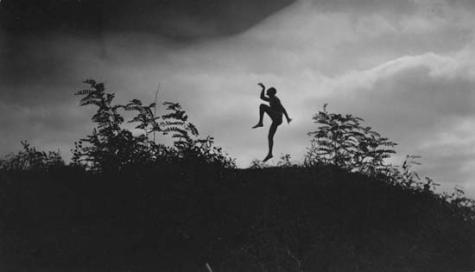
The Dancing Faun. 1919. AFP Photo/Andre Kertesz/National Gallery of Art

The Dancing Faun. 1919. AFP Photo/Andre Kertesz/National Gallery of Art

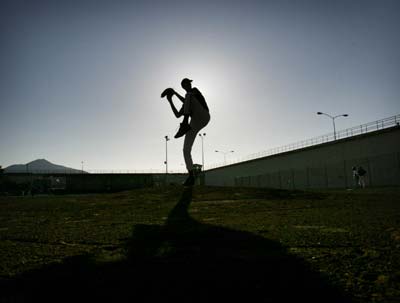
A few weeks ago I promoted a David Bauman slideshow documenting the San Quentin Giants. The anchor image to Bauman’s multimedia project was an image of a silhouetted pitcher mid-throw (below). Photographer David Simonton pointed out the image’s likeness to André Kertész’s well-known Dancing Faun.

Pitcher for San Quentin Giants. Credit: David Bauman/PE.com

Pitcher for San Quentin Giants. Credit: David Bauman/PE.com

run

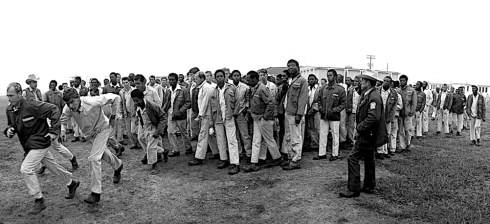
Credit: Bruce Jackson

NY Times LENS Blog

Here, there and everywhere people are celebrating the New York Times’ LENS Blog as a messianic gift for the photophile. I was therefore happy to see that less than two weeks in LENS is featuring Bruce Jackson’s wide angle documentary work from Arkansas Prison in the early 1970s

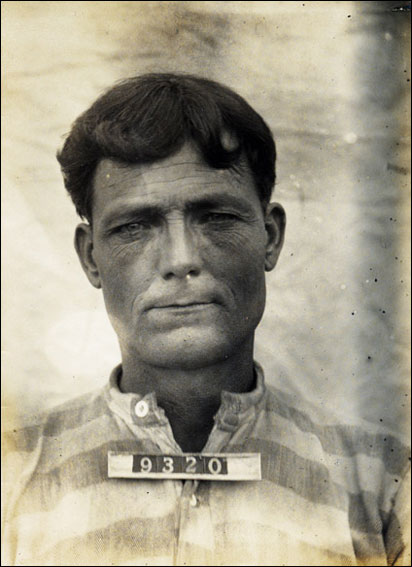
Bruce Jackson should be a familiar name as it was he that rescued, scanned and shared the enigmatic Arkansas Prison Mugshot series, Mirrors.

arkansas24

Found and presented by Bruce Jackson. Arkansas State Prisoner Portrait

June 100 Eyes Issue

Over at 100 Eyes, Andy Levin from insists that “Whatever ones perspective, be it victim, civil rights activist or cop, there is one shared idea – something needs to change.”

The June edition of 100 Eyes, titled, America Behind Bars features the work of Dominic Bracco, Jerome Brunet, Darcy Padilla, Jenn Ackerman and Tim Gruber – all very talented and committed photographers.

As editor, Andy Levin, concludes, the genre of prison photography (or to be less aggrandizing) simply the practice of photography within sites of incarceration is often a difficult and thankless task;

The photographers who have contributed to “America Behind Bars” have worked against overwhelming odds to bring back powerful images of American prisons. One can’t simply walk into a prison with a camera. This kind of photography requires long negotiations and often a warden who has the vision and concern to allow a photographer into his jail.

Wonderful exposure for the most pressing of social issues in America today.

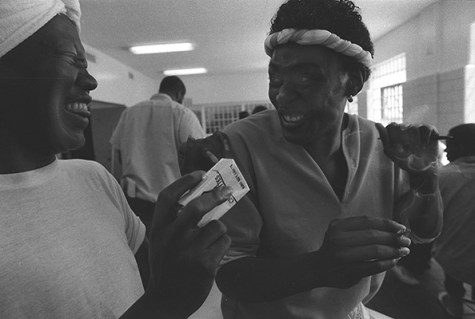
Darcy Padilla. From AIDS in Prison Series.

Darcy Padilla. From AIDS in Prison Series.

Prison Photography began its project in September 2008 with a celebration of Darcy Padilla’s portrait of former San Quentin Public Communications Officer, Vernell Crittendon.

In February, I was gob-smacked by Jerome Brunet’s Riding Shotgun with Texas Sheriffs.

I’d like to feature here two very separate projects. If you’ll allow me, I want to overview Matej Kren’s Book Cell and think of the book literally as a sculptural physical constraint. At the same time, I’d like to introduce Herman Spector’s program of bibliotherapy at San Quentin Prison and frame the book as a pedagogical tool for control.

book-cell-02

For his 2006 installation of Book Cell at the CAMJAP in Prague, Matej Kren stated:

The Book Cell Project repeats the recurring procedure, in the work of this artist, of piling up thousands of books, creating an architectonic structure where we are invited to step inside.

The memory and knowledge accumulated in the books gathered, closed and inaccessible, diverse and precious will be potentially recovered in the end, when all of the books can return to their function of being read, but meanwhile they will have been worked on as sculpting matter and as the spirit of the place where the artist intends to hold us: an hexagonal enclosure with a passage defined by mirrors that assure the vertigo of a fall, the ad infinitum fragmentation, the panic of spatial disorientation characteristic of a virtual infinity.

first-drawings

The fact that these structures are made from the library/archive of the hosting institution makes me shudder. CAMJAP claims a pride in this making the structures site specific.

Prague is a great literary city and the absurdity of being confined by books would be appreciated by Kafka, and yet Krens offers us a way out that Kafka never would. He intends that books return to use and are reborn into cultural thought.

Kren’s literal use of bound knowledge in the fortification of space calls to mind other powerful (if less poetic) uses of books in controlling inmate populations. I’m thinking specifically of Herman Spector’s program of Bibliotherapy at San Quentin State Prison

plan1

From 1947 until 1968, Herman Spector was employed as senior librarian at San Quentin. He put in place a meticulous, long-term program offering 7-days-a-week library access and a choice from over 33,000 titles. By the end of his tenure he stated (not estimated, for he knew every book checked out) that 3,096,377 books had circulated through his system. His project drove up prisoner literacy and had inmates reading 98 books/year.

The project sounds nothing but positive and indeed it brought about much self improvement. But, remember this was a grand experiment with a captive audience and Spector had total control over the reading lists – and latterly, the outward correspondence and writing by San Quentin inmates. Spector employed censorship as readily as he conducted reading groups and assigned classic texts.

frame

Five years ago I was fortunate to meet Eric Cummins, whose book The Rise and Fall of California’s Radical Prison Movement details Spector’s manipulations at San Quentin (Chapter Two: Bibliotherapy & Civil Death). It is the most thorough examination of that great experiment. Cummins writes:

Books, for Spector, were the “deathless weapons of progress” by which prisoners could be “paroled into the custody of their better selves … by feeding on hallowed thoughts.” And, “The hermitage of a small, dank cell,” Spector wrote, “if provided with books, can yield a rich harvest of sheer delight and practical values.“‘ (Page 26)

Though the prison’s official censor was the associate warden for care and treatment, the actual work fell to Spector. Except for mail, which was read in the cell blocks or the mail room, the senior librarian censored all writings by inmates that left the prison and decided what publications would be purchased for the library.‘ (Page 24)

book-cell-01

Spector stated his own censorship policy as follows: “Those which emphasise morbid or antisocial attitudes, behaviour, or disrespect for religion or government or other undesirable materials are not purchased.” Like most other librarians of the treatment era, Spector gave little thought to the danger of political, class or cultural bias implicit in his prison censorship policies, and he wasted no time worrying that denying prisoners law books might be unfair or even unconstitutional. Books that gave inmates access to the law were to be confiscated at the gates. Books that criticised church or state were seditious.‘ (Pages 25/26)

It wasn’t only reading that was controlled and owned; writing too:

The reduced civil status of prisoners was reaffirmed in 1941 in a section of the penal code titled “Civil Death,” penal code 2600-2601. As a consequence of the Civil Death statute, the California Department of Corrections regarded all writing produced by state prisoners as state property, just as a chair or table made in the prison industries belonged to the state.‘ (Page 25)

book-cell-05

Almost constantly throughout his tenure, Spector was at odds with the prison administration who were either unable to grasp, or unwilling to endorse, his aggressive methods of control. When Spector left his post over 25 years of meticulous notes and records were destroyed.

Bibliotherapy and censorship, as Cummin’s concludes, ‘separated prisoners from the power of their own words. Even so, the underlying assumptions of bibliotherapy would soon have a tremendous influence on the lives of certain of the brightest of San Quentin’s inmates, for they would take the notion of reform through reading and writin, the foundation of Herman Spector’s faith, as their own first principle … turning the notion of civil death on its head, reconnecting themsleves to the power of words previously denied them.‘ (Pages 31/32)

Conclusion

Spector’s project founded,at San Quentin, a tradition of literacy that would engender the works of Caryl Chessman, Eldridge Cleaver and the expanded political prison writing movement of the 1970’s. In some ways, the approaches of autodidactism and self determination of the Black Panthers began with the obsessive endeavours of the eccentric biblio-evangelist Herman Spector.

The “Prison Movie” belongs to an undefined genre. Everybody has seen a movie that would fall within its flexible parameters of definition, and yet the concept is a little unnerving.

The genre, I believe, is misunderstood and suffers from an overall apathy or misinterpretation of prison realities. ‘Captivity’ – a necessary requisite of prison – has other discomforting associations such as bondage, unequal power relations, psychological violence, abuse & coercion, constant tension, artificial alliances, survival instincts, homosexuality, rape and exploitation to name a few.

Prison movies, because of their (perceived) content are rarely dinner table conversation. To acknowledge a genre is to acknowledge the common problems that arise when one set of humans puts another set of humans in cages.

A prior guest blogger recommended the work of Paul Mason to help me through this quandary. In his excellent introduction to defining the genre, Men, Machines And The Mincer: The Prison Movie, Mason discusses major themes and audience motivations for viewing. Mason sets the tone for discussion with two truisms;

Two dilemmas exist concerning prison movies: first, hardly any research has been undertaken in the area and secondly, there has been little attempt to define the prison movie. Paradoxically, whilst the genre may not be instantly recognisable, there are many prison movies that stick in the memory.

Mason references a multitude of titles including: Brute Force (1947), Riot In Cell Block Eleven (1954), Birdman of Alcatraz (1962), Cool Hand Luke (1962), Papillon (1973), The Mean Machine (1974), Lock Up (1989), Chained Heat (1992), In The Name Of The Father (1994), Murder In The First (1994), A Man For All Seasons, The Count Of Monte Cristo, There Was A Crooked Man, Silent Scream (1990) We’re No Angels (1955), Breakout (1975), Sleepers (1996), The Hoose Gow (1929), Jailhouse Rock (1957), Porridge (1978), Prison Break (1938), Crashout (1955), Breakout (1975), Midnight Express (1978), McVicar (1980), Scum (1983) Lock Up (1989), The Shawshank Redemption (1995), The Loneliness Of The Long Distance Runner (1962), Numbered Men (1930), The Criminal Code (1931), San Quentin (1937), Men Without Souls (1940), Dead Man Walking (1995), The Shawshank Redemption (1995),  I Am A Fugitive From a Chain Gang (1932), San Quentin (1937), Wedlock (1990), Two Way Stretch (1960), The Ladies They Talk About (1933), Road Gang (1936), Hell’s Highway (1932), Blackwell’s Island (1939), The Pot Carriers (1962), The Big Doll’s House (1971), The Big Bird Cage (1972), Women In Cages (1972).

Mason elaborates:

The term ‘prison movie’ is both a nebulous and problematic one. It is not a term used in everyday discourse like ‘gangster film’, ‘musical’ or ‘western’ is used and yet most of us would describe Midnight Express, Birdman of Alcatraz and Papillon as ‘prison movies’. Only Querry (1973), Nellis & Hale (1981) and Crowther (1989) have written about the prison movie and none of them attempts to define the genre. It is perhaps the difficulty in definition which explains why so little has been written about the prison film despite over three hundred having been made since 1910.

Mason’s paper was written just over 10 years ago now and if I were to bring the debate up to speed, I’d talk about the many independent documentaries and activist films that have sprouted particularly in response the political landscape of American incarceration since the late nineties – Mr. Big, Up the Ridge, Making the River, Prison Town, Gray Days, In Prison My Whole Life and A Hard Straight are just a few examples.

I’d be eager to hear reader’s favourite, memorable or simply known prison movies.

Bringing us full circle to our medium of choice, this discussion leads me to the difficult task of defining the genre of prison photography which I intend to do in the near future …

Germany; Indoor Pool "Tropical Islands" in Berlin Brandenburg; Tourist watching the evening show. ©  Reiner Riedler / Anzenberger

Germany; Indoor Pool "Tropical Islands" in Berlin Brandenburg; Tourist watching the evening show. © Reiner Riedler / Anzenberger

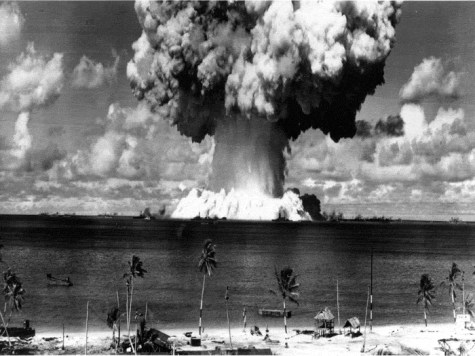
Nuclear Test on Bikini Atoll

Nuclear Test on Bikini Atoll

Lenscratch was right to single out the work of Reiner Riedler from the 50 chosen artists of Critical Mass at Photolucida, Portland, Oregon.

The search for the authentic undertaken by the tourists of Fake Holidays creates paradoxically inauthentic (“anti-authentic”) spaces. Invariably, engagement with these theatre-sets of leisure is as spectator. Of the audience, the spectacle requires passive acceptance and, to some degree, a surrendering of their self identities as agents of change.

Many of Riedler’s images are caustic in their humour but others are flat out depressing. “Tropical Islands” reminded me of the images of 50’s movie-goers in 3-D glasses; fun at the time but now cut into apocalyptic montages of human division, destruction and powerlessness.

Riedler’s image suggest little progression since the late colonial exploitations of Europe in the South Pacific. It is as if he turned the camera 180 degrees on its tripod, eradicated half a century, added colour and caught the masses still gawping.

Furthermore, “Tropical Islands” can be read as a simulation of the defacement of human existence. The fake plastic trees, sealed dome architectural skin and industrial spotlights have me imagining these people kicking back on their loungers as a nuclear winter takes hold outside their chlorinated, hemispherical world. It is as if the only method of survival in this radioactive-proof conch is to relive (in full surround-sound) the astounding beauty of the awesome act that drove them to their hermetically sealed lives.

Also, while we are on the topic of nuclear holocaust, you should listen to Nitin Sawhney’s Beyond Skin.

Archive of Prison Photography Convergences.

Today, The Exposure Project highlighted the work of Daniel & Geo Fuchs’ STASI – Secret Rooms describing it as “an exploration of the now outmoded interrogation rooms and detention centres of the East German Secret Police.”

No matter how outmoded, the depictions are chilling.

© Daniel & Geo Fuchs. From the series "STASI - Secret Rooms"

© Daniel & Geo Fuchs. From the series "STASI - Secret Rooms"

Daniel & Geo Fuchs’ STASI – Secret Rooms is featured in the latest Aperture accompanied by a Matthias Harder essay laying out the nature of Germans’ handling of memory and narrative. The architectural remnants of the era are interwoven with the national dialogue.

“The rehabilitation of the East German justice (or injustice) system and its surveillance apparatus continues; the remaining Stasi files and methodically recorded wire-tapping logs are now available to the public.”

“With this series Daniel and Geo Fuchs have rubbed salt onto an open sore of recent German history while simultaneously contributing to its articulation and healing.”

Author’s note. Prison Photography has been interested in HohenSchonhausen prior, promoting the work of the still unknown Lars.blumen

Pastor Marcos Pereira da Silva and prisoner in Polinter Prison, Rio de Janeiro. © Gary Knight, VII Agency

Pastor Marcos Pereira da Silva and prisoner in Polinter Prison, Rio de Janeiro. © Gary Knight, VII Agency

Dispatches Mag out today with the theme Out of Poverty. It includes Gary Knight’s photo essay from Polinter Prison, Rio de Janeiro.

I have been waiting for Knight to publish these images. An internet-murmur a few weeks ago alerted me to his work in Brazil’s prisons.  As I fleshed out the scenario at Polinter Prison those few weeks ago, I won’t go in to huge detail in this post.

In a nutshell, Pastor Marcos Pereira da Silva visits the critically overcrowded prison with his unique brand of evangelism. It starts with anthems of praise and ends up in wailing convulsions and the exorcism of spirits. He acts generally messianic and the prisoners (at least those pressed against the bars at the front of the cages) seem quite responsive.

Knight is uncomfortable with these enactions and so am I.

Click here or the image below and you’ll be directed to 9 minutes youtube footage of the said pastor doing his thing.

Still from video of Pastor Marcos Periera de Silva in Polinter Prison, Rio de Janeiro, Brazil.

Still from video of Pastor Marcos Periera de Silva in Polinter Prison, Rio de Janeiro, Brazil.

I started Wednesday Words last week to throw out some brief and wise writings on prisons. I’ve got Winston Churchill, Charles Darrow and David Ramsbottom lying in wait. But they must all hold fire because I am taking the podium this week.

I have just unsubscribed from Getty’s Photoblog. Having it filter through my reader next to thoughtful and (in most cases) non-commercial blogs it became plainly obvious Getty are pandering to their audience. The result is a bland regurgitation of celebrity imagery. I guess this is what their audience wants. GettyBlog is watery gruel compared to the rest of the blogophotobiosphere.

My conclusion: Getty is effectively held captive by their audience.

Apparently, Getty Blog’s readership wants about 60 or 70% of Getty’s narrative to be about young, famous women and their clothing choices. Well, I don’t.

This minor alteration to my daily visual feed came a day after I read Confessions of a Former Online Producer, a candid piece by Jake Ellison;

During my last year at the Seattle Post-Intelligencer, in its last year as a newspaper, I published online thousands of pictures of half-starved, mostly naked women – celebrities and fashion models. I even became so deranged as to argue vehemently in the newsroom that those photos were necessary because we were a dying industry and people wanted to look at those women, so get on board.

The Seattle PostGlobe is an all volunteer, blog-reporting venture made up of many former Seattle Post Intelligencer journalists. The P-I went under a couple of months ago and the PostGlobe is simultaeneously a service to the now one paper Emerald City, a boredom evasion technique, experiment in new-journalism and an acknowledged unsustainable economic model. For all those reasons I love it, support it and endorse it.

I’d tweet its stories more often but the PostGlobe’s URLs are 142 characters long!

EMAIL

prisonphotography [at] gmail [dot] com

Prison Photography Archives

Post Categories