In October, I posted an image of Orleans Parish Prison inmates guarded on a New Orleans Bridge following a problematic evacuation. It was within a meandering article charting a chain of discoveries beginning with Arnold Genthe and ending with Pay-As-You-Stay jails in Los Angeles.

My conclusion then remains the same now: Katrina dealt with the poor in the same way a American society and markets have for the past 30 years; it picked them up, took them wherever it was heading on its disastrous path and spewed them out the back with nothing … and likely closer to death.

O.P.P. Inmates guarded on New Orleans overpass following Hurricane Katrina

O.P.P. Inmates guarded on New Orleans overpass following Hurricane Katrina. Credit: David A. Phillip/AP

In February, an assistant producer working on David Simon’s new project Treme got in touch with me to source the above image. (So, expect some Orleans Parish Prison related plot line!)

In response, I spent hours trying to hunt down my original source. FAIL. I found other images like it belonging to David A Phillip/A.P. and so, it is he I credit. I am 99% certain.

I have talked before about prisoners as waste, and this image is a convergence on that thought. Both people and trash have been herded into their corner; trash checked by freeway wall and current, people by armed guard.

This image bristled for some time during which I read reports on rivers full of trash and Charles Moore’s TEDtalk about the Great Pacific Garbage Patch.

Then, add hero David Simon telling Bill Moyers that the reason America has never solved the chronic poverty in cities because America’s economy (no longer manufacturing based) does not need 10-15% of it’s population and labour pool. America has turned people into excess.

It begins to get depressing and heavy.

© Megan Martin 2009 www.meganmartinphoto.com

© Megan Martin 2009 http://www.meganmartinphoto.com

Add to this the fact I f*#kin’ hate those stupid-pearlescent-pearly-plastic-pearls-destined-to-choke-a-fish and it was all starting to get back to a dirty, sad, wasted and wasteful place.

Collapse.

I’ve never been to New Orleans’ Mardi Gras. Large celebrations unnerve me and the party – as legendary as it is – remains on my “to avoid list”.

I searched for the image that had bedded like sediment at the foot of my brain stem. Any trash image of the Mardi Gras aftermath was to serve the purpose, but when Flickr presented Megan Martin’s photo it was like string of predetermined conscience came home to fester.

The compositional mirror of these two images just polished my obsession with the unsustainability of most things. Processes have products and by-products. By-products are shipped to Asia to pollute its children or trampled into our unsustainable soils.

Louisiana has the largest number of prisoners per capita in the United States. Fiscally, Louisiana prisons must be feeling the pinch as much as any other state?

It appears a society’s self-made problems – when they  are big – won’t even be washed away by a 100year storm. Let’s stop filling prisons like we fill landfill. Prisoners and their rights cannot be ignored. Prisons are unsustainable.

For a full account of the disastrous evacuation of New Orleans prisoners during Katrina watch Prisoners of Katrina by the BBC.

See Megan Martin’s photos here.
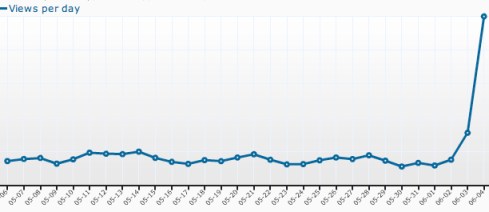
This week, Metafilter – among others – threw a stats-bomb at my wordpress account. The lure? Uncredited, amateur, pinhole photographs. No name … no logo.

graph

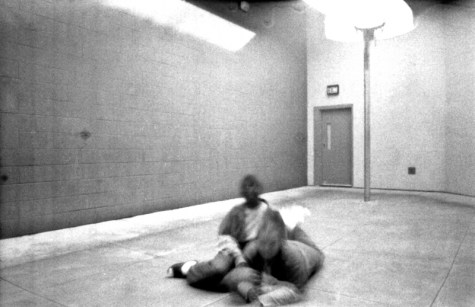
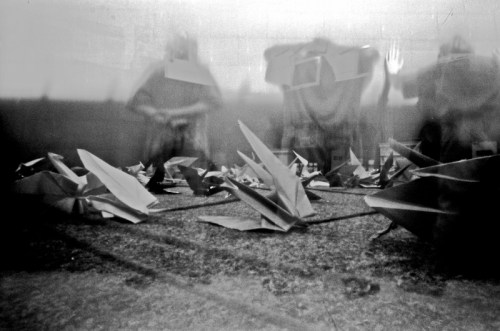
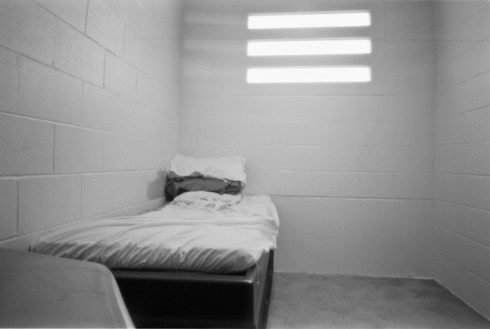
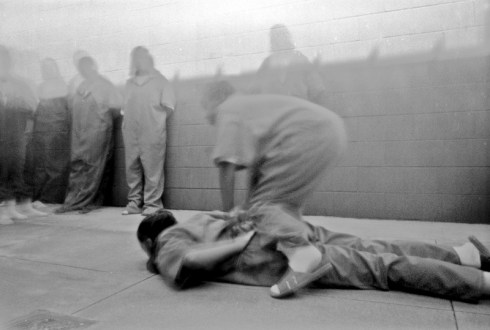
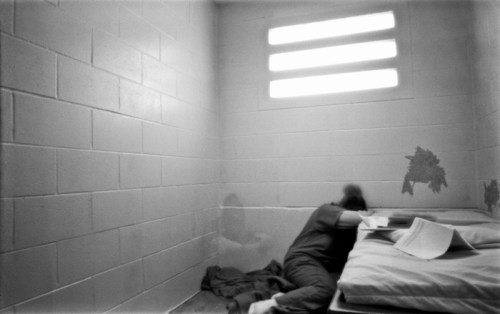
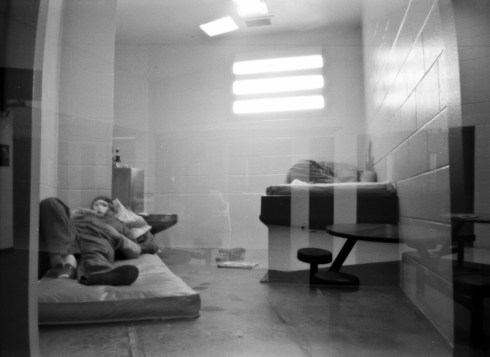
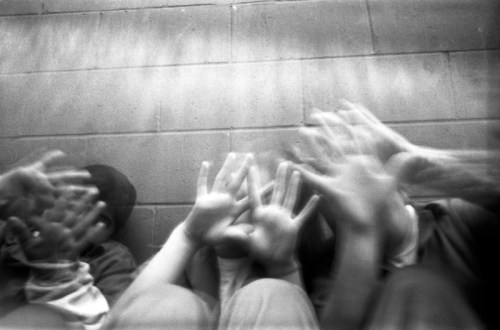
The photography was by Girls in the Remann Hall Juvenile Detention Center, Tacoma, WA during a 2002 Steve Davis arts workshop.

These pictures really struck a chord. I am left to wonder what sort of interpretations are being made by viewers?

One thing I know is that a big CV, a big camera and fancy digijournalist turns may not be enough to secure soul-grabbing images. In fact, I’d argue it probably isn’t possible to compete with those nameless girls of Remann Hall.

Remann Hall girls 2002.  Image created with pinhole camera in a Steve Davis workshop

Remann Hall girls 2002. Image created as part of a Steve Davis workshop. Pinhole camera.

Please contact Steve Davis for inquiries about image use and reproduction.

Photography in prisons and jails isn’t always edgy nor riven with fraught emotion. Sometimes it can be quite ordinary. In fact, given the utter boredom of most prison facilities it would be good to see a photo essay that communicated effectively vacuous time and psychological space.

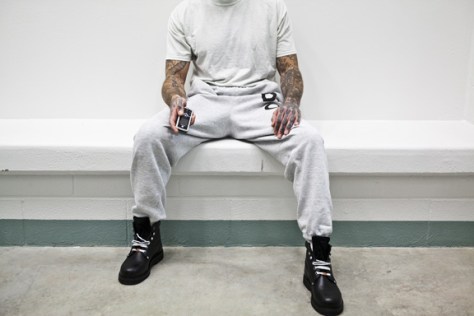
…but, I digress. Hetherington, over at the venerable What’s The Jackanory?, indulged in some “shameless self promotion” of his magazine work at North Branch Correctional Institution. Within the Wired article, Prisoners Run Gangs, Plan Escapes and Even Order Hits With Smuggled Cellphones, Hetherington’s images include a cell-tableaux, sniffing dog and bagged phone. I am more interested in the non-published images Hetherington provides in his post; they’re crisp, pared down images of inmate and interior.

Andrew Hetherington for Wired

Andrew Hetherington for Wired

It got me thinking about how the environmental fabric – along with the representation – of American prisons has changed.

When (documentary) photographers first began accessing prisons – Danny Lyon, Conversations with the Dead (1971), Jacob Holdt; Taro Yamasaki, Inside Jackson Prison (1981) – the conditions were poor.  And prisons were only one response to criminal behaviour and social contract.

Even latterly, Ken Light shot the black & white, in-your-face and sweaty Texas Death Row (1994) and in doing so romanticised historicised American prisons as definitively dirty sites of “the other”. By the 1990s, though, the US had implemented long term custodial sentences as the primary “solution” to crime. The phase-out of Federal parole beginning with Reagan and culminating with Clinton bloated the Federal Bureau of Prison (BOP) population, alone, from 40,000 to 200,000.

So two trends intersected: Prison populations swelled resulting in overcrowding and economically efficient facilities were rapidly being built. The mass construction of new warehouses prisons altered the spatial experience of confinement and the nature of interpersonal interaction within. Cell tiers were replaced by AdSeg wings.

The BOP has a reputation for housing the hardened criminal and specialises in high security facilities. Additionally, from the late 1980s states were building their own new high security and supermax prisons. This new penological architecture replaced 40 foot brick walls and watch towers with razor wire and motion sensors.

Prison environments are sparse. Problems with dark corners & damp have been replaced with the psychotrauma of constant fluorescent light. Problems with stashed contraband have been replaced with an absence of surfaces to set down objects. Denim uniforms have been replaced by sweat outfits. The penological management of gangs & group violence has been replaced with the pharmacological management of locked-up basket cases.

One former inmate of the Federal Supermax facility in Florence, Arizona (ADX) has described it as the “Perfection of Isolation.”

Correctional Officer Jose Sandoval inspects one of the more than 2,000 cell phones confiscated from inmates at Calfornia State Prison in Vacaville, California. Rich Pedroncelli / AP

Correctional Officer Jose Sandoval inspects one of the more than 2,000 cell phones confiscated from inmates at Calfornia State Prison in Vacaville, California. Rich Pedroncelli / AP

Telephoning a way out Isolation

“Cell phones,” says James Gondles, executive director of the American Correctional Association, “are now one of our top security threats.” (Wired, July, 2009)

I posited in the past that cell phones were just one part of the prison economy and their commodity status was in direct reaction to the cost of corporate-managed prison payphone systems – in essence a racket in response to a racket. However. having read the Wired article it is clear how much of a serious security threat cell phones pose to prison authorities.

The majority of tactics for isolation, perfected over the past 30 years by prison administrations, are rendered immediately obsolete,

With a wireless handset, an inmate can slip through walls and locked doors at will and maintain a digital presence in the outside world. Prisoners are using voice calls, text messages, email, and handheld Web browsers to taunt their victims, intimidate witnesses, run gangs, and organize escapes—including at least one incident in Tennessee in which a guard was killed. An Indiana inmate doing 40 years for arson made harassing calls to a 23-year-old woman he’d never met and phoned in bomb threats to the state fair for extra laughs.

So what’s the answer? Debate exists over the value and legality of jamming all signals around prisons but a High School in Spokane, WA proved localised signal-jamming a bad idea when it interfered with the local Sheriff’s radio signals.

We should also bear in mind that ‘The 1934 Communications Act prohibits anyone except the federal government from interfering with radio transmissions, which now include cell calls.’ (Wired)

Criminalize Smuggling but Not Talking

TIME does a good job of breaking down the stats and describing the evolution of the problem. It is obvious that authorities are going to make strategic response to a growing trend but prison authorities must not compromise the already limited opportunities for inmates to talk with friends and family. Close family ties and contact are key to reducing recidivism and giving former prisoners the best means to integrate back into society.

And of course, inmates aren’t the only ones caught up in the illicit trade of cell phones in prisons. One California prison guard admittedly to making over $100,000 in a year through smuggling and selling cell phones!

On that note, I offer you a CDCR sanctioned news VT.

As so very often, the spark of thought was ignited by the Change.org Criminal Justice blog.

In the interests of full disclosure, DuckRabbit and Prison Photography have become virtually-close these past couple of months, beginning with an acknowledged shared politic, via encouraging support, to a mention in DuckRabbit’s announcement of a daring competition that I feel I had only a small part to do with.

duck

I am not advertising DuckRabbit’s $1,000 competition for brevity’s sake. I am promoting it because:

a) Stan Banos had an excellent point in the first instance
b) DuckRabbit has not been shy to challenge inequalities before (including MSF – opening dialogue, discussing visual ethics and celebrating consequent positive representations on MSF’s photoblog)
c) PDN, with an all-white 25 juror panel has a valid charge of passive racism to answer.
d) I think it is a ballsy move, and I want to see what comes of it.

Up for the debate?

FOR $1,000 YOU MUST;

“Come to PDN’s defense and answer the question, What possible, plausible excuse could exist for an all white jury from a publication of such influence?’”

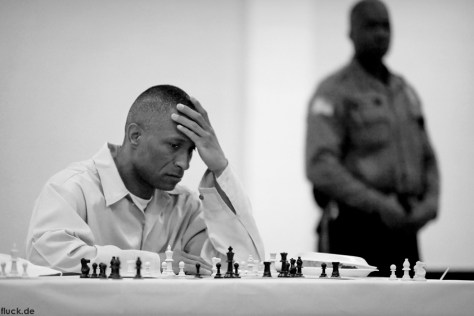
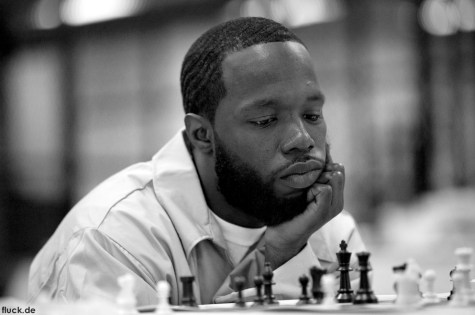
Prison Chess Portrait #14. Oliver Fluck

Prison Chess Portrait #14. Oliver Fluck

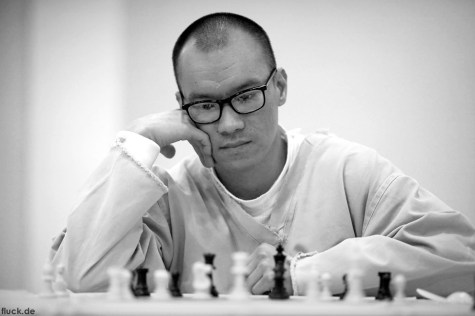
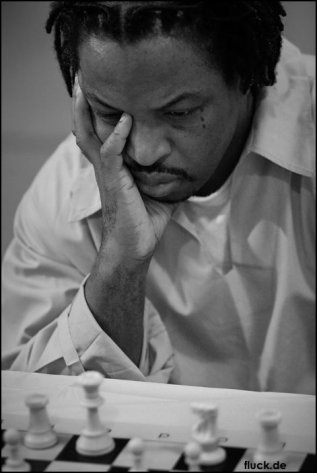
Oliver Fluck’s series of Prisoner Chess Portraits is an interesting counterpoint to other prisoner portraiture. It is unfussy, neutral, quiet. Fluck is experimenting with the figure and I would like to see him in the future settle with a preferred vantage point in relation to his sitter. For example, I like the portraits of the Prison Chess Champ and of Christopher Serrone. Fluck is headed in the right direction.

Prison Chess Portrait #14 (above) is a very strong shot also taking advantage of particularly high contrast light conditions.

Is photographing stationary silent chess-playing sitters simple or difficult? On the one hand, the sitter is still for you, but on the other, it’s difficult to spark rapport with a man concentrating on the game.

Text with Image

An integral part of the project is Fluck’s drafted questionnaire which secured answers to standard questions from as many competitors as possible.

Inmate quotes such as, “Having been incarcerated since age 15 and never getting out, it is helpful and healthy to know that not all of society lacks interest or willingness to become productively involved” keep reality checked. As do sobering statistics such as 50+ years or 66-year prison-terms.

J. Zhu. Oliver Fluck

J. Zhu. Oliver Fluck

Christopher Serrone. Oliver Fluck

Christopher Serrone. Oliver Fluck

Competition Winner. Oliver Fluck

Prison Chess Champ. Oliver Fluck

Q&A with Oliver Fluck

How and why you came to this topic?
I enjoy playing chess, which is why I’m in touch with the local university chess club here in Princeton. The students got the opportunity to play against inmates of a maximum security prison, and when I heard about it, I proposed to photograph the event and volunteer as a driver for the students.

What are your hopes for the project as a whole?
Very frankly, from a photographer’s point of view, I would like to see it exhibited, and provoke some thought.

What is your message with the portraits?
I can talk about one thing that I am not trying to do: I’m not trying to propagate any kind of standpoint about how one should deal with criminals, and whether or not they should have the right to enjoy chess. I’m like most other viewers, I stumbled upon this project and got curious … Curious on an unprejudiced level from human to human. Start from there if you are looking for a message.

Anything else that you’d like to add and feel is important.
I would like to thank John Marshall for this experience, and David Wang for constructive feedback regarding the prisoner questionnaire.

Competitor with Unknown Name. Oliver Fluck

Competitor with Unknown Name. Oliver Fluck

Prison Chess Portrait #4. Oliver Fluck

Prison Chess Portrait #4. Oliver Fluck

Prison Chess Portrait # 21. Oliver Fluck

Prison Chess Portrait # 21. Oliver Fluck

Original Links to portraits 1, 2, 3, 4, 5, 6 and 7.

Oliver Fluck’s Flickr

Watch this youtube clip of a local news report from the prison during the tournament.

A few things emerging today to which I’d like to doff my cap.

Lenscratch

Aline Smithson at Lenscratch, rumoured to be in Santa Fe (Good Luck, Aline), celebrated all Lori Waselchuk’s documentary work; Waterlines, one project of many projects wrapped up in Louisiana, and Grace Before Dying community portrait of the Prison Hospice at the Louisiana State Penitentiary (Angola).

Lock Down Visit. Lori Waselchuk

Lock Down Visit. Lori Waselchuk

Lori, a member of the New Orleans Photo Alliance, launched her project Grace Before Dying April 3rd at the Louisiana State Prison Museum in conjunction with the Louisiana-Mississippi Hospice and Palliative Care Organization (LMHPCO), the Louisiana State Prison Museum, and helped along with a Distribution Grant from the Documentary Photography Project of the Open Society Institute and Moonshine Studio.

The issues of age and health in prisons – together and in isolation – have been reasonably well covered. But, Waselchuk succeeds where so many others fail (with the exception of Edmund Clark) in really communicating the infirmity and vulnerability of the inmates

Fraction offered a good summary, as does Waselchuk’s Alma Mater. Critical Mass has the best gallery of Grace Before Dying

Bint PhotoBooks on Internet

Bint PhotoBooks on Internet got to grips with Martin RoemersRelics of the Cold War which includes a Valencia orange room within a Stasi Prison. Roemers goes tête-à-tête with the Fuchs brothers in the communist-archaeology-photo genre.

Germany, East Berlin. Visitor-room in former Stasi prison Hohenschoenhausen. Political prisoners were held in this prison. Martin Roemers

Germany, East Berlin. Visitor-room in former Stasi prison Hohenschoenhausen. Political prisoners were held in this prison. Martin Roemers

Unrelated to prisons, I am also a fan of Roemers’ Lourdes Pilgrims series.

Subjectify

Subjectify grapples with the latent appropriation of images since the 2004 release of Abu Ghraib photographs.

much has been written about the ways in which war photography often echoes iconic religious imagery.  but i have been wondering how, in turn, the iconography of the new war and torture photography is also influencing fine art photographers today?

Subjectify offers Jessica Somer‘s work ‘Origin’ from the Bend So Not to Break series as a case in point. I drew some interest along with disbelief and derision when I skirted the issue regarding Ballen and the torture aesthetic.

Origin. Jessica Somers

Origin. Jessica Somers

I believe artists biggest problem is to work away from viewers natural tendency to superimpose meaning so easily. I think Somers is safe. She’s got a style that stands on its own – it doesn’t get drowned out by media noise or green gloves.

AN Other

Yusuf Sayman‘s work on individuals going through Re-entry programs after long term prison sentences presented itself in the Independent‘s bizarre and confused “Britain’s Best Crime Photography” competition.

Starlene from the Free Again: Starlene series. Yusuf Sayman

Starlene from the Free Again: Starlene series. Yusuf Sayman

Starlene Patterson is one of three former prisoners, Sayman has collaborated with after prison release for the Free Again series. Starlene is at college to qualify as a Social worker. “People need help.”

Starlene has written a book, Up Against the Wall. She says, “My book has a message. There’s a lot of young people who need guidance and they my not have that. If my book can help one [of those children] than I’ve achieved.”

Non-prison related I like Sayman’s Henry’s World series.

In his book Prisongate (2005), David Ramsbotham, former Chief Inspector of Her Majesty’s Prison Service, quotes a young prison reformer, Winston Churchill.

Ramsbotham read Churchill’s words very early in his employment as Chief Inspector, and kept them close throughout his five year tenure. Ramsbotham understood the following quote as “the clearest possible condemnation of punitive, as opposed to rehabilitative, imprisonment.”

Churchill concluded the parliamentary debate:

We must not forget that when every material improvement has been effected in prisons, when the temperature has been rightly adjusted, when the proper food to maintain health and strength has been given, when the doctors, chaplains and prison visitors have come and gone, the convict stands deprived of everything that a free man calls life. We must not forget that all these improvements, which are sometimes salves to our consciences, do not change that position.

The mood and temper of the public in regard to the treatment of crime and criminals is one of the most unfailing tests of the civilisation of any country. A calm and dispassionate recognition of the rights of the accused against the state, and even of convicted criminals against the state, a constant heart-searching by all charged with the duty of punishment, a desire and eagerness to rehabilitate in the world of industry all those who have paid their dues in the hard coinage of punishment, tireless efforts towards the discovery of curative and regenerating processes, and an unfaltering faith that there is a treasure, if you can only find it, in the heart of every man these are the symbols which in the treatment of crime and criminals mark and measure the stored-up strength of a nation, and are the sign and proof of the living virtue in it.

House of Commons speech, given as Home Secretary, July 20, 1910

Note: Often Churchill’s House of Commons speech, July 20, 1910 is quoted without this first paragraph. Ramsbotham plumped for the expanded version.

Prisongate is a riveting book in which Ramsbotham details his observations, strategies, inspections and concern within a broken UK prison system. The London Review of Books said “Prisongate will make uncomfortable reading for ministers. It is a vivid and at times idiosyncratic account expressive in equal measure of personal frustration and moral outrage.”

Girls' Pinhole Photography Project

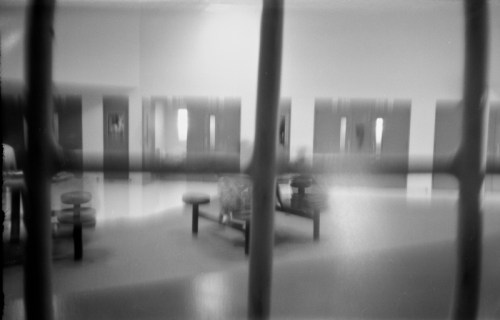
These images are the result of a collaboration between photographer Steve Davis and the girls of Remann Hall Juvenile Detention Center, Tacoma, Washington State in the US.

Davis was forced to think of the camera as a tool for different ends, essentially rehabilitative ends. For legal reasons and the protection of minors, Davis and his female students were not allowed to photograph each others faces. It became an exercise in performance as much as photography.

We see portraits of the girls with plaster masks, heads in their hands. The girls limbs outstretched made use of evasive gesture. The long exposures of pinhole photography resulted in conveniently blurred results.

remann hall kids 2002-7


remann hall kids 2002-8

remannhallkids 2002-10

Girls' Pinhole Photography Project

PINHOLE PHOTOGRAPHY vs ROTE DOCUMENTARY MOTIFS

Photography in sites of incarceration often depicts amorphous, vanishing forms within stark cubes; it is usually black & white, and often from peep-hole or serving-hatch vantage points. When this vocabulary is used and repeated by photojournalists, visual fatigue follows fast.

Heterogeneous architecture doesn’t help the documentary photographer. Limited and repetitious visual cues make it tough to work in prisons. Images, shot through doors, by visitors only on cell-wings by special permission, are dislocating and sad indictments of systems that fail the majority of wards in their custody. 

I celebrate all photography shining a light on the inequities of prison life. Having said that, very occasionallyonly very occasionally, do I wish a “prison photographer” had expanded, waited or edited a prison photography project a little longer … but I do wish it.

Photojournalism & documentary photography have taken a battering from within and been asked some serious reflective questions. I don’t want to accuse photographers of complacency. To the contrary, my complaints are aimed at prison systems that so rarely allow the camera and photographer to engage with daily life of the institution.

Girls' Pinhole Photography Project

remann hall kids 2002-13

remann hall kids 2002-11

remann hall kids 2002-3

remann hall kids 2002-12

Therefore, I stake two positions on the issue of motif/cliché. First, repeated clichés have developed in the practice of photography in prisons. Second, prison populations have had little or nothing to do with the creation, continuation or reading of these clichés.

As a general criticism, I would say photographers in prisons struggle to achieve original work. But, prisoner-photographers – whose experience differs vastly from pro-photographers, custodians and visitors – cannot be held to that same criticism.

WHEN THE PRISONER CONTROLS THE CAMERA

These images by the girls at Remann Hall are distinguished from the majority of prison documentary photography, because the inmate is holding the camera. When an inmate repeats a motif it is not a cliché.

These are images of all they’ve got; concrete floors, small recreation boxes, steel bars, plastic mattresses and chrome furniture … all the while lit brightly by fluorescent bulbs and slat windows. These aren’t images taken for art-careerism, journalism or state identification. These are documents of a rarefied moment when, for a while – in the lives of these girls – procedures of the County and State took back seat.

When a member from within a community represents the community, the representation is above certain criteria of criticism.  A prison pinhole photography workshop has very different intentions than any media outlet. Cliche is not a problem here; it is a catalyst.

The simulation and reclamation of visual cliche (in this case the obfuscated hunched detainee) is doubly interesting. Why the frequent use of the foetal position? Why did the girls choose this vulnerable pose to represent themselves? Was it on advice? Was it mimicry? Was it part of a role they view for themselves? Why don’t they stand? Emotionally, what do they own?

As in evidence in some images, one hopes that some of these girls are friends. This selection of shots share a single predominant common denominator; the psychological brutality of cinder block spaces of confinement. Companionship seems like a small mercy in those types of space.

remann hall kids 2002-4

remann hall kids 2002-9

These photographs should knock you off your chair. I am in doleful astonishment. In the absence of faces, how powerful and essential are hands?

For now, consider how visual and institutional regimes square up.

remann hall kids 2002-6

Girls' Pinhole Photography Project

Since the original publication of these images, they have been viewed tens of thousands of times. More than any other photographer – famous or not – these images by anonymous teenage girls have been by far the most popular ever featured on Prison Photography. That appetite shows that when prisons and struggle and creativity are presented in a meaningful way, images can be used as a segue into wider discussion of the underlying issues.

The Remann Hall project was done as a part of the education department program at the Museum of Glass in partnership with Pierce County Juvenile Court. This comment sums up the importance but also the fiscal fragility of these arts based initiatives:

The Remann Hall project was an incredible project, which culminated in an outdoor installation at the museum and many of the participants coming to volunteer and participate in education programs at the museum after they were released. It was one of the many incredible programs I was lucky enough to be part of there. A book of poetry, artwork (and I think some of the photos in that link) was produced as well. The whole program was a great model for how arts organizations can do meaningful outreach in their communities. Unfortunately, the program was cut one year before the planned completion, due to budget concerns.”

[My bolding]

EMAIL

prisonphotography [at] gmail [dot] com

Prison Photography Archives

Post Categories