welcome_bully

Reading the Goethe-Institut Fashion Scene article about Haeftling designers in Berlin, I thought it was an Onion style send up. “Prisoner chic” sounds like something straight out of satire, but I guess I was snoozing when this hit the news wires in 2003.

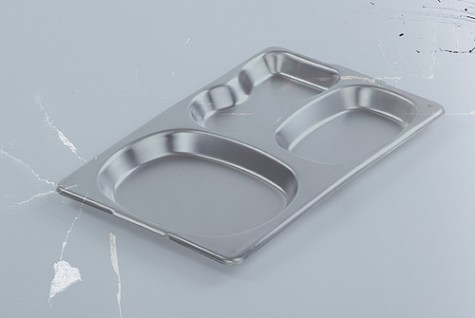
Haeftling (translated as ‘Prisoner’) employs inmates across Europe to manufacture clothing and housewares inspired (they say) by prison life, “The garments are highly functional and have a classic and timeless cut. Only high-grade, rugged fabrics are used in manufacturing.”

Well, whatever you say. I actually don’t mind how they market it, I am just pleased they support prison reform, the abolition of the death penalty, political prisoners rights and a philosophy of rehabilitative justice.

Haeftling Tray

Haeftling Tray

But let’s not kid ourselves. This project was borne of commercial interests. “It began in the JVA (Justizvollzugsanstalt/prison) Tegel and developed into an international undertaking. More and more prisons have joined and today production is even taking place elsewhere in Europe. One Bavarian prison supplies honey from its own two colonies of bees; a prison in Switzerland even has its own vineyard and exports its own red (Pinot Noir) and white wine (Müller Turgau).” (source)

Karola Schoewe, Haeftling’s PR & communications manager says, “On the whole, the prisons are all very helpful,” says  “There are some prisons that have very good production capacities for making homeware.”

Schoewe then marries the business speak to social responsibility speak, “Through its production, Haeftling is creating measures that help to support rehabilitation processes.”

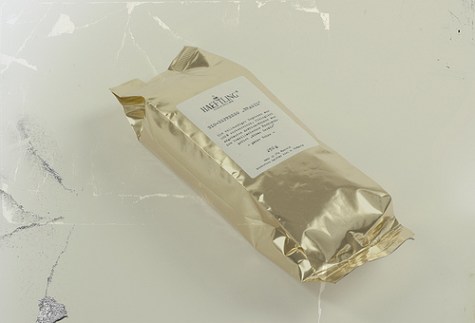
Haeftling Espresso

Haeftling Espresso

Without seeing Haeftling’s account-books or sitting in on a board meeting, I have no way to tell if resources and profits are divvied up in a way that benefits prisoners more then in the state run prison industries. This was the situation in July 2003

With 40% of Tegel’s prisoners unemployed, the Haeftling project has come as a welcome boost to the jail. The prisoners get an allowance of €26 a month, but ones working on the clothing line can earn up to €12.50 a day. The cash from the sales is divided among the bankrupt city of Berlin, the prison and the inmates.

(Author’s Note: €12.50 is substantial pay compared to American prisons.)

Prison industries are a divisive issue. For some they are the perfect use of prisoners’ time and energies developing job skills, work community & self-esteem. To others prison industries are a modern slave labor exploiting societies’ self-created incarcerated class.

Both viewpoints have legitimacy, but the first makes a prior assumption that could be misleading – that work programs are the only means to provide skills, community or self-worth. Education does this too.

But educating someone instead of putting them to work is going to cost a prison authority rather than generate it wealth.

Male

Generally, I am unnerved by the disconnect between the reality of incarceration and its representation to consumers,

Shoppers at the Haeftling store can have Polaroid mug shots of themselves made, holding a plaque with their names spelled out in white block letters. The stereo system plays the soundtrack of the Coen brothers’ prison film “O Brother, Where Art Thou?” And customers browse through racks of striped jackets and shirts.

Then again, Klaus-Dieter Blank, of Berlin’s Tegel Prison states the success of the label’s online store has meant that people are beginning to understand “what goes on behind the walls”. Haeftling features on the Tegel Prison website.

Is there too much space here for consumers to create their own version of prison life? What is included and/or played down in the minds of consumers? Are they being coerced and sold a disingenuous view along with that ‘rugged’ product?

Blanket

"Justiz 82" Scratchy Blanket. Haeftling Product

We can assess this a number of ways – rehabilitative worth, public awareness worth, benefits to state finances, tax-payer savings, external benefits of development in social entrepreneurship.

But essentially, we must ask, “Does this enterprise help reduce prison populations by reducing recidivism? It MUST be compared to other rehabilitative programs. The purpose of prisons the world over should be to create societies where prisons are no longer necessary.

How do you judge this type of enterprise?


Tina Schula, from the 'Ratline' series

Tina Schula, from the 'Ratline' series

Harlan Erskine contacted me this weekend.

At the moment there are some MFA exhibitions at the blockbuster schools. Before you read this look over Daniel Shea’s neat run down of SVA, Columbia & Yale photography grads.

As concerns Harlan’s graduating class at the SVA, here’s five picks:

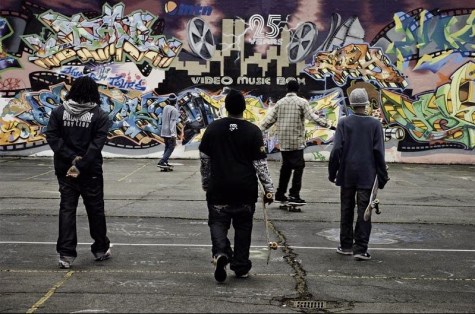
Carlos Alvarez Montero for his street portraits, but more so for his meld of youth, friends & skating.

Carlos Alvarez Montero, from the 'Harlem Shuffle' series

Carlos Alvarez Montero, from the 'Harlem Shuffle' series

Maureen R. Drennan for her sophisticated restraint down at a marijuana farm.

Maureen R. Drennan

Maureen R. Drennan

Jessica Bruah because I think she takes a lot of shots and edits well. You don’t just “come across” the subjects Bruah photographs.

Jessica Bruah

Jessica Bruah

Scott Houston for a harsh, harsh and close view of meth and people … together. And for proof in the argument that captions are essential; providing caring and careful context for image.

Scott Houston

Scott Houston

Tina Schula gets a double shout out for two weird series. Ratlines (very top) is creepy & suspenseful. Oskar’s Sister (below) is playful, offensive & menacing.

Tina Schula, from the 'Oskar's Sister' series

Tina Schula, from the 'Oskar's Sister' series

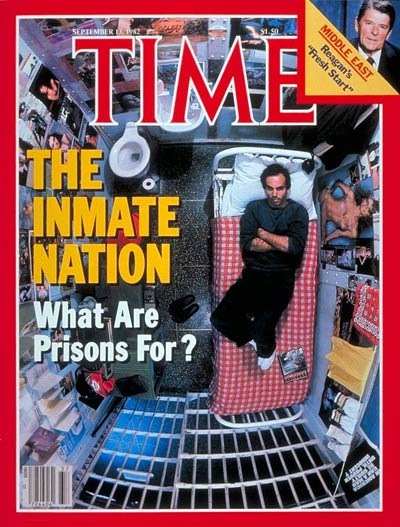
I recently came across this 1982 Time Magazine cover. It immediately reminded me of Juergen Chill’s Zellen series that I blogged about some months ago.

Time Magazine Cover, September 1982

Time Magazine Cover, September 1982

The early eighties signal the end of innocence for America’s criminal justice system. Reagan ushered in an era of extreme punitive sentencing and the most rapid prison expansion of any democratic society ever. That said, you’d hope that with 27 years experience under our belts we’d have some firm answers for the 1982 journalist, huh?

© Juergen Chill

© Juergen Chill

View all Monday Convergences

I don’t envy Chris Parks. If, according to him, he was never in the military (which I believe), then he got a pretty rough ride when stepping back on US soil. This week, the busiest and best free newspaper about went with The Accidental AWOL, a story on Chris Parks.

Chris Parks by Kelly O. in the Stranger

Chris Parks by Kelly O. in the Stranger

The interesting thing about Parks’ story is his processing through multiple legal stages and sites. He was held by other state agencies until he could be accommodated at Fort Knox military base and was then just dumped into the daily military procedures that keep recruits actively docile. And he’s in that until the military realise they’ve lost much of the pertinent information to the case.

In italics below I have quoted author Jonah Spangenthal-Lee directly, but added my own subheaders.

Charlotte Douglas International Airport, NC (Time Detained: “Several Hours”)

Parks had been heading back to Seattle after a trip through Central America with a group of friends. As he passed through customs at Charlotte Douglas International Airport in North Carolina, agents from the Department of Homeland Security, pulled Parks out of line, handcuffed him, and detained him for several hours before taking him to the Mecklenburg County Jail without a word as to why.

Mecklenburg County Jail (One Week)

Parks spent a week in the county jail. After two days, he found out why: At customs, a computerized database had flagged Parks as an AWOL U.S. Army soldier who’d been missing since 2002. Because of his “fugitive” status, he would eventually be transferred to the personnel control facility at Fort Knox. The problem: Parks says he was never in the army.

“Years ago, I signed up to enlist in the army,” Parks said. “Before I actually flew out to basic training, I talked to my recruiter and explained to him I didn’t want to go.” He was just out of Freeman High School in Rockford, Washington—a suburb of Spokane—at the time and had been drawn in by the offer of a $10,000 signing bonus. But ultimately, he says, “All I wanted to do was just snowboard and screw around and be a kid for a while.”

Fort Knox’s personnel control facility (Two Weeks)

Parks was sent to Fort Knox’s personnel control facility, where his head was shaved and he was issued fatigues and a blanket, given a bunk, and instructed not to talk to any of the women in the facility or other soldiers on the base. “I basically had to play army,” Parks says. “You have to fall in and stand in line. I had no idea what the hell I was doing.”

After a total of three weeks, Parks was released with little explanation. And after three weeks of procedural but unjust detention due to bureaucratic failings, the military are still going to send Parks the bill for his flightfrom Charlotte to Fort Knox! And his head was shaved …

graville5

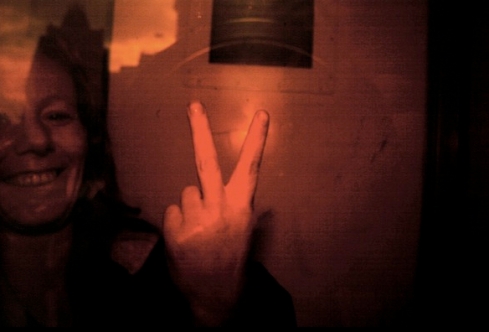
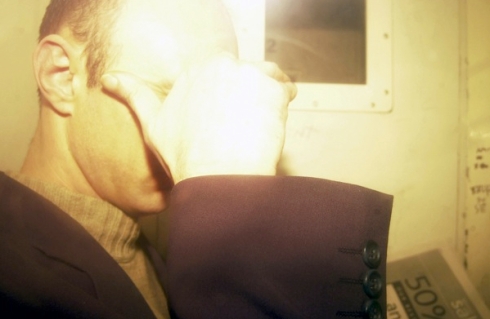
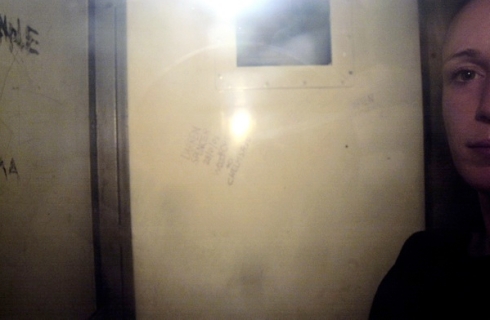
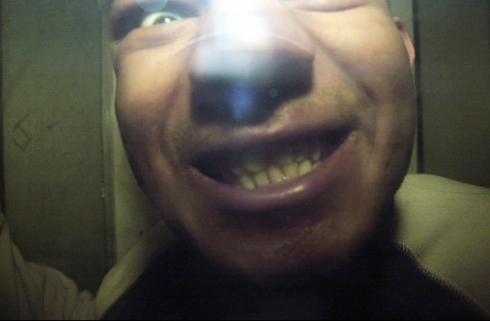
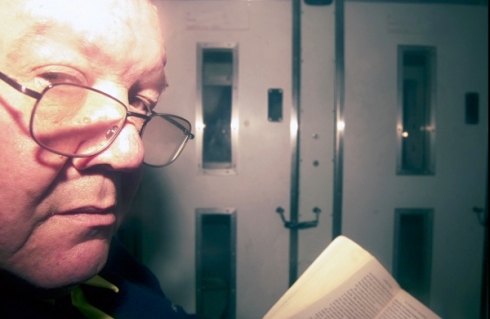
I grinned ear to ear yesterday when Foto8 In & Out the Old Bailey ran Ben Graville‘s work of remand prisoners (and security guards) in reaction to the press camera up against reinforced glass. It is a novel, clear and entertaining project. Why did it take someone so long to put a series like this together?

If photography is – in cases – intended to plumb the human soul and aggressively seek out human frailty, pride, conversion, obstinacy, etc., then the back of a cop-van is probably a good place to start. Folk on their way to trial are going to have a lot to say about a) their charge b) their case c) everything else that the first two don’t cover.

James Luckett over at consumptive coined the term “Photo booth from Hell” and he’s right on the money. They sit in a big white box subject to a camera behind a small glass rectangle. The environment is claustrophobic, impersonal and germy.

If a prisoner has the forethought or experience they may ready him or herself for the photograph. If not they’ll be captured on film anyway.

graville2

graville3

How balanced is the interaction between camera and subject? The image will serve the media more than it will serve the balance or accuracy of the court case. But this is a truism.

Graville is interested in state enforced anonymity and the effect it has on mystifying and intensifying understanding;

The long process and dark grim historical nature of criminal law was the starting point of these pictures, highlighted through the anonymity of the remand prisoners hidden away from public view – not through choice but a decision made by authorities to potentially alienate the prisoners further from society. You can often hear remand prisoners banging on the window of the van to attract attention. This desire to be heard or seen is manifest in these photos, showing how the processes of criminal law mystify and intensify situations as the prisoner travels between the remand prison and the Old Bailey.

It should be no shock that many prisoners perform, gurn and address Graville’s camera directly; they are – literally and legally – in a transitory, undecided state. If I was in this same situation, I think it would be a natural reflex-come-obligation to self-represent to the camera. These prisoners may not have chosen to have the camera in their space, but they have the choice of how to address it.

graville1

… and of course there’s always a security guard who gets in on the action.

graville4

Copyright: Angela Shoemaker

Copyright: Angela Shoemaker

Angela Shoemaker, visual journalist and graduate of The School of Visual Communication at Ohio University, informs us, “Ohio Reformatory for Women (ORW) nursery, one of four such programs in the U.S., offers a unique opportunity for female inmates to keep their babies while serving out their prison sentences.”

Angela has also produced Prison Nursery: Keeping Mothers and Babies Together in an audio slideshow format Prison Nursery.

melaniacomoretto_001

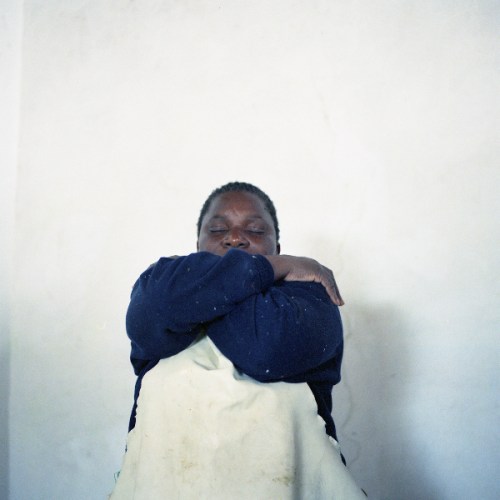
I wouldn’t describe Melania Comoretto‘s portfolio Women in Prison as portraiture; it’s bigger, it’s emotional landscape.

Comoretto’s work tinged with sadness, possibly even resignation. Their circumstance may have dulled outward looking expectancy.

This work stands out, for me personally, as one of the finest photographic documents of women prisoners, globally. Women in Prison is charming and disarming. These are women whose words would likely shock us and yet they seem to know the weight of their own stories and captive futures. The reticence of Comoretto’s subjects, paired with the arresting gaze (when given), is a triumph.

comoretto

Q&A

Where is this prison?

I photographed in two Italian prisons in Rebibbia and Trapani.

Why did you do a project there?

I wanted to investigate and understand how women could express their femininity and take care of their body in a situation of extreme marginalization.

The starting idea was to reflect the mental and psychological labyrinths and internal prisons that prevent human beings from living their lives freely. I asked myself, “What could be the extreme expression of this idea?” The answer; Prison.

What were the women’s lives like? Was their prison experience positive or negative?

The way the women live in prison depend on the prison in itself and how it is organised. It also depends on the personality and psychological attitude of the woman.

Most of them fall into depression; others react in a very active way. The body is the mirror of that. The more a women fall into depression the more she forget to take care of her body, that was the reason why I decided to focus on bodies and femininity.

Where are the women now?

Most of the women are still in Rebibbia and Trapani prisons. I shot this series of photos only in the last 10 months.

melaniacomoretto_002

Were the women good portrait subjects? Did they want to be photographed?

They were very willing to speak and to be portrayed! They liked to spent time with me. They rarely have the chance to speak with someone who wants to listen deeply their stories.

Did they see your photograph prints?

I sent them each contact sheets.

In Italy what is society’s attitude toward prisoners and, specifically, female prisoners?

Unfortunately, in every city and country of the world, the social attitude towards prisoners is not very open-minded. They [societies] focus on the fact that prisoners are guilty and rarely on the fact that (in the majority of cases) that they had no chance because their lives started in very tragic conditions. Without any help it is very difficult for prisoners to change their destiny.

What was your experience on the project?

I understand how in some situations life does not leave you many chances to change.

Can the camera be a tool for rehabilitation?

I deeply believe it is. I don’t know if photography could be a tool of rehabilitation for the women. For me it was and is … so maybe [the camera] could be for them and for many other people. It prevents me from destroying myself and I believe it could have the same advantage for many other people!

melaniacomoretto_0010

melaniacomoretto_0018

melaniacomoretto_008

melaniacomoretto_0012

melaniacomoretto_0020

melaniacomoretto_009

melaniacomoretto_007

melaniacomoretto_0019

Polk Prison 09rgb

David Simonton contacted me and shared his long term project at the former Polk Youth Center in Raleigh. After thoughtful discussions David and I decided upon a pairing of articles.

In this post, Part One, David talks about the background to the project and his objectives in the work.

I also chose a selection of David’s prints to showcase and offer comment. At the bottom is a thumbnail-pop-out-gallery with all the pictures in one place.

…and, in a few weeks, Part Two will dissect the atypically rich and varied visual-history of the Polk Youth Center.
Polk Prison 08rgb

Polk Prison 02rgb

David Simonton’s Commentary (PP’s Subheaders)

Photographing Disused Architectures of Citizen Management

In the late-1980’s I was one of a number of photographers working on Ellis Island, the former Immigration Station in New York Harbor, documenting the progress of the restoration of the facility (reopened to the public in 1990).

The project was called “The Ellis Island Project: Documentation/Interpretation.”  I was living in New Jersey at the time, and traveled to the island to photograph twice a week for nine months. During this period I was also pursuing my personal projects.

Polk Prison 15

Opportunist Photographer

In 1989, I moved to North Carolina

The “Old” Polk Youth Center/Prison, Raleigh which has a long and storied history, closed in 1997 when a modern facility (which the “Old Polk,” most assuredly, was NOT) opened in Butner, NC. The inmates were transferred to Butner in November of that same year.

Living nearby, I could hardly resist the opportunity to photograph there. So before any “No Trespassing” signs were posted, I went and photographed the site. The doors (cell doors, some of them) to many of the buildings were wide open!

“Old” Polk Youth Center – a euphemism if ever there was one – was located on land directly adjacent to the North Carolina Museum of Art in West Raleigh, near the State Fairgrounds.

The prison buildings were razed in 2003. But before that occurred, the prison was essentially abandoned until the land (along with the buildings on it) was transferred to the museum.
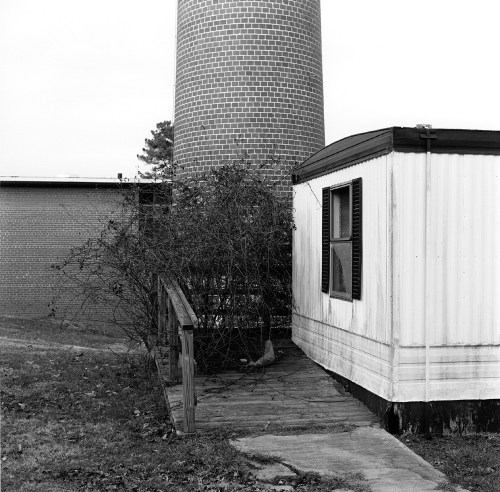
Polk Prison 13rgb

Official Photographer

During the mid-nineties, I exhibited my personal, interpretive work from Ellis Island – 90 images – at a gallery in Raleigh. Huston Paschal, a curator at the state art museum, attended the exhibition.

Unaware that I had already photographed there, Huston Paschal invited me to document the site, which was now in the museum’s hands. In late-2000 the invitation was formalized with a commission. I continued working on the project (even after the commission had lapsed) until the buildings came down, the ground leveled and grass planted.

My involvement was always with an empty site, when the prison was closed and inmates transferred. I photographed a long-abandoned facility: empty buildings, empty cellblocks and overgrown grounds.

Polk Prison 06

Simonton: “Art for art’s sake”

As an art photographer (an unfortunate, nearly pretentious-sounding term, even if it’s the category my work falls into), my goal is to make interesting pictures; interesting in-and-of themselves, so that THEY are worth looking at, repeatedly.

What’s depicted is not unimportant, but it’s of secondary importance; this is my approach to my own picture making. The fact that my “subject” was a prison is happenstance – I photograph all kinds of abandoned structures. I also photograph the smalls town North Carolina (day and night) and photograph landscapes. An interesting photograph is always my intent, even when what it depicts is not itself inherently interesting … or beautiful.

Polk Prison 14rgb

Art and Documentary converge.

The Polk project was a “documentary” project, but not in the strict sense of it being wholly objective. My pictures describe the place I saw, and, if not the place I “saw”, then the place I thought and felt.

The project is not a comprehensive cataloging of the site either; rather, the pictures reflect my response to it during the passage of several years.  They inform history by showing the place as it was in those waning years, after being – at long last – set aside as a relic; finally to be torn down and planted over and – with still more time – forgotten.

Polk Youth Center was located in a heavily populated area, which was not the case when it was built. Improvements were rarely made because, why spend money on any improvements if the facility was about to be moved or closed? – as were the recurrent promises for decades.
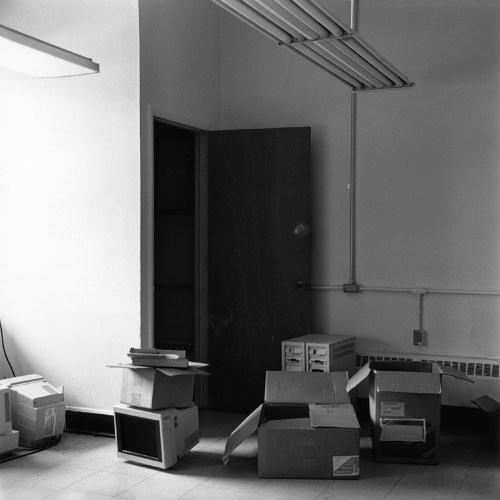
Polk Prison 16rgb

Institutional Narratives

I was not aware of the prison or the prison sites history until after I had completed my work; which may be just as well, since it was difficult enough to find beauty in such a physically “unbeautiful” place.

Had I been mindful of the ugly history of the old Polk Youth Center – riots, rape and other forms of violence in its final years, – I may have had a harder time photographing.

Polk Prison 01rgb


Prison Photography’s Commentary

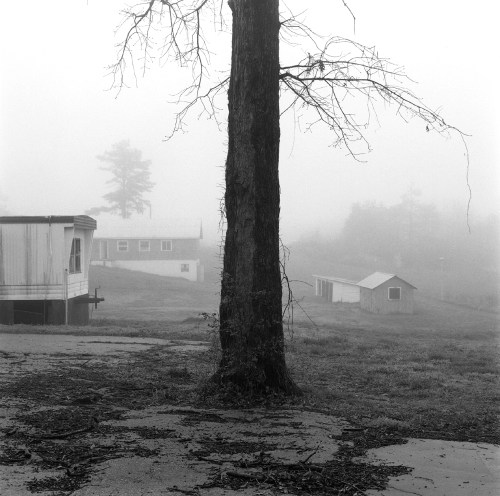
Simonton’s three years at Polk yielded a varied portfolio. In editing the selection (from 100+ images to these 16) images distinguished themselves for very different reasons. If the lens wasn’t pointed at something crumbling, it was pointing at something overgrown and grown over.

Some images (Steep Steps) are flattened and exposed matter-of-factly, whereas others (Laundry Bin) luxuriate in silvery sheen.
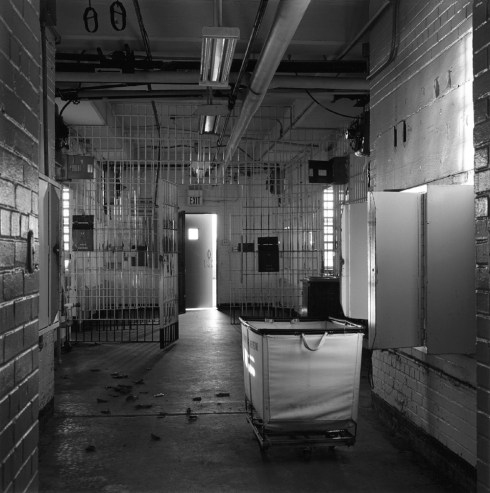


Polk Prison 12rgb


I choose one pairing here of the same view in different season; Simonton took many pairings so to secure the evidence of time in his series. Apparently, the chimney was a signature of Raleigh’s landscape.

Polk Prison 17rgb

Polk Prison 18rgb

It is in the different states of dilapidation that one finds a visual allusions. Simonton’s photograph of the teeth counterpoise the dental ephemera in Edmund Clark’s photography of a functioning geriatric UK prison wing. When given the opportunity, Simonton ties the fragility of the body to the decay of the site.

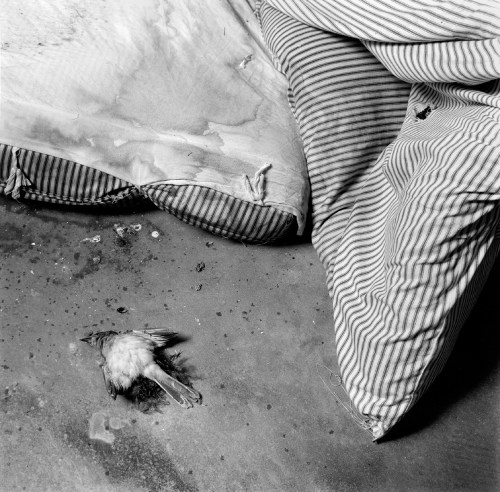
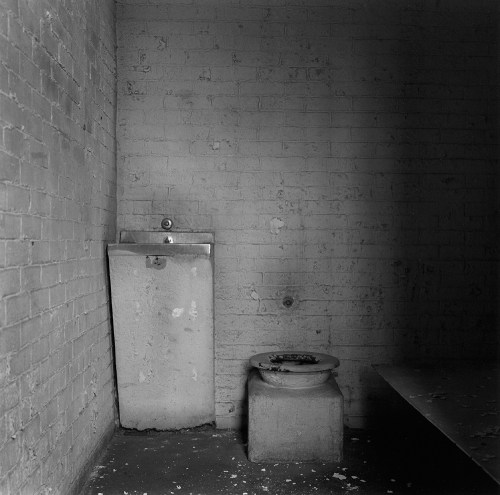
Other recalls. Simonton’s cavernous grimed up cells, the expired bird, the textural friction between hard concrete and friable life are not too dissimilar to Roger Ballen. The reflected dormitory of cacophonous bed frames is a Moholy-Nagy-informed dark-fantasia march of welded steel.
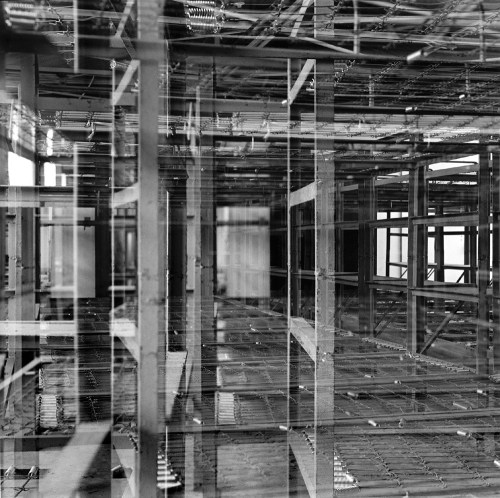
Polk Prison 07rgb

Only a few of Simonton’s images describe the site as one of incarceration. Few of the normal visual clues are available; no visible bars on windows, no holding cages. This could as easily be a disused YMCA or summer camp.
Polk Prison 03rgb

For Prison Photography, the real interest in Simonton’s work comes when it is positioned in a wider context of the site. David provided me with background info and some press clippings which whetted my appetite. Further research was rewarded with an unusual series of photographic manoeuvers sequentially on this site through its various guises. All of this I will cover in Part Two.

Closure & Erasure

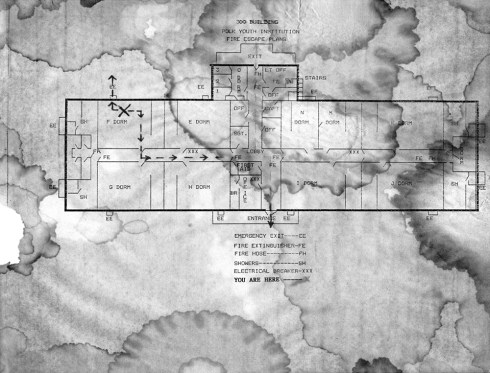
The photo of the evacuation plan below touches upon that procedural rigour that has cycled at the site of the former Youth Polk Center. The image at the very bottom (as well as being Simonton’s favourite) is a fine accompaniment to the evacuation plan.

Both images bear evidence of water blistering, bubbling and staining its way through materials. These evocations are “Art for Art’s sake” but they are also poetic closures, historical records and proof that in the absence of human interference erasure sets in rapidly.
Polk Prison 20

Polk Prison 19

David Simonton has been a photographer for 40 years and has been photographing North Carolina for the past 20 years. An adjunct instructor of photography at Peace College in Raleigh, David often chooses to focus on the more rural parts of the state. His series “Photographs from North Carolina” features black-and-white photographs from the 345 North Carolina towns he has visited. He has completed commissions for the North Carolina Museum of Art and the United Arts Council of Raleigh and Wake County. He has had work in solo and group exhibitions throughout the United States, and his photographs are in the permanent collection of the North Carolina Museum of Art. David was awarded a visual artist fellowship from the North Carolina Arts Council in 2001. (via)

View other images at David Simonton’s website. Indyweek have written on his work previously.

Thank you to David Simonton for reaching out. Thanks for the time spent over questions and for your collaboration. Pleasure working with you.

EMAIL

prisonphotography [at] gmail [dot] com

Prison Photography Archives

Post Categories