LONDON, UNITED KINGDOM - 15.06.08. A Metropolitan Police Forward Intelligence Team (FIT) photographer films and photographs journalists as police and protesters clash during a demonstration against U.S President George W Bush in Parliament Square, Westminster on Sunday 15 June 2008, London, England. Protesters had been banned by the Metropolitan Police from demonstrating outside 10 Downing Street to protest against the wars in Iraq and Afghanistan. (Photo by Marc Vallée/marcvallee.co.uk) (c) Marc Vallée, 2008.

LONDON, UNITED KINGDOM - 15.06.08. A Metropolitan Police Forward Intelligence Team (FIT) photographer films and photographs journalists as police and protesters clash during a demonstration against U.S President George W Bush in Parliament Square, Westminster on Sunday 15 June 2008, London, England. Protesters had been banned by the Metropolitan Police from demonstrating outside 10 Downing Street to protest against the wars in Iraq and Afghanistan. (c) Marc Vallée, 2008. http://www.marcvallee.co.uk

After reading this phenomenal post by Jamblichus about state surveillance and electorate apathy/powerlessness in the UK, I was compelled to post the above image.

I know for two posts now in as many days I have diverged from “photography in sites of incarceration”, but this topic keeps throwing up unanswered questions.

Forward Intelligence Teams , introduced in 1996, are now central to British policing of all public crowd events. F.I.T.s don’t try to hide. They are highly visible and operate use facial recognition technology to add folk on camera to a central database.

Jamblichus raises a really important question about this. What is the nature of this database? We should all be asking these questions: Under who’s authority is the database maintained. Which government departments have access to it?

Local councils in Britain have used anti-terrorism legislation to spy on its citizens for minor infractions. What is to stop similar abuse with regard this database? The UK has built a police state infrastructure and no-one is immune to its effects should the cameras and mics be pointed their way.

Is the British Press “free” in all definitions of the term? I think not.

I am probably in the database due to my interest in a seal-hunting protest outside the Canadian Embassy of London last year. I went over to have a peek and a natter, mainly because I was shocked that anyone would want to picket Canada! When I turned to continue on my way, I had two long-range lens pointing at me.

Jamblichus points us to The Journalist which describes the Met’s purposeful surveillance of the press;

Police tactics seem to be becoming more menacing. Photographers have complained that the Metropolitan Police’s Forward Intelligence Team (FIT) — set up to target public disorder and anti-social behaviour by having high-visibility police officers use camera and video footage to gather intelligence — has started surveillance of press-card carrying journalists. They say that images of them are given a four-figure “photographic reference number” and held on a database.

I’d really like to know when they’ll need 5 digits or more!…. While we wait on that you can look over the Flickr group FITWatch.

Munkhbayar is the director of the women's prison just outside Ulaanbataar, her background is in Law. © Grace Gelder

Munkhbayar is the director of the women's prison just outside Ulaanbataar, her background is in Law. © Grace Gelder

Grace Gelder is building a portfolio with some impressive images. She graduated with an MA from Bolton University in International Photojournalism , Documentary & Travel Photography. I am chuffed to promote her work because Bolton is one of many mid-sized cities of England’s Northwest that has been the brunt of dismissive attitudes during my childhood and adolescence.

The University of Bolton is helping reshape those ill-informed attitudes and building a reputation for its photojournalism department. This is helped by its partnership with the Dalian College of Image Art, China. Which helps to explain how Gelder came to work on her far-flung series Professional Mongolian Women. Mongolia is just next door, right?

As the Metro puts it, Gelder “counteracts misconceptions of Mongolia as an under-developed country. Her series of striking colour portraits, each depicting one woman in her professional context, follows up a UN report last year that placed Mongolia first in a league table for women’s participation in the workforce.”

I think particularly with her portrait of Munkhbayar, Director of the women’s prison just outside Ulaanbataar, Gelder succeeds in quashing stereotypes that exist regarding Non-western nations, Mongolia itself, and women in those societies. I am just glad Gelder had a prison warden as one of her subjects; as to provide me an excuse to promote her well-informed work. I recommend reading Gelder’s own description of gender relations and equalities in Mongolia.

(Via PhotoMABlog)

London Metropolitan Police Anti-Photography Propaganda Campaign Poster

London Metropolitan Police Anti-Photography Propaganda Campaign Poster

When I began writing this blog, it was meant as a vehicle to display the documentary work of photographers working in sites of incarceration and to generally expound the stories touched upon. It was also meant to deconstruct some of the persistent myths surrounding prisons and prison populations and how visual culture has played its part in weaving some of those myths.

Not once did I envisage the current situation whereby the act of photography could bring about the threat of detention and imprisonment. Such impingement on basic rights of expression has been known in some of the dictatorial and despotic regimes of modern history … but not so much in the West, right? The times they are achangin’.

Photo: Liam Oliver Newton Craik-Horan. http://www.flickr.com/photos/liamch/3423810669/

Photo: Liam Oliver Newton Craik-Horan. http://www.flickr.com/photos/liamch/3423810669/

When my brother visited from the UK last month he couldn’t stress enough how much of a police state it has become. We reasoned that the fingerprints taken by US homeland security are know also the possession of the UK government. It used to be the case that fingerprints were only taken and kept on file in the UK if you had been convicted for a crime. How things change.

A few months ago I signed up as a member of ACLU, the decisive moment was when the ACLU representative said to me, “You don’t want the US turning out like Britain with all those cameras and surveillance do you?”

Britain really is a country that has got itself on edge; it’s culture promoting men and women in all guises of security to exert illegitimate power and enforce ludicrous policy. Unfortunately, this robotic application of rules has infected even our art galleries, as the venerable John Berger discovered.

This past months have seen a slew of stories coming out of Britain regarding the rights of photographers in public spaces. All these are in response to a slew of legislation to slowly whittle down the rights of photographers; the rights of UK citizens.

On 16th February, the Counter Terrorism act came into effect making it illegal to photograph a police officer or “elicit information” about them. The British Journal of Photography has the details.

After the disgust at such brazen restriction of rights, the response by the photographic community in London was to go to Scotland Yard, headquarters of the Metropolitan police, and in an act of mass civil disobedience take lots of photographs of lots of officers.

The Guardian UK has been the mainstream print media that has really pursued this topic, reminding us all of what we have just lost. They broke the story that Kent police monitored members of the press during an environment protest, for which the Kent constabulary have apologized.

The Press Gazette explained this tactic and the associated tension between police and photographers.

David Hoffman, a photographer with 32 years’ experience, said he now carries shinpads in his bag, claiming he had been kicked by police officers at protests.

“The police today [NUJ Protest] have been beautiful – but that isn’t always the case,” he said. “Recent protests have been very bad. The worst was October last year, at the Climate Rush demo. One copper spent his time kicking my leg. Stood there with his steel toe caps kicking away – and me, a silver-haired man. I’ve still got chunks missing from my legs five months on. They want you to think: I won’t cover it next time. They have been using FIT [Forward Intelligence Teams, who use cameras], they have been using intimidation.”

Hoffman added, “It’s important the police know they’re being watched and observed. If you don’t see what’s going on, your society’s less democratic.”

It is almost like the lines have been drawn so indelibly, people are having to pick a side. It is sad to see but the police fall in line with the government and the majority sympathise with the press. This has led to a conflation of stories involving the G20 protests, police misconduct, and the death of (and vigil for) Ian Tomlinson. Judging by the Guardian’s recent coverage, you’d be forgiven for thinking that London was on the edge of civic breakdown.

I think the media and the Guardian in particular are taking a principled stance here and just reminding the Met at every opportunity that they are watched and the press will not be cowed. I think most of us realise that with millions of people in possession of recording equipment it is unenforceable to stop people from documenting the streets.

Ian Tomlinson’s death received a lot of coverage and rightly so, but I shall wait for the inquiry ruling before making a call, despite the early damning evidence. We, however, in the business of images know that they can never tell the full story. This is now an investigation of excessive force by the police and distinct from the main issue of photographers/civil rights.

Yesterday, the Guardian published this footage of the police threatening photographers with arrest if they did not move. Again, later the force apologized. But what is interesting here is the Guardian‘s decision to line up video footage of various scenes of confrontation from different days in the right hand nav bar. It is a dossier of police activity and unlike anything I have seen in mainstream media.

Photo: Roger Lancefield. The protesters stickers read "I am not a Terrorist, I am a Photographer". http://www.flickr.com/photos/rlancefield/3285904973/in/set-72157613975803636/

Photo: Roger Lancefield. The protesters stickers read "I am not a Terrorist, I am a Photographer". http://www.flickr.com/photos/rlancefield/3285904973/in/set-72157613975803636/

From the sublime to the ridiculous, the Guardian showed that front-line press aren’t the only ones under scrutiny. Metropolitan police deleted a tourist’s photographs this week to “prevent terrorism”. Klaus Matzka, the tourist involved summed his experience up as such:

“I’ve never had these experiences anywhere, never in the world, not even in Communist countries.”

So, at best you are harassed for your photographic activity and at worst, if thought to hold sinister motives, arrested and face a 10 year sentence.

Before all this gets to any court, however, the clashes are felt on the street, on the shins and in the constantly diminished rights to freedom of expression. Where citizen photographers may feel powerless, it seems the press – and the Guardian in particular – are just getting powered up.

_________________________________________

Thanks to all the Flickr users credited above for their images, but more importantly their acts of documentation in the face of legislation to prevent such freedoms. I hope we all stay out of prison.

godfather2

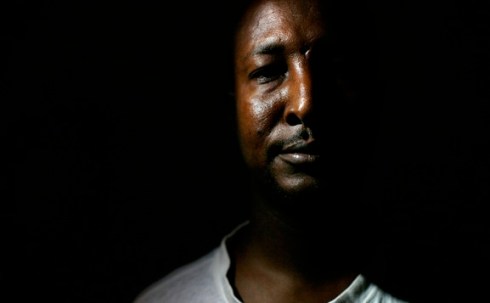
When Jehad Nga’s photographed Somali pirates it was at a time when frigates not people were perceived as the main victims of their contemporary skull-duggery. It was also before American military engagement and the associated global media entered the fray

The main reason I focussed on Nga’s work back in December was because his pirate-subjects were imprisoned. Nga’s work at the time was featured in Time Magazine and The New York Times and I’d be lying if I wasn’t part of the consuming public that took more notice of the pictures than the politics.

ngapirate1

ngapirate21

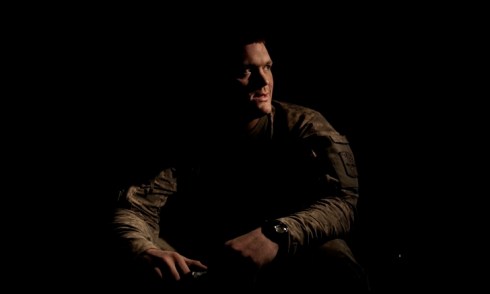
Since the close of 2008, activities in the Gulf of Aden have ramped up. So has Nga’s career; in photojournalist terms he unleashed another blockbuster this week with his portraits of US Marines in the New York Times. I’ll confess – I’m a sucker; I think Nga’s Chiaroscuro portraits are irresistible. My only problem is that the same aesthetic has been put in place by Nga and I am left confused.

nga1

nga2

nga3

Nga described the jails in which Somali pirates were kept as dark and dank, so his visual language makes sense when working in that context. Has he made multiple photo essays of high contrast, using vibrant colour-schemes and dark negative space. Nga, has to my mind, forged himself a visual brand.

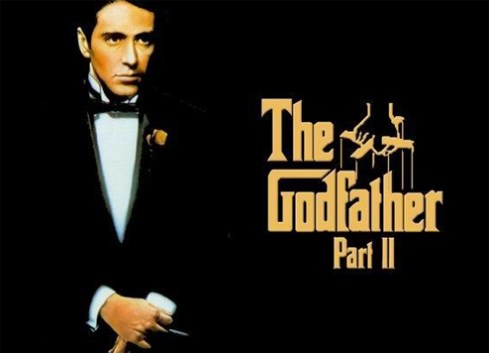
What is the end result of this? Is Nga just playing a longview game, in which his brand sustains longer than the stories? Is Nga just giving the public the cinematic frames it has lapped up previously? Is it problematic that he gives the same treatment to the ‘vilified pirates’ and ‘patriotic heroes’ we’ve seen in the newspapers this week? Are my queries unfair. After all one man’s terrorist is another’s freedom fighter. One man’s criminal is another’s political prisoner. Is it even Nga’s place to distinguish, or use visual devices to shape viewers’ thinking? We’d do well to remember Brando and Pacino played great villains, but they were villains we loved to hate.

What do you think? Do you contemplate the character of a subject differently when it is struck by bright pockets of light if it is an American soldier or Somali pirate? How do you reconcile that?

brando

All images, except the Godfather II and Apocalypse Now still (final image) ©Jehad Nga.

© Patricia Aridjis

"Karla Liliana" 2005. Women's Prison "Reclusorio Oriente", Mexico City. © Patricia Aridjis

Patricia Aridjis spent over seven years on The Black Hours Project. She documented incarcerated women in the Mexican penitentiaries of Santa Martha Acatitla, Tepepan, “Reclusorio Norte & Oriente” and Michoacan Prison in Mexico City.

It is not only the photographs that Aridjis uses to tell the women’s stories with familiarity and sensitivity. Aridjis also compiled a video archive and a correspondence archive; I urge you to listen, read and pause.

I contacted Patricia and she generously gave permission to publish works from The Black Hours. It gives me great pleasure to do so, as her motivation bear striking similarity to a core principle of Prison Photography; to present imagery that jolts viewers into reassessments about prisons and the lives and stories therein.

Aridjis has been described as one of the photojournalists most committed to social issues in Mexico. It has also been explained that this project was a point of revelation in her career; Aridjis [coming to] understand prisons as only reflections of outside society:

The female penitentiary is more than a place where society hide its errors and cleans its faults; inside there are hundreds of stories of abandonment, abuse and even love.

Exhibition Board, Nacho Lopez Hall, INAH National Photographic Library

Aridjis’ photographic philosophy is clear, “To Make Visible, the Invisible”. Mexico’s penal system exerts control over what can and can’t be seen mimicking the practices of parts of the American penal system.

© Patricia Aridjis

© Patricia Aridjis

© Patricia Aridjis

© Patricia Aridjis

Photographers Statement

To do this photo essay I thought about being for long hours inside some women’s prisons in Mexico City. I considered that that was the only way to capture the feelings that go around the cells and corridors of these places. Loneliness, lesbianism as a way of satisfying affective needs; self punishment and suicide attempts are like gaping wounds in the wrists that cry for help. Drugs to escape reality, maternity, solidarity. Life is limited by watching towers, guards, gates and schedules. The black hours. My commitment found its exact words when I took an inmate’s picture in her cell. She asked me to be photographed because that was to be her only way out of there.

Patricia Aridjis, Mexico 2004

© Patricia Aridjis

© Patricia Aridjis

"Mario (Maria) and Eli" 2000. Tepepan Women's Prison, México City. © Patricia Aridjis

"Mario (Maria) and Eli" 2000. Tepepan Women's Prison, México City. © Patricia Aridjis

Where is Jail?

“What would you do if I mugged you?” Natalia asked mischievously.

“You wouldn’t.” I answered. When Juan Carlos the inmate’s five-year old son over heard us he screamed, “Don’t do it mom! Don’t! Or you’ll end up in jail!”

“Jail does not exist.” she said after a brief silence.

“Where is jail?” I asked the boy who was inside his mother’s cell. “Outside, where the policemen are” he answered, pointing out to the window.

Talking with Natalia & Juan Carlos
Womens Prison, Tepepan, Mexico City, 2002.

© Patricia Aridjis

© Patricia Aridjis

Time

To enter you have to walk through a long tunnel which leads to an almost completely feminine world, a world with no living colors, but beige and navy blue of the uniforms.

“I have been here seven years, four months and two weeks.” Exact, endless counting. Time that passes slowly and suddenly has turned into years ‘the black hours’.

Visitors are special; they are a breath of fresh air, freedom that comes from the outside.

"Cereso", 2004. Mil Cumbres, Prison Michoacan, Mexico. © Patricia Aridjis

"Cereso", 2004. Mil Cumbres, Prison Michoacan, Mexico. © Patricia Aridjis

Children

Some children have been born inside and their eyes have not seen any other light than the one that passes though the bars, especially those that have no one to take care of them. If such is the case they remain under the custody of government institutions until the legal system says otherwise.

“Dulce, Why are you in for?”
“Drugs.”
“How many years did they give you?”
“Ten.”
“Where did they get you?”
“At the airport.”
“How much did you have on you?”
“Two kilos.”
“What is your cause?” [sic]
“My mom… Maria.”

These are the words that Dulce, a four year-old girl memorized. She was born during her mother’s conviction.

© Patricia Aridjis

© Patricia Aridjis

Objects, People, Spaces

Objects acquire a different value once they pass through the gate. Either because they are not allowed, such as scissors, perfumes in glass bottles, mirrors, or because they are outrageously expensive, like soap, deodorant or toilet paper. A phone card is like gold; the telephone is one of the few ways to keep in touch with the outside world. Family visits are another, but it is common that their partners or even their closest relatives abandon the inmates.

Beds have to be earned. Each cell houses about 15 inmates and is no more than 9 square meters. There are people sleeping on the floor and under the beds. As they leave, the ones that have been there longer get the beds. Other way to obtain this privilege is to buy it from someone who has been there more time.

© Patricia Aridjis

© Patricia Aridjis

Love in the Time of Jail

Silvia and Claudia met in prison, they fell in love. They have loved each other night and day … intimacy is a very public thing in prison. Silivia did her time, soon after the relationship began. She could not bear to be free without Claudia – the love of her life – and planned a simulated burglary. She asked a friend to press charges so that she could be in prison again, and together again with Claudia.

"Silvia and Claudia" 2004. Women's Prison, "Reclusorio Oriente", Mexico City. © Patricia Aridjis

"Silvia and Claudia" 2004. Women's Prison, "Reclusorio Oriente", Mexico City. © Patricia Aridjis

Biography

In 2006, Aridjis obtained the sponsorship of Revelaa Spanish organization which supports social justice photography. In 2002, she received a Grant for the Encouragement of Cultural Projects from FONCA (National Fund for Culture and Arts). That same year she won 1st place in the Anthropological Photography Contest awarded by the National School of History and Anthropology. In 2001, she received 1st place in the 5th Biennale of photojournalism. In 1994, Aridjis obtained a Grant for Young Creators (FONCA). She has been part of over sixty group & solo exhibitions.

Aridjis has recently been praised for her project The Sickness Behind Every Flower, which examines the use and toxic side effects of pesticides in agriculture.

98 prisoners are kept in a cell measuring 25 square meters originally designed for 16 inmates. The longest-serving prisoner in one of these cells has been there for 5 years. The prisoners are locked up for crimes as varied as non-payment of alimony to murder. The long-timers sleep in hammocks up high, the newcomers on the floor. Temperatures reach 50 degrees celsius in the summer. The prisoners are the poorest members of society, have poor legal representation, and are disenfranchised from political representation as they have no vote.

Gary Knight, Private Photo Review

Overcrowding at Polinter pre-trail detention centre, Rio de Janeiro © Gary Knight, VII Agency

Overcrowding at Polinter pre-trail detention centre, Rio de Janeiro © Gary Knight, VII Agency

Originally published in Social Issues #42 last Autumn, Gary Knight‘s astonishing photography at one of the (now closed) overcrowded Polinter Prisons in Rio de Janeiro, Brazil. Polinters are temporary holding facilities used to house police detainees.

There’s a bit of back story in to Knight’s work in his interview with the Financial Times.

Two things intrigue me about this. Firstly, my research tells me this prison closed down late 2006/early 2007. Why has it taken so long for Knight’s photography to get even short coverage? Secondly, I am astounded by Knight’s answer to the question of how he secured access:

I was doing a project on poverty, and a photographer at O Globo newspaper in Rio introduced me to the governor of Polinter prison – a place with conditions so bad the governor herself was appalled. She wanted something to be done but she couldn’t really let in a photographer from a local paper. She felt more comfortable with a foreigner: I guess she thought that stories published overseas might put pressure on the government from abroad.

Can you imagine a reversal of this logic? That US prison wardens would accommodate foreign photojournalists more readily?

Knight does his part in bringing visibility to the situation, but that doesn’t affect the shut out experienced by local photographers. That said, it is a great example of the power of international photojournalist activity bringing new possibilities to bear.

Detailed information on the Polinter prisons is hard to come by. We should share Knight’s relief that the Polinter he photographed is now closed. Amnesty International mentioned it in its 2006 report on Brazil:

In Rio de Janeiro, human rights groups denounced conditions in the Polinter pre-trial detention centre. In August the unit held 1,500 detainees in a space designed for 250, with an average of 90 men per 3m x 4m cell. Between January and June, three men were killed in incidents between prisoners. Officials in the detention centre were also forcing detainees to choose which criminal faction they wished to be segregated with inside Polinter. In November the Inter-American Commission on Human Rights ordered the Brazilian government to take measures to improve the situation.

Finally, let’s consider with necessary dexterity the role that Pastor Marcos Pereira da Silva plays in all of this. He visits, evangelises, “foot-stomps”, exorcises evil and sends prisoners collapsing to the floor. Knight confesses a “real disquiet about him”. Supporters point to the fact that violence in Polinter has abated since da Silva’s visits, but Knight parries that its easy to influence the most vulnerable of groups.

I cannot bring myself to embed the video of the Pastor at work, but you can follow this link and thusly imagine him bouncing around the walls of a prison, agitating its population and putting on a show they’re not likely to witness again or even understand. I guess different eyes experience different wonder.

_______________________________________________________

UPDATE (06.01.2012): The Open Society Institute published ‪Justice Denied: Brazil’s Polinters, documentary video focusing on “the costs of excessive and unnecessary pretrial detention.”

The poor conditions are obvious. OSI describes the film as part of their broader work on “a Global Campaign for Pretrial Justice […] helping governments develop bail and supervision systems that can make pretrial detention an exception, and not the rule.”

_______________________________________________________

Gary Knight, born in England, started working as a photographer in Southeast Asia during the 1980s as Indochina emerged from bitter wars and the region came to grips with the end of Cold War. In 1993, he moved to collapsing Yugoslavia where he returned repeatedly from the siege of Sarajevo through the fall of Kosovo. Between assignments for Newsweek, he documented crimes against humanity.

After 9/11, he worked in Afghanistan and two years later independently followed U.S. troops into Iraq. He covered wars in the Middle East, Africa, Europe and Asia and other breaking news, but Knight’s central focus is on the survival of the world’s poor and fundamental human rights issues.

Knight is founding director of VII Photo Agency. He established the Angkor Photo Festival, is a board member of the Crimes of War Foundation, a trustee of the Indochina Media Memorial Foundation and Vice President of the Pierre & Alexandra Boulat Foundation.

His work, widely awarded, published in magazines, is in museums and private collections. He has initiated education programs with universities and voluntary agencies, and is the author of Evidence: War Crimes in Kosovo.

If you are going to spend time with anything though, make it dispatches, a superbly edited magazine co-founded by Kinght. It cuts to the core of the issues, the rest of us skirt from distance.

(Found via Travel Photographer)

Bilingual Signs © Andreina, IDRA/Albuquerque Public School District, Critical Exposure Photography Project

Images Unseen, Images Unknown written by a guest blogger on Prison Photography last week was well received by readers, provoking more questions and some intriguing possibilities.

Change.org offered a synopsis of the article. Change.org focused on the concluding points of Images Unseen, Images Unknown which described the culture of shame shrouding California prisons created by the control of images and manipulated invisibility.

Too many prisoners are hidden from view to serve out their time. Many prisoners refuse visits from family because they don’t want loved ones to see them in institutions that deny them individuality, work to subdue the general population, hide prisoners from society, and keep them docile.

So, the issue of self-representation and empowerment arises. Specific to my interest would be the possibilities of empowerment through photography.

Recently, Stan Banos asked me, “Are you aware of any photography programs in prison for prisoners.”

My answer, in short, is no. This doesn’t mean they don’t exist, it just means for all my searching I have unearthed nothing.

Art therapy has been explored among prison populations and recently San Quentin piloted it’s first ever ‘Film School’. The project did many things at once, teaching inmates the technical skills of documentary film making, building team work and trust; and it allowed inmates to communicate narratives of their choosing from prison life.

Inmates documented the work of the prison nurses distributing medications; filmed the prison kitchens; recorded the “wasted talent” of artists, musicians and writers within San Quentin; and studied American Islamic faith in prison.

With that in mind, we can say empowerment through the arts has been well explored and apparently successful in a number of penal institutions. However, it would seem photography in prisons has not been used as a tool for self-representation and rehabilitation … yet.

Turn Away © Stephene Brathwaite, Red Hook Community Justice Center Photo Project

Turn Away © Stephene Brathwaite, Red Hook Community Justice Center Photo Project

The model for this type of program exists. Dozens of important non-profits use photography as a means for at-risk-youth to tell their stories. Organisations such as Youth in Focus, Seattle; AS220 Youth Photography Program, Providence, RI: Focus on Youth, Portland; New Urban Arts, Providence; Critical Exposure, Washington DC; First Exposures by SF Camerawork in San Francisco; The In-Sight Photography Project, Vermont; Leave Out ViolencE (LOVE), Nova Scotia; Inner City Light, Chicago; My Story, Portland, OR; Picture Me at the MoCP, Chicago; and Eye on the Third Ward, Houston; The Bridge, Charlottesville, VA; and Emily Schiffer’s My Viewpoint Photo Initiative are exemplars of empowerment through photography.

The Red Hook Photo Project New York offers photography opportunities specifically to a community blighted by crime. The photo project is run by the Red Hook Community Justice Center which operates many programs to improve the lives of teens within the geographically and socially isolated Red Hook Neighbourhood.

Only slight tweaks would be necessary to these types of programs for them to be effective as rehabilitative tools among prison populations. The central driving philosophy is to offer individuals a method of self-representation they’ve never been afforded previously.

A Backwards Eye © Gwendolyn Reed, Red Hook Community Justice Center Photo Project

A Backwards Eye © Gwendolyn Reed, Red Hook Community Justice Center Photo Project

It seems the main factor, aside of funding, for rehabilitative programs establishing themselves in prisons, is the philosophy of individual wardens. San Quentin Film School was pitched repeatedly across 47 states until Warden Robert Ayers decided to launch it at San Quentin. Likewise Burl Cain, at Louisiana State Penitentiary (Angola) has become well known for maintaining a varied roster of programs to keep inmates occupied. They include the renowned (and ethically questionable) Rodeo, an American Football league and a hospice program in which inmates volunteer to carry out the palliative care tasks.

On this evidence, it would make sense that criminal justice reformers and those interested in increasing the visibility of prisons should actively seek out wardens currently supporting novel, or even pilot, projects. Wardens currently accommodate programs in education, the arts, dog-training, first aid, video and much more. Photography could be added to that list.

There is a lot of mainstream media programs featuring American prisons – Lockdown, Americas Hardest Prisons, Inside American Jail – but of course these are all made for cable distribution and ultimately profit; their common denominator is a heightened sensationalism.

© Wayman, Inner City Light Student Photography Project

© Wayman, Inner City Light Student Photography Project

Documentary projects upholding rehabilitation and education as their core purpose are a distinctively different type of exposure. There would be no need for regional or national television channels to provide financial backing as an end (marketable) product would not be the motivation. That said, if the narratives of such documentary projects could be shown to enhance the image of an institution the prison authority might be open to trying them. The prison warden has the decision making power, so if under a wardens leadership a prison is given (positive) exposure it makes sense that the warden would be interested.

All successful rehabilitative arts programs presumably share a cooperative approach from the outset. Wardens and authorities are not to be feared or misunderstood, but can be convinced, cajoled and open to novel suggestions and programs.

Matt Kelley has suggested that the criminal justice reform community take note of wardens who are open to more transparency within their institution. Could coordinated media access drive a movement against the “invisibility” of prisons in America today?

The ideal program I envisage, would have only a small operating budget allowing pre-screened inmates to learn the practical skills of photography and apply them for the purposes of self representation.

If San Quentin can mount a film school I am sure any prison in the future can develop a Photography School? What do you think?

I Reach © Stephene Brathwaite, Red Hook Community Justice Center Photo Project

I Reach © Stephene Brathwaite, Red Hook Community Justice Center Photo Project

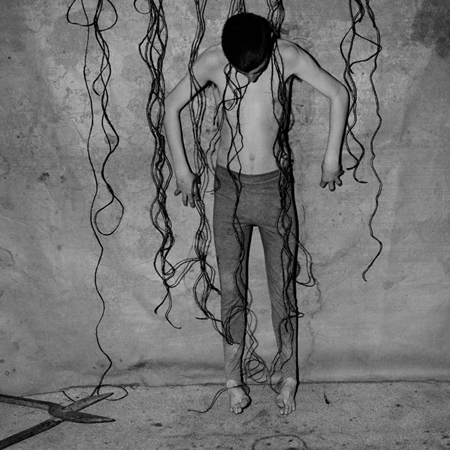
Cut Loose. Roger Ballen, 2005

Cut Loose. Roger Ballen, 2005

In critiques of Roger Ballen‘s photography I haven’t seen more than mere passing references to Abu Ghraib. New York Art Beat coyly described Ballen’s prints as “Reminiscent of the images from Abu Ghraib” and continued, “Untitled (1069) shows a gaunt man clad only in sweatpants. His head hangs down, toes curled and fingers scraping the wall.”

Culture Vulture afforded Ballen just one sentence in its review of the After Nature group exhibition, “Roger Ballen’s b/w photos draw on our deep visual memories of Abu Ghraib, without truly recording any torture.”

7_41 4_19

4_14 1_15

In real time and the real world Ballen’s work has absolutely nothing to do with Abu Ghraib. But my charge is to speculate on the meandering visual cultures and cross overs that wash over us daily.

Let me start by saying that Ballen has not in any way been influenced by Abu Ghraib. He began his Shadow Chamber work in 2001 and continued for 6 more years. His visual vocabulary was drawn from his own portfolio and observations from as early as the 70s when he photographed in homes of the poor with exposed wires, smears and semi-feral mammals.

Prowling. Roger Ballen, 2001

Prowling. Roger Ballen, 2001

New York Photo Festival will have to be special in 2009 if it is to eclipse Ballen’s show-stealing lecture of last years inaugural show. Just as Ballen had quietly plied his craft for decades without much commercial interest, so he quietly took to the stage for the unrockstar 11am slot on the first morning. Many concluded at midday that they may as well go home there and then. Ballen was it; “So if you missed it sorry the festival might just be all down hill after this.”

Why? Apart from being unexpected, Ballen took the viewer deep into a closely controlled isolated world and into the psychological uncertainties of his vision. Ballen is the perfect foil to typologies, minimalist cliche, first-project enthusiasm and the manicured fine art of contemporary photography.

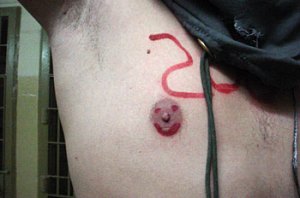
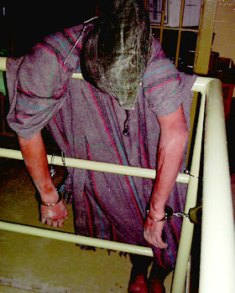
Effigy and Prowling are disconcerting, bizarre, staged and lit with hard flash – in other words they hold the same characteristics as the Abu Ghraib images.

abu-ghraib8 ballenfour

ballenthree
abu-ghraib1

It seems the comparison is so glaring no-one has wanted to state it! Is it with guilt we accept Ballen’s work into an art aesthetic, and then stand with repulsed incertitude before the Abu Ghraib images? Much has been made of Ballen’s hypnotic work and his vortex of image and dis-logic. I wouldn’t suggest he is a mystic seer, but if some sort of visual, global Zeitgeist exists, I would suggest that Ballen tapped it. Few commentators have readily acknowledged this visual convergence. Why? Strange forces.

We have argued the ethics and presence of torture in non-photographic media, but have we failed to satisfactorily take up issues surrounding the aesthetics of torture in photography?

Maybe all the visual culture theorists were worn out and distracted after the publication of the Abu Ghraib images; maybe I am writing this a year or two too late; maybe visual similarities aren’t enough for a water tight hypothesis? But, you must admit the smudging and blurring of faces is further provocation toward comparison and spinal shudders.

_______________________________________________

There are some amazing resources online for Roger Ballen. The indubitable Lens Culture has a 25 image gallery and 18 minute audio interview.

Heather Morton compares his Ballen’s with Ralph Meatyard, Joel Peter-Witkin and Tim Roda.

Colin Pantall does the best blogosphere survey of Ballen’s aphorisms, antics and work.

Hot Shoe has a solid review of the Shadow Chamber book.

The V&A offers three very short audio snippets by Ballen.

And, these are the best of the articles provided by Ballen’s own website – 1, 2, 3, 4, 5, 6,

EMAIL

prisonphotography [at] gmail [dot] com

Prison Photography Archives

Post Categories