Author’s Note: If there exist any photographs of the violence described below I wouldn’t want to see them, only trust that photographs were used to bring high ranking US officials to justice for crimes against human rights.

I have been familiar with Mark Danner‘s work since reading the excellent Torture and Truth. It dealt commandingly with the Abu Ghraib scandal, putting it into the procedural context of the Bush administration and US operations during the War on Terror. Not to be distracted by the available Abu Ghraib images, Danner continued his fervent document-trawling professionalism and pursued the truth with regard to other Black Sites and detainee torture & interrogation.

Abu Zubaydah after his capture in Pakistan, 2002. Credit: ABC News

Abu Zubaydah after his capture in Pakistan, 2002. Credit: ABC News

Last month, Danner published an Op-Ed piece for the New York Times (to accompany an extended piece for the New York Review of Books) that laid out the details of an International Red Cross report of detainee testimonies. I have only read the shorter NY Times piece and strongly urge you to take 10 minutes to do so. It is a succinct presentation of facts detailing US torture procedures.

Men were tortured in America’s name.

Indeed, since the detainees were kept strictly apart and isolated, both at the black sites and at Guantánamo, the striking similarity in their stories would seem to make fabrication extremely unlikely. As its authors state in their introduction, “The I.C.R.C. wishes to underscore that the consistency of the detailed allegations provided separately by each of the 14 adds particular weight to the information provided below.”

Danner deals with the circumstances of three high ranking Al Qaeda prisoners, one of whom is Abu Zubaydah (pictured above following his 2002 capture). Judging by the Red Cross report which used separate chapters – “suffocation by water,” “prolonged stress standing,” “beatings by use of a collar,” “confinement in a box” one can assume Zubaydah looked significantly more broken after his months of early detention and beatings.

Danner concludes;

What we can say with certainty, in the wake of the Red Cross report, is that the United States tortured prisoners and that the Bush administration, including the president himself, explicitly and aggressively denied that fact.

The use of torture was a decision made by the US government. Danner’s conclusion is ominous;

The consequences of this choice, legal, political and moral, now confront us. Time and elections are not enough to make them go away.

It gives me great pleasure to introduce Prison Photography‘s first guest blogger. However, it saddens me as much that he must remain anonymous.

A couple of months ago, I received an email from a California state employee who worked as a prison educator. To paraphrase that initial contact, he stated that “California prisons were places of extreme emotion and stress – due in part to their ‘invisibility’  – and photography within the walls of prisons could go some way in bringing visibility and public understanding to the realities of contemporary prisons.”  This was a remarkable statement and the first of its kind that I had heard from someone in employment at a state prison. I asked if he could expand on those thoughts and I am grateful he did.

The great irony of this is that the essay is not illustrated by the images he witnesses daily. He has offered us poignant descriptions of scenes from within prison. The descriptions are a powerful device to get us thinking about what we think we know and what we potentially could know about our penal system.

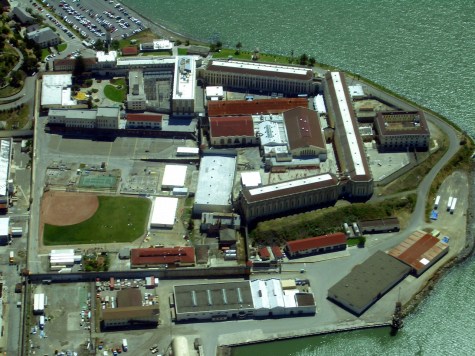
He suggested I use some of CDCR’s own images. The aerial shots included are the official vision of the California prison system that disciplines and orders the different sized units that comprise the institution; cells, wings, blocks and facilities. The institutional eye of CDCR’s aerial views lies in powerful contrast to the personal narrative recorded here.

Avenal State Prison. Courtesy CDCR

Avenal State Prison. Courtesy CDCR

I work in California prisons. Penology has become grown into avocation over the last 10 years. A past career in journalism with some practice in photojournalism informs a strong inclination to report/communicate what I see and experience. So I am daily frustrated by prison policies against recording the visual images I see. Each day I wonder if these policies are justified. If not, are they an impediment to rehabilitation, perhaps even prison reform? Do these policies protect society and the prisoners and staff persons who are a part of society? Or are these policies so much heavy furniture upon the carpeting under which we have swept our societal human detritus?

[IMAGE] There but for the grace of God go I – Close up of a hollow expression on the face of a prisoner as he watches two uniformed guards escort another prisoner across the bare, brown dirt of a prison yard. One guard holds a baton at the ready, the other menacingly waves a carafe-sized container of pepper spray, his finger on the trigger. In the background are multiple 12-foot chain-link faces topped by rounds of glistening razor wire.

North Kern State Prison. Courtesy CDCR

North Kern State Prison. Courtesy CDCR

If you ever work with law enforcement on the street, you will hear the mantra “officer safety.” Policies, procedures, even individual officer actions have this mantra as an underlying core within their stated mission to serve public safety. In the prison, that mantra becomes “safety and security of the institution.” Everything is measured against that mantra. Nothing is approved if anyone can show that it may be a threat to institutional safety and/or security. Uncensored and uncontrolled photographic images seem to be considered an inherent threat to institutional safety and security. From a rookie guard to the departmental secretary, few things seem to frighten them quite so much as image impotence in the institutions they so wholly control. From regular staff trainings to informal reminders I have been inculcated (brainwashed?) to accept the imprudence of taking pictures on prison grounds. Simply having a camera on prison property could be cause for termination.

[IMAGE] The burden of laundry – a prisoner wearing only boxer shorts sits on the lowest metal slab of a three-high tier of bunk beds in a prison gymnasium. His hands are deep in a bright yellow, worn mop bucket on the floor in front of him. Inside, white socks and underwear mingle in lukewarm, soapy water.

Prison regulations acknowledge their public nature and the public’s right to know what goes on inside prisons, at least bureaucratically. Title 15 of California Code of Regulations, Section3260 is entitled “Public Access to Facilities and Programs.” It states:

“Correctional facilities and programs are operated at public expense for the protection of society. The public has a right and a duty to know how such facilities and programs are being conducted. It is the policy of the department to make known to the public, through the news media, through contact with public groups and individuals, and by making its public records available for review by interested persons, all relevant information pertaining to operations of the department and facilities. However, due consideration will be given to all factors which might threaten the safety of the facility in any way, or unnecessarily intrude upon the personal privacy of inmates and staff. The public must be given a true and accurate picture of department institutions and parole operations.”

Is absolute control over visual images in and around prison an unreasonable imposition on prisoners, staff, families, general public, media, etc? Does it interfere with the desirable goal of family/community connection with prisoners? Does it contribute anything to either rehabilitation or punishment, the two general goals of incarceration? I’ve catalogued the reasons I’ve been given, or even imagined, over the years and want to see how they stand up to public scrutiny.

Pleasant Valley State Prison. Courtesy CDCR

Pleasant Valley State Prison. Courtesy CDCR

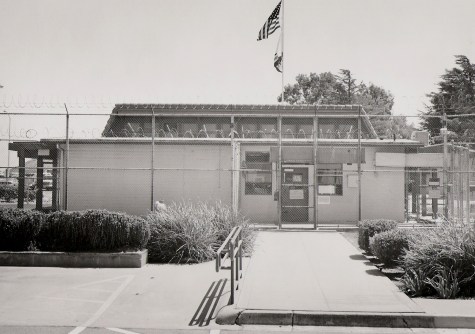
The first and foremost reason for image control would seem to be the prevention of both escapes and incursions. Photographs of prisons may provide intelligence to anyone planning escapes, contraband smuggling, perhaps even terrorist activities. This seems reasonable enough, at least until you start prowling around the Internet. The California Department of Corrections and Rehabilitation Web site has high-resolution aerial photographs of every one of its prisons. Anyone with even rudimentary analysis skills could do serious escape/incursion planning based on these photographs alone. But wait, there’s more. Google maps have more information – local maps, photographs of the prisons, even their “street view” photographs in some instances that clearly show fences, towers, gates, etc. With that level of public information available, I don’t see how you make a credible argument that I can’t take pictures on prison grounds.
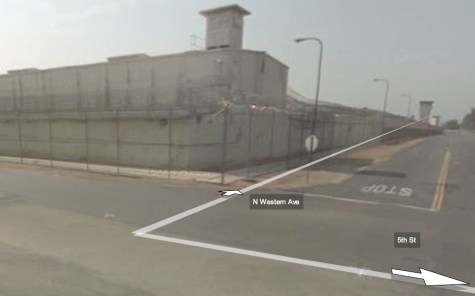
5th & Western, Norco, CA. Google Street View.

5th & Western, Norco, CA. Google Street View.

[IMAGE] The spread – four heavily tattooed prisoners in underwear standing around a dented, dingy gray metal locker. There are bowls on top of the locker and they are sharing food they cooked using hot water, instant soup noodle packets and canned meats, vegetables and seasonings. On the dirty gray concrete wall behind them is stenciled in fading red paint: NO WARNING SHOTS FIRED.

Privacy would seem to be the next strongest argument for prohibiting prison images. Given the open policies in other states, this argument seems flimsy. For prisoners, all conviction information is public. Simply go to the appropriate county court and the information is openly available to the public. Yet it is extremely difficult to get any information about prisoners in the California prisons. For the public there is one telephone number you can call. [916 445-6713] You must know either the prisoner’s CDCR Identification Number or the full name and correct date of birth. The line is perpetually busy and, if answered, the caller can expect to be put on hold for a long, long time (yes, hours). On the other hand, if you go to the Nevada Department of Corrections Web site, you can search for Orenthal Simpson and it will show not only his prison and address but all his convicted offenses, terms and release date. Oklahoma, not generally known for openness, shows the prisoner’s location, convicted offenses, release and parole dates, even pictures. The federal Bureau of Prisons will provide prisoner location and release dates for current and past prisoners. Try a search on their site for Martha Stewart.
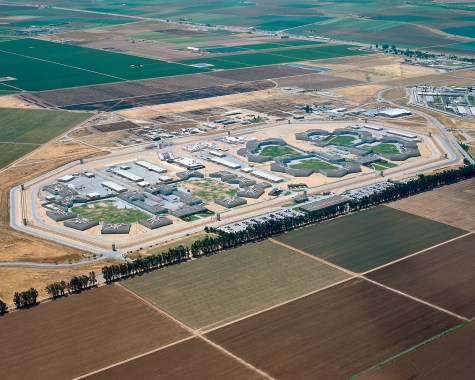
Salinas Valley State Prison. Courtesy CDCR

Salinas Valley State Prison. Courtesy CDCR

A major defense California prison management will make for the privacy argument is gang violence. They believe if it is easy to find a person in a particular prison, that can make it easier for gangs to use him. The gangs may use the prisoner to do their illegal work or to order him killed if he has fallen from grace, so to speak. CDCR logic is that by keeping prisoners hidden they are keeping them protected. If this is true, the magnitude of the gang problem is nothing short of monumental. Other states apparently do not have this problem. Why not?

[IMAGE] A pile of clothing, denim pants, orange coveralls, boots, etc. on a six-foot folding table. Two uniformed guards on one side of the table. Two naked inmates on the other side of the table, one bent over spreading his rear-end cheeks for officer inspection.

I categorize all other arguments against my taking prison pictures as simple totalitarian need for control. An uncontrolled image is seen as a risk – and why take a risk? The fewer images that exist, the fewer possibilities there are for something to happen that they can’t control. Statistically speaking, very few members of the public or the media ever get to see what happens inside prisons. Media representatives are escorted at all times and only see what prison management wants them to see. They are rarely given unfettered access to prisoners. Visitors are the bulk of the public that see anything of a prison, and that is a very limited view – parking lots, processing rooms and the visiting rooms. Even inmate appearance is tightly controlled in the visiting experience. The prisoner who shows up needing a shave or wearing a wrinkled shirt doesn’t get into the visiting room. And he or she will be strip-searched going in and coming out.
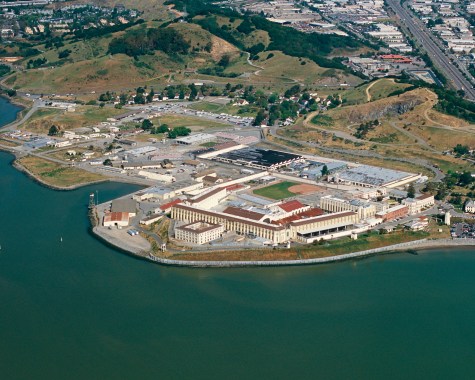
San Quentin. Courtesy CDCR

San Quentin. Courtesy CDCR

Prisons, at least in California, are reactive rather than proactive. California’s first permanent prison, San Quentin, opened for business in 1852. Since then, the prison system has been making rules and regulations based on preventing the recurrence of negative events. For example, a prisoner at R.J. Donovan prison at San Diego escaped using a fake staff identification card he had made. He walked out amid a small crowd of other staff leaving at shift change time. As was customary then, he simply held up his photo ID and was waved through with the rest of the ID card wavers. To prevent this from happening again, CDCR policy now requires the gate officer to physically touch and examine the employee ID card before letting the person through the gate. Such policy-creation has been repeated tens of thousands of times over the past 157 years of the California state prison system. It does not lend itself to the openness of unfettered prison images.

[IMAGE] The back of a prisoner’s shaved head as he sits in the audience of a GED graduation ceremony. Visible under his mortarboard are gang tattoos on his head and neck. Blurred in the background an inmate stands at the podium giving his valedictory address.

Until 1980, incarceration in California had rehabilitation as a major goal. The state legislature in that year, bowing to a Reganesque rabble-rousing changed prison law to say the purpose of incarceration is punishment. The concept of rehabilitation disappeared and so did most of the prisoner programming and policies meant to promote rehabilitation. Connection with family is known to be one of the most important factors in rehabilitation. I suggest the control of images in the prison system is one policy that discourages family connections.

Substance Abuse Treatment Facility at Corcoran. Courtesy CDCR

Substance Abuse Treatment Facility at Corcoran. Courtesy CDCR

Prison subsumes human beings. Prisoners disappear over time. As soon as a man goes to prison, he begins to fade from his former life. Just as a photographic print will fade over the years, the place of a man in his family fades while he is in prison. Life goes on – without him. His linkages to the fabric of family and community eventually fray and break. Phone calls, letters and visits cannot fully replace the foundations of shared daily interactions, family projects, adventures, challenges and the intimacy of shared emotions. Despite our ability to love, we are creatures of habit, and over time absence can become a habit that seems a normal reality.

The absence of prison images in society supports the concept of shame in incarceration. This shame then supports an estrangement that prison system managers find useful for their purposes. The human toll of that is prisoners who simply hunker down to do their time. Some resist family contact. “I don’t want my children coming to see me in a place like this,” is a common thing I hear from prisoners who could have visits if they wanted them. Would this change if prison images were common in our society? I think so. I think it’s worth a try.

If an individual and the law don’t agree to the point the individual is imprisoned, one hopes lawful imprisonment changes the individual, right? For the better, right?

Unfortunately, American prisons have proved the opposite of rehabilitative or hopeful of positive change. Recidivism rates in America are between 60% and 68% (depending on the source).

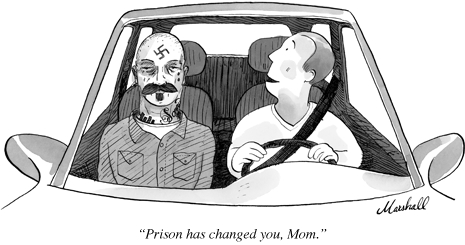
"Prison has changed you, Mom" © 2009 Marshall for the New Yorker

"Prison has changed you, Mom" © 2009 Marshall for the New Yorker

Spurred possibly by the fiscal-driven prisoner releases across the nation, Marshall penciled this pearl.

Some of the best comedy is simultaneously tragedy. The truth is America’s prison archipelago has bruised the lives of the current 2.2 million prison population, the lives of family members AND our lives and communities. Inmates returning to society haven’t been suitably prepared or shown new paths. Change has been for the worse in majority of cases.

I was astonished to read this AlertNet article. It excavates the background to Lovelle Mixon’s massacre in Oakland that killed four people.

I cannot agree with the article’s logic 100%. It would be a sad day if I ever presumed the individual totally powerless and unable to act upon non-violent decisions, but as the author writes:

“Though Mixon’s killing spree is a horrible aberration, his plight as an unemployed ex-felon isn’t. There are tens of thousands like him on America’s streets. In 2007, the National Institute of Justice found that 60 percent of ex-felon offenders remain unemployed a year after their release.”

It is not easy to resist the urge to think of mass-murderous crimes as the singular actions of an individual.

I appreciate Earl Ofari Hutchinson‘s article because it brings together the many invisible and minor trials in life that collectively make daily stress unbearable. I finished the article amazed that there are fewer desperate crimes akin to Mixon’s. An uncomfortable thought.

Again, Hutchinson reminds us that the problems of incarceration, recidivism, education, unemployment and crime are inseparable:

Washington, D.C. is a near textbook example of that. Nearly 3,000 former prisoners are released and return to the district each year. Most fit the standard ex-felon profile. They are poor, with limited education and job skills, and come from broken or dysfunctional homes. Researchers again found that the single biggest factor that pushed them back to the streets, crime, violence and, inevitably, repeat incarceration was their failure to find work.

Q. Why do we warehouse people, break them, and then return them to society in a poorer position to cope?

A. Punitive and immovable laws, collective arrogance & utter denial.

With an estimated 600,000 prisoners either released or due for release in 2009, it’s about time we make a small change in our accomodations – especially given the size of change we expect of former prisoners.

© 2009 Ged Murray

© 2009 Ged Murray

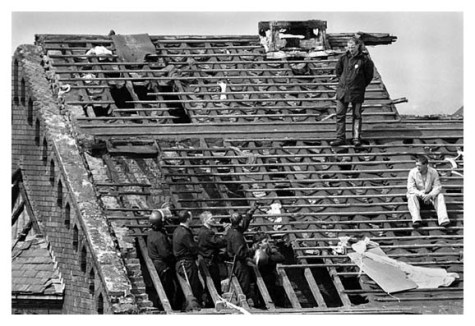
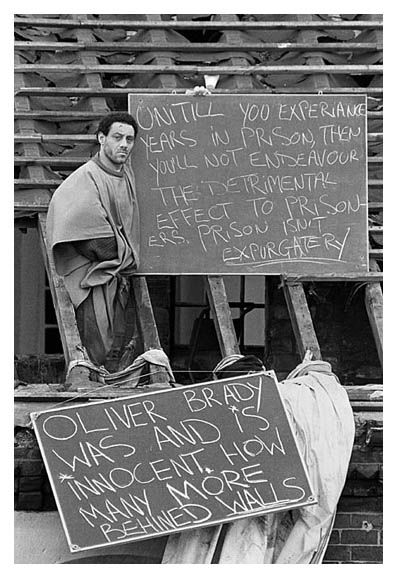
To append my last post about iconic photographs of rooftop inmates during the Strangeways riot of 1990 is a nod to the work of Ged Murray. Previous lamentations at the lack of Strangeways photography were premature on my part … I just had to keep digging.

© 2009 Ged Murray

© 2009 Ged Murray

These are my choice shots from a series of 20 Strangeways images on Ged Murray’s website. The image below of the two inmates in discussion is iconic (according to my brother). The silhouetted tower is instantly recognisable.

© 2009 Ged Murray

© 2009 Ged Murray

© 2009 Ged Murray

© 2009 Ged Murray

© 2009 Ged Murray

© 2009 Ged Murray

© 2009 Ged Murray

© 2009 Ged Murray

© 2009 Ged Murray

© 2009 Ged Murray

This last image of an inmate with signs took a large portion of my time. I am still thinking it over. Unerringly, I like the image. The shot bypasses the potency of icon and dilutes our consumption of events; returning our appreciation to more modest levels, focusing on the individual lives involved during a brief but pivotal moment in the history of British governmental prison policy.

© 2009 Ged Murray

© 2009 Ged Murray

__________________________________

Thanks to Ged Murray for his permission to publish the images.

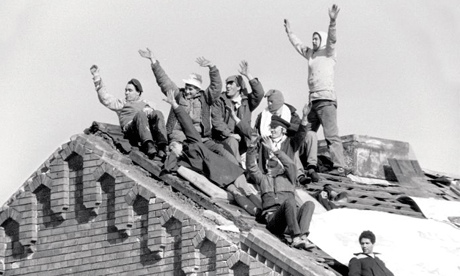
The Strangeways riots in 1990 led to breakthroughs in the prison system. Photograph: Don McPhee for the Guardian

The Strangeways riots in 1990 led to breakthroughs in the prison system. Photograph: Don McPhee for the Guardian

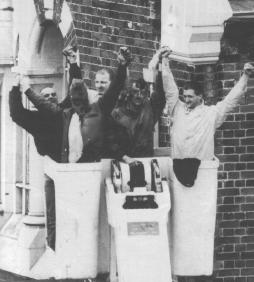
On April 1st 1990, began Britain’s largest prison riot in history. Strangeways may not mean a lot outside of the UK, but within, Strangeways, Manchester is synonymous with the romanticised image of the Northern criminal. The photographs of prisoners on the roof are iconic. Britons watched with shock.

Photo: Ged Murray

Photo: Ged Murray for the Observer

Prison conditions had rarely been in public debate. Our level of shock was only equivalent to our level of apathy, prior. The general public were in awe of the unprecedented institutional collapse.

Prisoners occupied the roof for 25 days in front of round-the-clock media coverage. The protest ended when the final five prisoners surrendered themselves peacefully on 25th April.

The estimated damage was pegged between £50 and 100 million. The true cost for the HM Prison Service was lord chief justice, Lord Woolf’s subsequent damning report, which cited inmate frustration and poor prison conditions as a main reasons for the riot.

Credit: Unknown

Photo: Ged Murray for the Observer

According to the Guardian – which includes a transcript of the prevailing exchange between proctor and prisoners – the stirrings of unrest began in the chapel following the 10am service. Prison officers evacuated the chapel and then (arguably) too hastily other areas of the prison. Inmates using keys taken from chapel guards released other inmates. Soon the overcrowded and understaffed facility was no longer in the control of government authority.

Strangeways roof protest photographs are iconic because their subject was so unexpected. Britain had harboured class and political confrontation much in the past. But in the miners strikes and clashes with police, football hooliganism, the general strike violence could be in some way predicted. The circumstances for those prior tensions had been played out through media narrative. UK Prisons were neglected; they were in desperate conditions and we – the public – were oblivious.

Don McPhee

Photographs of the Strangeways riot are hard to come by but I have gleaned a few from the web. In doing so I came across the work of the late Don McPhee.

I strongly urge you to watch this slideshow of his work.

McPhee had a 2005 exhibition at the Manchester Art Gallery and is a fondly remembered northern talent. He was a crucial part of the alternative editorial voice of the Guardian at that time. That distinctly Northern paper is now internationally distributed & respected.

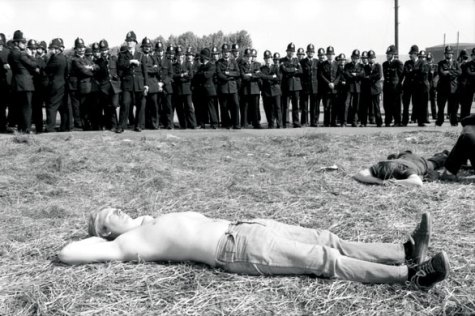
Miners sunbathing at Orgreave coking plant. Photograph: Don McPhee

Miners sunbathing at Orgreave coking plant. Photograph: Don McPhee

_______________________________________________________

Here is the inevitable percolating legacy of Strangeways in public dialogue.

Here, Eric Allison makes a succinct argument for British prison reform.

And here is the UK Parliament debate in 2001, ten years after the January, 1991 publication of Woolf’s report reviewing the response to the report recommendations.

Deuel Vocational Institution, California. © 2009 Robert Walsh

Deuel Vocational Institution, California. © 2009 Robert Walsh

Predictably, my partner is my first critic and supporter. Often distilling my whirling thoughts, she’ll draw some coherence from my arguments. I asked her to look over the photography of Robert Walsh. He had submitted his work via email. She pointed out that three of his images bore striking resemblance to school environments. I can only agree.

School

School

Of course, this is not a novel notion and philosophers have, for decades, had a field day dissecting and bisecting institutional architectural forms. I’ll add this quick post to the heap of rhetoric and swagger.

Deuel Vocational Institution, California. © 2009 Robert Walsh

Deuel Vocational Institution, California. © 2009 Robert Walsh

Mill Creek Middle School secretary Jane Crum works beside the new buzz-in system that was installed for safety purposes at the school. Press Photo/Emily Zoladz

Mill Creek Middle School secretary Jane Crum works beside the new buzz-in system that was installed for safety purposes at the school. Press Photo/Emily Zoladz

Maybe worth returning to would be Richard Ross‘ work. He pin-pointed the many shared criteria in institutional architectures of authority. His prints are pristine and his visual evidence compelling.

Deuel Vocational Institution, California. © 2009 Robert Walsh

Deuel Vocational Institution, California. © 2009 Robert Walsh

School Buses in Yard

School Buses in Yard

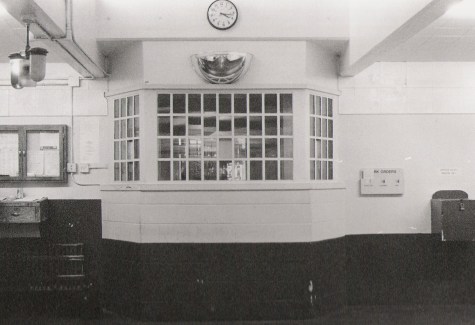
wiesbaden_1

In Germany, as in most European nations, prisons often lie within towns and cities; European prisons & jails are older than the housing estates and urban developments that, ultimately, came to surround them.

In Britain, castle-like Victorian-era prisons were the dominant type until the seventies when they were replaced by draft-proof, medium-sized institutions in rural locations. Bricks and mortar made way for concrete & razor wire. That said, a few town-centre “citadels” such as Preston Prison and Lancaster Castle still operate within Her Majesty’s Prison Service, the latter dating back to the 14th century!

wiesbaden_2

In the American penal landscape, a high proportion of prisons (and all new builds) are outside of conurbations – sometimes isolated in the mountains or desert, sometimes just within grasp of a rural town to prop or establish a local economy.

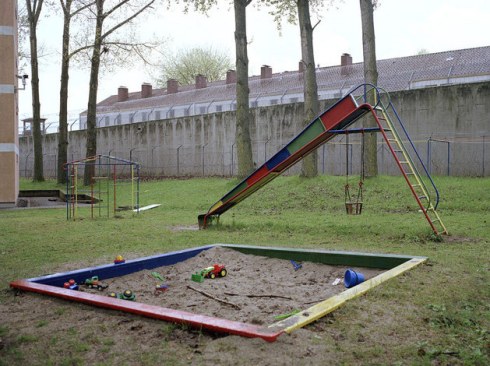
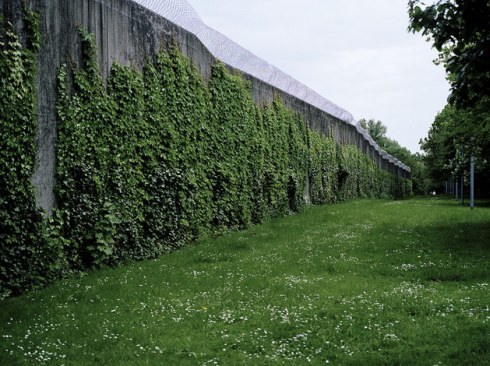
Christiane Feser‘s photographs could not be mistaken as American, just as the New Topographics couldn’t be mistaken for anything but American. I don’t want to say Feser’s series Prisons is typically German, because I don’t know what that means. Instead, I will say it is typically Northern European. Feser’s photographs embody the spirit of pedantic spatial ordering which I have observed not only in Britain and Germany, but also Austria and the Netherlands.

We don’t know the specific locations of these prisons so we can not know the construction dates. Given the carceral/residential interplay we can say that if Feser’s images aren’t about the zoning of space, they are about a time before zoning dominated civic-planning.

dieburg_3

“When I photographed the prisons I was interested in how these prison walls are embedded in the neighbourhoods,” said Ms. Feser via email. “How the neighbours live with the walls. There are different strategies. Its a little bit complicated for me to write about it in English …” Feser’s images do the talking.

Feser’s world is one of silence, order and manicured nature. Her images evince a harmony between the prison, its neighbours and vice-versa. We witness no trauma here.

friedberg_2

Feser has obviously decided to omit humans from her compositions. The neighbourhoods are well tended and so presumably inhabited. One presumes the neighbourhoods are occupied daily, and yet we see no cars in driveways nor bikes on the street. Feser almost suspends belief. Are these actual places? Is this a toy-town?

Why does Feser rely on manicured topiary and brick pointing of the absent inhabitants to illustrate the “different strategies”? Is Feser suggesting a common psychology between prisoners and residents?

Have the neighbours adopted psychologies of seclusion and discipline as exist in the prison next door? Can penal strategies of control transfer by osmosis through prison walls and throughout a community? Or are certain personalities attracted to these new build estates? Are a portion of these homes reserved for prison staff? Or has Feser’s clever framing and omissions just led the viewer along these lines of inquiry?

Many would think in this peculiar carceral/residential inter-relationship the prison dominates, overbears. I doubt it. I contend those who live in such locales influence the institution also. The two agents in this relationship aren’t separate; they are drawn to one another and they overlap.

Feser uses visual devices to point toward this overlap. Angles of the oblique walls, dead ends, tended verges and brown-toned brickwork repeat through the series; sometimes these elements are part of prison fabric, sometimes part of a house.

kassel_4

There exists no hierarchical coda in Feser’s images as all the surfaces are equal. One has to pay attention to figure out which architecture is carceral, and which is not. Even the barbed wire doesn’t confirm it totally as (in England at least) one commonly sees barbed wire and glass shards lining the walls of merchant-yards and back alleys.

Feser’s photographs cradle a palette of grey concrete & skies; dense greens and the browns of brick & mortar. This is Germany, but it could as easily be Lancashire housing estates, Merseyside new towns or the reclaimed industrial sites of Scottish cities.

kassel_3

So how about it America? You are the land of the suburb and subdivision. You may not be familiar with a socio-spatial history that favours the awkward in-fill of urban and semi-urban space over the encroachment on to undeveloped land. It’s alright. Prisons needn’t be invisible and we needn’t be afraid. Locks and keys work as well on your street as they do in up-state, high-pain, back-water seclusion!

The location of prisons matters because when prisoners are sent to facilities on the other side of the state, families are likely to visit less. The commitment of time and money required to make such a lengthy trip usually precludes the poorest families from the essential and simple act of visiting a loved one. Research has shown the largest single factor in a prisoner successfully reentering society and not re-offending is the maintenance of family ties and the continued support it provides.

kassel_1

hessischen-gef_ngnissen

All images © Christiane Feser. Used with permission.

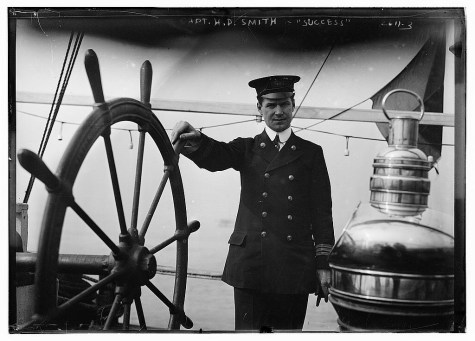
Capt. H.D. Smith of SUCCESS, Date Unknown. Glass negative. George Grantham Bain Collection (Library of Congress). Call Number: LC-B2- 2611-3

Capt. H.D. Smith of SUCCESS, Date Unknown. Glass negative. George Grantham Bain Collection (Library of Congress). Call Number: LC-B2- 2611-3

A couple of weeks ago I gave a nod to subtopia’s article on Floating Prisons. This is a topic that gets more meaty the more contemporary the examples become. The intrigue levels reach new heights when the 21st century, nautico-military gun-vessels are spear shaped, warp radar detection and travel quicker than your average barracuda. Concomitantly, the further back one ventures, prison ships are mired in the shameful times of slavery and the dirty deeds of colonial conquest.

There is a period between these two paradigms, when American authority locked up American pioneers on prison hulks. When the western expansion became western settlement, predominantly centered about San Francisco, the authority of the time needed a “bulk” solution to the settling and incorrigible population. The quickest solution to the quickest lawlessness on the continent was the prison ship.

Image: Telstar Logistics (Source)

San Quentin Prison. Image: Telstar Logistics (Source)

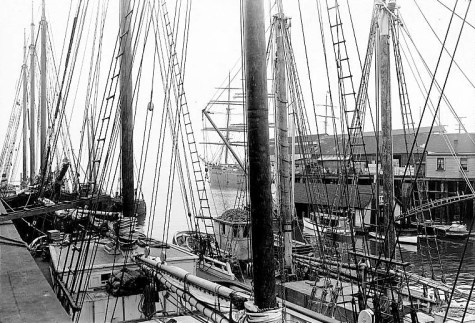
In 1851, the first prison on the west coast of America was established at Point San Quentin, but when it was established it was not bricks and mortar but beams and gulleys. The Waban, a 268-ton wooden ship, anchored in San Francisco Bay, was outfitted to hold 30 inmates. Subsequently, inmates who were housed on The Waban constructed San Quentin which opened in 1852 with 68 inmates. Unfortunately, I could find no images of The Waban.

I think it is interesting that a “prison-as-terminal” was immediately necessary when humans reached the edge of a continent. San Quentin prison replaced the archipelago of local jails across America as a permanent and expanding facility – the final stopping point for California’s early lawless contingent.

It is poetic that the first penological-structure chosen (based on practical needs) was one that straddled land and water; permanently moored, but temporary in its utility. Carceral use demotes the ship to ‘container’ and The Waban, like its inhabitants, entered its demise.

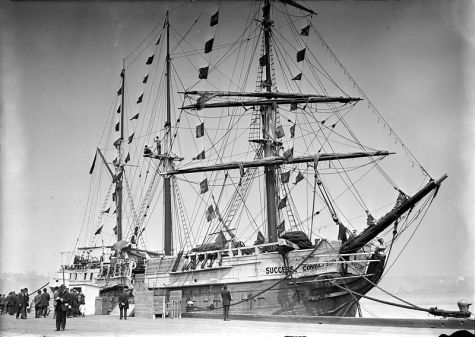
Success convict ship, no date recorded. Image: Library of Congress

Success convict ship, no date recorded. Image: Library of Congress

Anyway, just to prove its not all bad news for prison ships, above is one of the most famous. Success was reincarnated as a global museum traveling the world purportedly as a museum demonstrating the transportation horrors of the British Empire.

Here’s the skinny, “Constructed in built in Natmoo, Tenasserim, Burma in 1840.  sold to London owners and made three voyages with emigrants to Australia during the 1840s. On 31 May 1852 the Success arrived at Melbourne with emigrants, and the crew deserted to the gold-fields, this being the height of the Victorian gold rush. Due to an increase in crime, prisons were overflowing and the Government of Victoria purchased large sailing ships to be employed as prison hulks. These included the Success, Deborah, Sacramento and President.

“When no longer needed as a prison ship as such, the Success was used as a detention vessel for runaway seamen and later as an explosives hulk.

“When the Victorian Government decided to sell the last of its redundant hulks, Success was purchased by a group of entrepreneurs to be refitted as a museum ship to travel the world advertising the perceived horrors of the convict era. Although never a convict ship, the Success was billed as one, her earlier history being amalgamated with those other ships of the same name including HMS Success that had been used in the original European settlement of Western Australia.

“A former prisoner, bushranger Harry Power, was employed as a guide. The initial display in Sydney was not a commercial success, and the vessel was laid up and sank at her moorings in 1892. She was then sold to a second group with more ambitious plans.

“After a thorough refit the Success toured Australian ports and then headed for England, arriving at Dungeness on 12 September 1895 and was exhibited in many ports over several years. In 1912 she crossed the Atlantic and spent more than two decades doing the same thing around the eastern seaboard of the United States of America and later in ports on the Great Lakes.

“The Success fell into disrepair during the late 1930s and was destroyed by fire at Lake Erie Cove, Cleveland, Ohio, while being dismantled for her teak on 4 July 1946. (Source)

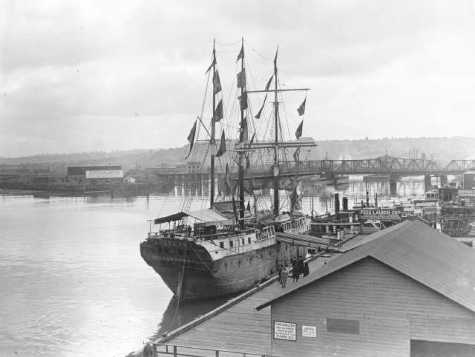
Prison ship SUCCESS, Seattle, 1915. Photographer Unknown. Image: University of Washington Digital Archives

Prison ship SUCCESS, Seattle, 1915. Photographer Unknown. Image: University of Washington Digital Archives

The Success passed through the Panama Canal and spent 1915/1916 on the Pacific Coast. She drew huge crowds in Seattle. I found the image above at the University of Washington Archives, which was my main reason for constructing this post. Success also docked in Tacoma in 1916.

Around 1916, the exhibition prison ship "Success," from Melbourne Australia, was docked at the Tacoma Municipal Dock Landing and open for tours. Marvin D. Boland Collection, Tacoma Public Library. Series: G50.1-103 (Unique: 31555)

Around 1916, the exhibition prison ship "Success," from Melbourne Australia, was docked at the Tacoma Municipal Dock Landing and open for tours. Marvin D. Boland Collection, Tacoma Public Library. Series: G50.1-103 (Unique: 31555) (Source)

I guess I just like the fact the Success was repurposed so many times and for a long period of time was a museum to the macabre. Some commentators were bothered by Roger Cremers recent World Press Photo win in the “Arts & Entertainment” category for his photographs of Auschwitz tourists. I guess ‘Dark Tourism’, or Thanatourism, has always existed. 21st century generations may not be as perverse as we perceive.

__________________________________________

A timeline of Success and An obituary for Success

EMAIL

prisonphotography [at] gmail [dot] com

Prison Photography Archives

Post Categories