Stones. Mark Kirchner

Stones. Mark Kirchner

Mark Kirchner has been returning to Manzanar for over 25 years. Kirchner’s project is Manzanar Pilgrimage which focuses on the annual memorial gathering and documents former internees and their families’ stories. Mark explains in his artist statement:

This project is a work in progress. As a photographer, I felt the need to create a visual record as the Japanese American community struggled to preserve the site, its history and legacy. My primary role is that of a witness. The process of witnessing the pilgrimages over many years has given me the time to attempt a holistic photographic document. Within this body of work I hope to make visible those brief moments when the human spirit is revealed. I have discovered that some of the people I have photographed do not see themselves or their actions as historically significant and rarely worth photographing. I hope some of their modesty has been instilled in me.

Watanabe. Sentry Post Building, 1984. Mark Kirchner

Inscription: Watanabe. Sentry Post Building, 1984. Mark Kirchner

March 30th 194(2) and Kanji, 2006. Mark Kirchner

Inscription: March 30th 194(2) and Kanji. 2006. Mark Kirchner

It is somewhat fortuitous that Mark asked me not to include images of people and that I didn’t wish to include any pictures of people. Manzanar is a peculiar site and certainly not of a human scale. As the Eastern Sierras drop off sharply, the plateau of high desert to the east is a stark landscape. Beautiful, awesome, sublime – yes; livable – barely by today’s standards.

Some could argue that Manzanar should be allowed to recede into the dust and weeds of the California/Nevada borderlands – that humans should never have been interred and nor should human’s need to return. But we are funny creatures and I, for one, appreciate the impression of meaning upon a site once the site has run through its cycle of original use. The dialogue about former sites of incarceration is where one finds responsibility, complexity and community.

Tets Ishikawa, 45, 55, 66, 83. Sentry Post Building, 1984 and 2007. Mark Kirchner

Inscription: Remember. Sentry Post Building, 2007. Mark Kirchner
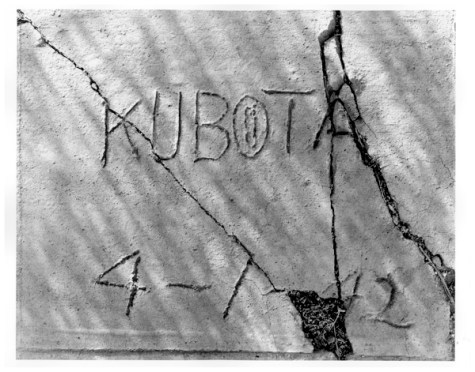
Kubota 4-1-42 1984. Mark Kirchner

Inscription: Kubota 4-1-42. 1984. Mark Kirchner

Manzanar is a flat site with no place to hide. Everything that is visible is rooted to the ground, and all that is invisible is in the memories and oral histories of the people Mark Kirchner cares so much about. If Kirchner’s concern is preserving the stories of people interred, my concern is his images that reflect that aim. I chose these images because they speak of definites; definite people, dates and action (scribing). They are evidence of existence and time. These images are also all surface which to me summarises the barren desert site.

There is a poetic beauty that one speculates the original scrawler was aware or unaware of – that being, the paradox that the necessary human constructions at Manzanar are those to hold the visible, physical evidence. The concrete is as incongruous to the site at Manzanar as mass human occupation was between 1942 and 1945.

Remember, Sentry Post Building, 2007. Mark Kirchner

Inscription: Tets Ishikawa, 45, 55, 66, 83. Sentry Post Building, 1984 and 2007. Mark Kirchner
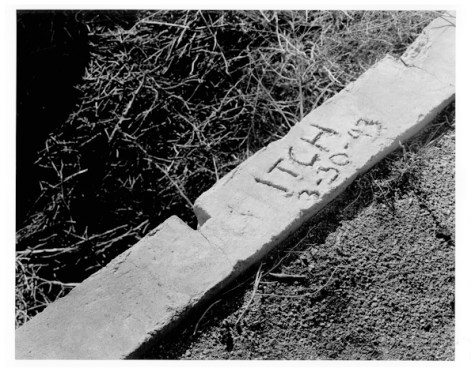
Itch 3-30-43. 1983. Mark Kirchner

Inscription: Itch 3-30-43. 1983. Mark Kirchner

Kirchner explains further:

Since the annual pilgrimage lasts only a few hours, I knew it would take many years to make the images for the foundation of this work. As the event grew from the intimate Manzanar Pilgrimage and Potluck of the early 1980s to the pilgrimages we experience today, the task of identifying and gathering contact information has grown. After the 2007 pilgrimage I decided to try to contact the people in my photographs. Most of my free time last year was spent in research and correspondence. I have attempted to identify and contact every person photographed on this site. I still have not been 100 percent successful with this effort. I am hopeful that any person that remains unidentified will in time contact me.

If this post can help Mark Kirchner in his noble endeavour I would be thrilled. Tell your neighbours about it!

____________________________________

Mark Kirchner is an expert bookbinder and salmon flies crafter. Here is his Silver Studios website. Read Kirchner’s biography. Found via photoexchange.

Thanks to Mark Kirchner for his permission to reproduce images and the helpful background information on the project.

____________________________________

Comment from Mark Kirchner: I like that you picked up on the nature of the artifacts and their relationship to the earth. At one time there were 800 buildings on the site. Now there are 4 buildings.

Discombobulated

Discombobulated

I was delighted to find this collection of “Jail Finds” recently. It is a quiet statement amidst the cacophony of dross we are subject to daily.

The person who documents these notes, scribbles and profundities works for a volunteer library service serving the local Dane County Jail and operated by the University of Wisconsin in Madison.

These are things I find abandoned in books or stuffed on the book cart at the jail where I volunteer. A little context: these come from a county jail, not a state prison – a very important distinction. Most inmates (approx. 75%) are short-term “holds.” They’re there awaiting trial (meaning they couldn’t afford bail); on probation violations; or are federal prisoners being shuffled around the system. About 1/4 are women and 1/3 are minorities. The vast majority stay less than 30 days.

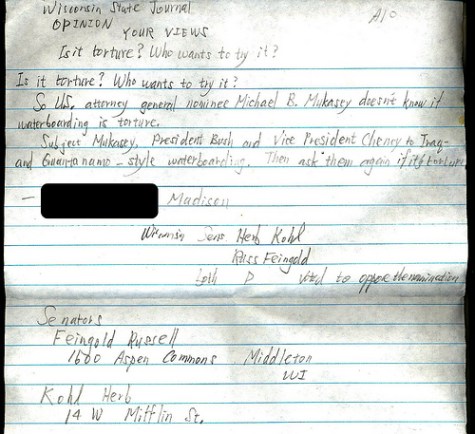
Torture?

"Subject Mukasey, President Bush and Vice President Dick Cheney to Guantanamo style Waterboarding. Then ask them if it is Torture."

Events and Consequences

Events and Consequences

Test

Health Testing Request

List

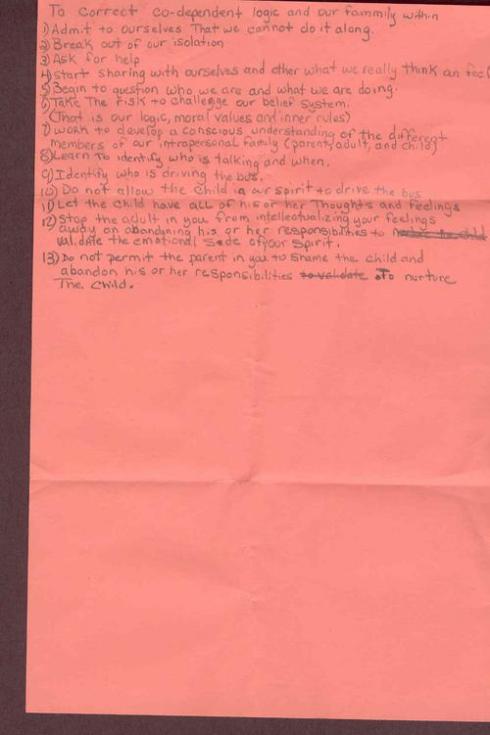
Childhood and Adulthood

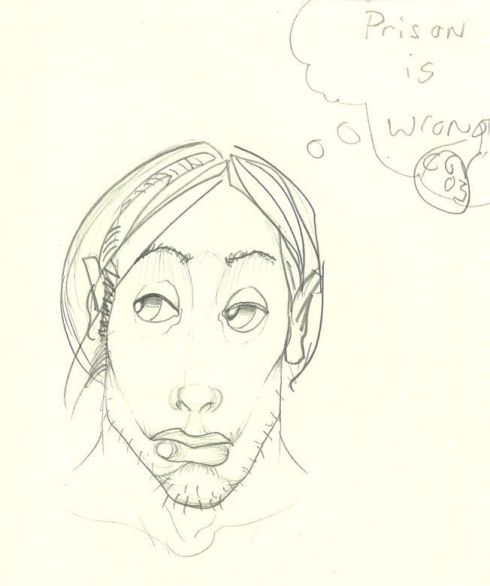
Prison is Wrong

Prison is Wrong

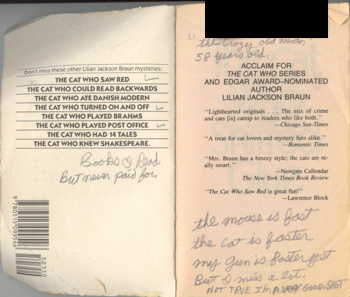
A Mouse is Fast, A Cat is Faster, A Gun is Faster Yet, But i always Miss. That is not True, I AM A GOOD SHOT

The Mouse is Fast, The Cat is Faster, My Gun is Faster Yet, But I Miss a lot. NOT TRUE, I'M A VERY GOOD SHOT

List

Vocabulary

Letter

Letter of pledges, hopes and favours.

What ties these examples and the other 100 or so in the collection is humanity and surprise. Humanity we should hope of all and surprise we should absolutely insist on from all. Some of these scribbles are penitent in the old fashioned ideal, some are reflections of harsh reality.

I wouldn’t argue, that in my mini-curation, I may be biased. I have picked the most appealing and the most redemptive of scripts, but I feel this only goes some small way to redress the imbalance of mainstream media that a) simultaneously condemns and sensationalises criminals and b) cares little for the transgressor once locked away.

Spanish

"God give me serenity to accept the things I cannot change and give me valour to change those I can. And wisdom to recognize the difference. May your will be done and not mine."

Robert Walsh contacted me recently to alert me his 2007 project at Delta College, Stockton, with instructor Kirstyn Russell. I asked Mr Walsh to explain the context of the series.

The story is not complicated. I have been a moderately serious photographer since the late 60s, when I got my first real job, working in the camera department of a large discount store. I have kept at it, off and on, for 40 years.

I got a job with the Department of Corrections in 1980 and worked at Deuel Vocational Institution (DVI) for 24 years, retiring as a Lieutenant 4 years ago.

A couple of years after I retired I approached the Warden, who was about to retire himself, and asked for access to shoot a photo essay of the prison.

I promised that I would go to great lengths to ensure that there were no recognizable images of inmates (legal issues) or staff (personal/professional issues) and would give the Department veto authority over any photo with any possible security issues. It worked out, and they had no issues.

I shot about 200 frames of 35mm, 120 and large format B&W negative, and ended up with a collection of 20 prints which I put in the book Images of the Gladiator School, along with a few pages of text. The text is still evolving.

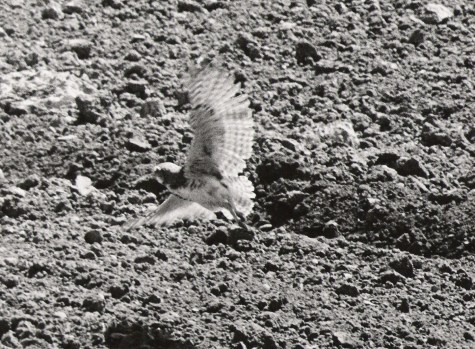
The photos were shot over two days in the fall of 2007. I was trying to convey the visual impact of the institution without showing any people, both for obvious legal reasons and as a technical/artistic “challenge” for lack of a better way of putting it.

Robert Walsh

Robert Walsh

Mr Walsh sent me through the series’ twenty images, from which I selected six.

Of the remaining fourteen, two of Mr Walsh’s photographs were of receding cell tiers, so they couldn’t be included by virtue of a pledge. Two more were of receding corridors, so I extended the pledge. Three other prints that stood out were exterior shots of the yards at DVI. They depicted similar spaces to those of elementary schools – I plan to return to these in a later post.

I choose a single photograph for its own reason and five others for shared reasons.

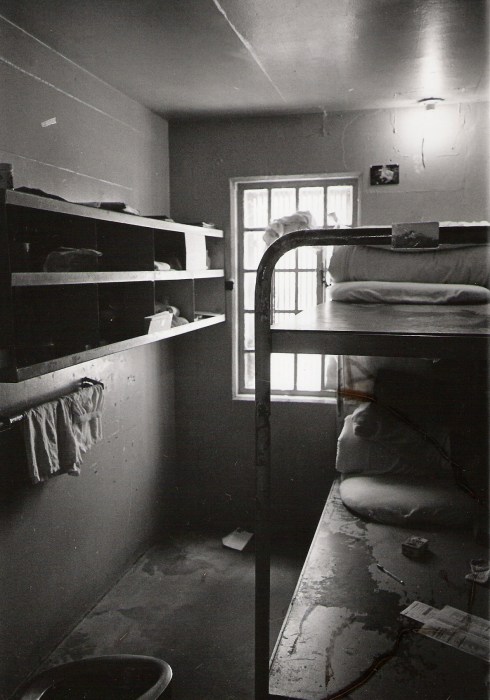
The image of the cell (above) is musty, scuffed and miserable as cell really get. Debris that lurks on the cold surfaces.

Mr Walsh actually provided two prints of the cell image; the other being less textured, darker and crisper. The other image also didn’t exhibit the same surface damage. The reproduction (above) was preferred because of its subtle mood of disintegration.

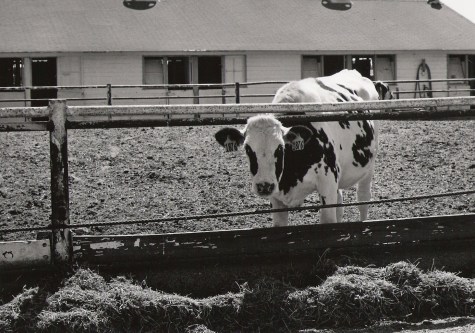
The remaining five were chosen because they express something of the action of the photographer. Away from the static buildings and fences, Mr Walsh has gone searching for anomalies amid the rigid penitentiary structures. The portrait of the cow is suitably awkward, the disturbed furrows of the field from which the owl flies are repeated in the pock-holes of the target range, repeated in the bullet-holes of the target-paper.

Robert Walsh

Robert Walsh

Robert Walsh

Robert Walsh

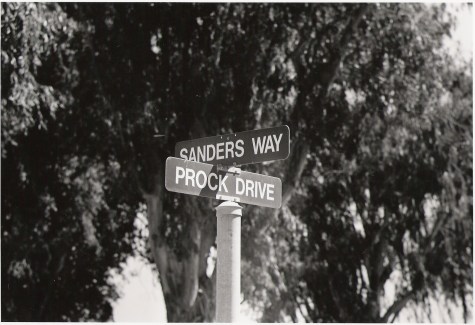
Palm trees. This is the West or Southwest, this is the land of middle distance road signs. This could be the work of John Divola‘s Correctional Officer Alter-Ego.

Robert Walsh

Robert Walsh

Robert Walsh

Robert Walsh

Robert Walsh

Robert Walsh

Mr Walsh challenged himself to “convey the visual impact of the institution” doing so with “no recognizable images of inmates or staff”. Bar two images, his compositions omit the activities of human life. Somehow, these five images specifically, give me the sense of human life recently fled or snuffed out entirely.

Whether Mr Walsh intended it, I find some of these images a little unnerving. The series is entitled Images of the Gladiator School based on DVI’s violent reputation between the 60s and early 80s. The project could as easily be called Ghosts of the Gladiator School.

Thanks to Robert Walsh for his time, words and images.

“Prison Polaroids: A Dispersed Portrait of American Life”

I was speaking to Sheila Pinkel recently about photography within prisons. She said only once had she been inside a prison with a camera of her own. We shared wonder at those photojournalists who through luck or nous gain access within US sites of incarceration.

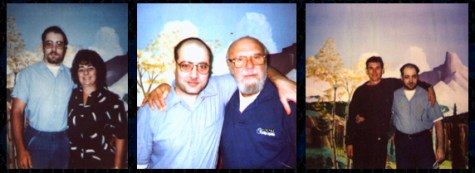
Sheila explained that photography was conducted in the visiting rooms. Standard practice is for a correctional officer or fellow inmate to operate a Polaroid camera and sell the Polaroids at $2 each.

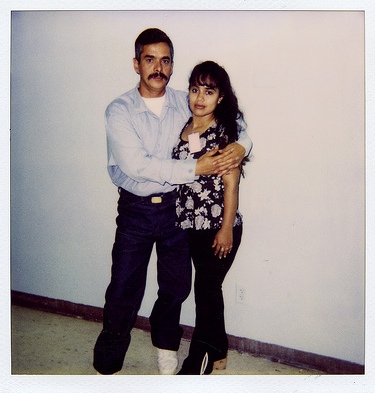
Imagine those Polaroids gathered together and the dialogue they’d rouse as a collection. But this portrayal of America is dispersed, and its dialogue is absent.

Susanville

Susanville

Susanville

Susanville

Dr Maria Kefalas, Assistant Professor of Sociology at the University of Chicago noted the collection and display of Prison Polaroids in Promises I Can Keep, a book about mothers’ poverty in the US:

In the course of Kefalas’s fieldwork she was invited into more than a dozen living rooms that displayed a “Prison Polaroid”, sometimes held to the wall by a thumbtack or tucked into a framed family portrait on the television set. Prisoners, she learned, can have these taken for only (sic) a few dollars at the prison commissary and usually pen cheerful descriptions such as “Happy Birthday” or “I love you” on the back. When family members come to visit, the commissary photographer will, for a fee, commemorate the occasion with a keepsake Polaroid. One mother showed Kefalas a photo album of Polaroid photographs taken in the prisons’ visiting area  – each commemorating one of the few times her daughter and her child’s father had been in the same room together over the course of the six years old’s life. the photos typically feature the inmate in his fluorescent orange department of corrections jumpsuit against a backdrop of a tropical beach scene, perhaps to give the illusion to the loved ones back home that their father is not in prison, but taking a much needed vacation.

San Quentin

San Quentin

San Quentin

San Quentin

After some digging I found this account:

In the processing room there is an inmate store where one can buy articles made by inmates and also buy these cards for $2, good for a snapshot of you and your friend taken in front of this large poster of a waterfall in the woods. I got one of these cards and when my friend and I went to get our picture taken I asked if we could have the dining room and everybody in it in the background. This was a big no-no, as people might be recognized in the photo. I didn’t know. We had our picture taken by an inmate with a Polaroid camera who later passed out the photos to the different tables. It turned out real nice.

San Quentin

San Quentin

Visitors are prohibited from bringing their own cameras or phones to the majority of US correctional facilities. Frequently the visitor buys two, one for the mantelpiece at home and one to return to the inmates cell. But there is no negative – just as there is no album. The Polaroids are dispersed across a nation. I think it would be fascinating to such Polaroids together.

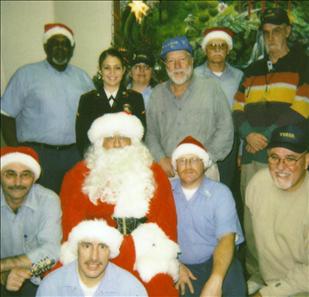
Santa with VVGSQ members and supporters. San Quentin Prison visiting room - December 18, 2005. The VVGSQ has always supported the San Quentin Christmas Toy Program with toy donations as well as by running the program each year. The Warden has authorized the VVGSQ to sponsor this program and the group purchased the "Santa" suit, beard and wig that is used for an appearance of Santa to the children each year at the visiting room. The program benefits all the children who come to visit family at San Quentin during the Christmas season. Started in 1988, December 2008 will be the 20th year the program has been giving toys to the children who visit San Quentin.

Santa with VVGSQ members and supporters. San Quentin Prison visiting room - December 18, 2005. The VVGSQ has always supported the San Quentin Christmas Toy Program with toy donations as well as by running the program each year. The Warden has authorized the VVGSQ to sponsor this program and the group purchased the "Santa" suit, beard and wig that is used for an appearance of Santa to the children each year at the visiting room. The program benefits all the children who come to visit family at San Quentin during the Christmas season. Started in 1988, December 2008 will be the 20th year the program has been giving toys to the children who visit San Quentin.

In piecing together this online group of images, I found it difficult to come across images. This does not surprise me.

In what circumstances do people scan their Polaroids of a prison visit for online upload? Just a few; friends & family with blog updates; purveyors of the macabre; journals of the death-row inamtes; inmate support groups and children’s rights organisations.

Please alert me to any other sources.

_______________________________

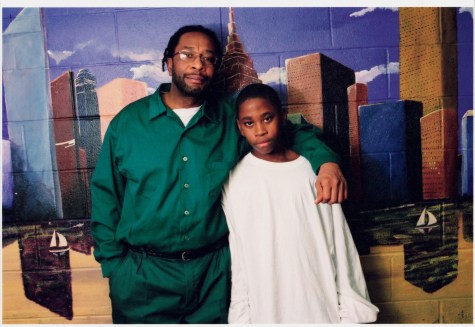
This is not a Polaroid but it is an image I came across here, with the enlarged image here. I had to include it. I challenge readers to find a better photographic portrait. The adult fights back tears and the child is solemn. Standing for the photo – for pride and for necessity – is a struggle for the father. The personalities are so strong, I wonder what words they have spoken to one another. Surely, the father’s outward show of emotion is typical of the sadness adults bear when behind bars, away from their children. I have no children. I can’t begin to know, even by comparison. These two portraits would excel as individual shots; to put them together is to light a firecracker under the seat of emotive curiosity.

Father and Son

Father and Son

I also found this image on Flickr, which has a stark backdrop by comparison.

Jail Visit?

Jail Visit?

Thoughts?

How about that as a potent exhibition just waiting to come together? Millions of Prison Polaroids in frames & drawers; homes & cells across America. The dispersed portrait of incarcerated Americans could be assembled in one place. The scale would be overwhelming and the juxtapositions endless. Let me know if the notion intrigues you as much as it intrigues me.

13

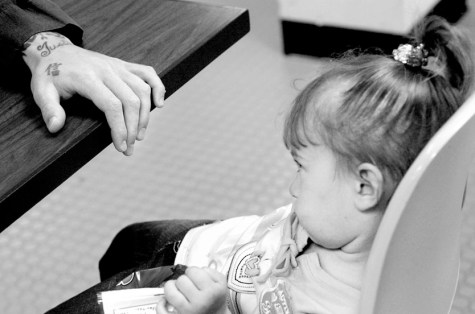
Hailey, 2, reaches out for a quarter in her fathers hand, Shane Macleod, while her mother Danielle Macleod stares out from the table. Each visitor is allowed to bring $20 of quarters for the vending machine and nothing else. Shane, like all of the inmates in the visiting room must ask his wife and daughter to buy certain snacks, as he is not allowed near the vending machines. During the visits, Shane says, “There is just not a lot to talk about after a while, you can only beat a subject to death for so long.” The couple married four years ago outside of prison, and Shane says, “Prison just really messes up your life.”

22

Hailey Macleod, 2, look outs across the table at her father, Shane Macleod, and his outstretched hand. Shane was incarcerated two months prior for bank robbery. Shane says. “It gets really stressful sometimes, to have my wife and daughter away from me.”

Elyse Butler repeat-visited New Hampshire State Prison in 2005. She was working as an intern staff photographer at the Concord Monitor in Concord, New Hampshire. The goal of the assignment was to capture the dynamics of relationships in the prison visiting room. Butler documented the behaviours of those within the room; “how these couples, families, and friends interact with each other when they have only a small amount of monitored time to spend together.” I asked a couple of questions.

How did you get access?

In order to get access into the prison we [Concord Monitor] had to contact the PR department and go through a process of paperwork and I had prison officers watching me at all times when I was in the visiting room.

What reactions did the work receive?

After the piece was done we got a great reaction from inmates and families in the visiting room. They were touched to have their time documented with their loved ones.

62

Heather Metcalf and Mark Vangordon hold hands at table 19 in the visiting room of New Hampshire State Prison. Vangordon is imprisoned for sexual assault and has been in the for a year. Metcalf says, “Not having him home is the hardest part.” When she is not visiting she waits for his letters to hear how he’s doing. During a visit, they are only allowed to have a 15 second embrace at the beginning and end of each visit and otherwise they are only allowed to hold hands above the table.

42

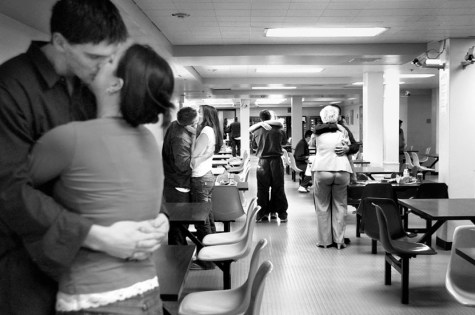
Lori Tasney and Chris Lang look into each others eyes as Marilyn and Daniel Haldeman hold each other at the end of a visit. Tasney and Lang have been dating for two years and plan to marry when he gets out. His current parole date is set for 2008. Lang was imprisoned for robbery in January 2005. Tasney visits twice a week, which is the most time any inmate is allowed visitors, but says “I would visit every day if I could.”

33

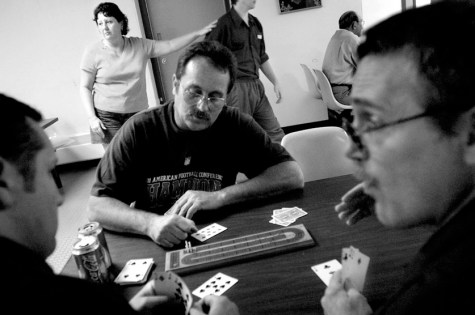
Mark Langlais plays cards with his brother, inmate Alphee Langlais (right) and his son, inmate Eric Langlias (left) while a mother gives her son one last touch at the end of a visit. This is the first time Alphee and Mark have seen each other since 1996. Mark claims, “Alphee’s been in here since his hair lost its color.” The family was estranged a long time ago, but they claim prison has brought them closer together. Eric was admitted for assault and Alphee was admitted on a parole violation following a prior sexual assault crime. Alphee carries around his inmate request slip as if its a trophy and cried when he finally spoke on the phone with his brother Mark. “This visit has been really special to me, ” Alphee claimed. Eric and his father always fought but no that he is on medication and his father is in counseling, Eric says “it is the closest we’ve ever been … I have always loved my father. I have always wanted him around.”

52

An inmate and his visitor share a last kiss and 15 second embrace, along with three other couples also saying their goodbyes, at the end of a visit. They started dating 5 months ago, only a month before he went to prison, and she says, “If he ends up having a long sentence, we probably won’t stay together.” He was admitted on a parole violation after an original conviction for multiple robberies and larceny. She says, “I come usually once a week. I hate coming here.”

Biography

Elyse Butler is represented by Aevum Photos. She is one of the hardest working and posting photographers in the business. She previously won College Photographer of the Year Award in 2004 for her documents of the porn industry. She has also photographed the debutante activity of La Jolla. I’d like to hear an interview between Butler, Lauren Greenfield and Wendy Marijnissen on the topic of female identity.

Butler did some nice portraiture in South America, but my favourite project of hers is “From Pond to Purse” which follows the trade of alligator products. Be sure to read Butler’s information on the project at her site in the ‘passion’ category.

James Estrin for the New York Times

James Estrin for the New York Times

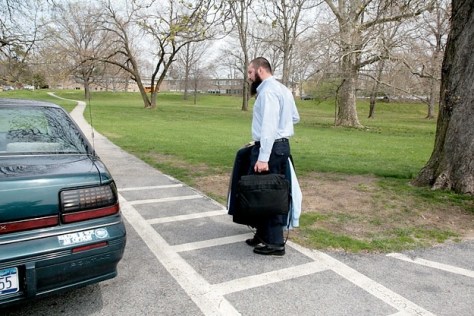
Jeffrey Deskovic was imprisoned for 16 years for a rape and murder he did not commit. The New York Times produced this sobering slideshow of his first year outside prison.

James Estrin for the New York Times

James Estrin for the New York Times

Two things in Deskovic’s story stood out. First of all, I was struck by the everyday practices and processes he lists as doing for the first time – cooking his own breakfast; opening and closing the window, keeping his own hours, shopping, even driving “represents power and freedom”; using the internet; using a cell phone (“I asked where the holes were to talk into”); first day at college; and swimming. “The water felt heavy” was Deskovic’s summary. It had been so long his body was not used to it.

James Estrin for the New York Times

James Estrin for the New York Times

The second thing that struck me was how alone Deskovic was. He admitted to low points, thinking about taking his own life, wondering if it was a dream. Most tragic was his nagging feelings that he has somehow slipped through the cracks and that a twist of fate landed him on the outside. He is struggling and wonders whether he will be a ‘prisoner’ all his life. His institutional life has seeped into his psyche it seems.

James Estrin for the New York Times

James Estrin for the New York Times

These revelations are most shocking to me because Deskovic looks so well equipped to deal with his new life. He is an advocate for overturning wrongful convictions, he works with the press diligently, he feels “at his best” when he is making a presentation or talk. And yet, he is still waiting for the gradual process of a “normal-life”, including a trusting partner, to become him.

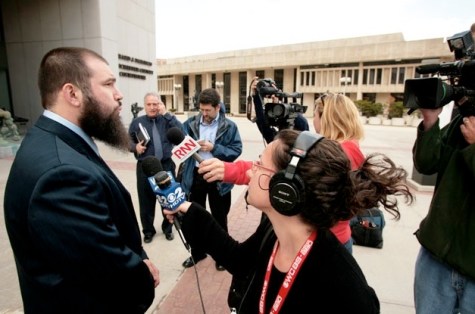
Jeffrey Deskovic addresses the press. James Estrin for the New York Times

Jeffrey Deskovic addresses the press. James Estrin for the New York Times

Jeffrey Deskovic admitted to a small smile when he first spoke to the press following his release, because “they knew what I had always known”. I would like to think this smile has sustained and grown in the 15 months since the New York Times did the feature.

Please read the original story by the New York Times. Photography by James Estrin and Suzanne DeChillo, who has photographed incarcerated immigrants awaiting deportation at Wyatt Prison, Rhode Island.

BURN Magazine, under the fiscal umbrella of the Magnum Cultural Foundation, have announced a $10,000 grant “to support [the] continuation of the photographer’s personal project. This body of work may be of either journalistic mission or purely personal artistic imperatives”

I am encouraging people to take on the difficult task of securing prolonged and necessary time with a prison/jail/detention-centre population in order to faithfully describe the stories and systems of its particular circumstance. On top of that your product must be “work is on the highest level”.

It’s a tall order but if you have carried out portrait or documentary photography in a site of incarceration before (I know many of you), then submit an application to continue that critical and valuable work. It will have to better than my attempt.

San Pedro Prison, La Paz. July 2008.

San Pedro Prison, La Paz. July 2008.

Hmm. On the same day I encourage photographers to attempt access into sites designed to be impenetrable, the government and police in my home country have introduced “laws that allow for the arrest – and imprisonment – of anyone who takes pictures of officers ‘likely to be useful to a person committing or preparing an act of terrorism’.” (British Journal of Photography via In-Public)

BURN Magazine is a new(ish) venture by David Alan Harvey whose got a Magnum portfolio and his own internets.

Saint Valentine was executed on February 14th, 270 A.D. He was a priest in Rome who covertly married couples against Emperor Claudius II’s dictate. Claudius had banned marriage because wedded men were unwilling soldiers and he needed to sustain his warrior-class.

The mythology tells us that while in prison Valentine befriended the gaoler’s blind daughter. She brought him meals and they talked at length about imperialism, machismo and state control in the Holy Roman Empire. The night before he was “beaten with sticks and had his head cut off”, Valentine reached through the bars of his cell and touched her eye lids. She could see. It was a miracle. Later that night, Valentine penned a note to his ladyfriend and signed it “From your Valentine”. This was a first.

What next? The civic authorities mopped up the blood and the church went on a propaganda campaign. At that time it was the custom in Rome, a very ancient custom, indeed, to celebrate in the month of February the Lupercalia, feasts in honour of a heathen god. On these occasions, amidst a variety of pagan ceremonies, the names of young women were placed in a box, from which they were drawn by the men as chance directed. The pastors of the early Christian Church in Rome endeavoured to do away with the pagan element in these feasts by replacing the names of maidens with those of saints. And as the Lupercalia began about the middle of February, the pastors appear to have chosen Saint Valentine’s Day for the celebration of this new feast.

EMAIL

prisonphotography [at] gmail [dot] com

Prison Photography Archives

Post Categories