Woman in cell, playing solitaire. ca. 1950. Nickolas Muray. Transparency, chromogenic development (Kodachrome) process. George Eastman House Collection - Accession # 1983:0567:0151

Woman in cell, playing solitaire. ca. 1950. Nickolas Muray. Transparency, chromogenic development (Kodachrome) process. George Eastman House Collection - Accession # 1983:0567:0151

I was blown away last month when the indicommons feed landed Nickolas Muray’s colour commercial photography on my desktop. Muray’s commercial work is fresh, witty, a sock in the eye and an all round feast of fun. The fact I haven’t any knowledge ofi the advertised products makes my enjoyment all the more visuocentric and naive. And that’s okay … every so often.

Pop music sprouted in the fifties, right about when this image was taken. I have Alma Cogan playing in my mind as I browse Muray’s commercial kodachrome prints. Visually, Woman in Cell, Playing Solitaire is an alterworld mash-up of Jehad Nga and Edward Hopper. Don’t you just dig those colours? None of the psychological edge though; the lady, despite being locked up, hardly looks harassed or without hope. Rather, she looks bored.

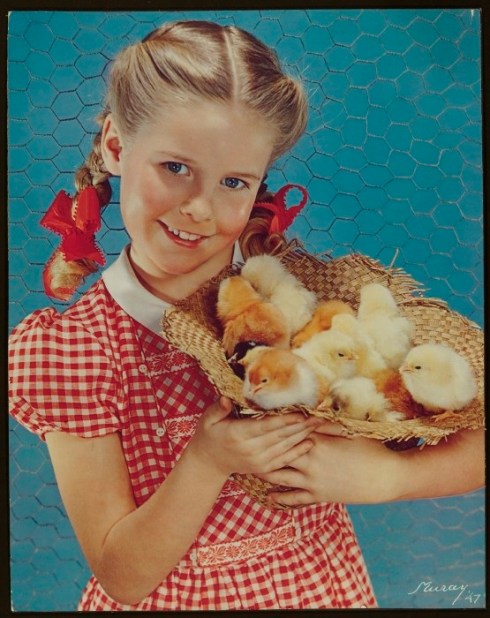
To continue the fest of technicolour, let me include the image below. Admittedly, it stretches the theoretical parameters of this blog but I would argue the subject is relevant. Depicted is the harsh subjugation of fowl to sites of incarceration – evidenced by the chicken wire and possibly even the girl’s well-disguised, maniacal grasp of the hat!

American Cyanamid Girl with Straw Hat Full of Chicks, 1947. Nickolas Muray. Color print, Assembly (Carbro) Process. George Eastman House. Accession # 1971:0048:0017.

American Cyanamid Girl with Straw Hat Full of Chicks, 1947. Nickolas Muray. Color print, Assembly (Carbro) Process. George Eastman House. Accession # 1971:0048:0017.

To end on a serious note, I knew of the exceptional George Eastman House collection, but was frequently frustrated by the archaic platform of its website. Browsing was not fun. To GEH’s credit they recognised this enfeeblement and avidly committed important works to the Flickr Commons project. Kudos to them. We are all the better for it! I am just happy an image came along with vaguely carceral imagery, providing me an excuse to share.

_________________________________________

Nickolas Muray (American, b. Hungary, 1892-1965) immigrated to the United States in 1913, working first as a printer and then opening a photographic portrait studio in Greenwich Village in 1920. He became well known for his celebrity portraits, publishing them regularly in Harper’s Bazaar, Vanity Fair, Vogue, Ladies’ Home Journal, and The New York Times. After 1930, Muray turned away from celebrity and theatrical portraiture, and became a pioneering commercial photographer, famous for establishing many of the conventions of color advertising. He is considered the master of the three-color carbro process. Muray’s portraits of Frida Kahlo are well known and well-loved.

While not related to the work of a single photographer or project, the lines of argument proffered by Subtopia are so resonant that Prison Photograph Blog feels the diversion justified. Through summary of the four chosen articles, we can gaze upon the complexity and omnipotence of incarceration in our frantic, contested global society. Subtopia’s images will knock you on your arse!

The analysis of Bryan Finoki at Subtopia consistently join the dots between geopolitics & biopolitics; movement & paralysis; spatial theory and spatial reality. Unsurprisingly, for a writer in the 21st century, his interest in the production of structures & networks, often leads him to theories of militarised space.

I am in awe of Subtopia’s output. From lengthy and comprehensive issue-based summaries; to purposed surveys; from fine image-editing; to diverse links and sources in each post. Finoki serves up rigorous analysis, or entertainment, but usually both.

© 2009 Subtopia/Brian Finoki

© 2009 Subtopia/Brian Finoki

Over the past couple of years Finoki has submitted a few pieces on “The Prison”. Subtopia’s preoccupation with power and spatial production means carceral sites/archipelagos are referenced frequently. Finoki has been keen to unravel the mysteries of the Global War on Terror (GWOT), its structures and its legacies – this always means dealing with detention, rendition, and construction (that can be visible, but more often invisible.)

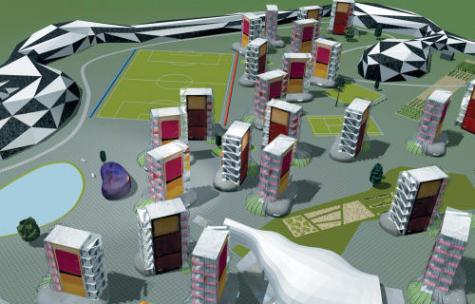
Article OneFantasy Prison is a meditation on potential prison architectures spurred by the 2007 Creative Prison project a collaboration between architect Will Alsop prisoners at HMP Gartree to redesign corrective and rehabilitative space. Two things struck me about the suggestions made by prisoners. 1) They were most afraid of attack from other inmates, and therefore an option to lock themselves IN was a shared high priority, and 2) They wanted to include a designated photo-room within the visitors center to allow for photography and variant backgrounds. I have posted before about manifestly curious prison-polaroid aesthetic. This article also threw up the crucial social responsibilities of architects & designers in a time of prison expansion, most notably the Prison Design Boycott launched in 2004 by the group Architects/Designers/Planners for Social Responsibility (ADPSR).

A rendering of Will Alsop’s new corrections landscape, developed in collaboration with prisoners, resembles a cross between Communist-era housing blocs and a series of South Beach condos. Courtesy Alsop Architects

A rendering of Will Alsop’s new corrections landscape, developed in collaboration with prisoners, resembles a cross between Communist-era housing blocs and a series of South Beach condos. Courtesy Alsop Architects

I have been a fan of Alsop’s work since his 2005 hypothetical SuperCity project which would subsume my hometown in the North.

Article TwoFloating Prisons is a historical survey of sea-faring, carceral solutions by warring and colonising nations. Finoki maps the use of prison ships from 18th & 19th century economic necessity to transport human cargo to contemporary manoeuvrings in avoidance of international law. He makes reference to the convenience use of islands as sites of detention, the use of ships as temporary housing in leiu of land locked sites, and the dubious experiments in swapping refugees held in off-shore camps. The summary was to say that new legal definitions and controls are creeping in giving one the sense, “refugees and migrants are just an excess of biomass to be herded around on prison islands or in prison vessels, traded like geo-economic commodities, removed and disposed of like capitalist human waste, reinforcing the state of exception that goes on re-organizing the architectural spheres of global migration.” Phenomenal.

The Vernon C. Bain is a prison barge operated by the City of New York, and houses some 800 prisoners in a medium and maximum security facility. She was built in 1992 at a cost of $ 161 Million, which as usual, means it would have been cheaper to send the inmates to Harvard instead.

The Vernon C. Bain is a prison barge operated by the City of New York, housing 800 prisoners in a medium and maximum security facility. Built in 1992 at a cost of $ 161 Million means it would have been cheaper to send the inmates to Harvard instead. (Source)

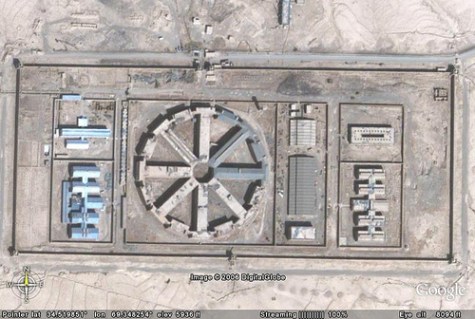
Article Three“Block D” enters the Pantheon of GWOT Space is a meditation on the totality of restricted space across the globe – in multiple nations – in order to sustain military operations. The point of the survey (which includes previously known sites such as Guantanamo, Baghdad’s ‘Green Zone’, Bagram Theater Internment Facility, US homeland immigrant detention facilities, and Taxi networks for rendition) is to add another site to the list: “Block D” in Pul-e-Charki Prison just east of Kabul, Afghanistan.

With persistent references to journalists’ work for the BBC, New York Times and Washington Post, Finoki summarises, ” ‘Block D’ or ‘Block 4’ as it is also apparently known: a newly built detention facility [is] quickly becoming understood as the Asian corollary of Guantánamo Bay. No matter, it is another utterly disturbing black hole in the universe of legally suspect and secret space.” Finoki doesn’t focus on the conditions of detention but rather America’s self-created legal imbroglio.

Nearly a year after writing, this analysis seems prophetic now, as the American public is slowly coming to realise that Obama’s closure of Gitmo doesn’t necessarily magic away the human rights issues … only shifts them somewhere slightly more obscured. As with Gitmo, one expects Block D to focus the new rounds of jousting between the same ideological stakeholders.

Pul-e-Charkhi prison, Kabul, Afghanistan. Construction began in the 1970s by order of then-president Mohammed Daoud Khan and was completed during the Soviet invasion (1979-89). The prison was notorious for torture and abuses under the control of Afghanistan's communist government following the invasion by the Soviet Union.

Pul-e-Charkhi prison, Kabul, Afghanistan. Construction began in the 1970s by order of then-president Mohammed Daoud Khan and was completed during the Soviet invasion (1979-89). The prison was notorious for torture and abuses under the control of Afghanistan's communist government following the invasion by the Soviet Union. (Source)

Article FourThe Spatial Instrumentality of Torture is a stomach-pounding dose of reality in the form of an interview with Tom Hilde, Research Professor in the School of Public Policy at the University of Maryland. I will not offer a synopsis, just encourage you to read through it. The interview is illustrated in part by Prison Photography‘s favourite Richard Ross.

Hilde ends with the sobering words, “The secrecy of much of the US torture program, its physical spaces, and its extent has certainly kept public debate rather subdued. But I think the dualistic moral framework has been even more corrosive of a public understanding of torture in general and the consequences of American torture in particular. When a majority of Americans say that torture is acceptable for some purposes, I think they have the fantasy of the ticking timebomb, and likely racism in many cases, in the backs of their minds.”

Camp X-Ray, Guantanamo, Cuba. The facility has not been used since early 2002, and recent heavy rains at Guantánamo Bay have brought about overgrowth. Credit: Kathleen T. Rhem

Camp X-Ray, Guantánamo, Cuba. The facility has not been used since early 2002, and recent heavy rains at Guantánamo Bay have brought about overgrowth. Credit: Kathleen T. Rhem

Kevin Van Aelst for The New York Times

Kevin Van Aelst for The New York Times

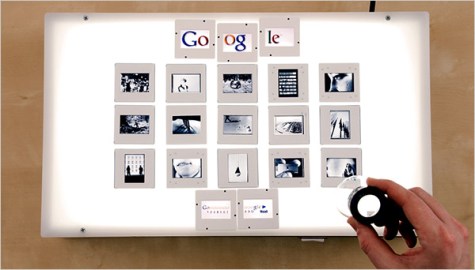
I posted about Google’s collaboration with LIFE Magazine a few months ago. I – like many folk – were excited to dig in, ferret about and generally enjoy the visual culture of decades past. It seems the novelty has worn off for some. An excellent diatribe, Photo Negative, in the New York Times last week made the point succinctly.

“When Google first announced on its blog that the Life archive was up, it seemed like another Google good deed: rescuing the name of Life magazine and the glorious 20th-century tradition of still photojournalism. But Google has failed to recognize that it can’t publish content under its imprint without also creating content of some kind: smart, reported captions; new and good-looking slide-show software; interstitial material that connects disparate photos; robust thematic and topical organization. All this stuff is content, and it requires writers, reporters, designers and curators. Instead, the company’s curatorial imperative, as usual, is merely ‘make it available’.”

Prisoners watching baptism of repentant killer, in Harris County jail, TX, US. March 1954. Credit: John Dominis. ©2008 Google

Prisoners watching baptism of repentant killer, in Harris County jail, TX, US. March 1954. Credit: John Dominis. ©2008 Google

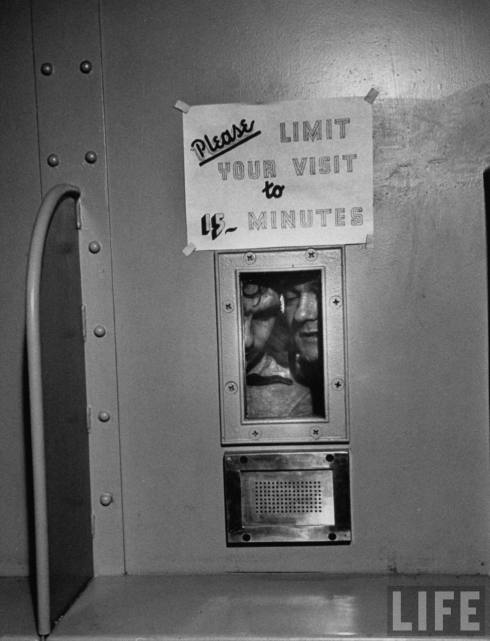
With little in the platform or functionality to inspire users, Google could find visitors’ perusal time shrinking. Users might face unavoidable limits to their search time and patience. 15 minutes?


I don’t want to get into the habit of posting on cases of police corruption, police brutality, or correctional officer misconduct.

I don’t want to do this for three reasons:

1. It distracts me, and you the reader, from digesting content directly related to photography and its praxis.
2. Many other regional, national and international newsrooms will cover these stories – as a matter of course – more thoroughly than I.
And 3. Despite their shared “peace officer” status, cops and screws are cut from a different cloth. It would be wrong of me to carelessly blur the activities of one disciplinary group with another. Police and correctional officers share minimal operational relation to one another.

So, I don’t wish to obfuscate the reader/viewer. However, the video below leaves no confusion in anyone’s mind.

The spokesperson in the video relayed the official words of an authority under investigation, but one feels even he could barely stomach the truth here. Where some videos are subject to interpretation – and consequently endless courtroom debate – there can be no doubt here. The officer lost his head and unleashed upon this young girl. He’s a thug, just like a guy fist fighting on the street is a thug.

As some of you may know, I have recently transplanted to Seattle. Occasionally, one witnesses acts of rote police procedure in place of common sense, but by and large, the cops on the streets here (as in my former home of San Francisco) are a friendly bunch on bikes and skates.

I am saddened such a horrendous beating should take place in my new hometown … which is why I have made an exception to my rule here.

Unfortunately, this brutal lashing occurred in the same month that Seattle police chief Gil Kerlikowske was selected by Obama to be America’s next Drug Czar. Seattleites have voiced varied opinions regarding this appointment, but secretly they are all really chuffed. It is a proud moment for Seattle residents, not least, because Kerlikowske – even as a police chief – shares some majority views of the citizenry. Kerlikowske adopted a common sense approach to urban policing by making marijuana infractions the lowest priority of his force in order to redirect resources to more serious matters … matters of violence. The Stranger, Seattle’s favourite free rag offers four wildly different but well-informed opinions on Kerlikowske’s appointment.

_______________________________________

Seattle lost an age-old institution recently. The Seattle Post Intelligencer, like the Rocky Mountain News and San Francisco Chronicle has had its day. I am not sad because I believe newspapers have unending rights or high position in urban comunities because I don’t – I am excited by new media and its different forms of creation and distribution. I am upset because it was the liberal leaning paper in this two paper town. That leaves the Seattle Times, which is very mediocre. If you are intent on getting good journalism in print pick up the San Jose Mercury Times. Crap city, great newspaper!

Alabama Death House Prison, 2004. Silver print photograph. Stephen Tourlentes

Alabama Death House Prison, Grady, AL, 2004. Silver print photograph. © 2009 Stephen Tourlentes

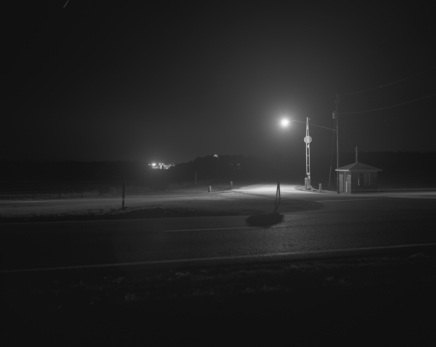
Stephen Tourlentes photographs prisons only at night for it is then they change the horizon. Social division and ignorance contributed to America’s rapid prison growth. Tourlentes’ lurking architectures are embodiments of our shared fears. In the world Tourlentes proposes, light haunts; it is metaphor for our psycho-social fears and denial. Prisons are our bogeyman.

These prisons encroach upon our otherwise “safe” environments. Buzzing with the constant feedback of our carceral system, these photographs are the glower of a collective and captive menace. Hard to ignore, do we hide from the beacon-like reminders of our social failures, or can we use Tourlentes’ images as guiding light to better conscience?

Designed as closed systems, prisons illuminate the night and the world that built them purposefully outside of its boundaries. “It’s a bit like sonic feedback … maybe it’s the feedback of exile,” says Tourlentes.

Stephen Tourlentes has been photographing prisons since 1996. His many series – and portfolio as a whole – has received plaudits and secured funding from organisations including the John Simon Guggenheim Foundation, the Massachusetts Cultural Council and Artadia.

Stephen was kind enough to take the time to answer Prison Photography‘s questions submitted via email.
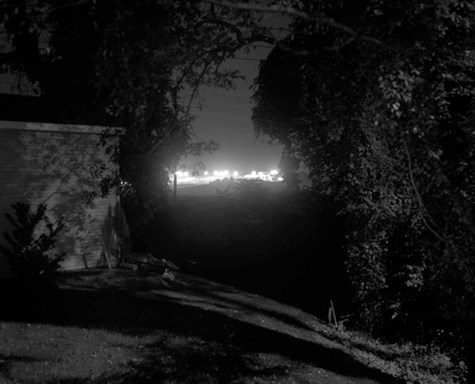
Penn State Death House Prison, Bellefonte, PA, 2003, Stephen Tourlentes

Penn State Death House Prison, Bellefonte, PA, 2003. © 2009 Stephen Tourlentes

Carson City, Nevada, Death House, 2002. Gelatin silver print. Stephen Tourlentes

Carson City, Nevada, Death House, 2002. Gelatin silver print. © 2009 Stephen Tourlentes

Blythe Prison, California. Stephen Tourlentes

Blythe Prison, California. © 2009 Stephen Tourlentes

Pete Brook. You have traveled to many states? How many prisons have you photographed in total?

Stephen Tourlentes. I’ve photographed in 46 states. Quite the trip considering many of the places I photograph are located on dead-end roads. My best guess is I’ve photographed close to 100 prisons so far.

PB. How do you choose the prisons to photograph?

ST. Well I sort of visually stumbled onto photographing prisons when they built one in the town I grew up in Illinois. It took me awhile to recognize this as a path to explore. I noticed that the new prison visually changed the horizon at night. I began to notice them more and more when I traveled and my curiosity got the best of me.

There is lots of planning that goes into it but I rely on my instinct ultimately. The Internet has been extremely helpful. There are three main paths to follow 1. State departments of corrections 2. The Federal Bureau of Prisons and 3. Private prisons.  Usually I look for the density of institutions from these sources and search for the cheapest plane ticket that would land me near them.

Structurally the newer prisons are very similar so it’s the landscape they inhabit that becomes important in differentiating them from each other. Photographing them at night has made illumination important.  Usually medium and maximum-security prisons have the most perimeter lighting.  An interesting sidebar to that is male institutions often tend to have more lighting than female institutions even if the security level is the same.
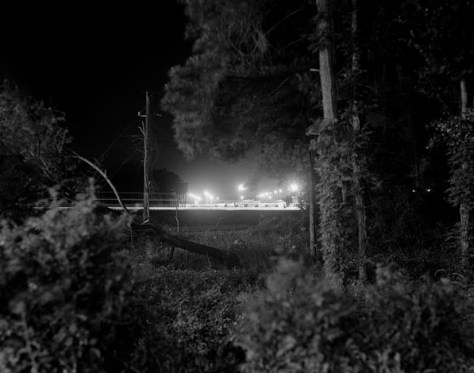
Holliday Unit, Huntsville, Texas, 2001. Gelatin silver print. Stephen Tourlentes

Holliday Unit, Huntsville, Texas, 2001. Gelatin silver print. © 2009 Stephen Tourlentes
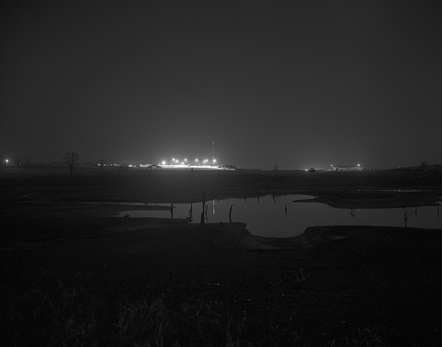
Springtown State Prison, Oklahoma, 2003. Archival pigment print. Stephen Tourlentes

Springtown State Prison, Oklahoma, 2003. Archival pigment print. © 2009 Stephen Tourlentes
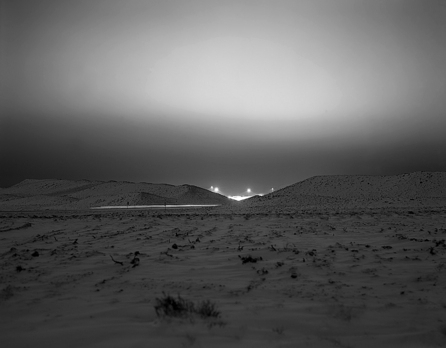
Death House Prison, Rawlins, Wyoming, 2000. Archival pigment print. Stephen Tourlentes

Death House Prison, Rawlins, Wyoming, 2000. Archival pigment print. © 2009 Stephen Tourlentes
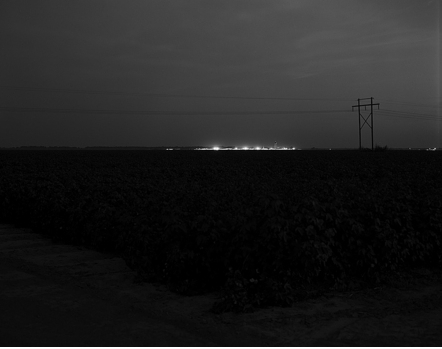
Arkansas Death House, Prison, Grady, AK, 2007. Stephen Tourlentes

Arkansas Death House, Prison, Grady, AK, 2007. © 2009 Stephen Tourlentes

PB. Are there any notorious prisons that you want to photograph or avoid precisely because of their name?

ST. No I’m equally curious and surprised by each one I visit. There are certain ones that I would like to re-visit to try another angle or see during a different time of year. I usually go to each place with some sort of expectation that is completely wrong and requires me to really be able to shift gears on the fly.

PB. You have described the Prison as an “Important icon” and as a “General failure of our society”. Can you expand on those ideas?

ST. Well the sheer number of prisons built in this country over the last 25 years has put us in a league of our own regarding the number of people incarcerated. We have chosen to lock up people at the expense of providing services to children and schools that might have helped to prevent such a spike in prison population.

The failure is being a reactive rather than a proactive society. I feel that the prison system has become a social engineering plan that in part deals with our lack of interest in developing more humanistic support systems for society.

PB. It seems that America’s prison industrial complex is an elephant in the room. Do you agree with this point of view? Are the American public (and, dare I say it, taxpayers) in a state of denial?

ST. I don’t know if it’s denial or fear.  It seems that it is easier to build a prison in most states than it is a new elementary school. Horrific crimes garner headlines and seem to monopolize attention away from other types of social services and infrastructure that might help to reduce the size of the criminal justice system. This appetite for punishment as justice often serves a political purpose rather than finding a preventative or rehabilitative response to societies ills.
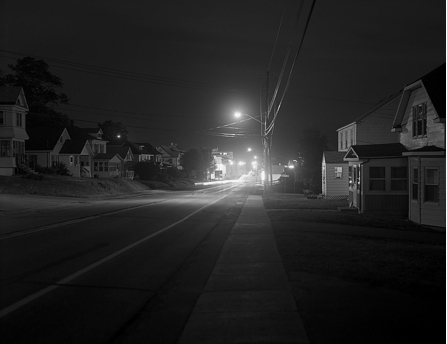
State Prison, Dannemora, NY, 2004. Stephen Tourlentes

State Prison, Dannemora, NY, 2004. © 2009 Stephen Tourlentes

Prison, Castaic, CA, 2007. Stephen Tourlentes

Prison, Castaic, CA, 2007. © 2009 Stephen Tourlentes

Federal Prison, Atwater, CA, 2007. Stephen Tourlentes

Federal Prison, Atwater, CA, 2007. © 2009 Stephen Tourlentes

Utah State Death House Complex, Draper, UT, 2002. Stephen Tourlentes

Utah State Death House Complex, Draper, UT, 2002. © 2009 Stephen Tourlentes

PB. How do you think artistic ventures such as yours compare with political will and legal policy as means to bring the importance of an issue, such as prison expansion, into the public sphere?

ST. I think artists have always participated in bringing issues to the surface through their work. It’s a way of bearing witness to something that collectively is difficult to follow. Sometimes an artist’s interpretation touches a different nerve and if lucky the work reverberates longer than the typical news cycle.

PB. In your attempt with this work to “connect the outside world with these institutions”, what parameters define that attempt a success?

ST. I’m not sure it ever is… I guess that’s part of what drives me to respond to these places. These prisons are meant to be closed systems; so my visual intrigue comes when the landscape is illuminated back by a system (a prison) that was built by the world outside its boundaries. It’s a bit like sonic feedback… maybe it’s the feedback of exile.

PB. Are you familiar with Sandow Birk’s paintings and series, Prisonation? In terms of obscuring the subject and luring the viewer in, do you think you operate similar devices in different media?

ST. Yes I think they are related. I like his paintings quite a lot.  The first time I saw them I imagined that we could have been out there at the same time and crossed paths.

PB. Many of your prints are have the moniker “Death House” in them, Explain this.

ST. I find it difficult to comprehend that in a modern civilized society that state sanctioned executions are still used by the criminal justice system. The Death House series became a subset of the overall project as I learned more about the American prison system. There are 38 states that have capital punishment laws on the books. Usually each of these 38 states has one prison where these sentences are carried out. I became interested in the idea that the law of the land differed depending on a set of geographical boundaries.

Federal Prison, Victorville, CA, 2007. Stephen Tourlentes

Federal Prison, Victorville, CA, 2007. © 2009 Stephen Tourlentes
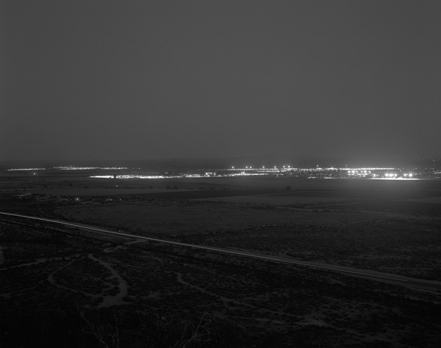
Prison Complex, Florence, AZ, 2004. Stephen Tourlentes

Prison Complex, Florence, AZ, 2004. © 2009 Stephen Tourlentes

Lancaster State Prison, Lancaster, CA, 2007. Stephen Tourlentes

Lancaster State Prison, Lancaster, CA, 2007. © 2009 Stephen Tourlentes

PB. Have you identified different reactions from different prison authorities, in different states, to your work?

ST. The guards tend not to appreciate when I am making the images unannounced. Sometimes I’m on prison property but often I’m on adjacent land that makes for interesting interactions with the people that live around these institutions.  I’ve had my share of difficult moments and it makes sense why. The warden at Angola prison in Louisiana was by far the most hospitable which surprised me since I arrived unannounced.

PB. What percentage of prisons do you seek permission from before setting up your equipment?

ST. I usually only do it as a last resort.  I’ve found that the administrative side of navigating the various prison and state officials was too time consuming and difficult. They like to have lots of information and exact schedules that usually don’t sync with the inherent difficulty of making an interesting photograph.  I make my life harder by photographing in the middle of the night.  The third shift tends to be a little less PR friendly.

PB. What would you expect the reaction to be to your work in the ‘prison-towns’ of Northern California, West Texan plains or Mississippi delta? Town’s that have come to rely on the prison for their local economy?

ST. You know it’s interesting because a community that is willing to support a prison is not looking for style points, they want jobs. Often I’m struck by how people accept this institution as neighbors.

I stumbled upon a private prison while traveling in Mississippi in 2007. I was in Tutweiler, MS and I asked a local if that was the Parchman prison on the horizon.  He said no that it was the “Hawaiian” prison. All the inmates had been contracted out of the Hawaiian prison system into this private prison recently built in Mississippi. The town and region are very poor so the private prison is an economic lifeline for jobs.

The growth of the prison economy reflects the difficult economic policies in this country that have hit small rural communities particularly hard. These same economic conditions contribute to populating these prisons and creating the demand for new prisons. Unfortunately, many of these communities stake their economic survival on these places.

Kentucky State Death House, Prison, Eddyville, KY, 2003. Stephen Tourlentes

Kentucky State Death House, Prison, Eddyville, KY, 2003. © 2009 Stephen Tourlentes

PB. You said earlier this year (Big, Red & Shiny) that you are nearly finished with Of Lengths and Measures. Is this an aesthetic/artistic or a practical decision?

ST. I’m not sure if I will really ever be done with it.  From a practical side I would like to spend some time getting the entire body of work into a book form. I think by saying that it helps me to think that I am getting near the end.  I do have other things I’m interested in, but the prison photographs feel like my best way to contribute to the conversation to change the way we do things.

________________________________________

Author’s note: Sincerest thanks to Stephen Tourlentes for his assistance and time with this article.

________________________________________

Stephen Tourlentes received his BFA from Knox College and an MFA (1988) from the Massachusetts College of Art in Boston, where he is currently a professor of photography. His work is included in the collection at Princeton University, and has been exhibited at the Revolution Gallery, Michigan; Cranbook Art Museum, Michigan; and S.F. Camerawork, among others. Tourlentes has received a John Simon Guggenheim Foundation Fellowship, a Polaroid Corporation Grant, and a MacDowell Colony Fellowship.

________________________________________

This interview was designed in order to compliment the information already provided in another excellent online interview with Stephen Tourlentes by Jess T. Dugan at Big, Red & Shiny. (Highly recommended!)

© 2009 Jerome Brunet Photography. All rights reserved.

© 2009 Jerome Brunet Photography. All rights reserved.

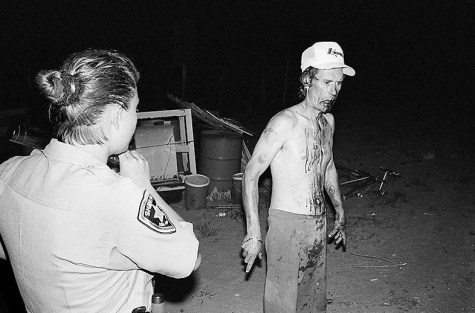
Jérôme Brunet‘s photo essay Riding Shotgun with Texas Sheriff’s is a ferocious document of police activity and procedure in America’s ‘love-to-hate’ lone star state. I am in deep admiration of this project for it connects the dots and marries everything in a police officer’s routine from violent confrontation to mundane paperwork.

Brunet spent six months with Texas Sheriffs and the stark quality of his work demonstrates that.

Brunet’s work inevitably features sites of incarceration, but I contend viewers are more shocked Brunet’s depictions of inhumanity on the highways (and front yards) than they are of inhumanity within the confines of state institutions.

Prison Photography Blog embraces complexity and unanswerable questions and Brunet poses many. Prisons and jails are not isolated from society but a point of destination and departure throughout the cyclical mechanisms of state authority. It is right to feature a project that merges the chaotic unknowns (crime scenes) and prevailing controls (sites of incarceration) of police activity.

Brunet explains:

When asked why I’m interested in law enforcement, I’m compelled to reply, “We all should be.” The fact that we know so incredibly little about our ‘boys in blue’ all though we see them on our street corners and of course in more dramatized versions on television and in Hollywood, I’ve always been interested in the symbolic aspect of the modern day police officer; the man with the badge, gun and authority to dramatically change a persons life forever. Societies apparent answer to all life’s little and not so little problems. However bleak and insignificant a situation may seem, officers are constantly dealing with lost children, family quarrels, various assemblies of homeless and confronting each day, the violence and corruption humanity inflicts on each other everyday.

55

© 2009 Jerome Brunet Photography. All rights reserved.

Much of the Sheriff’s department’s work is devoted to tackling drug-smuggling and again Brunet comments with incredible even-handedness

Roads linking Mexico to the U.S., such as the I-10, are sensitive arteries of a flourishing contraband. Even though another deputy in a deep sigh, admitted to me catching only ten percent of the actual traffic, a task force made up of U.S. Customs, D.E.A., Texas and New Mexico police have seized over 30 kilos of heroin, 2 tons of cocaine and 75 tons of marijuana. Even though these quantities sound enormous, actually landing on a large bust was a different story, only luck and perseverance enabled me to land on what was to be one of US’s largest single drug bust in US’s history. As a nervous Mexican driver arrives at the U.S. border and a routine check is made on his car, officers reveal neatly packed away in the trunk, 23.3 pounds of black tar heroin, estimated at 24 million dollars. This package is later revealed to the local press in Hollywoodesque fashion. I watch in amazement and think of the outcome of this Mexican peasant paid 1000 dollars to transport this load into the land of the free.

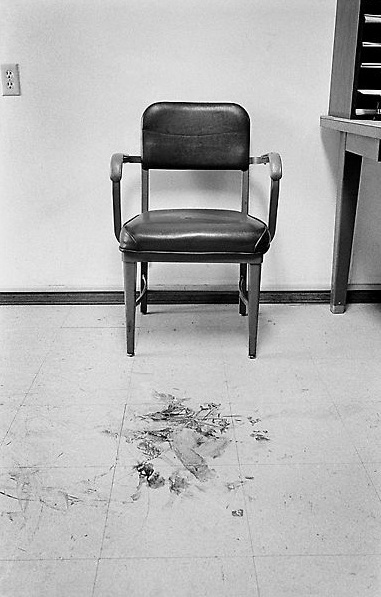
As an editorial decision, I have not included Brunet’s images of the station or officers’ meetings, but they are as vital as the images from within the jail. The images inform one another.

Here are two desperate images from the station and I’d like to know the exact context. I shall not speculate, only present.

45

© 2009 Jerome Brunet Photography. All rights reserved.

37

© 2009 Jerome Brunet Photography. All rights reserved.

Brunet offers insights into El Paso County Jail:

Texas, the second largest state in the U.S. also boasts the highest rate of incarceration (700 for 100 000). In an ultramodern county jail of El Paso, Texas, I witnessed different aspects of “the inside world”. Body searches, finger printing and delousing before the anonymous inmate dons the regulation blue overalls inscribed E.P.C.D.F. (El Paso County Detention Facility). On the top floor is the outdoor gym, from which you can admire the end of the Rocky Mountains and the beginning of the Sierra Madre into Mexico. Caged like lions, 40 federal prisoners await transport to a large prison. I am placed alone with one guard in this cage. Surprisingly enough, like a ghost, I hover through the crowd unnoticed, my heart beating for what felt like an eternity. Prisoners can only be exposed to the natural light of the gymnasium a sparsely granted privilege of only three hours a week.

65

© 2009 Jerome Brunet Photography. All rights reserved.

The photo essay even covers tactical training exercises.

An afternoon spent with the elite S.R.T. (Sheriff Reaction Team) proved to provide more excitement. This team made up of tough looking officers is specially trained to counter an unlikely riot in the prison. I was presented a billboard full of makeshift weapons made by previous inmates, everything from hand sharpened spikes, to knives made out of tooth brush handles with razor blades attached to their ends. All used for assassination purpose by gang members thriving too in the “inside world”.

18

© 2009 Jerome Brunet Photography. All rights reserved.

Brunet has admiration for officers “just like you and me”, whose work is unpredictable and occasionally very dangerous.

We will find in the police officers, goodness, honesty, corruption and brutality. In many cases we are the police, and like it or not we are responsible of their actions as much as our own. The more we know about them, the more we observe and tie ourselves to them, and the more this society will feel secure. This realistic testimony succeeds in making us share a few privileged moments into the life of these Texas and New Mexico cops as well as revealing the true backdrop of American culture.

Unlike other reportages of state authority, Brunet is keen to impress the absence of racial inequalities of power.

The majority of the men and women I interacted with were primarily Hispanic. Because of their ancestry they were able to bring forth a much appreciated warmth and understanding that I and, I’m sure, the rest of the townspeople, who were also Hispanic, enjoyed and accepted openly.

_________________________________________

Jérôme Brunet is a freelance photojournalist Jérôme Brunet was born in southern France and raised in London, Ontario (Canada). After obtaining his O.S.S.D. majoring in visual arts, he started his post secondary education in Paris, France, at the E.F.E.T. School of Photography, graduating in 1997. Jérôme Brunet has been published internationally through such diverse publications as Rolling Stone Magazine, Forbes and The New York Times. His client list includes The Discovery Channel, Fender Musical Instruments, Nikon Imaging Inc. and is currently featured on the official websites of musicians Eric Clapton, Carlos Santana and James Brown. Jérôme Brunet is currently working and residing in the Bay Area of San Francisco and is represented internationally by the Zuma Press agency.

Jérôme Brunet also takes portait pictures of musicians here and here.

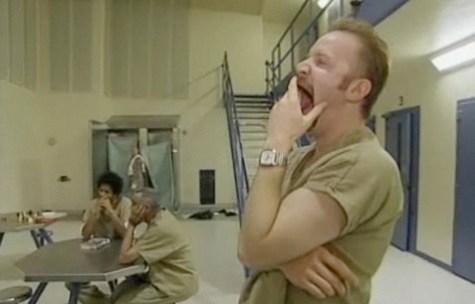
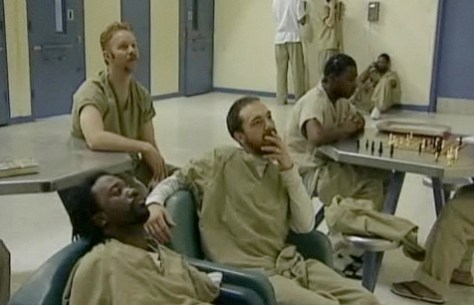
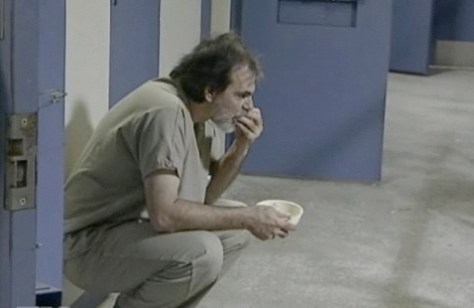
Morgan Spurlock is a decent guy. I’d like to have a beer with him. He lays it out straight. Prisons & jails are boring and hopeless. He knows this because he spent 30 days in a county jail just outside of Richmond, Virginia.

24

Spurlock nails it. “One of the most surprising things about prison is that you are pretty much left on your own. all you can do is kinda suck it up and fall into a pattern. I’m gonna get up, gonna eat, gonna play cards, gonna watch TV, gonna do some push ups, do some sits ups, write a letter, read a book….”

He continues, “People will be in their rooms or down here – just hanging out, you know, on the phones. The punishment is the monotony. This is it. You don’t have to think. You’re in jail. There is no thinking involved. And you’re feeding the machine. And you feel like that … you don’t feel like a person in a lot of ways.”

64

44

Spurlock elaborates “I haven’t seen a tree in over two week;, I haven’t seen one blade of grass; I haven’t breathed fresh air. It gets to you being in here … it really does. I see people like George and Randy who keep making the same mistakes over and over and over again. What is the system doing for these guys? They’re stuck! I see this cycle that were putting people in and punishing people for problems we could be helping them with. And the prisons and jails are just becoming a dumping ground. It really is a place that feels hopeless.”

36

54

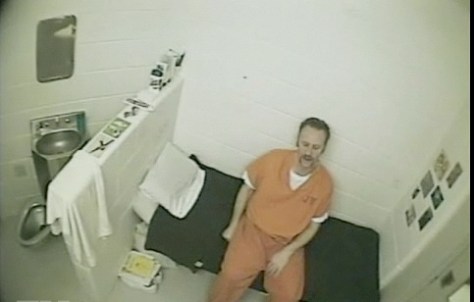
Spurlock even challenged his sanity by agreeing to a 72 hours stretch in solitary confinement. Spurlock couldn’t comprehend how Randy (mentioned earlier) spent a year in solitary.

17

Great series. Great episode. Sobering reality. Spend 45 minutes of your life and witness the monotonous and expensive warehousing of society’s misfits.

An interior view of the dining facility at the newly opened Baghdad Central Prison in Abu Ghraib on February 21, 2009 in Baghdad, Iraq. Wathiq Khuzaie for Getty Images Europe.

An interior view of the dining facility at the newly opened Baghdad Central Prison in Abu Ghraib on February 21, 2009 in Baghdad, Iraq. Wathiq Khuzaie for Getty Images Europe.

Yesterday, my good friend Debra Baida sent me through the link to the New York Times Abu Ghraib – Baghdad Bureau Blog. This came at the same moment I was preparing a post to discuss the first images to come out of the renamed, refurbished and relaunched Baghdad Central Prison.

By far the best, and possibly the only, extended photo essay of Abu Ghraib Baghdad Central Prison is by Wathiq Khuzaie of Getty Images Europe. There is also this brief video from the BBC.

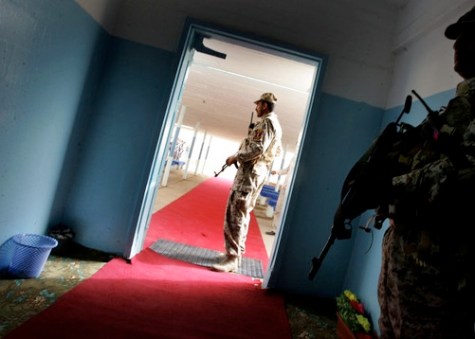
Iraqi security personnel stand guard at the newly opened Baghdad Central Prison in Abu Ghraib on February 21, 2009 in Baghdad, Iraq. The Iraqi Ministry of Justice has renovated and reopened the previously named "Abu Ghraib" prison and renamed the site to Baghdad Central Prison. Wathiq Khuzaie/Getty Images Europe

Iraqi security personnel stand guard at the newly opened Baghdad Central Prison in Abu Ghraib on February 21, 2009 in Baghdad, Iraq. The Iraqi Ministry of Justice has renovated and reopened the previously named "Abu Ghraib" prison and renamed the site to Baghdad Central Prison. Wathiq Khuzaie/Getty Images Europe

New Era, New Penology

The BBC noted, “Along with the change of name, the Iraqi justice ministry is trying to change both image and reality, billing it as a model prison, open to random inspection by the Red Cross and other humanitarian organisations.”

This transparency is a refreshing change to the policy of Abu Ghraib’s former operators. The work is not yet complete though and the upgrade is ongoing. The BBC describes, “[The prison] will eventually be the city’s main jail, holding about 12,000 inmates. Initially, only one of its four sections will be used. There are already about 300 prisoners there to test it out and, once the prison has been officially inaugurated, that figure will rise to 3,500.”

So, not only do Iraqi authorities want to repurpose the institution, they want to make it the penal institution of “The New Iraq”. This is an ambitious policy riddled with dangers; the site is loaded with memory and controversy. As the New York Times notes, “the promise of a new era can also be a time for remembrance.”

I highly recommend one goes onto read accounts from Iraqis, correspondents and photographers who lived and recorded Abu Ghraib’s recent history, particularly photographer Tyler Hicks’ account of Saddam’s prison amnesty in October 2002 that turned from celebration to human catastrophe.

Wathiq Khuzaie/Getty Images Europe

Wathiq Khuzaie/Getty Images Europe

An interior view of one of the cells at the newly opened Baghdad Central Prison in Abu Ghraib on February 21, 2009 in Baghdad, Iraq. Wathiq Khuzaie/Getty Images Europe

An interior view of one of the cells at the newly opened Baghdad Central Prison in Abu Ghraib on February 21, 2009 in Baghdad, Iraq. Wathiq Khuzaie/Getty Images Europe

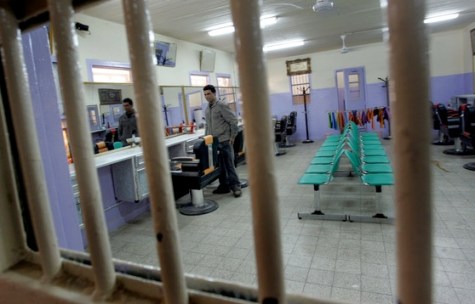
Two things struck me about the photographic series of the new prison. Firstly, the number of flags, insignia and national colours across walls, above fences and emblazoned on uniforms. The Iraqi authorities have stamped their identity all over this project. It is the presentation necessary to supersede Abu Ghraib’s reputation.

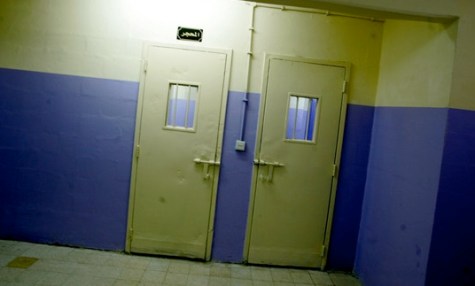
Secondly, the pastel palette of many of the interior shots – namely the ubiquitous lilac. I want to know who has the decision-making power at Baghdad Central Prison! However, I suspect lilac paint was cheap and readily available; so it wasn’t so much a decision – more a fact created by circumstance.

Interior view of the barbers shop at the newly opened Baghdad Central Prison in Abu Ghraib on February 21, 2009. Wathiq Khuzaie/Getty Images Europe.

Interior view of the barbers shop at the newly opened Baghdad Central Prison in Abu Ghraib on February 21, 2009. Wathiq Khuzaie/Getty Images Europe.

Following that logic, one could presume lilac and purple fabric & thread is also at a surplus in Baghdad…

Interior view of sewing machines at the newly opened Baghdad Central Prison in Abu Ghraib on February 21, 2009. Wathiq Khuzaie/Getty Images Europe.

Interior view of sewing machines at the newly opened Baghdad Central Prison in Abu Ghraib on February 21, 2009. Wathiq Khuzaie/Getty Images Europe.

I don’t want to sound facetious, I was just shocked by the light purple, which according to colour theory is supposed to evoke emotional memory and nostalgia. Darker purples are supposed to represented, nobility, royalty and stability. From those evocations one is instilled with wisdom, independence, dignity and creativity.

If Baghdad Central Prison is to spur such emotional response in its inmate population it will succeed where many, many prisons have failed.

Basically, I am hopeful that the new prison can operate justly and succeed with the rehabilitation it emphasised this week. And despite all the lilac, soft-furnishings and current open media access – in reality it remains a prison with doors, locks and guards.

Interior view of cell doors at the newly opened Baghdad Central Prison in Abu Ghraib on February 21, 2009 in Baghdad, Iraq. The Iraqi Ministry of Justice has renovated and reopened the previously named "Abu Ghraib" prison and renamed the site to Baghdad Central Prison. According to the Iraqi Ministry of Justice about 400 prisoners were transferred to the prison which can hold up to 3000 inmates. The prison was established in 1970 and it became synonymous with abuse under the U.S. occupation. Wathiq Khuzaie/Getty Images Europe.

Interior view of cell doors at the newly opened Baghdad Central Prison in Abu Ghraib on February 21, 2009 in Baghdad, Iraq. The Iraqi Ministry of Justice has renovated and reopened the previously named "Abu Ghraib" prison and renamed the site to Baghdad Central Prison. According to the Iraqi Ministry of Justice about 400 prisoners were transferred to the prison which can hold up to 3000 inmates. The prison was established in 1970 and it became synonymous with abuse under the U.S. occupation. Wathiq Khuzaie/Getty Images Europe.

EMAIL

prisonphotography [at] gmail [dot] com

Prison Photography Archives

Post Categories