After spending the last 50 years of his life behind bars, 75 year old Earl Reinhardt is about to be set free. He is completely unprepared and has no money, no destination, and no family or friends to help him when he walks out the prison door. Sarah Bones

After spending the last 50 years of his life behind bars, 75 year old Earl Reinhardt is about to be set free. He is completely unprepared and has no money, no destination, and no family or friends to help him when he walks out the prison door. Sarah Bones

“What happens when a 75 year old who has spent his last 50 years behind bars gets released?” This is the questions Sarah Bones asks in a careful study of Earl. Earl has no plans, no money and no destination. He makes this clear to those in positions to aid his assimilation into society and yet, after he leaves prison, he predictably turns up homeless and seemingly alone.

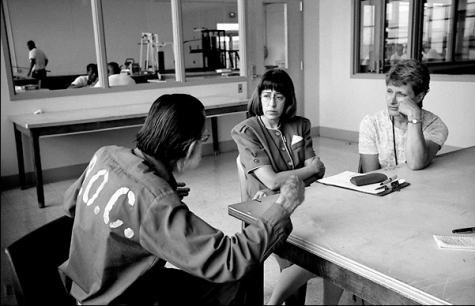
At an exit interview in Laural Highlands SCI in Somerset, Pennsylvania, Earl tells the prison social workers that he doesn't want to leave and he is confused about where to go and how to survive. Sarah Bones

At an exit interview in Laural Highlands SCI in Somerset, Pennsylvania, Earl tells the prison social workers that he doesn't want to leave and he is confused about where to go and how to survive. Sarah Bones

Bones does an excellent job with the captions pointing out the realities of Earl’s modest life – keeping warm in the library, eating at soup kitchens, avoiding queues at the health center, unable to find work, wearing the same prison jacket – only with his name crossed out. Earl explains over coffee that living homeless is tough and he wishes he was back inside. Bones’ photography is evidence that for a lot of former inmates the common experience after release is homelessness. Being outside the prison walls is to be outside all walls.

Earl thinks that if he keeps a low profile and stays quiet they will forget to release him. Sarah Bones

Earl thinks that if he keeps a low profile and stays quiet they will forget to release him. Sarah Bones

Earl is unable to wrap his head around his imminent reentry into the free world so he shuffles and hides around the prison hoping the prison authorities will forget about him. I think the same denial would strike pensioner who hadn’t walked free since the early 1950s as a young twenty-something.

Still wearing his prison jacket only now with his name crossed out, Earl stands underneath an abandoned storefront roof to stay dry. Sarah Bones.

Still wearing his prison jacket only now with his name crossed out, Earl stands underneath an abandoned storefront roof to stay dry. Sarah Bones.

After Earl’s release Bones searched for him. She found him in his home town a few hours from the prison. He had taken greyhound. For three months, Earl lived on the streets. He fell down some stairs, and thereafter was admitted to Reading hospital. Earl was hospitalised for 8 weeks and then taken into permanent nursing home care. During his three months on the street, Earl often showed his prison ID to people he met. His institutional identity was one of the few things he had, and when he ended in up in permanent nursing care one feels that a return to an institution, without the stresses of life outside, was a positive result for Earl. Maybe.

Earl flashes his prison ID photo card when approached. It is all that he has to show for himself. Sarah Bones

Earl flashes his prison ID photo card when approached. It is all that he has to show for himself. Sarah Bones

There have been several photo essays done about prison release, but often they feature men with a story to define based on their own choices. These men are younger prisoners who usually return to complex communities, daily decisions, and family interaction. Or the inmate is the exonerated after an overturned sentence. Vance Jacobs did a great series covering Alan Crotzer’s story of exoneration after 25 years for a crime he didn’t commit.

Earl’s case seems very different. It doesn’t seem Earl had many choices … or ones that he was aware of. Sarah Bones completed this series in 2002/03. Earl died in July 2005.

Of Bones’ other work, I am particularly struck by three photographs from East Africa which includes two heartwrenching portraits of AIDS sufferers shunned by their families and a top-drawer portrait which deserves an essay in itself. Please view Bones’ other photo essays on Rwandans lives 15 years after the genocide and her Lightstalkers gallery which includes her work for the Sierra Leone Global Action Foundation.

Sarah S. Bones is a self-taught, award-winning, internationally-exhibited photographer. Sarah saved for her first 35mm camera at age 13. She has documented peoples’ stories in Cuba, Guatemala, Kenya, India, Rwanda, Sierra Leone, Somalia and Tanzania. In the Pennsylvania area, she has photographed in prisons, homeless shelters and on political campaigns. Bones tells the stories of men, women, and children who are voiceless and too often ignored by the popular media.

This has absolutely nothing to do with photography. The matter-of-fact second answer is outshone by the hasty confusion of the first.

Question: How much is a card from prison worth?

Answer: Like, if you sold a letter from someone in prison?! Nothing. Why would people want to buy a letter from a criminal?!

Answer: In a game of monopoly, depending on the house rules, around $50.

Get Out Of Jail Free Card

Get Out Of Jail Free Card

Source: Original Wiki Page

Update: Prison Photography collated a Directory of Photographic & Visual Resources for Guantanamo in May 2009.

U.S. Army 1st Lt. Sarah Cleveland
A detainee kicks a soccer ball around the central recreation yard at Camp 4, Joint Task Force (JTF) Guantánamo Bay, Cuba, June 10, 2008, during his daily outdoor recreation time. Detainees in Camp 4 get up to 12 hours of daily of outdoor recreation, including two hours in a central recreation yard. Photo Credit: U.S. Army 1st Lt. Sarah Cleveland

Just gratefully recieved a nudge from an urban conspirator to check out these 30 vetted photographs posted on the Boston Globe website. Obviously, many were taken during the same media tour I mentioned in the last post. Enjoy!

Update: Prison Photography collated a Directory of Photographic & Visual Resources for Guantanamo in May 2009.

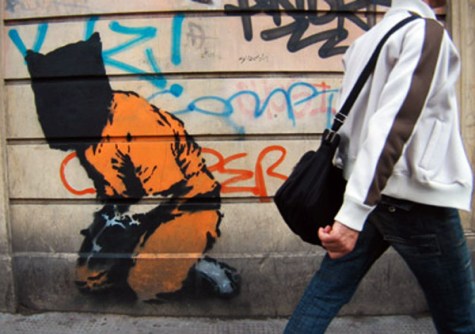
Guantanamo Prisoner, Political Graffiti. Banksy

Guantanamo Prisoner, Political Graffiti. Banksy

Anyone who says the recent media tour of Guantanamo isn’t a public relations exercise by the lame duck has not had their eyes open. Global media were given a tour of camps 4, 5 and 6 at Gitmo and all the footage was screened and vetted before release.

Video: Here is the Guardian’s three minute offering. With any hope Obama will put this illegal operation out of action in 2009.

Artistic legacy of Guantanamo

Guantanamo Protesters outside the US Embassy, London

Guantanamo Protesters outside the US Embassy, London

Meanwhile, we can think of the potency that the orange jump-suit has gained. It’s another icon of the Bush presidency. With regard it’s establishment and its bare-faced operations, Guantanamo was far outside of the public’s imagination. Our culture stomached the guilt and under the Bush administration it was never likely Guantanamo prison would be brought back into line with international law. Activist and non-activist art protested Guantanamo by subverting the camp’s own visual vocabulary.

UHC Collective. Art Instalation, Manchester, 2003. Guards with replica guns were on duty 24 hrs and followed a regime copied from media reports.

UHC Collective. "This is Camp X-Ray". Art Installation, Manchester, 2003. Guards with replica guns were on duty 24 hrs and followed a regime copied from media reports.

Back on my home turf in Manchester, UHC, a notoriously bold and inventive art collective, scaled up a version of Camp X-Ray on an unused lot in Withington. It was complete with guard towers, fake guns and orders and activity that replicated the media’s reports of Guantanamo, Cuba. See other UHC Projects here, and read the BBC report here.

Road to Guantanamo (2006). A Michael Winterbottom Film

Road to Guantanamo (2006). A Michael Winterbottom Film, Spanish Release

And while we are not focusing entirely on photography, slightly off topic with video, I cannot recommend Road to Guantanamo highly enough. The film tells the ridiculous story of three young British-Pakistanis who were in the wrong place at the wrong time (southern Afghanistan, November 2003), and ended up in Guantanamo for 2 years. Your jaw will not leave the floor.

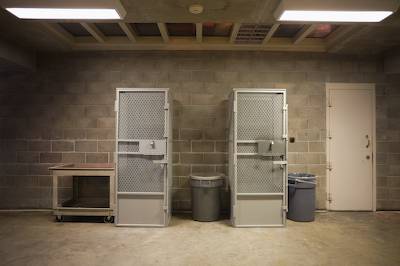
Holding cells, general population area, Security Housing Unit, Pelican Bay State Prison, Crescent City, California. Richard Ross

Holding cells, general population area, Security Housing Unit, Pelican Bay State Prison, Crescent City, California. Richard Ross

In this response to Richard RossArchitecture of Authority I’d like to discuss two pictures – the first, Interview room, Abu Ghraib prison (“hard site”), Abu Ghraib, Iraq and the second, the Detainee housing unit, Camp Remembrance, new Abu Ghraib Prison, Iraq.

There is rich discussion to be had with Richard Ross’ Architecture of Authority. Political footings jockey with ethical inertia, jockey with instructional histories, jockey with considerations of the soul. Readings thick and fast. No less, these meta-narratives are deformed by one’s own emotional interruptions. One recollects perhaps passages and interrogations through border controls, transport hubs, reception rooms and state corridors. One recalls school, streets and flaking paint.

Random knowledge bombards the equation, – Raves at Ansthruther’s decommissioned nuclear command centre during university days; A deliberate detour made during honeymoon to locate Pelican Bay maximum security prison; An introduction at San Francisco International.

My good friend, and Hesitating co-conspirator, Keith Axline recently featured Richard Ross in a Wired gallery. Keith explained to me that it is Ross’ ability to rattle shutter and catch the necessary shot every time that impressed him most. Ross’ manipulations are in spite of the unpredictable (and sometimes unexpected) access to the different sites. Ross prevails with perseverance; “No never really means no;” and aggressive networking (Ross’ chances of accessing Abu Ghraib depending largely on the trust and recommendations of military personnel he liaised with for his Guantanamo work).

Ross gets the shot he needs, even when he has only a limited number of exposures, and a limited amount of time. More surprising, Ross achieves this with almost perfect tonal harmony throughout the collection of prints. This said, Ross’ technical prowess is not my concern here, rather the gaps and routes between the images he has assembled. Ross consistently presents isolation, the viewer consistently seeks human incidence.
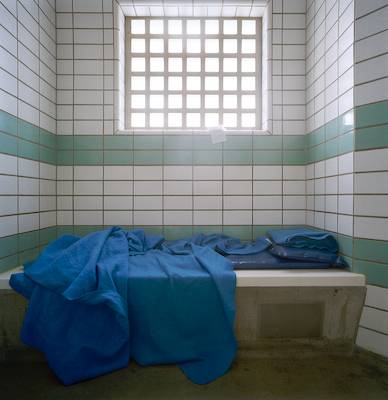
Holding cells, Metropolitan Police, Collingwood Road, Hillingdon, London. Richard Ross

Holding cells, Metropolitan Police, Collingwood Road, Hillingdon, London. Richard Ross

One is compelled when looking at Richard Ross’ starkly depicted environments to search out the signs of life. On a few occasions one is rewarded, a curious tourist looks back at us from atop Syria’s Craq de Chevalier Crusader Fort; a heart shaped paperweight and polystyrene cup sit on the judge’s bench in Santa Barbara’s superior court; an open bag, that will travel home with its owner, sits at the foot of a movie executive’s desk. The loose blanket left in the cell at Hillingdon Road Jail presses us to fleetingly wonder if the person who unfolded and used the blanket in the cell earlier, will be back in the cell later, possibly to use the blanket once more.

The praying figure in Istanbul’s Blue mosque is representative of the building’s purpose. He is a motif of religious expression. The security guard at Topkapi is frozen rigid behind the glass, which serves to separate him from the viewer and present him as a part of the larger observing machinery. How different the shot would be if the guard stared straight down the camera lens? I imagine Ross made a few exposures in which the man did face the camera, but Ross prefers to keep attention on the environment. It is temperate and logical for Ross to choose an image in which the guard looks like a wax model – like a construction.

The austerity of The Architecture of Authority as a collection is hard to deal with. The geographical and institutional reach of the project is impressive. Inconceivably, across this wide subject matter Ross seems to have control in all the locations. Ross distills the form of each site and presents that bare form as the key to understanding the sites function.

Segregation Cells, Camp Remembrance, new Abu Ghraib prison, Abu Ghraib, Iraq. Richard Ross

Segregation Cells, Camp Remembrance, new Abu Ghraib prison, Abu Ghraib, Iraq. Richard Ross

To my mind, Ross has control in all the locations bar two. The old Abu Ghraib “Hardsite” and the new Abu Ghraib prison. In both forms, Abu Ghraib was a site of photographic desperation for Ross – he was forced briefly to compromise the overall tonality of his project.

The interrogation room is disordered. This room was not designed for interrogation purposes by the American military. It has inconvenient features such as two windows (one barred and boarded), an electrical box, a dusty fire extinguisher, exposed wires, a fallen map, makeshift furniture and used soda cans. There is also a plugged-in laptop, unidentified hold-all bags and what appear to be loose wire on the floor. There is a can or tub of something half-concealed behind the nearest chair. It seems to get more ridiculous the closer you look. There are two camp beds, one folded against the wall with a bag of belongings at the foot. What filled the bookcase? Why did Ross’ guides show him here? Is this an interrogation room? It looks like a sparse room for visiting guests. Is every room at the old Abu Ghraib, de facto, an interrogation room?

Interview room, Abu Ghraib prison ("hard site"), Abu Ghraib, Iraq

Interview room, Abu Ghraib prison ("hard site"), Abu Ghraib, Iraq. Richard Ross

There has been much made of the juxtapositions between photos presented in the Architecture of Authority book and exhibitions; between schools and prisons; between barracks and mental asylums. It is Ross’ right and responsibility to guide his audience in ways of seeing. But there is enough information, memory and rituals of communication embedded in any of Ross’ individual images to warrant singular assessment.

Humans in Ross’ pictures never threatens to steal attention for very long. The narrative of the building or structure dominates the narrative of the individual. There are moments when Ross’ photographs effortlessly adopt the surveillance philosophies of each object – bank, London tube station, hotel phone booths, or the confessional. This is part the photographers skill but also the unavoidable disclosure upon sight of the modes of each disciplining, single-purpose site.

Some sites are more difficult to read than others. Ross was in new Abu Ghraib as a guest, he had a guide. The fact he included a second image counter to his over all vision reveals, not unsurprisingly, that Ross would take what he could get from his tour of new Abu Ghraib, also.
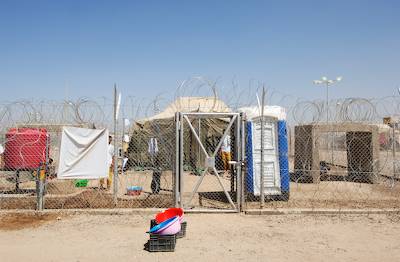
Detainee housing unit, Camp Remembrance, new Abu Ghraib prison, ABu Ghraib, Iraq. Richard Ross

Detainee housing unit, Camp Remembrance, new Abu Ghraib prison, Abu Ghraib, Iraq. Richard Ross

Detainee housing unit, Camp Remembrance, new Abu Ghraib prison, Abu Ghraib, Iraq is a fierce image. It is at first glance still and linear but under a paper-thin surface it is simmering with tension. There are four detainees in this image. In Ross’ depopulated world, that is akin to a cacophonous arena crowd. The two clearly visible men are curiously peering at Ross’ activities and make a mockery of Ross’ attempt to mimic the prison’s personless eye of surveillance. A third man sits in the shade to the right of the image reading and otherwise oblivious. A fourth man sits on the left side of the image obscured by a water tank.

The sheepish glance of one detainee and the craned neck of the other come to dominate this image the longer one looks at it. The man at the door of the tent has no shoes on. Has he just emerged in response to the photographer’s presence? These two men brilliantly illuminate the unnatural and inflexible relationships that exist across and through chain link and barbed wire. They are merely curious at this point and do not gesture or ask anything of Ross, at least not in this exposure. They have been briefly distracted from house-keeping routines by another human that is as foreign to them as any other. Proximity means nothing here for Ross and his inadvertent subjects.

The most remarkable thing about Detainee housing unit, Camp Remembrance, new Abu Ghraib prison, Abu Ghraib, Iraq is not the clarity with which Ross communicates the apparatus of power, but rather how that drains human interaction of meaning or purpose. Does this mean I’d like to see more people in Ross’ photography? Absolutely not, there are plenty of documentary photographers who are trying to convey the spectrum of human existence, and it is not Ross’ charge. It just means that upon the appearance of non-typical images the audience’s attention is gripped. The two anomalous images from Abu Ghraib draw to attention Ross’ otherwise effortless manipulation of his audience. Ross shapes and prepares his viewer for a cold interaction. His manipulation of the audience’s eye is fitting for a project that studies dominance over subjects and imposed order of authorities.

Further investigation: Good text interview. Better audio interview. Best video presentations

When intellectual withdrawal sets in, I stem the tide and sate the need at a handful of reliable dispensaries. It would seem that two weeks ago, three of my favourite cartophiles (not a word) jumped on the same bandwagon boat. The boldest at-sea-heist of the modern era had just taken place, and it seemed the misfortunes and misadventures on petrochemical distribution routes were top of everyone’s agenda. Spurred by a AP photo in the New York Times (below), the indubitable Brian Finoki focused on the inseparable threads of the pirate clique, theorising that without their vessel, the posse of pirates had only each other to stay afloat in the hard concrete prison yards of Mombasa.

AP

Eight Somali pirates sat at the Kenya Ports Authority Port Police station in Mombasa, where they are being held after being handed over to the Kenyan authorities by the Royal Navy. The eight pirates were arrested, and three others killed, by sailors of HMS Cumberland, as they attempted to hijack a cargo ship off the Horn of Africa. The pirates will be charged in a Mombasa court. Credit: AP

BLDGBLOG was twisting its melon, highlighting improv google map action along with the official sounds coming out of the International Maritime Bureau and its Live Piracy Report. Meanwhile, InfraNet Lab could only conclude that piracy was the opportunist’s career of choice given the current absence of government in Somalia.

I need my own bent on this and so refer you to Jehad Nga‘s phenomenal Pirates Inc. Somalia photo essay depicting pirates under lock and key in Boosaaso Jail & Mandhera Prison, Somalia. Nga is no slouch – he has (largely self-funded) returned to Somalia repeatedly over the past three years. It is incredibly dangerous to work within Somalia. It is more dangerous, in some regards, than in Iraq or Afghanistan where journalists can rely on isolated cordoned-safe-green-military zones and when at large, can work embedded with Western forces. But Nga is no stranger to Iraq either; as foto8 reminds us, “Nga has worked widely in Iraq on assignment for the New York Times. His image of blindfolded Iraqi prisoners arrested by US forces was used as the main publicity shot for the Oscar-winning documentary, Taxi to the Dark Side“.

Jehad Nga for The New York Times

Pirates imprisoned in Boosaaso's main jail. Photo: Jehad Nga for The New York Times

I would like Nga’s images and words to represent themselves. Words: here’s an indepth interview, from September 2008, with Nga about the situation in Somalia. Images: I have accompanied Nga’s (dare I say it) Carravagioesque prints with his own website commentary about the project:

Nga: Looking over that Somaliland naval map I noticed that the Gulf of Aden (the narrow band of ocean that separates Somalia and Yemen) and the Somali cost line were littered with upward of 100 little skull and cross bone flags. Black flags to denote ships that were successfully taken by pirates and gray for ships that were attacked by pirates but managed to escape. Most of these flags are black.

Jehad Nga for The New York Times

(Clockwise from Top Left) Mohamed Mahamoud Mohamed; Abdi Rashid Ismael Abdullahi; Farah Ismael Eid; and Abdullahi Mahamoud Mohamed, are each serving 15 years for a piracy conviction. "Believe me, a lot of our money has gone straight into the government's pockets," Farah Ismael Eid said. His pirate team typically divvied up the loot this way: 20 percent for their bosses, 20 percent for future missions, 20 percent for the gunmen on the ship, and 20 percent for government officials. Photo: Jehad Nga for The New York Times

Housed in the Mandhera Prison in Somaliland are 719 inmates 5 of whom are serving 15 yrs sentences handed down to them for their involvement in Somalia’s thriving pirate industry.

Jehad Nga

Photo: Jehad Nga

The autonomous region of Somaliland is doing their part to combat the growing influx of pirates in the gulf and coastal areas. Utilizing the small fleet of gunboats and navy personnel, they patrol their waters and on occasion escorts’ ships coming in from Yemen. Somalia, in stark contrast to Somaliland, still suffers from the turmoil that has put the country on the map for many people for the last 17 yrs, when the country made a dramatic turn from relative stability to brutal civil war in 1991.

Jehad Nga

Prisoners. Photo: Jehad Nga

Pensive and quiet the 5 men sat surrounded by prison guards and told their stories of how and why, before one by one they were ushered away and led back to their various cells shared amongst the general population of criminals in the eight block prison set miles out into the arid desert.

In recent months the port town of Boosaaso has also made a name for itself as the kidnap capital of Africa. Previously known best for being the main hub for human smuggling for Somalis eager to flee to nearby Yemen and usually coasting them their lives. With piracy on the rise and stakes getting higher, it is rumored that the money trails lead to some top government officials in the area – due to the large sums of money pirates now demand in return for a seized vessel.

Jehad Nga

Inside the Prison. Photo: Jehad Nga

Traveling through Boosaaso it is necessary and commonplace to hire a security details consisting upward of 10 local militia to be a deterrent for anyone hoping to cash in on captured a western journalist that, in the past year, has proven to fetch a good price. Maneuvering through Boosaaso we traveled with our rented army toward Boosaaso‘s main jail where currently 100 captured pirates sit out their long sentences or await trial.

In Boosaaso, if the kidnappers don’t find you the extreme heat always finds a way. In an open and shadeless courtyard, two facing jail blocks contain hundreds of prisoners literally caged to bake in the sun. The heat so heavy against your back. It was not only the hope of better pictures that tempted me to enter these filthy concrete boxes, but also escape from the looming mid day sun heavy over head.

Jehad Nga for The New York Times

"Pirates, pirates, pirates," said Gure Ahmed, a Canadian-Somali inmate of the jail. "This jail is full of pirates. This whole city is pirates." Photo: Jehad Nga for The New York Times

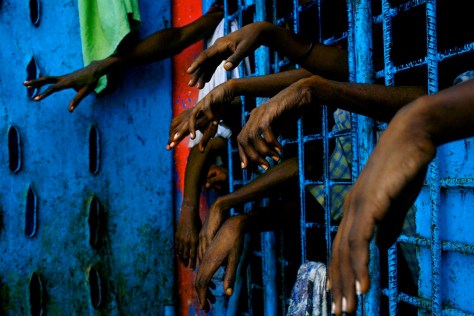
As I approached the iron bars of the blocks movement is heard and then and as came closer murmurs grew into rumbles and further until the deafening sounds of hundreds of inmates came crashing against me like a wave of anger and despair. [They] stretched their arms through the bars inviting us to listen to their stories of how they were dying in this place. Of how each of them was suffering from one disease or another.

Jehad Nga

Inmates of Boosaaso Jail. Photo: Jehad Nga

Beyond the out reached hands just eyes and parts of their faces could be made out inside the lightless rooms. Figures moving in and out of the small amount of light streaming in from the between the blue painted bars.

Jehad Nga for The New York Times

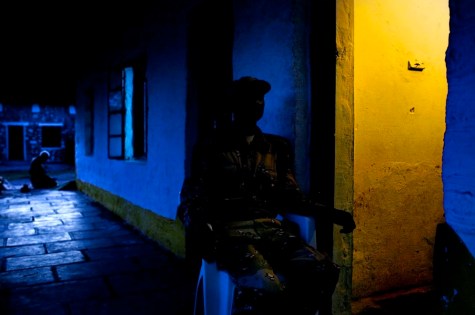
A prison guard inside Mandhera Prison. Photo: Jehad Nga for The New York Times

As pirates are proud of their catch so are the guards of  these jails. They know that their numbers will remain consistent as long as Pirate season persists in the Somali waters. No slow down is the trend in expected as little international help has been organized, and with numbers of active pirates in these waters continuing to grow even that help seems, in some ways, futile.

View Jehad Nga’s other work at his website

View his New York Times photo essay here

Read an interview with a pirate here

Herman Krieger – stalwart of the Oregon photography community and Eugene resident – is a self-made specialist in the art of captioning. However, more than his quirky words, I appreciate the great lengths he goes to in order to document sites of the prison industrial complex.

View from Boise Gun Club, New Idaho State Prison. Herman Krieger

View from Boise Gun Club, New Idaho State Prison. Herman Krieger

Krieger described the circumstances of the series, “The idea of making a photo essay on prisons and their settings came after driving from Tucson to Phoenix.  The view of the prison in Florence, Arizona struck me as an odd thing in the middle of the landscape.  At that time I was only looking at churches for the series, Churches ad hoc.

With Lifetime Mortgage, Vacaville, California. Herman Krieger

With Lifetime Mortgage, Vacaville, California. Herman Krieger

“I then made some photos of prisons in Oregon and California. Others were made during a trip by car from Oregon to New York. I would have made a longer series, but I was too often hassled by prison guards who noticed me pointing a camera at a prison.  They claimed that it was illegal to take a photo of the public building from a public road, and threatened to confiscate my film”, explained Krieger.

Room Without a View, Pelican Bay, California. Herman Krieger

Room Without a View, Pelican Bay, California. Herman Krieger

Pelican Bay was opened in 1989 and constructed purposefully to hold the most violent offenders, usually gang members. Along with Corcoran State Prison, in the late 1980s, Pelican Bay ushered in a new era of Supermax facilities in California. They are remote (Pelican Bay is just miles from the Oregon border) and they are expansive. Their distant locations prohibit regular visits from inmates’ family members – a detail probably not lost on the CDCR authorities who sought to transfer, contain and stifle the aggressions of Californian urban areas.

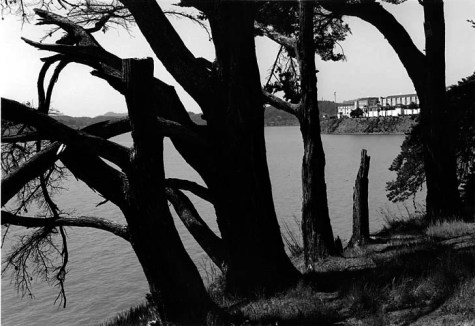
Bayside View, San Quentin, California. Herman Krieger

Bayside View, San Quentin, California. Herman Krieger

Having lived in San Francisco for three years, the policies, activities, controversies and executions at San Quentin State Prison were always well reported in the Bay Area press. One of the most frustrating repetitions of the San Quentin coverage was the journalist’s compulsion – regardless of the story – to remind readers of the huge land value of San Quentin and the opportunities for real estate on San Quentin Point.

Open for Tourists, Old State Prison, Wyoming. Herman Krieger.

Open for Tourists, Old State Prison, Wyoming. Herman Krieger.

Over the Hill, New State Prison, Wyoming. Herman Krieger

Over the Hill, New State Prison, Wyoming. Herman Krieger

America is a large country. It should be no surprise that prisons are built in isolated areas – it makes economic sense to build on non-agricultural hinterlands and it makes strategic sense to purpose build facilities on flat open ground. More significantly, to locate these “people warehousing units” out of society’s view, allows convenient cultural and political ignorance for the authorities & citizens that sentenced men and women to America’s new breed of prison.

Krieger’s photographs summarise the key intrigues and detachment “we” feel as those excluded from prison operation and experience. Krieger, in some of his other images, gets closer to the prison walls and yet I deliberately featured these six prints precisely because of their disconnect. What terms, other than those of distance and exclusion, can we legitimately use in dialogue about contemporary prisons?

Lloyd DeGrane‘s work is long-term and it is honest. DeGrane would like to see more transparency surrounding American correctional facilities, “I think people, taxpayers should see what they’re getting for their money”. I came across DeGrane in James R Hugunin’s 1996 curated exhibit Discipline and Photograph.

DeGrane carried out his Prison series between 1990 and 2001, when he photographed within the state maximum security Stateville Correctional Center,  Illinois and Cook County Jail in Chicago. The three photos featured here each depict scenes at Stateville.

DeGrane took the time to discuss the role of photography in sites of incarceration, a photographer’s best approach, the names and labels given to him by inmates and images of the spaces between cells.

Did you await each photo opportunity? While working, were you alone or accompanied on the corridor or wing?

“I was usually escorted by a counselor – an unassuming, non-threatening person. Sometimes I’d go into a unit and walk around by myself, being careful not to get out of the view of a correctional officer. Stateville is a maximum security facility so some of the inmates were violent offenders. I talked to the inmates directly, sometimes going into their cells. For the most part the officials let me browse freely and talk to any inmates I wanted. Things, to a point, were pretty transparent. When I came into a unit someone would usually yell out my arrival”.

Isolation Unit, Stateville Correctional Center, 1992. Lloyd Degrane

Isolation Unit, Stateville Correctional Center, 1992. Lloyd Degrane

What is happening in the Isolation Unit photograph?

“This is the isolation unit – I called it ‘the jail within the prison’. Inmates who committed an offense in the prison were taken out of the general population and held there 23 hours a day with one hour for outside exercise. That [the display of legs and arms] was the first reaction to me being on the wing”.

“The inmates, for reasons unknown to me, thought I was a state official of some kind. But, after I got to talking with a few people independently I was able to photograph several inmates with no problems, with the exception of one inmate who would try to throw excrement at the guards”.

Lockdown Protest, Stateville Correctional Center, 1993. Llloyd Degrane

Lockdown Protest, Stateville Correctional Center, 1993. Lloyd Degrane

Explain the situation here, with the trash and food on the floor.

“That was taken in 1993. Inmates were ending a five day lock-down and totally disgusted by the lunch served (cold baloney sandwiches every day). So, they threw the servings out of their cells onto the floor. The floor of the wing is commonly known as ‘the flag’.”

“Guards eventually had to clean it up. I noticed when I came back the next week that the roach problem was severe. I had to tuck my pant legs into my socks so the roaches wouldn’t crawl up my legs”.

Protective Custody Unit, Stateville Correctional Center, 1992. Lloyd Degrane

Protective Custody Unit, Stateville Correctional Center, 1992. Lloyd Degrane

The interaction between the guard and inmate in the protective custody unit is fascinating – it melds contortion, humanity, routine and unlikely types for the prison environment.

“The inmate was in the protective custody unit. That’s a pregnant guard that’s looking at him. He didn’t have a mirror so the only way he could see what was happening outside his cell was to stick his head out of the food tray slot.”

Did the subjects of your images, specifically inmates, see the photographs after they were produced/exhibited?

“I always made a small photo for the inmates. Sometimes they got them and sometimes the warden or captain (for reasons I do not know) didn’t get around to giving them the photo. But, I was able to get a little deeper into the lives of the inmates that received photos.”

How do you work?

“The images are made slowly and carefully. No surprises. Observation and discussion with the inmates and then photos. That was my modus operandi. It’s like going into someone’s home, they know you’re there! So, it’s best to be respectfully curious. Some inmates wanted nothing to do with me (I think they had committed other crimes on the outside and didn’t want to be recognized). Other inmates didn’t mind at all. I talked with people all the time. I think taxpayers should see what they’re getting for their money. Transparency is key. But, many prison officials believe the opposite and in their facility, they rule!

Final thoughts on the prison system?

Prisons – and not correctional facilities (as the State of Illinois has named their institutions) – the concrete human warehouses behind razor wire are just that! Buildings that confine people. It’s an existential experience in a world that is both separate from America but a big part of the American economy. One sees homemade signs along Interstate 55 that read, ‘Don’t shut our prison down’, ‘Save the prison, Save our jobs’ outside Pontiac, Illinois, home to another maximum security facility that may close because of state budget cuts.

Don’t get me wrong though, some people belong in prison. I met many men who raped innocent women, killed children, beat other men to death for a few dollars and some who murdered their cellmates. I was glad that I didn’t meet them in a dark alley in Chicago. But, one thought that always went through my mind was, most of these people will get out some day. Will they change for the better or just be better criminals?

You kept an index of how the prisoners referred to you. It’s length, variety and contradictions reflect well the complexity of social experience within correctional facilities. Can you remind us of the index?

This is my index of how inmates referred to me. Picture Man, White man, The Man White Mother Fuckin’ Press Man, Black Gang Lover, Spic Gang Lover, White Prisoner Lover, Straight Dude Looking for Something – Policeman, The Photo Man, The European, The Springfield Connection, A Fair Man, An O.K. Photographer, An Artist, Homes, Homey, Fuckin’ Photographer, Homo, Fuckin’ Camera Man, The Camera Man, Inmate Lover, The Police, Friend and Cute Mother Fucker (The label given to me by Richard Speck).

EMAIL

prisonphotography [at] gmail [dot] com

Prison Photography Archives

Post Categories