Schafer_Whores&Madonnas_01

Yesterday, I included an existing Medium story, by Peter Schafer, in the Vantage publication. Diary of a Sex Tourist is a very unusual account. Firstly, a man is speaking frankly about his use of sex workers in the Dominican Republic. Secondly, the man is a photographer who chose to pay for services in order that he could get closer and, by his appraisal, make better images. Thirdly, the work ends up focusing not so much on the sex industry as a whole but on private moments between Schafer and D_____ throughout their three year association.

It’s very unusual not because these things don’t happen but because these things are rarely admitted to or spoken of in public.

The images exist between amateur modeling, devotional portraits, candid shots, reportage, phone snaps and voyeurism. They are many things at once just as Schafer’s position on his work and the issue of sex-work is generally. The piece ends with advocacy. Yes, advocacy. Of sorts. Schafer calls supports the Global Network of Sex Work Projects‘ call to Amnesty International to support a move to decriminalise all sex work. They’ve launched a petition which (at the time of writing this) has 8,000+ signatures. It reaches far further than previous moves to decriminalise sex work.

Schafer believes the change will empower women. Many leading female celebrities who have figure-headed campaigns for women’s rights oppose the petition, but Schafer fairly notes that the recommendations to Amnesty International were made based upon feedback provided by sex-workers themselves. Molly Smith writing for the Guardian asks that Amnesty International not be bullied out of acting upon its own findings by Meryl Streep and others.

Asking women who work in the sex trade about the laws that are required to protect them most seems like good policy making.

Opponents to wider decriminalisation, that this petition proposes, worry that it will merely shield pimps and abusive men from the law and not improve women’s lives significantly. Streep, Steinem, Winslett et al. want to maintain the Nordic model of decriminalisation as the policy for worldwide progressive standards. “Legalisation keeps pimps, brothel keepers, and sex-slavers in freedom and riches. Criminalisation puts the prostituted in prison […] What works is the ‘third way’, the Nordic model, which offers services and alternatives to prostituted people, and fines buyers and educates them to the realities of the global sex trade,” says Steinem.

Smith and other supporters of widening decriminalisation, say the Nordic model–also known as the Swedish model–has serious problems. The Nordic model decriminalises the selling and keeps the buying as an offense, but it is applied inconsistently in some cases used by police against vulnerable migrant sex-workers.

The Nordic model also strips the sex-worker of agency. It assumes that all clients are enacting a type of male violence. So, the model is designed to slowly counter that, reduce demand and eradicate the sex trade. Schafer on the other hand believes that paid sex can be an equal exchange, a loving exchange and even part of friendship.

Ultimately, where you stand comes down to what type of interactions you think characterise the sex-industry most and which ones should be protected by, and combatted by, law enforcement. Currently we’re on the lefthand-side of this 4-bit chart. Most pliticans are reluctant to venture toward the righthand side.

Criminalisation / Decriminalisation / Wider decriminalisation / Full legalisation

If you feel that all, or nearly all, interactions between women and male clients and pimps are coercive and abusive, decriminalisation can still break and discourage those interactions. The criminalisation of sex-work (still very common) targets male clients and pimps the same, but has proven very unsafe for female sex workers.

I don’t know what the answers are. I do know that there are many women and men who make good and safe livings from sex work. Equally, there are many, many women who are coerced into sex-work and “trafficked” quickly becomes the best term to describe their circumstance. But even then those two simple binaries are not a reliable reflection of matters. In Schafer’s case, it doesn’t seem like there is a pimp involved in his exchanges with D____. She seems in control. That said, D____’s voice, except a couple of paraphrases by Schafer, is absent. In the pictures, D____’s bottom features in a disproportionate number of the pictures.

In places that have decriminalised sex-work, they’ve done so by putting in place legal qualifiers, paperwork and parameters of operation. These things have been found to obstruct safe practice of safe sex-work. Molly Smith writing for the New Republic notes that New Zealand is an example to follow and has been extensively praised by the U.N. for its removal of bureaucracy and an approach that forefronts women’s safety and access to services. “The director of the U.N. Development Programme’s HIV, Health and Development Practice observed, in accidentally amusing phrasing, “I would like to be a sex worker in New Zealand“,” recounts Smith.

Clearly, there is a debate to be had. I’d like to see that debate led by the sex-workers themselves, but given how marginalised they are it seems unlikely. I know I’ll be following the thoughts of Molly Smith from here on out.

One final thing, I cannot talk about sex-work, without mentioning Red Light Dark Room; Sex, Lives & Stereotypes, a stellar photography and book project by Gemma Rose Turnbull.

Turnbull, during a residency with non-profit organisation St Kilda Gatehouse, taught, photographed and interviewed street sex workers. Red Light Dark Room is a collaborative, frank look at sidelined and denied lives by those who live them. Importantly, the work doesn’t victimise, or claim to save, or preach; it describes and lays out the details for audiences to find connection.
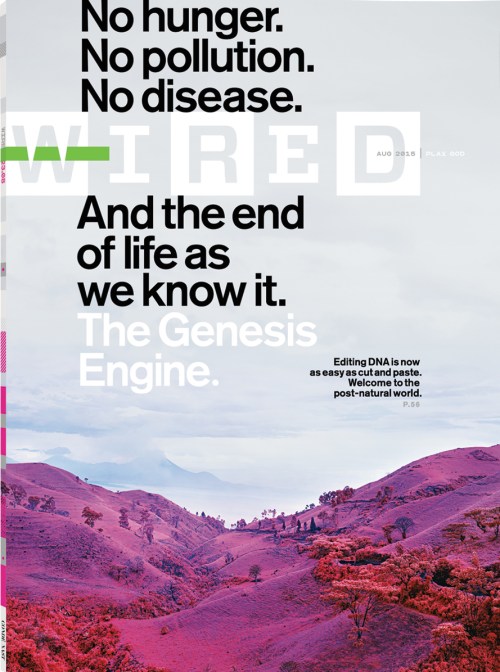
I just published What’s a War-Torn African Nation Got To Do with Editing DNA?, a piece on Vantage about Wired Magazine’s choice of a Richard Mosse photograph Myths Of The Near Future (2012) for the cover of its August issue.

The photograph was made as part of Mosse’s series Infra about the ongoing civil wars in the Democratic Republic of Congo, but the story is about the science behind– and the copyright battles over–Crispr-Cas9 a genetic engineering technique. The gulf between the original subject matter and the nature of the story raised some questions for me.

I must mention that, in light of 5.4 million deaths in DRC, the line “And the end of life as we know it” emblazoned in 48-font on the front cover, seems a little clumsy, but I’m too clueless about the magazine world for that to be my line of main inquiry. Someone else can muse over those loose words if they think there’s anything more in them than a disconnect between packaging and content typical of the marketplace.

[…]

Perhaps I am so discomfited because Mosse’s work makes so much more visual sense being bent ever-so-slightly for this futuristic narrative, than it does for its original intended political purpose?

Mosse pitched in on Twitter with the following three comments, they’re part of a longer back-and-forth with a couple of threads between Ed Brydon and I. Chase those threads if you can.

Read the full piece and see what you think.

chin

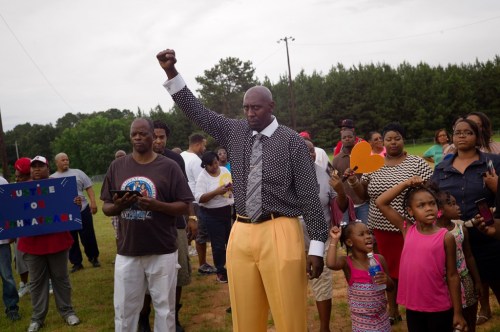
A rally in Stonewall, Mississippi calling for the indictment of Officer Kevin Herrington on charges of murder of Jonathan Saunders

The last thing I consumed on the internet yesterday was a story Another Reason To Question Whether Black Lives Matter In Mississippi by Alan Chin about the fatal shooting of a black man by a cop in rural Mississippi. His name was Jonathan Saunders.

The first thing I consumed on the internet this morning was a cop body cam video of said cop shooting an black man in the head. His name was Samuel DuBose.

Is it now a daily, normalised experience for myself, and for others, to consume death, filmed and online?

In between last night and this morning, I put the finishing touches to an essay for a fall publication about some haunting and frantic sketches made by a prisoner in solitary confinement. What is happening in the darkest, invisible, coldest cells of our criminal justice has everything to do with what is happening on our streets (after all, solitary confinement is disproportionately used against men of color and black men are 250% more likely to be thrown in the hole.) In my essay last night I wrote:

The Black Lives Matter movement has successfully tied over-zealous community policing, to stop-and-frisk, to restraint techniques, to custody conditions, to a bail system that abuses the poor, to extended and unconstitutional pretrial detention, to solitary confinement in a devastating critique of a structurally racist nexus of law enforcement. #SayHerName. Sandra Bland in Waller County, Texas; Jonathan Saunders in Mississippi; Tamir Rice in Cleveland; Charly Leundeu Keunang in Los Angeles; Sgt. James Brown in an El Paso jail; James M. Boyd in the hills of Albuquerque; John Crawford III in a WalMart in Ohio; Walter Scott in North Charleston; Eric Garner and Akai Gurley in New York; Michael Brown in Ferguson, Missouri; and thousands of more people over the past 12 months alone killed by law enforcement.

The Guardian is trying to keep track, and Josh Begley at the Intercept is trying to visualize killings by cop, but the statistics are frightening and as the cases come more and more often, they seem to get more and more egregious. Ray Tensing straight up murdered Samuel DuBose. No question. July is set to be the deadliest month of the year for people killed by police.

The tragedy heaped upon tragedies that Chin’s article hit home for me was that the news cycle can only deal with a handful of cases at any given time. But there’s scores of officer involved deaths every month. If the rate of killings continues, we’ll have seen over 1,100 deaths at the hands of law enforcement by the close of 2015.

I can’t imagine the trauma, anger and sense of injustice in Saunders’ family and community. I cannot fathom that 1,100 times over. I’m almost lost for words except for this thought. Pre civil rights, photography was used to boast of lynchings and hate crimes. During the civil rights struggle photography was ammunition in the fight for justice and the abolishment of racist laws. Since civil rights photography has broken from its usual documentary constraints to power the biggest growth of any society in the history of man, but despite massive wealth, we are still so poor in terms of understanding inequality and the combined effort by a society to fend it off. Now, images–moving and still–are taking center stage in public outrage and prosecution attempts toward law enforcement personnel who kill citizens. I just wonder what we will do with the footage of death — the jail surveillance tapes and the police body camera videos — if, in 10 or 20 years, we’ve not been able to change anything.

If nothing changes, the footage will become evidence against our own inaction in the face of massive racism and social inequality.

Change we must.

As I am lost for words, I’ll leave you (as Alan Chin did in his article) with the words of Frances Sanders, the mother of Jonathan Sanders.

“He is my son and I loved him and he didn’t deserve to die. There ain’t but one policeman who came to offer his condolences and he was black. So don’t tell me it wasn’t racism. We got a long way to go.”

See more of Alan Chin’s photos from the assignment at Facing Change.

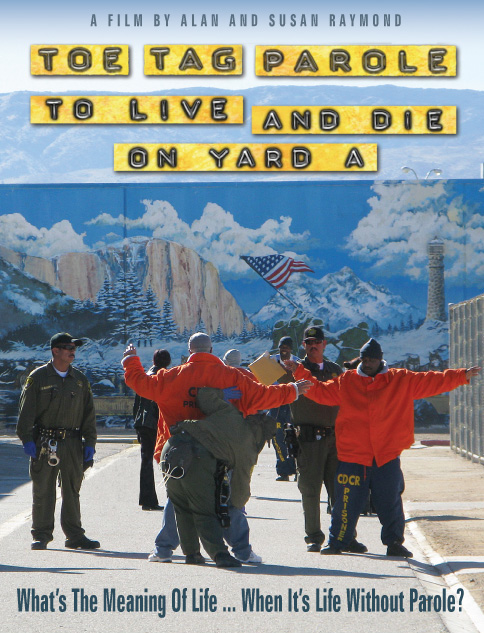
TTP-poster-with-HBO-13

Toe Tag Parole premiers Monday, August 3rd at 9pm on HBO.

A: When it is a Life Without Parole (LWOP) sentence.

While criminal justice reformers, D.C. politicos, President Obama and the like are pressing for change they all too often focus on arguments for the release of non-violent (usually drug) offenders. Releasing that “category” of prisoner though doesn’t deal adequately with mass incarceration or prison overcrowding. We need, as a society, to look at how we treat those who are imprisoned for the longest sentences, how they got their and what we can do as a community to scale back on the vengeance and violence inherent to the prison system.

A literal life sentence is commonly referred to as Life Without Parole or LWOP. Activists tend to use the term Death By Incarceration.

In all other circumstances, parole is a complex and varied thing, but when the possibility of parole is removed it’s far simpler … and more brutal.

On HBO on Monday, there’s a documentary Toe Tag Parole: To Live and Die on the Yard, by Oscar-winning filmmakers 
Alan and Susan Raymond about LWOP.

To tell the story of LWOP, the Raymonds found an unusual facility in Los Angeles County, a maximum-security facility in the Mojave Desert. Yard A at California State Prison is the The Progressive Programming Facility — a space that committed LWOP prisoners and the California Department of Corrections forged together. With laws and sentences unlikely to change for those who are deemed the most dangerous, the “most dangerous” went about finding their own solutions.

Yard A — which inmates call The Honor Yard — is a prison yard is free of violence, racial tensions, gang activity and illegal drug and alcohol use. It’s the only type of its kind in the nation. 600 men living in The Progressive Programming Facility and seek self-improvement and spiritual growth through education, art and music therapy, religious services and participation in peer-group sessions.

The press release reads:

Ken Hartman, who beat a man to death at age 19 while drunk, and has been in prison for 36 years, says, “There’s a progression that these things go through. People used to be stoned to death and then they were shot and then they were hung, they were electrocuted. Each step along the way always the argument is made that this is a better kind of death penalty. I’m sentenced to Life Without the Possibility of Parole. It’s not better than the death sentence, because it is the death sentence.”

It promises to be a wonderful film. In an ideal world though, extraordinary efforts by men inside wouldn’t be needed because many of them would be offered the opportunity for improvement and release by the structures of the state.

pep

Social Justice and Environmental Justice Intersect

Any links between mass incarceration and environmental abuse might not be immediately obvious. But they exist and the Prison Legal News, the Human Rights Defense Center and Nation Inside are combining resources to talk to this unlikely but potent and dangerous intersection of issues.

The Prison Ecology Project is creating tools to dismantle toxic prisons.

Ask people in Appalachia who have watched prisons such as FCI McDowell built on exhausted mountain-top removal mining sites. Ask folks out west who’ve watched prisons plonked down upon fragile desert ecosystems. Ask those in the rust belt, who’ve seen prisons brought to town for the sake of jobs after heavy industry and mineral extraction have left town. When one would think regions couldn’t be stripped and abused anymore, the rape of communities follows that of the environment. In Pennsylvania, a prison built on a toxic coal ash dump is crippling those locked up inside.

Prisons, historically, have gone up where desperation for employment has meant little-to-no oversight, public discussion or even opposition. No one forecast problems because they didn’t want to imagine them; prisons provided an answer to your uncle Frank’s four years of unemployment.

“The prison industry has a long history of ecological violence. Rikers Island prison in New York City was literally built on a trash heap, and evidence suggests a high incidence of cancer among guards and prisoners,” writes the HRDC. “In California and Texas prisoners have little recourse but to drink arsenic-laced water. In Alabama, an overpopulated prison habitually dumps sewage into a river where people fish and swim. In Kentucky, construction of a new prison is poised to clear 700 acres of endangered species habitat. Stories like these are too common. The issues impact millions of people in and around prisons across the US but are largely ignored.”

GIVE ‘EM YOUR MONEY

The Prison Ecology Project is raising $15,000 on IndieGogo to boost its capacity to research and analyse data. They are uncovering abuses and amassing a clearinghouse of information on over 5,000 prisons nationwide which we can all use to fight poisonous prisons!

HRDC’s work in this chronically understudied area will “keep pressure on an industry notorious for its lack of transparency.”

DONATE

They’ve got the chops. HRDC is the publisher of Prison Legal News which has exposed environmental problems and covered stories of whistleblower litigation in prisons for over 20 years.

The first target of HRDC is a federal prison planned for Letcher County, Kentucky. Its construction would demolish 700 acres of endangered species habitat in Appalachia while imprisoning people hundreds of miles from their families.

WHY THE WORK?

“Incarcerated people are some of the most vulnerable and uniquely over-burdened demographics in our nation,” explains HRDC. “Almost all of the prison population is low-income, and people of color are disproportionately represented by wide margins in every state. Most people whose lives have been impacted by the criminal justice system have not engaged with the environmental movement up to the present time.”

The Prison Ecology Project changes that dynamic.

DONATE

Operating prisons stresses the environment. Recognising that provides yet another reason to fight the toxic philosophical underpinnings and racism of a broken and out of control system. Decarceration is good for your lungs!

It’s not so much as convincing players in one political action to adopt another, as it is exercising closer bonds between movements of the left that operate in opposition counter to the abuse and social exclusion of lower income groups. It’s about recognising new allies and being collectively stronger. I love this type of imagination.

IN THE PRESS

DONATE

_84292583_dsc_0109

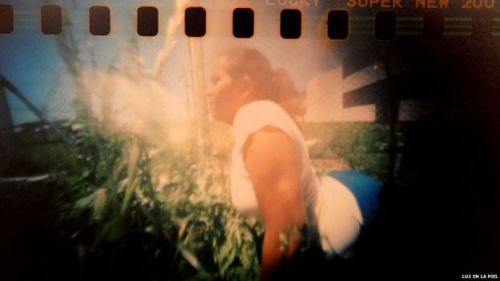
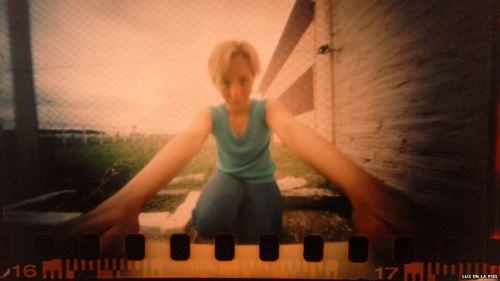
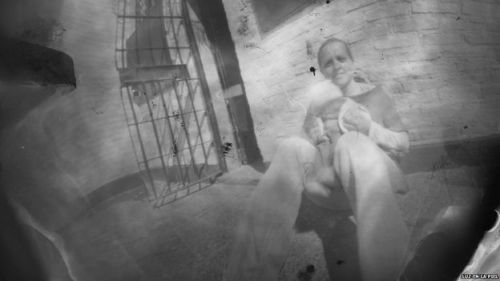
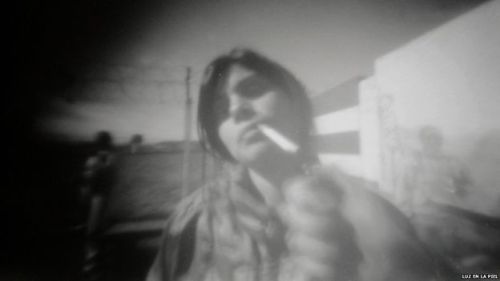
This weekend, the BBC ran a piece about a pinhole photography workshop in a women’s prison in Argentina. I greatly admire pinhole photography in prisons.

The images are atmospheric – retro, a little blurred and with almost fish-eye perspective in some. They look like stills from some 90s skate video or something (I don’t know why that matters). They are awash in color, not unlike every hipster’s favorite, the aura portrait (not sure why that matters either).

_84292253_b-n4

_84291740_dsc_0117

Maybe it was precisely because these images didn’t look like a prison that I was attracted to them. If they weren’t the feature of an article about prison and rehabilitation, they’d have scuttled right by during my day of contestant image flow. naturally, I wanted to know more about their production.

[ SEE MORE OF THE IMAGES HERE ]

They were made during a workshop offered YoNoFui, a organization that provides teaching, community, skills, personal development to prisoners. The organization was founded by Maria Medrano who believes prisons can become productive places for women, cultivating their individuality, esteem and confidence. Currently, they offer nothing of the sort. Medrano has ben recognized as an esteemed Ashoka Fellow and upon the Ashoka website we can find out more about her and YoNoFui’s philosophy.

“Convinced that the prison is the last link in a chain of exclusion and disenfranchisement that ensnares poor women, Medrano pioneered a relationship-centered continuum of education and engagement for women prisoners and ex-convicts to create concrete opportunities for women out of prison and to change the mindsets of prisoners, their families and communities,” it reads.

_84283996_luzenlapiel2

_84291737_dsc_0122

YoNoFui (translated as “It wasn’t me) also offers courses in poetry, journalism, textiles, bookmaking and carpentry. It’s providing a “holistic approach to transform the way the criminal justice system conceives of and treats women prisoners, making it a productive and more nurturing place. […] Maria’s program deals with the root problems affecting the women, including their lack of labor skills, emotional marginalization and poor self-confidence.”

Some of this language is familiar to us, but a lot of it has not been implemented in Medrano’s home country.

“Women prisoners are the most marginalized segment of Argentine society,” writes Ashoka. “The vast majority are mothers and housewives from very low economic segments of society. 90% of them also come from broken and dysfunctional families, with abusive or drug-addicted husbands and children—whom they often bore while in prison. Many come from two or three generations of women who have been unemployed, and who lack formal education and the social customs that familiarized them with a culture of work. Most never learned the values a healthy workplace inculcates, such as personal responsibility and self-respect. The children of these women are often either neglected or abandoned outright, sent to live with a relative or put into state institutions. About 41% of these women are immigrants with few connections to the local society, having migrated on their own without official papers to seek a better fortune in Argentina, or who were victims of transnational trafficking rings.”

Women end up committing low-level crimes and misdemeanors in Buenos Aires, more out of desperation or necessity rather than from a pathological sense of criminality. However, once sentenced the path is predictable. Argentine prisons reflect upon the most disenfranchised exactly what they had experienced in free society – social exclusion, and permanent second class status. The effects of this exclusion are ben more pronounced upon immigrant women. The majority of people in Argentina are unsympathetic to female prisoners unaware of the complex web of causes to their situation.

Rehabilitation has not been the way.

“Prisons in Argentina function in a militarized way, due to a law passed in 1973 under the military dictatorship. They bear very little emphasis on policies and practices that help support reinsertion of men and women into the labor and social mainstream, leading to high rates of recidivism—although the public ministries do not even care to record the exact figures,” says Ashoka.

_84291732_luzenlapiel

Until Medrano’s efforts, reform efforts were largely absent. Focuses first on building individual relationships, belonging and interdependence, Medrano hopes to break the cycle. It’s hard for us to believe but many women in prison have not been exposed to, shared in, or shown how to believe in themselves.

Medrano is going further than just offering classes; she is tying all education into self-improvement and cultivating buy-in from all constituents. Only with the support of the authorities is she implementing cultural change.

“Success for the effort requires a complex series of negotiations with multiple ministries whose support will be required,” says Ashoka. “Negotiations have already begun with the Ministry of Education and Ministry of Labor, where YoNoFui is holding workshops. By developing broad constituencies among multiple ministries, Medrano is beginning to overcome bureaucratic intransigence, while also shifting the program’s dependence on the penitentiary system, which is part of the Justice Ministry, to other ministries with less of a “law-and-order” stigma attached.”

YoNoFui is working in two of the five federal prisons in Argentina, both in Buenos Aires, with some 600 women prisoners each. Medrano plans to scale up and move into other facilities.

_84292256_b-n5

_84283998_miriampereyra-lalo

Financial support comes a number of governmental departments astutely identified by Medrano — subsidies for micro-enterprises through the Social Development Ministry; job training grants through the Ministry of Labor; seed capital from the Ministry of Industry. YoNoFui connects women with housing and jobs subsidies.

What they begin in the prison they continue outside. YoNoFui also works with agencies for Social Issues, Prisons, Migrants and Gender Issues, with the Secretariat for Children, Youth and Families — both of which have responsibilities related to the young people whose mothers are incarcerated.

Former prisoners return to the jails to work as teachers, and they are new positive role models to the women inside. Relationships are key. Skills ALONGSIDE psychological and emotional health. Arts and trades continue outside of the penal institutions — carpentry, bookbinding, textile design, textile machinery, weaving, graphic design, silkscreen, photography, poetry and journalism.

The organization is young but Medrano wants a permanent, staffed, full-time “School for Work” inside the prison. In the way, YoNoFui considers young people too in helping them re-establishing their bonds of family, re-adapt to society, YoNoFui can be though of as akin to The Harlem Childrens Zone. Targeting both the practical and the attitudinal is key, that is to build key skills but also to shift the mindset of an entire downtrodden group.

[ SEE MORE OF THE IMAGES HERE ]

Inspiring stuff. Now, aren’t you glad you took a closer look? I am.

1

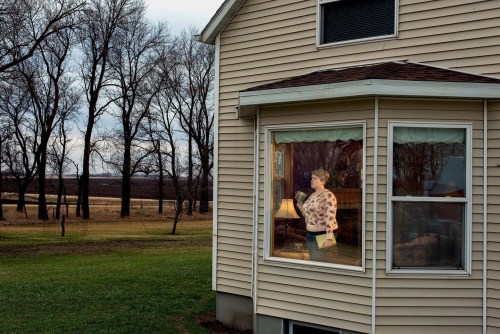
Dale Hammock at the Amity Foundation in Los Angeles. Credit Damon Casarez for The New York Times. From the story ‘You Just Got Out Of Prison. Now What?

True to form in traditional media another impressive feature piece about the criminal justice system You Just Got Out of Prison. Now What? was released by the New York Times last week. The story is summed up perfectly in the sub-header: “Carlos and Roby are two ex-convicts with a simple mission: picking up inmates on the day they’re released from prison and guiding them through a changed world.”

Carlos and Robery help people like Dale Hammock (above) who was imprisoned for 21 years to readjust to the outside world.

It wasn’t until the mid-2000s that this looming ‘‘prisoner re-entry crisis’’ became a fixation of sociologists and policy makers, generating a torrent of research, government programs, task forces, nonprofit initiatives and conferences now known as the ‘‘re-entry movement.’’ The movement tends to focus on solving structural problems, like providing housing, job training or drug treatment, but easily loses sight of the profound disorientation of the actual people being released. Often, the psychological turbulence of those first days or weeks is so debilitating that recently incarcerated people can’t even navigate public transportation; they’re too frightened of crowds, too intimidated or mystified by the transit cards that have replaced cash and tokens.

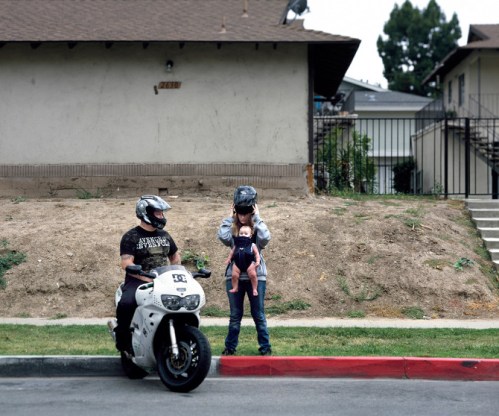
The quality of the photography met the quality of the writing. The two pictures accompanying the piece were made by Damon Casarez.

An unfamiliar name. I looked him up. This was great assigning by NYT. Throughout Casarez’s other bodies of work is something of the uncanny. From an early project depicting the “Utopia” of the suburb he grew up in (Clearly effected, he mentions “suburb” in his bio) to a series of actors playing out cliche types who live in his neighbourhood, it seems Casarez is obsessed with the weird around him.

Or more precisely he teases the weird out.

From the unnatural order of Boomerang Kids (children that return to parents’ home after college graduation) to a series titled Dioramas of recreations of peculiar vignettes in everyday life around him, Casarez channels Jennifer Karady, Holly Andres, early Gregory Crewdson, the vulgar Jill Greenberg, and David Lynch, (and, yeah, I guess, even Hopper).

dc2

dc4

damon-casarez-564x380-sig

dc1

dc

Everyone has been talking about Google’s neural network DeepDream recently saying that it might be the closest thing to what Androids dream of when they sleep or what pure (LSD-inflected) visuals look like. The world is a freaking bizarre place and it only because of inbuilt systems to filter most of it that our brains don’t get overrun.

Casarez’s work is so appealing to me because it bucks that tendency. He searches out the ill-fitting and garish surface tensions we put on, prop up and rely on daily.

It makes sense why the worlds of (predominantly) Southern California would weird him out. One day he’s photographing victims’ families of street violence, and the next the aspiring and upper classes basking in the arts-industrial complex.

As odd places, prisons do nothing if not produce odd behaviours and characters. Carlos and Roby have been out years but still fantasize about prison food. They are the sanest folks engaging with the prison issue because they see reentry from a personal and informed perspective .. and yet they sit for hours in their car under the words “Now what?” waiting for a man who’ll probably arrive. He does and their work begins.

2

Roby So (left) and Carlos Cervantes in Pomona, California. Damon Casarez for The New York Times. From the story ‘You Just Got Out Of Prison. Now What?

For all the quantitative research, NGO white papers, expert testimony, politicians’ best intentions, it is still the one-one-one, face-to-face, simple and small things that make the biggest difference in getting people out and keeping people out. That might sound crazy but it is not; it’s true. For example, the Prisoner Reentry Network does something as simple as send directions to prisoners pre-release so that they know how to get from the prison gate to the their hometown. Having not navigated the free world for years or decades that’s key information the rest of us take for granted.

No one has experimented so perversely with prisons as California. The unexpected details, the frank reporting and the NYT’s choice of photographer all worked well together here and described an unnatural situation and set of problems to which committed folks are trying to find solutions.

Follow Damon Casarez on Tumblr and Instagram.

5

Heidi Levine hugs her driver Ashraf Al Masri after his home in Gaza was destroyed. Photo: AP/Lefteris Pitarakis

It can be tricky to talk about photojournalists’ work without over-simplifying, romanticising or glorifying. Thankfully, this piece Bearing Witness does none. Writer Doug Bierend does a sterling job of describing the decade-long work of Heidi Levine and teasing out the bittersweet award of the inaugural Anja Niedringhaus Courage in Photojournalism Award for her coverage of the Israeli bombardment of Gaza in the summer of 2014. Levine knew Niedringhaus and an award is a strange thing in the face of societies destroyed by war:

“This award has made me reflect, and spend a lot of time thinking back and understanding — I have been very lucky. We were talking about experience — sometimes it’s not even how experienced you are, it can boil down to just having bad luck. I guess I’ve always felt committed to bearing witness, and feel that is just so important to give people the opportunity to know what’s happening in the world, and I don’t believe that there’s any excuse anymore for people looking the other way and claiming, as they did in the past, in history, that they were just unaware and didn’t know.”

3

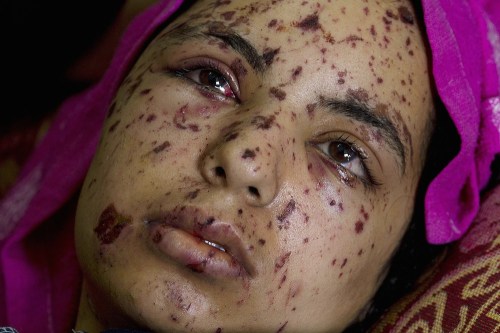
Wounded Palestinian Rawya abu Jom’a, 17 years old, lays in a hospital bed at the Al Shifa Hospital in Gaza City, July 22, 2014. Rawya was seriously injured when two Israeli air strikes hit her family’s apartment. Her sister and three of her cousins were killed in the attack. She is suffering from shrapnel in her face, her legs have perforated holes in them and the bones of her right hand were crushed. Photo credit: Heidi Levine/The National/Sipa Press

Keith Axline and I are editors of Vantage — a new gorgeous place for looking and photos and learning their context.

Some photos we feature are gorgeous and some are gory. In Levine’s case she manages to combine to the two. As Bierend puts it, Levine makes pictures in “a subtle or even artful way requiring a high degree of sensitivity [that] sees through the violence to the dignity of the subjects suffering at its heart. At its best, this skill can convey the true stories of conflict, the hidden personal and private lives shaken to their foundations by the nations, militaries, and leaders which tend to be the sole subjects in any discussions about war.”

It’s a sobering piece. Levine talks about risk, fixers and luck. I’ll leave you with another statement of hers:

“If you’re not trained, it’s really, really important to become trained, to take a hostile environment course, to take a combat medical training class … I have seen a lot of people out there in the field that are very inexperienced. It’s not like rockets or bullets discriminate between who is experienced and who’s not experienced. As you saw, Chris Hondros, who was one of the most experienced conflict photographers, was killed in Libya.”

Read in full at Bearing Witness.

6

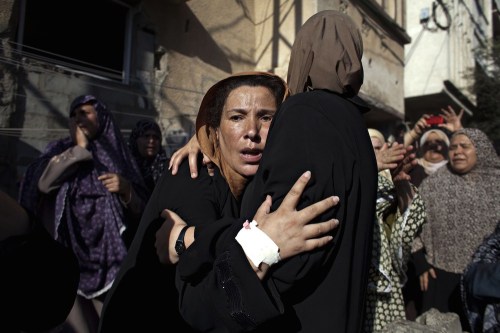
Women mourn during the funeral of the boys killed by an Israeli naval bombardment in the port of Gaza, Gaza City, July 16, 2014. Four boys died instantly during an Israeli naval bombardment in the port of Gaza, a fifth boy died shortly after the attack in hospital. Israel stepped up its attacks on July 16 by bombing the homes of Hamas leaders after the Islamist movement rejected a truce proposal and instead launched dozens more rockets into Israel. Photo: Heidi Levine/The National/Sipa Press

4

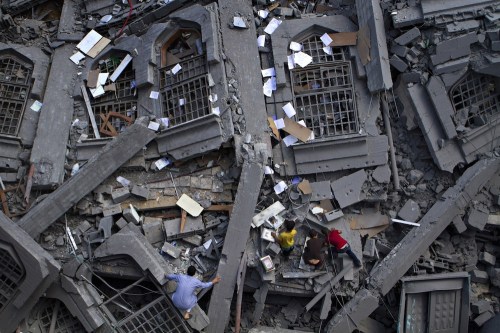
Palestinian men run with a white flag in the Shejaia neighborhood, which was heavily shelled by Israel during the fighting, in Gaza City, July 20, 2014. At least 50 Palestinians were killed on Sunday by Israeli shelling in the Gaza neighborhood, and thousands fled for shelter to a hospital packed with wounded, while bodies were unable to be recovered for hours until a brief cease-fire was implemented. Photo: Heidi Levine/The National/Sipa Press

2

Palestinians collect religious books in the rubble of the Al-Qassam mosque in Nuseitat camp, located in the middle of the Gaza Strip, July 9, 2014. Photo credit: Heidi Levine/The National/Sipa Press

1

Hidya Atash stands on the top floor of her home as she overlooks the destruction in Shujayea, at dawn Aug 8, 2014. Her family’s home was hit two weeks prior by a warning rocket and the family of 40 people fled. When they returned during the cease-fire, they discovered their home was heavily damaged during the fighting. Photo credit: Heidi Levine/The National/Sipa Press

EMAIL

prisonphotography [at] gmail [dot] com

Prison Photography Archives

Post Categories

RSS PETE BROOK’S TUMBLR ‘PHOTOGRAPHY PRISON’

  • An error has occurred; the feed is probably down. Try again later.