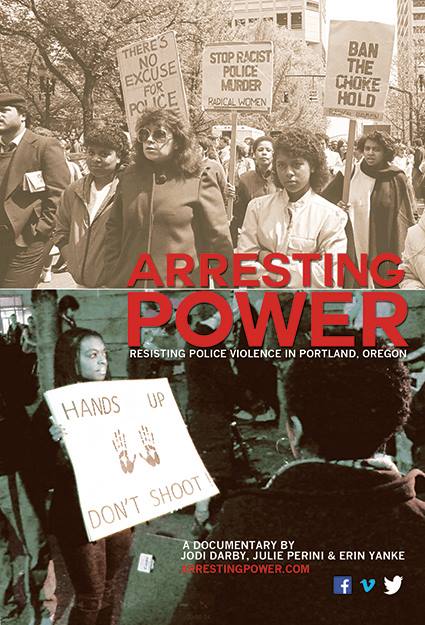
Portland’s a pretty small town. When I lived their I was a fellow panelist with Julie Perini. Jodi Darby once beat me, by mere seconds, to a killer secondhand sweater in a donation pile on the street. I’ve never met Erin Yanke. The three producers have recently completed Arresting Power, a documentary about resistance to police violence in Portland, Oregon.
I supported the Kickstarter to get the film over the finishing line, so I am happy to see it out in the world. On Friday, May 8th, Arresting Power will screen at the Kala Art Institute in Berkeley, CA.
Arresting Power – Resisting Police Violence in Portland, Oregon provides a historical and political analysis of the role of the police in contemporary society and the history of policing in the United States. It provides a framework for understanding the systems of social control in Portland with its history of exclusion laws, racial profiling, gentrification practices and policing along lines of race and class. It serves to uncover Portland’s unique history of police relations and community response.
Arresting Power features interviews with the families of people who were killed by Portland police, victims of police misconduct, local historians and community organizers. Utilizing archival newsreel from the Oregon Historical Society’s moving image archive, the film explores the history of police reform and abolition movements that have been active throughout the past 50 years.
Kala Art Institute 2990 San Pablo Avenue, Berkeley, CA Sliding scale $5 – $15 Refreshments will be served Screening followed by Q&A with the filmmakers
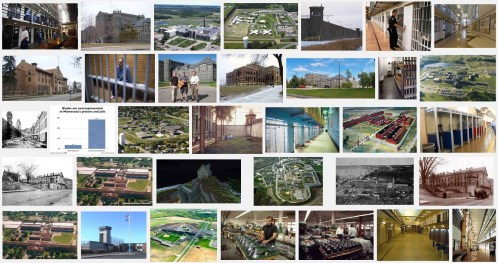
“Photos are a vision of the past. So, among the many things they are, they are ghosts. However, due to the lazy overuse of the word, ‘Haunting’ doesn’t apply anymore. A key characteristic of the photographic medium has been slowly and silently eradicated because of our lack of invention. Alongside ‘Stunning’ ‘Awesome’ and ‘Epic’, ‘Haunting’ is a word that carries no meaning in photography any more. It’s a turn off. And it’s a hard sell. I reserve similar contempt for the adjectives ‘Eerie’ and ’Surreal.’ The real shame is that these formulas are almost unavoidable in publishing these days. I’m guilty. Stories I’ve written have been published under headlines that have included the words ‘Stunning’ ‘Awesome’ ‘Epic’ ‘Eerie’ and ’Surreal’. And, yes, ‘Haunting’ too.”
^^^ What I said when Humble Arts invited me to trash an adjective. ^^^
If the image above is useless, get used to it. The Minnesota Department of Corrections has banned news cameras.
Under a sub-head of ‘Special Access’, the policy, which was introduced in February, reads:
A visit facilitated by the communications unit and lasting one hour in length. The representative of the public news media may bring a recording device (if approved), paper, and a writing utensil. Video and photography cameras are not allowed.
Interviews with prisoners should not be considered special access; they should be considered key to maintaining open access to information and to accountability. Society uses prison to deny prisoners their liberty, not their voice.
Incredibly, this ban is not a response to any embarrassing or damaging event or story. It is, by the DOC’s reasoning, a shift of policy in line with other rules about contraband!
Because cellphones (with cameras) are contraband in prisons, the twisted logic of the prison administration goes that news cameras are also contraband! What?
This is reckless bureaucracy in full swing. The public will lose out by not having a free and unencumbered press on which to rely for impartial information. The biggest losers will be the prisoners who are silenced. In a reasoned OpEd for the Star Tribune, journalist James Eli Schiffer writes:
“My concern about the camera ban goes beyond the implications for my own industry. It means that the nearly 10,000 inmates of Minnesota prisons will recede even further from public view, their faces all but invisible.”
Schiffer points out that a long term project Young & Armed that he and colleagues made in 2012 about youth gun violence, which included dozens of interviews from inside prisons, just would not be possible today.
The Minnesota Pro Chapter of the Society of Professional Journalists (SPJ) is outraged.
“The Minnesota DOC is now equating both still and video news cameras with contraband items such as pornography and lighters, which is patently absurd,” says the SPJ Minnesota Pro Chapter. “Other DOC concerns could be dealt with through policies other than a full ban on cameras. We urge the Minnesota DOC to immediately reverse its camera ban.”
Unfortunately, Minnesota Gov. Dayton sees no political advantage in calling out this nonsense policy and has backed his DOC Secretary’s decision. Ugh.
In coordination with the Open Society Watching You, Watching Me exhibition, this online panel wanted to reflect not only upon surveillance in our society but how it is pictured and if those depictions meet the realities of networked viewing that are at constant play behind our walls,, systems, nodes and screens.
I felt like an amateur in the room with other esteemed panelists lining up thus – Simone Browne, Assistant Professor of African and African Diaspora Studies, UT Austin; Cara Finnegan (moderator) writer, photography historian, Associate Professor of Communication, University of Illinois; Rachel Hall, Associate Professor, Communication Studies at Louisiana State University; Marvin Heiferman, writer and curator; Hamid Khan, co-ordinator, Stop LAPD Spying Coalition; and Simon Menner, artist, and member of OSF surveillance exhibition.
Over two hours discussion, we discuss 10 images in turn. They flash up as we deconstruct their meanings, but it might be helpful to consult the gallery first, too.
Over the coming weeks, BagNews will be adding highlight clips for easier to digest morsels that get to the meat of our conversation.
“Surveillance technology permeates the social landscape,” says BagNews. “Tiny cameras monitor traffic, parking lots, cash registers and every corner of federal buildings. Through personal devices and social media, citizens also monitor one other.” In the highlight clip (above), moderator Cara Finnegan and panelists Simon Menner, Simone Browne, Hamid Khan, Rachel Hall and Pete Brook discuss generic imagery and the use of stock photography to represent this reality of daily life
SALON
The BagNewsSalon is an on-line, real-time discussion between photojournalists, visual academics and other visual or subject experts. Each salon examines a set of images relevant to the visual stories of the day often focusing on how the media and social media has framed the event. The photo edit is the key element and driver of each Salon discussion and great care is taken to create a group of photos that captures the depth and breadth of media representation.
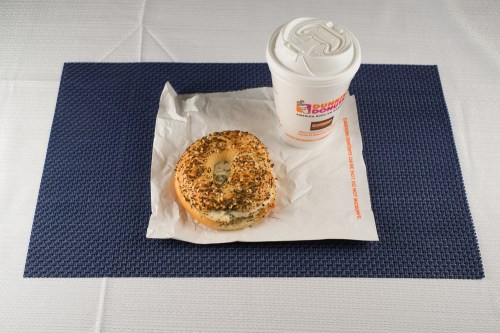
There’s no shortage of projects about meals in the small corner of photographic practice concerned with prisons and human rights. Specifically, the final meals of condemned prisoners have stoked the macabre and outraged intrigue of artists.
Julius Motal‘s photographs of “first meals” are therefore something of a departure and a welcome addition to the visual narratives trying to convey the transitions out of prison and into society. Instead of an end point, Motal suggests a starting point (although the quality of help for reentry is up for question in many jurisdictions). Still, this work is simple and hopeful. Returning citizens cannot make it on their own. They’ll need to carry resolve and hope and see that reflected back from society. Perhaps Motal’s series with its extended captions helps humanise former prisoners?
The startling thing for me is the similarity in the types of food choices made by people about to face execution and people making a more inhibited choice once they’re outside of prison — almost without exception they go for fast food. Do returning citizens opt for fast food because they’re poor, have for the most part been poor, and eaten the cheapest and most accessible food? Or is it more simply a case of reaching out for easy comfort (supposing fast food equates to comfort) in times of relief?
There’s a reflection of class in Motal’s work, which is a good thing. It’s a healthy reminder how the prison industrial complex functions; hoe it brutalises communities of lower economic standing. Very few prisoners are like the middle class, liberal arts college educated Piper Kerman — or the TV show equivalent Piper Chapman — from Orange Is The New Black. Most people going to and leaving prison are poorer than the average American.
Currently, Motal’s series First Meals: This is What Freedom Tastes Like is only six images deep. I hope he’ll extend the survey and continue to ask ex-prisoners about their relationships to food. There’s many different directions in which this work could go not only in terms of interaction with subjects but in terms of public education to tie in with reentry services, food deserts, mother and child nutrition programs, and so on and so forth.
It’s significant that more than one caption refers to the overwhelming choice within — and paralysing nature of — grocery stores for former prisoners who were unaccustomed to variety and decision making power for extended periods. One caption reads:
For Stacy Burnett, the choices at the Burger King in Montrose, PA were overwhelming, so much so that she couldn’t make a decision. “I could feel the energy shift behind me,” Burnett, 39, said of the growing restlessness behind her. She finally told the cashier that she’ll have what the woman ahead of her ordered, which was a whopper, fries, a shake and a soda. For the first six months after her release, going to the supermarket was tremendously difficult. There were simply too many choices, and if she didn’t get anything in the first 10 minutes, she would leave without getting anything.
Last meals are a captivating topic but direct us only to the plight of 3,500ish people on death row in the country. Motals’ work about “first meals” directs us to the tough realities of the millions of people leaving jails and prison every year in America.
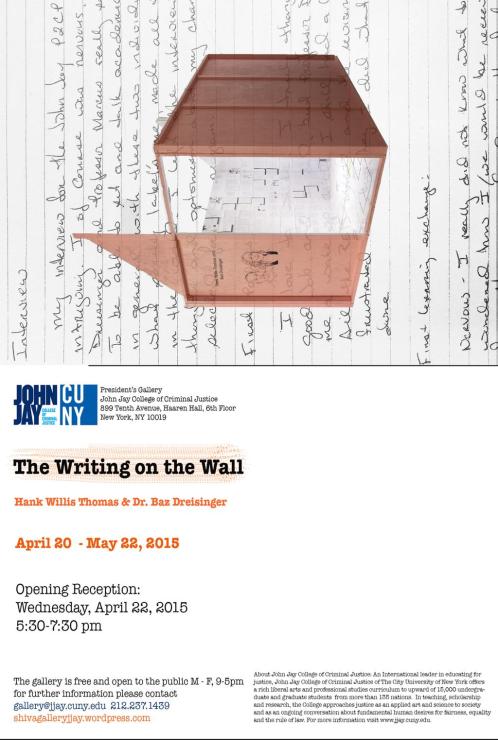
If you’re in NYC between now and May 22nd go see The Writing on the Wall, an installation by Hank Willis Thomas and Baz Dreisinger. It opened yesterday at the President’s Gallery at John Jay College.
The Writing on the Wall debuted in September 2014, at the Museum of Contemporary Art in Detroit (MoCAD) where it was part of the Peoples’ Biennial.
There’s an opening reception tomorrow night, Weds, April 22nd, from 5:30 to 7:30pm.
THE BLURB
The installation is made from essays, poems, letters, stories, diagrams and notes written by individuals in prison around the world, from America and Australia to Brazil, Norway and Uganda. The hand-written and typed pieces were accrued by Dr. Dreisinger during her years teaching in US and international prisons, in the context of both the Prison-to-College Pipeline program she founded at John Jay and her forthcoming book Incarceration Nations: Journeying to Justice in Prisons Around the World.
On a basic and literal level, The Writing on the Wall is about giving voice to the voiceless and humanizing a deeply de-humanized population. It represents a kind of modern-day hieroglyphics, projecting a hidden world into a very public space and allowing a people too often spoken of and for—by politicians and a punishment-hungry public—to speak for themselves, in the most intimate of ways. It is a tribute to the power of the pen, a deliberate verbal intrusion and an assertion that some words need very much to be seen in order to be heard. Indeed the writing is not just on the wall but on the floor, on every inch of the installation space, such that the viewer, unable to look away, is compelled to confront a crisis: global mass incarceration. The piece thus fittingly references the Biblical story in which the writing on the wall, as interpreted by the prophet Daniel, foreshadowed imminent doom and destruction.
Just as mass incarceration is a living, growing global phenomenon, The Writing on the Wall is an ever-evolving installation. With every iteration, it grows and assumes a new shape, because the documents comprising it—material written by those living behind bars—continue to land in Dr. Dreisinger’s hands and mailbox.
THE BIOGRAPHIES
Hank Willis Thomas is a photo conceptual artist working with themes related to identity, history, and popular culture. He received his BFA from New York University’s Tisch School of the Arts and his MFA in photography, along with an MA in visual criticism, from California College of the Arts (CCA) in San Francisco. Thomas has acted as a visiting professor at CCA and in the MFA programs at Maryland Institute College of Art and ICP/Bard and has lectured at Yale University, Princeton University, the Birmingham Museum of Art, and the Musée du Quai Branly in Paris. His work has been featured in several publications including 25 under 25: Up-and-Coming American Photographers (CDS, 2003) and 30 Americans (RFC, 2008), as well as his monograph Pitch Blackness (Aperture, 2008). He received a new media fellowship through the Tribeca Film Institute and was an artist in residence at John Hopkins University as well as a 2011 fellow at the W.E.B. DuBois Institute at Harvard University. He has exhibited in galleries and museums throughout the U.S. and abroad. Thomas’s work is in numerous public collections including the Whitney Museum of American Art, the Brooklyn Museum, the Guggenheim Museum, and the Museum of Modern Art. His collaborative projects have been featured at the Sundance Film Festival and installed publicly at the Oakland International Airport, the Oakland Museum of California, and the University of California, San Francisco. He is an Ellen Stone Belic Institute for the Study of Women and Gender in the Arts and Media, Columbia College Chicago Spring 2012 Fellow.
Baz Dreisinger is an Associate Professor in the English Department at John Jay College of Criminal Justice, City University of New York. She is the founder and Academic Director of the college’s Prison-to-College Pipeline Program (P2CP), which offers credit-bearing college courses and reentry planning to incarcerated men at Otisville Correctional Facility. She is also a reporter on popular culture, the Caribbean, world music, and race-related issues for the New York Times, Los Angeles Times and Wall Street Journal, among other outlets; she produces on-air segments for NPR and is the co-producer and co-writer of the documentaries Black & Blue: Legends of the Hip-Hop Cop, which investigates the New York Police Department’s monitoring of the hip-hop industry, and Rhyme & Punishment, about hip-hop and the prison industrial complex. The author of Near Black: White to Black Passing in American Culture (2008) and the forthcoming Incarceration Nations: A Journey to Justice in Prisons Around the World (2015), Dreisinger earned her Ph.D. from Columbia University and has been a Whiting Fellow and a postdoctoral fellow in African-American studies at UCLA.
THE DETAILS
President’s Gallery, John Jay College of Criminal Justice, CUNY 899 10th Avenue, Haaren Hall, 6th Floor , NY 10019.
Prisons are hostile, and potentially lethal, environments for transgender individuals. The acute need for understanding, medical care, and protection from predatory abuse is made visible for us through the remarkable efforts of Ashley diamond, a woman incarcerated in the mens’ Georgia State Prison.
Hearing her case and the evidence put forth by her advocates, The Southern Poverty Law Center (SPLC), it is a wonder Ms. Diamond is still alive. She has suffered no fewer than seven serious sexual assaults in the three years of her term.
Georgia’s prison system is notoriously dysfunctional and brutal. The prison in which Ms. Diamond is incarcerated is Georgia State. It had more sexual assaults between 2009 and 2014 than all but one other state prison. Ms. Diamond’s access to safety is merely one of her request in the recent lawsuit. Mainly, Ms. Diamond asks that her medically diagnosed condition of Gender identity disorder (GID) or gender dysphoria is recognised by the Georgia Department of Corrections and that they provide her the hormones that she was taking for 17 years prior to imprisonment.
Ms. Diamond describes her incarceration to this point as nothing short of torture. Her gender identity is held in contempt by the authorities and her vulnerable situation is in no way accommodated. Bravo to her for forcing a lawsuit against the state in order to secure recognition, medical hormones treatments. This is a fight that will not only elevate the visibility of the severe issues facing LGBQT in prison but may secure human rights hitherto ignored or trampled.
Ms. Diamond and transgender prisoners like her are in a perilous position.
In reporting on the case and the subsequent Federal level support for it, The New York Times says, “Many face rejection by their families, harassment at school and discrimination in the workplace. Black transgender people have inordinately high rates of extreme poverty, homelessness, suicide attempts and imprisonment; nearly half those surveyed for the National Transgender Discrimination Survey had been imprisoned, compared with 16 percent of the study’s 6,450 participants. Transgender women in male prisons are 13 times more likely to be sexually assaulted than is the general population, with 59 percent reporting sexual assaults, according to a frequently cited California study.”
When budgets for non-profit advocacy groups are so scarce and the resources and intractability of the state opposition is so large, media outreach and messaging has to be perfect. Bravo to SPLC for delivering a message in which Ms. Diamond is front and center. From a contraband cellphone, Diamond makes a direct plea to the public. The illicit nature of the act adds a sense of urgency to the appeal. It is as if all other avenues have been cut off and desperate times require desperate measures.
It’s a bold move and possibly not without its consequences. I would not be surprised if the GDOC was to retroactively punish Ms. Diamond for possession and use of a cellphone. Given the daily threat to which Ms. Diamond is subject, it hardly seems sanction for possessing a cellphone would be high on her list concerns. Whatever the extent of “risk” is involved in publishing this cellphone video it is another significant lens through which we can see this case, this story and this political action.
It is also crucial that other prisoners are present in the video. It is empowering to see anonymous prisoners feature as allies and supporters. It balances the narrative of prisoners only being predators. Prisoner-led self-organisation is the most quickly silenced but the most effective of resistance against the state and prison industrial complex. I wonder if videos such as this could potentially add further to future struggles?
A FEW QUICK THOUGHTS ON PRISON VIDS
I’ve been promising myself for years to in some way put together an analysis of contraband cellphone photo and video footage. The only definitive thing I can say is that I’ve not seen the vast majority of it and never will.
99.99% of prisoner made recordings are shared between devices, between loved ones and never uploaded to the internet for public viewing. If they do make it to social media they are on the internet behind passworded social media accounts.
Often when prisoner made cellphone videos emerge it is to villianise the prisoner further. News stories peddle in public consternation — we abhor prisoners who might be seen to be thumbing their noses at authority. We also like to frame the stupid or “foolish criminal” and mock them when their video gets them caught. But the truth is, prisoners are very, very sensible with their videos and digital distributions. Why do you think we see so few prison videos?
Prisoners have an interest in protecting their assets — this applies to cellphones that are expensive to acquire and very, very useful. Prisoners have zero incentive for making it publicly known they have or had have had a cellphone. Most prisoners use cellphones to contact families as a cheaper alternative to a price-gouged market. And, let’s remember that phones — like any contraband — get into prisons through the hands of staff as much as they do because of family visitors or civilians.
If the cellphone becomes an issue for the prison administration then their complete lack of understanding of the complaint is exposed — it’d prove the point being made by Diamond and SPLC that the Georgia DOC has demoted human rights to the point of endangering lives.
SPLC’s strategic use of Diamond’s video testimony is deliberate, timely and well-advised. It accelerated and humanised the issue. I, for one, hope it might be a method repeated in the future to benefit the crucial legal battles of prisoners. If so, it could also change our appreciation of prisoner-led political actions.
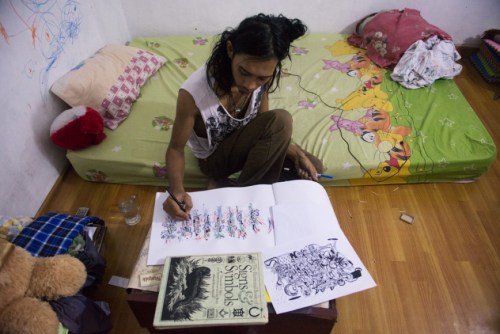
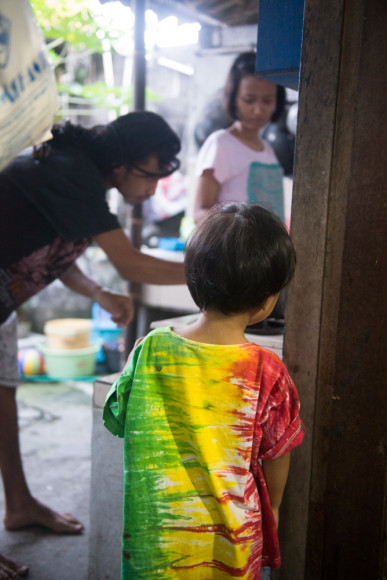
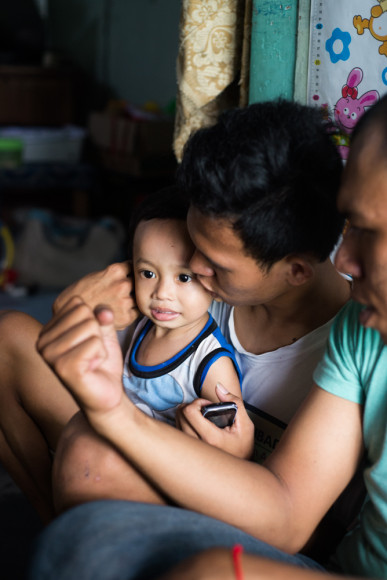
American photographer Willow Paule has spent half her time, in recent years, in Indonesia. She recounts in PsychoCulturalCinema how she slowly learnt about the past incarcerations of her two friends. Their conversations together led to more questions. Paule writes:
Through my research and conversations with these former prisoners in Indonesia, I discovered that they had faced rampant corruption, extortion, and violence in prison. I found that people were often convicted without solid evidence, that they sometimes possessed only small amounts of narcotics or marijuana but were given long drug distribution sentences, while large time dealers got off with lighter sentences. The person with the fattest wallet got the best treatment.
I learned that mentally ill people often became police targets, and periodically drugs were planted on them in order for police to meet arrest quotas. Once they were locked up, they didn’t necessarily receive adequate care, and they sometimes created turmoil in the cramped cells they shared with the general population. Many people told me disheartening stories about human rights abuses in Indonesian prisons.
My focus is the U.S. prison system, but as I say, dryly and reductively, on my bio page, “problems exist in other countries too.” Paule knows this all too well. She recorded the art that her two friends created as a matter of survival and also their difficult reentry into society. There, as here, jobs are difficult to come by for former prisoners and the stigma of prison lingers long.
The extent to my knowledge on the Indonesian prison system spans the length of Paule’s article. The system sounds dire.
“Prison sentence lengths were decided depending on bribe amounts and prisoners had to pay for a cell or face daily beatings and electrocution in solitary confinement,” writes Paule.
Connecting Paule’s years-old inquiry to today, in the U.S., is Paule’s desire to repeat the methodology and record the stories of returning citizens in America.
There’s no shortage of people in this country with whom Paule could meaningfully connect and weave their history and story over a long period as she did in Indonesia. It takes more than just images though; I encourage Paule and all young photographers to use audio, family archives, collaborative processes and — as Paule did here — a focus on non-photo 2D artworks. Most of all, I encourage young photographers to empower not only individuals impacted by incarceration through the telling of their stories but also to empower small local communities by exhibiting and programming the work with those most closely implicated in the issue.
Simply put, a show at the local community centre is as important as one in the brand name gallery downtown. The former deals in hearts and minds, the latter in sales.










 Prison Photography