drone

Anyone doing work about drone and drone policy that I’ve spoken to has, as some point in their research, relied on the information put out by the Bureau of Investigative Journalism (BIJ). When I wrote my piece Here’s What Drone Attacks in America Would Look Like for WIRED, BIJ was an invaluable resource, especially in providing solid figures for the numbers of drone strikes, deaths from those strikes, and specifically civilian deaths from those strikes.

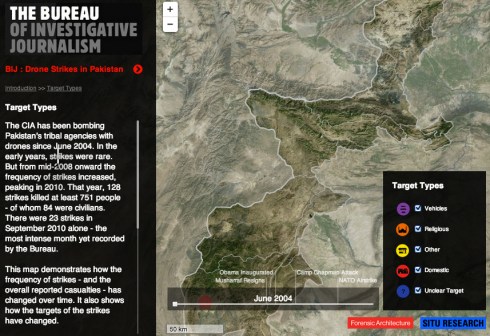
BIJ’s good work continues, as it played host to the Forensic Architecture (Goldsmiths University, London) and SITU Research to produce an online interactive WHERE THE DRONES STRIKE.

With WHERE THE DRONES STRIKE which we can examine drone target types (vehicles; religious; other; domestic; unclear target). Was that an insurgent training camp that was annihilated or was it a marriage celebration full of women and children?

Due to secrecy at the Pentagon (and previously at the CIA, when it controlled the drone program), reliable information on drone attacks is very difficult to come by.

“The CIA has been bombing Pakistan’s tribal agencies with drones since June 2004. In the early years, strikes were rare. But from mid-2008 onward the frequency of strikes increased, peaking in 2010. That year, 128 strikes killed at least 751 people – of whom 84 were civilians. There were 23 strikes in September 2010 alone – the most intense month yet recorded by the Bureau,” say the BIJ.

BIJ routinely collects info on drone strikes through thousands of reports, witness testimonies and on-the-ground data from Pakistan, but this is the first time this data has been put rendered as an interactive to propel human rights and accountability.

“The map demonstrates how the frequency of strikes – and the overall reported casualties – has changed over time. It also shows how the targets of the strikes have changed,” explains BIJ. “Domestic buildings have been the most frequently hit target type in each year of the drone war. Attacks on vehicles have become gradually more frequent, and in 2011 almost as many vehicles were hit per strike, on average, as buildings. But this dropped from a peak that year and in 2013 drones targeted vehicles just three times. Attacks on vehicles tend to kill fewer people than attacks on domestic buildings, and fewer civilians. The highest death tolls of all are in the comparatively rare attacks on madrassas and mosques.”

The U.S. dropped it’s first bomb from a drone in late 2002, on Yemen. The Obama Administration only formally acknowledged it was flying killer robots over foreign lands in 2012.

Go to www.WHERETHEDRONESSTRIKE.com

For a wild editorial break down of the data (and more graphs!) read the BIJ’s report Most US Drone Strikes In Pakistan Attack Houses which accompanied last week’s release of WHERE THE DRONES STRIKE.

For regular updates on drones at home and abroad, may I recommend following the Drone Weekly Roundup and signing up for the Newsletter (scroll down) put out by the Center For The Study Of The Drone at Bard.

sfpride

There’s a brouhaha brewing in San Francisco. The Armory — home to legendary controversial fetish porn empire Kink.com — is to host an event to coincide with San Francisco Pride. The WE Party Prison Of Love is being billed as THE BIGGEST PRIDE PARTY … EVER.

The predictable format for the prison-themed discoteque includes chains, shackles, a dungeon, and likely a whole lot of improv domination roll play. The majority of the 3,000-strong crowd is expected to be gay men.

As a cisgender straight male, I tend not to have any opinions on gay culture worthy of public proclamation. But, a prison-themed rave does seem a little tacky, though. For San Francisco’s trans-community, the Prison Of Love Party is far worse than tacky; it is an affront and a politically-clueless venture.

The Transgender Gender Variant, Intersex Justice Project in San Francisco, in an open letter to San Francisco Pride at the Armory, points out that the prison industrial complex abuses transgendered people strategically and disproportionally.

The primary signatory is Miss Major, one of this years SF Pride Grand Marshals.

It reads:

This year at least three SF Pride grand marshals are trans women who have been directly affected by the Prison Industrial Complex. Chelsea Manning is currently incarcerated, Miss Major is previously incarcerated and was politicized at Attica just after the 1971 uprising, and Jewlyes Gutierrez was arrested for defending herself from bullies in her high school.

The prison industrial complex and the incarceration of generations of people of color, gender variant, trans people, and queer people is not a sexy trope to throw a play party around. It’s not that we don’t love sex, sex parties, sex workers, and kink. It’s that we love it as much as we love justice, and are appalled by the casual use of the Prison Industrial Complex, which destroys the lives of millions of people and kills thousands every year, as a party theme.

The United States has the highest incarceration rate in the world. In our own LGBTQI communities, incarceration and significant abuses perpetrated by the Prison Industrial Complex constitutes no less than a crisis. According to the National Center for Transgender Equality, nearly 1 in 6 transgender people have been incarcerated at some point in their lives. Among Black transgender people, 47% have been incarcerated at some point in their lives. These rates overwhelmingly reflect the experiences of transgender women and especially trans women of color, who are housed in men’s prisons and face catastrophic rates of physical abuse, psychological terror, rape and sexual assault, and death. According to Just Detention International, 67% of LGBT prisoners reported being assaulted while in prison.

Not only is our queer community being harmed, the War on Drugs and the increasing privatization of prisons has created a phenomenon of mass incarceration of young Black and Latino men, and increasingly women too, which has economically, socially, and politically devastated these communities.

We are not interested in yucking anyone’s yum or shaming anyone who has fantasies or fetishes about ideas of this real-life violence. We are not interested in censorship or policing anyone’s sex life. We are interested in public space and party themes that get us closer to liberation from systemic and administrative violence and do not recreate a culture that normalizes or continues our oppression. Our push back is about navigating the legal and extra-legal targeting and criminalization of our communities.

At a time when public discussion and media finally has an eye toward the daily systemic violence against trans and queer people, your party theme and promotions are especially harmful and trivializing.

As individuals and organizations committed to justice and equality for LGBTQI peoples, we are working to end violence in our communities, and particularly at the hands of law enforcement, jails, detention centers and prisons. We’ve been doing this for years, and we’ll be supporting our brothers, sisters and siblings behind prison walls while you’re hosting a sex and dance event on Pride weekend that trivializes themes of incarceration and abuse as a good time.

We’re calling on you to understand how important these issues are to every member of our community, even if you’ve had the good fortune to not be hyper-visible and profiled by police, locked up, and then trapped in a cycle of institutional violence perpetrated by the California Department of Corrections and Rehabilitation, ICE, and the Federal Bureau of Prisons.

We’re calling on you to immediately change the theme of your party, and not use themes of arrest and incarceration, correctional officers beating inmates, solitary confinement, prison yards, or suggestions of prison rape in promoting your event.

As a step towards accountability and redress we’re also calling on you to donate a portion of the proceeds of your party to the Transgender Gender Variant Intersex Justice Project, El/La Para TransLatinas, and Communities United Against Violence, all organizations that are dedicated to ending police, prison, and systemic violence against trans and queer people in the Bay Area and beyond.

Signed,

Miss Major, SF Pride Grand Marshal/Director of Transgender Gender Variant, Intersex Justice Project
San Francisco Trans March, SF Pride Community Grand Marshal
Janet Mock, SF Pride Celebrity Grand Marshal/Author of “Redefining Realness”
Transgender Gender Varian Intersex Justice Project (TGIJP)
Community United Against Violence (CUAV)
El/La Para TransLatinas
Californians United for a Responsible Budget (CURB)
Justice Now
California Coalition for Women Prisoners (CCWP)
Community Justice Network for Youth
Sex Workers Outreach Project – Bay Area (SWOP)
All of Us or None
Dr. Annalise Ophelian, Filmmaker, Director/Producer – MAJOR! documentary
StormMiguel Florez, Musician & artist, Co-Producer – MAJOR! documentary
Courtney Trouble, Host of Queerly Beloved Pride Party, owner TROUBLEfilms

Well said.

Unfortunately, I don’t think the protests nor the #NotProud Boycott SF Pride movement will stand in the way of this Pride At The Armory shindig. Half the tickets have already sold. It’s large event long in the planning and those types of entertainment-ships don’t turn.

That’s a shame because facts are facts and the issue is undeniable.

  • LGBT teens comprise as much as 15% of the general population in juvenile justice facilities; among girls alone, 27% are lesbian or bisexual.
  • LGBT young people and adults face harsher penalties from the justice system. LGBT people face higher rates of abuse and assault in prison.
  • The two 2 leading risk factors for prisoner rape are previous sexual abuse and being LGBT.
  • Incarcerated homosexual and bisexual men are sexually assaulted at rates 10 times higher than their heterosexual counterparts.
  • The federal definition of “rape” didn’t even include men or non-vaginal penetration until 2010. Men assaulted in prison were not considered rape victims by the U.S. Department of Justice until 2010.
  • Incarcerated trans women in men’s prisons report rates of sexual assault nearly 13 times greater than that among groups of other people.

More depressing facts here.

Bad call. PR fail SF Pride.

As Jezebel puts it, “Call it Dungeons & Dragons themed, call it Party in Westeros, do something else that involves bars and chains and implements of “torture.” But this? Taking one of the biggest issues facing the LGBT+ community and turning it into a party?”

Lorenzo Steele

“I had buddies that couldn’t take the job and wound up quitting because of the mental abuse and, sometimes, physical abuse,” says Steele. “You could be responding to a fight, not knowing that they’re setting you up to stab you with a shank. It’s a very dangerous job. Corrections officers don’t have guns. At that time we weren’t even carrying mace. The only weapon you really have is your mind — how you used it dictated if you were going to have a good 8 hours or a bad 8 hours.”

COP TURNED ADVOCATE

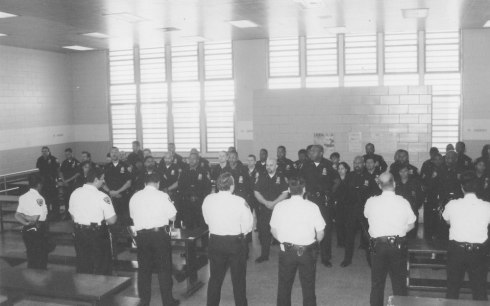
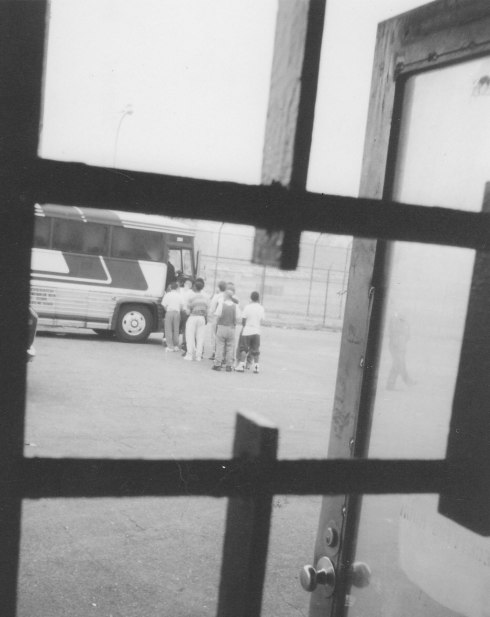
Lorenzo Steele Jr. worked as correctional officer on Rikers Island between 1987 and 1999. Most of his time was spent in the juvenile units. When the officers had retirement parties and other events, he was the one with the camera. In 1996, Steele began talking his small compact film camera into the units and making photographs of the dirt, the filth and the despair. All without any official approval. As part of his work, he also made evidence photos of injuries following violence inside the Rikers Island.

WARNING: THIS ARTICLE INCLUDES GRAPHIC IMAGES OF MUTILATION

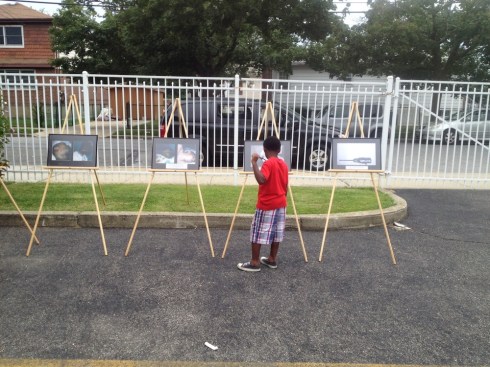
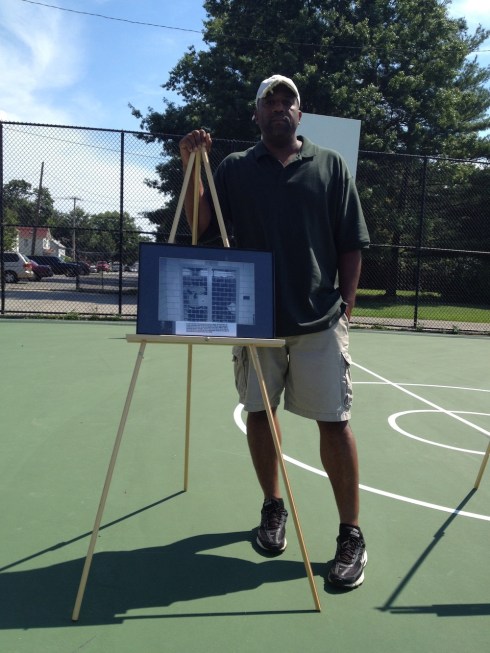
When Steele decided to leave the job, his “leap of faith” took him back to community instruction. As founder of Behind These Prison Walls Steele gives public lectures and brings pop-up exhibitions to New York neighbourhoods. It’s a mobile show & tell to shock and educate youngsters on the destructiveness and terror of prison. Steele estimates he has made close to 1,000 presentations in schools, churches and community centres since 2001.

I came across Steele’s archive when some of his images accompanied For Teens at Rikers Island, Solitary Confinement Pushes Mental Limits, a Center for Investigative Reporting article that was also adapted and cross posted to Medium as Inside Rikers Island, part of the excellent ‘Solitary Lives’ series.

It is very unusual for photographs made by correctional staff to surface, let alone for there primary use to be as tools for street-side exhibition and engagement. I called Steele and asked him some questions about his self-propelled cop-to-advocate career change, his motives for making the images, the efficacy of his methods and what we need to start doing differently to decrease the numbers of kids we lock up.

Lorenzo Steele

Q&A

Prison Photography (PP): When did you decide you wanted to be a correctional officer?

Lorenzo Steele (LS): At 21 years old I took a [New York] City test. At that same time I was a para-professional for the New York City Board of Education working with Middle School children. I was there for 8-months and loving the job. I got a letter from the city saying that if I could pass a physical, if I could pass the psychological, if I could pass the drug test, I could become a correction officer.

The only reason I became a correctional officer was because it was paying more money than the Board of Ed. I didn’t know I had to experience the system for 12 years, in order to know the system, and later to help people avoid the system.

I’m 22 years old, and it is just a job — no one in my family went to jail. In the neighborhood I grew up in, nobody went to jail.
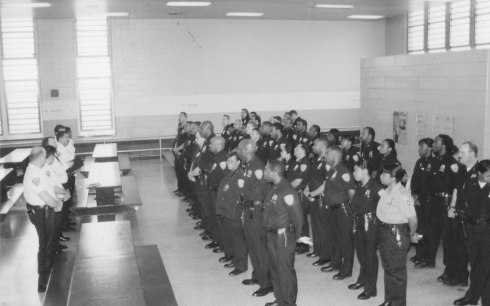
Lorenzo Steele

The academy was 2 to 3 months at that time. They could never prepare you mentally and physically for what you were about to experience working in a prison. On the first day took the ‘on the job trainees’ OJT’s into an actual facility. Now, they would tell you things — don’t talk to the inmates; don’t stare at the inmates but that was about it. I was afraid, but later I realized that in a prison you can not show fear because you will be manipulated. OJT was about 2 weeks, and after that we were assigned to our facilities.

I worked the C-74 Unit, the Adolescent Recession Detention Center (ARDC) for 14 to 21 year olds. Within that age range, of course, half are adolescents and half are adult inmates. One day you’re working with the adolescents, the next you’re working with adults. I dealt with mental health issues, behavior issues, socio-economical issues. I found out what our people actually go through and why they come to jail.

PP: What were your early impressions of the job?

LS: I’m young, I’m making good money. I have my own apartment, but I have the mind of an officer now.

Can you imagine sitting in a day room with a capacity of 50 inmates and you’re one officer that’s in charge? Your main function is to make sure they don’t kill each other or rape each other and if you see a fight you push a personal body alarm. Depending on which housing area you are in, you can sit there sometimes for 8 hours. I remember the day when I thought, “I can’t do this for twenty years. There are bigger and better things out there for me.”

I’m a photographer. I wondered what I could do legally. I started formulating a mentoring program. I used to volunteer my time in schools as a correction officer and share my insight on what the prison system’s really like. The average person doesn’t really know until its too late. It’s my mission to let these young children know that jail is the last place on earth they want to be.

PP: Do you consider yourself fortunate in that you came to that decision? Because for a lot of people in a lot of jobs, sometimes the stress is so high and the options seem so few they can’t even step back for a minute to see a change in circumstances.

LS: It was very rare for anyone to just resign from the department, unless they were brought up on charges. It was almost unheard of. People asked, “What are you gonna do? This is the best job.”

The last day that I knew I was going to be there, I walked around the jail and I grabbed a little object where I could and wrote on the wall. I carved my name in some wood objects and on some metal doors.

It was around the time of Mother’s Day. My Grandmother was in town and I took her to church. Sometimes, the preacher is actually talking to you. He said, “If there’s anything on your mind just leave it behind you, step out on faith.” That next day, that Monday, I went downtown and turned in my shield, turned in my gun.

PP: What year did you resign? 

LS: 1999.

PP: In between which years did you make photographs in Rikers? 

LS: I began maybe around ’95 or ’96.

I was the photographer for COBA, the NYC Correctional Officers Benevolent Association. People retire or you have parties or special events. I always had a camera on me. After that, I used to take pictures of inside of the prison not knowing that I was to turn it into an enterprise to save people from going into the jail.

I had a camera with no flash. Can you imagine taking out a camera? You’ve got 200 prisoners coming down the corridor to the cafeteria — they’re going to see the camera going off so I had to disguise it somehow. You get an adrenaline rush knowing that you can’t get caught. Once that shutter button is released its almost the best feeling in the world. Its like a high once that shutter button goes off and you’ve captured that image. And you know.

Lorenzo Steele

PP: Where did you keep the camera? In an office or did you take it home with you every day?

LS: I had it in my pocket. Sometimes I would take pictures of the officers in their uniform because the average officer never really has a picture of himself in uniform. It was a good time back then because the camaraderie was great. We had one team; the officers, the captains, the deputies, the warden. We were all one team back then, but you couldn’t do it today because after twenty years things change in the department.

PP: What type of camera did you use?

LS: A 35mm. One of those CVC store cameras. Digital cameras weren’t even out then. I put some black tape around the flash and disguised it almost like a cell phone or a beeper.

PP: How many photographs do you think you took, in total, inside the prison?

LS: Over 200 photos. Shots of prisoners in cells, of the solitary confinement unit, pictures of prisoners who were physically cut. In colour. You can’t imagine the power of those images when I show the kids: “If you don’t change your ways, this could happen to you.”
b

LS: Children cannot relate to prison, yet they see the negative violence on television and sometimes a rapper will glorify prison. Some rappers are promoting violence, promoting gang activity, and that’s some children’s reference to the criminal justice system.

But, once you step foot in that criminal justice system your life changes forever. Sometimes they might not even make it out. At 15-years-old we’ve had adolescents that end up taking 25 years with them upstate because they caught jail cases cutting and stabbing individuals while they was on Rikers Island.

Lorenzo Steele

PP: How do you exhibit those 200 photographs to the public? 

LS: It depends on the audience. I have a lot of graphic images so I don’t put those in the schools with the kindergarten kids and the third graders.

I have select images that I use when I exhibit on the sidewalk in at-risk communities. About 20 images at a time but it depends on where and what message I’m trying to get out.

PP: I’ve seen only a few images like the ones you’ve published. One example is the selection of images leaked by a Riker’ Island officer to the Village Voice two years ago.

We don’t see many images shot from the hip. If we do, they’re usually anonymous. Such images do exist but one must work hard to seek them out. How many people see your presentations? Are people shocked? Surprised? Do people respond to the images in the way that you hope they will?

LS: The first time they see the images, yes, they are shocked, especially students. Students that I deal whether in the church, in schools, in the community, are shocked. Images are powerful but the knock out blow is information, the experience, that actually goes behind what’s in that image.

PP: How dangerous was Rikers? In the 12 years you worked there how many incidents of serious assault and possibly even murder occurred or occurred on your shifts? 

LS: Let’s talk about the adolescents first. Rikers Island was considered the most violent prison in the nation. We used to average sometimes 50 to 60 razor slashings a month. Slashing with the single edge razor blade. Cut somebody over the face multiple times inside. There was a lot of blood.

When I went into corrections, I didn’t like the sight of blood [but] I saw so many people get cut that it became normal. I was so desensitized. And that’s scary because that normalcy meant somebody had a scar on their face for life and for every cutting there was a repercussion; if a prisoner got cut he had to get revenge on the other guy and catch another jail case.

PP: I have no idea how politics, street politics or gang culture — in or out of prison — work in New York today let alone in the late 80s and 90s. Over your twelve years, was there consistent gang activity or did it change? 

LS: In ’87, there weren’t gangs in the New York prison system. In the early ’90s, we realized we had a gang problem in the prisons. The gangs had their own language. 300 prisoners in the cafeteria and five officers. We had to learn the language real quick and that is what established the Gang Intelligence Unit. By conducting cell searches, we would get the paraphernalia and the by-laws of the gangs

Later on, they flipped gang members into telling the department what the language meant; that’s how the Department of Corrections infiltrated the gangs. We passed the information on to NYPD.

It was very dangerous. You had to be on your toes all the time. The gangs recruited younger people whom they would force sometimes to do harm on officers or do harm to prisoners. We did the best we could.

One of the blessings was that I always had good supervisors. When the captain said ‘go’, you went, and when he said ‘stop’, you stopped. You put your life in the hands of your captain; it’s almost like being in a war. I am old school. That’s what really kept us on top of the prisoners. The jail would never be overrun because you had a select group of officers that demanded respect and that knew how to take care of the business without anybody getting hurt. When prisoners saw that select group of officers, nothing was going down that day.
Lorenzo Steele

Part of being a Correction Officer is knowing your prisoners and you always wanted to know the gangster, you always wanted to know the person who was running the housing area because that’s the one that you would use, you know. “Listen man, while I’m here today, nothing’s gonna go down. Tell the boys man to shut it down while I’m here.”

PP: Clearly, I’m opposed to prisons as they exist. I think we lock too many people up and I think when we’re locking people up we’re not providing the right sort of conditions or services for them. Obviously, what goes on in the jails and prisons relates to outside society. The reason you do your work now, I presume, is because you see that link between poverty, what goes on in the neighborhoods and what happens in the jails.

What do we need to do better? How do we rely less on incarceration and when you must  imprison people, how do you make it safer for everyone in the place? How do you stop people from coming back? Do we need smaller prisons, do we need more money, do we need different sentences for different crimes? 

LS: It starts before prison. I worked in the neighborhoods classified by criminal justice books as “high-crime areas” and it starts with parenting.

Bill Cosby said on National TV that we have parents more focused on giving their kids cell phones, expensive gear and expensive pants. And they condemned Cosby. They found some black guy on CNN to come on and say ‘Cosby, you are wrong.’ But he was right. Unless you are inside the school system you wouldn’t necessarily know.

That’s why I hit the streets. I try to let the parents know that without that proper parenting their child has more chance of going through the criminal justice system.

Imagine being in a first grade class in an impoverished neighborhood (it depends on the school district) with 30 to 35 students in one class. 1st grade. Half the children can read, half the children cannot read, now you have one teacher. How is that teacher going to really teach? There’s two different dynamics going on in that classroom. We have children across America that are coming into the public school system unprepared to learn.
INMATE PHOTOS1_0032

LS: Poverty is a crime, because poverty comes with where you live. Those in impoverished neighborhoods are subjected to crime, shootings, and drugs, and then children have to go into a school system that doesn’t have the necessary resources. It’s a ticking time bomb.

Unless a parent or guardian is there to break down that math homework, for them, some children don’t know what’s going on. Unless there’s a parent there that could check the homework that the teacher gives every night. Its not going to get done. There’s a lot parents in poorer communities who are uneducated themselves. Look at the statistics coming out of poor neighborhoods — many young adults are not finishing high school and are not going to college. If a parent is not educated, then probably education is not talked about in the home.

The point of attack, strategically, needs to be that early childhood.

PP: Parenting and education. I can agree. But we can’t roll back the years’ generations to correct past mistakes. So what about the situation as it stands now? Say, you have a 15-year-old who’s acted out, he’s been pulled in by the police, he’s got a serious charge over his head. Is Rikers Island the best place to deal with that kid? Is Rikers Island the sort of institution in which — while they are kept away from the public for public safety — they themselves are kept safe?

LS: If you break the law there are consequences. There are necessary disciplines in place so we have a civil society. But is it Rikers Island or is it a juvenile detention center?

If you would have asked me this question as an officer, I’d have said, “Rikers, yeah.” But, now, when I go into the communities and hear what the parents have to say about a lot of these children just mimicking their parents, I wonder is that child at fault? Why did he steal that cell phone? Maybe his father was a thief, or maybe they don’t have structure in the home. Maybe there needs to be a place where a child’s whole history needs to be examined? What’s going on in that child’s home. Does he have a support system? He lives in a high crime area, how much do we expect him to succeed?

Lorenzo Steele

LS: Yes, I feel there needs to be places where children can go to receive those special considerations, not thrown into a place like Rikers Island in which you’re housed with murderers.

Let’s create places and bring in the necessary mentors. And I’m not just talking about doctors in psychology. Sometimes, it takes the correction officer. Sometimes, it takes that guy that did 25 years in jail.

Create a first offense type place. “Young man, we give you a year. If you do the right thing in this place we’ll seal your record, but if you don’t, you gotta go to the next level.”  Sometimes, some people have to go through that prison system if they’re going to turn their lives around.

Create a place where they could come in and get properly mentored to. You understand? Some people have degrees and others not, but there’s only a select few who can really get through to these children.

PP: So, the prison system is too rigid?

LS: It doesn’t always work. Prisons are putting way too many adolescents with mental health problems behind bars. They’re banging on the cells for 3 or 4 hours. These young children need advocates. They can’t speak. Not too many kids are writing a letter to mommy saying, “I’m thinking about suicide tonight; being locked in a 8×6 foot cell for 23 hours, I can’t take it no more.”

Lorenzo Steele

PP: Your photographs were used in an article by the Center for Investigative Reporting about solitary confinement. Over your time as a correctional officer did you see the use of solitary for youngsters increase, decrease, or stay the same? 

LS: We had one unit, about 66 cells. Prisoners that cut, stabbed, or assaulted officers, were locked in solitary confinement.

Warden Robinson implemented a program called Institute for Inner Development (IID). The warden put together a team. Hand-picked. A select few that you could trust and you knew they weren’t going to violate any prisoners rights. We did two weeks of training and took it to a select housing area. We transformed that housing area. Imagine going from 50 slashings a month, [among the] adolescents, to zero for four years.

Programs work if you can get the necessary personnel to properly run and maintain them. When we ran the IID program, we took another housing area — a hundred more prisoners — then another housing area. Eventually, we had 200 prisoners in the nation’s most violent prison in America and and next to no violence.

PP: What was different about that program? What was it that you provided the youngsters?

LS: I love children. I’m a disciplinarian, I love reading, so I had tons of knowledge about slavery and the connection between slavery and incarceration, so when you start talking about this new thing, they just love it. These 14, 15, 16 year-olds didn’t have any type of discipline at home, didn’t have the male role models at home. “This is what men do young man. Pull your pants up. Grown men do not walk around with their pants down.”

PP: So it was more about developing different interactions between the correctional officers and the prisoners, and changing the culture within the unit?

LS: Out of all of those officers, twelve officers, we had no psychologists, no therapists. We were the psychologists we were the therapists. Just because you have a degree that doesn’t mean that you can work in an area like that. There’s a lot of passion that’s involved in that.

Lorenzo Steele

PP: After you resigned, when did you begin exhibiting the photographs?

LS: I detoxed for about 8 months, just not doing anything. From being on the drill to taking it back to normal. Then I started going into the schools and just sharing my information.

PP: With the images?

LS: I laminated some 8×10” color prints and put them on the blackboard. Then I got a laptop and a projector, and went from holding the pictures in my hand to projecting them agains auditoriums and classrooms walls. My first printed use of  the images came in a 2005 Don Diva Magazine feature. They gave me 5 or 6 pages. I provided my phone number. Soon after, a police officer who worked with youth called me and asked, “Could you come in a talk to my youth?” That was the start of giving back.

PP: How do you evaluate your work? 

LS: Seeing that look on somebody’s face when they think they know what jail was like, but then I show them the reality. Talking to 500 students in an auditorium and asking them, “Is this new information?” and they all say yes. Many of them have to make a change right there. For others its going to take longer to make that change.

PP: Is what you do anything like Scared Straight!

LS: I’m not trying to scare you straight I’m trying to inform you straight.

When you’re looking at somebody and they got a thousand stitches on their face, the shock is there but along with the shock is the information behind it. Prison is a violent place and the criminal justice system is a for profit agency and so I break down a lot of information within the program.

PP: What images do we need to see? 

LS: We need to see the graphic images of the young guy that was in solitary confinement unit who just cut himself with a razor blade because that was the only way that he could get out.

Lorenzo Steele

LS: We need to see the images of a young girl in shackles walking down the corridor with a hospital gown on. We need to see images of somebody crying in their cell at night and the only reason he’s in the cell is because his parents didn’t have the money to bail him out. We need to see those images of the abuses, we need to see the dirt, we need to see the filth.

We need to see the pain the officers go through — the officers that get cut and the officers that get feces thrown in their face hoping that they don’t have Hepatitis. An image is what stays in the mind. Every time you think about doing bad you need to think about that image.

Hollywood uses images too to glorify the rich and powerful with the jewelry on their neck. But it is fake. I use images to bring awareness to what really takes place behind bars and what young adolescents are actually going through. Everyday. It has to be traumatic.

Is the prison system still in the business of rehabilitation? That’s a question that needs to be asked in the Department of Corrections nationwide. Are prisons and jails in the business of rehabilitation? Yes, he did commit a crime, but does he have to be put into a cell for 23 hours. Is that rehabilitation? Or is that torture? We have to define cruel and inhumane treatment. We have to bring up those: terms, rehabilitation or torture.

What we do with this young child while we have him here for a couple years could make or break him for the rest of his life. There’s volunteers that go into the prison and mentor. Recently, I had the week off so I went back to Rikers Island, and did some workshops, talking to the kids. I felt obligated because we’re in a place that could make or break them. Some are going to the street. Some are going upstate. If you’re going to the street, prepare their minds while they’re here. If we’re trying to rehabilitate.

PP: Over the 12 years that you’ve been doing this work, if you can estimate, how many times have you presented to groups speaking and how many times have you presented images? 

LS: I’ve done close a thousand presentations — in churches, schools, and sometimes putting them on the streets. Just taking the images right to the high crime areas and putting them right on the sidewalk. People in the poor neighborhoods are not going to go to the museum so I bring the museum to the streets.

PP: Thanks, Lorenzo.

LS: Thank you, Pete.
           Lorenzo Steele

ENGN9

Arnau Blanch‘s series Everybody Needs Good Neighbours is a look at his home town, Vilobi d Onyar.

With only 3000 inhabitants, Vilobi d Onyar is defined its periphery. Large infrastructure projects such as the Costa Brava Airport, L’Eix Transversal, Mediterráneo Highway and the AVE train line surround the settlement. Townsfolk, seemingly, fall in line and fall in between the cracks; everyone living in temporary and interstitial space.

“Vilobi d Onyar’s ‘No man’s land’ condition turns it into a dismembered territory. Tunnels, retaining walls, bridges and fences form a landscape that has influenced inhabitants’ adaptation to the environment,” writes Blanch.

Good stuff.

1angel-diaz-execution-left-arm

Diaz’s left arm had an 11-by-7 inch chemical burn from the lethal drugs. By the time the autopsy began, the superficial skin had sloughed off, revealing white subcutaneous skin. (Source: New Republic)

Yesterday, The New Republic published for the first time a set of photographs of a chemically burnt corpse. The body was that of Angel Diaz, a man executed by the state of Florida in December of 2006.

As author of the piece, Ben Crair explains, “The execution team pushed IV catheters straight through the veins in both his arms and into the underlying tissue.”

Diaz sustained horrendous surface and subcutaneous chemical burns.

“As a result,” Crair continues, “Diaz required two full doses of the lethal drugs, and an execution scheduled to take only 10 to 15 minutes lasted 34. It was one of the worst botches since states began using lethal injection in the 1980s, and Jeb Bush, then the governor of Florida, responded with a moratorium on executions.”

The photographs were made by a Florida medical examiner during Diaz’s autopsy. Crair discovered the photographs in the case file of Ian Lightbourne, a Florida death-row prisoner whose lawyers submitted them as evidence that lethal injection poses an unconstitutional risk of cruel and unusual punishment. While the details of Diaz’s botched execution have been known since 2006, this is the first time visual evidence of the injuries sustained from the lethal injection has been presented publicly.

I’d like to tell you that such images are anomalous, but sadly that is not the case.

I, myself, have seen a set of images of a burnt corpse post execution. The victim in that case was executed in the electric chair. Similarly, in that case, the images were in the possession of a lawyer (who had acquired them through family of the executed) and used in court in argument against the electric chair as cruel and unusual punishment.*1

May I suggest that the photographs of Angel Diaz’ corpse, and all those images like them, be accessioned into the Library of Congress?

If the Library of Congress’ mandate is to preserve those things that are central to American culture; central to the American conscience, dear to this nation’s body politic and truly reflective of our culture, then I hold there is no better collection of images than these.

Between 1890 and 2010, the U.S. has executed 8,776 people. Of those, Austin Sarat, author of Gruesome Spectacles: Botched Executions and America’s Death Penalty says 276 went wrong in some way. Of all the methods used, lethal injection had the highest rate of botched executions — about 7%.

Photographs of a botched execution are as American as apple pie.

Whether an execution is considered officially “botched” or not, the torture imposed on a body in the minutes before death is unconscionable. Crair pursued the story and the publication of the images, rightly so, in the aftermath of the recent botched execution of Clayton Lockett in Oklahoma.

“The execution team struggled for 51 minutes to find a vein for IV access,” writes Crair, “eventually aiming for the femoral vein deep in Lockett’s groin. Something went wrong: Oklahoma first said the vein had “blown,” then “exploded,” and eventually just “collapsed,” all of which would be unusual for the thick femoral vein if an IV had been inserted correctly. Whatever it was, the drugs saturated the surrounding tissue rather than flowing into his bloodstream. The director of corrections called off the execution, at which point the lethal injection became a life-saving operation. But it was too late for Lockett. Ten minutes later, and a full hour-and-forty-seven minutes after Lockett entered the death chamber, a doctor pronounced him dead.”

CLOSING THE BLINDS

The single detail about the Oklahoma debacle that really stuck in my mind was the state’s decision — upon realising the execution was being botched — to drop the blinds.

The gallery of spectators including press, victim’s family and prisoner’s family lost their privileged view.

In that instance when the blinds dropped, the scene switched from that of official, public enactment of justice to the messy, sick, complicit torture of a human. In that instance, the barbarity of the state revealed itself fully. And the state was ashamed. The public were no longer allowed to see.

The notion — indeed the internal logic of the state — that viewing one type of execution is acceptable and another is not is astounding. By virtue of its actions during Lockett’s botched execution, the state has distinguished between what types of torture (execution) it is acceptable to see. Quick, quiet, seemingly painless = good. Noisy, drawn out, demonstratively torturous = not good.

The distinctions are petty. All executions are cruel and unusual.

At this point, I can only presume those who still support the death penalty are those who subscribe to some pathological eye-for-an-eye illogic. Wake up! The state shouldn’t be involved in murdering people. Especially when we have seen 1 in 10 people locked up for life or on death row for capital offenses later exonerated due to DNA evidence or prosecutorial misconduct. The state shouldn’t be involved in murdering innocent people.

*1 People are under the misconception that the electric chair zaps a person and kills them instantly. This is not the case. Electricity takes the paths of least resistance which is outside of the body. Therefore, tens of thousands of volts serve only to burn the points at which they are attached, namely the lower leg and the skull. Death by electric chair is in fact just boiling the victims brain for 7 seconds. Boiling the brain alive.

regional_rates_1978-2010

For the last 30 years, there have been clear regional differences in states’ use of the prison, with the southern states relying on the prison the most often. (See larger.)

The small, independent and incredibly effective Prison Policy Initiative (PPI) has delivered us a great service once more.

Not content with *only* filing lawsuits, pressing states to move away from Prison Based Election Gerrymandering; battling corrupt and expensive jail phone systems; and protecting prisoners’ rights to communicate unhindered by letter, PPI is committed to providing fellow prison reformers with accurate up-to-date data on mass incarceration. We cannot rely on the governmet to provide recent data.

“Until 2006, researchers, advocates, and policymakers could rely on state-level race and ethnicity incarceration rate data from the Bureau of Justice Statistics “Prisons and Jails at Midyear” series. Unfortunately, these state-level statistics have not been updated in eight years,” says PPI.

PPI has used data from the more recent 2010 U.S. Census counts to measure each state’s incarceration rates by race and ethnicity. Most (57%) people incarcerated in the United States have been convicted of violating state law and are imprisoned in a state prison. Monitoring trends at the state-level is imperative.

“State-level policy choices have been the largest driver of our unprecedented national experiment with mass incarceration,” says PPI. “Each state is responsible for making its own policy choices about which people to lock up and how for long. We can’t end our nation’s experiment with mass incarceration without grappling with the wide variety of state-level criminal justice policies, practices and trends.”

As such, PPI published yesterday the most comprehensive breakdown of demographics in our state prison systems to date. In three distinct sections:

Breaking Down Mass Incarceration in the 2010 Census: State-by-State Incarceration Rates by Race/Ethnicity

Tracking State Prison Growth in 50 States

50 State Incarceration Profiles

In total, PPI has published 316 new charts, graphs and maps for an accurate view of our shameful, expensive and failed recent history of imprisonment.

Kudos to Peter Wagner, Leah Sakala and all the PPI staff.

In recent months, there’s been a number of interesting — and in some cases, urgent — photo stories coming out of prisons worldwide, that I’d like to draw you attention to.

ANDREW BURTON

Andrew Burton

Anthony Alvarez, left, 82, eats breakfast with Phillip Burdick, a fellow prisoner and member of the Gold Coats program at California Men’s Colony prison in December. Mr. Alvarez said he has been incarcerated for 42 years for a series of burglaries, possession of illegal firearms and escapes from county jail. He eventually got a life sentence due to three-strikes laws. Shown is Mr. Alvarez’s first day being assisted by the Gold Coats; he largely needs help with mobility. Mr. Alvarez tries to work out for a few minutes every other day. Mr. Burdick, 62, has been volunteering with the Gold Coats for more than 18 years and is the longest-serving member of the program. Mr. Burdick has served 37 years on a 7-years-to-life sentence for first-degree murder.

Andrew Burton‘s photographs of aging prisoners for the Wall Street Journal have been well-received. With one of the largest state prison populations, a history of long sentencing laws and inadequate healthcare, the old men and women have the odds stacked against them for a comfortable day-to-day living.

The percentage of prisoners 55 or older in the U.S. increased by more than 500% between 1990 and 2009.

Burton’s photos focus on the Gold Coats program at California Men’s Colony, in San Luis Obispo, which pairs younger, willing prisoners with older prisoners suffering dementia and terminal illness. In 1991, California Medical Facility created the first prison hospice program in the nation to deal with the AIDS crisis, and the hospice is now used for elderly prisoners who are terminally ill.

Great photos. Burton is realistic about the situation but seems clearly impressed with efforts there.

However, here’s some context. Ever since California’s medical prison system was deemed cruel and unusual and it was brought under federal receivership, the state has been making efforts to deliver specific facilities for health care. The largest was to open the California Health Care Facility in Stockton, CA. It is the largest medical prison in the world. At a cost of $840M it was supposed to solve many issues and provide care for 1,800 prisoners. Nothing is so straightforward. Since opening in July, 2013, it has been beset by waste, mismanagement and miscommunication between the prison and medical staffs.

Watch this space. Hopefully vast, vast improvements will ensue.

[Todd Heisler has photographed at the California Men’s Colony too.]

ANDREA WISE

Andrea Wise

Erika Roberts, 26, of Hartford is a factory worker, a dancer, a teaching artist, a worshiper, a mother of three, and a felon.

Photographer Andrea Wise soon realised that when lives are intertwined with the criminal justice system nothing is straightforward. From the millions of effected formerly-incarcerated millions, Wise’s Freedom Bound manages to tell the story of Erika Roberts on very humanising terms. And with touching photographs.

“Her story is both a simpler one – a quiet story of a young family just trying to do the best they can – and a more complex and nuanced story about life in poor urban communities where people grow up in and around trauma, where criminal activity and incarceration are commonplace, and where Erika’s story isn’t all that uncommon,” says Wise.

Freedom Bound explores Erika’s quiet determination and struggle to break the cycle of incarceration.

“Erika strives for more from life, for her children, and for her community,” writes Wise.

ANIBAL MARTEL

Anibal Martel

In 2012, Anibal Martel photographed inside Lurigancho Prison, the largest and most overcrowded prison in Peru.

“According to the National Penitentiary Institute of Peru (January 2012) Lurigancho has a capacity limit of 3,204 prisoners but it actually holds 6,713 with a ratio of one police officer to 100 inmates,” says Martel.

“With corruption, tuberculosis and drug dependency together with its appalling management by the state, the prison gained a reputation as one of the most dangerous prisons in the world,” Martel continues. “Today, Lurigancho is fighting to survive thanks to the internal organization of some prisoners and their work. These prisoners have managed to create a small, internal infrastructure that allows them to feed themselves and live a more dignified life.”

ERIC GOURLAN

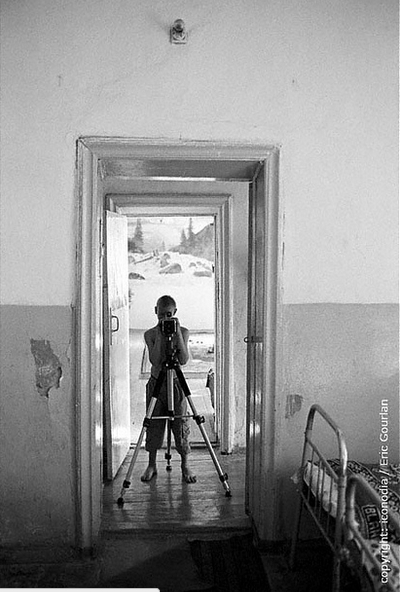
Gourlan, Eric - Bishkek, Kygryzstan Juvenile Prison

French photographer Eric Gourlan voluntarily spent a month inside Kyrgyrzstan’s prison and documented life in two men’s prisons, one women’s jail, and a juvenile detention centre — all in the capital Bishkek.

Gourlan has published on Flickr photographs from the juvenile facility in Bishkek, Kyrgryzstan.

There’s a great interview with Gourlan on the Institute for War and Peace Reporting website. Gourlan explains that he gained access through valuable partnerships with State Service for Execution of Punishment (GSIN), the United States Agency for International Development, Freedom House, the OSCE Center in Bishkek, the GSIN Public Oversight Council and the Kyrgyz NGO Egel — a long list which gives us an idea of the importance of partners for this type of work.

“I would really like to commend the openness of [prison] officials in Kyrgyzstan – I could go almost everywhere I wanted,” says Gourlan. “The only thing was that in the first two days, I was accompanied by guards until everyone got used to me. But then I was given more freedom and practically could move around on my own. On some occasions, I ate with prisoners.”

Gourlan met some hardened criminals but also met people who’ve been victims of overly-punitive sentences.

“One woman told me that she had been in a very difficult financial situation and somebody asked her to transport 30 grams of heroin from point A to point B for 100 [US] dollars. She was caught and given 12 years in prison. She had never used drugs before, never sold them, and never got her 100 dollars, but she has been locked up for 12 years,” explains Gourlan. “Obviously I do not know if those stories I was told were true or not. But that was not why I embarked on this project.”

Eric Gourlan’s project was backed by Freedom House, the OSCE Centre in Bishkek, a local NGO called Egl, and the prison service in Kyrgyzstan.

More photos on l’Oeil de la Photographie and this video on Freedom House, a group in support of human rights in Kyrgyzstan.

ISABELLE SEROUART

Isabelle Serouart‘s rare photographs from within a prison in Madagascar were published by SoPhot. The images are small and embedded, but I also found this footage Serouart made of female prisoners singing.

“In a very confidential way record of women song in a jail in Madagascar,” says Serouart. “To sing is a way for her to survive together.”

DAVID RYDER

David Ryder

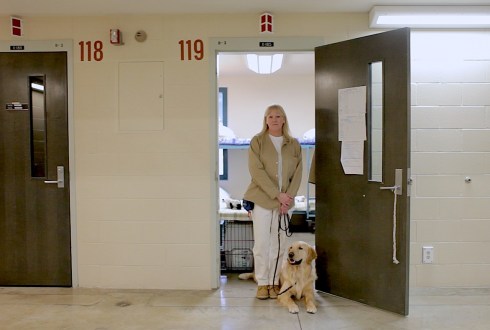
David Ryder, for The Wall Street Journal, made a video about the Prison Pet Partnership at the Washington Corrections Center for Women in Gig Harbor, Washington is an interesting watch.

“The program allows inmates to learn job and life skills while providing kennel and grooming services to clients from the surrounding community,” says Ryder. “In addition, unruly dogs from other programs (who might otherwise be put to sleep) are able to have a second chance by entering the prison’s training program.”

This is a win-win for the women, the dogs, the prison administrators and the media. Despite prisons being a continual source of distress and latent abuse, the press always needs new angles — depressing stories don’t have the readership coming back. A human interest story about (wo)man’s best friend and redemption plays well, and we’ve seen them before. Here’s a couple more similar project in Florida and Colorado.

Another thing that makes me slightly uncomfortable with the story is that simultaneously, just over an hour south, detained immigrants were on hunger strike for their confinement in solitary and slow progress of their cases. Now I know, the state prison system and U.S. Immigration & Customs Enforcement are different authorities, but if we’re to look at lock-up in Washington State, I’d suggest we factor in ALL types of prisons and prisoners. ICE facilities remain the most inviisble.

The full WSJ story, to accompany Ryder’s video, by Joel Millman and with photos by Stuart Isett, you can see here (behind a paywall).

As an aside, the most interesting photography project on prison dog’s programs remains Jeff Barnett-Winsby’s Mark West & Molly Rose. After Barnett-Winsby had photographed the prisoner (Manard) and the program administrator absconded from the Safe Harbor Program and escaped from Lansing Prison, KS and went on the lam for 11 days. A weird tale of fact and fiction, manipulation and unsaid knowns. The investigating police acquired Barnett-Winsby’s photos because he had made the most recent images of Manard’s tattoos. Yet Manard had drawn false tattoos for the shoot predicting their use later following his escape. Twists and turns. No photographer can ever plan or predict such a bizarre story, or implication in it.

MAE RYAN

Mae Ryan

A child plays with his mother at the cafeteria inside The Community Prisoner Mother Program in Pomona, California. Mothers and their children live in open barracks shared with two other mother-child family pairs.

Mae Ryan‘s series on the Community Prisoner Mother Program in Pomona, California was one of the last assignment’s she made before moving from KPCC to The Guardian. And it is stand out.

Pregnant in Prison offers a look at a select group of minimum security prisoners who may live with their young children until the child turns seven years old. Mothers live with their children in rooms shared with other prisoners. During the day, children are enrolled in the on-site preschool and Kindergarten and mothers take rehabilitation and other classes.

In 2011 and 2012, 233 female prisoners gave birth while serving time in the California prison system. So, this program applies to only a tiny fraction of women suffering California’s prison system. It is a welcome, forward-thinking program. Psychological studies are unanimous that close bonds between mother and baby, from the earliest hours, are vital in sparking healthy cognitive and social behaviours. Why wouldn’t we allow incarcerated mothers the ability to raise their own children?

In terms of such residential programs, most (and there are only a handful) allow mothers and babies to be together until the baby is 2 or 3 years of age. Pomona is exceptional.

Let me be clear though, I don’t want to see more prisons with this type of program; I want to see less prisons with lesser need for these types of programs. I want to see community supervision instead of incarceration and if prisons must be used, then for them to be bursting with positive programs designed around the women’s needs. That said, the Community Prisoner Mother Program has many elements to inform better care.

ANONYMOUS GREEK PRISONER

Greece

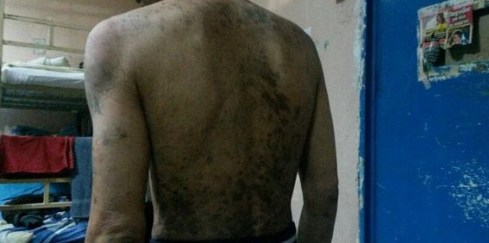
An expose by a Greek Prisoner registered on American news consumers’ radar when Medium published the piece Greece’s Biggest Prison Is Boiling by Yiannis Baboulias. The photographs accompanying the piece were taken by a prisoner and were then published repeatedly through the Twitter account @kolastirio.

He also got his footage out:

The expose caused outrage.

Baboulias writes, “People suffering from HIV, tuberculosis, psoriasis, cancer and other serious diseases, are discarded like trash in common rooms where hygiene is an unknown term. Spaces designed to hold 60 people, now hold more than 200. Reports say that some of these diseases have already started spreading amongst the inmates, making the prison a threat to public health in the general area. As inmates report, when the staff realises someone is close to death, he is quickly transported to a hospital, so his death won’t be recorded in the prison’s logs.”

Given that the infrastructure of Greece is collapsing in the wake of it economic meltdown, how surprising is this neglect? Hospitals are having budgets cut by 25% so what chance have the prisons and prisoners in the grapple for resources?

In an update, Baboulias says that the prisoner that leaked the photos and video has been prosecuted and faced trial.

VALERIO BISPURI

Valerio Bispuri

Valerio Bispuri has photographed in 74 prisons in South America, over a period of a decade. I was grateful to find a short interview with him as part of Fotografia’s ‘Prison Week

“It was clear to me that  would have required a great time commitment when I realized that permissions to photograph in the prison were going to take months to obtain,” says Bispuri. “In a few cases I’ve had to wait for years.”

Women’s prisons are rarely any better.

“There certainly is anger in female prisons as well, which sometimes turns into violent attacks. Moreover, in most prisons, female inmates are denied the “intimate visit”, that is the possibility to have sexual intercourse with their husband or partner, which is instead granted to those male inmates who behave properly,” explains Bispuri.

The work has had some effect. Following an exhibition of Bispuri’s photographs, in Buenos Aires in 2009, in collaboration with Amnesty International and the Argentine Government, Mendoza Prison’s Pavilion N5 was closed down.

“Life conditions there were tragic,” says Bispuri.

Bispuri’s series Encerrados describes how hellish many of the facilities. He has had a knife held to his neck and infected fluids thrown at him as protest to being photographed. Still, Bispuri is sympathetic to the resolve of many prisoners.

Also, featured during prison week were photographers Stephen Tourlentes, Sergei Vasiliev and Amy Elkins.

AMY ELKINS

Amy Elkins

Amy Elkins recently won the Aperture Portfolio Prize for her projects Parting Words and Black Is The Day, Black Is The Night. Congratulations to her. I’ve written and thought extensively about both projects (for Huffington Post and for Daylight Digital, respectively) and in the wider context of Elkins’ approach.

Hope you appreciate these works and find something you like. Sorry this post is effectively an illustrated barrage of links, but we should be grateful there’s so much work being published! Let me know what you think of it all.

9_veterans-hd-bon-2

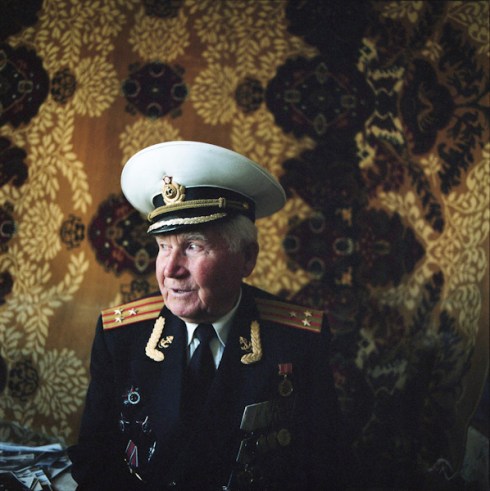
Colonel Matcegor Ivan Gregorevitch

Throughout the ongoing events in Crimea, eastern Ukraine and Russia, we’ve seen many images. Some good, some bad, but most briefly (tomorrow’s chip-wrap, and all that). Has photography adequately described the unfolding turmoil? For me, the jury is still out, but I’m in a combative mood this evening.

Of the news photography coverage I was impressed with those by Brendan Hoffman and Sergei Ponomarev (who’s been shooting in the region for years) and as a scene setter, I liked Maxim Dondyuk’s old work from a Russian kids military training camp. Of the amateurs, Dima Tolkachov showed us just how ripe for image-making Maidan Square was.

Knowing that armchair critics such as myself would be decrying the fact that photojournalism was doing exactly as it was supposed to do — capture wrought images of struggle with smoke, barricades and actions — a few photographers aimed to make series that were descriptive of the people and the struggle, but forged new typologies. Stationary typologies of weapons and fighters from within the front lines. Anastasia Taylor Lind and the duo Jean-Marc Caimi and Valentina Piccinni both made portraits and (sometimes within arms reach) Tom Jamieson and Donald Weber made studies of DIY weapons and molotov cocktails respectively. Of Jamieson and Weber’s work I’m ambivalent, even if critics I respect are all for it.

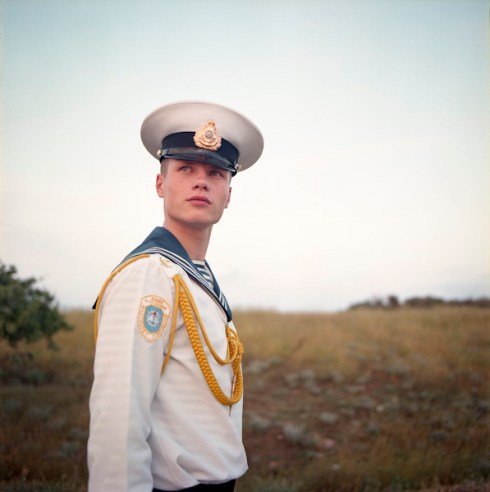
If I am being imprecise here, it is because I feel I can afford to be. I mention these photographers’ works as context for Julie David de Lossy‘s work which was made long before events erupted in Kiev. De Lossy’s series Black Sea Fleet Cadets and Black Sea Fleet Veterans are not reactive as the above-mentioned bodies of work are. Maybe, as a consumer of images, I am just more comfortable seeing formal portraits made in times of peace as opposed to times of shells and bullets falling all around?

Black Sea Fleets

Kolia, 20, Cadet at Nakhimova Institute

The Black Sea Fleet was an aging institution that was under threat of closure for decades. Somewhat ironically, the 2010 election of the now-ousted pro-Russian Yanukovitch as Ukraine president brought with it a new extended lease of the Black Sea Fleet facilities beyond 2042 (presumably now defunct). The Russians provided discounts on natural gas in exchange. Quite why the facilities to this old military group were part of negotiations between the Russians and Ukrainians is not entirely clear, yet de Lossy explains that  it recruited both Russian and Ukrainian cadets and that both Russians and Ukrainians honoured the veterans. De Lossy adds that in Sevastopol — where the Black Sea Fleet was based — is considered by the locals as a Russian territory.

It is within the experience of the ranks young and old that we might begin to discover the historic and complex ties between Russia and Ukraine. De Lossy’s work requires us to do more than identify the good guy and the bad guy from afar; indeed it instructs us that as history collides with current affairs our labels may shift. Whereas the work of many photographers is literally made on one side of the barricades or the other, and whereas such work has buy-in from one side or the other, archive work such as de Lossy’s takes us back to a time before people were forced to stand one side of the line or the other. It takes us to a time that explains the now.

Images of violence are images of loss; loss of stability, loss of choice (to a degree) and loss of self. In mainstream (news) images of ongoing revolution and violence, loss is an abstraction — the parameters and extent of loss are still being determined. Made in times of non-violence, de Lossy’s photographs depict the absence of violence. Her quiet portraits of cadets and veterans are a requiem for times not shaped by nationalism and conflict.

Quietness replaced by conflict is a grave loss. For all. However they identify.

JULIE DAVID DE LOSSY

Julie David de Lossy studied political sciences and international relations. She worked for two years at the Ministry of Foreign Affairs in Brussels, before receiving a Masters degree in Conflict, Security and Development from King’s College London. For many years, she has photographed in Central Asia, working on the security and environmental issues in Tajikistan, Kyrgyzstan and Kazakhstan. She has an ongoing project called ’20 Years After: Soviet Legacy in Central Asia.’ She lives in Brussels.

EMAIL

prisonphotography [at] gmail [dot] com

Prison Photography Archives

Post Categories

RSS PETE BROOK’S TUMBLR ‘PHOTOGRAPHY PRISON’

  • An error has occurred; the feed is probably down. Try again later.