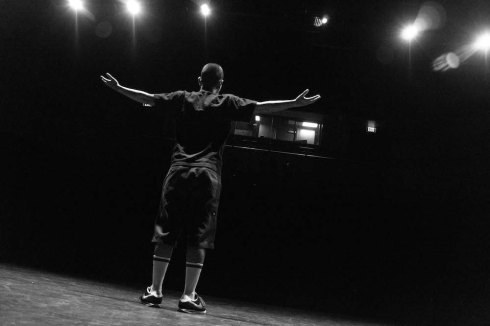
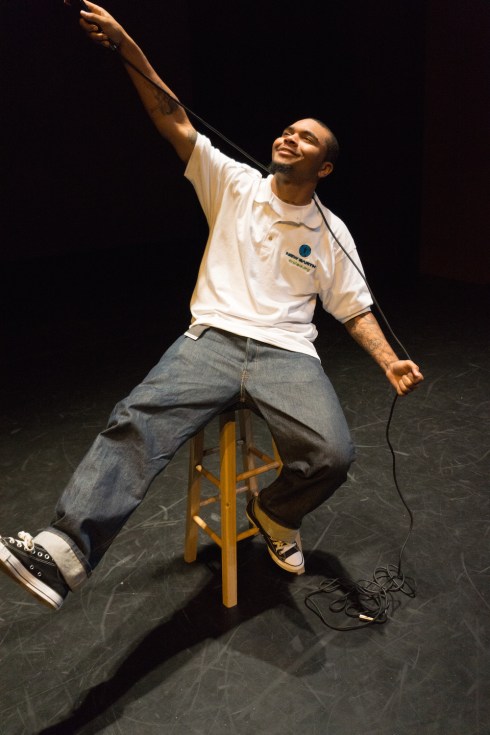
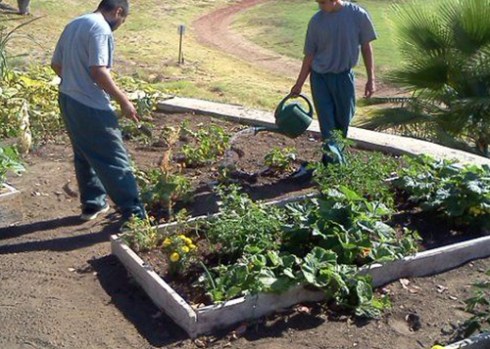
The city of Los Angeles has the highest population of incarcerated youth of any city on the planet. A new non-profit on the block, named New Earth, that offers programs for incarcerated and formerly incarcerated youth in the City of Angels is working with media, music, gardens and outward-bound programs to offer children skills, alternatives to gang life.
New Earth claims that their efforts have reduced rates recidivism from 80% to 5% among those in their program. Quite a statistic!
You can see the work of students here and below is New Earth’s latest press release.
From New Earth:
A Step to Ending the Youth-to-Prison Pipeline – New Earth’s Programs Reduce the LA County Youth Recidivism Rate From 80% to 5%
It is time to shed light on an unacceptable unspoken fact that lies in the belly beneath the surface of awareness in Los Angeles. As of July 2014, there are roughly 30,000 young people on probation or locked up in L.A. County, more than any other metropolitan area in the world. 95% of these youth face incarceration for nonviolent offenses. Once a young person meets such a fate, there is an 80% recidivism rate, which means 80% will end up incarcerated again. This system is broken and its rehabilitation depends upon the deployment of acute and revolutionary tactics.
New Earth, a non-profit started in 2004, is making significant strides in reducing the recidivism rate in Los Angeles. They provide mentor-based arts, educational and vocational programs to incarcerated and formerly incarcerated youth ages 13-22. These programs aim to reduce the recidivism rate by empowering these youth’s lives, and enable them to reach full potential as contributing members of our community.
It’s working.
New Earth’s programs have an incredible success rate. Once a youth starts a New Earth program while incarcerated and continues on with New Earth programs and services post release, his chance of getting re-incarcerated drops down from 80% to less than 5%. It costs taxpayers $125,000 per year to lock up one youth, however it takes a mere $3,500 to put one young person through the New Earth programs for an entire year. Youth remain free from gangs, crime and jail – they’re kept inspired, productive and ALIVE. Today, New Earth serves 2,500 young people per year in 9 out of the 18 juvenile probation camps in Los Angeles County. They work with more incarcerated youth in L.A. than any other non–governmental organization.
“Our goal is to reduce the recidivism rate in Los Angeles and keep these kids from coming back to the camps, going to prison or worse yet, becoming a statistic” explains Harry Grammer, Founder and CEO of New Earth.
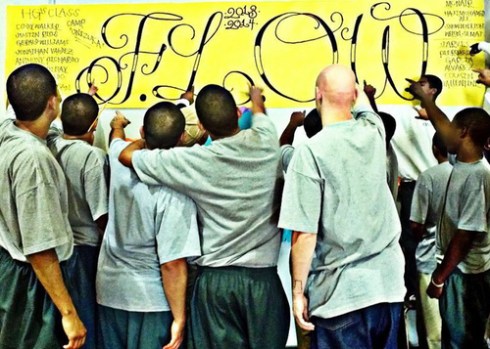
The results are inspiring. One of New Earth’s foundational programs is F.L.O.W, an acronym for Fluent Love of Words, which is a writing, poetry and music program based on the California Common Core Standards of Education. Through the discovery of their unique voice, youth begin to realize their potential as artists, creators and instruments of positive societal change. These programs have the ability to prevent violence, increase social consciousness, and expand vocabularies and reading comprehension by creating safe places for creative expression. This leads to broadening of their sense of freedom and self-esteem, and recrafting of their attitudes towards authority, their peers, and their self-perception.
“New Earth has changed my life in many ways,” says Alex Pham (21) a program alumni who now works at the New Earth offices as a camera operator. “It has changed how I view the simplest things in life. The love, care, and appreciation the viewers have for the job I do is incredibly outstanding. It made me realize that we should appreciate more and be grateful for every little thing in life.”
The road to change within the historically harsh and unjust industrial prison system is one with deep rooted complexities, but New Earth’s programs are a firm step in the direction of repair and life-changing retribution.
SOCIAL
Every other month, New Earth hosts awareness mixers to share information about the problems of youth prison systems and its own contributions to combat them.
The next mixer is on Wednesday July 30th, 5:30pm-7:30pm at the Center for Arts and Educational Justice, 3131 Olympic Blvd. 2nd Floor, Santa Monica, CA 90404.
California used to be a private prison-free state, but as overcrowding, unconstitutional conditions and budget crises have gripped, Governor Brown and legislators have increasingly turned to the quick-fix of leasing private facilities.
“One out of 10 California inmates is serving time in a leased or private prison,” reports the Los Angeles Times. “Women’s prisons are the most cramped: the Central California Women’s Facility at Chowchilla is listed at 182% capacity in last week’s state prison census report, with 1,600 prisoners more than it was intended to hold.”
The latest addition to California’s archipelago of lockdowns is McFarland Women’s Prison operated by GEO group, one of the two largest private prison corporations in the U.S. This is a backward step, not only because it is the reopening of a prison the state doesn’t need, but because profits will be made off of the back of those imprisoned. GEO Group has a history that includes sexual abuse and poor medical care in its jails and prisons.
Grassroots organising is to protest the new prison at the end of this month. From the organisers:
RALLY AT MCFARLAND PARK, 100 FRONTAGE RD, MCFARLAND, CA, THURSDAY, JULY 31, 2014, 5 PM
Rally against McFarland Women’s Prison the GEO for-profit women’s prison recently opened in McFarland, California. Demand that the CDCR cancel its contract with GEO, release all prisoners through available alternative programs and divert the money being used to fund the prison to community-based services.
We will be linking up in McFarland with the Trail for Humanity, women and children marching across California to demand the protection of immigrant women and their families, comprehensive immigration reform and an end to racial profiling, and with members of the California Prison Moratorium Project who are joining the march.
Car caravan in the Bay Area is leaving from MacArthur BART, at 11 am, Thursday July 31, 2014. Information about other meeting sites to come soon.
For more campaign information and to sign up to caravan to McFarland, go to http://womenprisoners.org/ or email notomcfarlandgeo@gmail.com or call the California Coalition for Women Prisoners at 415-255-7036 ext. 4.
Women and trans people at two of California’s women’s prisons provided the following statement for our education on the matter.
STOP THE MCFARLAND GEO WOMEN’S PRISON!
We the undersigned incarcerated at Central California Women’s Facility (CCWF) and the California Institution for Women (CIW) are outraged that CDCR has signed a contract with the GEO Group, the 2nd largest private, for-profit prison corporation in the U.S. According to the contract, GEO will open a new women’s prison in McFarland, CA by fall of 2014. We call upon California State Legislators to direct CDCR to cancel the contract with GEO and implement existing release programs instead of opening a new prison!
Once again we are shuffled around without regard for our well-being or our human rights. Since VSPW was converted to a men’s prison in January 2013, we have been subjected to overcrowding at historically high levels (CCWF is now at 185% capacity), even while the state is under court order to reduce the prison population. This is discrimination against people in women’s’ prisons! As a result of this overcrowding, health care, mail services, food and education have greatly deteriorated. We are locked down more frequently, leading to heightened tensions, drug overdoses and suicides. The prison staff has responded by locking more people into solitary, further violating our human rights.
CDCR could easily implement existing programs to reduce overcrowding, such as: Alternative Custody Programs (ACP); Elder and Medical Parole; and Compassionate Release. Instead, on April 1, 2014 GEO announced its new contract with CDCR to open a 260 bed women’s prison with an “enhanced rehabilitation and recidivism reduction program.” This is nothing but a bad April Fool’s joke! The 260 women who are “chosen” to go to McFarland could be released through one of these other programs instead. None of us should be hauled off to showcase a so-called “gender responsive” prison and to put money in the pockets of GEO investors.
GEO is a private corporation whose business makes profit from imprisoning primarily people of color and immigrants. GEO’s press release about the new prison reports expected revenue of $9 million in McFarland’s first year. Think of how much $9 million could do for providing community-based re-entry services!
GEO has been the subject of numerous lawsuits around the country about atrocious, unconstitutional conditions. Private prisons are notorious for operating with even greater secrecy than the CDCR: assaults are 49% more frequent; racist behavior and sexual abuse by staff are widespread.
• GEO is responsible for human rights violations at many of their facilities. In 2012 GEO was forced to close the Walnut Grove, Mississippi youth detention Center after being condemned for allowing, in the words of Fed. Judge Carlton Reeves, “a cesspool of unconstitutional and inhuman acts and conditions to germinate, the sum of which places the offenders at substantial ongoing risk..”
• In March 2014, 1200 people detained in GEO’s Northwest Detention Center in Tacoma, WA (for immigrants) went on hunger strike to protest the grossly inadequate medical care, exorbitant commissary prices and low or NO pay for work within the center. Other GEO prisoners have since gone on hunger strike at detention facilities in Conroe, Texas and Stewart, Georgia.
• The city of McFarland is located in an area known as an environmental cancer cluster and breeding ground for Valley Fever. Instead of opening new prisons in this area, all of them should be shut down.
• In January of 2014, Governor Jerry Brown’s reelection campaign reported $54,400 in donations from GEO Group. GEO Group has spent $7.6 million on lobbying and campaign contributions in the U.S. in the last decade.
• GEO lobbied strongly to advance laws that increased the time served for drug convictions and other non-violent crimes through mandatory minimum sentencing, three-strikes laws, and truth-in-sentencing laws. GEO was a member of the American Legislative Exchange Commission (ALEC) when the model bill that became AB 1070 (profiling immigrants in Arizona) was drafted. These legal changes resulted in significant profits for GEO.
• In McFarland, CA, GEO has signed a contract incentivizing prolonged incarceration over release by charging the California Department of Corrections and Rehabilitation less per prisoner if the facility is more than half full.
• GEO operates reentry facilities around the state, including the Taylor Street Center at in San Francisco and the Oakland Center in Oakland. Residents experience these facilities as “re-entry prisons” that are structured to threaten and punish people rather than providing support for people to reenter community life.
It is shameful that CDCR is about to open a for-profit “boutique prison” that does nothing positive to solve the disproportionate overcrowding in the women’s prisons at this time. Assembly Members and Senators, please intervene! Stop the GEO prison from opening. Instead use this $9 million to fully implement existing release programs immediately and fund community-based (not for-profit) reentry programs.
Thank you for listening to this urgent request,
Natalie DeMola, CCWF
Jane Dorotik, CIW
Fonda Gayden, CCWF
Anne Marie Harrison, CCWF
Valerie Juarez, CCWF
Terah Lawyer, CCWF
ChiChi Locci, CCWF
Maydee Morris, CCWF
Amy Preasmeyer, CCWF
Patrice Wallace, CCWF
If you can make it to McFarland (a typically remotely-located prison) in California’s central valley, I urge you to do so.
There are 36 U.S.-based major financial investors that own over one million shares of CCA and GEO combined. The following companies each own over 1 million shares of CCA and GEO, and collectively own over two-thirds of CCA and GEO:
One might think the cob of corn and carrot held by a hand in a prison protest banner is an unusual inclusion, Unfortunately, access to nutritional food in prisons up and down the country is not guaranteed. This symbol is highly indicative of the very basic struggles prisoners take on in the face of slashed budgets and disregard for life’s basics. Poor food and cutbacks in food provision are not unusual.
As part of a peaceful protest at SCI Coal Township, a petition from the prisoners is now being circulated. It includes 22 demands seeking the restoration of human rights and dignity for the people being held in Pennsylvania prisons.
There are hundreds of actions each year for better conditions for prisoners, but I thought the ask for simple nutrition was a good indicator of the desperate situation in some U.S. prisons. The protest is also being supported by DecarceratePA, an abolitionist group I support and admire.
This week, I received the following letter from activist Emily Abendroth and the DecarceratePA group:
In late June, in response to dramatic food cutbacks at the State Correctional Institute at Coal Township, over 1300 men staged a week-long boycott of the prison dining hall. At the end of a week of peaceful protest, with still no commitment to change forthcoming from the prison administration, participants released a list of 22 requests/demands.
The prisoners are asking that prison officials at SCI Coal Township, and across the PA Department of Corrections, honor the basic human rights of people in prison. Among other things, these men are petitioning for: access to adequate food, the ability to hold cultural events, an effective grievance process, respectful medical care, and an end to policies that dehumanize and punish prisoners and their families.
Given the fact that more than 1,300 prisoners at Coal Township were able to stand and act in solidarity with one another in the name of changing current prison conditions, at great risk to their personal livelihood, we on the outside should be aiming not only to match but to massively amplify those numbers in our own displays of support.
Call PA DOC Secretary John Wetzel on 717-728-4109 and/or SCI Coal Township Superintendent Vincent Mooney on 570-644-7890 to register your thoughts on the demands and situation at Coal Township.
Today, June 30th, marks the 150th anniversary of The Yosemite Grant, signed by Abraham Lincoln, putting the protection of Yosemite Valley into the hands of the state of California with ‘the express conditions that the premises shall be held for public use, resort, and recreation, for all of time. The grant was a precursor to land-use-law that later led to the establishment of the National Parks.
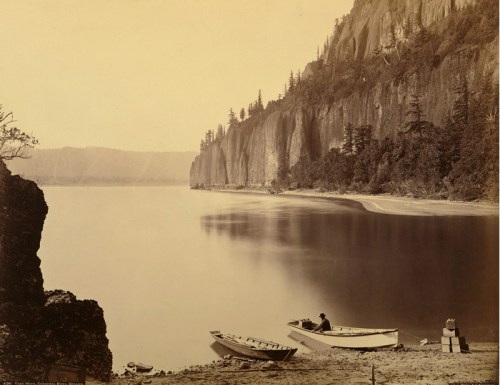
There can be no photographer better known for the early exploration of the American West as Carleton Watkins (1829-1916). Nor is there a mid-to-late 19th century photographer (Ansel Adams did his bit later!) who shaped public opinion about natural spaces as much as Watkins.
What would Watkins say about the RVs that roll into Yosemite and Yellowstone each year? What would Watkins say about the monoculture agribusiness that dominates large swathes of the United States’ land? What would Watkins make of the ubiquity of corn syrup in our diets?
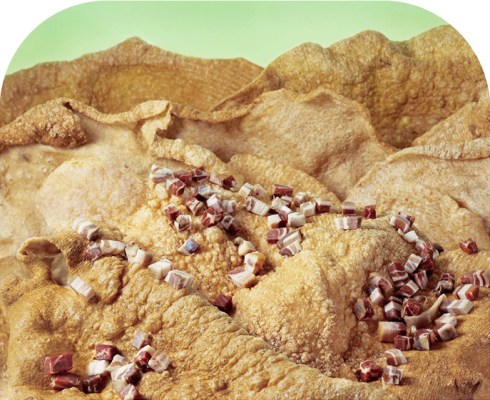
“The series Processed Views interprets the frontier of industrial food production, the seductive and alarming intersection of nature and technology,” write Lindsay Lochman & Barbara Ciurej in their artist statement. As we move further away from the natural sources of our food, we head into uncharted territory replete with unintended consequences for the environment and for our health.”
Processed Views is a witty and painstakingly constructed project that gets at some serious issues. What were Lochman and Ciurej thinking? Exactly how did they piece together these distopic dioramas that drip with E-numbers? Scroll down for our Q&A to find out.
Prison Photography (PP): You’re talking about industrial food production. Is this a concern to you specifically because you are Midwest based?
Lochman & Ciurej (L&C): We built these views to examine consumption, progress and the changing landscape.
As Midwesterners, we have seen the landscape transformed from family farming to agricultural industry. This is not exclusive to the heartland, however, Big Ag and food processing facilities cross the country. In Processed Views: Surveying the Industrial Landscape, we are thinking about trends in consumption, ideas of progress and the changing geography of our country.
We came to Processed Views from an earlier project which addressed the nature of nurturing. In those photographs, we were interested in picturing the emotional and physical energy that flows through the act of preparing and sharing food. We could not ignore, however, the flip-side of food consumption in America: a complex, impersonal system of industrial agriculture, food processing and marketing.
PP: Why use Watkin’s images as the conduit to these issues?
L&C: Watkins’ sublime views framed the American West as a land of endless possibilities and significantly influenced the creation of the first national parks.
However, many of Watkins’ photographs were commissioned by the corporate interests of the day; the Central Pacific Railroad, the Oregon Steam Navigation Company, North Bloomfield Mining and Gravel Company and other lumber and milling interests. His commissions served as both documentation of and advertisement for the American West. Watkins’ images upheld the popular 19th century view of Manifest Destiny – the inevitability of America’s bountiful land, justifiably utilized and consumed by its citizens.
PP: Given the anniversary, Processed Views was good timing, no?
Stanford’s Cantor Arts Center presents an exhibition Carleton Watkins: The Stanford Albums (April 23–August 17, 2014) in celebration. Tyler Greene recently interviewed curators and scholars, Alexander Nemerov, Erik Steiner and Corey Keller, associated with the exhibition.
PP: You’re fans of Watkins?
L&C: We turn to history and mythology to clarify and anchor our research.
Looking back 150 years, Carleton Watkins iconic photographs honored unsullied nature and documented human behavior on the frontier. They were a revelation at that time. His images record a critical time in the ongoing relationship between industrial development and conservation. We are at another such a moment now and the current discourse is fractured. How can the state of our health, industrial agriculture, chemistry, biological modification of plants and livestock, water and land use, finite natural resources, demographic and geographical change be included in a single conversation?
Referencing Watkins’ sublime views and sites of nascent technological activity in California and Oregon, are an invitation to viewer to consider an alternate reality in which the trajectory of our agricultural production is taken to an extreme. We fast forward to seductive, garish and static monocultures.
We allude to Watkins’ far vista in our tabletop landscapes, hinting at vastness, yet stranding the viewer in a swale of familiar processed food products. The photographer’s 18″ x 22″ Mammoth Plate Views were extraordinarily large and detailed in their time, but are now considered small. We use this format to force the viewer into an intimate encounter with the average American diet. We have oversold our technological commitment to bend the forces of nature in order to fulfill fantasies of a yummy life and heroic expectations of feeding the world. Should we rethink our fun-food utopia?
L&C: An answer to this question is as vast and deep as Yosemite Valley!
Most recent thought regarding landscape is defined by scholars like Lucy Lippard in The Lure of the Local: Senses of Place in a Multicentered Society. Landscape is not just an aesthetic experience, it must be thought of in terms of community, land use, contemporary perceptions of nature, what is produced on the land and how it shapes the inhabitants through time. Rebecca Solnit’s writing projects Infinite City and Unfathomable City are exquisite examples of this approach.
Tyler Greene discusses Carleton Watkins’ photographs and the transformation of California agriculture a century-and-a-half later in a recent New York Times Lens blogpost.
PP: What for you are the main concerns about industrial food production?
L&C: Processed Views reflects our concern with current trends in consumption, ideas of progress and the changing geography of our country. All indications are that we are headed into an uncharted, unbalanced, unnatural territory. This terrain is garnished with unintended consequences for our health and for the environment. Why must we thoughtlessly degrade the soil by our technological-agricultural experiments? We must re-evaluate our man-made “utopias”.
PP: Where can we read more on these issues?
L&C: There are striking stories daily, many of them contradictory. We record ideas in our food-based notebook (blog). Recent posts mention books, articles and websites addressing the American diet (Nina Teicholz, Michael Moss, NPR’s The Salt blog) and industrial agriculture: corn production and marketing, meat processing (Christopher Leonard, Maureen Ogle), photography and social history.
Barbara Ciurej and Lindsay Lochman began collaborating when they met as students at the Institute of Design in Chicago+Illinois Institute of Technology. Through photographic projects they explore the confluence of history, myth and popular culture. Their photographs have been in numerous solo and group exhibits and are in the collections of the Art Institute of Chicago, the Walker Art Center and the Milwaukee Art Museum.
Crowdfunding, eh? What to make of it. I feel like the jury is still out, but then again I have had my head somewhat in the sands of late. I have benefited in the past from a Kickstarter campaign and in the immediate aftermath tried to give my feedback on the dos and don’ts.
Where the successful intersections between cultural production and social justice lie is, for me, a constant internal debate, so I hope this post serves two purposes.
Firstly, to clarify my thinking and to highlight the type of crowd funding campaign that I think encapsulates best practice.
Secondly, to bring a half-dozen endeavors (5 prison-related and 1 purely photo-based) that I think deserve your attention and, perhaps, your dollars.
On the first purpose, I’ve identified common traits among these projects that are indicative of a good practice:
– Track record. These fund seekers appearing out of the blue; they’ve done work in the specific area and have chops and connections.
– Direct action. These projects will directly engage with subject and, consequently audience on urgent politic issues
– Community partners. These funders have existing relationships with organizations or programs that will provide support, direction, accountability and extended networks
– Diversity. Of both product and outcomes. Projects that meld digital output/campaigns and boots-on-the-ground activism get my attention. Creators, in these instances, realize that they must leverage every feasible avenue to get out the political message.
– Matching funds. In cases where matching funds exist, I am reassured. It shows that the creator is forging networks and infers that they are inventive and outward looking when it comes fundraising. It infers that we’re all in it together; it might just give us those necessary warm fuzzy feelings when handing over cash on the internet.
On the second purpose, I’ll let you decide.
1. OUTREACH
Let’s start with a campaign to help OUTREACH, a program offered by Toronto’s Gallery 44 that breaks down barriers to the arts by offering black & white photography workshops to 50 young people each year.
OUTREACH’s darkroom is the last publicly accessible wet darkroom in Toronto. Gallery 44 has offered accessible facilities to artists since 1979.
Donations go to workshops costs: photographic paper, film, processing, chemistry, snacks and transit tokens.
OUTREACH has several existing community partners including the Nia Centre for the Arts, Eva’s Phoenix, Toronto Council Fire Native Community Centre, PEACH and UrbanArts.
“I went from being a student to a mentor,” says one participant. “I recently had my work exhibited in the Scotiabank Contact Photography Festival.”
In the summer of 2013, prisoners in California conducted the largest prison hunger strike in U.S. history. 30,000 men refused food in protest against the use of indefinite solitary confinement. Some prisoners refused food for 60 consecutive days. Dying For Sunlight will tell the story.
Across racial lines, from within the belly of the beast (Pelican Bay Secure Housing Unit) California prisoners mounted a reasoned and politically robust defense of their basic human rights that garnered nationwide attention. Their families joined them in solidarity. This was a true grassroots movement built by those on the front lines of state violence
“We prisoners of all races have united to force these changes for future generations,” Arturo Castellanos wrote from the Pelican Bay SHU.
“In a world of sound bytes, Dying For Sunlight feature length documentary will allow us the time to more fully delve into the questions this movement has raised,” says Guilkey. “Why and how is solitary confinement used in California prisons? What does the movement against it look like? And how did we get to the point where we’ve normalized a system of torture in our own backyards?”
Dying For Sunlight takes the premise that, in order to understand our society with “increasing inequality, militarization, incarceration, surveillance, deportation, and the criminalization of dissent, we must listen to the voices of those who have endured the most repressive form of social control–the solitary confinement unit.”
The U.N. Special Rapporteur, Juan Mendez ruled that solitary for anything more than 15 days is psychological torture, yet California and other states throw people in the hole for decades.
The film is in pre-production and all the fancy-schmancy gear is bought. Donations will go directly to costs associated with travel, expenses and editing related to interviews made up and down the state with family members, formerly incarcerated people, solitary experts, prison officials. They’ll attend rallies and vigils too. They hope to have a rough cut by December.
3. CHANGE THE AMERICAN INSTITUTE OF ARCHITECTS (AIA) CODE OF ETHICS TO OUTLAW DESIGN OF SOLITARY CONFINEMENT UNITS
Raphael Sperry continues his battle to rewrite an AIA ethics code which predates the widespread use of solitary confinement in the U.S.
An architect himself, but on hiatus to concentrate on this political and ethical fight, Sperry points out, “even though only 3 to 4% of prisoners are in solitary confinement, half of all prison suicides occur among prisoners who are in solitary confinement.
The AIA is the voice of the architectural profession.
“The AIA has disciplinary authority over its members. In the current code of ethics, they have language that says that members should uphold human rights in all of their professional endeavors. So it’s pretty clear that members shouldn’t design a Supermax prison or an execution chamber,” explains Sperry. “[But] the language about upholding human rights is unenforceable in the AIA code of ethics. So all we’re asking them to do is draft an enforceable rule associated with it that says that members should not design [a project that commits] a specific human rights violation.”
Sperry’s tactics go to the heart of his profession and tackle this issue that stains our collective moral conscience. It’s strategic and laudable. He’s won institutional support before.
Donations go toward ongoing conversations, writing, speaking, research and pressure on the top brass.
A Living Chance: Storytelling to End Life Without Parole is made in collaboration with females serving Life Without Parole (LWOP) in California. The word “collaboration” is the important detail. It is made with incarcerated members of California Coalition for Women Prisoners (CCWP), a grassroots social justice organization with members inside and outside of prison. CCWP rightly identifies incarcerated women as the experts on the issue of prisons.
Audio recordings, interviews, letters, and photographs will constitute a website and a publication about LWOP which is considered the “lesser” alternative sentence to the Death Penalty.
People sentenced to LWOP have no chance of release from prison and very slim opportunity for appeals or clemency. There are approximately 190 people sentenced to die in prison by LWOP in California’s women’s prisons. The majority of whom are survivors of childhood and/or intimate partner abuse. In most cases, evidence of their abuse was not presented at their trial.
California Coalition for Women Prisoners (CCWP) challenges the institutional violence imposed on women, transgender people, and communities of color by the prison industrial complex (PIC) and prioritizes the leadership of the people, families, and communities most impacted in building this movement. CCWP began in 1995 when people inside the women’s prisons filed a lawsuit against then-governor Pete Wilson rightfully claiming that the healthcare inside prison was so terrible it violated their 8th amendment rights.
A Living Chance was chosen as a recipient of a matching funds award up to the value of $6,000. Already, $2,000 has been raised in individual donations, so the crowdfunding target is $4,000 of a $12,000 total
Donations go creation of the storytelling website and publication, stipends for participants, travel costs to the prisons, and building future effective campaigns.
5. THE PRISON PROBLEM, SHANE BAUER’S YEAR OF JOURNALISM
Shane Bauer, a journalist I have long admired, wants to focus for one year on the urgent politics of prisons, specifically those routinely using solitary confinement.
“We spend over $80 billion a year on our corrections system and the cost is growing. At the same time, the number of privately run prisons is on the rise, and the for-profit prison model is spreading globally. In the US, the percentage of prisoners held in private facilities increased 37 percent between 2002 and 2009. Many of these are immigrants, a large number of which remain in pretrial detention for years,” says Bauer. “I’ll show you how U.S. prison practices are being exported to the rest of the world and dissect the systems that lead so many to be locked up in this country.”
For The Prison Problem, Bauer is basically asking for everything he needs to live on in order to create deep investigative journalism: funds to travel, interview, conduct research, and sometimes sue government bodies refusing access to information.
Bauer reporting in Pelican Bay Secure Housing Unit, Crescent City, California, 2013.
Bauer promises at least three or four major feature stories, each is the equivalent of a magazine cover story. He’s got the reporting chops necessary — No Way Out for Mother Jones about solitary in California (video, too) is widely acclaimed.
Pennsylvania Lawyers for Youth (PALY) provides educational rights counseling and assistance to young people in Montgomery County, PA who are reentering the community after being incarcerated. It’s asking for a little help. Montgomery County, PA has been identified as having a disproportionate amount of minority youth being involved in the juvenile system, and suffers from a lack of agencies focused on supporting youth reentering the community.
PALY recruits law student, as volunteers, to work one-on-one with reentering youth crafting individually-designed educational plans.
The average cost of incarcerating a juvenile for a year is about $88k per year; educating that same student is one eighth that cost.
The ask of only $10,000 is small by comparison, but the effect could be huge. Donations will cover PALY’s first year of programming costs: training mentors, youth educational programs, and a ‘Know Your Rights’ campaigns for the community.
AP reported today that an old power plant at Sing Sing Prison is being considered as the site for a museum.
Immediately, for me, alarm bells rang. The report focused on tourist dollars a potential museum could bring in. I have a great fear that the proposed Sing Sing prison museum will replicate the cheap and nasty shock-exhibits common of so many prison museums. Sure enough the report mentions the electric chair “Old Sparky”, “a metal ‘head cage’ used when prisoners were transported” and a “display of prisoners’ weapons, from axes made in metal shop to shivs fashioned from plastic forks.” Furthermore, a famous 1932 escape attempt, infamous hired killers of the mafia, and Hollywood films are also mentioned.
Crap, they’re talking about brand and forecasting a quarter million visitors per year.
“Sing Sing is a brand name,” said John Wunderlich, president of the Ossining Historical Society Museum. “You go anywhere in this country, in Europe even, everybody’s heard of Sing Sing.”
It’s all to predictable. It’s all to blinkered. Ultimately, it will be damaging to our collective consciousness.
America doesn’t need another prison museum to prematurely historicise an institution and package, for consumption, the lives destroyed within. America does need a prison museum that engages communities; a museum that serves and forwards conversations about inequality, policing, poverty, the war on drugs, public education, mental health, the politics of crime and employment, restorative justuice and existing together.
This need is particularly acute at Sing Sing, which still functions as a prison with 1,600 men inside. Many of the prisoners at Sing Sing would be well positioned to contribute to the programming and exhibitions. In 2011, I visited Sing Sing and discussed photography, representations and public perceptions of prison and prisoners. We agreed that more needed to be done to help the public understand lives inside. Unanimously, the men did not think mainstream media representations of crime and prisoners were in any way favorable.
Actively talking about current controversies and thinking about how to present them in exhibition-form is way, way more difficult than putting a bunch of objects on view. But it is what is needed. We must set high standards and take on tricky, multi-faceted and collaborative ways of curating and programming in museums.
There’s many men inside Sing Sing who have thought about the American prison industrial complex for a long time. They are the experts. Let the Sing Sing Prison Museum give them a voice. Also, let the proposed museum give a voice to victims and to communities that are impacted by crime. Let the proposed museum give a voice to labor unions and to the formerly incarcerated.
Student in a Prison Photography workshop holding a Richard Ross print, Sing Sing Prison, NY, 2011. Photo: Tim Matsui.
I care deeply about the potential for prison museums and frutrated when the potential is wasted.
In 2004, I wrote a Masters thesis about the San Quentin Prison Museum (SQPM). Some background here. The museum is just inside the gates. It is now closed or maybe just sporadically open? It’s narrative ends in 1971, prior to the era of mass incarceration. In order to evaluate the narrative at SQPM I had to learn about California prison politics then. The facts shocked me then and shock me still. Looking at prison museums and the transferral (or not) of knowledge put me on my course as a prison activist and writer.
Prison museums for too long have missed the opportunity to engage the public in purposeful discussion. The single exception I would like to applaud would be Eastern State Penitentiary (ESP) which, under the direction of Sean Kelley and colleagues, really grapples with modern day realities, with power & knowledge, and with the museum site as a nexus for exchange. ESP’s monumental sculpture Big Graph is an excellent case in point.
The Big Graph (2014). Photo: Courtesy Eastern State Penitentiary.
To close, I’d like to offer some suggestions for reflexive programming that the Sing Sing Prison Museum could pursue during its first few of years of programming.
– Photography exhibitions? All the research is right here on Prison Photography.
– Film screenings to coincide with programming. There’s plenty of choices.
– Any of the artworks (of all media) from the timeless PRISON/CULTUREproject and book.
The options are huge. Hey, readers! If you’ve any other powerful art or cultural projects that attend to mass incarceration please add them in the comments.
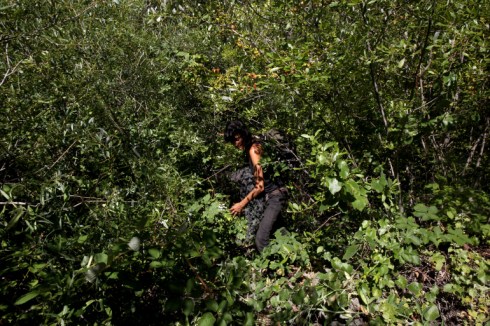
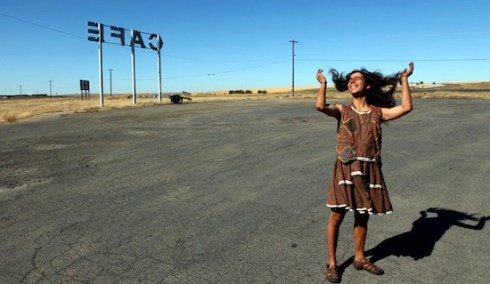
Lucia retrieving her stashed pack in the bushes. Kitra Cahana, California, 2013.
I’ll confess that until I met Kitra Cahana last week, I knew next to nothing about her work. That’s my loss more than anything because her work is fantastic; it’s empathetic and it subtly prods many assumptions of priggish Western culture.
Case in point is Cahana’s series Nomad, which documents the lives of a morphing group of young travellers in the U.S. All of it — the boxcars, the festivals, the tiredness, the freedom, the victories, the marginalised physical and psychological spaces, the run-ins with police and the friendship.
Mogli tries on a new dress he just found in a free pile at a truck stop in Washington State. Kitra Cahana, 2010.
As a 2014 TED Fellow, Cahana talked about Nomad to a crowd of TEDsters last month. The presentation A Glimpse Of A Life On The Road doesn’t sugarcoat of idealise the lives of these modern day nomads. “Addiction is real,” she says as she begins to list the many hardships that come with living subject to the elements and under the hammer of increasingly punitive laws.
“Who knows that in many American cities it is now illegal to sit on the sidewalk, to wrap oneself in a blanket and to sleep in ones own car?” Cahana asks the TED crowd. She goes on:
By night they sleep beneath the stars …
Some travelers take to the road by choice, renouncing materialism, traditional jobs and university degrees in exchange for a glimmer of adventure. Others, come from the underbelly of society never given a chance to mobilize upwards — foster care drop out, teenage runaways escaping abuse and unforgiving homes.
Where others see story of privation and economic failure, travelers view their own existence through the prism of liberation and freedom.
They’d rather live off the excess of what they view as a wasteful consumer society, than slave away at an unrealistic chance at the traditional American dream. They take advantage of the fact that in the United States up to 40% of all food ends up in the garbage, by scavenging for perfectly good produce in dumpsters and trash cans. They sacrifice material comforts in exchange for the space and the time to explore a creative interior.
Vagabonds confuse most of us. And when I say ‘us’ I mean ‘me.’ Why would someone even do that? Live like that?
To exercise empathy I must meet others at a half-way point, and I must meet them where they are at. And to understand. It was my lesson, from listening to Cahana, that I haven’t allowed my imagination to extend far enough to see a life-on-the-road as a solid political position.
In majority America, given the obvious economic inequality, waste, unemployment, sexism in populist media and the associated perverse obsessions of consumerism, you would think, we have plenty of reasons to opt out?!
Put like that, life-on-the-road seems like one of the more sensible responses. I’ve got a few lessons to learn from Cahana’s friends and subjects.















 Prison Photography