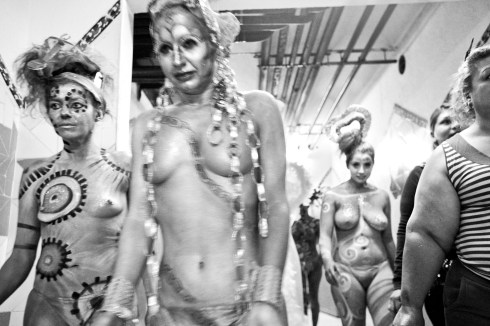
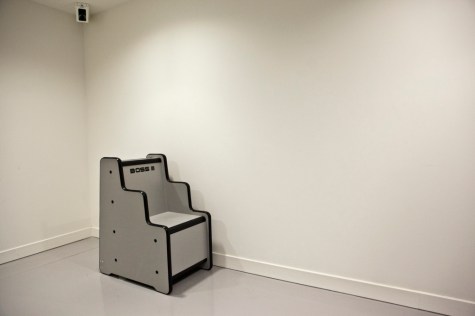
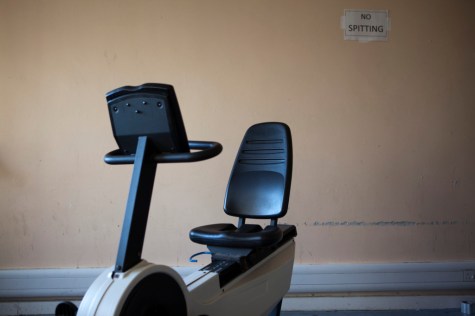
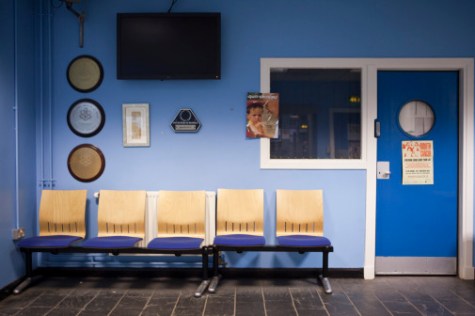
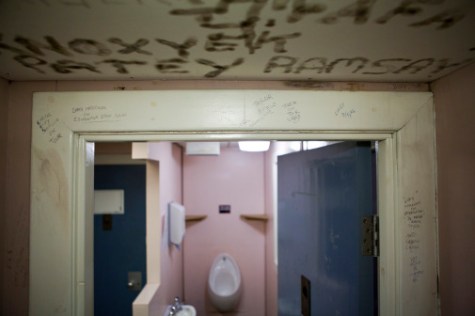
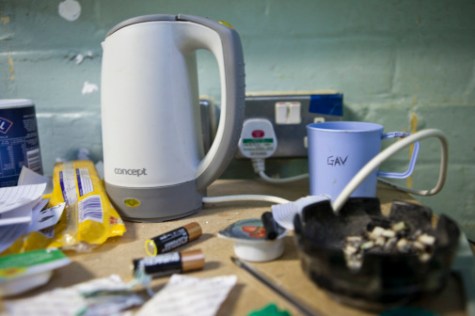
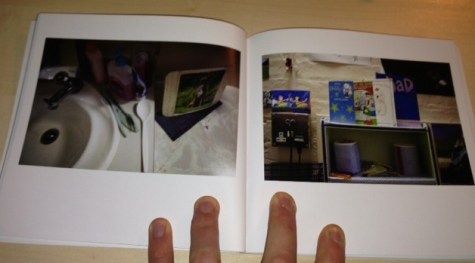
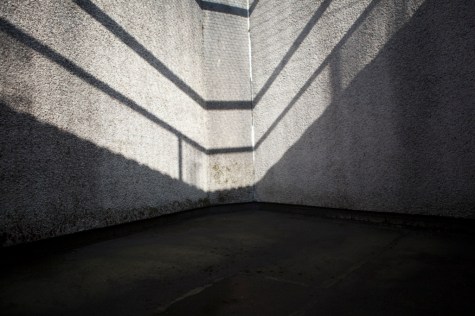
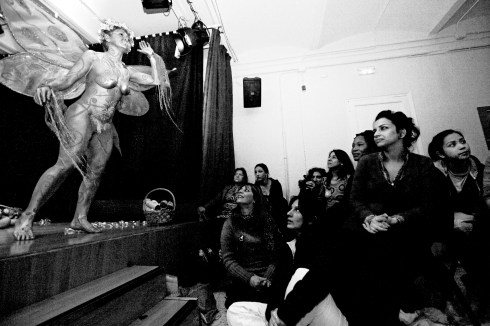
Spanish photographer, Bandia Ribeira Cendán‘s images of vibrant body-painted theatrics inside a Barcelona jail in celebration of International Women’s Day are startling. They might even encapsulate hope. Yet, as Bandia describes in our Q&A it was a fight to gain access to the jail, a struggle to achieve semblance of artistic freedom, and difficult to overcome staff skepticism. Bandia’s biggest frustration was her inability to deeply connect with the women in limiting circumstances. The paucity of support and materials, and some initial reluctance from women prisoners limited the accomplishment of her goals for her photography workshop Corners (Racons). Nevertheless, Corners was recognised as a valuable participatory arts projects at the City Of Barcelona Awards in 2012.

I’ve extolled the benefits of photography workshops in prisons and the empowerment that comes about through self-representation. My views are based somewhat on anecdotal information and also the feedback of people (photographers) always directly involved with such projects and, therefore, perhaps a narrative to perpetuate. Thus, it is pause for thought to hear Bandia say, “I don’t think that a prison is the best place for the rehabilitation […] Photography inside the jail can just be a way of evasion, a way to pass time and to avoid thinking about the own problems.”

I appreciate Bandia’s realism. I also appreciate that she has shared these images with Prison Photography as she has been rounded censored from publishing her photographs in print in Spain.

Scroll down for our conversation.
Q&A

What  is the public attitude toward this prison and the women inside?

This is a “transit” prison with a special section for mothers and little babies. That means that people inside are waiting for a trial and once they got it they are sent to a “permanent” prison or they are set free.

The attitude toward the prison, as you can imagine, is not very positive. Once someone steps into a jail he or she is seen as a criminal and stigmatized by the society. Most of these women are gypsies or citizens of South American countries and the majority are here because of drug traffic, so they belong to the lowest strata of Spanish society. Most of them were victims of violence by their husbands, boyfriends or relatives and it’s not common to meet someone with an education.

I met women who couldn’t even write and had problems reading correctly. We are talking about people with really hard lifes and usually from very poor families. Victims of the social injustice.

Our society doesn’t deal with poverty and margination as a part of itself, so instead of looking for solutions we turn our eyes to another place and try not to see these kind of problems. The people in jails are excluded from our society.

You were working as a photo teacher there. Tell us about your work with the women.

It was really an enriching experience for me to share a time with the women. Initially, some of them rejected photography because it was included in their internet workshop and they didn’t see the utility of knowing how to use a reflex camera, which I understand perfectly.

But with the passage of the time, they started to go inside and enjoy it. We built the learning around a common project called “Corners” and I proposed to them to shoot the best and the worst corners of the prison, and even the good and the bad corners of themselves.

A good corner for most of them was the toilet room, where they can smoke cigarettes and chat for a while far from the eyes of the guardians. A bad corner for many of them was the playground, where they have the obligation to spend few hours every day even when it’s raining or very cold weather, and this is especially hard for those women of advanced age who suffer some form of sickness. At the end we made a little exhibition in the jail which people really enjoyed.

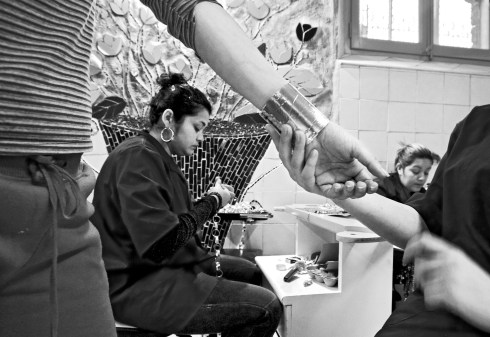
During my visits to the center the people were preparing a theatrical production with body painting. They proposed I shoot the process. I accepted with enthusiasm because I had the opportunity to make photos far from the guards’ control, limited to the jail’s hair-dressing room.

Can photography be a tool for rehabilitation?

I don’t think so. First of all, I don’t think that a prison is the best place for the rehabilitation of any single person. Photography inside the jail, in my opinion, can just be a way of evasion, a way to pass time and to avoid thinking about the own problems.

Photography is positive as a weapon of expression, but for this you must go inside the technical skill-set and we didn’t have the means and the time. We only had one camera for 10 persons. No one helped me to get more cameras for the girls. We are talking about a public institution and a NGO who gets money from the government and they were not able to buy materials for the workshop.

You were finally able to make a reportage, with all the limitations that it takes to work in this kind of places. What negotiations did you go through to take photographs inside?

It was a real mission. First of all I sent my project to the authorities of the Government of Catalunya and didn’t get any answer. I knocked on many doors. Afterwards, I got in touch with some theater companies who make workshops inside and offered to document their activities. Again, no success.

After months and months of trying and almost abandoning the idea, one of my school-mates introduced me to a woman from the Fundació per l’Innovation Social Action (FIAS) which organizes activities inside the jails in the city of Barcelona to introduce prisoners to the new technologies. Here was the key for me. She liked my ideas and proposed that if I wanted to shoot inside I had to offer something, so we decided that making a workshop of photography would be the best.

After 9 months of searching I could go inside this prison.

What celebration was occurring that led to body paint and theatre?

They were celebrating the international day of the working women, the 8th of march. Every year, they host a party in the prison. There are a few activities such as a picnic in the playground, live music, and an exhibition of photography about Africa. The women inside get really involved in this party.

Does this body painting drama take place annually?

Yes, they have done it for a few years. It’s a collaboration between the people from the hairdress workshop and the people from the fitness class; the teachers and the women make the show together. Generally, there are plenty of activities from the morning until evening; school to get a basic education and also working areas in which they earn a very minimum salary.

Are colorful activities such as those you document common in all Spanish women’s prisons?

I don’t really know but I don’t think so. This prison is very small with around 150 prisoners. The population changes frequently. I’ve been told that the tranquil ambience is an exception inside Spanish prisons. Still, when you step inside, some depressing feeling invade you and the celebrations have a touch of sadness. The women get really involved because they don’t have many similar events throughout the rest of the year.

In other prisons there’s not such an offer of activities and they use to have problems of overpopulation. Spain has the largest imprisoned population of all Western Europe, although behind other countries with biggest criminality tax. This means that in Spain the low delinquency is highly punished. And the jail is the solution, instead of the social actions.

What have been the reactions to your images from staff, women prisoners and the public?

Some of the staff didn’t like so much and they said that the images were not as “artistic” as they expected. What I understood from this reaction was that they supposed that I would “hide” more the jail situation and customise a view. However, it was my intention from the beginning to show a sad reality.

The women prisoners were happy about the photographs, and happy that I could show the images while I was working there – I know that after this there was no one from the staff who showed them the final work.

About the public, I’m not allowed to show these photos in my country.

Jail policies are so stringent that the authorities don’t want that these photos go out from the walls of the prison, even when I’m not showing anything about the life conditions inside. It looks amazing that this facts happen in a so called “western democracy”. This hermetism is unbelievable.

What are your thoughts on prison policy in Spain? What is being done correctly and what could improve rehabilitation for women prisoners?

My thoughts are not positive. First of all, the jail penalties for small delinquency are too harsh. This increases the prison population making it overcrowded. In the last 10 years, Spain’s prison population has doubled. The consequence is the deterioration of conditions and the welfare of the people inside.

Another facet [of prison management] which is denounciable is the FIES regime, an isolation regime used to condemn prisoners considered “dangerous.” This term “dangerous” sometimes gets very flexible. This isolation makes the prisoners more vulnerable and includes violent episodes from the guards and we have lots of files from humanitarian associations, like International Amnesty, denouncing FIES.

Rehabilitation is not possible when people are condemned to 20 years in FIES. They lose their identity, values and sometimes dignity as a persons; this goes against rehabilitation.

Were there any downsides to your experience?

I missed out on making very close contact with the women. We were controlled all the time by someone from the jail and it was impossible to have long conversation outside of the workshop. I listened to some stories and made surface-level inquiries but did not really get deep inside.
portland-press-herald_3725431

Video still. On June 10, 2012, Maine Department of Correction’s employee, Captain Shawn Welch sprays OC spray into the face of prisoner Paul Schlosser who is bound in a restraint chair after Schlosser, who has an infectious disease, spat at an officer.

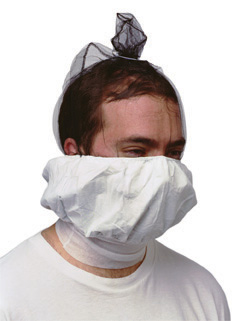
The pepper-spray – dispensed at point blank range – to the face of the restrained prisoner was horrific enough, but it was the use of the spit-mask that truly reflects the vindictiveness of this act of torture. Put on prisoner Paul Schlosser’s face after the pepperspray had doused his mouth, face and eyes, the spit-mask kept the irritant closer. If there was one consistent cry from Schlosser it was that the mask be removed.

Last week, the nation was shocked by video footage of Captain Shawn Welch, a Maine correctional officer discharging oleoresin capsicum (OC) spray, without warning, into the face of Paul Schlosser. Welch held the Mark 9 canister about 18 inches away. The Mark 9 is intended for disabling multiple people at a distance of no closer than 6 feet.

Some experts say the use of pepper spray can be a reasonable way to get control of a situation, even if a person is restrained, but in this case is seemed wholly unnecessary. It seems vindictive and personal.

1The incident occurred in June 2012 and the video came public following a leak. The Portland Press Herald broke the story. Welch was initially sacked but later reinstated following an appeal that took into account his service to the Maine Department of Corrections. It is scandalous that this man returns to a uniform.

Furthermore, as Press Herald OpEd argued the MDOC hunt for the source of the leak missed the point. The issue is the abuse the video shows.

The Press Herald’s coverage of the story has been thorough and I quote from it comprehensively below. The matter that stood out for me was the investigator’s observation that the confrontation became personal between Welch and Schlosser.

In the 24 minutes between Schlosser being sprayed and when he can wash the spray off his face, Welch strolls in and out of the cell holding the OC spray canister, telling Schlosser that if he doesn’t cooperate, “this will happen all over again.”

“You’re not going to win. I will win every time,” he says.

Welch says repeatedly, “If you’re talking, you’re breathing,” suggesting that as long as Schlosser was complaining, he was not in serious medical distress. Welch does call for a member of the prison’s medical staff.

At one point, he whispers to Schlosser, “Useless as teats on a bull, huh … What do you think now?” an apparent reference to an insult Schlosser directed at him two days earlier, according to the investigator’s report.

The investigator concluded that Welch’s treatment of Schlosser was personal.

“Welch continues to brow beat Schlosser and it looks like he has made this a personal issue,” said Durst in the report. “There is not one incident of de-escalation and in fact Welch continues to escalate the situation even after the deployment of chemical agent.”

Schlosser had been self-harming and refusing medical attention, actions which led to the extraction from his cell by riot-gear-clad prison guards.

Welch told an investigator that the use of pepper spray was appropriate because Schlosser, who has hepatitis C, had spit at an officer.

Schlosser gasps and fights for breath. He tries to lean forward to spit out the spray, but the guard holds his head against the back of the chair. One of the guards then puts a spit mask on Schlosser. The mask traps the irritant against Schlosser’s face, at one point covering both his mouth and nose.

Schlosser says he can’t breathe and promises not to struggle or argue anymore.

Pepperspray instantly dries out mucous membranes in the eyes, nose and mouth causing intense and overwhelming pain. Pepperspray leads to a sensation of not being able to breathe, although a National Institute of Justice study found it does not compromise a person’s ability to breathe.

“It’s just like getting jalapeno pepper in your eye, only multiplied by a bunch,” said Robert Trimyer, a use of force instructor and OC trainer with the University of Texas Health Science Center Police Department in San Antonio. Depending on the concentration, OC spray is roughly 300 times “hotter” than a jalapeno pepper.

“It’s painful, but it goes away. The people that have the problem breathing, it’s really more of the anxiety involved,” said Trimyer.

Yerger believes that putting the spit shield on top of the pepper spray would intensify the effect of the spray.

“I have never heard of any trainer I have ever worked with as a peer that would ever say, ‘Put a spit hood on someone after pepper spraying them,'” he said.

“They’re spinning out of control. Restraint, pepper spray, now cover their face — you’re just escalating the situation. In cases I’ve reviewed when people have died in a (restraint) chair, it’s not uncommon to see factors like that involved.”

DIRIGO

Above Schlosser’s restraint chair is the Seal of Maine, on which the latin word Dirigo, meaning “I lead” is emblazoned. Welch only demonstrated to his colleagues how to posture and escalate a situation. The irony ceases to matter when the outcome was so violent.

Independent experts and everyday folk can see that if spit born Hep-C was the real issue here then the spit mask should have been put on long before Welch whipped out his Mark-9 canister. And to be honest, wouldn’t anyone spit after pepper-spray to the face?

Scandalous.

Welch was ordered to take a personalised re-training program except the MDOC sent him away: It had nothing to teach him as he had already taken all recommended courses to the highest qualification. Didn’t seem to inform his conduct in this case, though.

After the episode, Schlosser was sent for a time to Maine State Prison in Warren for mental health treatment and returned to the Windham prison, where he is now in the general population. He said he is doing much better and has had no further encounters with Welch, although they see each other regularly.

portland-press-herald_3725428

Laura Schlosser, mother of inmate Paul Schlosser, watches the video Tuesday, March 12, 2013 of an incident involving her son and Welch. Shawn Patrick Ouellette/Portland Press Herald.

21539200_BG1

Harmony Korine’s Spring Breakers has got America in a tizzy. It’s entertaining but it’s no classic. Korine is the master of non-linear narrative, or to put it another way at bunching weird stuff together that could go in any order and ends up making a movie. Spring Breakers, his first – and hopefully only – “mainstream” offering follows a straight forward and straight plot; the spiraling of four young girls’ lives into a world of hyper-violence and sexuality.

As many have commented, Spring Breakers isn’t about spring break, but more about capitalism, survival, hedonism and a crime-chic version of the American Dream. A tried and tested cinema recipe if there ever was one. It’s just that in Spring Breakers the gunmen are gunwomen and they’re wearing glow in the dark bikinis.

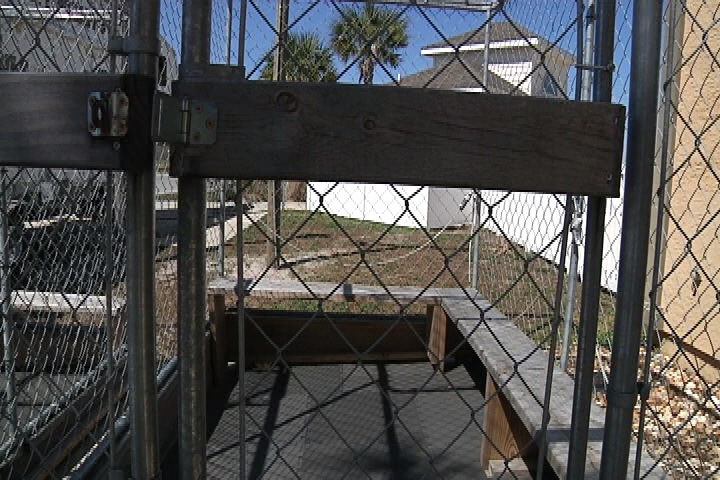
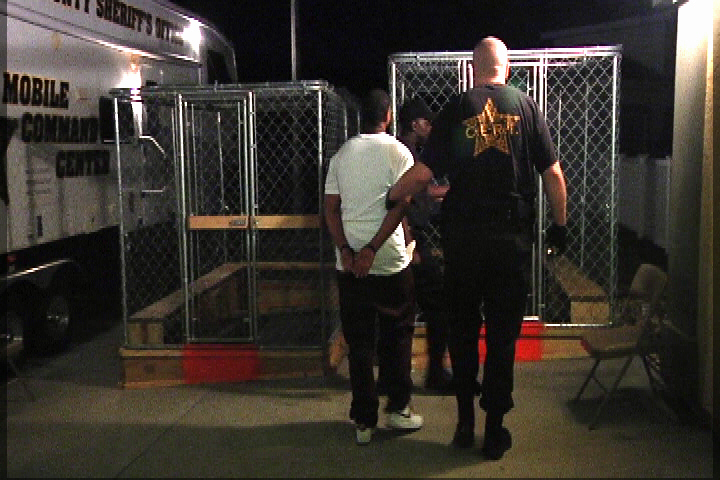
The perfect reality check is the story of Sheriff Frank McKeithen’s beachfront jail in the city of Panama Beach, Florida (the spring break capital of the world.) Bay County Sheriff McKeithen has been doing the press rounds, this week explaining his temporary and mobile jail. He calls it his “welcome center.”

21539200_BG2

It’s a practical solution. The county jail is an hours round-trip from downtown Panama Beach. When you have college kids exploding with excitement, booze and idiocy, it’s good not to have your officers’ in a squad car stuck in traffic.

The mobile unit and holding-pens serve the same functions as the regular jail – booking, fingerprinting and photographing.

McKeithen says spring break in his county can be “chaos.” It cannot be as lawless as Korine’s shoot-em-up version, but if you’re in any doubt as to the bacchanalia, perhaps (in photography at least) Emiliano Granado’s Beach Party shows this youngsters’ holiday tradition in the harshest and most honest light.

I prefer McKeithen’s version to Korine’s. The sheriff knows trouble is coming and makes preparations. Korine’s presentation – requiring unbelievably large and frequent suspensions of disbelief – is impractical.

What McKeithen, Korine, Granado and anyone else who takes a look at spring break, have in common is that the Florida resorts are bubbles in which people shed normative behaviours as quickly as they shed clothes.

It’s a bubble in which bad behaviour might be met with one of McKeithen’s open air cells, or just as easily it might be something one gets away with. Spoiler alert: all four of Korine’s femme fatales walk away scott-free from the bubble.

With repeated reference to escape; some place different; “creating ones own worlds” (James Franco’s character says he comes from out of space);  paradise, Spring Breakers almost ad nauseum drives home the point that the bubble remains apart from the real world. Duh! Richard Brody for The New Yorker notes:

“The four young women are closed units whose sole connection to the wider world is in their deceptive phone calls to family members, a sweetened vision of kids socializing in a constructive way that’s as fake as the values of the parents or grandparents who fall for it.”

So, we’re fooling ourselves if we don’t profess to know what’s going on in the pools and hotels rooms. Sure, and with his anti-heroines walking away unscathed, Korine lets us play along with the fantastic unreality he has so cleverly exaggerated.

Okay, we can walk away now? Despite the sex (there’s lots of boobs) and the self-consciously ludicrous gun fetishism (Franco gives two pistols a blow-job), Spring Breakers is a walk into a harmless silver-screen fantasy-land, right? No. There’s one crucial element of the film that Korine fudges. Big time. Race.

Again, Brody:

“The director’s ultimate spring-break fantasy is a vision of murder camp—and of “black camp”—and he doesn’t make any effort to distinguish the two. The very mainspring of the movie is his stereotypical and reductive view of black life as one of drug dealing and gang violence.”

Once again, depictions of race are skewed. Clumsy at best, irresponsible at worst.

Brody’s observation that the UV light darkens the bikini-clad skin in the crucial climatic scenes of murder and mayhem might be over thinking it, but doesn’t detract from his overall point that while directing is a game, it’s a game poorly played when stuck on “old stories, old images, old stereotypes.”

17180257_BG1

TRAILER

The film was quite deifferent to that I had expected from the trailer. A success. Not enough thumping Skrillex dubstep, but some surprisingly good inclusion of Britney Spears (during the most celebratory of the violence montages).

All images: WMBB

© Jo Metson Scott

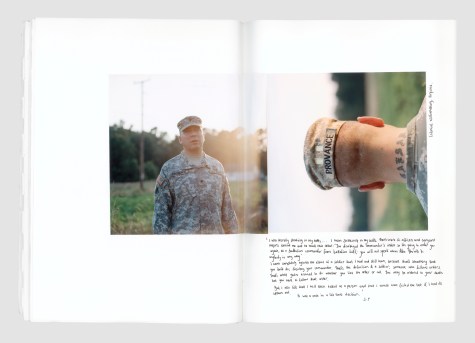
What happens when you’re a soldier and you are asked to fight in a war your conscience tells you is immoral?

Jo Metson Scott‘s series The Grey Line and accompanying book interrogates this conundrum and those that lived – and continue to live – it.

I’m not from a military background and I always opposed the Iraq War, so it was a stretch for me to empathise with Jo’s struggling subjects who, to me, simply made – and continue to justify – rational assessments. How difficult or taxing can common sense be? To get me out my own head, I called on Jo to explain this emotional minefield of a topic.

Scroll down to read our Q&A.

© Jo Metson Scott

© Jo Metson Scott

Q&A

Prison Photography (PP): Where does the title come from?

JMS: The title is to try and explain the difficult position so many of the soldiers found themselves in. Nothing is ever black and white, nothing is ever as simple as right or wrong, and these people were having to make a decision between what they were contractually obliged to do and what they felt was the right thing to do. I felt The Grey Line was a way of explaining the difficult line they were choosing to walk.

PP: You say some of the soldiers were imprisoned for their views?

JMS: Actually, none of the soldiers were imprisoned for speaking out against the Iraq war. Some of the soldiers refused to fight in the Iraq war and were imprisoned for going AWOL, but not for speaking out.

Each person’s story is very different, so I’m always nervous about generalizing. So instead, I’ll give an example. Kevin Benderman was one of the older and higher rank soldiers I interviewed and he was very opposed to the Iraq war. He was deployed to Iraq for a short period. Over there his opinions really became clear and he felt strongly that being in Iraq was the wrong thing to do. When he came back he applied for Conscientious Objector status but it was denied. So he refused to go back. He was court martialed and given a 15 month prison sentence.

Kevin said he always knew that he would get a prison sentence. It was fascinating to hear how his morals were so strong he was compelled to go against the military and risk his career. It wasn’t that he was a pacifist, or had found God, he just strongly believed that what America was doing in Iraq was wrong. That’s what really impressed me about some of the people I interviewed, they really stayed true to how they felt. Kevin knew if he spoke out and refused to fight, his career would be ruined, he’d be accused of being a coward and he faced imprisonment, but he still refused to go to Iraq.

It’s like another person I met who refused to deploy to Iraq. He was openly gay, and could easily have got out through the ‘Don’t Ask Don’t Tell’ Policy, but he felt if he wanted to leave for moral reasons it would be wrong as he would see it as taking the easy option. Instead, he applied for Conscientious Objector status, which was denied, so was then imprisoned for refusing to be deployed.

Kevin Benderman can explain his situation so much more clearly that I ever will. He said to me:

“Have you heard the term, “I cannot in good conscience do that…?” Well, that’s how it was for me.

I took a look around when I got over there. We weren’t fighting an army, there were no weapons of mass destruction. None of that stuff was there. We were just bullying the civilians. We weren’t fighting soldiers; we were just kicking doors down of civilians’ houses and taking them out and that’s not what I joined the army to do. I mean, if there had been a soldier over there I would have fought a soldier, but that’s not what we were doing… not at all[…]

There was no doubt in my mind that I’d go to prison. I had to be made an example out of. I mean, I was an NCO for one. I wasn’t a young kid and they knew that if I was able to do what I was trying to do it would only strengthen my argument. They had to make an example out of me so that no one else would try it.

With all the charges they were trying to give me I could have got seventeen years. They tried to charge me with larceny, desertion, missing movement. I knew it was a bunch of bullshit. I knew they weren’t gonna be able to stick all that stuff on me. I was convicted of missing movement by design, which carried a fifteen month sentence. It was a dishonourable discharge but it was upgraded to bad conduct. But that still isn’t very good. I mean you can’t really do a whole lot with a bad conduct discharge.

I know I did the right thing but it just didn’t really change anything, you know? I invested twelve years of my life in the military. I gave that away. I gave away my retirement. I lost my home, my wife … I can’t really find a … well, I’m stuck here driving a truck.

I had more trouble with my family – sisters, brothers and brother-in-law – than with people in general.

My family didn’t even want to hear my reasons for doing what I was doing and they still don’t. Most of the ones who have openly criticised me have never served and don’t know what they’re talking about. More soldiers and veterans agree with me than my own family do. But I’m not really concerned about their opinion and that makes them mad. You know, that was part of the stress; my own family chose George Bush and his stupid ass doing something illegal over defending me, and they wouldn’t even hear my reasons why. […]

There’s still people who say I’m a hero. Well no, I’m not a hero. I was just doing what I thought was right and I really thought that people who made noises about the constitution and the law would stand up for that instead of just wanting someone to be a figurehead for them. […]

A few years ago I took a job in Afghanistan as a civilian contractor. I wanted to go back was because I know I’m a good mechanic and there’re still soldiers over there and I figured they deserved somebody who was conscientious about the work. I had given them the best vehicles that they possibly had. I didn’t leave the military to abandon the people that I served with, but I knew that it didn’t matter. Whether or not it was right to be there […] I’m a good mechanic and they’re still over there. They’re not coming back and we’re not prosecuting Bush and I wanted to make sure that they had the best possible vehicles. Should we be there? No. Are we there? Yes.

© Jo Metson Scott

© Jo Metson Scott

© Jo Metson Scott

PP: Benderman’s is one story of how many? What was the number of soldiers you met?

JMS: Over the space of 5 years I met in total 45 soldiers. 29 are in the book.

PP: Has the story of conscientious objectors been adequately told?

JMS: Before I started the project, I had only associated the term Conscientious Objector to the first and second world war – to times of conscription. So I was intrigued to know why someone would need to apply for conscientious objectors status when they had willing signed up. Meeting with the veterans and doing this project made me realise that of course people who are in the military can have a change of morals and principles just like any ones else does, and some people also realise that they no longer want to be a part of war.

But not all of the people I met with were conscientious objectors. Many of them didn’t even know that the process existed. I was interested in meeting people who had moral doubts about their involvement in the Iraq war, not all were conscientious objectors.

Some people choose to whistle blow and speak out to the media about their experiences, others simply refused to fight and went AWOL. Others chose to keep quiet until they left the military and then spoke out. Speaking out from within the military is a very difficult thing to do. The quote below is from a veteran called Ryan. He was in the Marine Corp and was deployed for 7 months to Iraq. After he was honourably discharged from the military, he decided to speak out about his experiences in the military and about what he came to see as atrocities that he and his colleagues committed in Iraq.

After I made my public testimony, my brother disowned me on Facebook for everyone to see. He said I was a traitor and I wasn’t his brother anymore, that I wasn’t even a man.

Every single person that I served with in the war found out about my testimony and have publicly said that I’m a liar, a bitch, that I’m full of shit, that I’m a fucking American flag-burning, troop-hating, communist.

I understand why a lot of these guys did what they did; they’re not ready to accept that what we did was wrong … because it’s hard. It’s hard to accept that what you believed in was wrong. And not just wrong like two plus two is five, but wrong like you fucking killed somebody and that’s something you have to live with for the rest of your life. Some people just aren’t ready to live with that yet.

© Jo Metson Scott

PP: What do you hope to communicate with The Grey Line?

JMS: Many of the people I spoke to were very torn between their duty, the bond with the people they fought with and their own belief that what they were doing was wrong. Several soldiers talked about being ordered to do things that they felt very uncomfortable about doing, but that they knew were legal.

I spoke to one soldier who had been a military Intelligence officer in Abu Ghraib. He had absolute faith in the military, but was feeling very uncomfortable with what he was being asked to do. In the quote below, he talks about his experiences of interrogating a young detainee.

He was 16; just a kid, scared to death, and skinny as a rail. We went out to get him from the ‘general population’ [prisoners who aren’t in solitary confinement] area to interrogate him. The general population area was right next to the questioning booth, but they still wanted me to put one of those sacks over his head to transport him. It wasn’t like a normal sack, it was like a plastic sand bag with sand all over it. It barely fit on his head and he was shaking as I put it over him. We used it so he couldn’t see where we were taking him, even though we could see the booth from where we were standing. We had to cuff him too, but his wrists were so skinny you couldn’t put the handcuffs on him. So he just kind of carried them instead. I felt so rotten.

The weirdest thing was when we were in the room with the kid and an MI guy came in and gave the interrogating officer a handful of Jolly Ranchers. It was meant to be put on the table like, if you talk we’ll give you some apple Jolly Ranchers, you know? The kid knew nothing. He was just this guy’s son. Originally we were supposed to interrogate his father, a general in Saddam’s regime, which was why I had agreed to be a part of it. It sounded interesting. But then when we got there, they told us that he had already been ‘broken’ and as a sort of consolation we were told we could interrogate his son.

I only found out afterwards what they had done to break his father. His son had been doused in cold water, driven around in a truck in the freezing cold night, and covered in mud. I guess, at the same time his father was being interrogated somewhere else and from what I understand they told him that they’d take a break from the interrogation and let him see his son.

So the general’s thinking he’s gonna see his son and have some kind of a reunion with him, but instead they just allowed him to see his son naked, shivering, and covered in mud.

A lot of people will probably wonder why I didn’t say something publicly right away, but it would have been pointless. Even though I thought what was happening was wrong, doesn’t mean that it was illegal anyway.

© Jo Metson Scott

PP: What are your thoughts on the Iraq and Afghanistan wars, Jo? Was it wrong, justified, legal or illegal? Is your opinion of importance? Does it come through in the work? Or need to come through?

JMS: I was shocked when Tony Blair took my country to war. I couldn’t believe that he could go against the majority of the country’s wishes. I was shocked that he didn’t listen to the advice of the UN. Maybe it was naive of me, but that is how I felt. I think that is why I became interested in the soldiers stories. I had really believed in Tony Blair when he had come to power. I never would have dreamt he would have taken us into a war like Iraq. And that’s why I wondered how some soldiers must have felt. Many people join the military having complete faith in their government, so what happens if then the government goes into wars you think are wrong? As a soldier you have no choice.

People will always say. “You can’t have military that questions every order their given,” but on the flip side what if it was you? If it was you being asked to do something you felt in the bottom of you stomach was wrong? Something you felt went against everything you been taught? Do you ignore that feeling and carry out your contractual obligation or do you listen to your conscience?

In the end I didn’t particularly want to look at the politics of the Iraq war (though a lot of issues are raised in the book). What I wanted to explore was how an individual deals with the doubts they have in times of war. I wanted to look at the more complicated issues affecting a soldier’s decision. There are so many other things that affect one ability to make a decision – commitments to colleagues, expectations of family, financial implications, confusions of loyalty and legality. The aim of the book was to explore the complexity of their situation. There wasn’t a right way or a wrong way of doing things.

PP: How does The Grey Line fit in with your other work? You’ve recently been in Sri Lanka, you hang out with Beth Orton. I mean, to me, all your work is gentle, warm and purposeful so I’m not asking about the style or aesthetics in The Grey Line, I’m asking about its purpose for you as an artist.

JMS: I love doing commercial work and the challenges and opportunities it brings. But my approach and my purpose in doing commercial work is different to my personal work, and its difficult to compare them.

I am interested in people and because I have a camera it allows me to enter their lives in a unique way. I like to tell other peoples stories through my photographs.

For a long time now the theme of morality is something that I have questioned and explored – my own sense of morality and other people’s sense of morality, and how that affects their decisions… I think that I was unintentionally looking for way of exploring this theme with my photography, and when I first met Robert, something clicked.

PP: Can you imagine not having explored this issue? Can you imagine not having made this statement to the world?

JMS: It doesn’t really feel like I made a statement, or at least it wasn’t my statement to make. The men and women that were in the military and had the courage to question are the people making a statement.

PP: Thanks Jo.

JMS: Thank you, Pete

© Jo Metson Scott

BOOK LAUNCH

On 20th March (6.30 -10pm) The Grey Line, published by Dewi Lewis, is having a book launch at Fishbar Gallery, 176 Dalston Lane, E8 1NG.

[Right click on the images below to view them larger.]

JMS12

JMS06

JMS07

BIOGRAPHY

Jo Metson Scott is a portrait and documentary photographer whose work highlights the relationship between people and their communities. She has been commissioned by organisations including The New York Times, The Telegraph and The Photographer’s Gallery and her work has been exhibited in both the UK and Europe, including Arles Photography Festival, Nottingham Castle Art Gallery, Hereford Photography Festival and the Venice Biennale Fringe. She is repped by Webber Represents. Jo lives and works in London.

In her series Missing Pauline Magnenat has photographed “places where people who disappeared without ever being found dead or alive were seen for the last time. Sometimes, belongings were found later on – a shoe, a skateboard, a jacket – sometimes, there was nothing but the inexplicable absence, the unsolved disappearance.”

Photographing absence is a recurring theme; absences of different sorts.

Jessica Ingram‘s A Civil Rights Memorial documents marked and unmarked sites of hate crime murders of African Americans, as well as Civil Rights triumphs such as interracial communities.

Kalpesh Lathigra‘s Transmission pairs eerie landscapes with portraits of the individuals who transmitted HIV at those sites. Directed at unremarkable spaces, I found myself feeling both hollowness and anger, which is almost inexplicable except for fact of the tragic witness.

Mari Bastashevski‘s File 126 documents spaces left absent by abductions in the Northern Caucases.

Likewise, Dalia Khamissy‘s The Missing photographs those left behind after the disappearance of approximately 17,000 people during Lebanon’s civil war (1975-1990).

Gustavo Germano‘s The Absent – Ausencias deals with those disappeared during Argentina’s Dirty War by asking people to pose in the same locations for photographs that previously included their now absent friends and family.

Even the way Will Steacy photographs Philadelphia at night asks the viewer to mediate on what once was. These Means Streets depicts “the loss and despair that prevails in urban communities to reveal a modern day portrait of the American inner city.”

To photograph absence or aftermath is, partly, to photograph time. It is to make a statement about time. It is to make a visual note of changing times and of changing attitudes, territories, and agreed histories.

There are hundreds of photo projects that wrestle with time. Many of them are listed in this discussion thread on the Develop Photo Facebook Page.

The majority use of photography is a vernacular use.

Vernacular photography (more than professional, purposeful photography projects) is about arresting or preserving time … and usually influencing and warping our perception of things through time; that image we untagged, that exposure we dodged and burned, those negatives we destroyed, that really good picture we circulated everywhere, that lie, that laugh, and that great hairdo.

We are manipulators of time.

For the most part, playing with time through photo is fun (and so it should be), so it stands to reason that more gravely serious content and themes, such as those in the six photo projects listed above, will jolt us.

But, there is a difficult truth in visualising suppressed histories and presenting photographs of absence. A photographer must trust viewers are ready to meet her or his work with openness and rigorous curiosity.

If a portfolio is about absence, then it is also about explanation and subtlety. I hope that the importance of projects about humanity, and its loss, are not themselves lost among the photos of holidays, cappuccinos and cats. My problem is not with fluffy images of that type, but with the prospect of them dominating our visual experience and edging out the education that can come through photos and stories of people beyond our daily experience.

Mishka Henner & Liz Lock published a blurb book called Photography Is, which is a collection of over 3,000 statements about the medium extracted from their original context without a source in sight. I was reminded of the book reading David Campbell‘s succinct The Difficulty Of Talking About Photography.

Ironically, it is Henner & Lock’s pilfered and reordered words, that mirror best our disparate, frustrating and ever conflicting thoughts toward the photographic medium. I think our expectations are a scatter-shot too.

Campbell asks, “What, if anything, connects stock photography, fashion photography, art photography, news photography, conceptual photography, documentary photography, amateur photography, forensic photography, vernacular photography, travel photography, or whatever sort of photography?”

What? Our responses and our choices, surely. We should be able to say we control these entirely.

We choose our viewing experiences. We can repeat ad infinitum the snaps we’re used to, or we can run headlong toward subtlety; toward difficulty.

Is your photo diet samey and fattening or is it lean, moderate and varied? How do you consume images? These are questions we should ask ourselves if we are to (as Campbell phrases it) figure out “what a photograph does, how it does it, and who does or does not want it to work in particular ways.”

General Abul Waleed, Head of Command for the Wolf Brigade, and Col. James Steele, Samarra, Iraq. Gilles Peress/Magnum, for The New York Times.

Remember at the height of the Iraq War, when sectarian fighting raged and bodies were being dumped in the streets daily? Well, the U.S. military was directly funding many of the killers’ activities. U.S. Colonel James Steele, decorated by Rumsfeld, was the man in collusion with the murderers.

Gilles Peress‘ made the above-photo during a 2005 New York Times assignment on Iraqi counterterrorism commando units. (You can find 27 of Peress’ images  by searching “Peress Iraq 2005” on the Magnum website.) On the right is Colonel James Steele, head of General David Petraeus’ counterterrorism operations.

I included the same photo in a blog-post nearly two-and-a-half years ago alerting readers to The Guardian‘s investigation into United States’ funding of Iraqi police commandoes.

Today, and in continuation of its investigation, The Guardian published details of a massive network of torture centers operated by the Iraqi police commandos.

See the full length 51-minute documentary about Steele and read the article of  horrendous details accompanied with a 5-minute edited version of the film. to the crimes covering all the essential details of U.S. Military

“The United States funded a sectarian police commando force that set up a network of torture centers to fight the insurgency. It was a decision that helped fuel a sectarian war. At it’s height it was claiming 3,000 deaths per month,” says the narrator.

Until now, the media hasn’t been certain if these commando units were part or all of the feared ‘Death Squads’ that kidnapped, disappeared and killed people, usually following night-time raids.

Both Peress and his fellow journalist Peter Maass offer statement in the Guardian video. Peress speaks of the inexplicable amounts of blood he saw in a room of the building. During the visit incredibly loud screams of pain could be heard throughout the building. According to Maass, Steele left the room, the screams fell silent, Steele returned and Maass continued his interview with a Saudi prisoner.

General David Petraeus – and Col. Steele of course – continually denied the Iraqi police commando force had been infiltrated by Shia militias looking for revenge against the Sunni’s who had benefitted under Saddam Hussein’s reign. Iraqi’s say this is preposterous as everyone knew the police were corrupt, and that sectarian and murderous groups such as the Badr Brigade had in regions completely taken over commando operations.

Absolute scandal. What else do we not know? What else have we not seen?

RESIDENCY

Body orifice scanner and surveillance camera, HMP Low Moss, 2012

UK photographer and artist, Jenny Wicks – working as an artist in residence at The Scottish Centre for Crime and Justice Research (SCCJR) at Glasgow University, the largest centre for criminological research in Scotland – set out a year ago to document spaces of said research. Invariably this meant photographing prisons. She photographed in two working prisons – Her Majesty’s Prison (HMP) Barlinnie and HMP Shotts. She also shot in a new prison, HMP Low Moss, prior to its opening.

I have posted before about Wick’s portrait project They Are Us And We Are Them also completed during the residency. Here, I’d like to focus on Wick’s prison interior photographs.

Wicks’ research broadly titled Working Spaces, Punishing Spaces: The Meaning and Construction of Place through Criminological Research sought to explore key boundaries: between innocent and guilty, researcher and researched.

“The conceptual frame for the project focuses on the ways criminological researchers relate to the spaces where research is conducted, analysed and disseminated,” writes Wicks. “A central premise is that working in particular spaces simultaneously contributes to their meaning as places of punishment.”

Wicks’ aim was to expose hidden sites. To differing degrees, this is a common aim of photography in prisons, so it is therefore paramount to say that Wicks delivers plenty of interesting images, the likes of which I, and we, have probably not seen before.

Keep reading below.

RESIDENCY

Scanner and cones on cell wing, HMP Barlinnie, 2012
RESIDENCY
Orifice scanner and zimmer frame, HMP Barlinnie, 2012
RESIDENCY
Gym, HMP Shotts, 2012.
RESIDENCY
Personal belongings tags, HMP Barlinnie, 2012

My dad used to use the same Carte d’Or ice-cream tubs (see above image) to store screws and brackets in the garage when I was young. It’s a jolt to see such a practical, modest storage solution crop up within a prison.

But then again, prisons are full of the mundane. Images of the ordinary (latex gloves, powdered milk, hygiene products, boring carpet) are balanced with constant, also pedantic details reminding us of the disciplining function of prisons (overly instructive signs, fire safety posters about escape, painted walkway instructions, holding cells, scanners).

Sometimes the juxtapositions seem too ironic, but then in turn sad. The awards that hang over the chairs in the medical office are shinier than the untarnished plaque of ‘quit smoking’ and ‘mouth cancer’ posters. There’s a flimsy lock on the back of the mugshot camera box. Stored neatly in a stairwell are an orifice scanner and zimmer frame side-by-side. This reminds me of Edmund Clark’s evidentiary images of clearly infirm prisoners in Portsmouth, England.

In Wicks’ book (see below), photographs of segregation cells for prisoners follow those of dog kennel cages.

In the HMP Low Moss new library, we see promise. An image of the books stored prior to shelving tells us prisoners read the same horror-schlock (Stephen King) as the everyman reads. Oh, and there’s a vacuum cleaner to maintain that boring carpet.
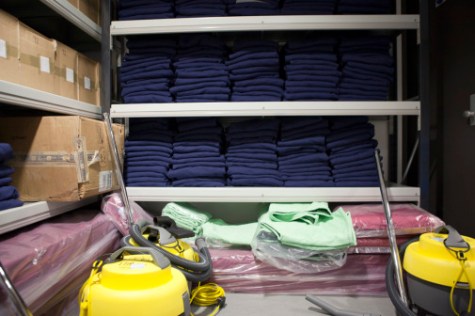
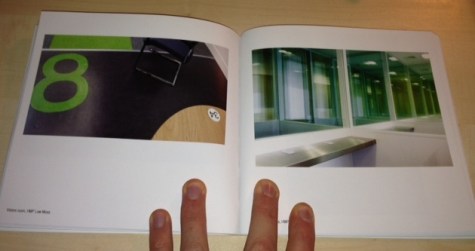
Also in the shiny new HMP Moss is a row of green-tint-windowed visiting rooms. They look like the sterile, institution environments of cinema – I’m thinking of the psychiatric wing of Michael Mann’s early eighties film Manhunter, in which Brian Cox stars as Hannibal Lector, not Anthony Hopkins.

The electrics still going in and Wicks captures the work of contractors at mid-point. The literal description of construction reminds us of the ties between labour and prisons. These are spaces paid for and made by society to meet a socially-agreed end. Hopefully resources and money invested in a new prison brings about better opportunities for rehab and a positive economic return further down the line through the reduction of crime and its associated social costs.

The prisoners must do work too. Wicks photographed recreation schedules as well as work rosters. We learn from an HMP Low Moss electronic notice board that “the finer details of prisoner mobilization plan are progressing,” a burauecratic way of saying they’ll be moving in soon. Alternatively, if we take note of text in the older prisons, we’ll be reading graffiti. Such-and-suchabody was here. We know that soon enough, prisoners will be there, in their new quarters. Does it matter if the burned graffiti reads “Jobby bum” or “jobby burn”? Does it instruct us more or does it just convince us that prisons are heavily used and heavily contested spaces? If anything, I hope Wicks’ coverage of Scottish prisons old and new demonstrate that – if we must incarcerate people – we do so in sanitary, safe places with wide provision of work, vocational and educational training.

If prisons fulfil those key criteria then prisons should theoretically be able to open gates to photographers. Imagine a day when human improvement and human rights could become the key content of prison imagery?

Keep reading below.

IMAGES: HMP BARLINNIE

RESIDENCY
HMP Barlinnie, 2012
RESIDENCY
Detention dog kennels, HMP Barlinnie, 2012
RESIDENCY
Photography apparatus, HMP Barlinnie, 2012
RESIDENCY
Toilets, HMP Barlinnie, 2012
RESIDENCY
Sinks, HMP Barlinnie, 2012
RESIDENCY
Personal belongings in a cell, HMP Barlinnie, 2012
RESIDENCY
Personal belongings in a cell, HMP Barlinnie, 2012

Wicks believes (and I concur) that depictions of crime, and crime science, in popular culture represent that world through a narrow and increasingly hackneyed set of spaces – the crime lab and courtroom offering two examples.

“As the residency progressed I discovered striking juxtapositions of the mundane and the spectacular in the work of criminology,” says Wicks. “Suicide watch cells, the back of a prisoner transport van, a storage room holding physical restraint chairs and Zimmer frames mark sites of extreme human experience and yet at the same time are part of someone’s day at the office: a site where data is collected, transferred to spreadsheets and displayed to audiences in lecture theatres and conference halls. Exploring this dynamic tension is a key aim of the project.”

Keep reading below.

IMAGES: HMP LOW MOSS

RESIDENCY
HMP Low Moss, 2012
RESIDENCY
Bars and Irn Bru machine, HMP Low Moss, 2012
RESIDENCY
HMP Low Moss, 2012
RESIDENCY
New library, HMP Low Moss, 2012
RESIDENCY
HMP Low Moss, 2012

THE BOOK, CORRECT

Wicks was kind enough to send me a copy of Correct. It’s a compact book of 86 pages. You can view a 25-page preview and buy the book through Blurb. My copy came with a fold out of 60 portrait thumbnails of portraits from They Are Us And We Are Them. I include some images below.

photo copy 2

photo copy 3

photo copy

photo

photo copy 4

RESIDENCY
Segregation unit exercise yard, HMP Shotts, 2012.

THE EXHIBITION, CORRECT: THE MEANING AND CONSTRUCTION OF SPACE

The exhibition titled ‘CORRECT’: The Meaning and Construction of Place features two audio pieces, and  an installation The Gallows, an installation of large format film giclée prints from They Are Us And We Are Them. You can see here a video of The Gallows previously exhibited in HMP Barlinnie.

The exhibition also features The Desk, a digital collage of giclée prints of criminologist’s desks.

“Closely cropped, excluding the life beyond the frame. Voyeuristic and subtly relating to the prison visiting experience: they are intrusive, this is a space where someone lives most of their waking week, a place the research comes back to and is pieced together. A personal space that appears impersonal. Cluttered with cheap plastic Chinese electronics, stationary, diary’s (hand made), mouse pads of choice, daily calendars, hand cream, distinctive handwriting and lots of notes,” writes Wicks.

Finally, and central, the exhibition includes digital C-type prints of prison interiors.

“They are an exploration of crime and justice spaces that criminologists inhabit. Such sites are more usually associated with highly iconic images of justice (bars, ankle tags, gavels) that are part of a larger popular essentialism of crime and punishment, i.e. places of cultural cliché,” writes Wicks. “I aim to demystify these places and the work criminologists undertake. Some of the images juxtapose the often-chaotic lives that occupy these spaces and contradict the harsh realities of prison life.”

‘CORRECT’: The Meaning and Construction of Place is on show now at The Briggait, 141 Bridgegate, Glasgow G1 5HZ from March 3rd – 22nd. Monday- Friday, 9.00 am to 5.00 pm.

RESIDENCY

HMP Shotts, 2012

Chritiansen, Teresa

© Teresa Christiansen, from Trace Psychedelia.

The Eye On PDX series continues with Teresa Christiansen.

Blake Andrews asks the questions most others might shy away from. Read the full interview on Blake’s blog.

– – – – – – – – – – – – – – – – – – – – – – – – – – –

BA: I love Trace Psychedelia. What is your experience with psychedelic drugs?

TC: The word “psychedelia” in the series title refers less to drugs than to the genre of music and art associated with that term. I also wanted to allude to the experience of seeing everything in immense detail through a heightened perceptual state of mind. I experienced this when I first moved to Portland after living in New York City my entire life. During my first spring here, I walked around with my camera, in awe of the dense greenness of everything. I painted onto the surface of the photographs that I took not only as a way to recreate this experience and the excitement I felt about being in a new place, but also as a way for me to put my photography in dialogue with painting.

– – – – – – – – – – – – – – – – – – – – – – – – – – –

Eye On PDX is an ongoing series of profiles of photographers based in Portland, Oregon. See past Eye On PDX profiles here and here.


EMAIL

prisonphotography [at] gmail [dot] com

Prison Photography Archives

Post Categories