Execution Chamber, Walls Unit, Huntsville (1994), from Texas Death Row @Ken Light

In early October, Ken Light and I sat down to discuss his project and book Texas Death Row (University Press of Mississippi, 1997).

Light was invited to photograph that dark hole of the Lonestar State by Suzanne Donovan, then the Director of the American Civil Liberties Union (ACLU) of Texas. “I said ‘yes’, knowing it would never happen!” Ken was proven wrong when Donovan’s groundwork and contacts sealed access – Light to the cell tiers and Donovan to the visiting room for interviews.

Texas’ death row is no longer located at the Ellis Unit, which murdered people since 1965. In 1999, the Texas Department of Criminal Justice (TDCJ) moved death row to the Polunsky Unit, West Livingston, TX.

Light describes the body of work, which consists of 13,000 images, as a historical document. The archive maintains it’s relevance proven recently by the case of Cameron Todd Willingham, of whom Light had “seven or eight photographs.” Light provided an image to the New Yorker for the article Trial By Fire, which explained how bunk arson forensics led to the execution of an innocent man.

Light estimates that between 55 and 65 of the men he photographed have since been executed. He felt a responsibility to inform with his camera. His aim was “to humanise the prisoners; to put a human face on the [death penalty] issue,” says Light “The public face of a death row inmate is the mugshot. When they go to appeal, it’s their mugshot; in the news, their mugshot; and when they’re executed, it’s their mugshot. We wanted to know who these men were. How can you have a discussion about the death penalty when you pathologise these men?”

This issue of invisibility, for Light, extends to prison culture in the U.S. as a whole.

“If the public knew about it and understood it then maybe the culture would change. Maybe we’d invest more in education and in rehabilitation. When it’s out of sight, it is out of mind. If you say someone is going to prison, it doesn’t really mean anything,” says Light.

Even so, Light recognises the limitations of the environment, “The prisoners are going to let you see what they are going to let you see.”

Ken and I talk about his liaison with the TDCJ and then Executive Director Wayne Scott (who now has a prison facility named after him); we talk about the power he asserted on assignment with both inmates and guards; the reactions of staff toward his activity; and his “surreal” meeting with Kerry Cook following Cook’s exoneration after 22 years of wrongful imprisonment. Cook is now a campaigner against capital punishment and prison rape.

LISTEN TO OUR DISCUSSION AT THE PRISON PHOTOGRAPHY PODBEAN PAGE
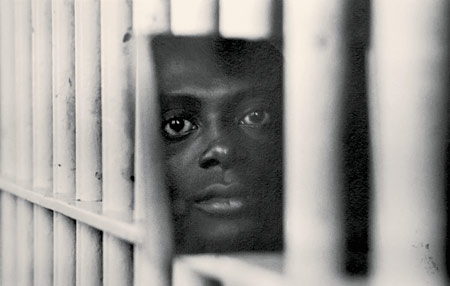
Prisoner with mirror (1994), from Texas Death Row © Ken Light
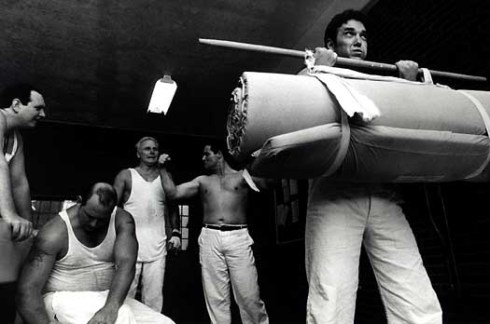
Weight-lifter with makeshift barbells, H-20 wing, work-capable cellblock (1994), from Texas Death Row © Ken Light

Death row inmates in Texas’s Ellis I Unit, with Perry Mason on the TV (1994), from Texas Death Row @ Ken Light

Cameron Todd Willingham on his bunk, in the work-capable cellblock (1994), from Texas Death Row © Ken Light
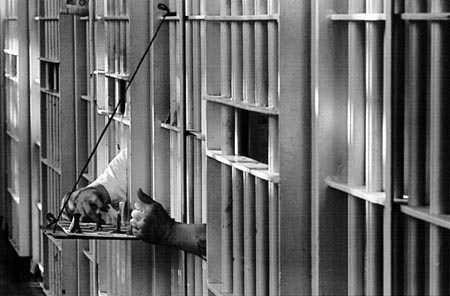
Inmates playing chess on handmade board, in the administration segregation cellblock (1994), from Texas Death Row. @ Ken Light
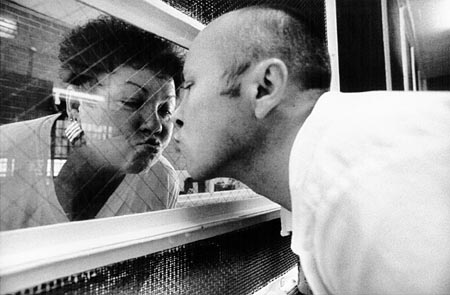
Martin Draughon greeting his mother through glass in the visiting room (1994), from Texas Death Row. © Ken Light

Strip Search in the “Shakedown Room” of the visiting area (1994), from Texas Death Row. © Ken Light

Night view of H-Wing cellblock (1994), from Texas Death Row © Ken Light
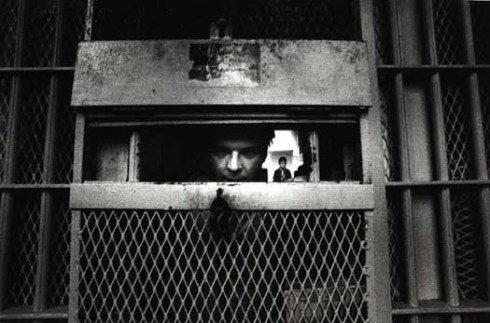
Bobby West with his cub-scout photograph (1994), from Texas Death Row © Ken Light

– – – – – – – – – –

Valley of Shadow and Dreams (2012)

Ken and his wife Melanie have just released Valley of Shadow of Dreams. The book is a photography and literary exploration of California’s Central Valley in the 21st century. Melanie and Ken look at life before, during and after the economic crash and touch upon overlapping issues: the oppression of immigrant workers, agribusiness’ effect upon communities and the environment, unemployment, families, economic volatility and home foreclosures.
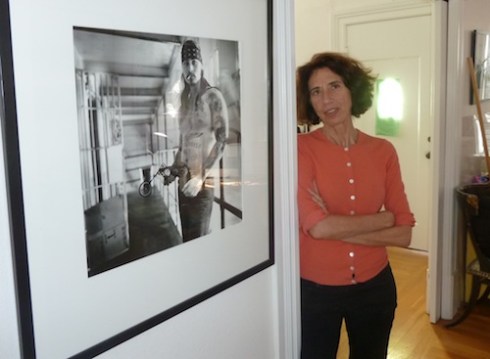
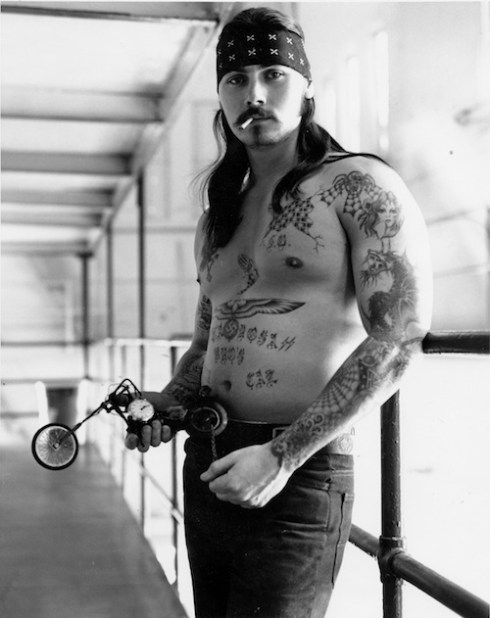
There were two categories of interviewees I planned to connect with during PPOTR – photographers and prison reformers. I didn’t expect to meet many individuals who satisfied both definitions. Ruth Morgan does.

Morgan became director of Community Works, a restorative justice arts program in the San Francisco Bay Area in 1994. Prior to that, she was director of the Jail Arts Program, in the San Francisco County Jail system (1980-1994).

It should be noted that the county jail system is entirely different to the state prison system and operate under separate jurisdictions. County jails hold shorter term inmates.

For three remarkable years, Morgan and her colleague Barbara Yaley had free reign of San Quentin State Prison to interview and photograph the men. In 1979, it was the sympathetic Warden George Sumner who provided Morgan and Yaley access. In 1981, a new Warden at San Quentin abruptly cut-off access.

“I think there were a few reasons [we were successful],” explains Morgan. “Despite the fact I was a young woman, I had a big 2-and-a-quarter camera and a tripod and so they took me seriously. That helped us get the portraits and the stories we did.”

The San Quentin News (Vol. I.II, Issue 11, June, 1982) reported on Morgan and Yaley’s activities. The story Photo-Documentary Team Captures Essence of SQ can be read on page 3 of this PDF version of the newspaper.

Ruth and I talk about how the demographics of prison populations remain the same; her original attraction to the topic; the use of her photographs in the important Toussaint v. McCarthy case (1984) brought by the Prison Law Office against poor conditions in segregation cells of four Northern California prisons; why she never published the photos of men on San Quentin’s Death Row; and the emergence, funding for, and power of restorative justice.

LISTEN TO THE DISCUSSION WITH RUTH MORGAN ON THE PRISON PHOTOGRAPHY PODBEAN PAGE

Ruth Morgan, San Quentin (1979-81)

“THE STUNNING SILENCE”

For every nine people we execute, there is one exoneration.

Bryan Stevenson, founder and Executive Director of the Equal Justice Initiative, makes the point that if one in every ten aeroplanes fell out the sky the entire industry would be shut down overnight.

Why is it we turn a blind eye to unnecessary deaths in the criminal justice system?

“The criminal justice system treats you better if you are rich & guilty than if you are poor & innocent. Wealth, not culpability, shapes outcomes,” says Stevenson.

Why the non-engagement with issues of poverty, racial inequality, disenfranchisement. Why the “stunning silence”?

Stevenson moved hearts and stole the show at this year’s TED conference, one attendee has told me. He lays out some shocking statistics but puts them in a context of optimism, basically saying to the world (and the monied, influential audience) you are party to this ongoing inequality, but you no longer need to deny it.

Stevenson doesn’t say “you”, he says “we” can change it; we can adopt a collective identity that embraces the best and the worst of our society. He warns that living with eyes wide open to injustice and poverty is a much more difficult existence, but – such is his logic, persuasion and truth – the difficulty is one to relish and not one to hide from any longer.

POSTSCRIPT

As I intimated in January, I believe that prison and criminal justice reform is more and more discussed and in the public consciousness. The warmth shown to Stevenson and the receptiveness to his message supports my belief. We can hope that those with money and influence are right behind Stevenson and others of his ilk.

Hat-tip to Suzie Katz of PhotoWings for alerting me to Stevenson’s TED talk.

Click for a larger version

PRISON EDUCATION AND REFORM

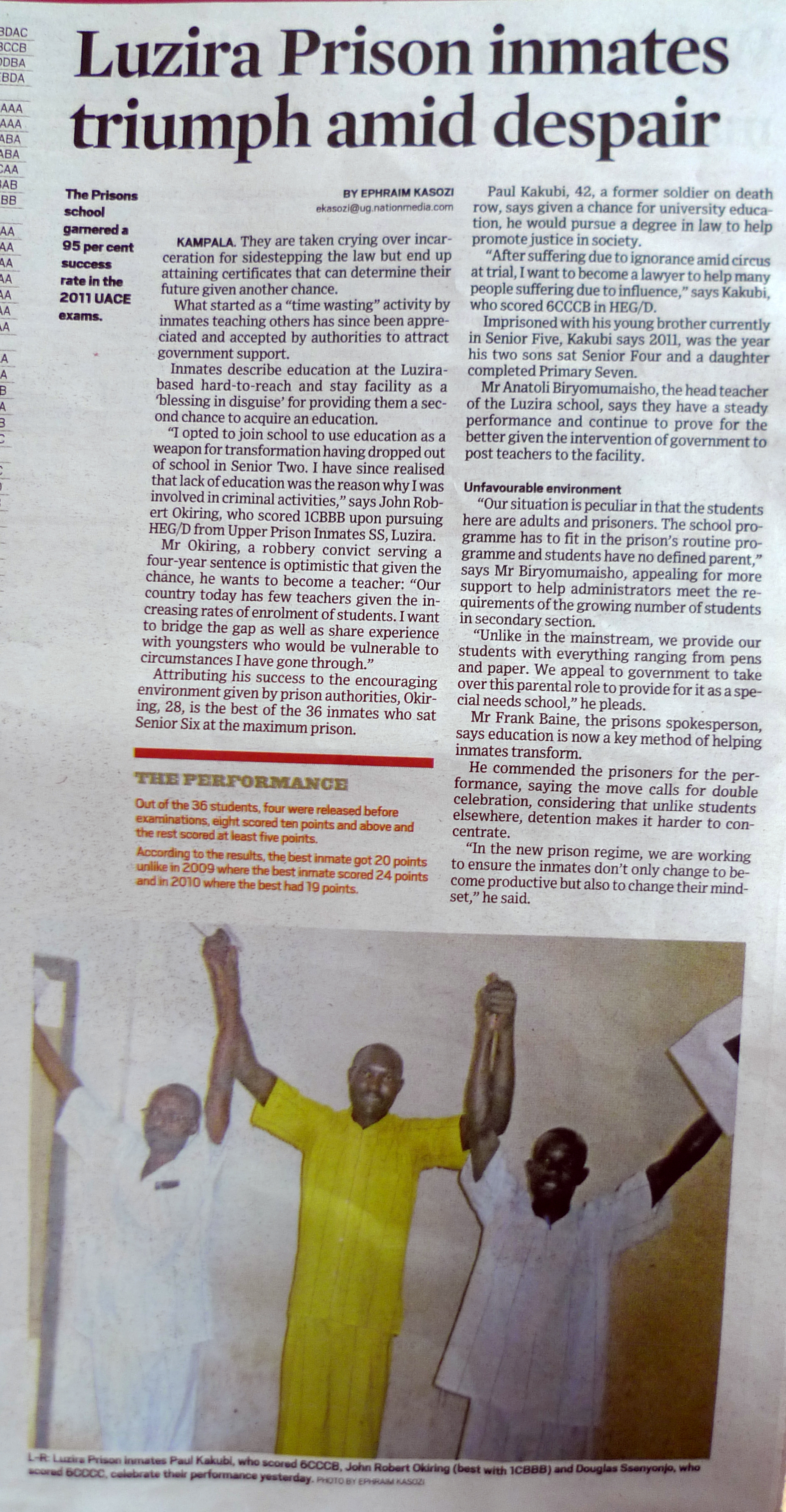
“Our situation is peculiar in that the students here are adults and prisoners […] Students have no defined parent. […] Unlike in the mainstream, we provide our students with everything [as a parent would]. We appeal to the government to take over this parental role.”

– – Mr Anatoli Biryomumaisho, head teacher of the Luzira Prison School, quoted in the Daily Monitor, Uganda, March 1st 2012.

From the tone of this article and the situation described by Biryomumaisho it seems Ugandan prison reformers have similar difficulties as their American counterparts in convincing wider society to invest in education for prisoners.

The activity described at the Luzira School is small, unhyped and vital; just one small victory among billions that play out every hour of every day. Quite different in scale to the crusade of Invisible Children.

Andrea Stultiens

Dutch photographer and critic, Andrea Stultiens sent the above article to me yesterday.

Stultiens has spent a lot of time in Uganda. If you want to be exposed to truly novel (and vernacular) photography from Uganda, you should explore her archival project History In Progress Uganda (Facebook group) and pick up a copy of her book The Kaddu Wasswa Archive.

KONY 2012 CONTROVERSY

Elsewhere, Uganda – or a version of Uganda – has been all over the internet. I’ve not much to add to the debate about the viral and controversial KONY2012/Invisible Children campaign, except to advise you to read these five pieces:

Invisible Children founders posing with guns: an interview with the photographer (Washington Post)

In Uganda, Few Can See Kony Video (NYT)

More Perspective on KONY2012 (Rosebell Kagumire’s blog)

Guest post: Joseph Kony is not in Uganda (and other complicated things) (Foreign Policy)

Why Invisible Children Can’t Explain Away This Photo (Scarlett Lion/Glenna Gordon)

And also, follow Glenna Gordon, John Edwin Mason and Rosebell Kagumire on Twitter. They’ve got reasonable things to say often.

“The unseen subject of these photographs is Power. They show us the human limits to the understanding of Power. There are many things we don’t know about Power. We don’t know if Power is the same everywhere, if its manifestation in one place and time is meaningful, measurable, subject to the same laws as another.”

– – Donald Weber, ‘Confessions of an Invisible Man’, Interrogations, pg. 158

Given that Donald Weber‘s Interrogations has just been awarded a World Press Photo award in the Portraits category, now is a good time to look at the book of the project.

– – –

At passport control my fingerprints flagged an “interaction” with the police authorities five months prior. Directed to a waiting room, I was told to take a seat and remain there until a customs and immigration officer could clarify the details of said interaction.

I wasn’t told how long the wait would be.

Thumbing around in my bag for some reading material to pass the time, I broke a wry smile when I pulled out Donald Weber’s Interrogations. He’d mailed it a few weeks prior. This was the first chance I’d had to look it over.

– – –

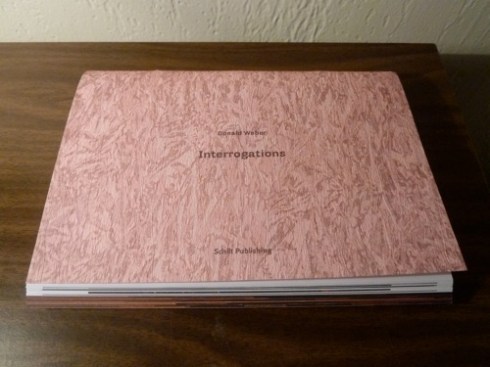
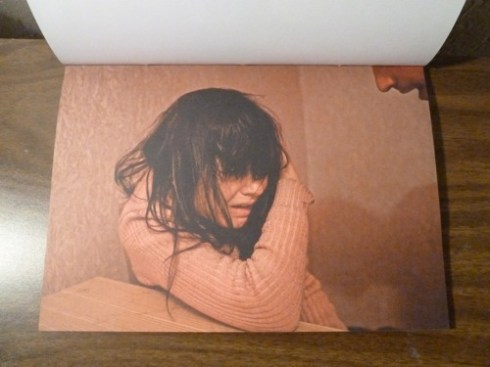
Held by a stitched spine, the 160 pages taper to the centre on the outside edge of the book (see image above).

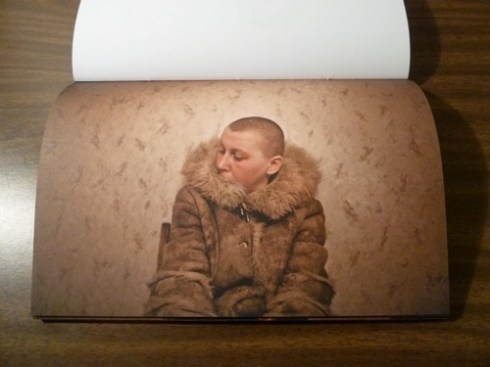
Weber and publisher Schilt also made the decision to bind it in the same wallpaper stock that hangs on the wall behind many of the detainees. Weber has come to see the modern State as “a primitive and bloody sacrificial rite of unnamed Power.” The choice of the outmoded wallpaper is an unnerving nod to the Power of a throwback era and brings us closer to the outmoded policing within these outmoded spaces.

Weber spent months – possibly years – building a rapport with the police department in order to sit in on their questioning and to make photographs. “I would just sit there from 9am in the morning to the evening, and just wait. I went days without actually taking pictures. It’s a game of chicken, and I always flinch last,” Weber told Colin Pantall. I’m a little disappointed Weber doesn’t provide the name of the station or town it is in. All we know is that it is in Ukraine.

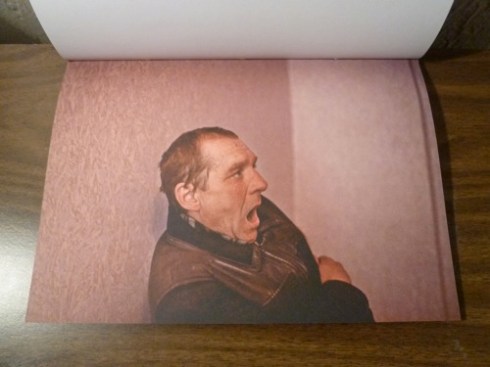
Interrogations is an unorthodox, shocking and depressing portraiture project. A juvenile, with words scrawled on his forehead in black marker-pen, sobs; a woman in a dirty sheepskin coat resembles more a carcass than a human; in a sequence of three images we witness one detainee first, terrified; second, threatened by an open palmed strike; and third, with a gun to his temple.

– – –

I was sat awaiting the inconvenience of an unnecessary interview, but I was certainly not awaiting the psychological and physical abuse meted out to Weber’s subjects.

After our brief chat, the immigration officer asked me if I had any questions and assured me I wasn’t on camera. In a relatively powerless position, to not be recorded was a small victory, I considered.

– – –

This idea of being seen during an interview goes to the heart of Weber’s series.

– – –

Here I was, subject to networked systems of law enforcement and U.S. Homeland Security, but I could be sure I’d not face the intimacy of abuse depicted in Weber’s photographs.
– – –

The strength of Interrogations is that it teeters on an ethical dilemma: should Weber have been present? In attendance, was Weber complicit? Are his photographs further abuse and violation?

The answers to these questions are ones that Weber is happy to take on and he has done so in public forums here on Prison Photography and also at Colin Pantall’s blog and at DVAFOTO.

The answers are also easier to find than we might think.

I’d argue Weber’s presence had little to no effect on the behaviours of the interviewers. Given the time he spent in interrogation rooms (evidenced by 51 portraits no less) I’m inclined to subscribe to the reasoning that eventually a photographer’s presence is taken for granted/forgotten and behaviour is less and less effected by the camera-wielding observer.

Diane Smyth, for BJP, describes the interrogations as violating theatre, “Igor and his partners play good cop, bad cop (“or actually, really bad cop, and bad cop”), using threats and intimidation to break the suspects they are questioning in the seemingly anodyne pink room.” Weber sat in the stalls, watching.

One presumes that if Weber’s attendance did alter activities it was to lessen the abuse, not escalate it?

When we are faced with decidedly uncomfortable (abusive) scenes in photography, we cannot help ourselves but to think of the photographer as in some way complicit. This is a sure way to derail inquiry; it is an emotional response that centres on the act of photography instead of the subject. As Susie Linfield lays out in The Cruel Radiance, photography of atrocity can as easily provide an opportunity to dismiss the act, distance ourselves from the images, and move away from topic at hand.

Weber’s work is in our face, but that doesn’t mean we should turn away. An illustrated prologue of Weber’s six years in the former Soviet provide some context for Interrogations. These darker, exploratory more ambiguous images temper a presumption that Interrogations was a smash-and-grab job; we know Weber spent years in the region and that he built-up to this particular project.

Similarly, Weber’s essay, ‘Confessions’ and Larry Frolick’s epilogue provide insight into living within the milieu of policing, crime and punishment in Russia and Ukraine. These elements of the book together provide opportunities for us to enter into the complex society in which Weber lived and worked.

Bluntly put, the superimposed dilemma of a photographer’s ethics are the least of the concerns for the people in the region and in Weber’s photographs.

Weber provides no caption information for his subjects. Did he ever have access to it?

In his brief essay, Weber is aware of his role as photographer within a web of power (with a capital P); how else would he be granted entry to interrogation rooms? Weber puts the meaning of his photographs not fully on the lives of his unknown subjects, but in the context of institutional power.

“We do know that Power is dangerous and exhilarating,” says Weber in the book’s essay, “It expands in proportion to its invisibility.”

With that, instead of asking what does it mean for a photographer to witness institutional abuse, we should be asking what does it mean when there is no witness, photographer or otherwise?

Interrogations, (160 pages) by Donald Weber (2011)

Published by Schilt, Amsterdam.

Designed by Teun van der Heijden of Heijdens Karwei, Amsterdam.

Printed by Wachter GmbH, in Bönnigheim, Baden-Württemberg, Germany.

Distributed by Thames & Hudson worldwide. Distributed by Ingram in North America.

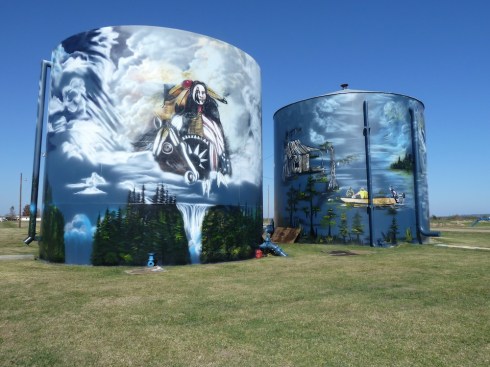
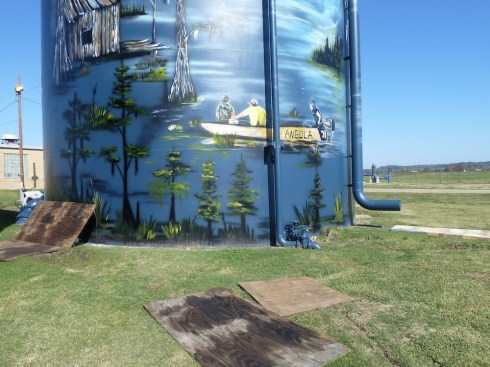
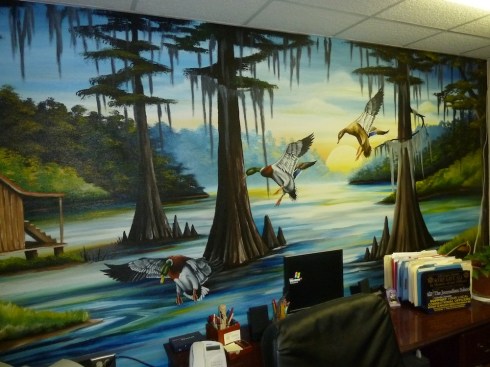
I wanted to share some PPOTR snapshots with you. Angola Prison (Louisiana State Penitentiary) is the state’s maximum security prison. An 18,000 acre former slave plantation, Angola is the size of Manhattan. At the time of my visit, Angola was “home” to 5,400 men, over 4,500 of whom will die within its razor wire.

Angola is a strange place. Burl Cain, warden since 1994, has blurred the lines between church and state by implementing a regime of “moral rehabilitation”. Of the six interfaith chapels on prison grounds, four have been constructed under his watch.

As well as providing God, Cain also provides as many programmes as possible to keep the prisoners active. From harvesting tonnes of crops (“We never open a can of food in our kitchens,” said prison spokesperson Gary Young), to refurbing wheelchairs for charitable use; from the twice annual rodeo season to the dog-training facility; from the horse breeding programme to the prison hospice; and from the prison newspaper – The Angolite – to the prison’s own TV station, prisoners who tow the line are kept busy.

Of course, on my media tour, I wondered what I didn’t see: the death row, the solitary confinement cells, the staff quarters.

I did see worklines in the fields guarded by armed correctional officers on horseback. I was also provided a meal of beans, rice and fried chicken at the Warden’s Ranch House. I visited shortly after Thanksgiving so the Christmas decorations were going up.

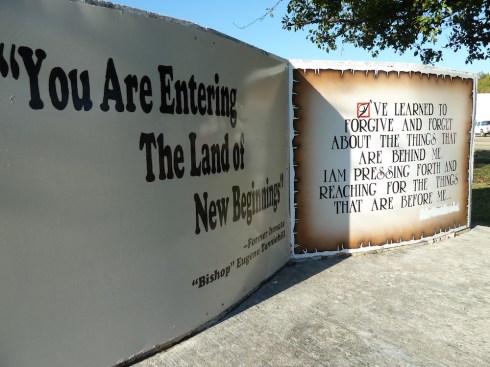
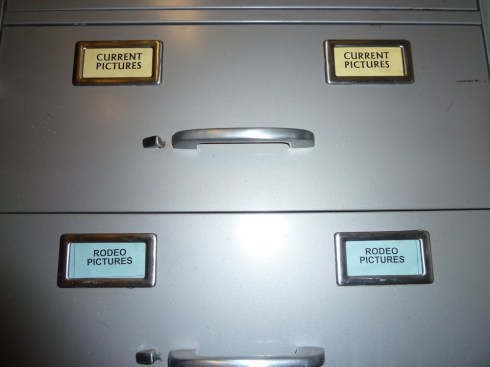
All in all, on that sunny late autumn day, I was driven through what outwardly appeared to be a pastoral idyll. I focused my lens at the signage, the murals, the markings of the regime. I present this little snapshot not in an ironic way, but that it may confound some viewers and we might wonder what lies behind these very surface-level illustrations.

Amy Elkins invited me to curate an online exhibit for Women in Photography, a group now under the umbrella of the Humble Arts Foundation.

My choice of twelve female photographers – Jenn Ackerman, Araminta de Clermont, Alyse Emdur, Christiane Feser, Cheryl Hanna-Truscott, Deborah Luster, Britney Anne Majure, Nathalie Mohadjer, Yana Payusova, Julia Rendleman, Marilyn Suriani, and Kristen S. Wilkins – are a eclectic mix of artists with different approaches to photography in sites of incarceration. Among their works you’ll find fine art documentary, found photography, alternative process, painted photographs, collaborative portraiture, dreamy landscape, photojournalist dispatches and social activism.

Some ladies’ work I’ve featured before on Prison Photography; some are relatively new discoveries; others I met during Prison Photography on the Road; and a few are included in the ongoing Cruel and Unusual show at Noorderlicht.

Thanks to WIPNYC co-founders Amy and Cara Phillips for providing an avenue with which to disseminate photography that counters stereotypes and informs audiences of lives behind bars. Thanks also to Megan Charland for formatting the exhibition.

From my curatorial statement

In the past 40 years, America’s prison population has more than quadrupled from under 500,000 to over 2.3 million. This program of mass incarceration is unprecedented in human history. Women have born the brunt of this disastrous growth. Within that fourfold increase, the female prison population has increased eightfold. You heard right: women are incarcerated today at eight times the number they were in the early 1970s. Are women really eight times more dangerous as they were two generations ago?

Please, browse the gallery, bios and linked portfolios.

Photo: Darryl Richardson, from the series Nothing To Lose (Angola Prison Rodeo)

I was given a media tour of Angola Prison while in Louisiana during Prison Photography on the Road. The arrangements were straightforward and the administration very welcoming. The warden’s office is set up for requests and visits like mine. The prison even puts on tours for high school kids; they come in their thousands every week.

I put it to Cathy Fontenot, the Assistant Warden, that Angola was the most photographed prison in America. She said that was probably the case. (Look through the PP archive for examples.)

The Angola administration are proud that they can accommodate photographers and journalists in the numbers they do. Naturally, a discussion must exist about the level to which journalists gain access – what they see and what they don’t see – but this is for another time.

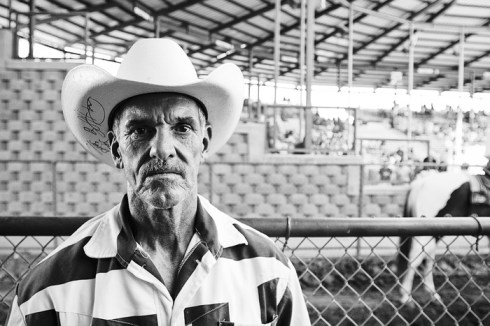
In the case of the Angola Rodeo, access for journalists is as easy as it is for the tens of thousands of public who attend each autumn. Florida based photographer, Darryl Richardson, went to Angola in October 2011. He, like others before him, focused on the visual spectacle of the rodeo. He attempted to draw a metaphor between the “combative livestock” and an unforgiving public; the prisoner always under attack.

Personally, I like Richardson’s portraits.

Take the portrait above. Whose is the signature on the hat? That’s a nice hat. Does the prisoner own it? Was it a gift or a prize? I’m drawn into the story behind that hat and behind that photograph.

The Angola Rodeo is a complex thing. At the arts fair, it is a chance for prisoners to interact with society and hawk their crafts; the rodeo is a big event that focuses energies of prisoners (Angola Prison is always looking for activities to occupy the thoughts of 4,500+ men that will die within its parameters); and it is about commerce. I was told by prison authorities that the rodeo raised $2.5million for the prison [programmes] last year. As the event grows, so does the figure year-on-year.

Richardson told me in an email, “I’m in the process of going back to Angola to connect with other inmates and take a look at other areas inside the penitentiary.” I wish him luck. For our sakes, we need to see more of Angola Prison than this wild public event. We’ll see what emerges.

More on Richardson’s work here and here.

EMAIL

prisonphotography [at] gmail [dot] com

Prison Photography Archives

Post Categories