http://vimeo.com/72732605

Over the past decade, documentary filmmaker Edgar Barens has explored the many issues at play in the American criminal justice system.

For his most recent project Prison Terminal, Barens was granted unprecedented access to the Iowa State Penitentiary (ISP).

Prison Terminal is a moving cinema verité documentary that breaks through the walls of one of America’s oldest maximum security prisons to tell the story of the final months in the life of a terminally ill prisoner and the hospice volunteers, they themselves prisoners, who care for him.

The Iowa Department of Corrections allowed Barens round-the-clock access to the ISP hospice and almost uniquely – to my knowledge – a space for him to cobble together living quarters and a production studio in the prison’s basement.

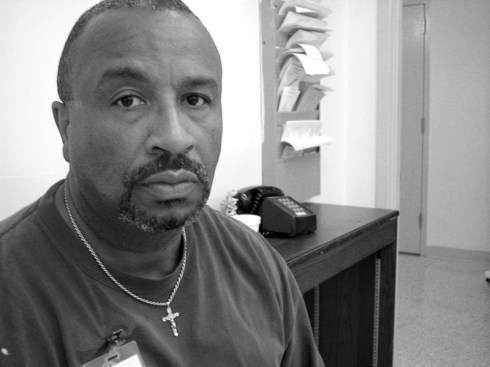
Jack “Comrade” Hall. Hospice Patient, Iowa State Penitentiary.

Bertram “Herky” Berkett. Inmate Hospice Volunteer

Prison Terminal is more than a documentary: it is a hub for information and context. You’ll need to spend some time with the biographies of those involved, a host of video shorts and general essays about the prison industrial complex.

Prior to working in Iowa, Barens also documented the hospice program at Angola Prison – a well photographed program probably best known through Lori Waselchuk’s Grace Before Dying.

These two hospice programs remain exceptional in America’s correctional landscape, but it is Barens’ hope that Prison Terminal will assist in making these services permanent throughout U.S. prisons, ensuring that inmates no longer have to die alone.

Charles “Woo” Watkins. Inmate Hospice Volunteer.

Larry “Big Papa”. Hospice Patient

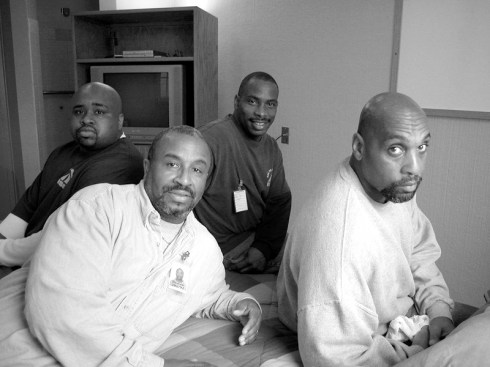
Inmate Hospice Volunteers (Front: Bertram Berkett, Michael Glover Back Row: Michael Williams, Charles Watkins.)

BIOGRAPHY

Edgar Barens received his Bachelors degree and Masters of Fine Arts in Cinema and Photography from Southern Illinois University, where he concentrated on photography and film production. His body of work includes documentary films, experimental shorts, music videos and public service announcements, which have been screened at film festivals, conferences, broadcast internationally as well as distributed educationally.

You can view all Prison Terminal videos here.

Follow Prison Terminal on Twitter

All images © Edgar Barens

There’s not a lot of humour to be drawn from America’s Prison Industrial Complex but, still, I made an attempt with an hours worth of April foolery and sarcasm:

Dress, Burgu #325 Tirana, 2008 © Annaleen Louwes

In the Spring of 2008, Dutch photographer Annaleen Louwes was artist-in-residence at Ali Demi Women’s Prison in Tirana, Albania. The prison welcomed Louwes as part of a wider philosophy of rehabilitation. “Louwes’ portraits constitute a diary of individuals, without emphasizing the circumstances or context in which these women live,” says the website of the Albanian Directorate General of Prisons.

She shot photographs every day and brought prints the next day. So the group of women who wanted to come to the little photo-studio she installed in the library, grew day by day, ” says FOAM Magazine. “They started to ask her to reproduce the pictures they had of their mother or lost child. She got a very intimate view on their lives in that way. At the same time she became their photographic tool and they made all kind of collages with the photographs she had made and they already kept.”

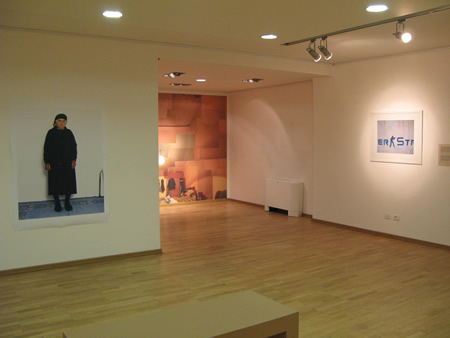
At the end of the two month residency, Annaleen presented the series Burgu #325, in For Those Who Cannot Enter, a joint-exhibition with her fellow artists in residence.

All in all, this seems like a remarkable “intervention” with art into this particular penal site. Not only did the women gain rehabilitative worth in the act of photography, they gained actual commodity value in the photographs. This value was eventually cashed in for emotional attachment when the photos made it into the hands of distant family members.

Furthermore, female prisoners from Ali Demi were granted a 2-hour day-release to visit the show at Galeria Zeta!

In thinking about Louwes’ work, my thoughts return once again back to the logistics of a photography workshop inside a prison. I’ve learnt that photo workshops used to be common in America, that they still continue abroad (Louwes being one example) and they occasional crop up in juvenile detention facilities in the U.S. today. But they have waned, disappeared.

I don’t expect prison administration to offer day leave to prisoners to see final artworks in place, but I would encourage them to think of the rehabilitative value of photography and self-representation behind bars. And to think about workshops.

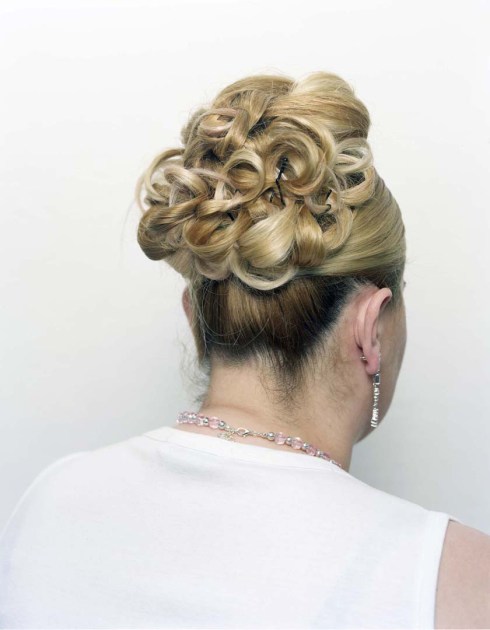
Hair, Burgu #325, Tirana, 2008 © Annaleen Louwes

The Tirana Institute of Contemporary Art (TICA) operates a rolling Artist-In-Residence (A.I.R.) program. For the fourth A.I.R. (April and May, 2008), alongside artists Yllka Gjollesha & Syabhit Shkreli, Annaleen Louwes worked in I.E.V.P ‘Ali Demi’ Prison, Tirana.

A.I.R. #4 was made possibly with the support of FONDS BKVB of the Netherlands and the support of Ms. Marinela Sota, Director of Ali Demi. The resulting exhibition For Those Who Can Not Enter was on show at Galeria Zeta, May 27 – June 20, 2008.

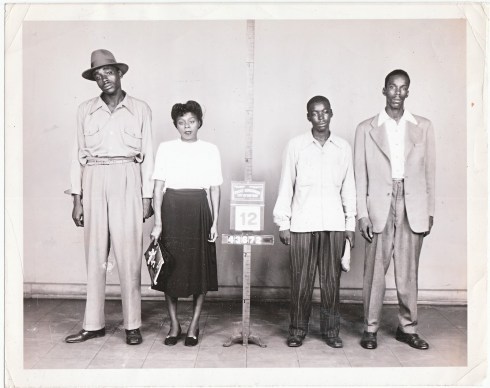
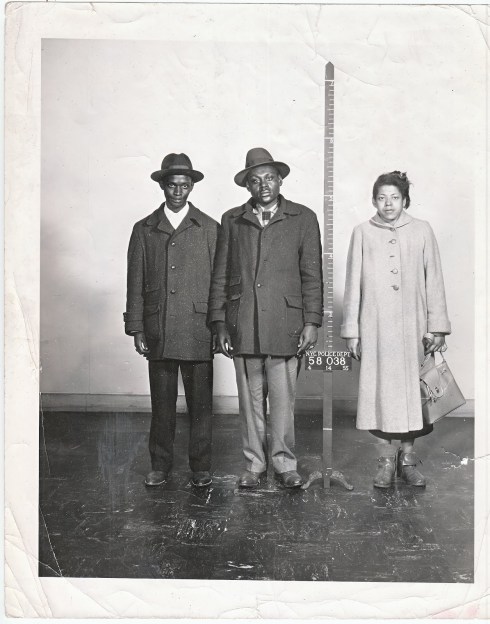
Jim Linderman just posted some original 1950s mugshots from Brooklyn, NY on Dull Tool Dim Bulb (one of my favourite photography blogs).

Of the images he says:

“Given attitudes, practices and institutional racism from 50 plus years ago, these sharp-dressers might have been just walking to work.”

Possibly, but we will probably never know the circumstances of their arrests.

I am fascinated by the tilted heads of many of the detained men and women. I read a hell of a lot of knowing defiance in the way many of the subjects gaze to the camera. It’s as if they are simultaneously acknowledging the photograph as a component in the apparatus of police power and the primary record of that unequal power. As such, they don’t hide or shrink but confront the photographic act.

All photos: Group of Original Mug Shot Photographs, New York City 1949 – 1955 Collection Jim Linderman

Nico Bick‘s work had been on my radar since Fotodok’s 2010 exhibition State of Prison. Between 2006 and 2009, Bick photographed the Bijlmerbajes prison in Amsterdam. In the past, Bick and I had played email tag, so it was nice to finally meet him last month in his native Netherlands and talk shop.

Q&A

Where were the inmates when you were taking your photographs?

Right behind me. It all looks very serene and quiet but there’s lots of noise behind me. I had to ask permission of each prisoner before photographing their cell.

Did the prisoners care about your artistic vision?

Not really. Obviously, those that refused permission to photograph their cell really weren’t interested. Some thought it was worthwhile. Most wondered, “Why take a picture of a prison?”

Yes, why? Are you an architectural photographer?

No. I do take pictures of space, but not architecture. I hardly ever do commissions for architects. I’m interested in the tension between public space and spaces more secluded. The prison embodies this tension.

In the Netherlands, prison is a public space. It’s not like in the U.S. where there exist private facilities. The government runs all prisons here, so in that regard they are a public space. The inside is not visible but it is owned by the state, funded by the public.

How did you get access?

Initially, I sent a letter to the director. But I never got a reply. I had a friend who said she might know someone who worked at Bijlmerbajes. It was a different path to try. I sent a letter to her, she dropped it on the right desk and someone called me (laughs).

This was only the first hurdle. During my work on P.I. I liaised with four different communication officers. All had a different approach in their willingness to cooperate in the project.

I won’t try to pronounce the prison’s name. Is the complex iconic?

The Bijlmerbajes? Yes, it is. Designed in the late 60’s and put into use in 1978, this prison is an architectural embodiment of the prevailing social-reformist ideas of that time. The architects tried to escaped the traditional ‘prison architectural design’.

Six towers, divided in units and connected by corridors, are constructed with respect to individual needs of ‘social’ comfort. The windows for instance featured no metal bars initially. However, the thick ‘unbreakable’ glass was found not resistant enough and had to be reinforced with metal bars.

Bijlmerbajes is not its official name. The name comes from the ‘Bijlmer’ part of Bijlmermeer which is a nearby neighbourhood (built at the same time as the prison) plus the word ‘bajes’ which is Dutch slang for ‘prison’. Bijlmermeer is well known for its high rises.

The official name of the prison is Penitentiaire Inrichting Over-Amstel – which is really difficult to pronounce!

Does its looming architecture represent “A prison” for the majority of Dutch people?

No, it does not. Situated near a rail road station it is often first looked upon as a social housing project. As usual, people do not look properly because with such a large perimeter wall and fence it is unquestionably a prison.

For years, there have been plans to move the prison to another location. Emphasis on plans. Nothing definitive has been decided. Possibly a move to the north but the ‘Not In My Back Yard’ crowd don’t want it. I was discussing this recently with a friend and he told me that in the U.S. town and cities welcome prisons because they provide jobs. This is not the case in the Netherlands; it’s not a deciding factor [on a prison’s location]. Dutch prisons are not considered as big jobs machines.

Bijlmerbajes was built as a “humane” prison. It is architecture along philosophical lines. Given the plans to replace it, do you think the next architectural solution for a prison will be driven by social ideals?

My feeling is that it will not. The replacement may not be as humane. Ideas today are not like the 60s and 70s. New prisons will have economic considerations within them. I won’t rule out that Dutch prisons may be privatized in the future. That’s the political climate we’re in.

How are prisons discussed in the Netherlands?

Generally, people talk about the legal system and not the prison system and they think that the legal system is okay; that the punishments handed out are correct and proportionate.

Unfortunately, there is – especially with that horrendous right wing cabinet we now have in the Netherlands – a discourse on how luxurious our prisons are. Of course, this is all perception.

Why have Dutch politics swung to the right?

In the Dutch parliament, 24 of the 150 seats are in the hands of the far right. So that’s about 15%. We feel the effects of the embrace of neo-liberalism in the 90’s by almost all political parties. As a result, votes shifted to the far right and left. The center is a wasteland. But bear in mind that the right-wing government in the Netherlands only has a majority of one seat in parliament.

Some people in the Netherlands think multiculturalism has failed?

Personally, I don’t think multiculturalism has failed. It is something that is here and it works. I see different types of people from all over the world around me everyday. I am aware of issues that immigration brings but [the far right leader] Wilders plays with feelings of fear and insecurity. People just need to give it time. Within a society that demands immediate solutions this is very difficult.
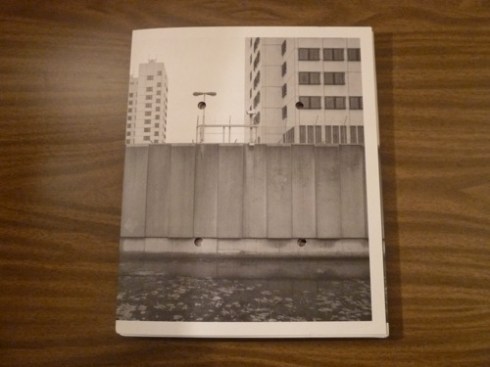
What does you book title P.I. refer to?

P.I. stands for Penitentiary Institution. I choose this title because the book is a metaphor for the universal notion of ‘prison’ and prison architecture in general.

How do you hope P.I. will influence discussion?

Besides the notion of a ‘hotel-like’ prison, another widespread stereotyped image of the prison is a dark, over-populated construction. With my book I try to nuance this opinion.

What is your audience for the book?

An audience with an interest in art and photography. Additionally, an audience interested in the social aspects of architecture, philosophy, ethics and cultural heritage. Obviously, with an edition limited to 400 copies my audience shall not be very large.

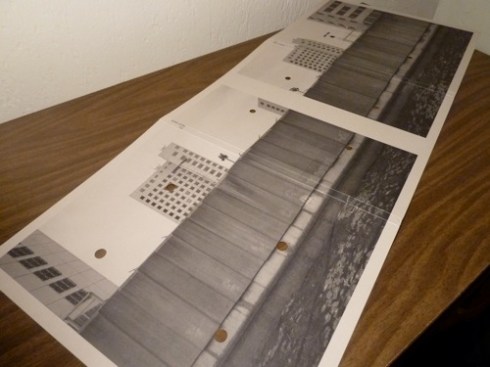
P.I. is not a bound book but a collection of sequenced offset prints. Why did you choose this book-portfolio design?

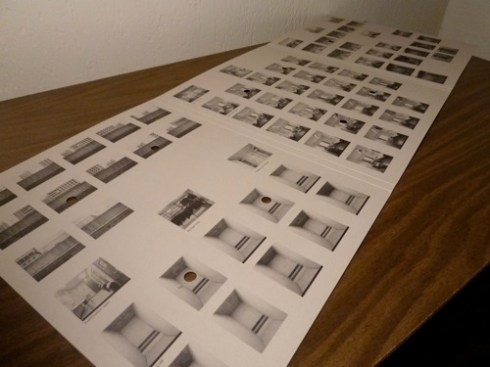
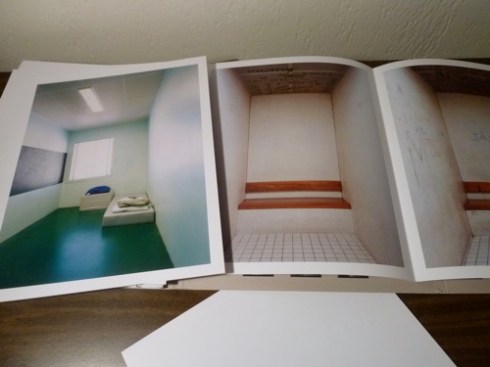
P.I. as a project contains more images then the ones printed as colour plates in the book. The photo index on the inside of the cover shows the series as a whole. It also shows what is available; images with no hierarchical ordering, just locations. Because the series consist of identically photographed interiors. Each series, each interior, is processed in the book as a separate set of pages. By taking this set of pages apart, you have an excellent way to compare the interiors with each other.

The publication concept of P.I. is that it is to be associated with a dossier. But at the same time – in terms of book typologies – it is to be associated with what I must define as the deconstructed book.

Deconstructed books are unbound, half bound, perforated or unfinished and, as such, emphasize the physical aspect of the book. It is this type of book that suits best my methodology and my description of a specific type of public space.

The graphic design of the book does not impose a narrative structure on the reader; by comparing the images, the story unravels. This kind of unfinished book, which even lacks ordering demands active readership.

It seems like P.I. is both fine art project and historical document?

Yes. Fine art project first but an historical document too. In terms of art strategy I am primarily interested in studying the use of public spaces.

Tell me about order, numerics and sequence in the architecture of Bijlmerbajes.

Six towers are connected by the main corridor. A tower contains five units. There are 24 single cells within every unit. Every unit has its own control room (no longer in use). A tower has a separate top floor with three isolation cells and six air cells. Each tower has two communal yards, a large one and a smaller one. Every tower has its own control room – all of which are controlled by the main control room.

Upon entering the Bijlmerbajes one is placed temporarily in one of the holding cells.

Does your book represent a single tower?

Yes, although it is pieced together from photographs of cells and spaces from all the towers. It wasn’t possible to photograph a single tower in its entirety. There are 12 photographs of cells in P.I. to represent the 24 in a single unit.

You showed the work at the Fotodok exhibition State of Prison.

Raimond Wouda, curator for State of Prison wrote about my photography during as part of his year of reviews for Fotodok. To conclude the yearlong “residency”, he mounted an exhibition. He chose the subject of photography in prisons and my project was a starting point for the exhibit.

Has photography changed the public debate on prison issues?

It’s difficult to measure. I’m interested in the Bijlmerbajes in particular but I’m not a prison expert, nor do I aspire to be the “prison photographer of the Netherlands”. I looked at one prison in isolation.

After prison, where do you go?

I’m interested in Parliaments of the European Union – 28 national parliaments plus the two European parliaments in Bruxelles & Strasbourg. Again they are public spaces and simultaneously they are not. Parliaments have notions of democracy for the people and of being seen. Prisons and parliaments; both make access difficult.

BIOGRAPHY

Nico Bick (Arnhem, 1964) studied photography at the Royal Academy of Art in The Hague (1986-1991). Characteristic of his work is a preference for inconspicuous places that appear to be so familiar that nobody seems to notice them anymore. He specifically direct his view at spaces with a tangible tension between the public and the private domain. With patience and careful observation he creates highly detailed images, in the absence of its users, to focus the attention to both the space itself and the meaning of these places. Nico Bick lives and works in Amsterdam.

P.I.

Photographs  Nico Bick
Text  Frits Gierstberg
Design  Joost Grootens
Published by Nico Bick, Amsterdam 2011.
ISBN 9789081428217
Edition: 400 copies with an English text on a supplementary sheet. Offset, folded, 64 pages, 32 colour photos, 24x30cm. 35 euro.
Special edition. 25 copies. Signed and numbered with an additional original photograph (C-print, 24x30cm). 160 euro
Available through Bick’s website.

MORE

At eyecurious

At Buffet

P.I. on Facebook

The Cruel and Unusual exhibition newspaper has a review of P.I. by Arno Haijtema in English translation. Purchase here. View here.

© Richard Ross. Cell of a 15 year old boy on the mental health wing of King County Youth Service Center, Seattle, WA. Many of the children on the wing here are on psychotropic medication. He didn’t leave his house for three years; he hasn’t gone to school in three years. He is locked up because he assaulted his mother and his mother doesn’t want him. Placement will be difficult. The first step will be reconciliation with his mother. Alternatives to Secure Detention (A.S.D). He is under 24-hour observation and checked on every 15 minutes.

“The U.S. Supreme Court hears arguments Tuesday in two homicide cases testing whether it is unconstitutionally cruel and unusual punishment to sentence a 14-year-old to life in prison without the possibility of parole,” says Nina Totenberg (Do Juvenile Killers Deserve To Be Executed)  for NPR. “There are currently 79 of these juvenile killers who will die in prison.”

Much of the coverage on JLWOP, an undeniably emotive issue, can be skewed. Totenberg, however, deals with the facts very evenhandedly (as she always does when reporting on the labyrinthine legal SCOTUS cases).

She gets to the heart of the matter, which is to ask ‘Are 14-year-old killers always killers who either can never – or do not deserve – to be rehabilitated?’ Essentially, in the 18 states where JLWOP has been handed down, the law believes that is the case.

It is Bryan Stevenson (whose TED appearance I mentioned last week) that is representing the two boys in this case. He argues that it is cruel and unusual to lock up until death a child who does not have the developmental capacity to appreciate his or her actions nor the ability to fully grasp consequence.

“We’re not saying that juvenile offenders who commit homicide can’t be punished severely,” Stevenson says. “They may even end up spending the rest of their lives in prison. But it’s premature, excessive and unfair to say we know this juvenile will never be rehabilitated.”

The problem is that law prohibits the consideration of an individual’s history or the circumstances of the crime in sentencing.

“Judges can’t consider it. Juries can’t consider it. No one can consider it,” says Stevenson.

Totenberg offers the example of Kuntrell Jackson a 14-year-old who robbed a video store with two others. An employee was shot dead but Jackson was not the gunman. “Under Arkansas’ felony-murder law, Jackson was deemed just as responsible as the triggerman. He was tried as an adult for aggravated murder and, under state law, received a mandatory sentence of life without parole,” explains Totenberg.

Sadhbh Walshe has just written (What JLWOP means: life without parole for kids) about a similar case in Pennsylvania. Robert Holbrook was look out for a drugs deal in which a female was killed.

Also in the Guardian, Ed Pilkington video interviews Quantel Lotts who murdered his step-brother in a fight aged 14 (Jailed for Life at 14: US supreme court to consider juvenile sentences). Lotts is in Missouri.

Pilkington puts it to Lotts that he might be a different person now as a 26-year-old. Lotts characterises his childhood – during which he was told violence solved everything – as a “phase.”

As I said in my last post, retribution cannot be eternal. We cannot justify it and we can only tolerate it if we make it invisible.

I close by repeating the words of an adult I met who had served three decades in prison on a LWOP sentence before winning a governor’s clemency against all odds. He said, “LWOP means you’re dying inside. It’s no different to a death sentence. It IS a death sentence.”

Still from Sentencing the Victim

It is my stated mission to discuss the unprecedented growth, size and activities of the American prison system. I believe that there are better solutions to solving transgressions in our society than warehousing people. I especially believe this with regards to people sentenced to non-violent crimes.

However, prisons should exist for people who are a threat to public safety. I worry that sometimes people may mistake me for an apologist for all criminals. This is not the case.

For heinous crimes – such as rape, kidnap, torture or pre-meditated murder – prison is a fitting punishment.

WOMEN & GIRLS LEAD ONLINE FILM FESTIVAL

As part of Women’s History Month, PBS and Independent Lens – in a series named Women & Girls Lead – are making available (only during the month of March) online films that amplify the voices of women and girls acting as leaders, expand understanding of gender equity, and ‘focus, educate, and connect citizens worldwide in support of the issues facing women and girls.’

There is a vast array of films, some about criminal justice. Me Facing Life is about a 16-year-old sentenced to life for killing a man who picked her up for sex and Troop 1500 is a participatory documentary about, and made by, the daughters of mothers who are serving time for serious crimes, giving them a chance to rebuild their broken bonds.

SENTENCING THE VICTIM

Very different in tone and very difficult to watch, Sentencing the Victim tells the story of Joanna Katz who was gang-raped in 1988. Following the trial of her five attackers, she is required to appear before the North Carolina parole board for each and every parole hearing. The film fluctuates between her account of the ordeal and the repeated visits and legal mantra by parole board members. The inflexibility of a system means the parole hearings of her assailants are not heard at the same time. This difficult process is something Katz and her incredibly supportive and wise parents go through five times as many times as should be reasonably expected.

Katz is now an advocate for all victims of rape and it is a testament to her strength that she produced this film; it is for all our educations. The film was instrumental in streamlining the legal process and lessening the burden on victims.

What I expect of a prison system is that it makes possible for every individual sentenced the opportunity to take full account of their responsibilities. Joanna’s assailants don’t feature in the movie, nor should they given its purpose to roundly describe the victims experience. Violence is a learned behaviour and it can become a disease of communities. It is much easier to continue a life of violence than it is to educate oneself and see the destructive and unforgiving reach of violence for what it is.

Taking responsibility for ones actions is transformative and positive; prisons need to allow the space and the environment for remorse and accountability to surface. Some prison do that and others engender violence further.

To deny liberty to the most predatory of criminals is a reasonable expectation of prisons. But there is too much violence in the world and prisons shouldn’t be incubators of violence. Even for the worst of the worst – especially for the worst of the worst – prisons should be places of self-examination, apology and healing.

ABOUT SENTENCING THE VICTIM

On June 17, 1988, Joanna Katz and another woman were abducted at gunpoint, taken to an abandoned house in Charleston, South Carolina, and brutally raped, beaten and tortured by five men for more than five hours. Sentencing the Victim is the story of how a blood-soaked 19-year-old was able to walk away from her attackers, save her friend from certain death, and continue fighting for the convictions of her assailants — and for the rights of crime victims everywhere.

Under South Carolina law, felons convicted prior to 1996 can eventually be considered for parole every two years. Despite their 30-to-35-year sentences, Katz’s attackers were eligible for parole after serving only a fraction of this time. And in a particularly cruel twist, criminals in South Carolina who participate in a group assault receive separate parole hearings on separate days. Victims who wish to oppose parole for their attackers must subject themselves to an emotionally agonizing experience that must be repeated year after year. In order to ensure that her attackers would remain behind bars, Joanna Katz had to travel more than 100 miles from her home numerous times every year to attend separate parole hearings for each of the men who assaulted her.

The hearings continue until the criminals are either paroled or complete their sentences and are released back into the community. Each hearing reopens old wounds. With each hearing, Katz wonders who was really sentenced: was it her attackers, up for parole after serving a minimal sentence, or was it her, forced to relive her trauma over and over again?

Through April 1st, view the WOMEN & GIRLS LEAD ONLINE FILM FESTIVAL and visit the website.

– – –

Life’s A Blast is a personal meditation on Israel and Palestine as seen through the lens of a young Swedish visitor. Linda Forsell visited Israel, Gaza and the West Bank several times between 2008 and 2010. She returned with a selection of images that read like a journal.

I first became aware of Forsell’s work when Life’s A Blast was shortlisted for the 2010 Magnum Expressions Award. I’m a big fan. I, therefore, did not hesitate to write a foreword when invited to do so by Linda. Below, punctuated by Linda’s images, is the I essay I wrote the new-release book Life’s A Blast.

– – –

– – –

“He lowered the glasses and pulled down the cotton mask from his face and wiped his nose on the back of his wrist and then glassed the country again. Then he just sat there holding the binoculars and watching the ashen daylight congeal over the land. He knew only that the child was his warrant. He said: If he is not the word of God, God never spoke.”

— Cormac McCarthy, The Road

It’s fair to speculate that all photography surfacing from Israel and Palestine is about land. Knowing what we do about land disputes, settlements and segregation in the region, it’s difficult not to ascribe images a political position favoring the land claims of either the Israelis or Palestinians. This is understandable in a climate of contemporary opinion that has roundly rejected the idea of photography and photographer as objective agents.

Linda Forsell’s photographs are not landscape photographs in the traditional sense. However, the beguiling vignettes within the pages of this book do return us to issues of land, and to the discomfiting realisation that no one in Israel or Palestine has a grounded or reliable relationship to the land.

In considering the surety of land-claims – claims backed with violence – in Israel and the Palestinian Territories, it may seem absurd to describe peoples’ connections to land as without root. Perhaps, the word ‘ambiguous’ more faithfully describes the disconnect. Between the certainty of established political positions and the uncertainty of physical existence in the region there exists a vast gulf of ambiguity.

Life’s A Blast is a challenge to convention and photographic authority, a sustained and deliberate visual wobble.

Within a photograph of an older man teetering atop a wall, the wobble is literal. In the photographs of children wielding weapons and playing among destroyed buildings, the imbalance is allegorical. Men, women and children in Forsell’s work maintain relationships among themselves, but struggle to find their feet.

The tropes of photography – particularly photojournalism – in Israel and Palestine are well known; the checkpoint; the rock-slinging youth; the huddled mother; the wall; the distant settlements on a desert hillside; the coffin raised high at a funeral; and  – perhaps with most appearances on international newspaper front pages – the flag. The flag is often accompanied by some billowing smoke.

These tropes persist because, within the boundaries of a news story, these scenes are the illustrative of the quote/unquote action. As consumers of images, we must keep at the forefront of our minds that living in Israel and Palestine goes on outside the boundaries of news column inches.

– – –

– – –

We have begun to see a small but noticeable response by contemporary photographers who have consciously moved away from “crisis photography” – I’m thinking here of recent work and publications by Irina Rozovsky and Yael Ben Zion – toward subtler observations of subtler gestures.

Forsell’s concern for the individual is noticeably different to the drawn back and almost cartographical response by celebrated photographers such as Sophie Ristelbuehler, Willie Doherty, Paul Seawright, Simon Norfolk and Richard Mosse. Of this group, curator and critic Charlotte Cotton says:

“Rather than being caught up in the chaotic midst of an event, or at close quarters to individual pain and suffering, photographers choose instead to represent what is left behind in the wake of such tragedies, often doing so with styles that purpose a qualifying perspective.” [1]

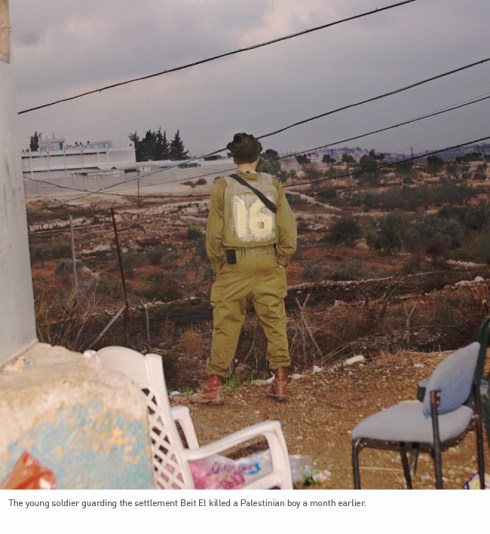
Equally committed to ideas of scarification and dislocation, Forsell, by contrast, takes us closer to people, not further away. In so doing, we encounter the personal and psychological; a soldier who doesn’t want to be there, an old man perplexed by border-point paperwork, the laughter of military-men, a side-street pat down and the confused glances of children. There’s vanity amid the daze and haze, too, in the form of rock-throwing demonstrators that look like they’re dressed for a violent-chic photoshoot. It’s only disconcerting if you accept there are no easy answers for the people of Israel and Palestine.

Too often, repeated news images provide us the excuse to think that events don’t change and can’t change. Worse still, is the trap to think that Israelis and Palestinians are different from us. Such thinking allows us to rationalise ongoing abuses. In discussing atrocities generally, lawyer and feminist scholar Catherine McKinnon characterises attitudes:

“If the events are socially considered unusual, the fact that they happened is denied in specific instances; if they are regarded as usual the fact that they are violating is denied; if it is happening, it’s not so bad, and if it’s really bad, it isn’t happening,” [2]

McKinnon describes the trap and illogic of apathy. The exit door from denial is to first see the victims of abuse as humans. To identify common emotions and thus ourselves in Forsell’s subjects is our responsibility to them … and her gift to us. Turning these pages is to shake the foundations of our excusatory logic.

Life’s A Blast is a significant contribution to the visual discourse of Israel and Palestine. It abandons literal depiction of the region and, instead, looks toward emotional territories.

It is the prior exploration of these emotional lands that will provide the most reliable base on which to stand for those who desire to debate the geopolitics of the region’s contested borders, laws and land.

– – –

1. Charlotte Cotton, ‘The Photograph as Contemporary Art’, p.167. Thames & Hudson, October, 2004.
2. Catharine McKinnon, ‘Are Women Human?: And Other International Dialogues’, p.3, Belknap Press, 2007.

– – –

– – –

Life’s a Blast (106 pages) 10 x 13 inches.
Published by Premiss Förlag.
Printed by Elanders Fälth & Hässler.
ISBN: 9789186743055
Available at the Premiss Förlag website.

Life’s a Blast does not yet have U.S. distribution, so if you want to buy a copy in cold-hard-cash-dollars you’ll have to email Linda and ask nicely: linda@lindaforsell.com

– – –

EMAIL

prisonphotography [at] gmail [dot] com

Prison Photography Archives

Post Categories

RSS PETE BROOK’S TUMBLR ‘PHOTOGRAPHY PRISON’

  • An error has occurred; the feed is probably down. Try again later.