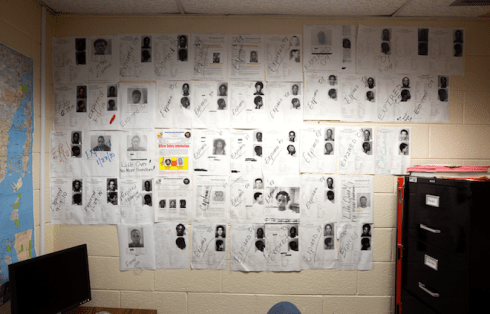
Referred to as the “Wall of Shame,” the mug shots here serve as a reminder to staff of the kids that have been killed on the street. Miami-Dade Regional Youth Detention Center, Miami, FL. © Richard Ross

These days, I contend that if photographers are to progress with their craft, they must be both excellent image-makers and energetic self-marketers.

I’ve known Richard Ross‘ work for a long time now so the former has never been in any doubt. Having seen the way his project Juvenile-In-Justice has been rolled out, it is clear he’s in full control of the latter too.

Ross has been featured on NPR and The TakeAway. The edit of his work in Harper’s Magazine is a finalist in the News and Documentary Photography category at the National Magazine Awards.

I wrote an article Uncompromising Photos Expose Juvenile Detention in America, published on Wired.com last week about Ross’ 5 years of photographing in juvenile detention facilities. (The article was well received and has led to a follow-up piece about the issue. Stay tuned). Ross was also a PPOTR interviewee.

Furthermore, the project will be presented as a traveling exhibition that will premiere at the Nevada Museum of Art, Reno, NV in August 2012. A photobook is also in the works with essays from Ira Glass and Bart Lubow.

After 40 years of photographing, one presumes that Ross has contacts and allies to help him “market” Juvenile-In-Justice and get it in front of the maximum number of eyeballs. The distribution of this work has been robust and effective – and it could hold some lessons for younger photographers.

I’m just thinking out loud here. My main purpose of this post was to share this five-minute feature on Ross’ juvenile detention work put together by PBS.

Image: Rupert Ganzer

California has more prisoners serving life than any other state.

Life Support Alliance (LSA) has identified a group of prisoners – the life-term prisoners – who have increasingly become subject to Kafkaesque procedure in California justice. LSA advocates on behalf of these life-term prisoners and educates the public on the invisible cycle of parole denial.

CONTEXT

There are four types of sentences handed down to California prisoners; the death sentence (execution), life without parole (never released), determinate sentences of a fixed period (3,5,10 years for example), and indeterminate sentences (5 to life, 12 to life, 20 to life). It is in this last category that life-term prisoners fall. If they are ever to win release they must serve the minimum term first and then convince a parole board that they are suitable for release. Suitability means not being a public threat.

In California there are 22,000 men and women on indeterminate term-life sentences. The average number of years served by a prisoner serving a life sentence with the possibility of parole is 20 years. For all these prisoners release is dependent on the Board of Parole Hearings.

GAIL BROWN ON THE CALIFORNIA PAROLE SYSTEM

The Board of Parole Hearings is not a neutral group however, and it is susceptible to political influence. New appointees to the board are made by the Governor. During our conversation, Gail Brown, Founder of Life Support Alliance talks about how the parole grant rate under Governor Gray Davis was 0%. During the tenures of Schwarzenegger and current Governor Jerry Brown, the figure rose as high as 20% and now sits at 18%. This increase is partly due to a more sensible approach to criminal justice, but also down to the economic crunch and to the fact that the governorship is likely to be Brown’s final job in public office; he doesn’t have to bow to powerful *tough-on-crime* lobby groups. Incidentally, California is one of only 3 states in which the governor has veto power over the board of parole hearings.

LISTEN TO OUR CONVERSATION ON THE PRISON PHOTOGRAPHY PODBEAN PAGE

We should listen to Gail Brown. Her proposals will save every CA taxpayer money, forge progressive and forgiving attitudes, and force a return to legal procedure that means thousands of prisoners won’t be held in limbo, or worse, denied release because politicians don’t want to have prisoners – perceived as public safety hazards – released on their watch. (For a lesson in the damage a discharged prisoner can do in the worst circumstances to a political career, read up on Willie Horton and Al Gore.)

It also makes good common sense to release term-life prisoners. They are aging or aged. Costs to house an adult prisoner nearly double from $50,000/year to $98,000 when a prisoner turns 55. When they pass the age of 65, the cost triples to $150,000. The majority of these costs are medical care (which in CA was ruled as cruel and unusual in any case.)

As well as reducing costs, Gail Brown points out that aged prisoners have grown out of transgressive behaviours and are statistically the safest population to release.

In December 2011, the Stanford Criminal Justice Center released the first rigorous empirical study of prisoners serving life sentences with the possibility of parole in California called, “Life After Limbo: An Examination of Parole Release for Prisoners Serving Life Sentences with the Possibility of Parole in California.”

The report found that California has laws enacted through the three branches of government often contradict one another.

In 2008, Marsy’s Law (also known as Proposition 9) gave victims additional rights to participate in parole hearings and the law greatly extended the time between hearings once a lifer is denied parole by the Board.

That same year, the California Supreme Court ruled in the Lawrence Decision that while the commitment offense is probative, in and of itself, it cannot serve as the sole reason to deny parole. The relevant standard for the Board to use in considering whether to release an inmate serving a life sentence with the possibility of parole is whether the prisoner is a current threat to public safety.

To further complicate matters, newly proposed legislation – SB 391 – would authorize the Parole Board to base its decision to deny parole solely upon the circumstances of the commitment offense. That would directly overrule the California Supreme Court opinion.

THE LAST WORD

More than statistics, costs and legal definitions, Brown wants us to heal as a society and look toward restorative justice and not rely on state agencies to enact vengeance within unseen penal institutions. As much as we are all potential victims of crime, we are all potential activists against the cycles of punitive violence that persist in broken prison systems.

Source: 225 Baton Rouge

Well, I thought I’d seen it all. But no.*

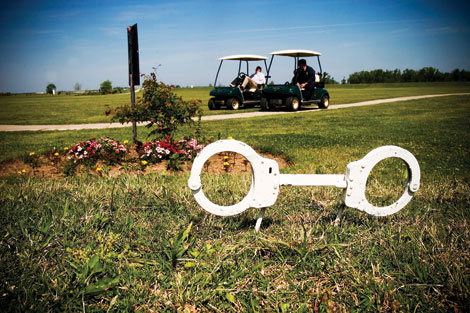
Prisonview Golf Course is a 9-hole, par 72, 6000 yard course, on the grounds of Louisiana State Penitentiary.

This isn’t golf for the prisoners, but amateurs who fancy a punt on one of America’s most ethically dubious courses. Could the disparity between the have and have-nots be played out in a more brazen manner in a more bizarre location? Many golf courses already invite criticism given their over-use of water and the cultivation of monocultures. In the case of Prisonview Golf Course, to those concerns, we might as well add cynical social attitudes.

Rules

– All guests must provide personal information (date of birth, drivers license number, social security number, etc.) for complete background check before play. (48 hours in advance)
– No tee times will be scheduled prior to completed background check.
– Convicted felons and individuals listed on any inmates visiting list will not be allowed access.
– All golfers must present valid, state issued identification upon arrival.
– Play may be suspended at any time, due to institutional need or at the Warden’s discretion.
– Tee times may be cancelled without notice.
– Absolutely NO firearms, drugs, alcohol or other contraband items (such as, but not limited to, cameras, knives, etc.) are allowed on the premises. 
– Persons entering Louisiana State Penitentiary must consent to a search of their vehicle, belongings and/or person at any time, while on institutional grounds.

I wonder if golfers are allowed to take photographs, unhindered?

– – – – – –

* When I visited Louisiana State Penitentiary in December, I did not see the golf course.

As you may know, I’ve recently relocated to Portland, Oregon. The Portlandia TV comedy narrative would have you believe this is a town full of loveable counter-culture stereotypes; under-employed dreamers, kombucha-swilling hippies, and coffee-obsessed yoga-rock-climbers, to name a few.

But …

PORTLAND IS NOT PORTLANDIA

It is fair to say that on the West Coast, the tech boom of the nineties – centred on Seattle, San Francisco and Silicon Valley – bypassed Portland. And the joke is that people pursued fire-eating, tattoos and weed instead of HTML and Java-code.

But Portland is not a harmless bubble populated only by self-aware, contented contrarians. Portland has the same problems with failing schools, violence and inequality as many large U.S. cities. Furthermore, the State of Oregon as a whole has seen dwindling public funds for education as measured against its burgeoning law enforcement and corrections budgets.

As a reality check, I’d like to recommend two articles.

Firstly, Our preoccupation with incarceration costs us in education, by Naivasha Dean in Street Roots:

Oregon is one of only a handful of states in the nation that spends more money on prisons than on higher education, a statistic that is often met with dropped jaws by students struggling for financial aid. The Department of Corrections has been one of the fastest growing state agency budgets that is eating up an ever-increasing percentage of the state’s General Fund. This does not bode well for Oregon’s future and represents a deeply misplaced set of priorities and an archaic approach to addressing crime and public safety.

Why is Oregon’s prison spending so out of control? Oregon can trace the trend directly back to 1994, when voters approved Ballot Measure 11. Measure 11 established mandatory minimum sentences for approximately 20 “person-to-person” crimes, and it automatically sends youth charged with any of those crimes, aged 15 and over, directly to adult court. Mandatory minimums are a one-size-fits-all approach to criminal sentencing that prevent judges from using their discretion and prevents Oregon from using smarter approaches to accountability and crime prevention.

Shortly after the passage of Measure 11, Oregon’s governor and legislature approved plans for more than 8,000 new prison beds, including siting for six new prisons. Since then, the legislature has authorized more than $1 billion for prison construction. As anticipated, Oregon’s prison population exploded — from 6,000 inmates in 1995 to more than 14,000 today, and the Department of Corrections budget more than tripled.

Secondly, Portland, the US capital of alternative cool, takes TV parody in good humor, by Paul Harris. This Guardian article, partly, dispels the temptation to get carried away with TV’s version of PDX life:

Portlandia is not the whole picture of life in Portland. Not everyone is white, urbane, child-free and in their 20s, or acting as if they are. In fact the city is 8% black and 9% Hispanic– communities that often live in poorer neighbourhoods that are gentrifying with newcomers who push out long-established families who can no longer afford rents.

Portland also has a problem with gang violence. […] One man who sees this side of Portland close-up is John Canda, founder of gang outreach group Connected. “I personally have been to 358 funerals,” he said of two decades working in the field. Connected, formed last year after a series of shootings, seeks to lessen violence by having volunteers walk the troubled streets, reaching out to Portland’s youth.

“Our message is talk with us. It starts with a greeting,” he said. For Canda, as a native black Portlander, the world of Portlandia and its concerns over recycling and organic food seem unreal. “It is like a parallel universe,” he said.

Graph courtesy of the Prison Policy Initiative.

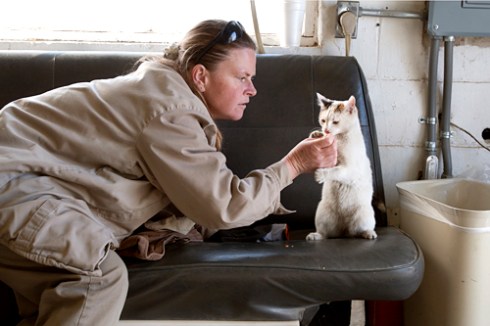
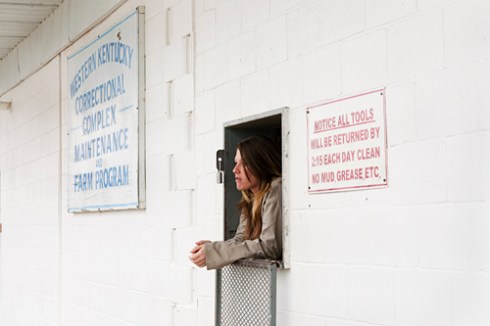
As soon as I saw Ashley Stinson‘s photographs, it was a priority for me to publish them. How many prison environments or programs can we confidently describe as wholesome?

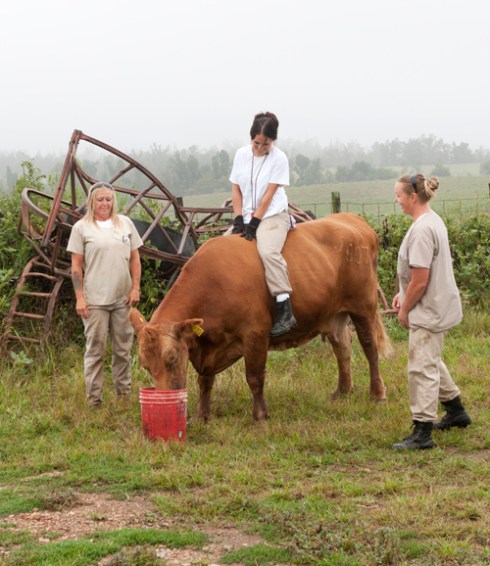
On the evidence, of Stinson’s images from Women’s Western Kentucky Correctional Facility in Fredonia, Kentucky, the female prisoners are given ample space and activity to forge their own purpose. Are these images sugar coating their experiences or faithfully depicting transformative hard-graft?

To close in on the truth, I asked Stinson a few questions. Scroll down for our Q&A.

What attracted you to the subject?

I wanted to start a project on female farmers around the Louisville, KY area because I continued to run into women who were pursuing it as profession and I thought it would be an interesting subject considering that it is historically a male dominated field.

A friend’s mother was a nurse at the prison while it was still an all male prison and she suggested that I look into the prison’s agriculture. So, what was initially a project about the surge in female farmers quickly turned into a project about this large-scale prison farming program.

Tell me about this seemingly unique program.

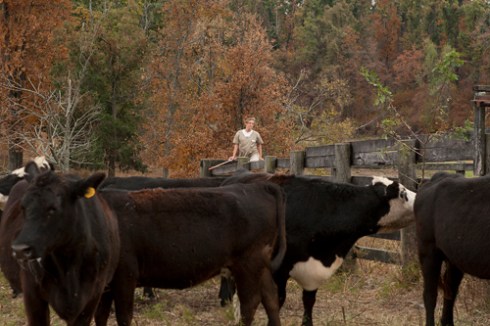
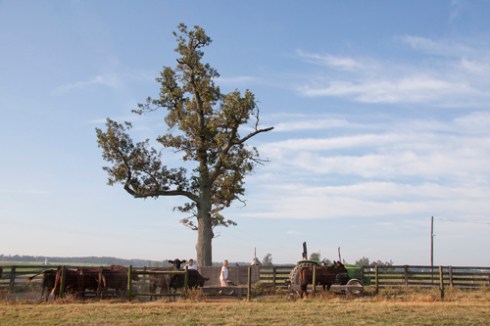
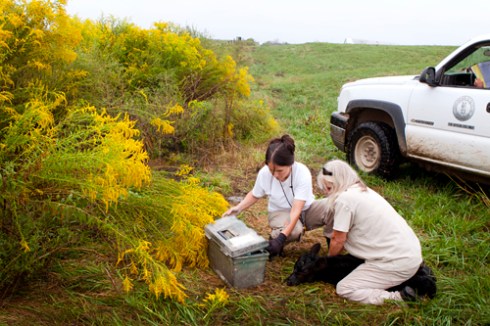
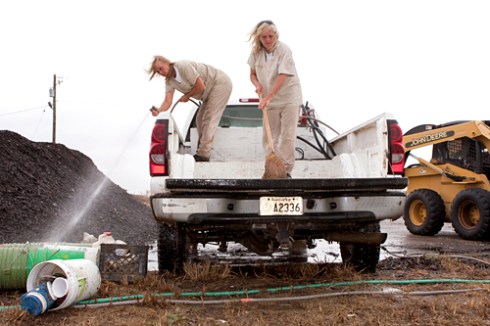
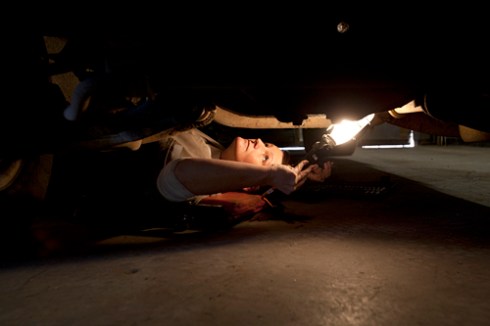
It currently has one of the largest farms in the nation run by female prisoners. It’s a fairly new program for the women; the prison was an all-male prison until a few years ago. The state is really proud of the work the women have done – they tend the crops, maintain the farm machinery, and take care of a large number of beef cattle. It’s a really positive program and I am reminded of that every time I travel to Fredonia to photograph.

What are these ladies locked up for?

Western Kentucky Correctional Facility is a minimum and medium security facility and to participate in the farming program the women have to be in the minimum security portion which naturally means that they have been convicted of lesser crimes. Mostly substance abuse or robbery with a few cases of manslaughter.

In your photographs, they seem like they’re enjoying themselves. Is this the case?

Absolutely! They certainly work hard but it is a fun atmosphere and I have never encountered a tense moment with these women. They are happy, healthy, and truly working on bettering themselves and I am trying to convey that through my photographs.

They have formed really solid friendships because farming can be incredibly dangerous and a lot of what they do requires looking out for one another and trusting co-workers. I believe that the biggest benefit of this program has been the relationships these women have formed. Not just with each other but also with animals that they have cared for, the crops that they tend and the employer/employee relationship they have with the farm management team.

I do not know the women’s backgrounds but I get the impression that these are whole new situations for them. They are  held completely accountable for their daily tasks, and they can literally see the positive results of the hard work they are doing. The program taps into their ability to nurture and care for others which is such a positive experience. Also, it’s hard not to have fun when you are bottle-feeding a newborn calf or driving a huge tractor.

Beyond daily purpose and building self-esteem (which I take as a given in programs such as these) are these ladies hopefully they are acquiring skills that will sustain them in the job market when they’re released?

They are certainly acquiring a number of skills that could be applied to other jobs once their time has been served – car maintenance, welding, gardening, composting, etc. The farm managers are extremely experienced farmers, not police officers or trained guards, and I believe that creates a work dynamic that is much closer to what the women will find outside of prison if they decide to pursue a career in agriculture. Some of these women may continue farming in the future but they will ALL leave with a positive work experience and a sense of accomplishment which will serve them well when the re-enter the job market.

Who owns the farm? Who owns the products of the farm? Who eats the crops?

The state owns the farm. I am assuming the state or the prison “owns” the products of the farm. Most of the corn is used to feed the beef cattle and other crops are either used for food at this prison or the male prison in Eddyville. Extra veggies and fruit have been donated to the local food-bank and local churches.

Do the crops go into the prison system or onto the open market?

They have discussed selling surplus produce to the community in the future.  A portion of the cattle stay on the farm to reproduce and the majority are sold at auction, with the money going back into the prison.

Is this project complete?

It is ongoing. I have clearance at the prison until August and then my next step will be to visit these women once they are paroled to take photos of them after incarceration so I may have some more photographs in the future.

View the work here.

Cruel and Unusual, an exhibition of prison photographs that I co-curated with Hester Keijser at the Noorderlicht Photo Gallery in Groningen, Netherlands closes on Sunday (8th).

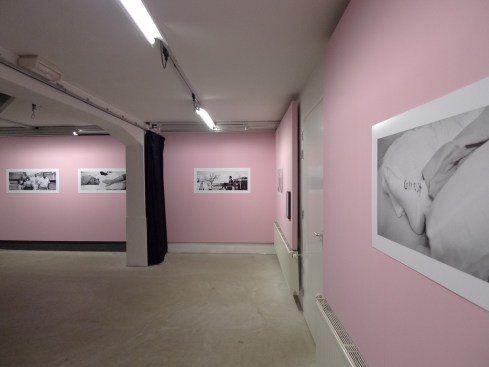
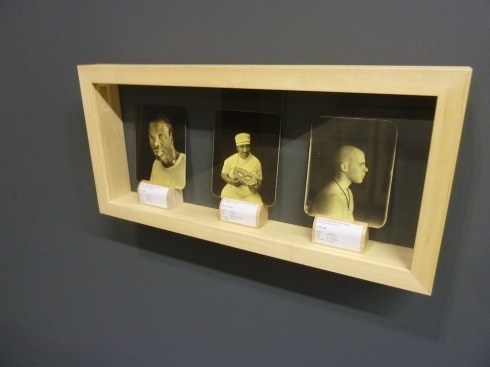
You probably know about it because I haven’t been shy to promote it; it is one of my proudest achievements. I’d like to take this opportunity to share with you some thoughts on the Noorderlicht team and publish some installation shots. Part debrief, part abridged journal entries.

The show balanced two interrelated parts. One could not exist with out the other.

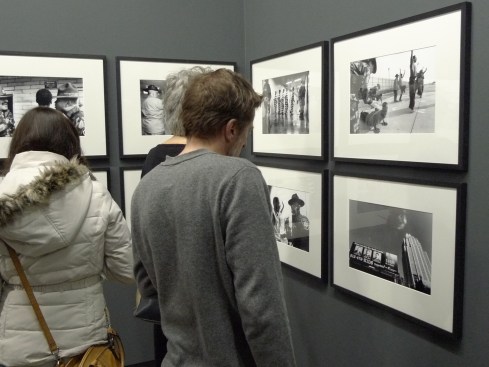
The main section of Cruel and Unusual looked exactly like a tradition photo show – ordered, framed prints of 11 named photographers. Cerebral and reliable. Mindful. The mind.

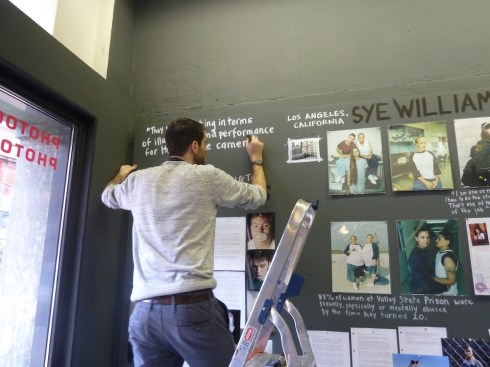
The counterpart was the PPOTR wall – a “mayhemic reflection” of some of the stories and images I encountered during Prison Photography on the Road. It included the photographs and quotes of another 18 photographers.

The PPOTR wall was messy, imperfect, unmediated, and attached to the core of my sprawling interest in prison imagery. It was the best solution Hester and I could think of to reflect our frantic immersion in international, blogging photo-territories. Physical, with tentacles, corporal. The body.

Body and the mind are inseparable. They communication with one another through a central nervous system. Noorderlicht, our host was backbone, nerve centre and sensitivity.
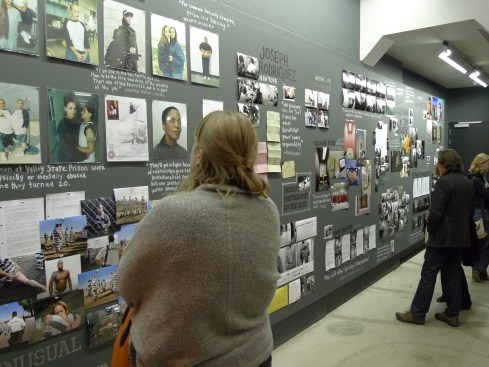
Outside of my home country (and my comfort zone) I clamped onto my host. Noorderlicht gallery connected mind and body; perfection with imperfection; polished ideas with raw, in-process threads; finished photographs with found stories.

The PPOTR wall was the first time I’ve tried to bring my sprawling project to some sort of overview suitable for visual consumption (lecture Powerpoint presentations excepted). As such, I was required to direct the PPOTR installation.

It is at the point of installation, one begins to appreciate the attitudes of the host and its staff.

As a practitioner with little experience in installation, the Noorderlicht installation team of Marco, Ype and Margriet were supportive without qualification, enthused, and willing to make gentle interventions when necessary. Their relaxed professionalism is one reflected through the organization from top to bottom. I worked with Charissa Caron on press liaison, with gallery director Olaf Veenstra on business decisions. Geert printed the work. There was always fresh coffee on hand. There were flowers in the gallery. At the opening they let dogs come in to see the artwork!

Noorderlicht is more than a workplace. It is a home.
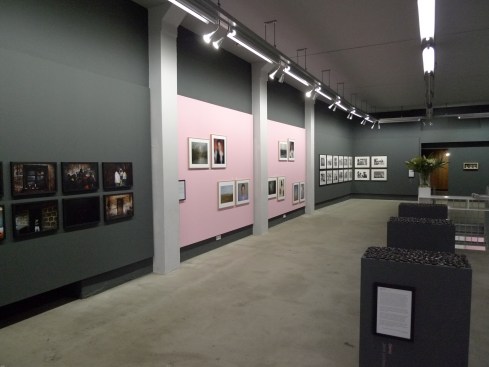
It was somewhat of a risk for Noorderlicht to commission two photobloggers to curate. Yes, we have the knowledge and the online networks, but blogging (writing emails, forging prose, editing online galleries) is very different to herding photographers and liaising with gallery staff for a physical show.

I should say that Hester is a much more accomplished gad about phototown with a long CV of collaborations and in the past year has taken on the role of curator at large for the Empty Quarter Gallery, Dubai. Her knowledge and discipline propelled the pre-show nuts-and-bolts organizing. Without her, I’d have been knocked on my arse early in the venture.

There is a reason Noorderlicht took a risk on us though. It is because they do it often. Noorderlicht is probably best known for its international photography festival. The size and reputation of their festival is astounding given the foundation’s modest size. Take a look through the festival archives and see how many big name photographers showed their work at Noorderlicht before they became big names. They are pioneers.

Groningen is in the north of the Netherlands, 3 hours drive from Amsterdam and the rest of the cultural heart of Holland in the west and south (den Haag, Utrecht, Lieden and Rotterdam). Because of this Noorderlicht often gets overlooked or pigeonholed. I think in some cases, folk might be slow to acknowledge Noorderlicht’s accomplishments. We know how London and NYC dominate the cultural psyches of the UK and the U.S., and I think a similar imbalance persists in the Netherlands. If I am in anyway correct – and I wish I were not – then this is everybody’s loss.

The risk paid off.

Cruel and Unusual was extended by a week due to public demand. Visitor numbers have been substantial and the Dutch press went doolally over it. National radio, newspapers, magazine features – the whole shebang.

This does not surprise me. For many reasons, the subject matter is compelling. But I think the show has been a success because there is a dearth of discussion about prisons in Europe. As grand an ambition it may sound, Hester and I hoped the show would be a warning shot across the bows of Europe: DON’T REPEAT AMERICA’S MISTAKES. DON’T MASS INCARCERATE! It would seem people were hungry for Cruel and Unusual because the topic was a challenging breath of fresh air. Much of the work was also being shown in Europe for the first time. As thrilling as photography can be, I think the show was a thrill.

At the opening, were visitors from Amsterdam photo circles. It was huge validation to welcome knowledgeable folk venturing such a distance from their reliable cultural locale. Another indicator of legitimacy.

I am grateful the show was a success. Prior, I didn’t think about it; I didn’t know how to define success with a show. And I don’t know what I’d have done if it had been a flop!

I’m happy for all the beautiful staff at Noorderlicht that it has worked out. Hester and I were treated like family. That’s not an exaggeration – I’ll leave you with the words of Ton Broekhuis, Noorderlicht Foundation Director as written to me in an email following my return to the U.S.

“Pete, you mentioned ‘being welcomed into the Noorderlicht family’. You did not mention leaving the Noorderlicht family, which is reasonable. Everyone who joins the family by free will makes – at the same time – a promise to come back. Family is family. It is forever.”

PRESS FOR CRUEL AND UNUSUAL

American Photo: “There’s a wide range of photography blogs on the internet, but how would it be possible to measure their impact on the real world? It’s difficult to see the offline effect of an idea published online. […] We’re interested to see what other ways photography bloggers choose to usher their projects into the real world, and Brook certainly sounds excited. “This is going to sound crazy,” he said, “but I’ve never seen these works any bigger than 600 pixels wide on a screen.” Spoken like a true 21st-century curator.”

Elizabeth Avedon: Noorderlicht Gallery is producing a ‘must-have’ catalog for Cruel and Unusual, designed as a newspaper by Pierre Derks in an edition of 4,000. Along with visuals from the main exhibition, the catalog contains articles, interviews, ephemera and material from photographers Pete Brook encountered during his crowd-funded road-trip through the U.S.” (One and Two and Three)

Daylight Magazine: “What steps are being taken to productively rehabilitate inmates, rather than simply secluding them from society and releasing them once their term is up? The Nooderlicht Photogallery has curated a show from nine women photographers to explore the effect that mass imprisonment has had on our sense of justice and virtue.”

Marc Feustel: “Brook and Keijser write two of the most dynamic and esoteric blogs that you will find on the web. To state the obvious, prisons are not exactly a sexy subject and the fact that they have managed to put this show together is very impressive. Instead of a ‘traditional’ exhibition catalogue, the curators have put together a newspaper in an attempt to reach more readers than an expensive photobook could. The world of photography online can be an exasperating, sprawling mess, but the fact that it can lead to projects such as this one makes it genuinely worthwhile.”

Stan Banos: “If you’re interested in documentary photography and interviews with the top notch photographers who made the work, Cruel and Unusual [newspaper] is very much worth the look.”

Greg Ruffing: “How citizens (aka taxpayers) understand the prison system and life behind bars, and how do they formulate their thoughts and convictions about mass incarceration based on the information they receive (and where that info is filtered through)? Cruel and Unusual gets to the heart of that issue by examining how prisons and prisoners are presented in images, and how those images are created, distributed, and consumed.”

Colin Pantall: “It is testament to how the internet and blogs are having a real impact that is breaking new ground and making new visual discoveries and connections.”

No Caption Needed: “Cruel and Unusual will provide another occasion to consider how the carceral system condemns those within and without, and how photography can reveal and build relationships where before there was only confinement, within and without.”

re-PHOTO: “Regular readers will know that I’ve often mentioned Pete Brook’s Prison Photography blog on these pages. He’s someone who has often raised interesting issues, both photographic and political, and the forthcoming show Cruel and Unusual at Noorderlicht which he is curating together with Hester Keijser looks to continue in that vein.” (One and Two)

Lens Culture
Eastern Art Report
La Lettre De La Photographie
Wayne Bremser
GUP Magazine

Dutch Press
FotoExpositie
FocusMedia
PhotoQ
Hamburg Art & Culture blog
Dutch free daily, De Pers ran a double spread of Scott Houston’s Arizona Female Chain Gang work. Dutch and Google translated English.
Noorderlicht has links to the De Pers article as a PDF and also a PDF of the Vrij Nederland feature on Alyse Emdur’s work (Dutch only)

Hester did three interviews for Dutch Radio
Radio Netherlands Worldwide
NOS, Netherlands Public Radio (Dutch only)
VPRO, Netherlands Public Broadcaster (Dutch only)

*Auto-Press*

Hester with the announcement and the backstory, and Hester reflecting on the churn that was newsprint catalogue design and production.

Prison Photography: Announcement, thoughts on the newsprint catalogue,  newspaper distribution.

And finally, a Feature Shoot interview I did with  about how the road-trip and exhibition have shaped the Prison Photography “Project”.

April 4th is the United Nations’ International Day for Mine Awareness.

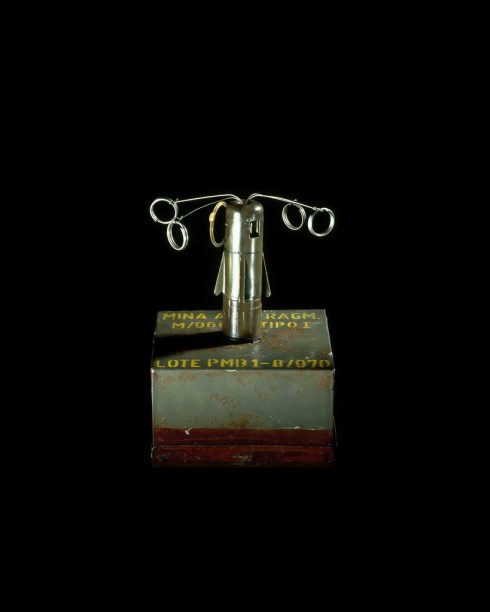
Raphaël Dallaporta‘s Antipersonnel is a typology of these little fuckers that take doors off armoured vehicles and dice humans into small bloody portions.

Photographed against a black backdrop with the high production value of advertising photography, Dallaporta in some ways disarms us (‘xcuse the pun). Dallaporta’s work has some of them looking more like Tamagotchi’s than instruments of war. If we’re not careful, we might forget that for most of their existence these objects are either being put together in a factory, stored in cache or waiting to blow. They’re a one purpose gadget with only negative outcomes.

Human’s piece the deathly components together and then bury them under shallow soil in full knowledge they’ll exist quietly, perpetually, until someone or something presses down a medium amount of load. Yes, it’s all or nothing for these little fuckers.

But, I am anthropomorphising. These objects are not to blame. We are to blame. You can fire 1000 rounds from a gun and you cannot know how many will achieve their destructive purpose. But 1000 landmines are going to rip apart 1000 lives. They’re a guaranteed return. They are the absolute in nihilism and hate. That’s why it is important to distinguish antipersonnel mines from other weapons and that is why it is good the UN leads an effort to see them banned.

The UN:

Since the Convention on the Prohibition of the Use, Stockpiling, Production and Transfer of Anti-Personnel Mines and on Their Destruction, commonly known as the Anti-Personnel Mine Ban Convention opened for signature in 1997, 156 countries have ratified or acceded to it. More than 41 million stockpiled anti-personnel mines have been destroyed, and their production, sale and transfer have in essence stopped.

All images: Raphaël Dallaporta

Video still from a surveillance camera in Richmond Heights Jail, St. Louis, Missouri. Anna Brown has just been carried into the cell and laid on the floor. She is dying.

Over on BagNewsNotes, Karen Hull has written a brief but poignant piece about the death of Anna Brown, a young, Black homeless woman. In particular, Hull considers the role surveillance cameras have played in the investigation into Brown’s death.

In September, 2011, Brown died in a jail cell in St. Louis, Missouri. She had visited three hospitals earlier in the evening complaining of pain in her legs but she was turned away by each of them. When she protested and insisted she needed treatment she was arrested and booked into jail. 15 minutes after they closed the door she was found dead. Brown had not used drugs, yet an officer later casually remarked and assumed she had.

Hull:

Race, health care, and surveillance culture come simultaneously into play here. That the healthcare system can be reckoned as something other than a force for good is balanced by the good of a typical “evil”: surveillance. Without surveillance film, it’s possible the death of this young woman would have gone unnoticed. […] as much controversy as there is surrounding CCTV, rest assured that in the future, we will increasingly witness via surveillance.

The footage was attained by the St. Louis Dispatch via a sunshine request.

Full surveillance video of Anna Brown’s demise here. MSNBC provides the backstory.

NOT UNIQUE

Unfortunately, the mistake of authorities to think of a distressed woman as manic instead of in need of urgent medical attention is not unprecedented. In 2009, Cayne Miceli suffering an asthma attack was dragged away from a New Orlean’s hospital and put into a five point restraint in the Orleans Parish Prison. She was disruptive, fearful and loud, but the medical staff at the jail should have known the immediate threat to her life. She died of hypoxic brain injury, cardiac arrest and asthma, brought on by the horizontal position of her restraint.

EMAIL

prisonphotography [at] gmail [dot] com

Prison Photography Archives

Post Categories