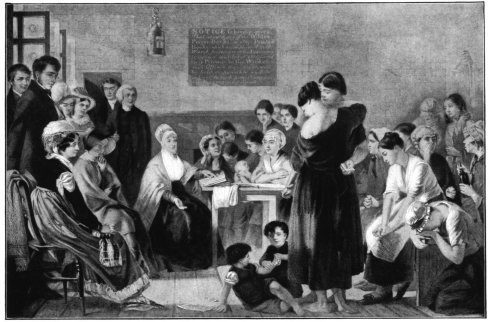
Elizabeth Fry was born this day 1780. If you live in the UK, she’s a familiar face. If not, you should make her soon a familiar face; she’s an example to all socially-engaged folk.

Fry is on the five pound note. She’s the Abe Lincoln of Britain (?!)

Fry knew about compassion before it was even in vogue. If she was kicking it today, she’d kick Jolie into touch. A one-woman hurricane of compassion; the “angel of prisons”; proper girl power; the matriarch, take a bow, Elizabeth Fry.

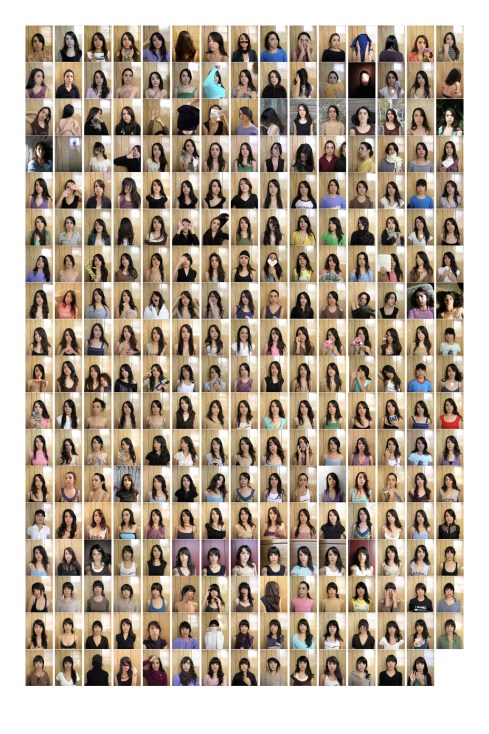
© Amy Elkins 269 self-portraits, part of Beyond This Place: 269 Intervals

Last week, I reviewed Photographs Not Taken (ed. Will Steacy, published by Daylight) for Wired.com. It is a book I have enjoyed thoroughly, which may seem a bit perverse as the majority of the tales seem to be about literal death and sullen loss. The other essays are all essentially about metaphorical death – death of an idea; the abandonment of an ideal; fractured and sudden awareness of mortality; or a shattering of photographer-bravado.

Bryan Formhals, many months ago, hollered for more writing by photographers. PNT would be the most recent, stand-out collection of essays to support that call.

PNT features two essays about prison.

Stefan Ruiz talks about his frustration with the limitations on camera during a seven-year stint teaching art at San Quentin State Prison.

“Most of the time […] I was a photographer in a visually amazing place with all these great subjects, and I couldn’t take a picture,” writes Ruiz.

Amy Elkins recounts a visit she and her brother made to see her dad in federal prison in 2005. She ends up describing a thousand or more photographs she didn’t take.

Call it compulsion, call it therapy, her response during the final 9 months of her dad’s imprisonment was to turn the camera on herself. Amy began making self-portraits began in 2006. Her self-portrait series, Beyond This Place: 269 Intervals became a mini internet sensation in 2007, by which time her dad was out but Amy was not out of the habit. Her self-portraits continue in Half Way There and Everybody Knows This is Nowhere.

“All three projects overlap with my father’s story,” says Amy “Half Way There continues as he lived in a re-entry house for 365 days under strict supervision. Everybody Knows This is Nowhere becomes more about re-entering the world and starting over. All in all I’ve shot over 6 years of these portraits.” Amy still photographs herself daily.

You can view the legacy blog posts here and Amy speaks about the relationship between her self-portraiture and family-life briefly toward the end of this conversation with Joerg.

AMY ELKINS’ PHOTOGRAPHS NOT TAKEN

We had been talking here and there. Once a week. Fourteen and a half minutes before hurried goodbyes were exchanged with uncertainty. It was our allotted time to share what we were experiencing. My new chapter in New York. His, in a federal prison, three thousand miles away. My father’s stories were endless. His seventy bunk-mates. Spanish ricocheting off of the concrete walls until it became static, white noise, a flock of birds. The mess hall. The books that had their covers torn off. The Hawaiian friend he made who sang like an angel. The night he woke to flashlights banging along the metal bunks, looking for inmates with blood on their clothes.

The teams that were formed. The chess matches and basketball games. Prison Break on the television in the rec room. The pauses in his voice. We had shared just under fifteen minutes a week for months from across the country. I mostly listened, the imagery leaping to mind, as his words came through the line. These were the things I wanted to make photographs of. By the time I actually had my one and only visit with him while he was in prison, my imagination had grown wild and I was so emotionally charged that I had to place my hands together in order to keep them from shaking, and to hide the amount of cold sweat pooling in them. There were metal detectors, x-ray machines, electronic drug tests, and questionnaires before my brother and I were led into locked waiting rooms, before we were led into a barbed wire walkway, before we were led to the visitors’ area. No cameras, cell phones, keys, wallets, jewelry, hats, purses, food, or gifts were allowed. Just myself, my brother, my father, and a small square yard of short brown grass containing picnic tables, a walkway, and vending machines, wrapped in barbed wire fences, two rows deep. My father, looking aged by stress, wore a tan uniform that seemed to fall all around him like robes. His hair had grown somewhat wild and was whiter than I remembered it. His eyes were youthful and tired.

The photograph was in my head. The moment of panic, of not knowing what to talk about or how to catch up in reality, while families reeled all around us with children and their mothers or grandparents. The vending machine coffees and board games. I longed for this moment to stay preserved, as if it would become more real if I could hold it captive on film.

Or that my story would be more intriguing if I could prove what it looked like. The photograph not taken, a portrait of what we had become, the fear that my family had failed me, the confrontation of unconditional love, a portrait of uncertainty. Instead, I sat with my hands tucked against the worn-out wood of the picnic tables, watching and listening to the sounds of what we were able to be for a moment.

THE SELF

The story runs deep. But how about the images? There’s a touch of naivety in Amy’s self portraits, but no more than any other young artists sussing his or her emotions. The portraits are paired with quotes by her father delivered in those weekly 15 minute calls, a text/image play that adds some depth.

Whatever life these photos have had or will have, I’d like to think they’re ultimately for future generations of her family; mementos of the quirky granny who grew up in the first quarter of the 21st century; the favourite aunt with certainty of narrative but evidence of younger faltering.

After all, we might be miffed if we missed that shot of those things over there, time and time again, but we have no excuse for not recording ourselves. We might hit old age and regret not having the photos to match our memories.

Short-sighted folk may criticise 269 Intervals for its seeming indulgence or vague manipulation; it is strange that images to represent a family temporarily smashed apart by the efficiency of the law are of a pretty las (occasionally in a state of undress) but take a long sighted view and admit you are intrigued by photo-a-day projects. Who hasn’t thought about doing one themselves? … If only you I had the discipline. Between Kessels, Karl Baden, Hugh Crawford, Noah Kalina and Homer Simpson, Amy is in good company.

Amy Elkins was born in Venice Beach, CA, and received her BFA in Photography from the School of Visual Arts in New York City. Her work has been exhibited nationally and internationally, including Kunsthalle Wien in Vienna, Austria; the Carnegie Art Museum in California; and the Minneapolis Institute of Arts in Minnesota. Elkins is represented by Yancey Richardson Gallery in New York, where she recently had her second solo exhibition.

The Global Post has just launched ENCARCELACION an investigative series about the correctional systems of Latin America that “have gone horribly wrong.”

We’ve seen the headlines of jailbreaks in Mexico, riots in Venezuelan prisons, and fires in Honduran jails, but often these stories seems a world away. The politics underpinning the strife in Latin American prisons is not my area of expertise but the importance of the stories is undeniable. It is interesting that the Global Post has used photography as an anchor to the front page.

After digging down into ENCARCELACION‘s trove of info, you may want to follow links to Prison Photography‘s irregular coverage of various aspects of life in Latin American prisons:

Gary KnightJoao PinaJackie Dewe MatthewsValerio BispuriPedro LoboVance Jacobs and Columbian prisonerstourist photography in Bolivian prisonsprison tattoos (some from Central America)Kate Orlinksky’s portraits of Mexican female prisoners Fabio Cuttica at a Columbian prison beauty pageantPatricia Aridjis in Mexico – even Cornell Capa was in Latin American prisons at one time.

– – – – –

Thanks to Theo Stroomer for the heads up.

This afternoon, I’ll be speaking to photography students at Evergreen State College, Olympia, WA. Instructor, Steve Davis has asked me to discuss PPOTR, regale some stories, recount my interviews.

Without doubt, Lloyd Degrane‘s story was one of the most remarkable. I have yet to edit the audio of Lloyd’s interview, but I did transcribe part of our conversation so it could be included in the Cruel & Unusual/PPOTR Newspaper. I’d like to share the text (below).

When Lloyd and I met in Chicago, he was preparing for Prison, the first ever exhibition of his prison photographs. It was at Gage Gallery (which coincidentally just showed Lori Waselchuk – another PPOTR interviewee). Gage put together an audio slideshow, which I also wanted to share (bottom).

THE BACKSTORY

Lloyd is a gentle, unassuming, older gent. He worked diligently for an entire decade (1990-2000) within three Illinois prisons – the Joliet Receiving Center, the Stateville Maximum Security Prison and Cook County Jail (the largest walled facility in the world with approximately 11,000 inmates). Degrane did this without any fuss or anything approximating self-promotion.

Before the authorities allowed him in with his camera, the Department of Corrections sent Degrane on a 600-mile round-trip to Menard Prison, a maximum-security prison in Southern Illinois. At Menard, Degrane was to just have a tour of the facilities. The warden instructed him not to take in his camera, and said that they he discuss with Degrane the proposed photography project after Degrane has taken the tour.

Due to an extraordinary experience during his prison visit, Degrane never met the warden. The extraordinary experience did, however, give Degrane a bargaining chip with which to win access to the Illinois prison system.

LLOYD’S FIRST DAY IN PRISON

I was led around Menard Prison by a guard that was just about to retire. You don’t get comfortable for some time. On the yard, you’re walking around brushing shoulders with murderers and rapists. I’d never been around people who had committed heinous crimes.

We walked into a big cell house holding several hundred inmates. As we got to the centre of the cell house a race riot broke out around us. I later found out is was African American inmates who wanted to retaliate against a white biker gang for killing one of their own several weeks before, and we were right in the middle of that retaliation. I remember yelling and threats being directed at the guard I was with. I was wearing a white shirt at the time and prisoners stopped and looked at me as if to ask, “What is this guy doing here?” I ran with the guard through a gauntlet of muscular black inmates. We made it to a cell and inside the cell was one of the oldest inmates I’d ever seen – over seventy years of age. And the guard just pushed me inside the cell. And the race riot went into high gear then. The first thing I saw was a white biker gang member being beaten by four or five black prisoners and the beating got closer and closer to the cell I was in. One of the black prisoners picked up the white biker and threw him against the bars. His head split open and he fell right at my feet. That was my initiation into maximum-security prison. I thought he was dead.

I heard over the loudspeaker system “CIVILIAN INSIDE” and I looked at the guard who was in the cell with me and he pointed at me and he said, “That’s you”. About five minutes later I heard the state police come into the cellblock with kind of this chant from the wizard of Oz. It was a chant to get everyone psyched up and strike fear into the heart of the rioting prisoners. They marched in with clubs and they were there to rescue me. They made a pathway through this insanity and extracted me from the cellblock along with the officer. They got me out of the cellblock back to the warden’s office where I picked up my camera and they just kind of pushed me out the back door.

I went to the nearest tavern and had a couple of shots of whisky. The adrenaline was just incredible, to the point where I couldn’t sit down. I’d nearly lost my life and I’d never had an experience like that before.

Later that day, I contacted the communications officer for the Illinois Department of Corrections. He knew what had happened. He said, “If you don’t talk to the media about what happened today then we’ll send you into Stateville Prison,” And so I didn’t say anything. Two weeks later I got notice from the warden at Stateville that it was okay to come in and start the project.

International Commission Tent, St. Paul’s Camp. © Ben Roberts

Ben RobertsOccupied Spaces catalogues some of the communal and private spaces that were installed in the St. Paul’s and Finsbury Square camps. The traces of activity and inhabitance serve as a clear document of the utilisation of a limited space by a large number of permanent and temporary residents.

My colleague at Wired.com Jakob Schiller wrote about Occupied Spaces in November with his piece Pianos, Kitchens and Offices: Inside London’s Occupy Tents. It’s good to see this work progress into a book format.

Roberts says:

“On 15 October 2011, protestors representing the global Occupy movement set up a semi-permanent camp outside St. Paul’s Cathedral in central London. The aim of the protest was to encourage discourse and raise awareness of social and economic inequalities.”

“On 25 October, several UK newspapers and media outlets ran stories claiming that ‘thermal imaging’ proved that only 10% of the 250 tents in St. Paul’s Square were being inhabited overnight. I was immediately skeptical of these claims.”

Ben Roberts Occupied Spaces
210 x 288mm, 28pp 24 colour photographs Text by Naomi Colvin Digital indigo + riso print on uncoated recycled paper Elastic cord loose leaf document binding Bagged in clear self-seal polypropylene.
First edition.
You can buy the book HERE!
For further information contact: Harry Hardie harry@hereontheweb.co.uk +44 (0) 7813 431345

Last week, for her photos of representations of death row prisoners’ last meals, Helen Grace Ventura Thompson won a Sony Photography Award in the Still Life category.

Last year, I listed a swathe of projects that photographed similar representations.

© Helen Grace Ventura Thompson

Despite these numerous projects, execution is still an invisible act. Perhaps rightly so – it is very gory. But it is gory paid for by tax dollars. The many projects focusing on last meals are reflex actions to this invisibility.

Sometimes the most interesting discussions can arise from the most left-field of questions. In that spirit: We can learn the last words of the executed, but what if we saw a last photo?

A Guardian gallery explains Thompson’s work, “The idea behind the project was to juxtapose the morbid context surrounding the meal with the relative mundanity of the food itself.”

The dissonance between morbid and mundane may jolt people. I hope that a jolt may kickstart conversations, because without a debate to follow then Thompson’s images and those like them are little more than studio experiments.

Food unites us all so we should be compelled by these images, one would think. What would you choose to eat before being fried or poisoned? Yet, for me, food photography is so ubiquitous it’s boring – I’m as uninterested by commercial gigs with painted food-props as I am by Instagram shots of my friend’s friend’s appetizer.

I also feel a little uncomfortable with the reverence laid over the photos of last meals, especially in light of the ultimate act of violence unleashed shortly after that last bite. Prisoners I have spoken to always talk about the inescapable noise of prisons. Photography is a quiet medium and these photographs are quieter than most.

I accept that Thompson’s job wasn’t to meet my unorthodox wandering thoughts, but I feel short-changed by her images. I wonder who makes the meals that Thompson references? And where do they get eaten? We’ve seen photographs of electrocution and gas chambers; bullet-ridden firing squad chairs; video tours of death houses; portraits of condemned men; and a photograph of a stainless steel table at which a last meal is eaten, but never see a photo of someone actually chowing down their last meal. Does anyone sit down with them?

Thompson’s style mimics fine art painted still lives and as such the reality, the noise, and the act of eating (or in some cases, a prisoner’s choice not to eat) are lost. Time is lost. Scott Langley has done the best job of reinserting time into a body of images documenting the most final of events.

Would a photographer following the acts (and meal) of a condemned man or woman be as distasteful as people witnessing his or her death from behind mirrored glass? If so, what’s the alternatives? Could we imagine allowing a condemned man or woman – with a disposable camera – to document his or her own murder, should they choose to? We see images of, and by, dead people all the time. The environment for executions is so controlled and sanitised they’d be quite boring pictures … until the subject turned the camera on him or herself. That’d be dripping with emotion; that shot would have a time stamp. That type of shot falls the other end of the scale to Thompson’s distantly crafted images.

Think about it. The media formula for executions is to report the last meal, the last words, the last breath and the last body spasms. Wouldn’t you be far more interested in seeing the last image? An image made by a person who knew they were about to die? Isn’t that the shot that no one else could ever get?

Thompson has a Twitter and blog.

Yesterday, we were talking about Google Street View. So, the segue to today’s topic is pretty seamless.

There’s been plenty of reporting on the prison robots designed and now being trialled in South Korea. This simple breakdown of info on these over-sized dehumidifiers is as good of a place to start than anywhere.

Lets be honest, these storm-trooping bread-makers are weird but they’re a pretty clumsy use of technology. Yesterday, I deleted my Linked In account, at the weekend I was talking about nuclear war initiated by software viruses (a la Stuxnet). I mean to say that, if we’re thinking about technologies, digital footprints and code-based (non-physical) manifestations of monitoring and interaction are far more pervasive, instant, destabilising and effective ways to intervene in – and disrupt – the world. These stupid, pearly-white ionisers on wheels deserve nothing but mockery.

No matter how good their 3-D cameras and behaviour analysis softwares are, the damn thing still turns its back like a human prison guard. Why doesn’t it employ 360 degrees imaging?

The thing looks ridiculous. It will never work. Prisoners will take the first opportunity to kick the shit out of it … and so they should. In such a scenario, would disciplinary sanctions against a prisoner for vandalising a robot be dealt with in the same way the authority might punish a prisoner for an assault on a prison guard?

The isolation of solitary confinement destroys people; the threat and the psychological isolation of prisoners damages people; unhealthy and inhumane relations with gang-affiliated prisoners and/or stressed, possibly abusive or indifferent, officers damages people. If we expect prisoners to rehabilitate themselves we need to prepare them for reentry into majority society, not subject them to sci-fi distopia surveillance for the sake of saving a buck.

This is market economics gone mad. A product with a cost and with a projected cost-saving. At nearly a million bones a pop I hope they’re dismantled very rapidly by any prisoner class that encounters them. It wouldn’t be vandalism it’d be a service to humanity.

Last year, in the article Photographing the Prostitutes of Italy’s Backroads: Google Street View vs. Boots on the Ground, I compared the work of artists Mishka Henner and Paolo Patrizi both of whom were making images of prostitution on the back roads of Spain and Italy.

I argued that the photographs by Patrizi, due to their physical and emotional proximity had more relevance. Patrizi actually went to the roadside locations whereas Henner, making use of Google Street View, had not.

Around the same time, Joerg Colberg posted some thoughts about Henner’s No Man’s Land.

Shortly thereafter, Mishka Henner emailed me and mounted an impassioned defense of his work. Henner felt he had been “thrown to the cyber-lions.” Not wanting to see anyone with his or her nose bent, I offered Henner a platform on Prison Photography for right of reply.

CONVERSATION

PB: What was your issue with the commentary on No Man’s Land?

MH: There’s a section of the photo community judging No Man’s Land according to a pretty narrow set of criteria. So narrow they’re avoiding one of the elephants in the room, which is what role is left for the street photographer in the age of Google Street View? Comparing No Man’s Land to other projects on sex workers could be interesting but the way it’s done here is resulting in a pretty narrow discussion about whether it’s valid, ethical or just sensationalistic. I don’t see how that helps move documentary forwards. All the projects you mention, including mine, assert themselves as documents of a social reality. But in your discussion, this is secondary to how they make you feel and Colberg even argues Patrizi’s approach makes you care. My motivation isn’t to make you feel or to care – it’s to make you think.

MH: No Man’s Land uses existing cameras, online interest groups, and one of the subjects interwoven in the history of photography. And I think the ability to combine these elements says something about the cultural and technological age we live in. In some photographic circles, that’s the way it’s being discussed and I’m surprised Colberg and yourself have dismissed it in favour of more reactionary arguments that seem to hark back to what I see as a conservative and nostalgic view of the medium.

PB: Well, if preference for boots on the ground and a suspicion of a GSV project is reactionary, then okay. Why did you use GSV for No Man’s Land? Are you opposed to documentary work?

MH: This is documentary work, how can it not be? And what’s this suspicion of GSV? Would you have been suspicious of Eugene Atget walking the streets with his camera? I’m sure many were at the time but that suspicion seems ridiculous now. And your response is reactionary because it validates and dismisses work according to quite spurious and nebulous criteria. What does it matter if I released the shutter or not? A social reality has been captured by a remote device taking billions of pictures no one else ever looked at or collected in this way before. You’re only seeing this record because I’ve put it together. The project is about the scale of a social issue, not about trying to convince a viewer that they should have pity for individual subjects. Yet in these circles, the latter uncritically dwarfs the former as though it’s the only valid approach.

MH: Paolo Patrizi’s A Disquieting Intimacy is evidently an accomplished visual body of work, as is Txema SalvansThe Waiting Game but to argue they offer a deeper insight into the plight of sex workers is, I think, generous to say the least.

MH: The assumption underlying much of the critiques of No Man’s Land (in particular Alan Chin’s) is that there’s no research and it’s a lazy, sensationalistic account of something fabricated. But what if I told you it was researched and took months to produce; what basis would there be then for dismissing it? Doesn’t research inform 90% of every documentary photographer’s work (it did mine, maybe I wasn’t doing it right)?

What’s left unsaid in these critiques is that No Man’s Land doesn’t fit a rather narrow and conservative view of what one community believes photography should be. The fact we’re drowning in images and that new visions of photography are coming to light are a scary prospect to that community, hence the reactionary and defensive responses. But there’s more to these responses than simply validating boots on the ground. You’re prioritising a particular way of seeing and rejecting another that happens to be absolutely contemporary.

PB: I think we can agree Patrizi is accomplished. I was deliberately lyrical in my description of his work and I meant it when I was personally moved by Patrizi’s work. That is a personal response.

MH: That’s fine, but what does Patrizi tell us that is missing from No Man’s Land? Is the isolation and loneliness of a feral roadside existence and the domestication of liminal spaces really that much more evident in one body of work than the other? Surprisingly – given your sympathy for Patrizi’s’ approach – even the women’s anonymity is matched in each project. No captions, no locations, no names, and no personal stories. Just a well-researched introductory text that refers in general terms to the women’s experiences. I think you’re viewing the work through rose-tinted spectacles.

PB: I can’t argue with your point about anonymity. There may be an element of gravitating toward [Patrizi’s] familiar methods. This might be because reading the images resultant of those methods is safe for the audience; they find it more easily accessible, possibly even instructive in how they should react?

MH: Working in documentary for many years, I can’t deny I aimed for these lofty aspirations. But I now consider the burden of sympathy expected from a narrow language of documentary to be a distracting filter in the expression of much more complex realities. Pity has a long and well-established aesthetic and I just don’t buy it anymore. In themselves the facts are terrible and I don’t need a sublime image to be convinced of that. In the context of representing street prostitution, striving for the sublime seems a far more perverse goal to me than using Street View and much more difficult to defend.

MH: Alan Chin’s comments surprised me because I wouldn’t expect such a knee-jerk reaction from an apparently concerned photographer. But his work is a type of documentary that I’m reacting against; a kind of parachute voyeurism soaked in a language of pity that reduces complex international and domestic scenarios into pornographic scenes of destruction and drama. It’s the very oxygen the dumb hegemonic narrative of terror thrives on and I reject it. Why you would pick his critique of my work is beyond me – we’re ships passing in the night.

PB: I quoted Chin because he and I were already been in discussion with others about the many photo-GSV projects. He represented a particularly strong opposition to all the GSV projects including No Man’s Land.

MH:No Man’s Land is disturbing, I agree. And it troubles and inspires me in equal measure that I can even make a body of work like it today. But it isn’t just about these women, it’s also about the visual technologies at our disposal and how by combining them with certain data sets (in this case, geographic locations logged and shared by men all around the world), an alternative form of documentary can emerge that makes use of all this new material to represent a current situation. It appeals to me because it doesn’t evoke what I think of as the tired devices of pity and the sublime to get its point across.

PB: It’s not that I don’t like No Man’s Land, but I prefer Patrizi’s A Disquieting Intimacy; it is close(r) and it is technically very competent work. There’s plenty of art/documentary photography that doesn’t impress me as much as Patrizi’s does. A clumsy photographer could’ve dealt with the topics of migration and the sex industry poorly. I don’t think Patrizi did.

MH: I don’t know what you mean by clumsy. If by clumsy you mean a photographer who shows us what they see as opposed to what they think others want to see then bring it on, I’d love to see more of that. No Man’s Land might seem cold and distant, it might even appear to be easy (it isn’t), but it’s rooted in an absolutely present condition. What you consider to be its weakness – its inability to get close to the photographic subject, its struggle to evoke pity – is what I consider to be its strength.

PB: The detachment is the problem for all concerned. People may be using your work as a scapegoat. This would be an accusation that I could, partly, aim at myself. Does your work reference the frustration of isolation and deadened imagination in a networked world?

MH: At first, I reacted strongly to your description of my work as anemic but now I think it’s a pretty good description of the work. And it’s an accurate word for describing what I think of as the technological experience today, our dependence on it and its consequences.

PB: Consequences?

MH: I know, like most working photographers, that for all the fantasies of a life spent outdoors, much of a photographer’s workload happens online. And if you’re a freelancer, the industry demands that you’re glued to the web. It’s not the way I’d like it to be; it just happens to be the world I’m living in. And anyone reading this online on your blog is likely to share that reality. So it seems natural and honest that as an artist, I have to explore that reality rather than deny its existence.

PB: For audiences to grasp that you’re dealing – with equal gravity – two very different concerns of photography (the subject and then also contemporary technologies) opens up a space for confusion. Not your problem necessarily, but possibly the root of the backlash among the audience.

MH: Well, it’s surprising to me that few critics have actually discussed the work in relation to the context in which it was produced, i.e. as a photo-book. If even the critics are judging photo-books and photographs by their appearance on their computer screens, then I rest my case.

PB: What difference does the book format make to your expected reactions to the body of work?

MH: For one thing the book takes the work away from the online realm and demands a different reading. That in itself transforms it and turns it into a permanent record. Otherwise I’d just leave the work on-screen. I recently produced a second volume and intend to release a third and then a fourth, continuing for as long as the material exists.

PB: On some levels, people’s reactions to your work seem strange. If people are so affronted, they should want to change society and not your images?

MH: Too often, I find that beautifully crafted images of tragedy and trauma have become the safe comfort zones to which our consciences retreat. It’s something people have come to expect and it doesn’t sit easily with me. When I think of No Man’s Land, I keep returning to Oscar Wilde’s preface to The Picture of Dorian Gray:

No artist has ethical sympathies.
An ethical sympathy in an artist is an unpardonable mannerism of style.
All art is at once surface and symbol.
Those who go beneath the surface do so at their peril.
Those who read the symbol do so at their peril.
It is the spectator, and not life, that art really mirrors.
Diversity of opinion about a work of art shows that the work is new, complex and vital.
When critics disagree the artist is in accord with himself.

– – – – – – – – – – – – –

No Man’s Land will be on showfrom May 3rd until 27th – at Blue Sky Gallery, 122 NW 8th Avenue, Portland, OR 97209. Tuesday – Sunday, 12-5 pm.


EMAIL

prisonphotography [at] gmail [dot] com

Prison Photography Archives

Post Categories