Diagram showing the typical parts of a PLC used for door-control systems. Image courtesy of Teague Newman
“Vulnerabilities in electronic systems that control prison doors could allow hackers or others to spring prisoners from their jail cells, according to researchers,” writes Kim Zetter for Wired.com
According to security consultant and engineer John Strauchs, the same weaknesses that the Stuxnet superworm used to sabotage centrifuges at a nuclear plant in Iran exist in America’s prisons.
Strauchs plans demonstrate an exploit against the systems at the DefCon hacker conference which began in Las Vegas yesterday.
Zetter:
“Strauchs, who says he engineered or consulted on electronic security systems in more than 100 prisons, courthouses and police stations throughout the U.S. — including eight maximum-security prisons — says the prisons use programmable logic controllers to control locks on cells and other facility doors and gates. PLCs are the same devices that Stuxnet exploited to attack centrifuges in Iran.”
Exploiting Florida’s liberal public-records laws and Google’s search algorithms, a handful of entrepreneurs are making real money by publicly shaming people who’ve run afoul of Florida law.
Florida.arrests.org, the biggest player, now hosts more than 4 million mugs. On the other side of the equation are firms like RemoveSlander.com, RemoveArrest.com and others that sometimes charge hundreds of dollars to get a mugshot removed. On the surface, the mug-shot sites and the reputation firms are mortal enemies. But behind the scenes, they have a symbiotic relationship that wrings cash out of the people exposed.
Unlike these galleries that feature the latest bookings, FloridaArrests has raked the archives. But I would still criticise both for an amount of coercion; they induct, at some level, users into the visual language of law enforcement. By the act of looking we are perversely interacting with portraits threaded with menace; they are, after all, the outcome of some type of confrontation. But the visibility of these images (and thus confrontations) far outweighs the impact these contained confrontations have on the everyday life of the majority.
Kravets’ article demonstrates that beyond the dubious exchange of digital imagery for newsinformational purposes fear, a business model has been found to monetise the shame that goes along with being booked and photoed.
“The business model seems to be to generate embarrassment and then remove the source of the embarrassment for a fee,” said Steven Aftergood, director of the Project on Government Secrecy for the Federation of American Scientists, and one of the nation’s leading open-records advocates.
Now you are manipulated as much as prey of the mugshot industry as much as you were as a consumer!
Have you made one mistake in the Sunshine State? If so, you’re probably up there among the other 4 million mugshots. That is until you fork out $400 to a specialist firm to process a $20 take-down request. The take-down is a “URL for an automated takedown script on [a] site” that is activated by PayPal payment. FloridaArrests.org have provided the URL in advance for multiple companies.
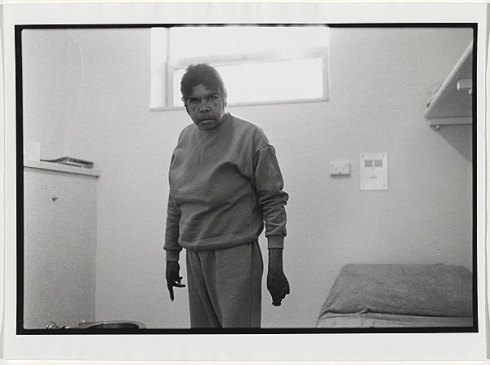
Ricky Maynard‘s No More Than What You See is an old project, but tackles a subject I’ve not featured before.
Following the report Royal Commission into Aboriginal Deaths in Custody (1991), self-taught photographer Maynard was compelled to look at the prisons of South Australia, including Cadell Training Centre, the Yatala Labour Prison, and the Northfield Prison Complex.
Maynard (born 1953 Launceston, Tasmania, Australia) explains in his 1993 grant winning Fifty Crows portfolio:
If you are Aboriginal in Australia you are 15 times more likely than a non-Aboriginal to spend time in jail. I felt that it was important for a Koorie (Aboriginal) photographer to record some aspects of what was happening to our people at this time. After all, the Australian Government spent millions of dollars and produced hundreds of pages of reports, but little that Aboriginal people could relate to. It seemed to me that a few strong images had the potential to convey more than all those words. We needed something that people could relate to, visual proof of the times and the experiences, for both Aboriginal people and non-Aboriginal people.
Philadelphia based photographer Sarah Stolfa, best known for The Regulars, a portrait series of punters at the bar she tended, has posted some new work on her website.
Pallbearers struggling with a casket, an elegantly dressed African-American lady with a gun holster, a man with a singed blanket stood in a charred field, a long-limbed man with leather bible, public urination, public housing; this is a visually uneasy but coherent edit and presumably the result of a road trip.
Also included are two photographs from the prison rodeo at Louisiana State Penitentiary (one and two). I am uncovering more and more photo projects from this particular event and I’m still working out what, if anything, this relatively high level of exposure means within the specialist sub-sub-genre of prison photography.
Lorenzo Meloni‘s series Amal begins by quoting a 21 year-old Palestinian, “In my short life, I’ve seen nothing that makes me hope for peace; I’ve only seen destruction, death, pain. In my life, I’ve only seen the sea once.”
Amal contains a variety of styles and weaves the viewer through multiple emotions in a short space of time. It’s confusing … in a good way. That depth fits with the complex politics of the region.
Beyond Prisons also includes an article about tertiary education for the incarcerated, by Carol Estes, executive director of University Beyond Bars, an education group I work with here in Washington State. Alas it is only available in teh print edition, so grab yourselves a copy. Only $4!
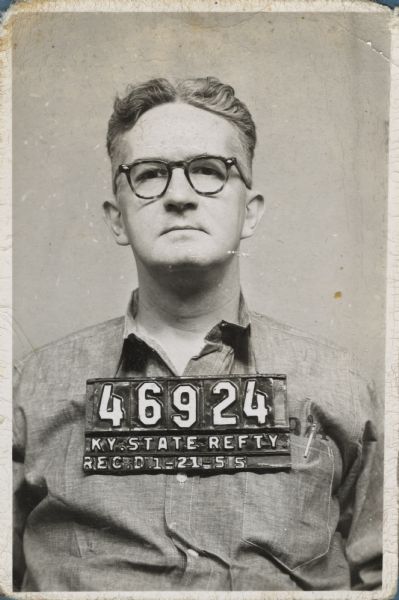
Braden and his wife Anne Braden were journalists-turned-activists who were part of the union movements and later the radical interracial left of the 40s and 50s. The Braden’s bought a house on behalf of the Wade family, their African American friends in suburban Louisville, Kentucky. When neighbours found out a Black family had moved in they burnt a cross outside the house and went after the Braden’s. Carl was charged with sedition in what is known as the Wade Case. Carl was sentenced to 15 years and served 8 months, eventually paying $40,000 to get out.
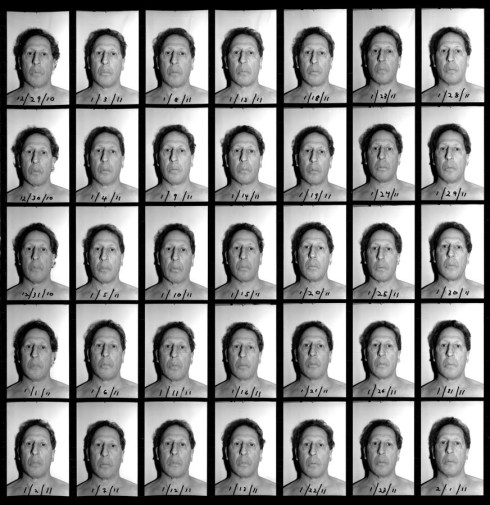
Karl Baden has chosen to put himself in the picture everyday for 24 years. Somewhere he has set up a self-imposed mugshot identification room. All these can be seen at his website Every Day.
Baden has established a unique set of data for a limited case study in visual anthropology. The date runs like an I.D. number at the bottom of his shots.
As Baden describes the project, he removes emotion and variables from the photography, just as police or criminal justice photographers do for mugshots:
Every Day is performed within a set of guidelines. […] Reserved exclusively for this procedure are a single camera, tripod, strobe and white backdrop. […] I use the same type of high-resolution film (Kodak Technical Pan until it was discontinued in 2007, Ilford Pan F since then) and the same strobe lighting. The camera is always set and focused at the same distance. When taking the picture, I try to center myself in the frame, maintain a neutral expression and look straight into the lens.
Baden lists the key tenets of Every Day to be mortality; incremental change; obsession (its relation to both the psyche and art-making); and the difference between attempting to be perfect, and being human. I’ll grant him those things, but I also wonder is does the project not feel like a sentence?
And my question to you, readers, is what should we make of this type of project? It could be just inventive fun or it might be one of the most present-minded approaches to photography there is? I can’t decide.
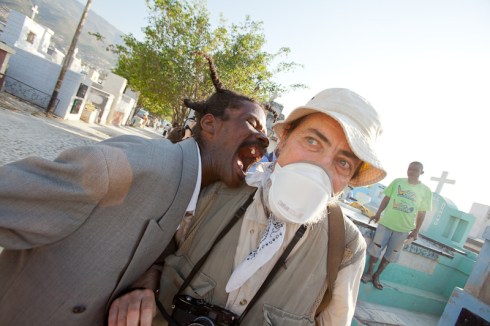
Bruce Gilden’s street shooting methods polarise opinion. His “ambush tactics” (for want of a better phrase) are, for some, the exercise of any photographer’s right in public space, for others he just goes about stuff in a rude way.
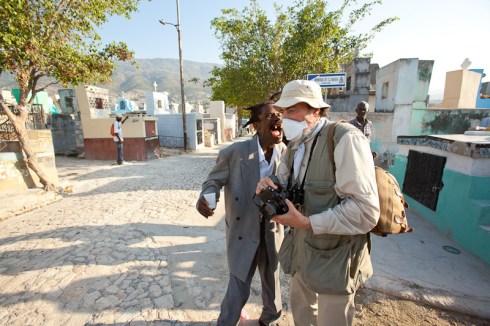
Anyway, here’s a TMZ-style photo exclusive of Gilden in front of the camera and not behind it. Gilden the ambushed; not Gilden the ambusher.
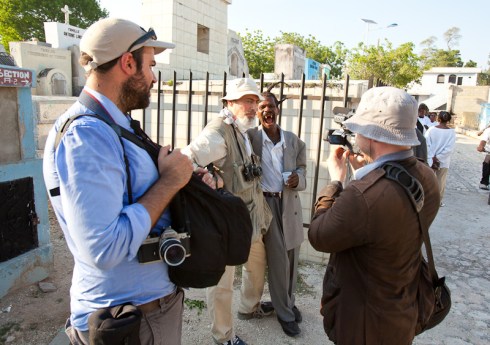
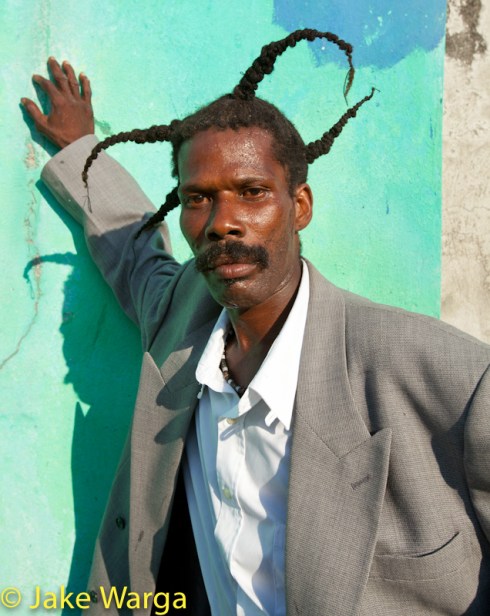
Journalist Jake Warga made these photographs in April. Warga was not part of Gilden’s entourage. We can presume that Gilden, at this time, was shooting Haiti: 15 Months Later.
I was critical of Gilden in the aftermath of the Haiti earthquake suggesting his images were little more than a digitised freak-show.
Warga was not surprised the Haitian, who he described as “drunk out of his mind on cheap wine” was attracted to the documentary film crew following Gilden through the graveyard with their photo accoutrements.
“He wanted his photo taken,” says Warga, “I try not to be seduced by spectacle but it was the only way he’d leave me alone. In turn, he gravitated towards Gilden’s cameras, joining the circus of gazes already in Bruce’s orbit.”
The bizarre nature of this interaction can be put down to a mixture of grief, inebriation, intrusion, Gilden’s personal theatre, and the scene acted out by the Haitian man. And all this in a cemetery.
Confusing layers here no doubt, but for me, the take away is Gilden’s flitting averted eyes (top image). As if part of some karmic return, this Haitian man getting up in Gilden’s grill can be read as a metaphor; as a spectre, and brief embodiment, of Gilden’s many victims down the years.
The tables are turned and it looks briefly unsettling doesn’t it?








 Prison Photography