© Marjorie Jean-Baptiste/Fotokonbit

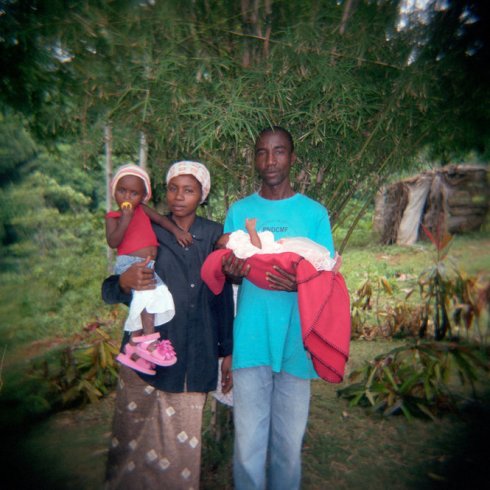
After my extended commentaries on photography in Haiti after the January 2010 earthquake, I’d like to bring attention to a non-profit producing and teaching photography workshops and putting cameras in the hands of Haitians.

FotoKonbit is a non-profit organization “created to empower Haitians to tell their own stories through photography. […] Inspired by the Creole word “konbit” which can be defined as the coming together of similar talents in an effort towards a common goal, we use our skills as photographers, educators, and artists to make a positive difference, through photography. By partnering with established Haitian organizations, FotoKonbit is uniquely positioned to inspire hope through creative expression and provide Haitians with the opportunity to document their reality and share it with the largest possible audience.”

The FotoKonbit team is made up of Frederic Dupoux, Ralph Dupoux, Maggie Steber, Marie Arago, Noelle Theard, Tatiana Mora Liautaud and Edwidge Danticat.

As TIME notes:

One of the most innovative uses for the photographs has been as documentary evidence for aid organizations. During three recent workshops for teenagers and younger adults living in tent communities, participants were asked to photograph aid efforts that they thought were successful, and to demonstrate needs that had not yet been met. Fotokonbit’s partnership with the American Embassy helped to get the work seen by the international aid community in Haiti.

In addition to these laudable humanitarian uses of Haitians photographs, is the simple fact that these images represent something distinctly different to the majority of Western media. How often have we seen naked, entranced worshipers prostrate in the waterfalls of Saut d’Eau? And how often are photographs from Haiti wrought with some outsider hyperbole or gratuitous pain? I don’t want to vilify photographers, especially as many such as Jonas Bendiksen and Louis Quail are committed to nuanced story telling.

Just to say that perhaps the mundane serenity of the landscape photograph below probably would not appear in our mainstream media.

And the market shot is just beautiful.

More images at TIME LightBox.

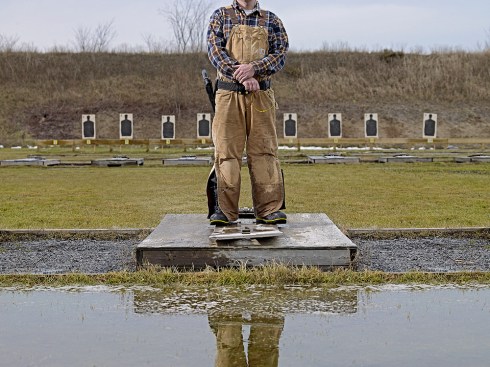
Correctional Services of Canada trainee in training to become a prison guard, Kingston, Ontario. © Jeremy Kohm

When Jeremy Kohm sent through this portrait, I saw the boots and the overalls and presumed it was a photo story on fishermen or lumberjacks. Wrong. A trainee prison guard.

I asked a few questions.

Tell us about the training facility and the town it’s located in.

Kingston, with a population of approximately 120,000, is located on the main highway roughly at the midpoint between Toronto and Montreal. Kingston is a town comprised of university students (18,000 who attend Queen’s University est. 1841), military personnel (as there is a large Canada Forces Base in the vicinity) and the Kingston Penitentiary (which houses some of Canada’s most notorious criminals).

The training facilities are a stones throw to Kingston Penitentiary which, having opened in 1835, is the country’s oldest prison. The penitentiary is considered maximum security and houses some 400 inmates – of which 40% have received a life sentence.

Do all trainees do range shooting?

When talking to the trainees what struck me the most was the brief nature of the job training program. It consists of four phases; 4-8 weeks of online training, 2-4 weeks of workbook assignments, 8 weeks of practical training and then 2 weeks of on-site training.

Most of the facilities were relatively pedestrian from a visual perspective – so I decided to photograph some of the trainees at the range once they had finished their target practice. This portion of the training was a mandatory element in their job preparation.

Who are the trainees? Where did they come from?

Some were just looking for a job whereas a few others were a little more idealistic and cited the reason as “wanting to make a difference.”  The backgrounds were equally varied, some had a military background whereas others had no experience and decided this career was purely an alternative to becoming a police officer. It really was quite varied.

Most of the trainees were in uniform, however, this one subject for some reason was able to wear clothing of his choice. In all honesty I’m not too sure why or if he was exempt. He allowed me to take the photograph as long as his identity remained hidden.

Anything else?

I do vaguely remember that punishment was given out in the form of push-ups. Punishable offences were essentially exactly what you imagine, things like tardiness and negligent safety behaviour.

While the trainees were waiting for my assistant and I to rig up the lights they were scouring the shooting range for unfired bullets. Apparently, they could redeem the bullets as a means of reducing the number of pushups required. Their eyes were constantly scanning as they paced in attempts to discover this odd form of currency.

Huh, weird.

Aired on BBC last month, Adam CurtisAll Watched Over By Machines of Loving Grace continues his knack of unnerving the viewer with hypnotising visuals and narratives that knits science, tech, neuropsychology to corporate and political ideologies. His use of music is also tragicomic.

Curtis is on top of his game. The BBC blog on his work and his own blog are good places to start, but this is the most user friendly place to get all his short-films documentaries.

All Watched Over By Machines of Loving Grace

All Watched Over By Machines of Loving Grace examines our collective hopes for the liberating experience of computer technology, networks and new modes of interaction.

Early network and internet engineers believed that our desires to free ourselves of government control, top-down authority and a globe modeled on the requirements of nation states, could be achieved by an embedded non-hierarchical network of communication.

Episode 2 focuses on ecosystems and how software developers have evoked myths of natural equilibrium to sell the idea that all forms of (computer-based) connectedness are inherently beneficial. I couldn’t help think of the persistent argument that “the internet is democratic”. It is not democratic, and yet the argument recurs time and time again – particularly as it applies to blogging and near-free publishing tools.

There are large corporate powers that dominate the internet; it’s no democracy. In terms of market penetration and information gathering – the multi-national tech companies dwarf the extraction and industrial manufacturing giants of the past. Through data they wield massive power. One power structure has been replaced by another.

Unfortunately, Curtis’ conclusion is that the unfulfilled promises of technology have led to cultural nihilism, in which we’ve convinced ourselves we are isolated machines and our only purpose it is to carry genetic data AND as such we’ve abandoned the idea of community. Bleak.

While you’re at it you should watch The Power of Nightmares: The Rise of the Politics of Fear. It is a wonderful and cogent explication of the shared history between fundamental Islamist thought and U.S. Neoconservatism.

The Power of Nightmares: The Rise of the Politics of Fear

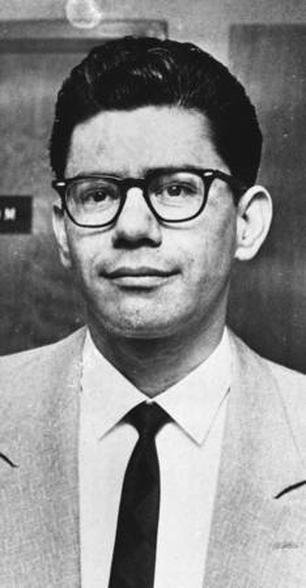
UPDATE: It just occurred to me that Ernesto Miranda looks like a young Al Franken.

Ernesto Miranda

Huh. I never realised Miranda Rights were named after someone named Miranda. And, if I had been shown a photograph, I’d have expected a female. Same applies for other renowned names. Say what do Roe or Wade look like? Or the Lovings? Or Brown, from Brown vs. Board of Education?

LIFE.com has a gallery of Faces Behind Famous Court Cases. From slide two:

Miranda v. Arizona, 1966. In 1963, police in Phoenix, Arizona, arrested career criminal and predator Ernesto Miranda (above) on charges of kidnapping and raping a young woman. Miranda was interrogated at the police station; without being advised of his right to representation and without being warned of his right against self-incrimination, Miranda signed written confessions and, at jury trial, was found guilty and sentenced to 20 years on each charge.

The issue before the Court: Were Miranda’s constitutional rights to representation and against self-incrimination violated by officers’ failure to apprise him of those rights? The decision: In a 5-4 ruling, the Court decided in Miranda’s favor. Chief Justice Earl Warren, writing for the majority, declared: “The warning of the right to remain silent must be accompanied by the explanation that anything said can and will be used against the individual in a court of law…”

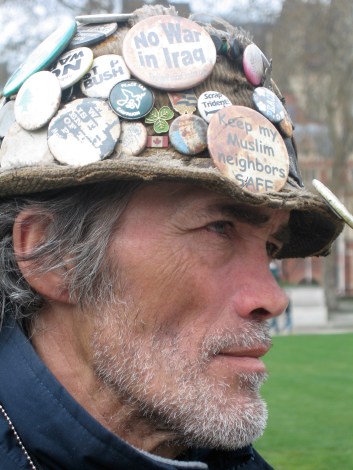
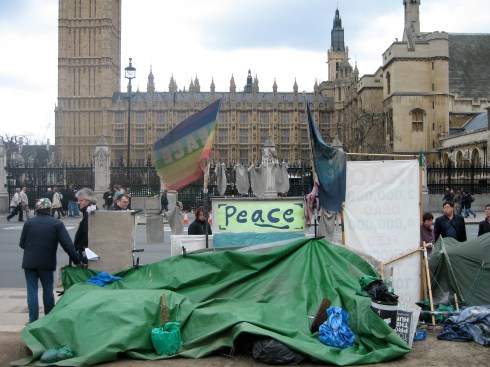
Brian Haw, Parliament Square, April 2008 © Pete Brook

Sad news this weekend. Global citizen and hero of the anti-war protest movement Brian Haw died aged 62 on the 18th June. His efforts, legacy and importance can be learnt about at http://www.brianhaw.tv/index.php

For nearly a decade, Brian Haw held a permanent presence in Parliament Square outside the UK Houses of Parliament. The only time he left the “camp” was to attend court hearings – many of them involving attempts by authorities to evict him.

While Haw was undergoing treatment for lung cancer in March, London Mayor Boris Johnson won a court ruling to finally evict Haw.

In 2007, Haw was voted ‘Most Inspiring Political Figure’ by the viewers of Channel Four.

That same year, artist Mark Wallinger recreated Haw’s protest inside Tate Britain. Wallinger won the Turner Prize for art a few months later.

Uncompromising and committed beyond the capacities of most others, Haw’s protest was a visual reminder to every single UK member of parliament that Bush had an agenda, Blair was wrong and the war on Iraq was waged on a pack of lies.

Haw actually began his protest in June 2001; against economic sanctions and the effects on civilian populations, particularly children. That’s a full five months prior to the U.S. invasion of Afghanistan in November 2001. Did he tap the zeitgeist? Did he intuit that the western powers were about to embark upon a decade of imperialist military incursion? Will an activist-commitment such as his – that captures the hearts and attention of a nation – exist again? One hopes so.

R.I.P. Brian.

Brian Haw’s camp, Parliament Square, April 2008 © Pete Brook

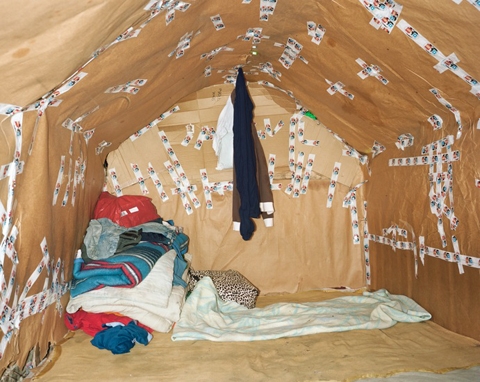
Madrid Prison © Gunnar Knechtel

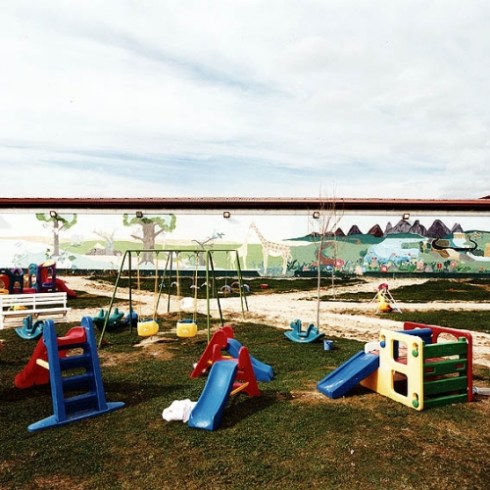
Tree lined corridors and green lawns; swimming pools and squash courts; but this is not suburbia, this is Madrid VI prison. I know very little about the Spain’s prison system. In fact, the only time it has featured on Prison Photography was as it related to Mathieu Pernot ‘s photographs of family screaming over the walls of a Barcelona jail. It would be speculation to wonder if Gunnar Knechtel’s series Madrid (2004) depicts the world into which Pernot’s subjects howled. Instead I, and we, shall reply upon the information provided by COLORS Magazine Issue 50:

“Madrid VI prison (opened 1998) is staffed not by guards but by funcionarios, unarmed civilian servants with college degrees. It’s part of a prison culture that according to one funcionario aims to foster “a certain level of mutual respect and trust” between inmates and staff.”

To American eyes, Knechtel ‘s photography may appear to describe something other than a prison. The human-scale of the design contrasts the dominant modes of American incarceration, especially the dehumanizing Supermax.

Where it makes no effect on function, recently-constructed Spanish prison design includes manipulation of colour, sight-lines and landscaping to lessen the psychological impact of these confined spaces. But more than that, Spanish prisons – as depicted here by Knechtel – provide health and recreational facilities to nurture humanity. No more is this nurturing in evidence than in the prisons’ policies toward family and reproduction.

“A [prison reform] law – the new Spanish parliament’s first piece of legislation – was passed in 1979. It guaranteed prisoners all their civil rights, withholding only their freedom of movement.” Other improvements include monthly family visits in private rooms, as well as conjugal visits with spouses, partners, or even prostitutes is specially designated bedrooms. In the mixed prisons, male and female inmates are allowed to begin relationships and if the prison director agrees can meet and use private rooms as an official couple. Homosexual relationships are also permitted.”

Since 1979, Spain has built 57 prisons that adhere to these standards; each one at an average cost of $42 million. The focus on conditions came about following the demise of Franco‘s Fascist regime (Franco died in 1975, but a new constitution was not passed into law until 1978.) During the dictatorship, many politicians were held in Spanish prisons overseen by Franco’s notorious military police. When these men and women returned to the legislature, prison reform was a top priority.
Madrid Prison © Gunnar Knechtel

Many U.S. prisons with stable populations allow for conjugal visits (“trailer visits”) as an earned privilege for prisoners. For prisoners fortunate enough to have the option, trailer visits provide invaluable human contact; a type of contact that is never forthcoming in dominant prison culture. And this applies to all types of contact, from time with a sexual partner to a weekend with the extended family. Trailers in U.S. prisons are beyond the body of the prison proper, often in a self-contained secure spaces; architectural afterthoughts. By contrast, in Spain the philosophy of the family has shaped the spatial fabric of many prisons.

In terms of child-rearing, there are a handful of pioneer facilities in the  U.S. Three of these facilities have been documented by three conscientious female photographers – Cheryl Hanna Truscott at the Residential Parenting Program, at Washington Corrections Center for Women (WCCW); Angela Shoemaker at Prison Nursery at Ohio Reformatory for Women, Marysville, Ohio; and Neelakshi Vidyalankara at Bedford Hills Correctional Facility in Westchester County, the largest maximum security women’s prison in New York state.

In the U.S., at those rare Mother Units, law allows mothers to keep their newborn babies with them until 18-24 months. In Spain, the age is 3 years. From the same issue of COLORS, a mother describes her dilemma:

“My daughter turns three in a couple of months and it’s difficult for me to be separated from her. She’s been with me since she’s been a baby but I can already see that she needs something different. When they take her on excursions to the zoo or to the mountains, I see that she’s really happy. She knows that she has to ask permission for everything; she knows that there are people in charge. She says, “Mommy, tell the lady to open the patio door”, and she knows that she has to respect those in charge.”

No one would want to argue a child should remain with its parent in a state of suspended freedom indefinitely, but discussion about the legal age limit to which they remain together is valuable.

Madrid Prison © Gunnar Knechtel

Whether it two years or three years, the eventual separation of mother and child, or mother and father from child can only be a gut-wrenching unbearable event. Having said that, any parent would surely bear such pain in return for the pleasure of bonding with their children over even the shortest time-span.

Social psychology has shown the most significant bonds and rapid cognitive development occurs in the baby’s earliest months and years. As such, the benefit to mother and child cannot be denied.

The U.S. prison system does not provide the type of Family Unit deicted by Knechtel in which incarcerated parents can (if approved) raise a child jointly. Spain has actualised one of the most progressive penological practices by including the father within a more complex understanding of family. The needs of children are often the same as the needs of the parent.

Knechtel’s photographs are by no means extraordinary, but as with most prison photography projects, it’s the debate about the unseen world they give rise to, that defines their worth. The ambiguity of prison architecture punctuated by soft furnishings and children’s toys fairly reflects the conflicted reality for parents behind bars.

Gunnar Knechtel’s website:

http://www.gunnarknechtel.com/stories-id-488.html

Madrid Prison © Gunnar Knechtel

THE CONTINUING BLOGGING COLLABORATION

Thanks oncemore to Aline Smithson who transcribed. This is our second collaboration done in the interets of shared learning and proof that the photo-blogging community is alive, strong and charitable. Part one: A Visit to ER: Thoughts on Torture, Invisible [War] Crimes and X-Ray Imaging as Evidence. Below is a photograph of Aline’s feet from her portfolio Self-portraits.

One June 16th, 1944, the United States executed a 14 year old boy. His name was George Junius Stinney Jr.

There is good reason to believe Stinney’s confession was coerced, and that his execution was just another injustice blacks suffered in Southern courtrooms in the first half of the 1900s.

More from SC crusaders look to right Jim Crow justice wrongs, by Jeffrey Collins for The Associated Press (Jan. 18, 2010)

The sheriff at the time said Stinney admitted to the killings, but there is only his word — no written record of the confession has been found. A lawyer with the case figures threats of mob violence and not being able to see his parents rattled the seventh-grader.

Attorney Steve McKenzie said he has even heard one account that says detectives offered the boy ice cream once they were done.

“You’ve got to know he was going to say whatever they wanted him to say,” McKenzie said.

The court appointed Stinney an attorney — a tax commissioner preparing for a Statehouse run. In all, the trial — from jury selection to a sentence of death — lasted one day. Records indicate 1,000 people crammed the courthouse. Blacks weren’t allowed inside.

The defense called no witnesses and never filed an appeal. No one challenged the sheriff’s recollection of the confession.

“As an attorney, it just kind of haunted me, just the way the judicial system worked to this boy’s disadvantage or disfavor. It did not protect him,” said McKenzie, who is preparing court papers to ask a judge to reopen the case.

Stinney’s official court record contains less than two dozen pages, several of them arrest warrants. There is no transcript of the trial.

RESOURCES

Sound Portrait: George Stinney, Youngest Executed (2004)

When Killing a Juvenile was Routine

Too Young To Die: The Execution of George Stinney Jr. (1944) in Ch. 5, ‘South Carolina Killers: Crimes of Passion’, by Mark R. Jones.

From the series Shelter by Henk Wildschut. From a shortlist of six photographers’ projects, Wildschut won the 20,000 Euro DUTCH DOC AWARD.

Last weekend was the Dutch Doc Festival.

The theme for this years Dutch Doc Festival is the slow type of journalism, which “focuses on long-term projects that frequently involve a strong personal commitment and steer clear of passing fashions. Projects that revisit a (pre-documented) subject in a sequel or to create a new sequence in follow-ups after set periods of time.”

Photoblogging duo Mrs. Deane were involved in the festivities and asked other bloggers and I to pitch in. They emailed:

To underline the relevance of the online community in shaping the contemporary debate, we would like to invite a number of what we consider ‘distinct voices’ to contribute to the festival via our presence. We would tremendously appreciate it, if you could select three photographic projects that you feel should be considered when discussing what’s needed right now, what people should be looking at, what has been forgotten, or what new projects are leading the way in the field of documentary photography (especially the kind that is also moving within the confines of the fine art galleries).

Ignoring the last criteria, I unapolo­get­i­cally picked three very polit­i­cal projects. Mrs. Deane posted my response over there, and I cross-post here for good measure.

THREE NEEDED PROJECTS

At a time when images rifle across our screens and reti­nas usu­ally serv­ing the pur­pose of illus­tra­tion or cor­po­rate pro­pa­ganda, the resolve of pho­tog­ra­phers to cre­ate bod­ies of work that deal with pol­i­tics — and often large nar­ra­tives too — can be read as either fool­hardy or enlight­ened. I’ll pick the latter.

Kevin Kunishi’s work in Nicaragua, Joao Pina’s doc­u­men­tary in South Amer­ica and Mari Bastashevski’s doc­u­ments from Chech­nya explore to varying degrees, “what has been for­got­ten.” Pho­tog­ra­phy is art and art should be polit­i­cal. If we con­sid­ered remem­ber­ing and mem­ory the first act in resis­tance against injus­tice then these three projects are high art.

kunishi.jpg
From los restos de la rev­olu­cion © Kevin Kunishi

Kunishi’s Los Restos de la Rev­o­lu­tion is a poignant look at the remains and the sur­vivors of the Nicaraguan civil war. The por­traits fea­ture both for­mer San­danista rebels and former US-sponsored Con­tras. The mun­dane every­day details along­side deep psy­cho­log­i­cal scars fol­low­ing con­flict can be easy to turn ones back on when the bombs stop light­ing up the skies. And it is easy to for­get the US’s impe­r­ial pol­icy and med­dling in this con­flict. One won­ders if Afghanistan will ever have a cush­ion of a sim­i­lar period of peace­ful time to be part of a sim­i­lar look back at the expe­ri­ences and actions of its cit­i­zenry amid con­flict.

126_maribastashevski.jpg
From File 126 © Mari Bastashevski

Mari Bastashevski’s File 126 doc­u­ments spaces pre­vi­ously inhab­ited by abductees who were “dis­ap­peared” dur­ing the Russian/Chechen con­flict. Bas­ta­shevski says, “the abducted are incor­po­real, as if they never were. They are no longer with the liv­ing, but they are not listed among the dead.” This is a par­tic­u­larly brave project given the state forces complicit in the depar­tures are still in power and their reac­tions to Bastashevski’s incon­ve­nient con­science are unknown.

JoaoPina.jpg

From Oper­a­tion Con­dor © Joao Pina

Joao Pina’s Oper­a­tion Con­dor expan­sive work across South Amer­ica, wants to both doc­u­ment and “pro­vide evi­dence” for ongo­ing mem­ory and tri­als into cases of of extra­ju­di­cial tor­ture, kid­nap and mur­der by the var­i­ous Right-wing Mil­i­tary Jun­tas in South Amer­ica dur­ing the 1970s and 80s. Like Nicaragua [and Kunishi’s work] the US had a strong influenc­ing hand in either estab­lish­ing or prop­ping up many of these hard­line gov­ern­ments. The crimes of thirty years ago are barely on the radar of the West­ern world how­ever. How quick we for­get! Pina is cur­rently rais­ing money for the next phase of his project at Emphas.is.

Colin and Joerg’s Selections

Mrs. Deane got a couple of other expert opinions.

Colin Pantall selected Third Floor Gallery, Timothy Archibald and Joseph Rock.

Joerg Colberg plumped for Brian Ulrich, Milton Rogovin and Reiner Gerritsen.

EMAIL

prisonphotography [at] gmail [dot] com

Prison Photography Archives

Post Categories