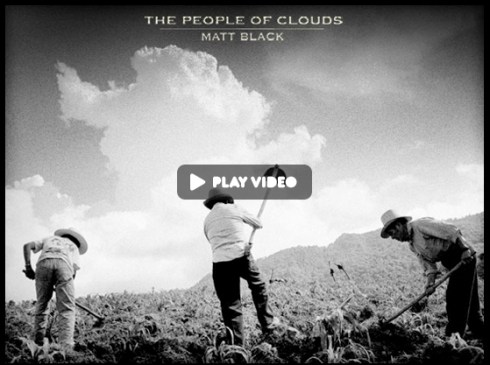
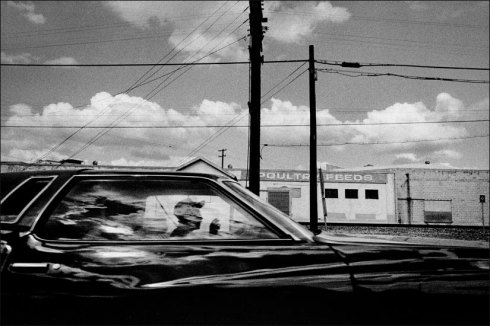
Warehouse District, Fresno, California © Matt Black

Last week, Stan blew the cover on my long held admiration of Matt Black. In the past couple of months, and on three different occasions, when conversation has moved toward photographers’ work that really turns us on I’ve begun explaining Matt’s work only to have the other person blurt out his name. You know that excitement when you’re on the same wavelength? Repeated.

Matt Black also has a great name. What else could he be but a photographer?

Matt’s documentary photography focuses on the social and environmental realities of southern and Central California, and the span of Mexico. Man-made borders need not apply. He’s knee-deep in the regions.

Each of Matt’s portfolios eddies of the last. It’s an admirable body of work. For his latest project, The People of Clouds, Matt has teamed up with Orion Magazine and Daylight Online for a cohesive distribution plan. He has also, for the first time, made use of Kickstarter for a very well-stated funding pitch.

Matt explains:

High in the Mixteca mountains of southern Mexico, an exodus is unfolding.  In the birthplace of corn cultivation, where farmers first coaxed maize from the earth nearly 9,000 years ago, an ancient way of life is crumbling as land degradation and erosion cripple the soil and as migration tears families apart. 

Named the “Place of the Cloud People” by the Aztecs, the Mixteca is home to one of the oldest and largest indigenous cultures in the Americas. Rugged and remote, the isolated region sheltered a pre-Colombian way of life that largely vanished from the rest of Mexico in the aftermath of the conquest.  At its heart, it’s a culture of the land, and corn.  Along the region’s hillsides, it is still possible to glimpse ancient terraces, canals, and runoff channels that protected the Mixteca’s rich but fragile soil, and nourished its inhabitants, for thousands of years.

But today, these ancient farming traditions have been lost, replaced by chemical fertilizers, hybrid seeds, and herbicides, the trifecta of modern agriculture heavily promoted in indigenous communities by the Mexican government and international charities as part of the “Green Revolution” of the 1960s.  When combined with slash and burn farming, the Mixteca’s steep terrain, and the loss of other indigenous soil-preserving traditions like multi-cropping, these imported industrial agricultural techniques have turned Mixtec corn farming, one of the world’s oldest and most perfectly integrated agricultural systems, into a soil-eating machine.

Today, much of the Mixteca has been declared an “Ecological Disaster Zone,” the result of unchecked erosion, deforestation, and soil exhaustion.  Per capita maize consumption is less than ten ounces per day, 90% below US rates, and fewer than a third of children under the age of five show normal growth by weight and height.  Ranked on the UN’s Human Development Index (HDI), the Mixteca’s poverty is deeper than nearly all of Latin America’s, comparable only to areas of Africa, India, and the Gaza Strip.  Far from sparking a Green Revolution, the industrial farming techniques prescribed to the Mixtecs have resulted in their becoming unable to even keep themselves fed.

Nearly a quarter million Mixtecs have emigrated to the US.   Some villages have lost as much as 80% of their population and have become little more than ghost towns.  “I only think about dying,” one elderly man told me.  “My only worry is how my funeral will be.”

Please consider helping Matt continue The People of Clouds.

Nicely said:

It was disheartening to read Justice Scalia, in his dissent, describe the case as one “whose proper outcome is so clearly indicated by tradition and common sense, that the decision ought to be shaped by the law, rather than vice versa.”

Justice Scalia’s respect for the requirements of the law apparently stops when convicted felons are the litigants. While he calls for common sense, he ignores the expert testimony, which led to the finding that prisoner release was necessary. He implies that 46,000 prisoners will be released en masse, and indiscriminately. At the time the opinion was issued, the prison population had already undergone a reduction of 9,000 inmates.

The reality is that the releases will not be en masse and the figure will be much lower. Relatively few prisoners serve their entire sentences due to the availability of good-time credits, which provide for reduction in the time served. The state has great discretion to select those inmates whose early release presents a minimal risk to public safety. Many of those prisoners who are serving time for technical parole violations will be diverted to community-based programs.

Justice Scalia also claims, without proof, that “Most of them will not be prisoners with medical conditions or severe mental illness; and many will undoubtedly be fine physical specimens who have developed intimidating muscles pumping iron in the prison gym.”

Justice Scalia ignores the reality that gyms have been used to house prisoners for many years, which is part of the problem brought on by overcrowding. Overcrowding and lockdowns compromise the immune systems of prisoners due to a lack of fresh air and exercise. The lack of sanitary conditions in these gyms exacerbates the spread of disease. Weights have not been available in California prisons for more than a decade.

While Justice Scalia’s criticism of the majority decision is trenchant and beautifully written, it is based on a false notion of the conditions in prison and blindness to the consequences of subjecting men to inhumane treatment for more than a decade. Justice Scalia ignores the sad reality that many of those who suffer from mental or physical disabilities lack the ability or means to bring complaints to federal court, especially given the difficult obstacles placed by Congress and the Court to prisoner lawsuits in recent years.

via zunguzungu

UPDATE: 06/27/2012 – The Prison Law Office (PLO), Berkeley represented the prisoners of California. PLO pointed me in the direction of this full gallery of images that were available to defense and prosecution teams.

On May 23rd, the Supreme Court of the United States (SCOTUS) affirmed – with a 5-4 majority – a federal court order requiring California to reduce its prison population to 137.5% of design capacity. California has two years to shrink the number of prisoners by more than 33,000. California currently has 143,335 prisoners, which is still significantly less than the 166,000+ the state housed at its peak five years ago.

Brown vs. Plata (formerly Schwarzenegger vs. Plata) was a landmark case in U.S. legal history and, I would hesitate a guess, the largest release program of convicted individuals ever enacted. And it is the right decision.

You can download the full SCOTUS decision as well as other documents from the case at SCOTUSblog.

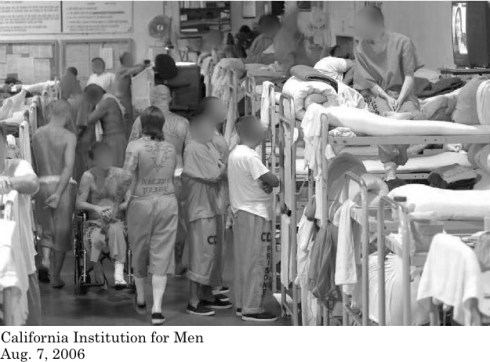
I want to draw attention to one particular aspect of the ruling: Justice Kennedy’s inclusion of photographs in the appendix.

Justice Kennedy wrote for the majority, joined by justices Ginsburg, Breyer, Sotomayor, and Kagan. Justice Scalia wrote a dissent joined by Justice Thomas, and Justice Alito wrote a dissent joined by Chief Justice Roberts.

Two of the photographs Kennedy included show prisoners being housed in a gymnasium. These are open dorms and clearly unsuitable for such numbers. The lawsuit however, was centred on standards of medical care; it was stresses of overcrowding that led to the drop in healthcare standards to the point of “cruel and unusual punishment” and the associated violation of the Eighth Amendment.

Justice Kennedy in a sincere way was trying to illustrate a point. An editorial at The New York Times is on board:

Looking at the photos, there should be no doubt that the conditions violate the Constitution’s ban on cruel and unusual punishment.

That’s a bit prescriptive for me but I’ll forgo that.

The images are quite unremarkable inasmuch as they are the norm. News media has shown images from California prisons like these for years. So much so, the California Department of Corrections provided a gallery of official “Prison Overcrowding Photos” (now with added fisheye lens!)

In 2006, Max Whittaker photographed overcrowded gymnasiums at Folsom prison. In 2007, Justin Sullivan went to Mule Creek State Prison. After the verdict, Gary Friedman‘s photo gallery ran in the LA Times.

The third picture (below) shows something a little different. It depicts the apparatus of inadequate care. According to the Court’s opinion: ‘Prisoners in California with serious mental illness do not receive minimal, adequate care. Because of a shortage of treatment beds, suicidal inmates may be held for prolonged periods in telephone-booth sized cages without toilets. A psychiatric expert reported observing an inmate who had been held in such a cage for nearly 24 hours, standing in a pool of his own urine, unresponsive and nearly catatonic. Prison officials explained they had “‘no place to put him.’”

It’s impossible to say what sort of reaction publication and underlining of these three images means for anyone reading-up on the case. Dahlia Lithwick for Slate asks Do photographs of California’s overcrowded prisons belong in a Supreme Court decision about those prisons?:

“Whether those photos will change anyone’s mind about the morality of prison overcrowding is open to debate. Whether they should may be the more important, and more interesting, question.” Lithwick wonders, “Should the court be using visual aids to prompt emotional responses or be inviting citizen fact-finding in the first place?” The weakness of this question is in its presumption that it is only through an emotional reaction that a viewer will conclude make-shift open dormitories and cages are unacceptable. Surely, logic dictates that these are not beneficial management strategies, let alone conducive to rehabilitation.

Photographs of overcrowded prisons in California have been available for a long time for anyone who cared to search. These three are representative of the failed system, and quite honesty Kennedy had thousands to choose from.

For a full round up of the ruling visit the phenomenal Prison Law Blog.

UPDATED: 06.12.2011

Previously, I was under the impression that only three photographs were used in the Brown vs. Plata deliberations, but according to Mother Jones, the two images below were also items of the appendix.

Poor positional play confounded by an absence of pace meant I found myself on the wrong side of a challenge for a soccer ball on Sunday morning. I won the ball, but didn’t stay on my feet. My right hand met the ground before my body.

Twenty-four hours later, with discomfort and swelling unabated, I chose to visit the ER to find out what the unglamourous tumble meant for my right wrist. On my way out the door, predicting a long wait at the hospital, I grabbed Trevor Paglen & A. C. Thompson’s book Torture Taxi (2006).

Morning Commute (Gold Coast Terminal), Las Vegas, NV, Distance ~ 1 mile, 6:26 a.m. © Trevor Paglen

I’ve talked about Trevor Paglen’s work before (albeit inadequately), and still maintain the best education on Paglen’s work is his Google lecture from 2009.

Paglen and Thompson, through an arduous but publicly-available paper trail, uncover the use of civilian aircraft in the Bush administration’s Extraordinary Rendition Program. Over 200 terror suspects were moved around the globe, not to mention the staff, transport teams, interrogators and American torturers. That’s a big operation. So while best attempts were made to keep is secret, Paglen and Thompson found and depicted its traces.
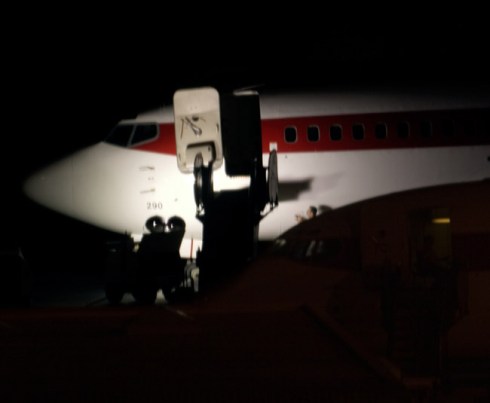
Unmarked 737 at “Gold Coast” Terminal Las Vegas, NV. Distance ~ 1 mile 10:44 p.m. © Trevor Paglen

For me, the surprising thing was that this activity was, as Paglen phrases it, “hidden in plain site”. Military aircraft must gain prior clearance before entering another nation’s airspace, whereas civilian aircraft need not satisfy the same protocols.  Also shocking is the fact that the CIA out-sourced it’s torture to convenient and “friendly” nations whose poor human rights records allowed for the application of unrestrained torture methods.

The CIA preferred Morocco and Mubarek’s Egypt to host and brutalise their human cargo.

In one passage, Paglen describes a particularly sadistic regime of torture in which Moroccan interrogators armed with scalpels visited and revisited Binyam Mohammed’s penis at two week intervals:

On the 21st of January, 2004, the Moroccans told Mohammad he was going home. […] Mohammad heard the sound of an airplane, then of men speaking American-accented English. As they had done in Pakistan, the American’s stripped Mohammad’s blindfold and clothes off, and Mohammad saw that he was again surrounded by black clad Americans wearing face-masks. ‘There was a white female with glasses’, he recalled, ‘she took the pictures. One of the soldiers held my penis and she took the pictures. This took awhile, maybe half an hour. She was one of the few Americans that ever showed my any sympathy. She was about 5’6”, short, blue eyes. When she saw the injuries I had, she gasped. She said, “Oh my God, look at that,” then all her mates looked at what she was pointing at and I could see the shock and horror in her eyes.” But Mohammad wasn’t going home. The Americans were taking him to Afghanistan.

Mohammad suffered for eighteen months in Morocco and the same period in Afghanistan at the hands of America’s contractors of violence. Since he was picked up off the street in Karachi, Pakistan in 2002, Mohammed was transported across the globe through multiple jurisdictions and tortured to within inches of his life countless times. Your tax dollars at work.

In May 2011, the U.S. Supreme court rejected the case of Binyam Mohammed v. Jeppesen Dataplan, Inc., a lawsuit brought by Mohammed and four other victims of the rendition program against Jeppesen a subsidiary of Boeing Aircraft. The plaintiffs claimed that Jeppesen provided the transportation that brought them to their respective places of torture.

The decision leaves standing  a federal appeals court ruling upholding the “state secrets'” privilege claimed by both the Bush and Obama administrations to prevent to testimony in matters regarding national security.

A defeat for human rights and the legitimacy of the law as it exists.

A man left with only two teeth in his lower jaw ­after being t­ortured with an electric truncheon, Chad, Africa, year unknown. Photograph: Courtesy Hermann Vogel

Paglen and Thompson interweave the horrific accounts of prisoner’s experiences with the mundane logistics of CIA front companies scheduling aeroplanes.

As I waited for the orthopedic’s analysis of my X-ray images, it was quite clear my injury, whatever it was, was is inconsequential.

Last year, I came across Brogdon, Vogel, and McDowell’s A Radiologic Atlas of Abuse, Torture, Terrorism, and Inflicted Trauma. This is a book centred on specialised imaging and imagery of political violence; it applies to the most pressing of basic global human rights and yet it is unlikely to be used or acquired by a photo enthusiast. The A Radiologic Atlas of Abuse, Torture, Terrorism, and Inflicted Trauma is an encyclopedia for use by medical and legal professionals likely involved in the investigation of war crimes or domestic abuse.

From the summary:

‘The results of aggression against humans can be hideously obvious, but may also be entirely concealed from casual inspection. Often […] only radiologic exploration of the inner recesses of the body can reveal the evidence of such violence. Victims of aggression range from the tiniest infant to entire populations. Hopefully you will never encounter every situation covered in this book. However, should you come across any, you will want a copy within reach.’

As I read Paglen’s horrific accounts of torture, it occurred to me a machine had just peered through my lower arm and a doctor was about to describe the exact nature of my injury. I wondered about the permanent marks left inside the tissues of torture victims and I wondered about the chances of these injuries ever being documented and, consequently, seen.

As with the extraordinary rendition program, one presumes the visual evidence will always be hidden, suppressed. Or non-existent.

Hermann Vogel, co-author of A Radiologic Atlas of Abuse, Torture, Terrorism, and Inflicted Trauma, has considered similar issues. Thirty years ago, Vogel began collecting x-rays of torture injuries. His collection now numbers 120 X-ray images. Vogel explains:

“X-rays reveal what the naked eye cannot see. A forensic investigation will reveal fractures, foreign objects and needles, but x-rays provide plausibility. Does the story match the pattern of injury? Does the age of the injury correlate with the time-span of when the torture occurred? Does the torture method correspond with the region, organisation, military or militia responsible?”

“In some countries, X-rays can be used as evidence in court and a few of my X-rays have helped prove that torture has occurred. They are also increasingly being considered as part of the [political] asylum process.”

The world saw the digital photographs made by soldiers asked to perform as prison guards at Abu Ghraib, but this was only a single prison (and the most audacious at that) operated by American forces in the global war on terror. Given that only lowly operatives were prosecuted for that shit-show, imagine what scientific X-ray images and the political will could achieve if they were delivered to a international court of law. And imagine George W. Bush, Dick Cheney, Donald Rumsfeld, Deputy Assistant Attorney General John Yoo and Assistant Attorney General Jay Bybee in the dock.

Sometimes, images with no author carry the most power.

But let’s not be blind. Torture in our name continues today. Vogel surmises:

“I can imagine that no one has access to x-rays from the American detention camps like Abu Ghraib, although I would also assume that American torture methods are so advanced now that any injury is undetectable. Pure psychological torture, which includes months of solitary confinement and days of sleep deprivation, is very popular worldwide because it does not leave behind any physical traces. Torturers have nothing to fear if nothing can be proved.”

There are some documentary photographers, namely Gilles Peress, motivated in their work by the prospect of their photographs doubling as evidence. Compared to Vogel’s collection of images, and compared to the thousands of X-rays that were never made of torture victims in America’s imperialist wars, this expected influence of their photographs is optimistic in the extreme.

FOOTNOTE: A BLOGGING COLLABORATION

This post was transcribed by Aline Smithson over Skype. During my recovery, we’ll collaborate once a week for six weeks on extended posts. This is done in the interets of shared learning and proof that the photo-blogging community is alive, strong and charitable. Thanks Aline!
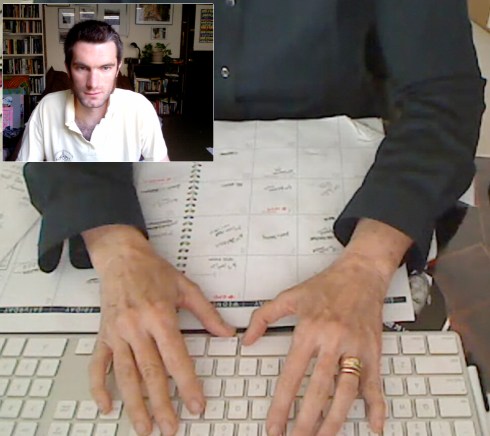
Screengrab: Pete and Aline at work.

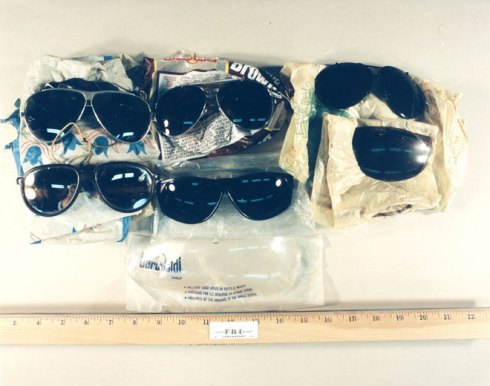
Ted Kaczynski’s Sunglasses. © U.S. Marshals

It may well have been one of the weirdest auctions in American history. Last month, courts order federal authorities to auction off Ted Kaczynski’s belongings in order to raise money for his victims. The auction closed Thursday 2nd June.

Kaczynski, dubbed the Unabomber, pleaded guilty in 1998 to a 20-year spree of bombings that killed three people and wounded 23.

U.S. Marshals used Flickr to post 51 images of the items included in the macabre auction — the first time the site has been used by U.S. Marshals for a sale — to presumably both reach out to and assist potential buyers.

In the press release, U.S. Marshals explained,”We will use the technology that Kaczynski railed against in his various manifestos to sell artifacts of his life. The proceeds will go to his victims.”

David Kravets writes for Threat Level blog, “Kaczynski’s so-called “manifesto” in which he railed against technology, sold for $20,053. In all, the auction raised more than $232,000. ”

Found via the liberator magazine.

P.S. The U.S. Marshals also have auctions of camera equipment.

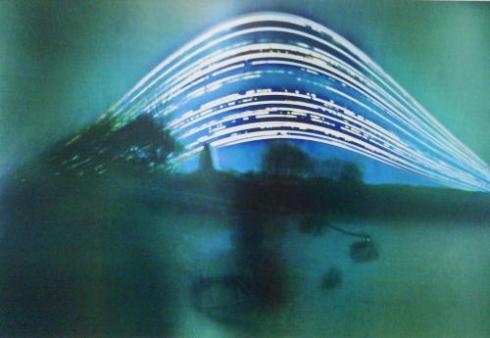
Photographer Mark Woods-Nunn and FLACK, a charitable social enterprise which works with homeless people in Cambridge, UK have put together an intriguing project.

Varsity Mag says, “the attachment of beer-cans to assorted lamp-posts is not another example of misguided modern art. A thin sheet of photographic paper was placed in each can, exposed to the world by only a tiny pin-hole, silently and vulnerably capturing an image.”

Good stuff.

Found via British Photographic History Blog.

There’s a long and verbatim interview with my friend Bob Gumpert at Sojournposse. Salina Christmas and Zarina Holmes ask the questions.

Bob describes the arc of his work from labor to detectives to street cops to the courts to the jails. It’s a trajectory he has described to me before and it’s a lot to get hold of; I’m happy I wasn’t transcribing!

However, I’d never heard Bob tell this particular tale:

The rule was: “Ladies, I take a photo [of you], you tell me your story. Next week, I give you four photos.” Literally, I give them four photos. “And I put the CD in your property.” So that’s the way it works.

The women took the photos and sent them to their boyfriends in [other] jails. The prison didn’t like this. Why? I don’t know. It’s not a problem when the men down [the jail] do it. But when the women did it, it was a problem. Do I understand why? Do I make an issue out of it? No! But what happens? I get banned from the jail. Because the women did it.

So then I went back and I said: can we try again? The jail said yes. So long as they understand the rules…

So I said fine. I went back. And I explained all this: “I give you photos. You can send them home. But you cannot send them to the jail.” All the women said, “No problem, we understand.” They sent them home with instructions to send them to the jail. From home. Why? Because they weren’t sending them to the jail.

So, what happened? I got banned again. So I get back in and I said to the women, “You cannot send anything, any of these photos, in any form, from any place to the other jail.” And a woman raises her hand and said, “Can I have Xeroxes made of photos, instead?” And I said, no, you cannot. And I stopped going in. Because it was – at some point – if I kept going in, a problem.

UPDATED: Bob soon after returned to the jail to work with female prisoners.

I have often described photographs in prisons as emotional currency. The tenacity and single mindedness of these female prisoners is, to me, quite amusing. They’re resolute in how they want to use photographs, and the variant ways they circumnavigate an unenforcable rule trumps any analysis they make of the rule itself.

They’re just trying to connect … but it caused problems for Bob!

Another thing to negotiate when making photographs in sites of incarceration.

Bob Gumpert’s website Take A Picture, Tell A Story

From the inbox:

Prison Photography will be honored with a 2011 Photo Blog Award from LIFE.com.

This is the first annual Photo Blog Awards from LIFE.com and this year the editors have selected 20 blogs. To determine the 2011 honorees, LIFE.com editors considered nearly 300 blogs that count photography as central to their mission. Winners range from major news organizations to individual enthusiasts who are transforming the ways that photographs are made, shared, and discussed.”

So that’s unexpected and quite a lovely way to start the week. Chuffed to be on a list with so many other great blogs I read and respect – 500 Photographers, A Photo Editor, aCurator, American Suburb X, Bagnews Notes, Burn, Conscientious, Feature Shoot, New York Times’ Lens, NPR’s The Picture Show, PDN, The Sartortialist, TIME.com’s Lightbox, What’s the Jackanory?

To celebrate, my housemate made a rhubarb-sprinkle-surprise-sponge-cake, which is just about the best cake there is.

EMAIL

prisonphotography [at] gmail [dot] com

Prison Photography Archives

Post Categories

RSS PETE BROOK’S TUMBLR ‘PHOTOGRAPHY PRISON’

  • An error has occurred; the feed is probably down. Try again later.