Scar © Sye Williams

Sye Wiliams photographed in Valley State Prison for Women, Chowchilla, California. His portfolio was included in the June 2002 COLORS Magazine.

Williams’ entire Women’s Prison portfolio can be seen on his website.

It is a bit of a time machine without a specific destination. The images are prior to 2002, we know that much. But it is anyone’s guess which particular year. (I have asked Sye and will update with the answer.)

Williams’ choice of film-stock, the era-less prison issue coats and baseball t-shirts, all amount to a almost “date-less” space and time. Even the hairstyles span any number of decades. Yet, this is what prison is for many inmates; prison is a time of stasis, if not reversal. When time is not your own, how should it matter? And when one’s time is detached (in an experiential way) from that of dominant society, then it stands to reason that very different rules of judging the days, measuring value, gauging worth, choosing behaviour, and – dare I say it – opting for styles, would shift significantly.

Officer © Sye Williams

It is not often prison photographers take portraits of correctional officers (mostly down to legal reasons).

Williams’ Officer (above) is a slippery image. The officer maintains the same steeled look as some of the inmates. The fact that she wears a helmet with visor, and that this particular portrait exists within a portfolio of weapon-still-lifes and an photograph depicting model-hairdresser-heads all unnerves me a little.

It is not that women’s prisons are uncontrollably violent. To the contrary, they’re more likely sites of boredom. However, as a viewer to Williams’ work, I find myself adopting the same caution as the staff and administration. Prisons are places where daily activities are shaped by the need to always prepare for the worst case scenario.

Williams manages to subtly suggest the latent violence of prison, and given recent reports (California Women Prisons: Inmates Face Sexual Abuse, Lack Of Medical Care And Unsanitary Conditions) he is probably close to the truth. Apparently, Valley State Prison for Women in Chowchilla is less dangerous than it once was, but it remains a notorious prison for women.

In the deviant milieu of prison, even when time ceases to exist, vigilance necessarily remains a constant.

View Sye Williams’ entire Women’s Prison portfolio.
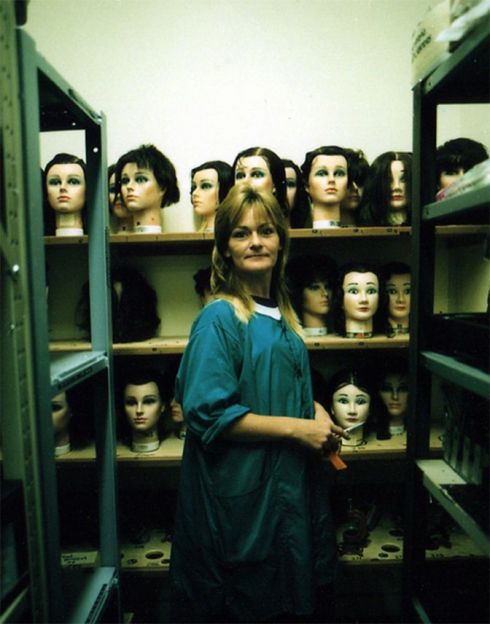
Beauty School © Sye Williams

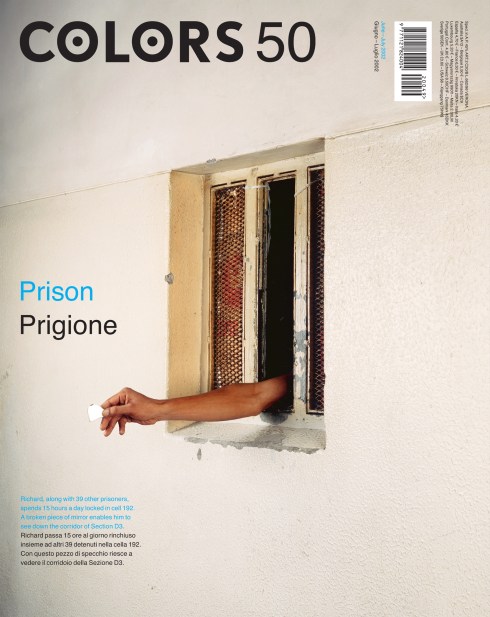
Front cover

COLORS magazine first fell onto my radar last year when reviewing Broomberg & Chanarin’s work. It cropped up again in March when I delved into Stefan Ruiz’s early career. All three were creative directors in COLORS continually rotating roster of aesthetic leadership.

Based in the north Italian town of Treviso, COLORS is part of the publishing activity of Fabrica, Benetton’s communication research centre. Benetton’s searing brand-making hit my young retinas with its controversial United Colours of Benetton (billboard) ad campaign of the early nineties.

Besides Saatchi and Saatchi, Benetton was the only time in my childhood I was aware of the names behind billboard products. That is an assumed level of cultural penetration, but I’m working from precious memory too much to determine its significance.

[As an aside, Enrico Bossan Head of Photography at Fabrica and Director of COLORS Magazine was co-curator for the 2011 New York Photo Festival. He also founded e-photoreview.com in 2010, which delivers without no-nonsense video interviews with photographers.]

The 50th edition of COLORS (June 2002) focused specifically on prisons. From the introduction:

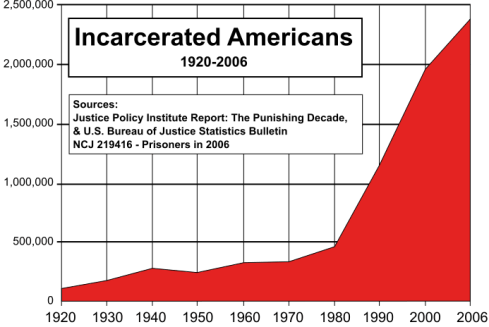
With over eight million people held in penal institutions the prison population is one of the fastest growing communities in the world. In the United States, a country which holds 25% of the world’s prison population but only 5% of the world population, prisons are now the fastest growing category of housing in the country.

For COLORS 50 we have visited 14 prisons in 14 countries and asked a difficult question: Is it possible to rehabilitate a person back into society by excluding them from it? We spoke to murders, rapists, pedophiles, armed robbers, thieves, frauds, drug dealers, pick pockets, high-jackers and prison wardens. In most cases the stories we heard confirm one thing. That prison does not work. In COLORS 50 we ask the inmates themselves to suggest alternatives.

The magazine is 90 pages of portraits and interior landscapes. I came to this collection of work late (in my research here at Prison Photography) and in many ways it challenges many of my former presumptions. This edition is a precursor to the “VICE-aesthetic” celebrating the battered and broken, and I’d be happy to dismiss it if it weren’t for the long-form statements made by the prisoners, which are printed with care and without censorship.

The issue includes bodies of work by photographers I was previously unaware of including Juliana Stein, Vesselina Nikolaeva, James Mollison, Charlotte Oestervang, Suhaib Salem, Federica Palmarin, Mattia Zoppellaro, Ingvar Kenne, Kat Palasi, Dave Southwood, Gunnar Knechtel, Pieter van der Howen and Sye Williams. I will be featuring selections of these photographers over the next few weeks.

I bought the paper edition, but you don’t have to as the entire Prison/Prigione Issue 50 can be viewed online.

Above all, while browsing the images and stories of the magazine, I am really pressed into thinking about the ease with which a commentator can politicise and argue against the prison system in America, but be flummoxed when asked to appreciate prison systems elsewhere. Benetton uses the common theme of incarceration to raise questions, but I am at a loss to think of common answers to tackle the pain, blood and damage done to individuals in their lives before, during and after imprisonment.

At a surface level this is car-crash photography; a look inside worlds we’ll never know, but at its heart it is a call to think about the nature of humanity and to think about the capacity for humans to kill, to survive, to get addicted and to repair and to forgive.

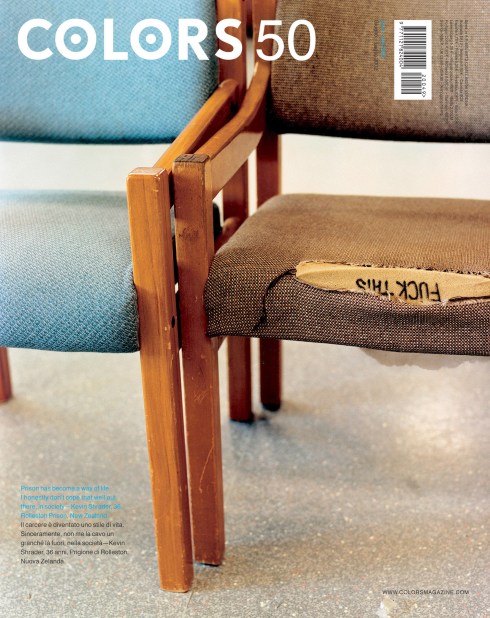
Back cover

A public flogging in Delaware in the early 1900s. Ullstein Bild, The Granger Collection.

For the Chronicle of Higher Education, Peter Moskos justifies the title of his new book, and explains why In Defense of Flogging is really about our bloated failed prison system:

The opening gambit of the book is surprisingly simple: If you were sentenced to five years in prison but had the option of receiving lashes instead, what would you choose? You would probably pick flogging. Wouldn’t we all?

My defense of flogging […] is meant to be provocative, but only because something extreme is needed to shatter the status quo. We are in denial about the brutality of the uniquely American invention of mass incarceration. In 1970, before the war on drugs and a plethora of get-tough laws increased sentence lengths and the number of nonviolent offenders in prison, 338,000 Americans were incarcerated. There was even hope that prisons would simply fade into the dustbin of history. That didn’t happen.

Some time in the past few decades we’ve lost the concept of justice in a free society. Historically, even though great efforts were made to keep “outsiders” and the “undeserving” poor off public welfare rolls, society’s undesirables—the destitute, the disabled, the insane, and of course criminals—were still considered part of the community. The proverbial village idiot may have been mocked, beat up, and abused, but there was no doubt he was the village’s idiot. Some combination of religious charity, public duty, and family obligation provided (certainly not always adequately) for society’s least wanted. Exile was a punishment of last resort, and a severe one at that. To be banished from the community was in some ways the ultimate punishment. And prisons, whether or not this was our intention, brought back banishment and exile, effectively creating a disposable class of people to be locked away and discarded. True evil happens in secret, when the masses of “decent” folks can’t or don’t want to see it happen.

(My bolding)

Particularly with the last paragraph, I couldn’t agree more.

© Walter Iooss for Sports Illustrated

With over 300 Sports Illustrated covers under his belt, Walter Iooss is no slouch. Check this out! and this.

But still, I had to laugh when I read the last paragraph of his bio, describing his specialisation in SI swimsuit specials later in his career:

“Walter matured with his swimsuit work. Ah, the Sports Illustrated swimsuit issues for which the Iooss lens has born fruit, all the riper for the backgrounds. As in the action shots, the portraits of SI’s swimsuit issues reveal an uncanny graphics sense and Rembrandt-like reverence for light and shadow. He sought and found more control in his swimsuit photographs, especially in the early days traveling light with only cameras and beautiful women, without the interference of art directors.”

More power to him.

BTW, check out the Sports Illustrated Vault Twitter Feed for smile-worthy images of past sportsmen and sportswomen (but mostly sportsmen) doing goofy stuff.

When I met Robbie Kaye at Photolucida last month, she showed me an image she’d made only two weeks prior. This is a live and lively pursuit.

Robbie has a few nice portraits in Beauty and Wisdom. This sentiment from Robbie’s statement really rang true for me:

Beauty and Wisdom explores the grace and courage in which these women age in a society so heavily focused on the beauty of youth. Ironically, these are the women who opened doors for future generations and now they are part of an overlooked generation.

It’s a question I’m asked time and time again. I have many reasons. I’ve said before I think prisons in the United States are a human rights abuse. That statement could launch a thousand debates.

Ultimately, I come back to the stats. Mass incarceration is a man made problem. It is more about bad laws and bad policy than it was ever about crime.

Source: Wikipedia

The funeral of Horacio Bau a montonero militant from Trelew in the Argentine patagonia. He disappeared in La Plata in November 1977. His remains were found and buried nearly 30 years after. © João Pina

About this time last year, LENS blog featured João Pina’s ongoing project Operation Condor (since renamed Shadow of the Condor). Daniel J. Wakin wrote, “Operation Condor was a collusion among right-wing dictators in Latin America during the 1970s to eliminate their leftist opponents. The countries involved were Brazil, Argentina, Chile, Paraguay, Uruguay and Bolivia.”

João Pina has broken up those six countires into three segments and is currently raising funds via Emphas.is to complete the first focusing on Brazil.

Pina has already interviewed victims and families in Brazil:

In Recife in northeastern Brazil I interviewed and photographed Elzita Santa Cruz, a mother of ten who is now 97 years old. In 1964, when Brazil’s military dictatorship began, several of her children were arrested for political reasons on different occasions. In 1974, one of them, her son Fernando, became Brazil’s first politically “disappeared” person. Since then, Elzita has been demanding that the Brazilian authorities open their archives and explain what happened to Fernando and the other victims of the twenty-one-year dictatorship.

Having worked across South America for six years already, Pina will, as he intends, be able to create a “visual memory”, but as for making evidence for “use by a number of human rights organizations which are still trying to bring those responsible for Operation Condor’s repression to justice,” well, that’s an ambitious goal. Nevertheless, as a documentary project the subject is ranging and imperative. Good luck to him. I’ve stumped up some cash, so should you.

See the Emphas.is project page for Shadow of the Condor and see Pina’s video pitch.

EMAIL

prisonphotography [at] gmail [dot] com

Prison Photography Archives

Post Categories

RSS PETE BROOK’S TUMBLR ‘PHOTOGRAPHY PRISON’

  • An error has occurred; the feed is probably down. Try again later.