
You are currently browsing the tag archive for the ‘Guantanamo’ tag.
Salman Rushdie made a statement yesterday attacking Amnesty International‘s decision to partner with Moazzam Begg and Cageprisoners, Begg’s advocacy group for Guantanamo prisoners.
Rushdie:
Gita Sahgal was the former Head of Amnesty Internationals Gender Unit. Sahgal had described Begg as “Britain’s most famous supporter of the Taliban” and contended the partnership severely brought into question AI’s ethics. Rushdie is a long time friend of Sahgal and supports her position.
From the Times:
Of course, one’s thoughts on this affair depends on whether or not you think Begg is seditious as his critics state.
If we are looking for impartial perspectives then Fahad Ansari, spokesperson for Cageprisoners is probably not the best source (although he states important facts about Begg’s past). I prefer to rely on British journalist Andy Worthington who has devoted his past eight years to researching and writing responsibly on Guantanamo.
Worthington looks at every angle, but states at the outset that Sahgal and the Rupert Murdoch owned Times may have been pursuant of an “editorial policy”:
The danger here is that people will dig in their heels on previously staked ground; that legitimate criticism of the illegal Guantanamo will be eclipsed by accusation and counter-assertion about the character of Begg.
One to watch ….

Rendition. Photographer Unknown
Last week, Eliza Gregory at PhotoPhilanthropy got knee-deep in speculations about prison photography.

Eliza was spurred by NPR’s On the Media which “did a story about a series of images that the International Committee of the Red Cross made of the prisoners at Guantánamo Bay. The ICRC made pictures of the prisoners to send to their families, and allowed each prisoner to choose which particular image would be sent. Naturally, the images the prisoners collaborated in making are very different from the images we’ve seen of them in the news.”

Eliza contacted me and asked me to leave some comments.
I rounded off my comments with a question I think is very important: Could an American photographer complete a project with the access, familiarity and story-telling-verve as Mikhael Subotzky did in South Africa for his project Die Vier Hoeke?
Not wanting to funnel my diatribe down just one web avenue, I copy my comments here …
Eliza,
I’d like to talk about two issues that you point to in your post. First, the general absence of prison imagery in contemporary media and secondly the urge to judge the subjects of the imagery that does crop up.
I doubt highly that Guantanamo would’ve been closed if more photographs had come out of there. While there is no question visuals out of Gitmo were controlled stringently, the MoD had proven itself impermeable to even the most reasonable requests by human rights advocates and legal watchdogs.
The point you make about smiling detainees instantly changing ones perception could be applied to all prison populations. Phillippe Bazin, Luigi Gariglio and Dread Scott have each used straight portraiture to cause audiences think about the individual character of prisoners.
I recommend books by Douglas Hall Kent, Morrie Camhi, Bruce Jackson, Jane Evelyn Atwood and Ken Light. I recommend work by Carl de Keyzer, Joseph Rodriguez, Steve Liss and Andrew Lichtenstein for imagery of prisons beyond the press shots of tiered-cells and orange jump-suits.
More than any of these though I recommend photography of self-representation. I have speculated on it before, and it has been done by Deborah Luster in Louisiana, and by the inmates of Medellin prison, Bogota, Colombia.
All of these photographic interventions are inspiring but barely make it into the mindshare of media consumers. I believe the unforgiven monster who deserves no thought is the predominant version of “the prisoner” in the minds of most Americans and many others in the Western world.
Of course, the invisibility of prisons is a collective tactic. We are molly-coddled by zealous enforcement agencies to whom we’ve outsourced management of transgressors. We have no interest in dealing with the difficult issues surrounding mistakes, mental health, inequalities and human frailty … this is where the “lock ’em up” mentality comes from.
Prisons and prisoners are not scary places because they are threatening and violent, they are scary places because they are wasteful, boring, soul-sapping warehouses. This is the document we never see. America’s prisons are a human-rights abuse.
Photography will play its part, but it’ll take a monumental cultural and media shift to change sentencing and prison policies in the West.
In the meantime, It’d be interesting to see if a long-term project similar to Mikhael Subotzky’s could ever be completed in an American prison?

© Mikhael Subotzky, from the 'Die Vier Hoeke' series.
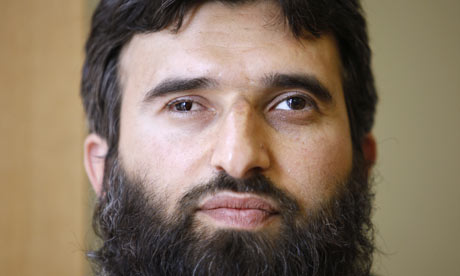
Omar Deghayes: 'I gave them a really hard time.' © Stefan Wermuth/Reuters
Excerpt: ‘How I fought to survive Guantanamo‘ (Guardian, UK)
I don’t want to give the impression I dislike Obama. I think he has toiled strenuously against many idiots this past twelve months. I think he’s carried a nation-sized curse of rhetoric and is subject to a Bush-beaten electorate hoping for more than neglect and dis-empowerment. However, I am disappointed he hasn’t yet been able to close Guantanamo, especially as it seemed like one of his easier-to-achieve promises.
Friend, Steve Silberman, pointed out Ezra Klein‘s WaPo article about where Obama has gone wrong this past year. Obama tried to get stuff done in a congenial manner but it was just not sexy enough for the American public. He never even tried to sell it;
Conclusion: No pleasing everyone. Politics is a b*st*rd of a career.
In the past I have provided varied perspective on Guantanamo. I put together a rudimentary Directory of Visual Resources. I alerted readers to important coverage of exceptional events here and here (granted, all events related to Gitmo are out of the extraordinary) and I have provided reflection on Guantanamo through the lenses of Bronstein, Clark, Gilden, Linsley, Pellegrin, Toledano and Lieutenant Sarah Cleveland.
Ultimately, none of these posts come close to describing or making sense of that most nonsensical of places. And so to ACLU’s latest video. My good mate Stan (cheers pal) posted earlier today:
Elsewhere, a friend of Prison Photography alerted me to the online journal JumpCut. Julia Lesage has assembled the most comprehensive webpage of Guantanamo links I’ve ever come across. Some of the links are already 404, but I would encourage you to peruse – I have still not exhausted the many resources. Leasge also contributes to the Spring 2009 issue with a section on ‘Documenting Torture’.
Today, I read this wonderful article about community acting cooperatively to send a message to the highest authorities.
Ruth Hooke contributing in the Guardian’s Comment Is Free:
A step has been taken to right the injustices being done to the remaining detainees at the Guantánamo naval base. On 4 November the representative town meeting of Amherst, Massachusetts, overwhelmingly passed article 14 of its warrant, which urges Congress to repeal the ban on releasing cleared detainees into the US and welcomes such cleared detainees into our community as soon as the ban is lifted.
To Sarah Palin, I’d state that this is true America.
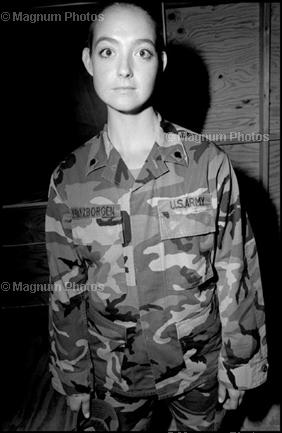

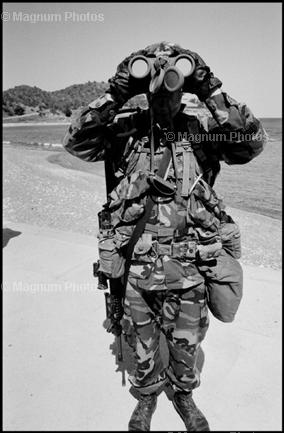

Go to Magnum and search “Gilden Guantanamo”. I’m not sure Gilden’s technique could really flourish at the illegal prison but he had a good go.
(From top left, clockwise) 1. Major-General Geoffrey Miller, Commander of Joint Task Force at Guantanamo Bay, is in charge of the 680 suspected enemy combatants in the camp. 2. Specialist Lily Allison Fitzborgen, a reservist who wants to become a police officer, is one of the guards who watches over the detainees. 3. Surveillance at Camp America. 4. Sergeant guard at a hospital for “enemy combatant” detainees. His name is blacked out so the detainees can’t see it. (Below) Before a prayer breakfast at Camp America.
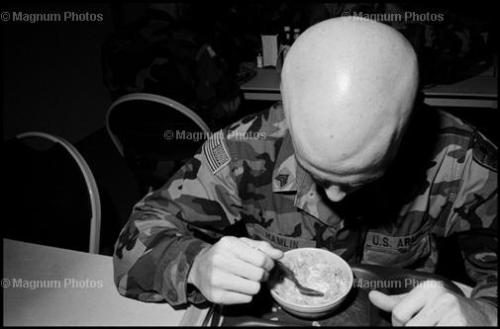
All photos © Bruce Gilden/Magnum
If I’ve ever heard an interview which encapsulates the pride-cum-naivety of the military rank and file, the necessarily difficult (but largely unprofitable) questions of the media and the legal blackhole the Cheney administration established with Guantanamo … it is this.
I was surprised to hear that detainees threw excrement and threatened to kill the guards. Perhaps this brash antagonism is a relatively recent development at Guantanamo, now it’s population is reduced to the most fanatical 200 or so prisoners.
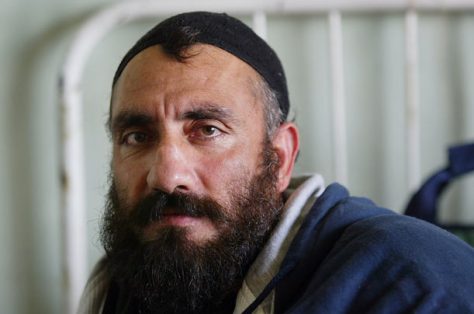
One of the first to be released in 2002, Mohammad, a farmer, says that he was forcibly conscripted into the Taliban, but tried to get away by surrendering himself to the enemy, the notorious warlord Abdul Rashid Dostum, who promptly served him up to the Americans. After less than a year, the Americans deemed him no threat and returned him to Afghanistan. He says that during his time in captivity, he was well treated by the U.S. military. © Paula Bronstein/Getty
In my recent feature of Edmund Clark’s work on Guantanamo (that focuses on not only the fabric of the prison but also the environmental details of their homes post-release) I was reminded of Paula Bronstein‘s Guantanamo detainee portraits.
Whereas Clark focuses on detainees released into Western – I presume UK – society, Bronstein tracks former detainees down in their homeland, Afghanistan. She has photographed returning prisoners many times since 2002. All her work is collated at here at Getty Images. Time magazine ran Portraits of Gitmo Detainees earlier this year.
There are many stories to consider, and they are of course more vital than the photographs. The early releases, including Jan Mohammad (above), from 2002 came with favourable testimony in which detainees said they were treated fairly and allowed to practice their religion.
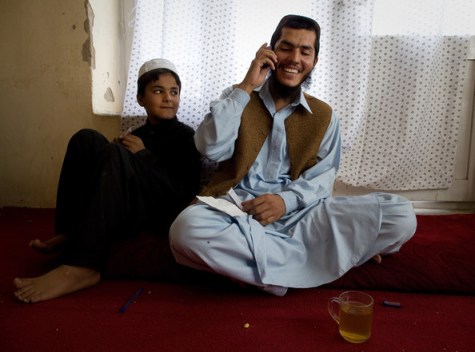
Mohammed Jawad talks on the phone to a friend as a relative looks on in his family home on September 25, 2009 in Kabul, Afghanistan. He was the youngest Guantanamo Bay prisoner only 17 when he was arrested six years ago, but his lawyer says he was 14 and family members say he was 12. Jawad's conviction was for throwing a hand grenade at two U.S. soldiers. The judge said his confession was obtained under torture. © Paula Bronstein/Getty
Mohammed Jawal, who could have been as young as 12 when he was detained was, according to a judge, tortured.
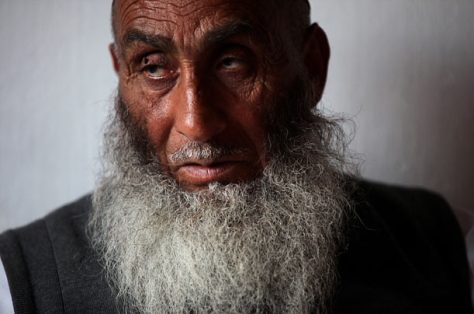
Haji Nasrat, 77 Released in 2006, the farmer was Guantanamo's oldest prisoner. Partially paralyzed for more than 15 years and illiterate, Nasrat says he does not know why the Americans detained him. Government documents relating to his case allege that he was a member of Hezb-e-Islami Gulbuddin, a former mujahadeen group said to be tied to Al Qaeda. © Paula Bronstein/Getty
Haji Nasrat, Guantanamo’s oldest detainee, has spoken words which bear the experience of failed American policy in Afghanistan, “When (the Americans) came to Afghanistan everybody was waiting for America to help us build our country. We were looking for you guys and we were very happy that you would come to our country. The people who hated you were very few, but you just grabbed guys like me. Look at me. Our very happiness, you changed it to (bitterness).”
After eight years of war and too many attacks that have killed civilians, President Obama’s military and non-military personnel have a large task to improve security and win back the trust of the Afghanistan people. Is it even possible? If not, the biggest losers resulting from the lie that was the war on Iraq – and all the distractions it carried – may be the people of Afghanistan.
Found via Travel Photographer

 Prison Photography