
You are currently browsing the tag archive for the ‘Iraq’ tag.

For a long time, in the early days of the war on Iraq, Abu Ghraib was a primary target for insurgents. Even before the photographs of torture were leaked, Abu Ghraib was mortared almost daily. Abu Ghraib held thousands of falsely accused men, the majority of whom were later released without charge, ceremony or apology.
Monica Haller‘s new book Riley and His Story is a collection of thoughts, diary entries and digital photographs from his tour of Iraq. For a period, Riley was a nurse in Abu Ghraib and the images from the medical tent are novel, uncensored, bloody.
Riley’s photographs from the hospital sits between snapshots from military vehicles, marines sat in paddling pools, goofy group shots, Al Franken (?) and decaying out-of-use planes.
This is the aesthetic we all know exists and we occasionally glimpse when there is interest, lawsuit or cultural re-use of military personnel snapshots in the media.
There must be millions of digital photos by American marines. Haller’s book is simultaneously a cleverly assembled piece of the wider dissemination of such imagery and an affirmation to the unexpected familiarity of such imagery.
A 21st century war is not a war without vernacular conflict photography.
Just as soldiers of WWI sent home words thus defining modern war poetry, so the soldiers of today bring home pixels and jpegs and define modern war imagery.
The singular prose, simile and letter-writings that painted a mind’s picture have been replaced by the multiple functionaries and fingers of digital observation.
As were the Abu Ghraib torture photographs, why shouldn’t we expect the next most iconic images of this century to be amateur snapshots? And why shouldn’t we be prepared for an equivalent violence in said iconic imagery?
It is curious that discussions about the lamentable loss of unembedded journalism have not always been balanced by discussion on the tumorous growth of ‘soldier-journalism’ (a term unsuitable, but an understandable extrapolation from the term ‘citizen-journalism’).
Whether you like it or not, the Canon PowerShot and its hand-held competitors own the future of war coverage.
Wilfred Owen and Siegfried Sassoon buffered the cruelty of war, but there are few artists now. (We are grateful to Haller for being such a thoughtful manager of Riley’s output.) Nothing is softened or made poetic/metaphorical. Laid bare. Perhaps, both the best and worst of scenarios we should expect is military censorship?
Monica Haller’s book is important not because it is Abu Ghraib and not because the images are snapshots made by American military personnel, but because it is a portent of an aesthetic already upon us. And we are in denial.
From here on in photography is ugly.


I found this project through Alec Soth on the Little Brown Mushrooms blog, via LensCulture.
A video interview with Haller is permanently available at LBM vimeo.
A sizeable preview pdf (over 100 pages) of Riley and His Story is available here.
Riley and His Story has a website. You can find out more about Monica Haller here, here and here.
–
UPDATED: SARAH SHOURD WAS RELEASED FROM EVIN PRISON ON 14TH SEPTEMBER, 2010. SHANE BAUER WAS RELEASED ON SEPTEMBER 21ST, 2011
–
Shane Bauer, Sarah Shourd and Joshua Fattal are imprisoned in Tehran’s notorious Evin prison. They are not spies; they are principled activists, valued journalists and now political pawns.
I’d like to summarise their situation and then focus on Bauer’s ongoing work in Sudan.
HIKING, CROSSING, LANGUISHING
Earlier this week I met Shon Meckfessel, one-time Cake band-member, occasional anarchist, and long-time writer for literary, political periodicals.
Shon has been known most recently as the fourth member of the hiking party on the Iraqi Kurdistan/Iran border. Shon is not in Tehran’s notorious Evin prison because he – due to illness – delayed the start of his hike by 24 hours.
The day after his three friends Shane Bauer, Sarah Shourd and Joshua Fattal had set out, Shon got on a bus headed to the same trail-head with the intention of catching up. While on the bus, he received a call from Shane telling him that the three of them had just been detained by Iranian border patrol. That was on the 31st July, 2009.
Most US mainstream media coverage has been neutral presentation of the known facts, sometimes peppered with confusion and incredulity. It has focused on the absurdity of the situation instead of the integrity of the writing, teaching and activism of the three members of the party.
Outside of the media, there has been organised support. There has also been the minority view – the predictably offensive right-wing nut-jobs.
To answer briefly the questions of how and why a party of Americans were hiking near the Iranian border, Iraqi Kurdistan has been peaceful for nearly twenty years since the close of the first Gulf war.
Shane, Sarah and Joshua were all seasoned travellers and they had been advised that the mountains and waterfalls of Ahmad Awah in the North East were well worth a visit. Shon and his friends travelled to As Sulaymaniyah together. When they took the two hour bus ride from the city they thought it headed northwest, not eastward. No locals they spoke to mentioned the proximity of the Iranian border.

Shon, Shane, Sarah and Joshua stayed in As Sulaymaniyah (bottom left) for a night. The bus ride they thought went north west in fact headed east to Ahmad Awah (top right).
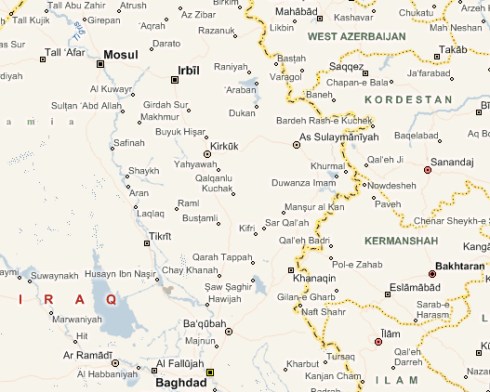
As Sulaymaniyah and Ahmad Awah are in Kurdistan, North Eastern Iraq. The areas marked Kordestan and Kermanshah are in Iran.

Iraq and Iran border and territories.
For a long time – aside of an early factual statement (August 6th) – Shon stayed out of the media spotlight and let the Department of State run its diplomatic channels. However, his friends remain imprisoned. Recently, media coverage of the story has declined (Diane Sawyer’s direct questions to a prevaricating Ahmadinejad the exception). On November 2nd, Shon wrote an open letter to Iranian President Ahmadinejad:
I had hoped that the misunderstanding would be resolved quickly. Three months have now passed, and I cannot imagine what more the Iranian authorities might have to learn about my friends or what they were doing in the area. … Mr. President, by continuing to deprive Shane, Sarah, and Josh of their liberty, Iran is working against some of the very causes it supports. Each of these three has a long and public record of contesting injustice in the world and addressing some of the inequities between rich and poor which you have spoken about through their humanitarian work in their own country and overseas.
Shon goes on to describe their various work and causes. Read the letter in full. Also on November 2nd, Shon appeared on Democracy Now! to reassert his position that the Iranian authorities can have no illusions as to their characters.
On November 9th, the three were charged with espionage.
Of the three, Shane Bauer has written and published the most. Most recently his article, Sheikh Down (Mother Jones) described how the ‘Pentagon bought stability in Iraq by funneling billions of taxpayer dollars to the country’s next generation of strongmen’.
Shon notes, “As a fluent speaker of Arabic, Shane has focused on injustices in the Arab world, in Iraq and Palestine in particular. The Christian Science Monitor published Shane’s January 7th interview with Musa Abu Marzook, the only English-language interview with a Hamas leader during Israel’s attack on Gaza.”
SHANE BAUER’S DARFUR PHOTOGRAPHY
I could have as easily featured the publicly available works of Josh or Sarah; each of the three illustrate their non-spy credentials through their past writings and journalism. That said, neither Josh or Sarah are involved in photojournalism or multimedia journalism as Shane is.
As Shane’s AP editor said in the clip atop this post, there are not many twenty somethings in Darfur freelancing and living with Sudanese rebels.
I have picked out five images from Shane’s Darfur series, but he also has produced two multimedia pieces One Day with the S.L.A. and Darfur: Rebellion from the Margins. In both stills and video he is trying to offer a context for the rebels bearing arms. The equation is simple: without a fight they would have “been run into the desert, where there is no water and left to die”.
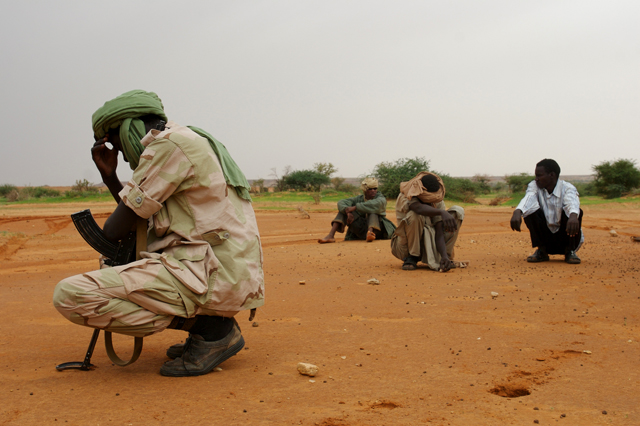
Rebels from the SLA-Unity faction sit stranded in the countryside. North Darfur, 2007. © Shane Bauer
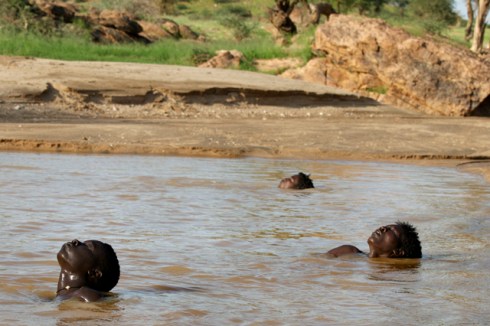
In the heat of the summer, SLA rebels swim near their base after a long night of rain. Deisa, North Darfur, Sudan, 2007. © Shane Bauer

A UN helicopter takes off after delivering medical supplies to a small clinic that was looted by the Janjaweed. Many Darfuris are demanding a UN peacekeeping force to replace the beleagured African Union mission, but for now the UN is limited short stopovers to deliver small boxes of supplies to villagers. Bir Maza, 2007. © Shane Bauer

Village elders meet in North Darfur. Many civilians remain in the countryside, either because they cannot afford to travel to a refugee camp or because they refuse to leave their homes, 2007. © Shane Bauer
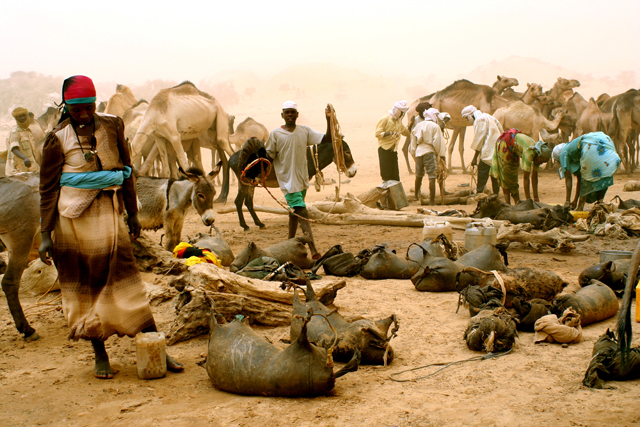
Women collect water in goatskins at a well in Farawia, North Darfur. With no water facilities and many wells poisoned or destroyed by the Sudanese government and its janjaweed militias, people have to travel long distances to find water. 2006. © Shane Bauer
The stills and video are a privileged view of existence for the Sudanese Liberation Army and the civilians they protect, but it is also a view that has dated. Shane continues to work on a feature length film about these same civilians, the S.L.A. and their continued struggle. Time ticks on.
Given that Shane is an accomplished photographer, I was a little surprised that his cause hasn’t been forwarded much in photographic circles, or more specifically the photoblogosphere. Jack Kurtz picked up on the story and posted it to Lightstalkers but it got no takers. Shane is a member.
Tewfic liked Shane’s Darfur multimedia but missed the story of his and his friends capture … as many of us did.
And, of course, we only anticipate Shane’s release in the context of all three’s release.
HELP HERE, HELP THERE
Perhaps, especially when the photographic community are mobilising to help in Haiti, we should also be aware of ongoing problems elsewhere?
The family have set up the Free The Hikers website, and also Facebook and a Twitter. We can start there with our actions.
BIOGRAPHIES
Shane Bauer received 1st place for independent audio slideshow features in the 2008 NPPA’s Best of Photojournalism contest. In 2007, he was a national finalist for photojournalism in the Harry Chapin Media Awards as well as a national finalist for feature photography for the Society of Professional Journalists’ 2007 Mark of Excellence Awards. He also received the Lyon Prize in photography that year. (Source)
Sarah Shourd, 31, is an English teacher in Damascus and is learning Arabic. She previously taught as part of the Iraqi Student Project, a program which gives Iraqi students living in Damascus the skills to continue their education in US schools. Sarah has written articles on travel and social issues reflecting her time in Syria, Ethiopia, Yemen and Mexico (Escape From Iraq: A Muslim Family Finds Solace in Ramadan, Brave Eyes, Laughing Hearts: My First Encounter with Yemen, Families Shout Their Love Across Minefields in Golan Heights). She attended UC Berkeley in the San Francisco Bay Area, where she lived after graduating until moving to Damascus with Shane. (Source)
Joshua Fattal began undergraduate work at UC Santa Barbara and graduated from UC Berkeley (2004). For three years after college he was invested in the Aprovecho Research Center, a sustainable living project in Oregon. In 2009, Josh was on a years travel partly independently and partly as a teaching assistant for the International Honours Program ‘Health and Community’ semester. (Source)

Still from video shown to the Baha Mousa public Inquiry showing Corporal Donald Payne, formerly of the Queen's Lancashire Regiment, shouting and swearing at hooded Iraqi detainees.
The British Army is facing accusations as serious as those leveled against the US military at Abu Ghraib.
Let me offer some context of UK Army abuses in Iraq.
Only one British soldier has ever been sentenced to prison for detainee abuses in Iraq. He is Corporal Donald Payne. Above is a still from this very disturbing video which was released in June of this year into the inquiry of Baha Mousa‘s death. A long-running and contradicting narrative followed this case since Mousa’s death in 2003 and the opening of the first inquiry in 2006. BBC has a timeline.
It seems that Corporal Payne and the six other soldiers aquitted during this inquiry may not have been the only British soldiers involved in abuse. I must say that these allegations are still just that – they are unproven, yet to be fully investigated.
Robert Verkaik of the Independent has pursued this story here and here:
The 33 new cases, which form part of a pre-action protocol letter served on the MoD last week, include allegations of mock executions, dog attacks, rape, exposure to lewd acts and exposure to pornography. The abuses are alleged to have occurred in 2003 – the time as Baha Mousa’s torture and death.
It is suggested it has taken so long for the allegations to come about because the Iraqi’s were fearful of reprisals during the British occupation of Southern Iraq. UK forces pulled out in April, 2009. Three camps are named: Shaat-al-Arab camp (shown below), Shaaibah British camp and Akka in Al-Zubayr.

Shaat-al-Arab camp, Southern Iraq
Details of abuse:
In May 2003, a 16-year-old Iraqi was among a group of Iraqis taken to the Shatt-al-Arab British camp to help fill sandbags. When the Iraqi youth, who wishes to remain anonymous, and his friends had filled the available sandbags, a British soldier indicated that he should enter a room, from where he assumed that he was to retrieve more sand bags, he says.
On entering the room, he claims he saw two British male soldiers engaged in oral sex. As soon as the two men saw him enter, they started to beat and kick him, he alleges. When he fell to the floor, one of the men held a blade to his neck while the other soldier stripped him naked. Although he screamed in protest, the two British soldiers, one after the other, raped him.
More:
They took off our blindfolds and I could see that we were surrounded by seven or eight soldiers. There were five of us. They asked us to pick fights with one another, or fight them. They were laughing at us and taking photos with digital cameras. They made us squeeze in pile-up, as in Abu Ghraib prison photos, while a soldier stood on top of us and started shouting and laughing. I felt so humiliated and treated as a toy they messed up with.
They picked further on a younger man who was good-looking. They made him strip naked and started messing with his penis and taking photos. “On one occasion I refused to pick a fight, then a soldier kicked me hard on my back, which made me fall on the floor. He started hitting me with a baton on my knees. Then he used an electric baton on different parts of my body.”
Source: Independent Saturday, 14 November 2009
Of course one wonders now whether the investigations will publish the photographic evidence or if it will be used only internally.
Personally, I have no desire to see these images. I sympathise with arguments to say that only through release of such images can the world know the full extent of what happened, but I also doubt what we can actually and accurately “know” from photographs that we wouldn’t otherwise learn through full disclosure and description of events.
It is extremely unfortunate that both Google and Daylife image searches for “Shaat-al-Arab camp” result in this image.

British soldiers share a laugh as their comrade walks around dressed as Borat, the Kazakh journalist played by British comedian Sacha Baron Cohen, during Christmas celebrations at the Shatt al-Arab camp in the southern Iraqi port city of Basra on December 25, 2008. The Iraqi parliament has voted to allow the presence of non-US foreign troops after December 31, giving British troops a legal basis to remain beyond the expiry of a UN mandate. © ESSAM AL-SUDANI/AFP/Getty Images
But the madness, brevity, violence, stress, justified escapism, testosterone and “laws” of war are vastly different than in any other milieu.
It just seems to me that the internet has collided stories and images here that could be as valid a critique of 20th century war as any of the great American Vietnam films.
____________________________________________________________
Interestingly, Shaat-al-Arab camp was erased by Google from their maps three years ago for security reasons. This action seems warranted as Shaat-al-Arab camp was a common target for insurgents – as Abu Ghraib was. Details are described half way through this article.
Thanks to Sean for the tip off.
Adam Broomberg and Oliver Chanarin
‘Unconcerned but not Indifferent’ Foto8 (March 2008)
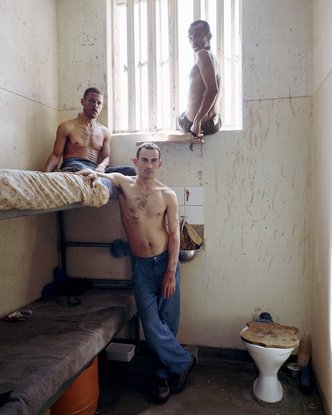
Timmy (center), with Peter (left) and Frederick, Pollsmoor Maximum Security Prison, South Africa (c-type print, 12" x 16", 2003)

Dion, 41, General in the 28s describing his imaginary uniform, Pollsmoor Maximum Security Prison, South Africa (c-type print, 12" x 16", 2003)
If two ends of the spectrum were identified this week during the debate about race and how it is (mis)treated by photographic practice we could see them as the moronic fashion world practitioners and then everybody else – “everybody else” being social documentarians, new-media image-makers, old-school bang-bang-club photographers and fine art practitioners. This second larger group is where most thoughtful folk place their energies.
Bizarrely there are a couple of guys who run the length of this spectrum. Adam Broomberg and Oliver Chanarin used to be the creative directors of Benetton’s controversial Colors Magazine AND they travel through Africa and Central America taking photographs of people in institutions.
Broomberg and Chanarin have also pissed a lot of people off. They are that good.
We all remember Steven Mayes’s departure speech from the World Press Photo, but Broomberg and Chanarin beat him to his oft-repeated remarks that photographers repeat motifs and collectively thicken the pen around photojournalism’s self-drawn caricature.
A full year prior to Mayes’ rallying call for new imagery (genuine, everyday Black culture; affluent drug use and users; and real sex), Broomberg and Chanarin were throwing punches low and hard at photojournalism’s conceit. They quoted Brecht; ‘The tremendous development of photojournalism has contributed practically nothing to the revelation of the truth about conditions in this world. On the contrary photography, in the hands of the bourgeoisie, has become a terrible weapon against the truth.’
In turn, Broomberg and Chanarin relied on Sontag and Barthes;
‘Since its inception photojournalism has traded in images of human suffering. If one of its motivations for representing tragedy has been to change the world then it has been unsuccessful. Instead the profession has turned us into voyeurs, passively consuming these images, sharing in the moment without feeling implicated or responsible for what we are seeing. Roland Barthes summed up the analgesic effect of looking at images of horror when he wrote “someone has shuddered for us; reflected for us, judged for us; the photographer has left us nothing – except a simple right of intellectual acquiescence”.’
They provide a pat description of the “obscene feeling” jury process in which there is no text, caption or context. Judgement is dependent only on the aesthetics of the image: “We are asked to judge whether, for example, a photograph of a child suffocating to death in a mudslide is sufficiently beautiful to win a prize.” After this Broomberg and Chanarin explain the means by which the panel narrowed down the 81,000 images to five winners, suggesting with some contempt that Hetherington’s Exhausted Soldier was a predictable result.
Before I go any further, I should say that Tim Hetherington voiced a stirring rebuttal to Broomberg and Chanarin’s derision.
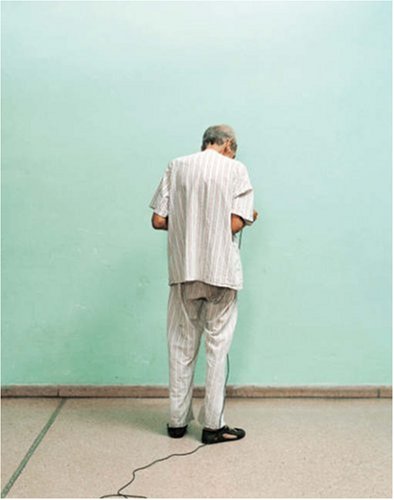
Self-Portrait by Mario, Ren Vallejo Psychiatric Hospital, Cuba. (c-type print 12" x 16", 2033)
So what? They’re a grumpy duo with a pocket full of common critical theory? Yes … and no. They go further. To my observations they apply what they preach. I have coined the term Slow Photography for this piece because they lug about a 4×5 camera and as well as standing over the top of their medium format to hold a conversation, they’ll usually stick around for a week or three.
They’ve described the relationships they build with their subjects as very important. Lucky for them they have the leisure to hang around you are saying?! Fair point, but they use their time well.
With Ghetto, they went to Pollsmoor Maximum Security Prison in South Africa and made portraits of male, female and transgendered inmates. They went to Ren Vallejo Psychiatric Hospital, Cuba also. In total they went to twelve rare communities, methodically photographing and asking the same questions: “Who is in power here? Where do you go to be alone, to make love, to be with friends? What are your hopes and dreams?”
I love that question, “Who’s in power here?”
Broomberg and Chanarin simultaneously reference old slower photo-processes and question the sped-up practices of 21st century photojournalism. Charlotte Cotton, Curator of Photographs at the V&A, has observed, “The sense of activity being slowed for the camera references nineteenth century photography both in terms of process and style. It also serves to detach their photographs from the conventions of photojournalism.”
And if we needed any more proof that these two geezers are on top of their game, lets look how they dealt with the two major conflicts of the beginning of the 21st century.
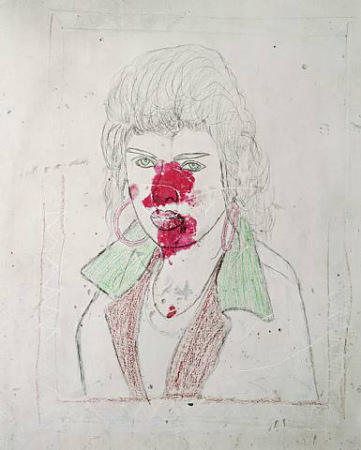
They got quiet with wartime scratches and scrawls, but have received none of the plaudits Peter Van Agtmael, Tim Hetherington, Roger Ballen or bubble chamber photography have.
The Red House documented the prison and torture center run by Saddam Hussein’s Baath party in Sulaymaniyah, Iraki Kurdistan, 330 kilometres from Baghdad.

The Red House

The Red House
The Red House
And, then when they were “privileged” enough to merit an embedded assignment with the British military in Afghanistan they thumbed their noses at any notion of photojournalism. Instead they took 70 metres of photo sensitive paper and unrolled sections to expose it to light and that became the record of each day and their time in conflict.
Each roll was given its title based on the occurrence of an event, death or absence of death during that day. Below is the work from the day of a prison escape.

The Jail Break, June 13th 2008. 76.2 x 600cm, c-type
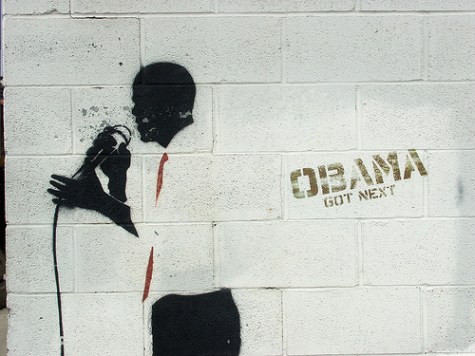
Obama Stencil. By Christopher V. Smith. Source http://www.flickr.com/photos/christophervsmith/3382123801/in/pool-obamastreetart
Obama’s decision to quash the release of Iraqi prison torture photographs has welled across the journo networks today. It began as a rumour and then confirmed by the Huffington Post, New York Times and other major news outlets.
Last month, I blogged about ACLUs legal victory and announcement of images release on May 28th. I told you to keep the date in mind as the images were sure to be a thwack on the retina – of course, not half as bad as some of the thwacks of twisted acts meted out by American rank and file under America military order.
I even went as far to say that Obama – with seeming little control – would possibly suffer at the fate of an early leak. Well, Obama’s done his u-turn and it looks like he might stop their release. He gets some support from Tomasky at the Guardian, but I can’t buy this argument. Obviously, Obama’s worried about the safety of his troops but the rest of us are worried about Cheney et al. getting off scott-free. The official line is that the Abu Ghraib abuses have been investigated fully, but in truth 25 low ranking officers were hung out to dry. There was no accountability further up the chain.
We should bear in mind that these are new images to the public and media, but not to politicians and internal investigators, and this is not the first time images have been suppressed and challenged.
The military’s mood was one of relative calm last month, with army investigators going on record that “these images are not as near as bad as Abu Ghraib”, but some are recalling long forgotten testimonies from 2004, namely by Seymour Hersh, here, here and here.
Hersh alleged that the children of female prisoners were sodomized in front of their mothers. These assertions were made on two occasions in 2004 – during a speech at the University of Chicago and at an ACLU conference.
There were audio files of these speeches online, but they do not seem to be operating. ACLU will have this on file nonetheless. And, in any case, Information Clearing House has a transcript of Hersh’s statements, from which I quote below:
Some of the worst things that happened that you don’t know about. OK? Videos. There are women there. Some of you may have read that they were passing letters out, communications out to their men. This is at [Abu Ghraib], which is about 30 miles from Baghdad — 30 kilometers, maybe, just 20 miles, I’m not sure whether it’s — anyway. The women were passing messages out saying please come and kill me because of what’s happened. And basically what happened is that those women who were arrested with young boys, children, in cases that have been recorded, the boys were sodomized, with the cameras rolling, and the worst above all of them is the soundtrack of the boys shrieking. That your government has, and they’re in total terror it’s going to come out. It’s impossible to say to yourself, how did we get there, who are we, who are these people that sent us there.
When I did My Lai, I was very troubled, like anybody in his right mind would be about what happened, and I ended up in something I wrote saying, in the end, I said, the people that did the killing were as much victims as the people they killed, because of the scars they had.
I can tell you some of the personal stories of some of the people who were in these units who witnessed this. I can also tell you written complaints were made to the highest officers. And so we’re dealing with an enormous, massive amount of criminal wrong-doing that was covered up at the highest command out there and higher. And we have to get to it, and we will. And we will, I mean, you know, there’s enough out there, they can’t.
And finally, if you thought you’d experienced the depravity of Abu Ghraib via the pictures – and if you thought you understood the extent to the crimes – you’d be wrong. This Guardian article, quoting Washington Post relays the testimony of a detainee witness to juvenile rape.
Detainee, Kasim Hilas, describes the rape of an Iraqi boy by a man in uniform, whose name has been blacked out of the statement, but who appears to be a translator working for the army.
“I saw [name blacked out] fucking a kid, his age would be about 15-18 years. The kid was hurting very bad and they covered all the doors with sheets. Then when I heard the screaming I climbed the door because on top it wasn’t covered and I saw [blacked out], who was wearing the military uniform putting his dick in the little kid’s ass,” Mr Hilas told military investigators. “I couldn’t see the face of the kid because his face wasn’t in front of the door. And the female soldier was taking pictures.”
It is not clear from the testimony whether the rapist described by Mr Hilas was working for a private contractor or was a US soldier. A private contractor was arrested after the Taguba investigation was completed, but was freed when it was discovered the army had no jurisdiction over him under military or Iraqi law.
IF THE IMAGES PEGGED FOR RELEASE ON THE 28TH ARE TO STIR UP FRESH INQUIRY INTO SEXUAL ABUSE OF JUVENILES THEN OBAMA HAS A SERIOUS PROBLEM.
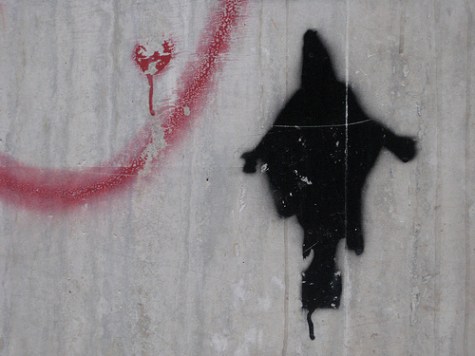
Detainee on Box Stencil. By Steve Reed. Source: http://www.flickr.com/photos/sreed99342/2077223377/
Author’s Note: I am taking my lead from Michael Tomasky for this blog post tying Obama’s call for a block on the release of images to the worst case scenario (sexual torture). Bear in mind that the buzz has been over 44 images – why, I don’t know – but over 2,000 were/are set to be released on May 28th. Also bear in mind that the images are said to be predominantly from facilities other than Abu Ghraib. There are a lot of unknowns in this matter. Nevertheless, I am sure of two things: 1) there is more visual evidence of abuse in existence and 2) Obama is obstructing the release of the latest evidence. Time will tell how these two variables cross or diverge.
First image by photographer Christopher V. Smith whose work can be found on his Flickr profile.
Second image by Steve Reed, whose work is on his Flickr profile and blog Shadows & Light.

US Soldiers in a Mosul Internet Cafe. Photo Credit: Andy HoboTraveler.com World Travels. http://www.hobotraveler.com/120mosul03.shtml
Last week, BLDGBLOG published How The Other Half Writes: In Defence of Twitter. It slammed Margaret Dowd’s “brain-dead editorial” in which she pouted like an adolescent instead of actually interviewing Twitter founders, Stone and Williams.
In Defense of Twitter was vitriolic and robust in its argument. Geoff usually sticks to urban-tectonics, mobile architecture and Los Angeles, so it was unusual to see him drop down to the base debate over whether Twitter is good or not. Alas, he dropped in and closed the debate.
Geoff’s argument was that Twitter is essentially a note taking application, and we shouldn’t crap ourselves just because the post-its are seen by the world.
Paul Carr’s article in the Guardian today suggested Twitter can take care of itself anyway. Twitter and other webomediasphere-folk have been brought in to consult on the loose ends and cable ends of a frayed Iraq. Carr exhorts
“I am not making this up. The department has just airlifted Twitter’s Jack Dorsey along with representatives from WordPress, Meetup.com, YouTube and Google into Baghdad to discuss how social media can help build Iraq 2.0″
Carr’s article runs at the same time the New York Times picks up on the story.
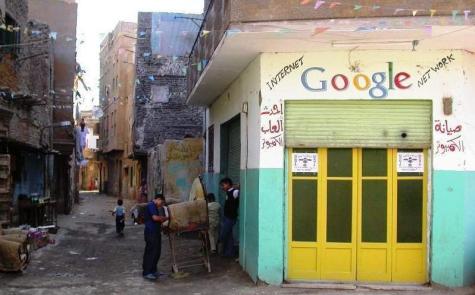
Internet Cafe in Baghdad. Photo Credit: BlogIraq (died April 2008). http://www.blogiraq.info/2007/02/22/at-last-google-opens-and-office-in-baghdad/
The US military’s partnership with non-military groups/corporations takes me back to a presentation made in 2005 (the pre-Obama era). Thomas Barnett bleated about the failings of the Iraq (mainly the “six months of dicking around” after Saddam was toppled). He relates all of this to the US military’s ongoing deficiencies since the end of the cold war. The American army can annihilate any chosen subject but it has not paid much attention to post-major-operations rebuilding. Iraq is a sorry testament to that fact. Barnett suggested a flood of 250,000 “administrators” into Iraq in April 2003 would have stabilised the country a lot quicker.
It seems the US military is now calling upon Twitter and others as “post-war administrators” infrastructure builders, vacuum fillers – whatever you want to call them – as described by Barnett. What should one make of this? Why shouldn’t Twitter et al. be working to improve the long term prospects of Iraq? The US military is great at shock, awe, power and might, but not building community. Barnett prefers his soldiers “young, male, unmarried and slightly pissed off”. But he insists the military personnel be followed up by a flood of partners who facilitate the the rebuilding of infrastructure. A 19 year old marine cannot carry out both distinct functions/philosophies of war.
I don’t like Barnett’s tone. I like his honesty about the realities of military combat, but not his pompous humour. Barnett takes on many groups; multiple government agencies, the UN, TSA, and not least liberals who squirm uncomfortably to pussy jokes. But just because he takes on the military – just because we share opposition to the Iraq war – does not makes us allies in thought. Barnett wants to make military better and ultimately a more efficient killing machine.
Military Icons for PC
It is perhaps this quote by Barnett describing the relationship of military and non-military responsibilities through hypothetical steps of entering, winning and closing warfare, that positions Twitter best. Twitter is part of the second group.
“The first group takes down networks, the second group puts them up. You’ve got to wage war here, in such a way to facilitate that [second group reconstruction activities]. “
Again, what should one make of this? Everyone knows about Halliburton, because of Cheney’s associations. Are Twitter and its do-no-evil web 2.0 pioneers any different to the tens of thousands of other corporate interests in Iraq?
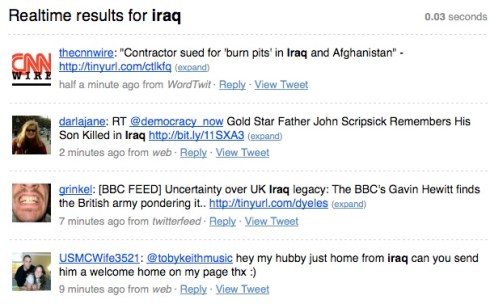
Screenshot of "Iraq" Search on Twitter. April 28th 2009
On Thursday, 28th May, photographs of prison conditions and detainee custody from six facilities other than Abu Ghraib will be released to the public.
Reports over the weekend suggested a figure of 44, but the Guardian has stated over 2,000 photographs are to be made public. Images of Bagram Air base in Afghanistan are included in the cache. Critics will surely scan for similarities in detention/torture methods used in Afghanistan as in Iraq to argue against the ‘few bad apples’ logic that railroaded earlier attempts to bring military and government commanding authorities to full-accountability.

ACLU’s advocacy deserves international acclaim. Not only have they forced the release of photographic evidence they won a ruling to prevent the destruction of audio tapes that record torture scenarios.
This is an interesting counterpoint. I presume we all assume we’ll see the images in the printed press. Would we expect the tapes to play on our televisions and radios? That scenario makes me uncomfortable.
Continuing with issues of format, it will be interesting to see how the media presents the-soon-to-be-released photographic documents in contrast to the recent torture memo’s. WoWoWoW set the bar low with the tabloid inquiry “How Bad Will They Be?” and the Los Angeles Times allays fears with a dead-pan assessment, “examined by Air Force and Army criminal investigators, are apparently not as shocking as those taken at Abu Ghraib.
No doubt these images will be contested and a ‘Meaning-War’ over the images will ensue, but I think people for and against the Bush administration’s interrogation policies are not going to change their position now – whatever the evidence.”
But, I guess it depends who’s looking.

Lefties want more weaponry in the push for prosecution of Bush and his cronies for war crimes. The right is debilitated and otherwise occupied by the economy, stocking guns before the “Obama-ban” and the latest Meghan McCain slur.
Politicians from both parties seem to want this to go away, snarking on about how the release of yet more Un-American activities will only fuel the burning hate toward the US. This position is an insult.
Did Bush care what Iraqi’s would think when he bombed them out of house and home? Did Bush care to think how American’s would react in the face of diminished civil liberties? Yet here, politicians of both parties are scrambling to avoid the negative reactions of entrenched, fundamental opponents INSTEAD of anticipating the beneficial good-will and return to mutual trust provided by honest disclosures of a transparent and constitutional government. Why cover-up a cover-up?
Maybe, the Democrats are shy to see these documents because they may implicate their top brass?

One concern I will air, is that all this could move toward some bizarre show-trial scenario, where lawyers bargain, Bush is spared, the American public settle for a conviction of Cheney, and careers and reputations lie in waste on both sides of the aisle!?!
I certainly didn’t expect the incriminating documents to flood as they have in recent weeks. I have no idea how all this is going to shake down. Obama doesn’t seem to have control of this. That doesn’t bother me. No-one can hold back the truth.
So, as wise at it’d be to remember the date, 28th May, you should bear in mind the photographs of abuse could well leak earlier…
________________________________________________
First Image lifted from Gerry May. http://www.gerrymay.com/?p=1426
Cartoon courtesy of the Nation. http://www.thenation.com/doc/20050307/duzyj
Final Image by Takomabibelot. http://www.flickr.com/photos/takomabibelot/2090273618/

An interior view of the dining facility at the newly opened Baghdad Central Prison in Abu Ghraib on February 21, 2009 in Baghdad, Iraq. Wathiq Khuzaie for Getty Images Europe.
Yesterday, my good friend Debra Baida sent me through the link to the New York Times Abu Ghraib – Baghdad Bureau Blog. This came at the same moment I was preparing a post to discuss the first images to come out of the renamed, refurbished and relaunched Baghdad Central Prison.
By far the best, and possibly the only, extended photo essay of Abu Ghraib Baghdad Central Prison is by Wathiq Khuzaie of Getty Images Europe. There is also this brief video from the BBC.
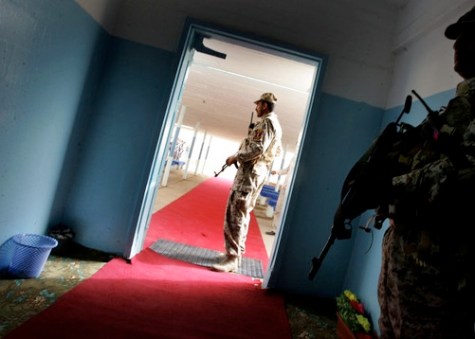
Iraqi security personnel stand guard at the newly opened Baghdad Central Prison in Abu Ghraib on February 21, 2009 in Baghdad, Iraq. The Iraqi Ministry of Justice has renovated and reopened the previously named "Abu Ghraib" prison and renamed the site to Baghdad Central Prison. Wathiq Khuzaie/Getty Images Europe
New Era, New Penology
The BBC noted, “Along with the change of name, the Iraqi justice ministry is trying to change both image and reality, billing it as a model prison, open to random inspection by the Red Cross and other humanitarian organisations.”
This transparency is a refreshing change to the policy of Abu Ghraib’s former operators. The work is not yet complete though and the upgrade is ongoing. The BBC describes, “[The prison] will eventually be the city’s main jail, holding about 12,000 inmates. Initially, only one of its four sections will be used. There are already about 300 prisoners there to test it out and, once the prison has been officially inaugurated, that figure will rise to 3,500.”
So, not only do Iraqi authorities want to repurpose the institution, they want to make it the penal institution of “The New Iraq”. This is an ambitious policy riddled with dangers; the site is loaded with memory and controversy. As the New York Times notes, “the promise of a new era can also be a time for remembrance.”
I highly recommend one goes onto read accounts from Iraqis, correspondents and photographers who lived and recorded Abu Ghraib’s recent history, particularly photographer Tyler Hicks’ account of Saddam’s prison amnesty in October 2002 that turned from celebration to human catastrophe.

Wathiq Khuzaie/Getty Images Europe

An interior view of one of the cells at the newly opened Baghdad Central Prison in Abu Ghraib on February 21, 2009 in Baghdad, Iraq. Wathiq Khuzaie/Getty Images Europe
Two things struck me about the photographic series of the new prison. Firstly, the number of flags, insignia and national colours across walls, above fences and emblazoned on uniforms. The Iraqi authorities have stamped their identity all over this project. It is the presentation necessary to supersede Abu Ghraib’s reputation.
Secondly, the pastel palette of many of the interior shots – namely the ubiquitous lilac. I want to know who has the decision-making power at Baghdad Central Prison! However, I suspect lilac paint was cheap and readily available; so it wasn’t so much a decision – more a fact created by circumstance.
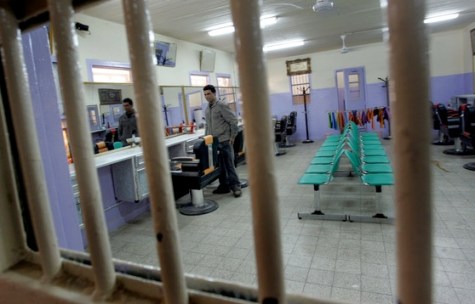
Interior view of the barbers shop at the newly opened Baghdad Central Prison in Abu Ghraib on February 21, 2009. Wathiq Khuzaie/Getty Images Europe.
Following that logic, one could presume lilac and purple fabric & thread is also at a surplus in Baghdad…

Interior view of sewing machines at the newly opened Baghdad Central Prison in Abu Ghraib on February 21, 2009. Wathiq Khuzaie/Getty Images Europe.
I don’t want to sound facetious, I was just shocked by the light purple, which according to colour theory is supposed to evoke emotional memory and nostalgia. Darker purples are supposed to represented, nobility, royalty and stability. From those evocations one is instilled with wisdom, independence, dignity and creativity.
If Baghdad Central Prison is to spur such emotional response in its inmate population it will succeed where many, many prisons have failed.
Basically, I am hopeful that the new prison can operate justly and succeed with the rehabilitation it emphasised this week. And despite all the lilac, soft-furnishings and current open media access – in reality it remains a prison with doors, locks and guards.
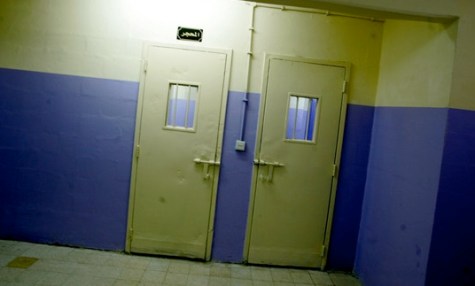
Interior view of cell doors at the newly opened Baghdad Central Prison in Abu Ghraib on February 21, 2009 in Baghdad, Iraq. The Iraqi Ministry of Justice has renovated and reopened the previously named "Abu Ghraib" prison and renamed the site to Baghdad Central Prison. According to the Iraqi Ministry of Justice about 400 prisoners were transferred to the prison which can hold up to 3000 inmates. The prison was established in 1970 and it became synonymous with abuse under the U.S. occupation. Wathiq Khuzaie/Getty Images Europe.

 Prison Photography