
You are currently browsing the tag archive for the ‘Jail’ tag.

Discombobulated
I was delighted to find this collection of “Jail Finds” recently. It is a quiet statement amidst the cacophony of dross we are subject to daily.
The person who documents these notes, scribbles and profundities works for a volunteer library service serving the local Dane County Jail and operated by the University of Wisconsin in Madison.
These are things I find abandoned in books or stuffed on the book cart at the jail where I volunteer. A little context: these come from a county jail, not a state prison – a very important distinction. Most inmates (approx. 75%) are short-term “holds.” They’re there awaiting trial (meaning they couldn’t afford bail); on probation violations; or are federal prisoners being shuffled around the system. About 1/4 are women and 1/3 are minorities. The vast majority stay less than 30 days.
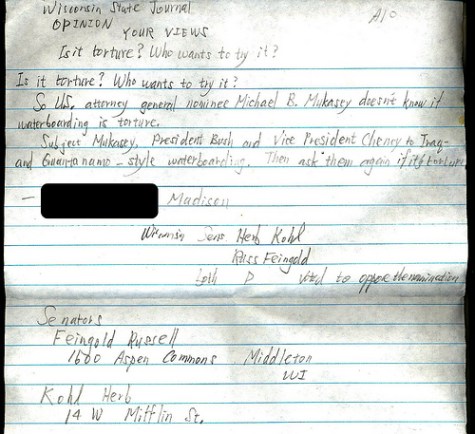
"Subject Mukasey, President Bush and Vice President Dick Cheney to Guantanamo style Waterboarding. Then ask them if it is Torture."

Events and Consequences

Health Testing Request
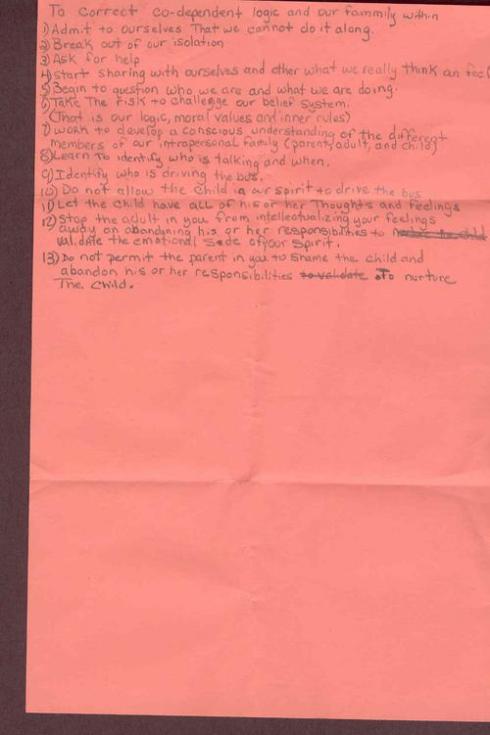
Childhood and Adulthood
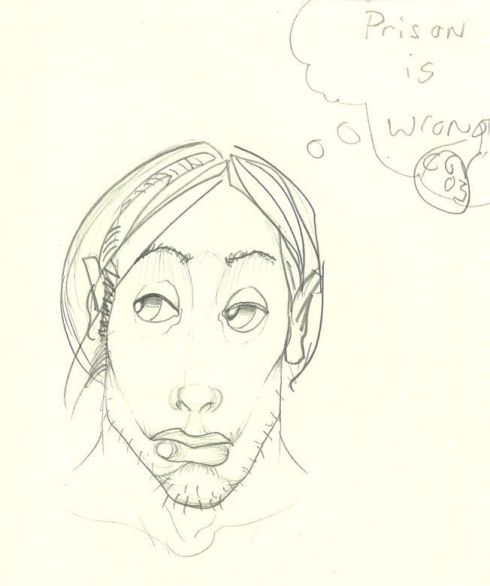
Prison is Wrong
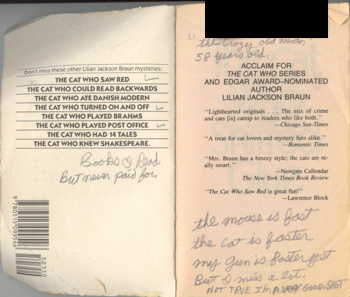
The Mouse is Fast, The Cat is Faster, My Gun is Faster Yet, But I Miss a lot. NOT TRUE, I'M A VERY GOOD SHOT

Vocabulary

Letter of pledges, hopes and favours.
What ties these examples and the other 100 or so in the collection is humanity and surprise. Humanity we should hope of all and surprise we should absolutely insist on from all. Some of these scribbles are penitent in the old fashioned ideal, some are reflections of harsh reality.
I wouldn’t argue, that in my mini-curation, I may be biased. I have picked the most appealing and the most redemptive of scripts, but I feel this only goes some small way to redress the imbalance of mainstream media that a) simultaneously condemns and sensationalises criminals and b) cares little for the transgressor once locked away.

"God give me serenity to accept the things I cannot change and give me valour to change those I can. And wisdom to recognize the difference. May your will be done and not mine."
“Prison Polaroids: A Dispersed Portrait of American Life”
I was speaking to Sheila Pinkel recently about photography within prisons. She said only once had she been inside a prison with a camera of her own. We shared wonder at those photojournalists who through luck or nous gain access within US sites of incarceration.
Sheila explained that photography was conducted in the visiting rooms. Standard practice is for a correctional officer or fellow inmate to operate a Polaroid camera and sell the Polaroids at $2 each.
Imagine those Polaroids gathered together and the dialogue they’d rouse as a collection. But this portrayal of America is dispersed, and its dialogue is absent.

Susanville

Susanville
Dr Maria Kefalas, Assistant Professor of Sociology at the University of Chicago noted the collection and display of Prison Polaroids in Promises I Can Keep, a book about mothers’ poverty in the US:
In the course of Kefalas’s fieldwork she was invited into more than a dozen living rooms that displayed a “Prison Polaroid”, sometimes held to the wall by a thumbtack or tucked into a framed family portrait on the television set. Prisoners, she learned, can have these taken for only (sic) a few dollars at the prison commissary and usually pen cheerful descriptions such as “Happy Birthday” or “I love you” on the back. When family members come to visit, the commissary photographer will, for a fee, commemorate the occasion with a keepsake Polaroid. One mother showed Kefalas a photo album of Polaroid photographs taken in the prisons’ visiting area – each commemorating one of the few times her daughter and her child’s father had been in the same room together over the course of the six years old’s life. the photos typically feature the inmate in his fluorescent orange department of corrections jumpsuit against a backdrop of a tropical beach scene, perhaps to give the illusion to the loved ones back home that their father is not in prison, but taking a much needed vacation.

San Quentin
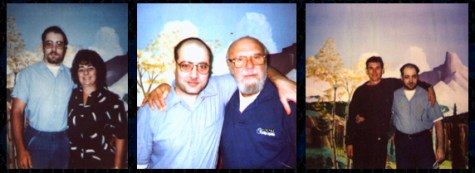
San Quentin
After some digging I found this account:
In the processing room there is an inmate store where one can buy articles made by inmates and also buy these cards for $2, good for a snapshot of you and your friend taken in front of this large poster of a waterfall in the woods. I got one of these cards and when my friend and I went to get our picture taken I asked if we could have the dining room and everybody in it in the background. This was a big no-no, as people might be recognized in the photo. I didn’t know. We had our picture taken by an inmate with a Polaroid camera who later passed out the photos to the different tables. It turned out real nice.

San Quentin
Visitors are prohibited from bringing their own cameras or phones to the majority of US correctional facilities. Frequently the visitor buys two, one for the mantelpiece at home and one to return to the inmates cell. But there is no negative – just as there is no album. The Polaroids are dispersed across a nation. I think it would be fascinating to such Polaroids together.
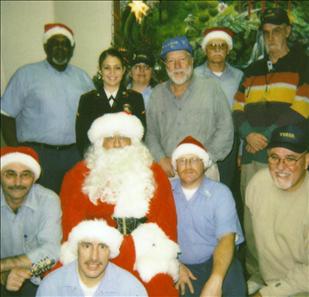
Santa with VVGSQ members and supporters. San Quentin Prison visiting room - December 18, 2005. The VVGSQ has always supported the San Quentin Christmas Toy Program with toy donations as well as by running the program each year. The Warden has authorized the VVGSQ to sponsor this program and the group purchased the "Santa" suit, beard and wig that is used for an appearance of Santa to the children each year at the visiting room. The program benefits all the children who come to visit family at San Quentin during the Christmas season. Started in 1988, December 2008 will be the 20th year the program has been giving toys to the children who visit San Quentin.
In piecing together this online group of images, I found it difficult to come across images. This does not surprise me.
In what circumstances do people scan their Polaroids of a prison visit for online upload? Just a few; friends & family with blog updates; purveyors of the macabre; journals of the death-row inamtes; inmate support groups and children’s rights organisations.
Please alert me to any other sources.
_______________________________
This is not a Polaroid but it is an image I came across here, with the enlarged image here. I had to include it. I challenge readers to find a better photographic portrait. The adult fights back tears and the child is solemn. Standing for the photo – for pride and for necessity – is a struggle for the father. The personalities are so strong, I wonder what words they have spoken to one another. Surely, the father’s outward show of emotion is typical of the sadness adults bear when behind bars, away from their children. I have no children. I can’t begin to know, even by comparison. These two portraits would excel as individual shots; to put them together is to light a firecracker under the seat of emotive curiosity.
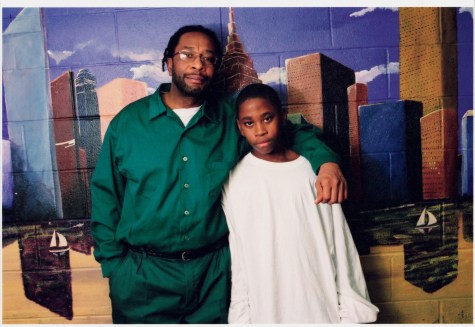
Father and Son
I also found this image on Flickr, which has a stark backdrop by comparison.
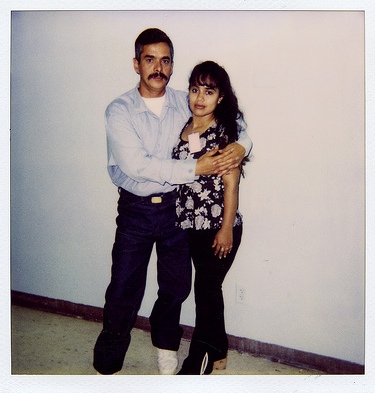
Jail Visit?
Thoughts?
How about that as a potent exhibition just waiting to come together? Millions of Prison Polaroids in frames & drawers; homes & cells across America. The dispersed portrait of incarcerated Americans could be assembled in one place. The scale would be overwhelming and the juxtapositions endless. Let me know if the notion intrigues you as much as it intrigues me.

Hailey, 2, reaches out for a quarter in her fathers hand, Shane Macleod, while her mother Danielle Macleod stares out from the table. Each visitor is allowed to bring $20 of quarters for the vending machine and nothing else. Shane, like all of the inmates in the visiting room must ask his wife and daughter to buy certain snacks, as he is not allowed near the vending machines. During the visits, Shane says, “There is just not a lot to talk about after a while, you can only beat a subject to death for so long.” The couple married four years ago outside of prison, and Shane says, “Prison just really messes up your life.”
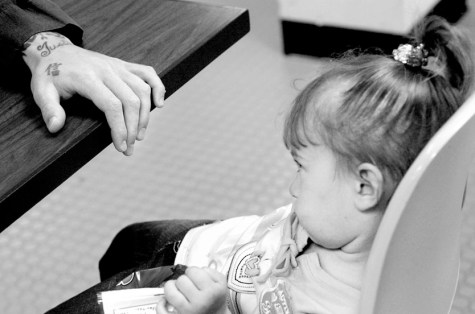
Hailey Macleod, 2, look outs across the table at her father, Shane Macleod, and his outstretched hand. Shane was incarcerated two months prior for bank robbery. Shane says. “It gets really stressful sometimes, to have my wife and daughter away from me.”
Elyse Butler repeat-visited New Hampshire State Prison in 2005. She was working as an intern staff photographer at the Concord Monitor in Concord, New Hampshire. The goal of the assignment was to capture the dynamics of relationships in the prison visiting room. Butler documented the behaviours of those within the room; “how these couples, families, and friends interact with each other when they have only a small amount of monitored time to spend together.” I asked a couple of questions.
How did you get access?
In order to get access into the prison we [Concord Monitor] had to contact the PR department and go through a process of paperwork and I had prison officers watching me at all times when I was in the visiting room.
What reactions did the work receive?
After the piece was done we got a great reaction from inmates and families in the visiting room. They were touched to have their time documented with their loved ones.

Heather Metcalf and Mark Vangordon hold hands at table 19 in the visiting room of New Hampshire State Prison. Vangordon is imprisoned for sexual assault and has been in the for a year. Metcalf says, “Not having him home is the hardest part.” When she is not visiting she waits for his letters to hear how he’s doing. During a visit, they are only allowed to have a 15 second embrace at the beginning and end of each visit and otherwise they are only allowed to hold hands above the table.

Lori Tasney and Chris Lang look into each others eyes as Marilyn and Daniel Haldeman hold each other at the end of a visit. Tasney and Lang have been dating for two years and plan to marry when he gets out. His current parole date is set for 2008. Lang was imprisoned for robbery in January 2005. Tasney visits twice a week, which is the most time any inmate is allowed visitors, but says “I would visit every day if I could.”
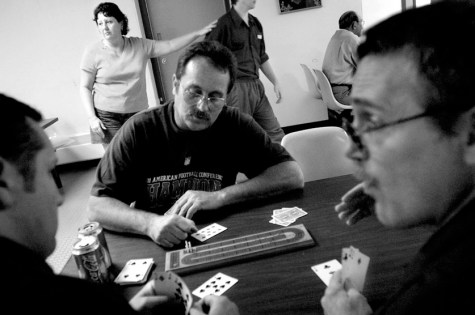
Mark Langlais plays cards with his brother, inmate Alphee Langlais (right) and his son, inmate Eric Langlias (left) while a mother gives her son one last touch at the end of a visit. This is the first time Alphee and Mark have seen each other since 1996. Mark claims, “Alphee’s been in here since his hair lost its color.” The family was estranged a long time ago, but they claim prison has brought them closer together. Eric was admitted for assault and Alphee was admitted on a parole violation following a prior sexual assault crime. Alphee carries around his inmate request slip as if its a trophy and cried when he finally spoke on the phone with his brother Mark. “This visit has been really special to me, ” Alphee claimed. Eric and his father always fought but no that he is on medication and his father is in counseling, Eric says “it is the closest we’ve ever been … I have always loved my father. I have always wanted him around.”
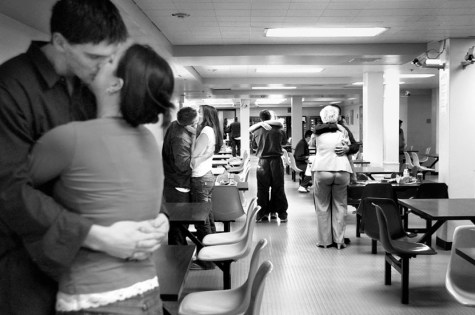
An inmate and his visitor share a last kiss and 15 second embrace, along with three other couples also saying their goodbyes, at the end of a visit. They started dating 5 months ago, only a month before he went to prison, and she says, “If he ends up having a long sentence, we probably won’t stay together.” He was admitted on a parole violation after an original conviction for multiple robberies and larceny. She says, “I come usually once a week. I hate coming here.”
Biography
Elyse Butler is represented by Aevum Photos. She is one of the hardest working and posting photographers in the business. She previously won College Photographer of the Year Award in 2004 for her documents of the porn industry. She has also photographed the debutante activity of La Jolla. I’d like to hear an interview between Butler, Lauren Greenfield and Wendy Marijnissen on the topic of female identity.
Butler did some nice portraiture in South America, but my favourite project of hers is “From Pond to Purse” which follows the trade of alligator products. Be sure to read Butler’s information on the project at her site in the ‘passion’ category.
BURN Magazine, under the fiscal umbrella of the Magnum Cultural Foundation, have announced a $10,000 grant “to support [the] continuation of the photographer’s personal project. This body of work may be of either journalistic mission or purely personal artistic imperatives”
I am encouraging people to take on the difficult task of securing prolonged and necessary time with a prison/jail/detention-centre population in order to faithfully describe the stories and systems of its particular circumstance. On top of that your product must be “work is on the highest level”.
It’s a tall order but if you have carried out portrait or documentary photography in a site of incarceration before (I know many of you), then submit an application to continue that critical and valuable work. It will have to better than my attempt.

San Pedro Prison, La Paz. July 2008.
Hmm. On the same day I encourage photographers to attempt access into sites designed to be impenetrable, the government and police in my home country have introduced “laws that allow for the arrest – and imprisonment – of anyone who takes pictures of officers ‘likely to be useful to a person committing or preparing an act of terrorism’.” (British Journal of Photography via In-Public)
BURN Magazine is a new(ish) venture by David Alan Harvey whose got a Magnum portfolio and his own internets.
Saint Valentine was executed on February 14th, 270 A.D. He was a priest in Rome who covertly married couples against Emperor Claudius II’s dictate. Claudius had banned marriage because wedded men were unwilling soldiers and he needed to sustain his warrior-class.
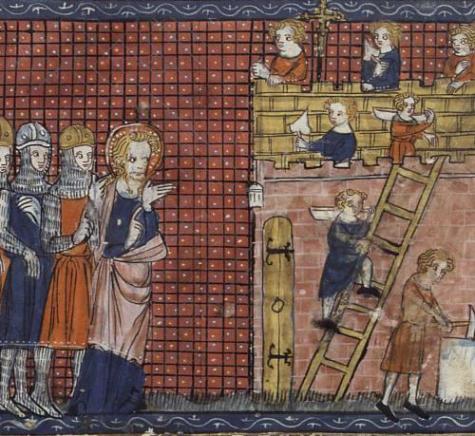
Wikicommons image: http://en.wikipedia.org/wiki/File:Valentineanddisciples.jpg
The mythology tells us that while in prison Valentine befriended the gaoler’s blind daughter. She brought him meals and they talked at length about imperialism, machismo and state control in the Holy Roman Empire. The night before he was “beaten with sticks and had his head cut off”, Valentine reached through the bars of his cell and touched her eye lids. She could see. It was a miracle. Later that night, Valentine penned a note to his ladyfriend and signed it “From your Valentine”. This was a first.
What next? The civic authorities mopped up the blood and the church went on a propaganda campaign. At that time it was the custom in Rome, a very ancient custom, indeed, to celebrate in the month of February the Lupercalia, feasts in honour of a heathen god. On these occasions, amidst a variety of pagan ceremonies, the names of young women were placed in a box, from which they were drawn by the men as chance directed. The pastors of the early Christian Church in Rome endeavoured to do away with the pagan element in these feasts by replacing the names of maidens with those of saints. And as the Lupercalia began about the middle of February, the pastors appear to have chosen Saint Valentine’s Day for the celebration of this new feast.

Modified captions on Colin Powell’s grainy images.
According to Joseph Pine we all crave – and will buy – authenticity these days.
According to Errol Morris we are more inclined to find authenticity in grainy low resolution images.
ERROL MORRIS: But, as we become more and more sophisticated about images — about how images are processed — haven’t we become more sophisticated about detecting fraud? Photoshop manipulations are relatively easy to detect. They fool the eye, but they don’t necessarily fool the expert.
HANY FARID: The answer is: yes and no. It depends on the image source. So, if we have the raw files[8], if we have the original footage from someone’s digital camera, you can’t fool us anymore. We have enough technology today where, given the camera, the original images that came off the camera, we can tell if you’ve manipulated them. If, however, you are talking about an image that has been cropped and reduced and compressed and posted on the web, then we might be able to do it, but there’s no guarantee. The task is decidedly harder because a lot of information has been thrown away. You’ve compressed the image; you’ve resized it. This is why all the Loch Ness monster and ghost images are always so tiny and grainy, because then you can’t see the signs of tampering. With low-res images it’s much harder to detect a fake. Definitely, when we have a high-res original image, we are much better at it.
[People often trust low-res images because they look more real. But of course they are not more real, just easier to fake. We look at picture of Nessie (the Loch Ness Monster). It’s grainy, fuzzy. It’s hard to make anything out. You never see a 10-megapixel photograph of Big Foot or the Abominable Snowman or the Loch Ness Monster. One explanation is: these monsters don’t exist. But if they did exist — so the thinking goes — they are probably unwilling to sit still for portraiture. The grainy images are proof of how elusive Nessie can be. This belief extends to documentary filmmaking, as well. If it’s badly shot, it’s more authentic. – E.M.]
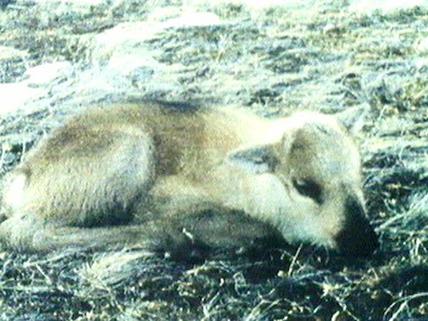
Grainy image of Caribou. From the Film Board of Canada, who gave Boards of Canada a name.
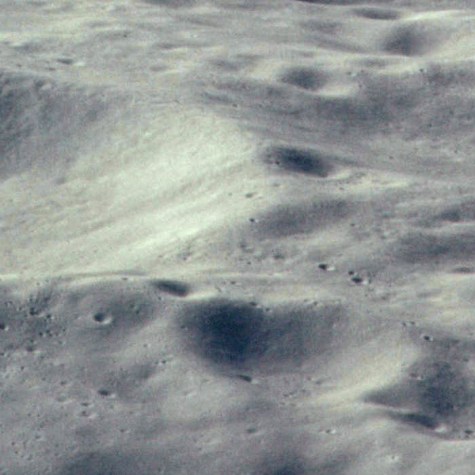
Grainy image of moon surface

Grainy image of Pentagon
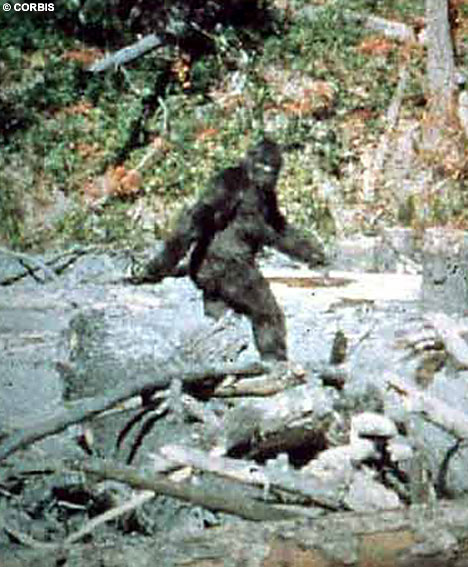
Grainy image of man in a flamboyant hirsute
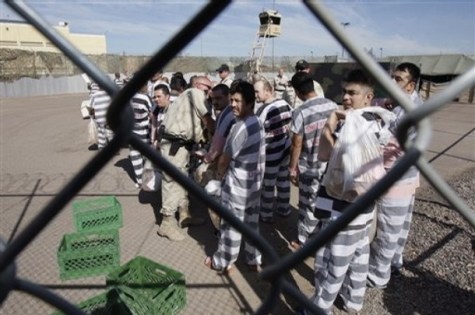
Approximately 200 convicted illegal immigrants handcuffed together arrive at their new part of the jail as they are moved into a separate area of Tent City, by orders of Maricopa County Sheriff Joe Arpaio, for incarceration until their sentences are served and they are deported to their home countries Wednesday, Feb. 4, 2009, in Phoenix. (AP Photo/Ross D. Franklin)
Hopefully, Prison Photography helps to clarify the facts behind images. In Maricopa County, Arizona yesterday the zealous Sheriff Joe Arpaio, ordered a parade of guarded, unsentenced & undocumented immigrants. Hand-cuffed and dressed in stripes, the men walked from one facility to Tent City. Hatewatch summarised the scene:
Along the way they were filmed by television news crews and guarded by at least 50 Maricopa County Sheriff’s Office (MCSO) deputies, wearing body armor and combat fatigues, armed with shotguns and automatic rifles. At least two canine units were present; a Sheriff’s Department helicopter hovered overhead.
The massive show of force was pure stagecraft for a blatant and dehumanizing publicity stunt orchestrated by Maricopa County sheriff Joe Arpaio. The MCSO gave no indication that any of the immigrant prisoners were particularly violent or presented a grave danger to the public.

Maricopa County Sheriff Joe Arpaio, left, orders approximately 200 convicted illegal immigrants handcuffed together and moved into a separate area of Tent City, inmates behind Arpaio, for incarceration until their sentences are served and they are deported to their home countries Wednesday, Feb. 4, 2009, in Phoenix. (AP Photo/Ross D. Franklin)
Arpaio, the self proclaimed “toughest sheriff in America”, has been roundly condemned by civil rights advocates, most of the regional media and clear-thinking locals for his colourful publicity stunt. Arpaio is a man hell bent on cleansing his county of undocumented immigrants and has done so by targeting Latino neighbourhoods, stopping Latinos for minor infractions (as an excuse for searching), and frequently deployed mask-wearing/gun-toting forces in petty shows of strength. Hatewatch elaborates on how all this is possible:
Arpaio is lionized by Minutemen vigilantes and other nativist extremists for his controversial “287(g)” arrangement with U.S. Immigration and Customs Enforcement, which empowers the MCSO, a local agency, to enforce federal immigration law.
Many Latinos taken into custody in recent months by MCSO 287(g) squads have been pulled over for minor traffic violations, such as a broken headlight or an improper lane change, and then arrested when they’re unable to produce proof of citizenship or a valid visa.

Feb. 4, 2009, in Phoenix. (AP Photo/Ross D. Franklin)
Arpaio is a nasty piece of work and it is unlikely he will let up. Alessandra Soler Meetze, executive director of the ACLU of Arizona, said “You’re sort of giving the message that it’s OK to treat these inmates differently. It’s OK to treat them like circus animals.” Meetze added, “He didn’t have to make a spectacle. He could’ve moved them on buses.” In the meantime, Arpaio said his office has received $1.6 million funding from the state that will go toward tackling illegal immigration.
Is dehumanisation is the issue? The point has been made on the blogs that when Iraqi forces paraded five US marines in March 2003, Rumsfeld cited it as a breach of the Geneva Convention, and yet here on American soil we have men defined as criminals, reduced to visual cliché and props in a vulgar display of power. Do these images shock? They shock me. Are they not images of racist control by the state?
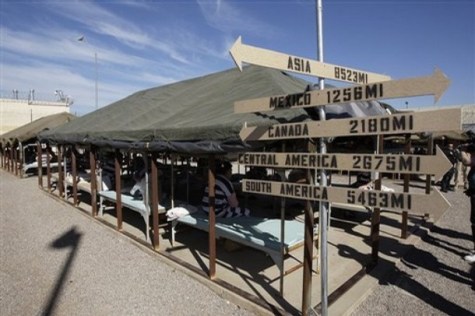
Feb. 4, 2009, in Phoenix. Arpaio said housing the illegal immigrants separately would save money, although he did not explain how other than to say it's cheaper to house inmates in tents than at traditional jails. He also said the move will be more convenient for consulate officials visiting foreign inmates and for Immigration and Customs Enforcement agents charged with deporting the inmates after they have served sentences in county jails. (AP Photo/Ross D. Franklin)
Fortunately, Arpaio, try as he might, is not winning the public relations war. His brand of policing is considered by many as direct challenge to law.
Speaking of law. The Phoenix New Times noted, this pantomime just happened to fall “on the same day that his employee and political helper, Captain Joel Fox, is set to appear at a hearing to context a massive $315,000 fine for making an illegal campaign donation in the name of the mysterious “Sheriff’s Command Association,”
Which event do you think average news consumers will remember on Thursday – an administrative hearing concerning a convoluted tale of campaign finance laws, or the image of 200 Mexicans in stripes marching in chains down a public street?
Last year, Arpaio paid a visit to one of his tent jails. It gave him the opportunity for yet another photo opportunity!

Former world heavyweight boxing champion Mike Tyson listens to Sheriff Joe Arpaio (R) in the tent Tyson will stay in for 24 hours at Maricopa County Jail's tent city for prisoners in Phoenix, Arizona November 20, 2007. Tyson was sentenced on Monday to three years probation and one day in jail for drug possession and driving under the influence. Tyson is holding a copy of the book "American Gangster" according to Maricopa County Sheriff Joe Arpaio. REUTERS/Photo Courtesy of Maricopa County Sheriffs Department/Handout
I’ll leave you with this eloquent summary of Arpaio’s antics from Kevin Appleby, the Director of Migration and Refugee Policy with U.S. Conference of Catholic Bishops, “Shackling and marching fellow human beings for all to see is not in line with the values of the American people. While Guantanamo (Bay) is being closed, another one is being started in Arizona,”
For more images of this circus, see Jack Kurtz’s Blog or Ross D. Franklin’s AP Gallery. If you’d like to book a tour of the Tent City, Sheriff Arpaio’s office can make arrangements. Be sure to wear smart casual.
Thanks to Brendan at Anxiety Neurosis for sharing this through Google Reader
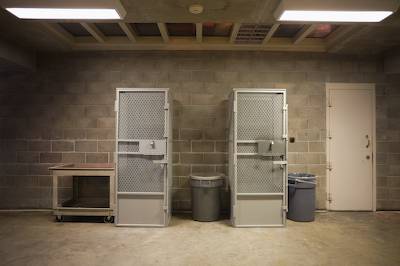
Holding cells, general population area, Security Housing Unit, Pelican Bay State Prison, Crescent City, California. Richard Ross
In this response to Richard Ross’ Architecture of Authority I’d like to discuss two pictures – the first, Interview room, Abu Ghraib prison (“hard site”), Abu Ghraib, Iraq and the second, the Detainee housing unit, Camp Remembrance, new Abu Ghraib Prison, Iraq.
There is rich discussion to be had with Richard Ross’ Architecture of Authority. Political footings jockey with ethical inertia, jockey with instructional histories, jockey with considerations of the soul. Readings thick and fast. No less, these meta-narratives are deformed by one’s own emotional interruptions. One recollects perhaps passages and interrogations through border controls, transport hubs, reception rooms and state corridors. One recalls school, streets and flaking paint.
Random knowledge bombards the equation, – Raves at Ansthruther’s decommissioned nuclear command centre during university days; A deliberate detour made during honeymoon to locate Pelican Bay maximum security prison; An introduction at San Francisco International.
My good friend, and Hesitating co-conspirator, Keith Axline recently featured Richard Ross in a Wired gallery. Keith explained to me that it is Ross’ ability to rattle shutter and catch the necessary shot every time that impressed him most. Ross’ manipulations are in spite of the unpredictable (and sometimes unexpected) access to the different sites. Ross prevails with perseverance; “No never really means no;” and aggressive networking (Ross’ chances of accessing Abu Ghraib depending largely on the trust and recommendations of military personnel he liaised with for his Guantanamo work).
Ross gets the shot he needs, even when he has only a limited number of exposures, and a limited amount of time. More surprising, Ross achieves this with almost perfect tonal harmony throughout the collection of prints. This said, Ross’ technical prowess is not my concern here, rather the gaps and routes between the images he has assembled. Ross consistently presents isolation, the viewer consistently seeks human incidence.
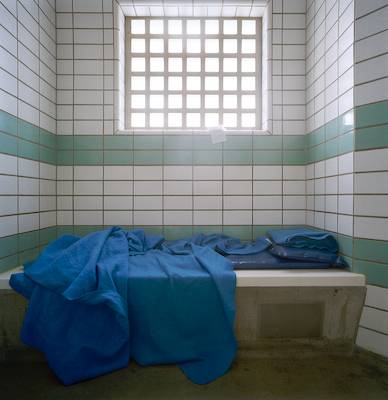
Holding cells, Metropolitan Police, Collingwood Road, Hillingdon, London. Richard Ross
One is compelled when looking at Richard Ross’ starkly depicted environments to search out the signs of life. On a few occasions one is rewarded, a curious tourist looks back at us from atop Syria’s Craq de Chevalier Crusader Fort; a heart shaped paperweight and polystyrene cup sit on the judge’s bench in Santa Barbara’s superior court; an open bag, that will travel home with its owner, sits at the foot of a movie executive’s desk. The loose blanket left in the cell at Hillingdon Road Jail presses us to fleetingly wonder if the person who unfolded and used the blanket in the cell earlier, will be back in the cell later, possibly to use the blanket once more.
The praying figure in Istanbul’s Blue mosque is representative of the building’s purpose. He is a motif of religious expression. The security guard at Topkapi is frozen rigid behind the glass, which serves to separate him from the viewer and present him as a part of the larger observing machinery. How different the shot would be if the guard stared straight down the camera lens? I imagine Ross made a few exposures in which the man did face the camera, but Ross prefers to keep attention on the environment. It is temperate and logical for Ross to choose an image in which the guard looks like a wax model – like a construction.
The austerity of The Architecture of Authority as a collection is hard to deal with. The geographical and institutional reach of the project is impressive. Inconceivably, across this wide subject matter Ross seems to have control in all the locations. Ross distills the form of each site and presents that bare form as the key to understanding the sites function.

Segregation Cells, Camp Remembrance, new Abu Ghraib prison, Abu Ghraib, Iraq. Richard Ross
To my mind, Ross has control in all the locations bar two. The old Abu Ghraib “Hardsite” and the new Abu Ghraib prison. In both forms, Abu Ghraib was a site of photographic desperation for Ross – he was forced briefly to compromise the overall tonality of his project.
The interrogation room is disordered. This room was not designed for interrogation purposes by the American military. It has inconvenient features such as two windows (one barred and boarded), an electrical box, a dusty fire extinguisher, exposed wires, a fallen map, makeshift furniture and used soda cans. There is also a plugged-in laptop, unidentified hold-all bags and what appear to be loose wire on the floor. There is a can or tub of something half-concealed behind the nearest chair. It seems to get more ridiculous the closer you look. There are two camp beds, one folded against the wall with a bag of belongings at the foot. What filled the bookcase? Why did Ross’ guides show him here? Is this an interrogation room? It looks like a sparse room for visiting guests. Is every room at the old Abu Ghraib, de facto, an interrogation room?

Interview room, Abu Ghraib prison ("hard site"), Abu Ghraib, Iraq. Richard Ross
There has been much made of the juxtapositions between photos presented in the Architecture of Authority book and exhibitions; between schools and prisons; between barracks and mental asylums. It is Ross’ right and responsibility to guide his audience in ways of seeing. But there is enough information, memory and rituals of communication embedded in any of Ross’ individual images to warrant singular assessment.
Humans in Ross’ pictures never threatens to steal attention for very long. The narrative of the building or structure dominates the narrative of the individual. There are moments when Ross’ photographs effortlessly adopt the surveillance philosophies of each object – bank, London tube station, hotel phone booths, or the confessional. This is part the photographers skill but also the unavoidable disclosure upon sight of the modes of each disciplining, single-purpose site.
Some sites are more difficult to read than others. Ross was in new Abu Ghraib as a guest, he had a guide. The fact he included a second image counter to his over all vision reveals, not unsurprisingly, that Ross would take what he could get from his tour of new Abu Ghraib, also.
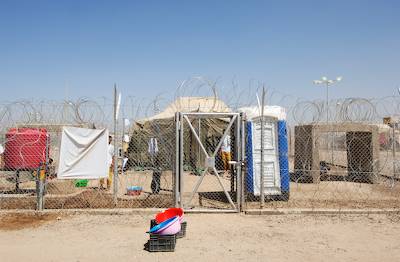
Detainee housing unit, Camp Remembrance, new Abu Ghraib prison, Abu Ghraib, Iraq. Richard Ross
Detainee housing unit, Camp Remembrance, new Abu Ghraib prison, Abu Ghraib, Iraq is a fierce image. It is at first glance still and linear but under a paper-thin surface it is simmering with tension. There are four detainees in this image. In Ross’ depopulated world, that is akin to a cacophonous arena crowd. The two clearly visible men are curiously peering at Ross’ activities and make a mockery of Ross’ attempt to mimic the prison’s personless eye of surveillance. A third man sits in the shade to the right of the image reading and otherwise oblivious. A fourth man sits on the left side of the image obscured by a water tank.
The sheepish glance of one detainee and the craned neck of the other come to dominate this image the longer one looks at it. The man at the door of the tent has no shoes on. Has he just emerged in response to the photographer’s presence? These two men brilliantly illuminate the unnatural and inflexible relationships that exist across and through chain link and barbed wire. They are merely curious at this point and do not gesture or ask anything of Ross, at least not in this exposure. They have been briefly distracted from house-keeping routines by another human that is as foreign to them as any other. Proximity means nothing here for Ross and his inadvertent subjects.
The most remarkable thing about Detainee housing unit, Camp Remembrance, new Abu Ghraib prison, Abu Ghraib, Iraq is not the clarity with which Ross communicates the apparatus of power, but rather how that drains human interaction of meaning or purpose. Does this mean I’d like to see more people in Ross’ photography? Absolutely not, there are plenty of documentary photographers who are trying to convey the spectrum of human existence, and it is not Ross’ charge. It just means that upon the appearance of non-typical images the audience’s attention is gripped. The two anomalous images from Abu Ghraib draw to attention Ross’ otherwise effortless manipulation of his audience. Ross shapes and prepares his viewer for a cold interaction. His manipulation of the audience’s eye is fitting for a project that studies dominance over subjects and imposed order of authorities.
Further investigation: Good text interview. Better audio interview. Best video presentations

 Prison Photography
