
You are currently browsing the tag archive for the ‘New York’ tag.

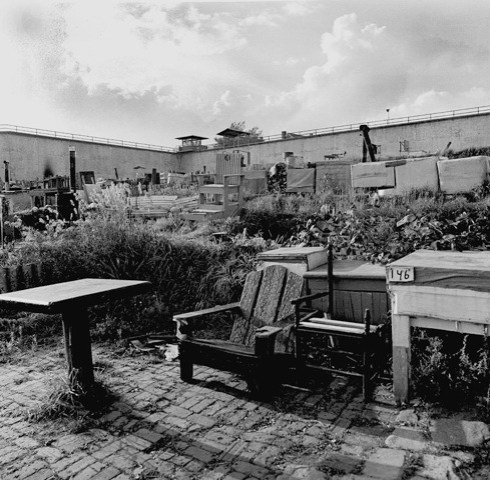
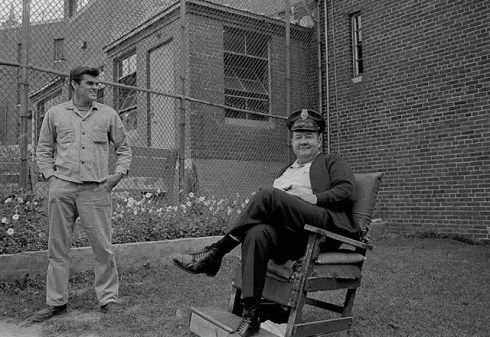
In 1972, Joshua Freiwald was commissioned by San Francisco architecture firm Kaplan & McLaughlin to photograph the spaces within Clinton Correctional Facility in the town of Dannemora, NY.
In the wake of the Attica uprising in September of 1971, the New York Department of Corrections commissioned Kaplan & McLaughlin to asses the prison’s design as it related to the safety of the prison, staff and inmates. The NYDoC wanted to avoid another rebellion.
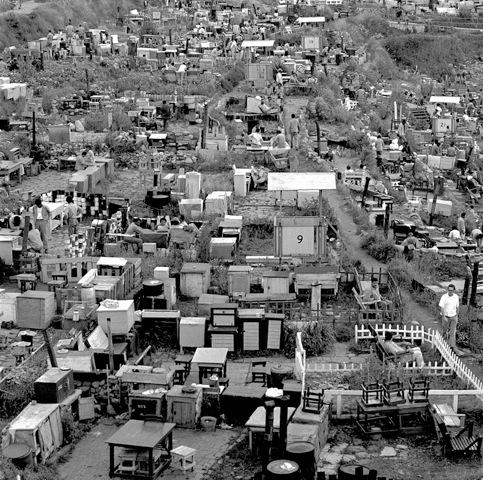
The most astounding sight within Dannemora was the terrace of “courts” sandwiched between the exterior wall and the prison yard. It is thought the courts began as garden plots in the late twenties or early thirties, although there is no official mention of their existence until the 1950s.
Simply, the most remarkable example of a prisoner-made environment I have ever come across.
The courts were the focus of Ron Roizen’s 55 page report to the NYDoC on the situation at Clinton Correctional Facility. Sociologist Roizen, also hired by Kaplan & McLaughlin, conducted interviews with inmates over a period of five days:
“Inmates waited months, sometimes even years, to gain this privilege. The groups would gather during yard time to shoot the breeze, cook, eat, smoke, and generally ‘get away from’ the rigors and boredom of prison life.”
In the same five days, Freiwald took hundreds of photographs at Dannemora. Eight of those negatives were scanned earlier this month and are published online here for the first time.
“Since I’d taken these photographs, I’ve come to realize that these are something quite extraordinary in my own medium, and represent for me a moment in time when I did something important. I can’t say for sure why they’re important, or how they’re important, but I know they’re important,” says Freiwald.
Freiwald and I discuss the social self-organisation of the inmates around the courts, his experiences photographing, the air “thick” with tension and surveillance, the spectre of evil, and how structures like the courts simply do not exist in modern prisons.
LISTEN TO OUR DISCUSSION ON THE PRISON PHOTOGRAPHY PODBEAN PAGE
All images © Joshua Freiwald



All images © Joshua Freiwald
© Dane Jones/Center for Employment Opportunities
What happens after incarceration? What does life look like; how does one operate? More to the point what does the world look like?
With the development of Released the Center for Employment Opportunities (CEO) in New York has tackled these queries with a multi-media-headed-hydra of photography and narrative.
Released “produced to offer a rarely seen perspective of those returning home from prison or jail” was set in motion by Cara Shih, Marketing Director at CEO. It consists of two parallel projects.
Firstly – to describe what life looks like – she contracted three young photographers to capture, produce and tell the stories of CEO’s clients as they left prison and built new lives.
Secondly – to describe what the world looks like – Shih enlisted CEO clients to self-document their re-assimilation into society.
The result are two very different sets of valuable works.

© Dane Jones/Center for Employment Opportunities
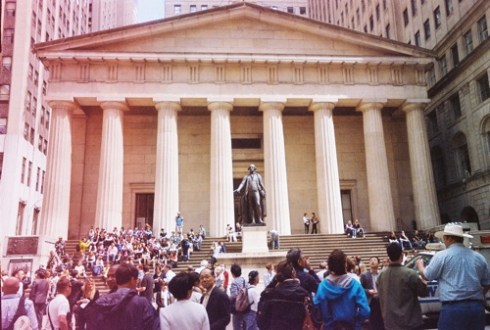
© Darryl Allen/Center for Employment Opportunities
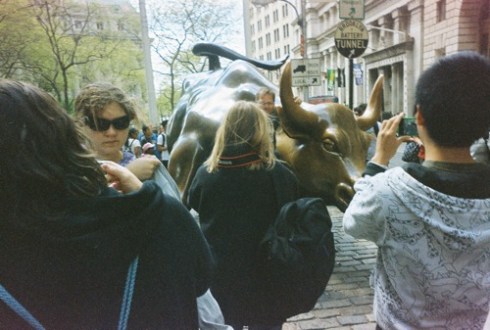
© Darryl Allen/Center for Employment Opportunities
The main body of work for Released is the collection of nine slideshows of nine individuals (youtube/embeddable) by photographers Jeyhoun Allebaugh, Michael Scott Berman and Bryan Tarnowski. There’s no narration but the subjects’ own, and that’s everything that’s needed. These are real characters. Kudos to Allebaugh, Berman and Tarnowski for getting out the way of the stories.
It was Allebaugh who first contacted me about the project and so I fired him back a few questions. Before that, let me mention the second element of Released.
As you know though I have high expectations of prison arts education and the prospect of self-rehabilitation through photography, so when Allebaugh explained the ‘Snapshot Project’ within the Released project I knew I wanted images made by the six former prisoners on disposable cameras to feature here on Prison Photography. Allebaugh understood.
I speak more on ‘Snapshot Project’ after the Q&A.
JEYHOUN ALLEBAUGH Q&A
PP: How did you come across this project?
JA: Released was the brainchild of Cara Shih. She wanted to create an honest and genuine portrayal of the experience of her participants in a creative and artistic way.
PP: Had prison improved or set back the lives of the nine subjects you followed?
JA: Hmm. That is a difficult and complex question. While incarcerated, one of my subjects, Revond Cox, had to attend his son’s funeral in shackles and a DOC jumpsuit while his other young son sat graveside. I’m not sure any person should have to go through something like that. To call it a “setback” would certainly fall short. However, in his piece on the site, he says, “[prison] saved me from death because the way I was running, it was just a matter of time.” He clearly has his head on very straight about the type of father he wants to be and I do think some of that epiphany is directly related to his very difficult time in prison.
PP: Do you think the systems for employment, reintegration are fair for those formerly incarcerated?
JA: Life is extremely difficult for formerly incarcerated people coming home. The line between a new life and their old lives is razor thin and just as sharp. It is often much more complex than just coming home and doing right. Coming back to families and the stigma of finding a job as an ex-con make it very difficult. That said, I think organizations like the Center for Employment Opportunity are a very effective way to balance these things out, but many go without services such as these.
PP: What’s your biggest take away from the project?
JA: When we started this project, one of the key ideas behind Released was to show that when the formerly incarcerated come back home, it is often not to the “clean slate” that many of us imagine it to be. We wanted to show that there are new and different obstacles these people must face and I believe the project highlighted these well, showing some of the areas where the aid of an organization like CEO is imperative.
I believe what ended up being great about the project, however, was that more than the differences, the similarities between what the subjects and normal people go through on a day to day basis was what was most evident. I think this is what was really special about seeing photographs taken by the subjects themselves in addition to the ones we took as professional photographers.
The nine individuals we documented over three months are some of the best human spirits I have come across; absolutely amazing people. I hope you’ll spend a couple minutes getting to know them by watching the short videos on the site.
I’ve very much enjoyed staying in touch with these great people since the project. Listening to them talk about the continual triumphs and struggles of this great life we are given has truly been a gift and is a great inspiration to me.
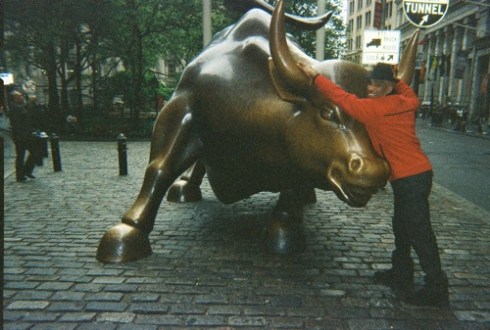
© Jose L Padilla/Center for Employment Opportunities
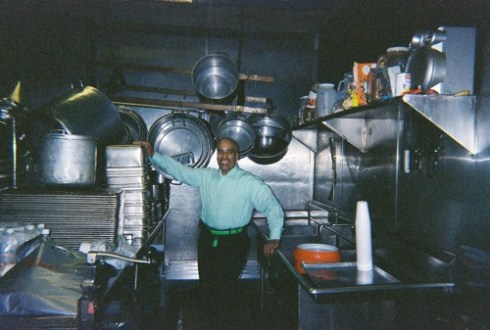
© Jose L Padilla/Center for Employment Opportunities

© Jose L Padilla/Center for Employment Opportunities
‘SNAPSHOT PROJECT’, RELEASED, CEO
The snapshots are the daily details, daily grind and efforts and situations that don’t make it onto an outsider’s camera or off the cutting room floor. If Allebaugh et al. provided the over-arching narratives of empowerment and improvement, these are the chapters, pages and phrases.
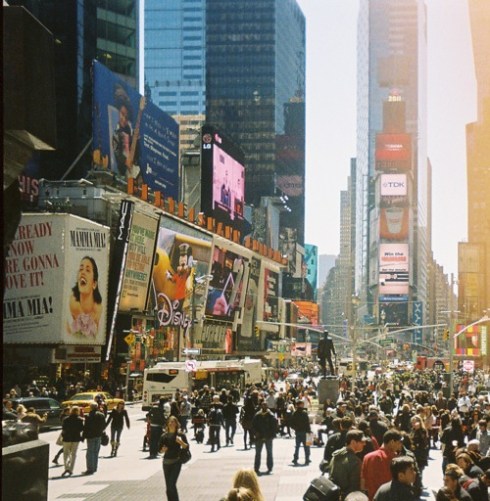
As Allebaugh stated, the snapshots show off the same foibles we all have – Jose Padilla‘s fashion savvy, big smile and willingness to perform for the camera; Dane Jones‘ wonder with the street and his omission of self; Lewis Epps‘ focus on the activities, training and environments to keep him on track; Dwayne Allen‘s tourist shots of Manhattan’s Financial District; Chester Boston‘s preoccupation with portraiture and the family; and Michael Hunt‘s meanderings about his new or old neighbourhood.
Too often we can get caught behind the idea – and support of – a large goal without stopping to think about the many tiny, terrifying steps needed to achieve the goal. These images reveal those steps. Due purely to the equipment, the ‘Snapshot Project‘ is overlaid with naivety. But there is also good intentions, massively important small victories and the promise of networks that will help these men achieve a life outside prison permanently.

© Lewis Epps/Center for Employment Opportunities
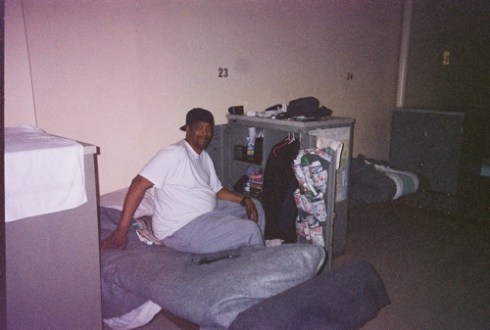
© Lewis Epps/Center for Employment Opportunities
LEWIS EPPS ON LIVING IN A SHELTER, PHOTOGRAPHY, AND HIS MOTHER
If you want to know more about Lewis Epps, CEO has published a Q&A with Epps on their blog. Here’s my choice of quotes:
I was happy that I was doing [The Snapshot Project] and engaging in a project that would reflect my life. You know how you want to leave a legacy? I want people to say, “Yeah, Lewis he’s a good guy.” You know, I was doing something good to help me, and to help others, and also to be thankful to CEO for the opportunity.
I feel like I am ashamed to be in a shelter, I have never been in one my entire life. I had no place to live, so they released me to the shelter.
I have a tight, helpful family and we’re all very close. I lived in the Bronx, that’s where my criminal activities came from. My mother is elderly and I don’t want to bring that back to her … My family is very supportive. I go every Saturday to my mother’s to do painting, backyard, do work for her. Sundays I go to church.
I’m about to move from a shelter into a room of my own. I save my checks. I hide my money when I cash my checks, so I’m not tempted to spend it. I’ve been saving for three months since I started working and I’m almost ready. I also have family support. Finding a suitable place is tough. I can’t afford a room yet but I’m doing better than I’ve been in the past. I need a permanent job so I can retain my income and keep being able to afford a place of my own.
It stays in front of me, being re-incarcerated. Once I stop being good, I could be back. I’m too old to go back, I’ve got to move forward and think positive. CEO is helping me strive, and I know I’ve got to keep my focus. Once I don’t keep focus that could be it. One mess-up, that’s all it takes. I’m not going to do that again. I’m going to stay around people who are trying to help me.
Shih informs me a similar Q&A with Jose Padilla is next.
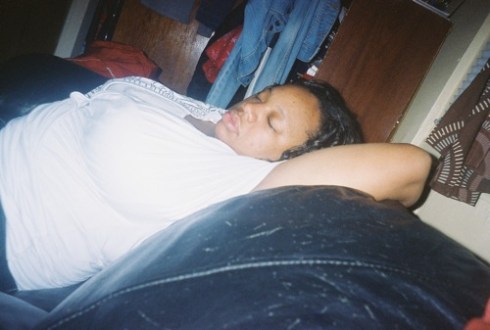
© Chester Boston/Center for Employment Opportunities

© Chester Boston/Center for Employment Opportunities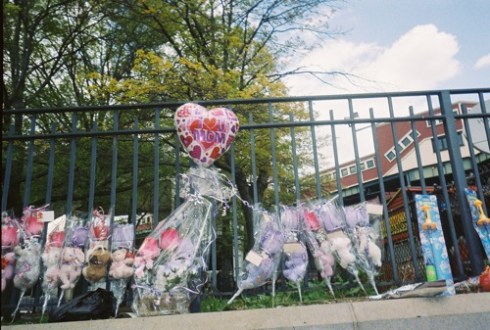
© Michael Hunt/Center for Employment Opportunities
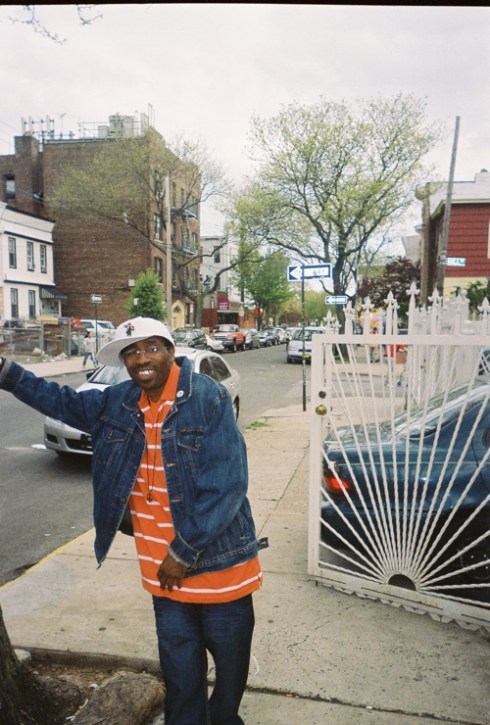
© Michael Hunt/Center for Employment Opportunities
SNAPSHOT PROJECT PARTICIPANT-PHOTOGRAPHERS
Dane Jones, 26, lives in the Bronx with roommates. His challenges to re-entry include obtaining employment, education, financial management and housing. When asked what is the most challenging part of his daily life, he says “fitting in and conforming to the norms of society.”
Lewis Epps, 49, resides in a shelter. Currently he works on the transitional job sites while searching for permanent employment. His biggest challenges to re-entry are obtaining full-time work and permanent housing. He has a very supportive family who is helping him succeed in the re-entry process.
Darryl Allen, 46, lives in Queens with his father, brother and nephews. He has three daughters (including a pair of twins), and his eldest daughter is a lawyer. His biggest challenge to re-entry is obtaining employment. Darryl says the most challenging part of his daily life is “being a friend and father to my children.”
Chester Boston, 34, lives in Queens with his uncle. His biggest challenge to re-entry is obtaining employment. He has a five year old daughter, whom he named after his mother. He says fighting for custody is a daily challenge and not seeing her is very hard.
Jose L. Padilla, 47, lives in Brooklyn. After completing Life Skills Education and becoming Job Start Ready, he landed a full-time job and now comes to CEO for retention services. To him staying punctual is the most challenging part of his day. He has a certificate in construction.
Michael Hunt, 48, lives in Brooklyn. His biggest challenge to re-entry is finding stability in his life, and “being able to be myself and become employed at the same time.” His certificates include carpentry, electrical technician, fire guard and maintenance.
If you would like to hire CEO participants please contact Mary Bedeau at 212 422 4430 x345.
‘RELEASED’ PHOTOGRAPHERS BIOGRAPHIES
Jeyhoun Allebaugh is a freelance photographer who specializes in documentary, sports and portraiture photography. He is based in New York City and North Carolina. As a Turkish-American and avid fan of Hip-Hop and Bluegrass music who has spent his college years in the mountains of North Carolina as well as South Africa, Jeyhoun brings a diversity of taste to all aspects of his life. His work has appeared in GQ, PDN Emerging Photographer, USA Today, UK Guardian, SLAM Magazine, HOOP Magazine, The Durham Herald-Sun, The Durham Independent Weekly, NBA.com and SI.com.
Michael Scott Berman is a photographer specializing in food and portraits. His past clients include the New York Daily News, the Guardian, PNC Bank, and the AARP. He was the recipient of two grants from the Brooklyn Arts Council and has exhibited his work at the Leica Gallery in Manhattan and at Brooklyn Borough Hall. He earned a Bachelor of Arts in English from New York University and a Master of Business Administration from Georgetown University. Besides taking pictures, Michael also produces video and writes stories for his food blog, pizzacentric.com.
Bryan Tarnowski grew up in North Carolina and moved up to New York City to pursue photography in 2008. He assists with a number of the best fashion, commercial and portrait photographers in the world and has worked on shoots for top magazines and worldwide ad campaigns. Focusing on social documentary subjects of a wide variety, he likes to shoot what interests him, often to learn more about a subject and to quench his thirst for greater knowledge of the world. His work has appeared in The Wall Street Journal, Vibe Magazine, PDNedu among others.
Last month, Allebaugh, Berman and Tarnowski exhibited their work at the CultureFix Gallery on the Lower East Side. CEO has a Flickr set of the opening.
RIGO 23 recently accompanied Robert H. King (formerly one of the Angola 3, now released), Emory Douglas (printer and legend of revolutionary graphic art) and Billy X Jennings (you HAVE to click that link!), three veterans of the Black Panther Party, on their recent trip to Porto and Lisbon in Portugal.
RIGO emailed:
“Here’s a little clip from the mural I painted at a housing complex south of the River Tejo in Lisbon to commemorate the visit to their community by Robert, Emory and Billy. Robert is a survivor of 29 1/2 years of solitary confinement; Emory Douglas was the Minister of Culture for the Black Panther Party.”
I have mentioned RIGO’s art in support of US political prisoners before. His TRUTH mural in San Francisco marked Robert H. King’s 2001 quashed conviction. RIGO continues to advocate for Herman Wallace and Albert Woodfox, the remaining Angola 2.
He supports Mumia’s ongoing legal battles and RIGO also recently joined Michelle Vignes – a true matriarch of radical documentary photography – for an exhibition in solidarity with Leonard Peltier. (Details and review of the show at the Warehouse Gallery in Syracuse, NY. Closed Feb. 6th)
RIGO conceived of the space as an imaginary museum – The Tate Wikikuwa Museum: North America 2024. Tate Wikikuwa is Leonard Peltier’s Lakota name and 2024 is the year of his next parole hearing. It showcases arts & crafts by the Oglala Sioux and Peltier’s paintings, as well as documents, books, writings and educational material. Making use of Peltier’s colour choices, RIGO created a spiritually and politically charged space.

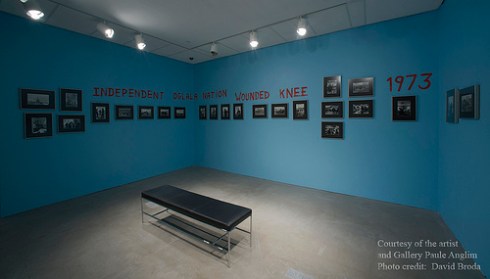
I would have loved to have seen Vignes’ prints of Peltier and the AIM Movement exhibited within the mood set by RIGO’s installation.
For such an important photographer of America’s West Coast counter cultures and radical movements, Vignes does not have a large web presence; there is a paucity of reviews and there are few images too. Next time I’m in the Bay Area, I will have to pay a visit to UC Berkeley’s Bancroft Library which acquired her archives in 2003.
Look out for more about Michelle Vignes on Prison Photography in the future.
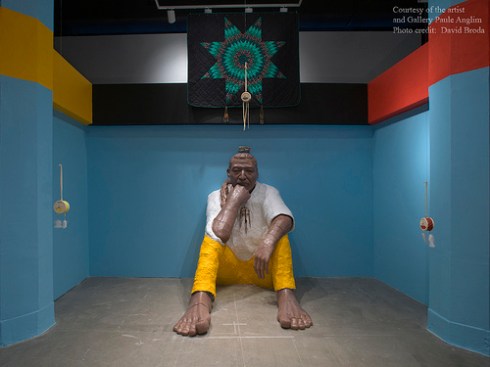
Photo Credits: All images David Broda
(Found via Just Seeds and Bob Gumpert)
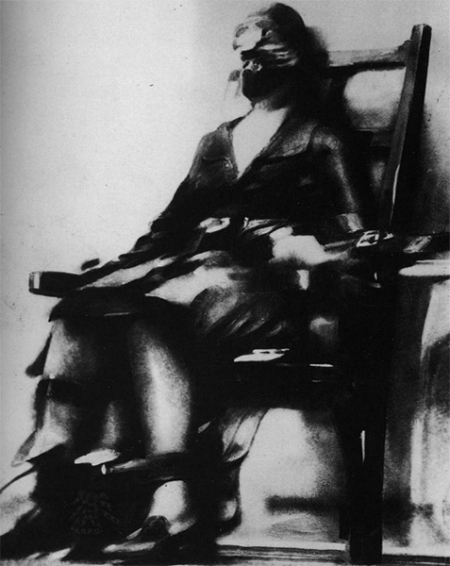
From the consistent, informative and often disturbing Iconic Photos:
“Photographers are not permitted into executions in the United States. For the notorious Ruth Snyder case, the New York Daily News was desperate to get pictures; so they hired a Chicago Tribune photographer Tom Howard – virtually unknown to the prison warders or journalists in the New York area. On that fateful day (12 January 1928), Howard, posing as a writer, arrived early in Sing Sing Prison and took up a vantage position. A miniature camera was strapped to his left ankle, the shutter release button was concealed within his jacket. As Snyder’s body shook from the jolt, Howard hoisted his pant leg and secretly snapped with a one-use camera.”
[My bolding]
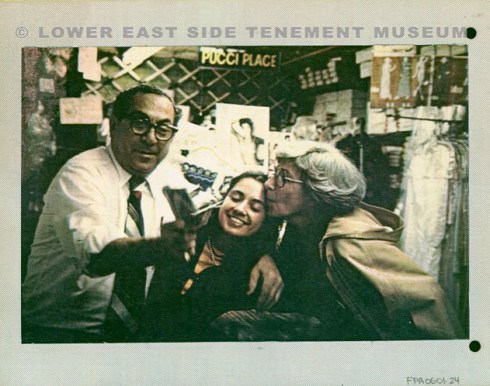
The Tenement Museum now has its photography archive online. What a treat! Go on, lose yourself …
(via)

© Neelakshi Vidyalankara
For her Babies Behind Bars series, Neelakshi Vidyalankara visitied the Bedford Hills Correctional Facility in Westchester County, the largest maximum security women’s prison in New York state.
“The prison opened in 1901 and has hosted many infamous women prisoners (including Kathy Boudin, Jean Harris, Carolyn Warmus, Sante Kimes and Pamela Smart). It is also one of a few women’s prisons in the USA that allow pregnant prisoners to keep their newborn babies with them for the first 12 – 18 months of their life. The Bedford Hills nursery has existed in some form since 1901 and was created to help foster a stronger attachment between mother and infant, improve parenting skills and reduce a mother’s chances of recidivism,” says Vidyalankara.
Qiana did a short interview with Neelakshi last year.
Previously, I have noted the work of Patricia Aridjis and Angela Shoemaker, both of whom have documented maternity and motherhood while incarcerated.
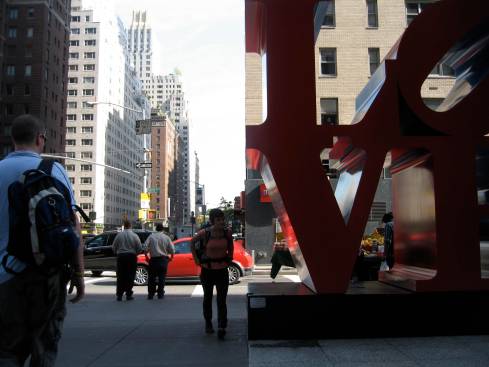
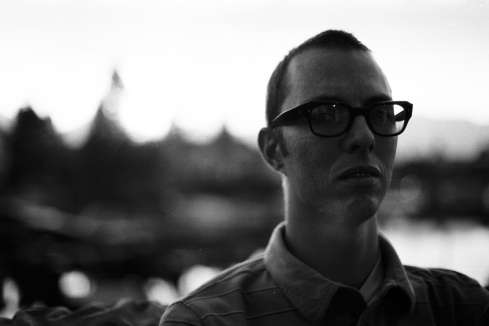
Had a fun time in New York last week. Stayed with Jack and Marisa. Below is not Jack. Below is Chris by Jack.
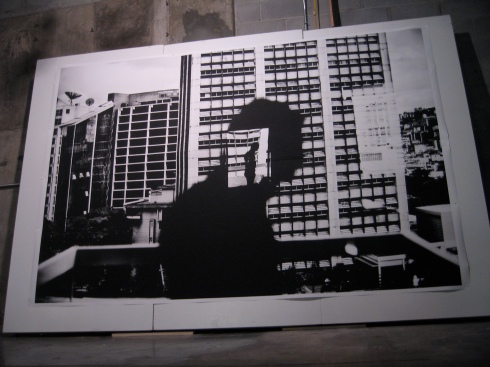
We went to Christopher Anderson’s book launch for Capitolio. It was great to see it after recent reviews, heated debates (check out comments) questions and wot not. I don’t think the selection of the images was the best.
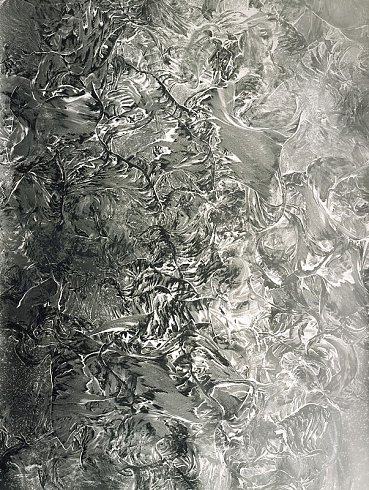
At the Metropolitan, Surface Tension: Photographs from the Permanent Collection was a pleasant whimsy into some mesmerizing works, notably Adam Fuss’ UNTITLED (1997) made by the metronome shimmers of snakes upon black dust upon white dust. Image Source: Cheim & Read
The Met’s photography department was putting together the final touches on Robert Frank’s The Americans which opened this week. It was all hands to the pump as evidenced by besuited Malcolm Daniel – who I spied carrying large, heavy object (post?) behind a partition and into the exhibition space.
Egg and Cheese Bagel.
Over at the Museum of Modern Art, I was pleased to see Russell Lee‘s work Bulletin Board in Post Office Showing a Large Collection of “Wanted Men” Signs, Ames, Iowa (1936). Who doesn’t love a mug shot?


Bringing the practice of mapping of transgressions into the 21st century, the Spatial Design Lab from the Graduate School of Architecture, Planning and Preservation at Columbia University exhibited its Million Dollar Blocks Project (2006).

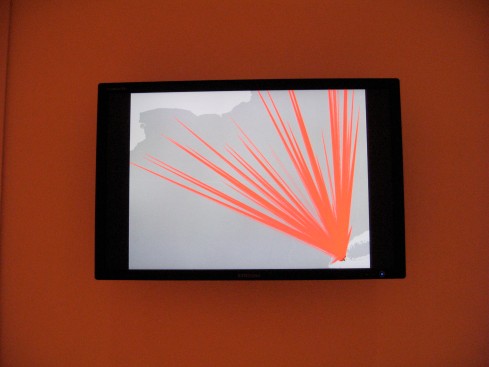
On Monday night I sat with Andrew Lichtenstein. We talked. Andrew recommended Brennan Linsley‘s work and was quite emphatic about the book ‘Concrete Mama‘. He also spoke highly of Max Kenner and the work at the Bard Prison Initiative
Tuesday, I met Emiliano Granado. We were first in contact over his San Quentin Giants pictures. We talked about many things including Trevor Paglen, Argentina, the Burke Gilman, and the Horticultural Society of New York, which recently lost Barbara Margolis who was an inspiring leader. Emiliano recommended Alessandra Sanguinetti‘s work.
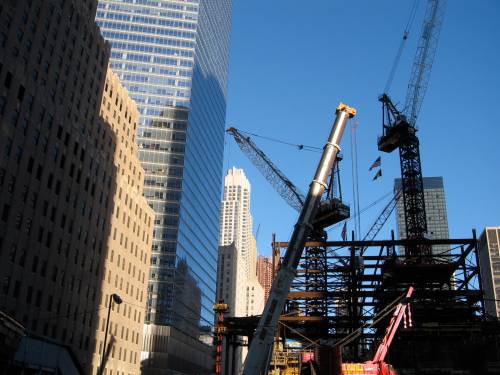
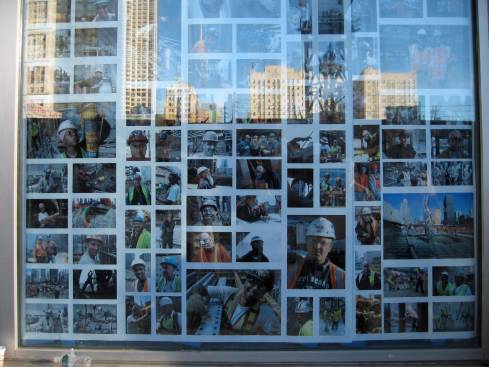
On Sunday, I’d been at the WTC construction site. There was some portraiture on display in a window. The space behind the window was closed but would usually be open. The photographs were easy on the eye.
On my last night I checked out Steven Hirsch’s Courthouse Confessions.
That’s Matt Kelley looking at Steven’s work. He’s coordinator for Change.org Criminal Justice, online communications for the Innocence Project and all together nice bloke. Matt’s double identity is twittered and can be followed here and here.
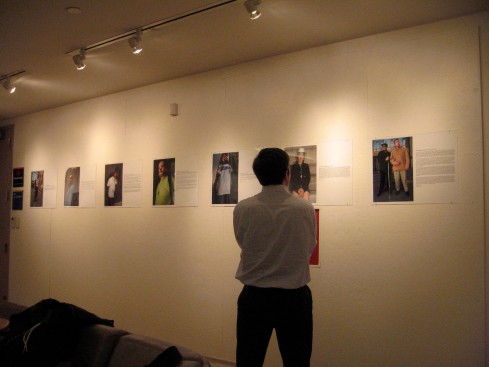
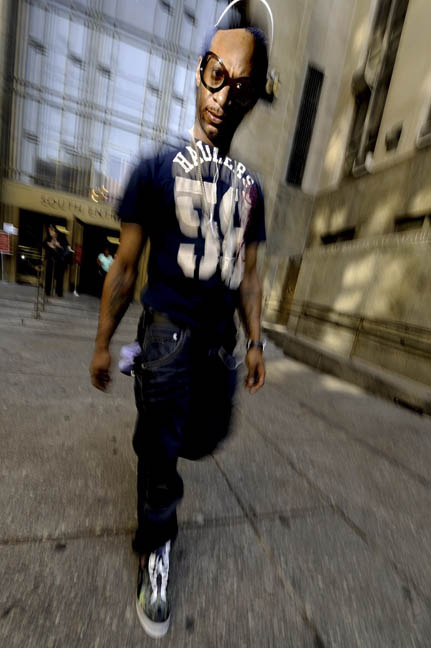
Hirsch takes street portraits of folk going to court, secures (in some ironic twist) a non-binding statement and then transcribes it verbatim to go with the portrait. Constantly moving the camera, Hirsch uses hard flash and distorted angles/zoom to depict these individuals as shape shifters; as anomalies. The fact Hirsch’s subjects (in most cases) seem alien to the logic of the courts – that any lessons arising from their cases are unlikely to effect sentencing laws in the future – should but be a source of disquiet for us as an audience.
One last thing. On Saturday, I saw John Baldessari sat outside a Grennwich Village coffeehouse, but I bottled saying anything. I’ve learnt that famous people abound in Manhattan and you see ’em everywhere.
Thanks to everyone who altered their orbits a little to coincide with mine.

Puppies Behind Bars, Photo: Joyce Dopkeen/The New York Times
NPR’s Fresh Air featured the Puppies Behind Bars project yesterday. They train young dogs for two primary purposes – seeing-eye/guide dogs and bomb-sniffing canines.
Here’s a New York Times article and photo essay from June 2008.

 Prison Photography