
You are currently browsing the tag archive for the ‘Pakistan’ tag.
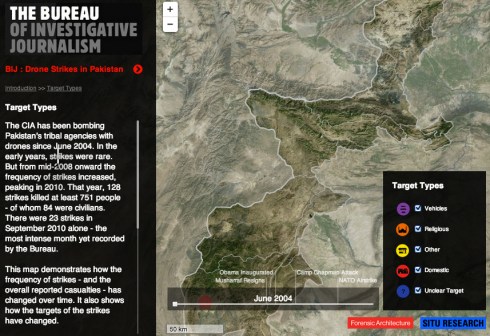
Anyone doing work about drone and drone policy that I’ve spoken to has, as some point in their research, relied on the information put out by the Bureau of Investigative Journalism (BIJ). When I wrote my piece Here’s What Drone Attacks in America Would Look Like for WIRED, BIJ was an invaluable resource, especially in providing solid figures for the numbers of drone strikes, deaths from those strikes, and specifically civilian deaths from those strikes.
BIJ’s good work continues, as it played host to the Forensic Architecture (Goldsmiths University, London) and SITU Research to produce an online interactive WHERE THE DRONES STRIKE.
With WHERE THE DRONES STRIKE which we can examine drone target types (vehicles; religious; other; domestic; unclear target). Was that an insurgent training camp that was annihilated or was it a marriage celebration full of women and children?
Due to secrecy at the Pentagon (and previously at the CIA, when it controlled the drone program), reliable information on drone attacks is very difficult to come by.
“The CIA has been bombing Pakistan’s tribal agencies with drones since June 2004. In the early years, strikes were rare. But from mid-2008 onward the frequency of strikes increased, peaking in 2010. That year, 128 strikes killed at least 751 people – of whom 84 were civilians. There were 23 strikes in September 2010 alone – the most intense month yet recorded by the Bureau,” say the BIJ.
BIJ routinely collects info on drone strikes through thousands of reports, witness testimonies and on-the-ground data from Pakistan, but this is the first time this data has been put rendered as an interactive to propel human rights and accountability.
“The map demonstrates how the frequency of strikes – and the overall reported casualties – has changed over time. It also shows how the targets of the strikes have changed,” explains BIJ. “Domestic buildings have been the most frequently hit target type in each year of the drone war. Attacks on vehicles have become gradually more frequent, and in 2011 almost as many vehicles were hit per strike, on average, as buildings. But this dropped from a peak that year and in 2013 drones targeted vehicles just three times. Attacks on vehicles tend to kill fewer people than attacks on domestic buildings, and fewer civilians. The highest death tolls of all are in the comparatively rare attacks on madrassas and mosques.”
The U.S. dropped it’s first bomb from a drone in late 2002, on Yemen. The Obama Administration only formally acknowledged it was flying killer robots over foreign lands in 2012.
Go to www.WHERETHEDRONESSTRIKE.com
For a wild editorial break down of the data (and more graphs!) read the BIJ’s report Most US Drone Strikes In Pakistan Attack Houses which accompanied last week’s release of WHERE THE DRONES STRIKE.
For regular updates on drones at home and abroad, may I recommend following the Drone Weekly Roundup and signing up for the Newsletter (scroll down) put out by the Center For The Study Of The Drone at Bard.
© Poulomi Basu
The border areas between India and Pakistan are dangerous and in many areas lawless.
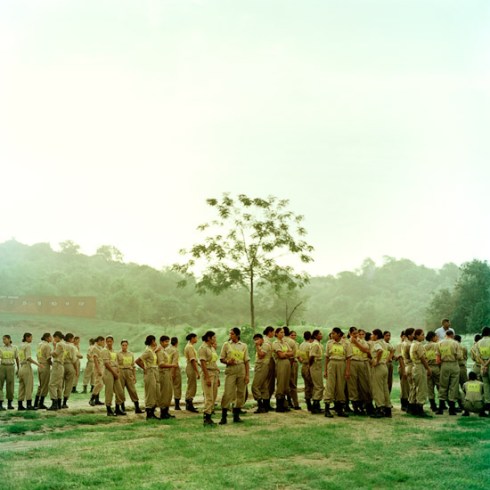
Indian women have very recently become part of the military response to arms dealing, drug smuggling and people trafficking.
“On September 2009, India’s first ever batch of women soldiers of The Border Security Armed Force were deployed in these infamous borders of Punjab, Jammu & Kashmir as the country’s first line of defence,” says Basu.
Poulomi Basu spent time with the young women (aged 17-25), both Hindus and Muslims, at boot camps, homes and on the front-line documenting their “transformation from women to soldiers.”
Basu believes these women are not only fighting their enemies but also the military tradition and the attitudes of a patriarchal society. Less than 1% of India’s 1.2 million armed forces are women.
To Conquer Her Land is about new forms of stress – related to combatant life – that has never existed for Indian women before in history. Basu says To Conquer Her Land wrestles with “intricate issues of conflict, psychological warfare, class, youth, gender, love, peace, the concept of home, an undefined idea of patriotism, and the strength of the mind.”
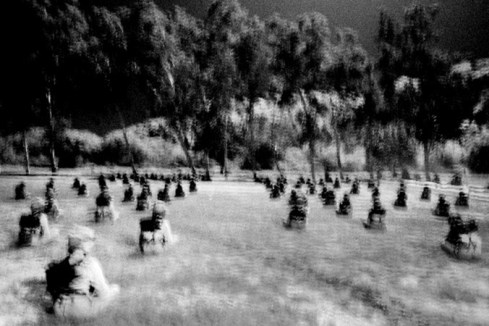
The series is a beguiling mix of fine art portraiture, B&W documentary images and PJ style theatre-of-war shots. The mixture can be quite disorienting; blurry B&W akin to Japanese art photography interrupted by delicate double and group portraits in colour. Basu even goes all Robert-Capa on us!
© Poulomi Basu
ALSO WORTH A LOOK
Photographer, Rachel Papo’s Serial #3817131 follows young Israeli girls through the mandatory military service.
Papo and Basu’s work have things in common, although Papo’s work is concerned with her own biography. Papo says, “Serial #3817131 represents my effort to come to terms with the experiences of being a soldier from the perspective of an adult. My service had been a period of utter loneliness, mixed with apathy and pensiveness, and at the time I was too young to understand it all. Through the camera’s lens, I tried to reconstruct facets of my military life, hopeful to reconcile matters that had been left unresolved.”

Qamar Jan,18, an Afghan refugee from Peshawar poses at the Ali Medical clinic in Islamabad, June 14, 2007. © Paula Bronstein
In my last post, I suggested the repetition of subject matter in photography is inevitable.
Equally, I’d like to stress that our constant exposure to (predominantly web-based) imagery may likely result in more frequent associations and recall (partial, total, overlapping) between photographers and their works.
Here, I’d like to argue that the gravity of some photography – or rather the gravity of the story it bears witness to – means that ultimately the name of the photographer is inconsequential.
MOTIF, MEME, PERSISTENT THEME
In my last post, I also challenged the notion of plagiarism and inserted the notion of ‘meme’. I was hasty. I used the term ‘meme‘ because meme evolution within host populations can occur without any awareness of said host population; I wanted to infer that repetition, mimicry, copying, mirroring mustn’t always be accorded a conscious origin. Conscious origin is precedent, is ownership, is lawsuit. And I want to live in a world where not everything is subject to ownership and contest.
That said, I want to back-track on the term ‘meme’. Meme is more appropriate for discussing larger shifts, whereas I am really discussing trends. Instead of ‘meme’ I’d prefer to use the term ‘persistent theme’.
FINE ART vs PHOTOJOURNALISM
In Burdeny’s work, the use of a persistent theme (including the minutiae of another artists’ motifs, style) just looks bad. Simply, Burdeny is a prat, but if you want to get uppity you’d argue he has debased artistic notions of respect, brevity and creative integrity.
In the light of Burdeny’s antics (1, 2, 3, 4, 5 & 6), any number criticisms are understandable BUT would anyone level criticisms at photographers in journalism repeating the work of others if it that work pertained to a story that perhaps has not been told enough?

Memona Karachi. 20 years old. Over 30 operations. Attacked by a boy on her way to school. © Izabella Demavlys
ACID ATTACKS: A CRUDE CRIME OF MODERN TIMES
Shouldn’t ‘persistent themes’ in the photography of journalism be judged on different criteria?
Joerg’s post on Izabella Demavlys today recalled the work of Paula Bronstein, Q. Sakamaki, Diego Ibarra, Katherine Kiviat and Emilio Morenatti. (Stan was impassioned by Morenatti’s work recently)
An acid attack is a heinous crime, but made all the worse by lack of awareness, empathy or rehabilitative service. Of course, photography plays second-fiddle to medical intervention in the aftermath of acid attacks, but that is not to say it can’t play its part.
Or are these portraits exploitative? Personally, I don’t think they are. The recurring ‘exploitation’ argument doesn’t develop a discussion – it merely demands you accept or decline the notion of ever-unequal power relations between the operator and subject of a camera. It becomes a discussion about photography and not about the reason the photographer and subject shared a space in the first place.
Personally, again, I don’t think we understand enough about the motives or consequences of these types of brutal attack, and I think portraiture and caption have their role in informing interested parties.
Fortunately, the reports alongside these images describe accessible medical treatment for victims (one woman has had 30 surgeries). More than physical healing though, many of the women have a resolve and psychological determination beyond words. (Read Nick Kristof’s NYT article).

A victim of acid attack stays in the hospital of the Acid Survivors' Foundation. In 2002 Bangladesh introduced very tough laws to try to stop acid throwing, including the death penalty in the most serious cases. However, acid attack is still common in the country -- more than 260 cases in 2005, since "The law is just like a dead law," according to Salma Ali of the Bangladesh National Women Lawyers' Association. Dhaka, Bangladesh, July 12 2006. © Q. Sakamaki
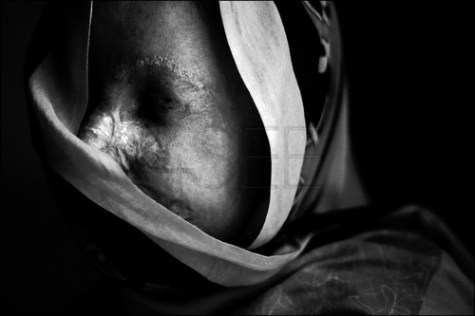
© Diego Ibarra. Portrait of a woman attacked by acid. The consequences of the attacks are for life. Islamabad. Pakistan, May 2009
Saira Liaquat
Both Kiviat and Morenatti photographed Saira Liaquat in the space of a year (the captions for her age must be inaccurate) but opprobrium will never be dealt Kiviat or Morenatti for their repetition.
Saira bears witness to her injustice and both photojournalists help her advocate.
Saira’s name and her story matter, the photographers names really don’t.

Saira Liaquat, 22 yrs, burn victim and survivor, holding an old photograph of herself before she was burned with acid by her husband. Photographed at Saira's parents' home in Lahore, Pakistan on February 7, 2009. Saira is presently working as beautician at the Depilex beauty salon in Lahore, Pakistan. There are presently over 300 cases of burn victims registered in Pakistan. Most victims are between the ages of 14 - 25 years old. Motives vary, but are most frequently obsession, jealousy, suspected infidelity, husband wanting to re-marry, sexual non-cooperation. The face and genitalia are the areas most generally targeted, those guaranteeing complete disfiguration. © Katherine Kiviat/Redux

 Prison Photography