
You are currently browsing the tag archive for the ‘Prison’ tag.

This afternoon, I’ll be speaking to photography students at Evergreen State College, Olympia, WA. Instructor, Steve Davis has asked me to discuss PPOTR, regale some stories, recount my interviews.
Without doubt, Lloyd Degrane‘s story was one of the most remarkable. I have yet to edit the audio of Lloyd’s interview, but I did transcribe part of our conversation so it could be included in the Cruel & Unusual/PPOTR Newspaper. I’d like to share the text (below).
When Lloyd and I met in Chicago, he was preparing for Prison, the first ever exhibition of his prison photographs. It was at Gage Gallery (which coincidentally just showed Lori Waselchuk – another PPOTR interviewee). Gage put together an audio slideshow, which I also wanted to share (bottom).
THE BACKSTORY
Lloyd is a gentle, unassuming, older gent. He worked diligently for an entire decade (1990-2000) within three Illinois prisons – the Joliet Receiving Center, the Stateville Maximum Security Prison and Cook County Jail (the largest walled facility in the world with approximately 11,000 inmates). Degrane did this without any fuss or anything approximating self-promotion.
Before the authorities allowed him in with his camera, the Department of Corrections sent Degrane on a 600-mile round-trip to Menard Prison, a maximum-security prison in Southern Illinois. At Menard, Degrane was to just have a tour of the facilities. The warden instructed him not to take in his camera, and said that they he discuss with Degrane the proposed photography project after Degrane has taken the tour.
Due to an extraordinary experience during his prison visit, Degrane never met the warden. The extraordinary experience did, however, give Degrane a bargaining chip with which to win access to the Illinois prison system.
LLOYD’S FIRST DAY IN PRISON
I was led around Menard Prison by a guard that was just about to retire. You don’t get comfortable for some time. On the yard, you’re walking around brushing shoulders with murderers and rapists. I’d never been around people who had committed heinous crimes.
We walked into a big cell house holding several hundred inmates. As we got to the centre of the cell house a race riot broke out around us. I later found out is was African American inmates who wanted to retaliate against a white biker gang for killing one of their own several weeks before, and we were right in the middle of that retaliation. I remember yelling and threats being directed at the guard I was with. I was wearing a white shirt at the time and prisoners stopped and looked at me as if to ask, “What is this guy doing here?” I ran with the guard through a gauntlet of muscular black inmates. We made it to a cell and inside the cell was one of the oldest inmates I’d ever seen – over seventy years of age. And the guard just pushed me inside the cell. And the race riot went into high gear then. The first thing I saw was a white biker gang member being beaten by four or five black prisoners and the beating got closer and closer to the cell I was in. One of the black prisoners picked up the white biker and threw him against the bars. His head split open and he fell right at my feet. That was my initiation into maximum-security prison. I thought he was dead.
I heard over the loudspeaker system “CIVILIAN INSIDE” and I looked at the guard who was in the cell with me and he pointed at me and he said, “That’s you”. About five minutes later I heard the state police come into the cellblock with kind of this chant from the wizard of Oz. It was a chant to get everyone psyched up and strike fear into the heart of the rioting prisoners. They marched in with clubs and they were there to rescue me. They made a pathway through this insanity and extracted me from the cellblock along with the officer. They got me out of the cellblock back to the warden’s office where I picked up my camera and they just kind of pushed me out the back door.
I went to the nearest tavern and had a couple of shots of whisky. The adrenaline was just incredible, to the point where I couldn’t sit down. I’d nearly lost my life and I’d never had an experience like that before.
Later that day, I contacted the communications officer for the Illinois Department of Corrections. He knew what had happened. He said, “If you don’t talk to the media about what happened today then we’ll send you into Stateville Prison,” And so I didn’t say anything. Two weeks later I got notice from the warden at Stateville that it was okay to come in and start the project.

In the past when I have discussed prison Polaroids, I have said they are perhaps one of the more significant subsets of American vernacular photography, and that they are not easily found online and that, due to their absence, our perception of prisons and prison life continues to be skewed.
Well, times change and that position now deserves correction. I have noticed a few collections coming online recently. Not least the Polaroids from Susanville Prison on the These Americans website. (Also, check out the new PRISON subsection of the site.)
Online, I have identified some increase in the number of contemporary prison visiting room portraits and, as in the case of These Americans, collections of older, scanned images.
I would suppose that many Facebook users have scanned visiting room portraits and added them to profiles but, only visible to friends, those social network image files have not been reproduced for public consumption or commentary. We might think of Facebook photos and albums as digital versions of the mantlepiece, i.e. seen only by close friends and family.
ONGOING FOCUS
“Prisoner-complicit” portraits (for want of a better term) are taking up a lot of my thoughts currently.
Yesterday, I had a workshop with the #PICBOD students at Coventry University, in which I assigned readings on Alyse Emdur’s visiting room portrait collection, prison cell phones as contraband, prison cell phone imagery as cultural product, a new Tumblr In Duplo that compares publicly available mugshots with publicly available Facebook profile pictures, and the racket that underpins the posting and removal of mugshots to the searchable web.
Particularly with cell-block-cell-phone images, we should anticipate a glut of prisoner-complicit photos in which prisoners – to a greater degree – self represent.
We should realise that this is the first time in modern history that prisoners have presented themselves to the internet and thus permanently to the digital networks of the globe. My hunch is that this may be significant, but really, it’s too early to tell.
We can note that in this video, most of the images seem to originate from the same cell phone camera in the same prison. We might surmise there is no epidemic of illicit and smuggled images yet. To further this inquiry, I hope to get some information from the maker of said video.
In the mean time, I’ve been in touch with Doug Rickard who administers These Americans as well as the wonder-site American Suburb X. I asked him about his recently published Susanville Prison Polaroids:
Any idea who took them? (any marks/prison-stamps on verso?)
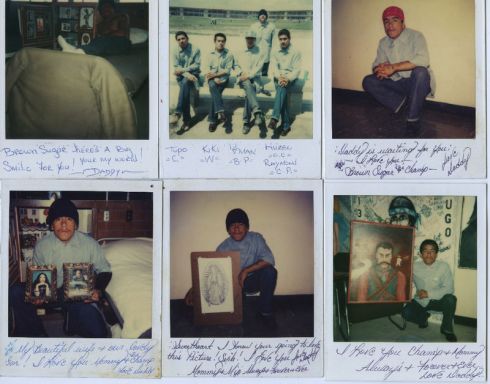
Probably a visitor or another inmate? I have a set (10 or so) of the main inmate (“Johnny”) that you see in many of the “Susanville” single poses, posed with “Brown Sugar” (his girlfriend/wife) and his son “Champ”, a boy that grows from 1-3 years old in the various pictures (see below).
What years do you think they span?
I can only find one date, 10-24-80. You would think that they were 90’s, but for sure, it says 80.
What makes this collection so fascinating to me is that the operator(s) appears to have had free reign of cells, tiers and the yard to make these single and group portraits. One of the PICBOD students at Coventry today wondered where their supply of Polaroid film came and then to where the images were eventually dispersed outside the prison.
We could only conclude that this prisoner and his group of friends had special privileges and access. From all of my research into (vernacular) prison photography – specifically prisoner-made photography – this sort of arrangement/privilege does not exist in American prisons today.
MORE ON THESE AMERICANS
http://www.theseamericans.com/media/minnesota-mugshots/
http://www.theseamericans.com/prison/last-prisoners-leave-alcatraz-1963/
http://www.theseamericans.com/prison/visiting-hours/
http://www.theseamericans.com/prison/prison-collection-%e2%80%9cjoliet-state-prison%e2%80%9d-1963/
http://www.theseamericans.com/prison/florida-collection-jack-spottswood-sunbeam-prison-camp-1950/
http://www.theseamericans.com/prison/california-collection-san-quentin-prison-1925-1935/
http://www.theseamericans.com/prison/polaroid-collection-mcneil-island-prison-wa-1970s/
– – – – – – – – – – – – –
Thanks to Peg Amison for the tip.

Matt Bor‘s statement is just terrific and pointed.
I’ve had a few conversation on my travels with people about the Occupy movement. For it to really drive the national agenda and to mold presidential candidates who will not be able to ignore the 99% the cause will need to unite workers, unions, students but most importantly the poverty-stricken.
The poor lose the most in a society where a select few control the majority of wealth.
I suspect poor folk might be more concerned with holding things together in their own neighbourhoods than having the time and incentives to join open-ended demonstrations in the downtown precincts of American cities.
But for a truly important Occupy movement the voices of the most disenfranchised are essential.
I’m left to wonder what the 2.3 million Americans behind bars (who obviously can’t pitch a tent or picket a capitol building) might think of the involvement of the people from their (usually the economically ravaged) communities. In fact I’m wondering what the incarcerated masses think of the Occupy movement generally.*
Despite the figure of incarcerated folk being actually about .7% of all Americans, we should note that 1 in 100 American adults are in prison or jail, and that 7 million American (approx 2% of the total population) are in custody, on parole or under other forms of supervision.
Matt Bor does a great job in confusing our presumptions about ‘freedom of assembly.’
I, for one, would appreciate seeing actual protest signs with this mantra at Occupy gatherings.
Check out Matt Bor’s blog and buy a copy of the cartoon here.
*Anecdotally, many prisoners I’ve worked with as an educator sympathise most with Republican notions of “freedom” and are suspicious of government “meddling”.

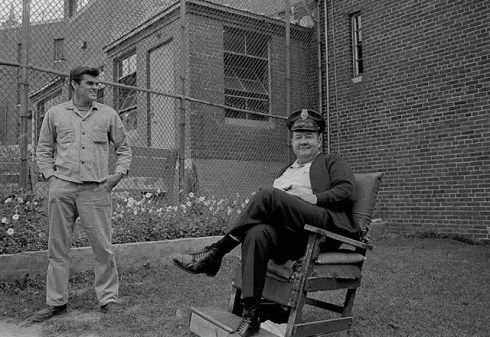
In 1972, Joshua Freiwald was commissioned by San Francisco architecture firm Kaplan & McLaughlin to photograph the spaces within Clinton Correctional Facility in the town of Dannemora, NY.
In the wake of the Attica uprising in September of 1971, the New York Department of Corrections commissioned Kaplan & McLaughlin to asses the prison’s design as it related to the safety of the prison, staff and inmates. The NYDoC wanted to avoid another rebellion.
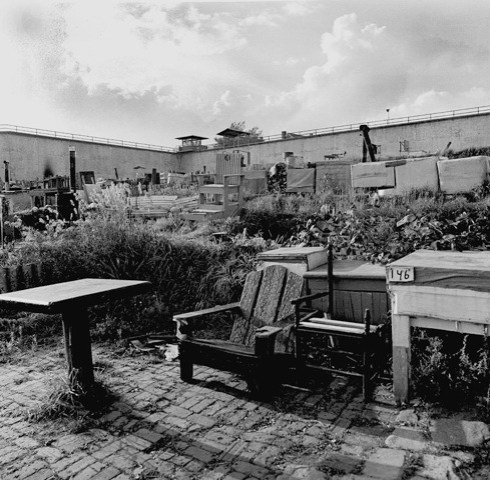
The most astounding sight within Dannemora was the terrace of “courts” sandwiched between the exterior wall and the prison yard. It is thought the courts began as garden plots in the late twenties or early thirties, although there is no official mention of their existence until the 1950s.
Simply, the most remarkable example of a prisoner-made environment I have ever come across.
The courts were the focus of Ron Roizen’s 55 page report to the NYDoC on the situation at Clinton Correctional Facility. Sociologist Roizen, also hired by Kaplan & McLaughlin, conducted interviews with inmates over a period of five days:
“Inmates waited months, sometimes even years, to gain this privilege. The groups would gather during yard time to shoot the breeze, cook, eat, smoke, and generally ‘get away from’ the rigors and boredom of prison life.”
In the same five days, Freiwald took hundreds of photographs at Dannemora. Eight of those negatives were scanned earlier this month and are published online here for the first time.
“Since I’d taken these photographs, I’ve come to realize that these are something quite extraordinary in my own medium, and represent for me a moment in time when I did something important. I can’t say for sure why they’re important, or how they’re important, but I know they’re important,” says Freiwald.
Freiwald and I discuss the social self-organisation of the inmates around the courts, his experiences photographing, the air “thick” with tension and surveillance, the spectre of evil, and how structures like the courts simply do not exist in modern prisons.
LISTEN TO OUR DISCUSSION ON THE PRISON PHOTOGRAPHY PODBEAN PAGE
All images © Joshua Freiwald



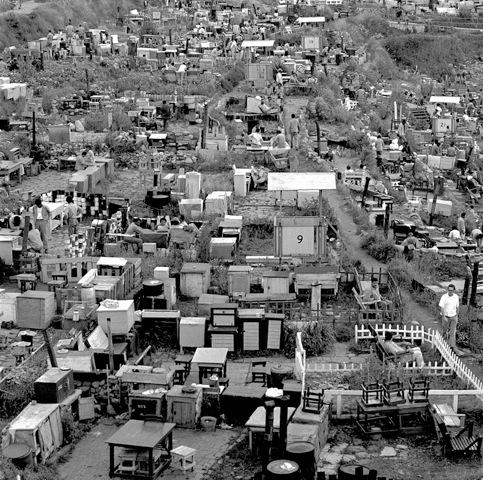
All images © Joshua Freiwald

Editor’s note: I’ve broken with the PPOTR chronology to bring you Dispatch #12. The decision was made because of the time sensitivity of the issue at hand – California’s Prisoner Hunger Strike. Dispatches 6 to 11 will follow shortly.
“I think the tragedy of this situation is not the prisoners willingness to give up their lives, I think the tragedy is that the CDCR does not see them as human beings,” says Isaac Ontiveros, Communications Director for Critical Resistance and part of the press team for the Prisoner Hunger Strike Solidarity (PHSS) coalition.
The PHSS is made up of grassroots organizations & community members committed to amplifying the voices of hunger strikers.
The strike originally ran from July 1st – July 22nd. It was suspended briefly to investigate the viability of concessions made by the California Department of Corrections and Rehabilitation. These were unsatisfactory and the strike resumed September 26th.
LISTEN TO OUR CONVERSATION AT THE PRISON PHOTOGRAPHY ON THE ROAD PODBEAN PAGE
Ontiveros and I spoke on October 11th, day 15 of the resumed hunger strike.
TIMELINE OF THE CALIFORNIA PRISONERS’ HUNGER STRIKE
For three weeks in the month of July, 6,600 California prisoners* took on a hunger strike against the conditions of solitary confinement at Pelican Bay & other prisons. The strikers made five demands: access to programs, nutritious food, an end to collective punishment, compliance with the US Commission on Safety and Abuse (2006), and an end to the “debriefing” practice that affiliates prisoners to gangs; a process vulnerable to manipulation and false evidence.
Late in July, the strike was suspended but due to the slow and “inadequate” response of the California Department of Corrections and Rehabilitation’s response it was clear there was a need for the protest to resume. On September 26th the strikers refused meals once more.
On October 15th, after nearly three weeks, the prisoners at Pelican Bay ended the resumed strike.
The prisoners cited a memo from the California Department of Corrections and Rehabilitation (CDCR) detailing a comprehensive review of every Security Housing Unit (SHU) prisoner in California whose SHU sentence is related to gang validation. The review will evaluate the prisoners’ gang validation under new criteria and could start as early as the beginning of next year. “This is something the prisoners have been asking for and it is the first significant step we’ve seen from the CDCR to address the hunger strikers’ demands,” says Carol Strickman, a lawyer with Legal Services for Prisoners with Children, “But as you know, the proof is in the pudding. We’ll see if the CDCR keeps its word regarding this new process.” (Source)
Ontiveros and I discuss the history of hunger strikes, the unprecedented scope of the strike in the U.S., the necessity of the demands, late summer negotiations and retaliations by the CDCR and the need for continued awareness of this still developing struggle.
In the context of the sit-in within the Georgia prison system in December of last year, the California hunger strike indicates a growing political awareness of U.S. prisoners to their conditions and invisibility. “Our bodies are all we have left,” says Ontiveros assuming the position of an incarcerated striker.
Generally, prison strikes can be played down by authorities and overlooked by national mainstream media. As our discussion proves, awareness of the details in cases such as this are critical. We cannot wait for deaths to be knowledgable of the issue. Please watch developments in California to see if meaningful results for the CDCR and prisoners can be agreed upon and shared.
*6,600 is an official estimate, and the lowest possible figure. Some reports put the figure at nearly double that at 12,000.
PRISONER HUNGER STRIKE SOLIDARITY
Coalition partners include: Legal Services for Prisoners with Children, All of Us or None, Campaign to End the Death Penalty, California Prison Focus, Prison Activist Resource Center, Critical Resistance, Kersplebedeb, California Coalition for Women Prisoners, American Friends Service Committee, BarNone Arcata and a number of individuals throughout the United States and Canada. For more info on these organizations, visit PHSS’ resources page.
CRITICAL RESISTANCE
Critical Resistance seeks to build an international movement to end the Prison Industrial Complex by challenging the belief that caging and controlling people makes us safe. We believe that basic necessities such as food, shelter, and freedom are what really make our communities secure. As such, our work is part of global struggles against inequality and powerlessness. The success of the movement requires that it reflect communities most affected by the PIC. Because we seek to abolish the PIC, we cannot support any work that extends its life or scope.

Natasha, Women’s Prison, 2009. © Michal Chelbin
For the past three years, Michal Chelbin has made portraits in the prisons of Russia and Ukraine. You can see a selection of the works from her series Locked on the New Yorker Photobooth blog.
Chelbin’s doleful portraits are striking – something different – and, of course, given their subject matter I was compelled to mention them here. However, without any specialist knowledge of the prisons in Russia and Ukraine, I struggled to think of a worthwhile statement to accompany with them. Is it enough for me just to say that work is beautiful and interesting? I don’t think so.
Therefore, this conundrum becomes the focus of this short post.
The way Chelbin describes it, her portraits are the first step on a journey (of undetermined length) to at least attempt to “know” her subjects:
“When I record a scene, my aim is to create a mixture of plain information and riddles, so that not everything is resolved in the image. Who is this person? Why is he dressed like this? What does it mean to be locked up? Is it a human act? Is it fair? Do we punish him with our eyes? Can we guess what a person’s crime is just by looking at his portrait? Is it human to be weak and murderous at the same time? My intentions are to confuse the viewer and to confront him with these questions, which are the same questions with which I myself still struggle.”
It seems to me that this the type of curiosity we should expect of all photographers and their works; it’s partly how we are drawn into the previously unknown.
But the unknown has its dangers. As Fred Ritchin stated:
“Photography too often confirms preconceptions and distances the reader from more nuanced realities. The people in the frame are often depicted as too foreign, too exotic, or simply too different to be easily understood.”
Beautiful photography is easy to come by these days, and so, for me at least, viewing beguiling portraiture becomes an act of enjoying the beauty but then stepping further and using it to get at something deeper. That might involve a dialogue with someone over coffee; it might be to find comparative examples [1, 2, 3, 4, 5, 6, 7]; it might be to read up on the conditions for juvenile prisoners in Russian prisons; it might be to read the photographer’s statement or even contact the photographer directly to seek the missing pieces.
Photographs, and particularly portraits, are often a door unlocked but often in our busy lives we don’t even try the handle.
Perhaps now is a good time to return to some thoughts on what makes a great portrait, here and here.

Diagram showing the typical parts of a PLC used for door-control systems. Image courtesy of Teague Newman
“Vulnerabilities in electronic systems that control prison doors could allow hackers or others to spring prisoners from their jail cells, according to researchers,” writes Kim Zetter for Wired.com
According to security consultant and engineer John Strauchs, the same weaknesses that the Stuxnet superworm used to sabotage centrifuges at a nuclear plant in Iran exist in America’s prisons.
Strauchs plans demonstrate an exploit against the systems at the DefCon hacker conference which began in Las Vegas yesterday.
Zetter:
“Strauchs, who says he engineered or consulted on electronic security systems in more than 100 prisons, courthouses and police stations throughout the U.S. — including eight maximum-security prisons — says the prisons use programmable logic controllers to control locks on cells and other facility doors and gates. PLCs are the same devices that Stuxnet exploited to attack centrifuges in Iran.”

Madrid Prison © Gunnar Knechtel
Tree lined corridors and green lawns; swimming pools and squash courts; but this is not suburbia, this is Madrid VI prison. I know very little about the Spain’s prison system. In fact, the only time it has featured on Prison Photography was as it related to Mathieu Pernot ‘s photographs of family screaming over the walls of a Barcelona jail. It would be speculation to wonder if Gunnar Knechtel’s series Madrid (2004) depicts the world into which Pernot’s subjects howled. Instead I, and we, shall reply upon the information provided by COLORS Magazine Issue 50:
“Madrid VI prison (opened 1998) is staffed not by guards but by funcionarios, unarmed civilian servants with college degrees. It’s part of a prison culture that according to one funcionario aims to foster “a certain level of mutual respect and trust” between inmates and staff.”
To American eyes, Knechtel ‘s photography may appear to describe something other than a prison. The human-scale of the design contrasts the dominant modes of American incarceration, especially the dehumanizing Supermax.
Where it makes no effect on function, recently-constructed Spanish prison design includes manipulation of colour, sight-lines and landscaping to lessen the psychological impact of these confined spaces. But more than that, Spanish prisons – as depicted here by Knechtel – provide health and recreational facilities to nurture humanity. No more is this nurturing in evidence than in the prisons’ policies toward family and reproduction.
“A [prison reform] law – the new Spanish parliament’s first piece of legislation – was passed in 1979. It guaranteed prisoners all their civil rights, withholding only their freedom of movement.” Other improvements include monthly family visits in private rooms, as well as conjugal visits with spouses, partners, or even prostitutes is specially designated bedrooms. In the mixed prisons, male and female inmates are allowed to begin relationships and if the prison director agrees can meet and use private rooms as an official couple. Homosexual relationships are also permitted.”
Since 1979, Spain has built 57 prisons that adhere to these standards; each one at an average cost of $42 million. The focus on conditions came about following the demise of Franco‘s Fascist regime (Franco died in 1975, but a new constitution was not passed into law until 1978.) During the dictatorship, many politicians were held in Spanish prisons overseen by Franco’s notorious military police. When these men and women returned to the legislature, prison reform was a top priority.
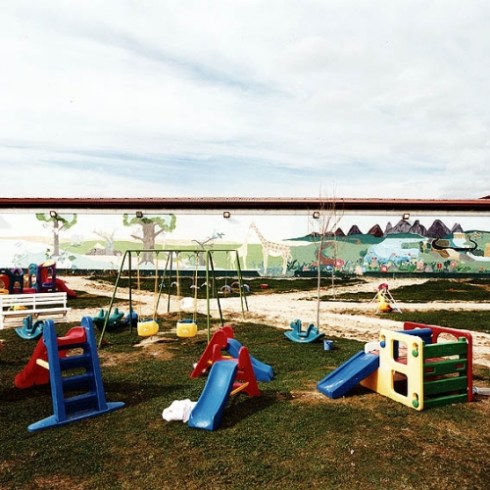
Madrid Prison © Gunnar Knechtel
Many U.S. prisons with stable populations allow for conjugal visits (“trailer visits”) as an earned privilege for prisoners. For prisoners fortunate enough to have the option, trailer visits provide invaluable human contact; a type of contact that is never forthcoming in dominant prison culture. And this applies to all types of contact, from time with a sexual partner to a weekend with the extended family. Trailers in U.S. prisons are beyond the body of the prison proper, often in a self-contained secure spaces; architectural afterthoughts. By contrast, in Spain the philosophy of the family has shaped the spatial fabric of many prisons.
In terms of child-rearing, there are a handful of pioneer facilities in the U.S. Three of these facilities have been documented by three conscientious female photographers – Cheryl Hanna Truscott at the Residential Parenting Program, at Washington Corrections Center for Women (WCCW); Angela Shoemaker at Prison Nursery at Ohio Reformatory for Women, Marysville, Ohio; and Neelakshi Vidyalankara at Bedford Hills Correctional Facility in Westchester County, the largest maximum security women’s prison in New York state.
In the U.S., at those rare Mother Units, law allows mothers to keep their newborn babies with them until 18-24 months. In Spain, the age is 3 years. From the same issue of COLORS, a mother describes her dilemma:
“My daughter turns three in a couple of months and it’s difficult for me to be separated from her. She’s been with me since she’s been a baby but I can already see that she needs something different. When they take her on excursions to the zoo or to the mountains, I see that she’s really happy. She knows that she has to ask permission for everything; she knows that there are people in charge. She says, “Mommy, tell the lady to open the patio door”, and she knows that she has to respect those in charge.”
No one would want to argue a child should remain with its parent in a state of suspended freedom indefinitely, but discussion about the legal age limit to which they remain together is valuable.

Madrid Prison © Gunnar Knechtel
Whether it two years or three years, the eventual separation of mother and child, or mother and father from child can only be a gut-wrenching unbearable event. Having said that, any parent would surely bear such pain in return for the pleasure of bonding with their children over even the shortest time-span.
Social psychology has shown the most significant bonds and rapid cognitive development occurs in the baby’s earliest months and years. As such, the benefit to mother and child cannot be denied.
The U.S. prison system does not provide the type of Family Unit deicted by Knechtel in which incarcerated parents can (if approved) raise a child jointly. Spain has actualised one of the most progressive penological practices by including the father within a more complex understanding of family. The needs of children are often the same as the needs of the parent.
Knechtel’s photographs are by no means extraordinary, but as with most prison photography projects, it’s the debate about the unseen world they give rise to, that defines their worth. The ambiguity of prison architecture punctuated by soft furnishings and children’s toys fairly reflects the conflicted reality for parents behind bars.
Gunnar Knechtel’s website:
http://www.gunnarknechtel.com/stories-id-488.html

Madrid Prison © Gunnar Knechtel
THE CONTINUING BLOGGING COLLABORATION
Thanks oncemore to Aline Smithson who transcribed. This is our second collaboration done in the interets of shared learning and proof that the photo-blogging community is alive, strong and charitable. Part one: A Visit to ER: Thoughts on Torture, Invisible [War] Crimes and X-Ray Imaging as Evidence. Below is a photograph of Aline’s feet from her portfolio Self-portraits.


 Prison Photography