
You are currently browsing the tag archive for the ‘Richard Ross’ tag.

Guantanamo © Chris Maluszynski/Agence VU

Guantanamo Map http://www.cubafutour.de/Karte%20Guantanamo%20Provinz.jpg

Guantanamo Bay Tents. Courtesy of The Department of Defense Visual Information Center
I am very happy with the way Prison Photography is progressing. I have done interviews with some outstanding photographers and artists. I have offered opinion where I think there’s something to be said. The most satisfying work on the blog is that contributed by guest bloggers, comment-makers and interviewees. Photographers have contacted me and I have been eager to comment upon their work.
But, there is one audience I never anticipated – The Google Image Search Audience. I get many hits for searches on Guantanamo, Guantanamo video, Iraq prison, Abu Ghraib, Abu Ghraib Images of Prisoners, etc, etc – which is strange because these are topics that many people have grappled over with more proficiency and depth than I am likely to.
It is obvious that there is a need for fast access to images of America’s sites of torture and incarceration, namely Abu Ghraib and Guantanamo. I certainly don’t wish to fuse the two institutional histories so I shall deal only with Guantanamo Bay.
Louie Palu
Walrus Magazine. 8 of Palu’s photographs and accompanying article.
The Atlantic. 6 of Palu’s photographs.
Private galleries. Palu’s Photoshelter profile offers three separate galleries, but they’re password protected. Contact the photographer directly.
NPR Interview. Palu offered insight into his experience and impressions of Guantanamo.
Christopher Sims
Mother Jones. 15 images of daily life outside of the prison complex.
Civilian Arts Project. 25 images of a bizarrely serene Guantanamo Naval Base.
BBC, The Other Side of Guantanamo. Article about Sims’ series.
Daylight Magazine. 4 minute audio of Sims’ experiences on project.
Chris Maluszynski
Agence VU/Moment. Twenty-six images exhibited. Likely more on file at the agency.
Cesar Vera
Guantanamo Prison. 18 Black & White images. 3 Colour.
Joint Task Force (JTF)
Many of the photographs shown in the press over the last few years were taken by members of the Navy’s own Joint Task Force. When press photographers visited the JTF vetted all images before release.
Boston Globe. 30 Hi-Res images.
Repeat of above selection. 20 Hi-Res images selected.
JTF Photo Galleries. 22 months (July 2007 – May 2009). Hundreds of images. Official photography.
Miami Herald
Description of the 8 different camps at Guantanamo
Explanation of the Legal contexts: Key defendants, the judges, the defense and prosecution counsel.
Cursory look at Art influenced by Guantanamo
Magnum
Bruce Gilden. Guantanamo Bay. Enemy Combatant Camps, 2003
Paolo Pellegrin. Guantanamo Detainees, 2006
Stuart Franklin’s work Cuba, 2003, included images from Guantanamo and you’ll need to search the Magnum website for images.
McClatchy
An eight-month McClatchy investigation of the detention system created after the Sept. 11 terrorist attacks has found that the U.S. imprisoned innocent men, subjected them to abuse, stripped them of their legal rights and allowed Islamic militants to turn the prison camp at Guantanamo Bay, Cuba into a school for jihad.
Intro. Text and 11 minute video.
Photos. Detainees held at Guantanamo Bay
Photos. Faces of Guantanamo Detainees. Part one.
Photos. Faces of Guantanamo Detainees. Part two.
Photos. Detainees held in Afghanistan.
Eyeballing
Comprehensive overview of base using Google Maps, official photographs. Details structures, uses and topography of naval base.
Camp America, Camp Delta, Camp V and Administrative & Court building.
Camp X-ray and construction of later detention camps.
Associated Press
Images of facilities and interiors of various detention blocks and camps.
Stars & Stripes “The Independent News Source for the U.S. Military Community”
Work at Guantanamo
Education at Guantanamo
Recreation at Guantanamo
Artistic Turns
David Hicks. Virtual Guantanamo Cell
Penny Byrne. Porcelain Guantanamo Detainee Figurines
Gregor Schneider. 21 Cells, Bondi Beach, Australia
Legofesto. Guantanamo reconfigured with Lego men and Lego pieces and Wired Interview
Flickr – Protest Images
Amnesty International. Guantanamo Protests
Various Photographers. 100 Days to Close Guantanamo and End Torture.
James M. Thorne. Protest images.
Miscellaneous Media
Prisoners of War. 2004 article by the San Francisco Gray Panthers with images of US airforce transporting detainees and early 2003 images of Camp X-Ray.
BBC. Life in a Guantanamo Cell

Rendition. Photographer Unknown
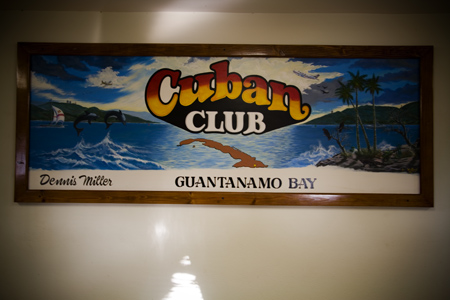
© Cesar Vera

Guantanamo Bay Navel Base with a New Commander-in-Chief. Photographer Unknown. http://www.obamalouverture.com/f39/guantanamo-bay-switch-bush-photo-obama.html
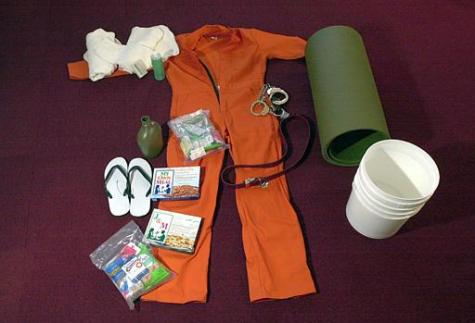
The standard issue of clothing, sleeping mat, food, sandles, canteen, soap, and buckets for detainees of Camp X-Ray is pictured in Camp X-Ray at the U.S. Navy Base at Guantanamo Bay, Cuba, on Wednesday, Feb. 20, 2002. © Tomas van Houtryve/AP Photo
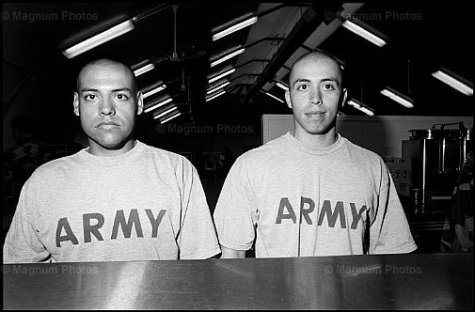
CUBA. Guantanamo Bay. 2003. Soldiers wait for their meals before a prayer breakfast at Camp America. Photo: Bruce Gilden/Magnum
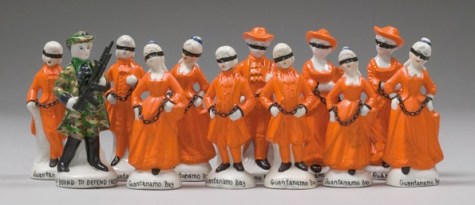
Penny Byrne Guantanamo Bay Souvenirs 2007, vintage figurines, metal chains, epoxy resin, plastic, re-touching medium, powder pigments, 14 x 32 x 10 cm.
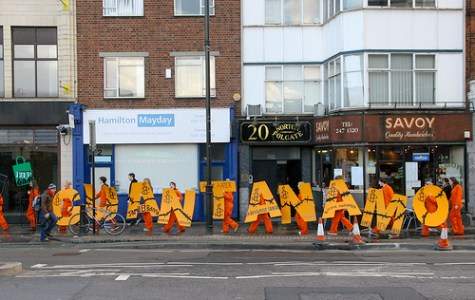
Photo: Jon McClean. http://www.flickr.com/photos/jonmclean/410055117/
IF YOU HAVE ANY RESOURCES TO SUGGEST,
PLEASE CONTACT ME AND I’LL ADD THEM TO THIS LIST.
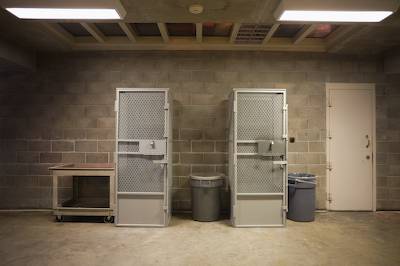
Holding cells, general population area, Security Housing Unit, Pelican Bay State Prison, Crescent City, California. Richard Ross
In this response to Richard Ross’ Architecture of Authority I’d like to discuss two pictures – the first, Interview room, Abu Ghraib prison (“hard site”), Abu Ghraib, Iraq and the second, the Detainee housing unit, Camp Remembrance, new Abu Ghraib Prison, Iraq.
There is rich discussion to be had with Richard Ross’ Architecture of Authority. Political footings jockey with ethical inertia, jockey with instructional histories, jockey with considerations of the soul. Readings thick and fast. No less, these meta-narratives are deformed by one’s own emotional interruptions. One recollects perhaps passages and interrogations through border controls, transport hubs, reception rooms and state corridors. One recalls school, streets and flaking paint.
Random knowledge bombards the equation, – Raves at Ansthruther’s decommissioned nuclear command centre during university days; A deliberate detour made during honeymoon to locate Pelican Bay maximum security prison; An introduction at San Francisco International.
My good friend, and Hesitating co-conspirator, Keith Axline recently featured Richard Ross in a Wired gallery. Keith explained to me that it is Ross’ ability to rattle shutter and catch the necessary shot every time that impressed him most. Ross’ manipulations are in spite of the unpredictable (and sometimes unexpected) access to the different sites. Ross prevails with perseverance; “No never really means no;” and aggressive networking (Ross’ chances of accessing Abu Ghraib depending largely on the trust and recommendations of military personnel he liaised with for his Guantanamo work).
Ross gets the shot he needs, even when he has only a limited number of exposures, and a limited amount of time. More surprising, Ross achieves this with almost perfect tonal harmony throughout the collection of prints. This said, Ross’ technical prowess is not my concern here, rather the gaps and routes between the images he has assembled. Ross consistently presents isolation, the viewer consistently seeks human incidence.
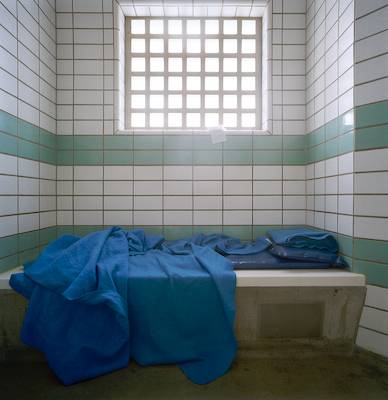
Holding cells, Metropolitan Police, Collingwood Road, Hillingdon, London. Richard Ross
One is compelled when looking at Richard Ross’ starkly depicted environments to search out the signs of life. On a few occasions one is rewarded, a curious tourist looks back at us from atop Syria’s Craq de Chevalier Crusader Fort; a heart shaped paperweight and polystyrene cup sit on the judge’s bench in Santa Barbara’s superior court; an open bag, that will travel home with its owner, sits at the foot of a movie executive’s desk. The loose blanket left in the cell at Hillingdon Road Jail presses us to fleetingly wonder if the person who unfolded and used the blanket in the cell earlier, will be back in the cell later, possibly to use the blanket once more.
The praying figure in Istanbul’s Blue mosque is representative of the building’s purpose. He is a motif of religious expression. The security guard at Topkapi is frozen rigid behind the glass, which serves to separate him from the viewer and present him as a part of the larger observing machinery. How different the shot would be if the guard stared straight down the camera lens? I imagine Ross made a few exposures in which the man did face the camera, but Ross prefers to keep attention on the environment. It is temperate and logical for Ross to choose an image in which the guard looks like a wax model – like a construction.
The austerity of The Architecture of Authority as a collection is hard to deal with. The geographical and institutional reach of the project is impressive. Inconceivably, across this wide subject matter Ross seems to have control in all the locations. Ross distills the form of each site and presents that bare form as the key to understanding the sites function.

Segregation Cells, Camp Remembrance, new Abu Ghraib prison, Abu Ghraib, Iraq. Richard Ross
To my mind, Ross has control in all the locations bar two. The old Abu Ghraib “Hardsite” and the new Abu Ghraib prison. In both forms, Abu Ghraib was a site of photographic desperation for Ross – he was forced briefly to compromise the overall tonality of his project.
The interrogation room is disordered. This room was not designed for interrogation purposes by the American military. It has inconvenient features such as two windows (one barred and boarded), an electrical box, a dusty fire extinguisher, exposed wires, a fallen map, makeshift furniture and used soda cans. There is also a plugged-in laptop, unidentified hold-all bags and what appear to be loose wire on the floor. There is a can or tub of something half-concealed behind the nearest chair. It seems to get more ridiculous the closer you look. There are two camp beds, one folded against the wall with a bag of belongings at the foot. What filled the bookcase? Why did Ross’ guides show him here? Is this an interrogation room? It looks like a sparse room for visiting guests. Is every room at the old Abu Ghraib, de facto, an interrogation room?

Interview room, Abu Ghraib prison ("hard site"), Abu Ghraib, Iraq. Richard Ross
There has been much made of the juxtapositions between photos presented in the Architecture of Authority book and exhibitions; between schools and prisons; between barracks and mental asylums. It is Ross’ right and responsibility to guide his audience in ways of seeing. But there is enough information, memory and rituals of communication embedded in any of Ross’ individual images to warrant singular assessment.
Humans in Ross’ pictures never threatens to steal attention for very long. The narrative of the building or structure dominates the narrative of the individual. There are moments when Ross’ photographs effortlessly adopt the surveillance philosophies of each object – bank, London tube station, hotel phone booths, or the confessional. This is part the photographers skill but also the unavoidable disclosure upon sight of the modes of each disciplining, single-purpose site.
Some sites are more difficult to read than others. Ross was in new Abu Ghraib as a guest, he had a guide. The fact he included a second image counter to his over all vision reveals, not unsurprisingly, that Ross would take what he could get from his tour of new Abu Ghraib, also.
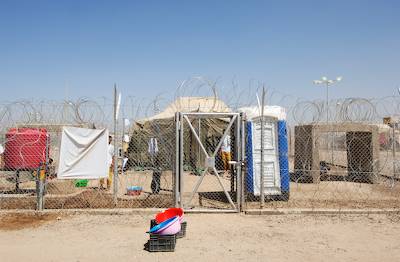
Detainee housing unit, Camp Remembrance, new Abu Ghraib prison, Abu Ghraib, Iraq. Richard Ross
Detainee housing unit, Camp Remembrance, new Abu Ghraib prison, Abu Ghraib, Iraq is a fierce image. It is at first glance still and linear but under a paper-thin surface it is simmering with tension. There are four detainees in this image. In Ross’ depopulated world, that is akin to a cacophonous arena crowd. The two clearly visible men are curiously peering at Ross’ activities and make a mockery of Ross’ attempt to mimic the prison’s personless eye of surveillance. A third man sits in the shade to the right of the image reading and otherwise oblivious. A fourth man sits on the left side of the image obscured by a water tank.
The sheepish glance of one detainee and the craned neck of the other come to dominate this image the longer one looks at it. The man at the door of the tent has no shoes on. Has he just emerged in response to the photographer’s presence? These two men brilliantly illuminate the unnatural and inflexible relationships that exist across and through chain link and barbed wire. They are merely curious at this point and do not gesture or ask anything of Ross, at least not in this exposure. They have been briefly distracted from house-keeping routines by another human that is as foreign to them as any other. Proximity means nothing here for Ross and his inadvertent subjects.
The most remarkable thing about Detainee housing unit, Camp Remembrance, new Abu Ghraib prison, Abu Ghraib, Iraq is not the clarity with which Ross communicates the apparatus of power, but rather how that drains human interaction of meaning or purpose. Does this mean I’d like to see more people in Ross’ photography? Absolutely not, there are plenty of documentary photographers who are trying to convey the spectrum of human existence, and it is not Ross’ charge. It just means that upon the appearance of non-typical images the audience’s attention is gripped. The two anomalous images from Abu Ghraib draw to attention Ross’ otherwise effortless manipulation of his audience. Ross shapes and prepares his viewer for a cold interaction. His manipulation of the audience’s eye is fitting for a project that studies dominance over subjects and imposed order of authorities.
Further investigation: Good text interview. Better audio interview. Best video presentations

 Prison Photography
