
You are currently browsing the monthly archive for July 2011.

In South African slang “pap” means spineless, wet or without character.* Why anyone would want to make a demand for immediate pap (of such a description) is beyond me. And yet, in its chosen company name PapNow! unintentionally hits upon the central tenet of its bilious enterprise – namely a mindless demand for crap.
PapNow! announced itself in June as the place to buy and sell your own celebrity pictures.
The venture takes advantage of the fact everyone has a camera. In my view, PapNow! exploits peoples’ contorted versions of citizenship in a celebrity culture; that they should mimic, stalk and waste time over the looks of others. PapNow! is, one assumes, in it to make money. It is – in the guise of a business model – the reckless, wolfish, jealous little brother of citizen journalism.
Its online presence might just be enough for users to convince themselves PapNow! has value.
There may be other sites like PapNow!; I haven’t bothered the time to do research because I know I’d say the same about each of them. Besides, high value paparazzi shots will always find their monetised routes to the tabloids anyway. My criticism of PapNow! is based purely on how it lowers the bar for entry into the already bottom-feeding paparazzi industry.
The timing is remarkable. Last week, The News of the World scuttled it’s destroyed brand in the wake of the phone hacking scandal that united Britain in disgust. As far as the NOTW is concerned it’s good riddance to bad rubbish, but I worry now that newspapers’ role as arbiters of gossip and candid snaps may be adopted by the docile masses. By process of unconscious assimilation, could the consumers become the producers? Could we end up with a dominant visual culture of only street scuffles, fashion commentary, nipple-slips, antagonism, and up-skirt photography?
Hope not.
By the by, the etymology of the word paparazzi is rather interesting.
* I don’t know if the South African use of the word is innocuous or offensive. If it is rude I don’t want to offend anyone by its use, but the analogy served the argument well.

Chris Vernon takes a long shot in the recreation yard at SEPTA Correctional Facility. Basketball, volleyball and horseshoes are the only opportunities for physical recreation. © Victor J Blue.
VICTOR J BLUE
“What do we expect from people who go to prison? They broke the law, there was a process, they were punished, they got out. But what then?” asks Victor J Blue who’s just published Almost Out, a 4-month long reportage about SEPTA Correctional Facility in Nelsonville, Ohio. The report consists of a photo essay, a short video documentary, and a 4500 word written piece.
Blue describes SEPTA:
“Opened in 1990 to provide judges and sentencing courts in southeast Ohio an alternative to prison or probation for felony offenders, and to help convicts transition back into home communities. The idea is that locking guys up in a place where a battery of programs are not just available to them, but required of them—can cause a shift. It can change outcomes. They can learn to stop coming to prison.”

Corey Cunningham, George Fisher, and Doug Starcher, (left to right) talk with Jeff Johnson, (right) on the recreation yard at SEPTA. Prison gang affiliations and racial tensions that mark other prisons are less prevalent here. © Victor J Blue.
Blue, who is trying to build a portfolio of projects documenting and unpacking the criminal justice system, contemplates the difficult transitions and changes facing former prisoners, “They are felons now, and they will carry that distinction for good. I am interested in how guys getting out are marked, physically and psychologically, by their experience of incarceration, but do not want to be defined by it,” says Blue.
I’ve been aware of Blue’s work since he shot the b-roll for Ted Koppel’s Breaking Point (2007) about California’s overcrowded prisons. Blue consequently produced an award winning Best of Photojournalism essay in the ‘Non-Traditional Photojournalism Publishing’ category, 2009.
OHIO UNIVERSITY
Last week, I spoke about the impressive photography and multimedia work of Dustin Franz and Angela Shoemaker; both graduates of Ohio University’s School of Visual Communication, the same body that Blue and his fellow students are working within.
So, it’s high time we pay recognition to the professional output of the OU SVC student body; especially as it seems to be a leader in the production value of its material published online.
“We just finished our annual reporting project here at OU, it’s called Our Dreams are Different,” says Blue. “We are trying to build some audience for our stories. I don’t know if you are familiar with the project, but this years edition is much tighter and with better storytelling than years past.”
From the website, the approach of Our Dreams are Different is described thusly:
“The stories in this project examine the American Dream — how the dream has changed, how it persists, as well as the myths and realities of its unending pursuit. By telling these stories in the small towns of Southeast Ohio, our goal is to help folks better understand our communities, our neighbors and ourselves.”
BRAD VEST
Ohio University students are being noticed elsewhere too.
Today, DVAFOTO sung the praises of Brad Vest‘s project Adrift and ran a short interview with him about his process and access. Brad writes:
“This is a story about drugs, family and absence along a bend in the river. Travis Simmons is attempting to move past his addiction, and despite prison, parole, parents, and his devotion to his daughters, he cannot stay out of trouble.”
Photojournalism is dead? My arse.

Chris Vernon opens his locker, decorated with photographs of his family in his room. Residents wear pink shirts like the one Vernon has on when they have committed rule violations and they are restricted from furloughs and going outside on the yard. © Victor J Blue.

Sometimes it’s associated with a British band, and sometimes it associated with people who are banned.

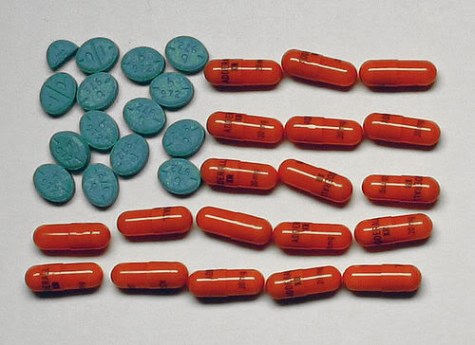
It’s about pills, madness and control. It’s about healing.

It’s about awesome fashions and it’s about bad accessories.


It’s about poor decisions by presidents.

It’s about corporate control and corporate profits.


It’s about death to ours and death to theirs.


Sometimes, it’s about imperialism.

It’s about religious freedom and freedom of religion.


It’s about fake sportspersons and real sportspersons.
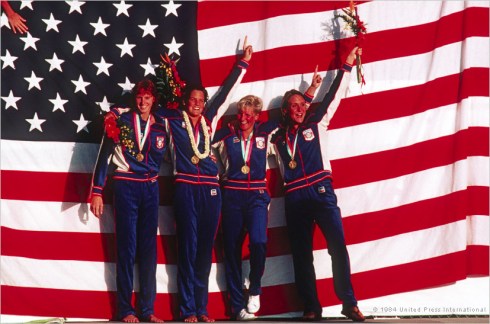

It’s about God and it’s about children.
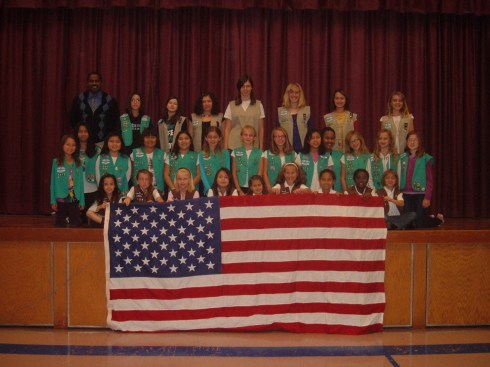
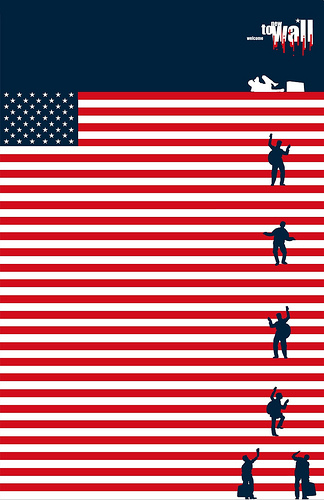
It’s about we the people, not them the people.

It’s about bigotry and it’s about a permanent underclass.


It’s about cold beer, cupcakes and weed.

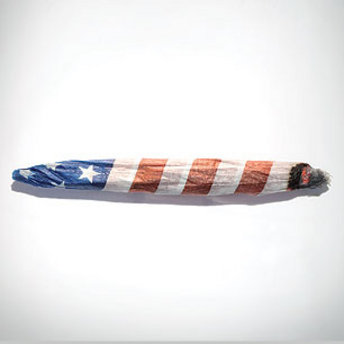
Images sources: Rolling Stones lips; Prison bars, from Teen in Jail; American flag of pills, by Talia Marisa; Heels, Fashion Munster; Spectacles, Linda Lovelock wears American flag sunglasses during the 2010 Tax Day Tea Party April 15, 2010 in Pleasanton, California. Tea Parties were held across the United States to denounce tax day. More than a thousand people attended the Tax Day Tea Party at the Alameda County Fairgrounds. (April 14, 2010 – Photo by Justin Sullivan/Getty Images North America); Bush family; Corporation flag; ISBN flag, via Adbusters; Coffin at night, Sudanese men look at the flag-draped coffin of U.S. diplomat John Granville, 33, who worked for the USAID, as it is received by U.S. officials in Khartoum, Jan. 3, 2008. (AP); US flag bomb graphic, via Daily Bleed; Imperialism flag, Christian cross, on eBay; Star-spangled burqa; Rocky Balboa shorts; Olympic winners, via Astropix (Teammates in the USA women’s 4 x 100 meter relay swim team stop in front of a giant American flag to wave to fans after winning the gold medal and setting a world record in the finals of the event during the 1984 Olympics in Los Angeles. From left are Jenna Johnson, Dara Torres, Carrie Steinseifer, and Nancy Hogshead.); Child’s drawing, via Fire Andrea Mitchell; School class photo, via Valley Community Newspaper (The Girl Scouts who meet for troop activities at Martin Luther King Jr. Elementary School had an American flag flown over the nation’s capitol on Dec. 6 to honor the school. Photo Credit: Unknown); Immigration wall graphic, by Luis Boix; “Does my fag offend you?” bumper sticker; Immigrant labour graphic, by La Mustia; Supermarket beers, via Corks and Kegs; Cupcakes, The Cupcake blog; Spliff, from Rolling Stone via The War on Drugs is a War on Me.
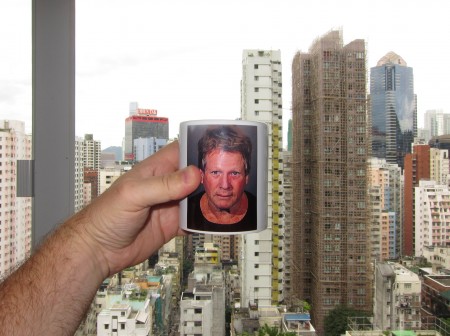
Michael Wolf’s mug. Photo by Michael Wolf for Hermann Zschiegner’s Mugshot Mugs project.
Hermann Zschiegner‘s cheeky Mugshot Mugs had me smiling. He wanted to make a comment on privacy and create and excuse to make contact with his heroes.
Zschiegner Googled and downloaded images of celebrities’ booking photos, printed them on mugs at Walmart and sent the mugs out to, as he puts it, “twenty people that have been of great influence to me in one way or another or whose work I have admired over the years. Some of the people who received a mug are friends, but most don’t know me very well – or at all. […] All I asked from the participants was to place the mug anywhere in their home and take a picture of it. The way the mug was framed in the picture dictates just how much privacy they were willing to give up.”
Zschiegner’s comparison of mugshots with paparazzi and within a framework of privacy-rights is thought-provoking:
“Federal booking photographs are automatically entered into the public domain in the United States, and can be obtained by anyone through the Freedom of Information Act. While designed as a tool to index and collect the images of potential criminals in a database, the publication and distribution of these pictures is an astonishing act of invasion of privacy. Institutionalized, but in effect not much different of paparazzi pictures shot from afar.”
Zschiegner is an active member of the Artists’ Books Cooperative (ABC) an international network created by and for artists who make print-on-demand books. Many of the recent book-projects within ABC have made overt use of public, internet and appropriated digital imagery. In a recent email, Zschiegner described ABC as “slow and spontaneous, small and excessive, serious and funny.” Okay, I’m amused so I’ll let you have it both ways.
THE BACKGROUND
In one of modern politics’ most outrageous adoptions of Doublespeak, Governor Arnold Schwarzenegger – in 2004 – renamed the California Department of Corrections the California Department of Corrections and Rehabilitation.* You can see videos – here and here and here – of the press conference announcing not only a change in name, but a supposed change in the management philosophy of the CDCr.
At that time, legal challenges were being made over the adequacy of healthcare. Following the 2004 criticisms and despite the 2004 promises, consistent constitutional healthcare was not provided to the prison population of California.
The CDCr failed to deliver on both medical care and meaningful rehabilitation. To prove the emptiness of the rhetoric we can look to John Gramlich’s report for the PEW Center’s Stateline last month. Gramlich made the point, that shortly after Schwarzenegger’s rebranding the “administration cut funding for prison rehabilitation programs by about 40 percent.”
THE PUSHBACK
It’s just as well for you and I, a diligent group of California citizens have for 17 years challenged the claim on the CDC acronym and since 2004 reclaimed entirely the discarded California Department of Corrections name. The CDC works to put right misleading messages, empty words and muddy communication.

Founded in 1994, the California Department of Corrections (CDC) describes itself as “a private correctional facility that protects the public through the secure management, discipline, and rehabilitation of California’s advertising.”
Above is the CDC’s latest correction of fact and assault on complacency. From their website:
The California Department of Corrections (CDC) has unveiled a new campaign of bus shelter ads to celebrate America’s assassination of Osama bin Laden.
Released prior to July 4th, a total of ten ads in MUNI bus shelters throughout San Francisco were apprehended, rehabilitated and discharged without incident. The ten liberated ads represent each year in the long decade spanning the declaration of the War on Terror by President Bush and the eventual demise of al-Qaeda’s elusive leader.
Joining in celebration with millions of US civilians after the demise of bin Laden, the red, white and blue advertisements not only pay patriotic tribute to our country, but also celebrate the unsung history of American assassinations.
The rehabilitated advertisements are currently at liberty and seem to have successfully readjusted to public life. However, these ads will remain under surveillance by department staff to prevent recidivism and any potential lapse into prior criminal behavior.
You gotta love direct action. View more works here.
* You may have noticed I always refer to the Golden State’s prison system as CDCr; using a lowercase “r” is an simple text-based slight but it makes the point.
(Via the ever-wonderful Just Seeds Blog.)

 Prison Photography