
You are currently browsing petebrook’s articles.

by La Mustia
ALTO ARIZONA has just launched an invigorating portfolio of protest posters.
From the website: “Arizona’s immigrant community is organizing and preparing to mount the political, legal, and economic pressure needed to restore constitutional protections to the state. They need the nation’s help to change the federal policy that allowed for the formation of SB 1070.”

by Savanah Loftus

by Ernesto Yerena
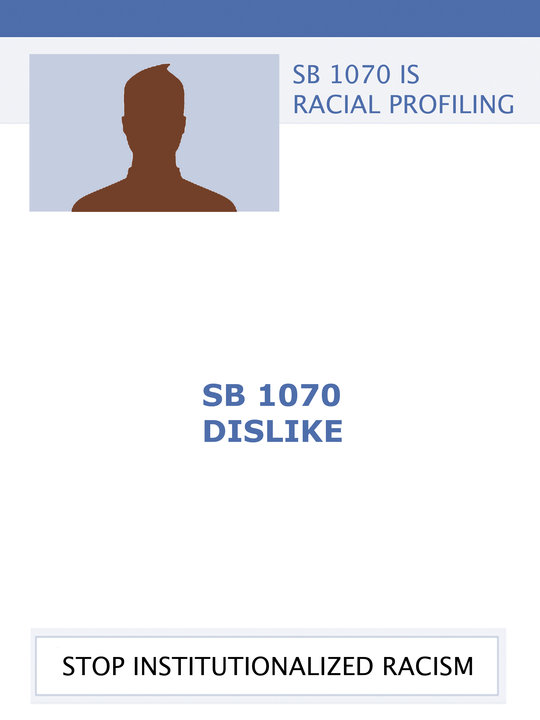
by Jason Gallegos
Thanks to Paul at Eyeteeth for the heads up. (via Just Seeds)
MORE GRAPHICS
While we are on the topic of illustration and instruction through posters, check out Jim’s discussion of authorities (civic, police, transit) graphics. In so doing, Jim includes the Fulana graphic below, which pushes back against posters requesting perfect paranoia and complicity of the public.

If you are in Seattle this Friday, think about dropping in at the Books To Prisoners‘ Art Auction; CREATIVE RELEASE.
Heck, if you turn up with a paperback dictionary you get in for free. I have some inside information that the quality of art is high. Loads of lithographs and a bunch of Just Seeds prison-specific prints!


Over two million individuals are behind bars in U.S. prisons, living in isolation from their families and their communities. Prison/Culture surveys the poetry, performance, painting, photography & installations that each investigate the culture of incarceration as an integral part of the American experience.
As eagerly as politicians and contractors have constructed prisons, so too activists and artists have built a resistance. Nowhere are these two forces pushing against one another as forcefully as in California. The book, Prison/Culture, compiles the documents of a two year collaboration between San Francisco State University, Intersection for the Arts (one of San Francisco’s oldest art non-profits) and prison artists & outside activists across the US.

Mark Dean Johnson’s essay summarises the visual/cultural history of incarceration; from Gericault’s institutionalized mentally ill subjects and his paintings of severed heads as protest against capital punishment, to Goya’s prison interiors of the inquisition; from Alexander Gardner’s portrait of Lincoln’s assassin Lewis Payne (1865), to Otto Hagel’s portrait of Tom Mooney (1936); and from Ben Shahn’s murals against indifference to the conditions of immigrant workers (1932) to the work of Andy Warhol and David Hammons in the modern era.
Johnson guides this lineage to the Bay Area, describing how Michel Foucault’s book Discipline and Punish: The Birth of the Prison became the conversation topic of Bay Area coffeehouses and classrooms (Foucault began lecturing at UC Berkeley in 1979). The swell of interest in Foucault’s structuralism coincided with a grassroots expansion of prison art in the early 1980s.
For text, the editors of Prison/Culture made two canny and provocative choices: Angela Y. Davis and Mike Davis (no relation).
THE TEXT
Firstly, in a 2005 interview, America’s most notorious prison abolitionist Angela Davis sets out – in her most accessible terms – how our prison industrial complex serves primarily as a tactical response to the inadequate or absent social programs following the end of slavery. Abolition was successful in that it redefined law, but it failed to truly develop alternative, democratic structures for racial equality. Powerful stuff, yet even newcomers to Davis’ argument won’t be as shocked as they may expect to be. She’s that good.
Next up, Mike Davis’ 1995 essay ‘Hell Factories in the Field’ is a bittersweet ‘I-told-you-so’-inclusion. Davis has made a specialty of dealing with – in stark academic prose – disaster scenarios, race-based antagonism and the environmental rape of recent Californian history. When Davis witnessed the mid-nineties expansion of the prison industrial complex (or as Ruth Gilmore Wilson terms it ‘The Golden Gulag’) he foresaw prisons’ economic band-aid utility for depressed towns; foresaw the mere displacement of violence; foresaw the assault on fragile family ties; foresaw the unconstitutional prison overcrowding and predicted the collective collapse of moral responsibility.
Davis’ article focused on the then new California State Prison, Calipatria – and not in a dry way. Paragraphs are devoted to recounting the installation of the world’s only birdproof, ecologically sensitive death fence following impromptu electrocutions of migrating wildfowl. The editors note, as of 2008, Calipatria’s facility design of 2,208 beds was 193% over-capacity with 4,272 inmates. Where birds saw an improvement in their lot, prisoners certainly did not, have not.
THE ART
Contributors include some well-known names – RIGO, (here on PP) Sandow Birk, Deborah Luster and Richard Kamler whose works address incarceration, criminal profiling, wrongful conviction, prison labor, and the death penalty. The book also includes poetry by Amiri Baraka, Ericka Huggins, Luis Rodriguez, Sesshu Foster and others but I shall not comment on these wordsmiths (their work is beyond my purview) other than to say they are talented and politically in the right place.

Special mention must go out for Deborah Luster’s One Big Self project (more here). In my personal opinion, it is the single most important photographic survey of any US prison. It is certainly the most longitudinal. Over a five year period, Luster visited the farm-fields, woodsheds, rodeos and national holiday & Halloween events throughout Louisiana’s prisons. She became a loved and recognized figure among the prison population; she estimates she gave away 25,000 portraits to inmates. Luster’s conclusion? Even mass photography struggles to communicate the vast numbers of men and women behind bars.
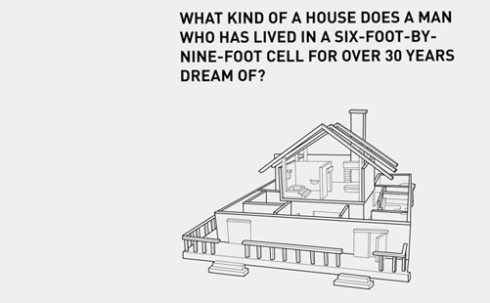
In 2003, artist Jackie Sumell collaborated with Herman Joshua Wallace (one of the Angola 3) on the design of his “Dream House”. The project The House That Herman Built is heartbreaking and bittersweet.
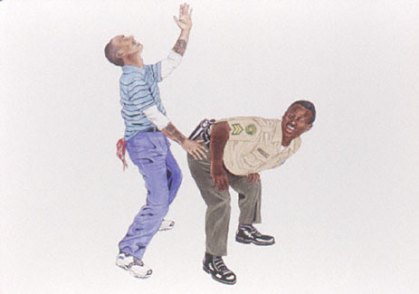
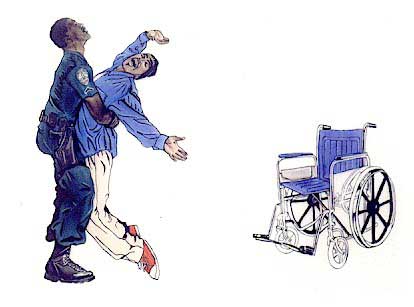
Alex Donis employs cunning and cutting humour for his series WAR. He sketches criminal “types” with figures of authority (policemen, prison guards) mid-dance, often bumping and grinding. He even conjures a kiss between Crips and Bloods gang members.
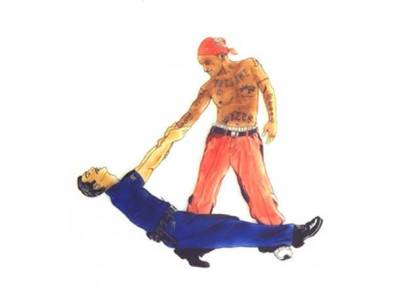
Also unexpected is the visual testimony of condemned mens’ last requested meals. For The Last Supper, Julie Green painstakingly painted porcelain plates with the last meals of nearly 400 executed men. Grayson Perry won the Turner Prize a few years ago, in large part due to his vases of abuse, bigotry and social ills. This clever use of regent materials has also been adopted by Penny Byrne for her Guantanamo Bay Souvenirs which sets up interesting parallels and a new turn for discourse between US homeland prisons and those used for the “Global War About Terror” (GWAT).


Relating to GWAT, Aaron Sandnes established a sound sculpture in which gallery visitors were subjected to the same pop songs used in Psych-ops by police and military interrogators.
Dread Scott‘s use of audio is intentionally to give silenced men a voice. (Scott has talked about the primacy of audio in his exhibition of prison portraits previously at Prison Photography).
Mabel Negrete collaborated with her brother incarcerated in Corcoran State Prison. She mapped out the floorplan of his cell as compared to her apartment bathroom. She then developed a dramatic dialogue in which she played both herself and her brother. (No images unfortunately.)
Traced – but essentially fictional – lines of structure are fitting for San Francisco, the city in which world-famous architect/installation artists Diller & Scofidio got their start with the architectural memories of the Capp Street Project. Negrete’s CV is extensive, she was instrumental in organising Wear Orange Day, a prisoner awareness action. Also check out her Sensible Housing Unit.

Cross-prison-wall collaborations are vital to the project as a whole; so much so, that without input from prisoners, the entire enterprise would fall short. Primarily, it is the men of the Arts in Corrections: San Quentin run by the William James Association who deliver acrylics and oils of optimistic colour and profound introspection. More here.
Collaboration as delivered in a multimedia and digital format comes by way of Sharon Daniel’s Public Secrets. Public Secrets “reconfigures the physical, psychological, and ideological spaces of the prison, allowing us to learn about life inside the prison along several thematic pathways and from multiple points of view.”

In closing, it is worth noting that San Quentin prison (only 12 miles north of San Francisco) has one of the few remaining prison arts programs in the state following 20 years of cut backs. The works in Prison/Culture challenge – as Deborah Cullinan & Kurt Daw, in their foreword, suggest – “traditional boundaries between inside and outside, between professional and amateur, between institutions and people” and, “by juxtaposing work by professional artists with artists who are working inside a prison, this book challenges us to rethink notions of community and culture.”
Prison/Culture is simultaneously a consolidation of achievement, a fortification of resources and celebration of resistance. This may be a book with a Californian focus, but it has national and international relevance. Succinct, well researched, egalitarian and lively. For me, Prison/Culture is the best collection of works by any US prison reform art community up until this point in history.
The resource list of over 80 organisations at the back of the book (page 92) is ESSENTIAL reference material for anyone looking to commit energies into prison art programs. All told, this book is a must read for those interested in the artistic landscape of our prison nation. It powerfully exposes the vast gulf between criminal justice and social justice in US society.
– – – – – – – – – – – – – – – –
Prison/Culture is published by City Lights, edited by Sharon E. Bliss, Kevin B. Chen, Steve Dickison, Mark Dean Johnson and Rebeka Rodriguez.
Read a Daily Kos review here, and view images from a 2009 exhibition here.
City Lights Celebrates the Release of Prison/Culture
On Thursday, May 6 at 7:00 pm, join Steve Dickison, Jack Hirschman, Ericka Huggins, and Rigo 23 for a reading and book release celebration at City Lights Books. Tune in to KQED Forum at 9:00 am PDT the morning of the event for an interview with the book’s editors and contributor Angela Davis.
– – – – – – – – – – – – – – – –
Images (from top): PRISON/CULTURE book front; Sandow Birk; Deborah Luster; Exhibition views of The House That Herman Built; Alex Donis; Alex Donis; Alex Donis; Julie Green; Julie Green; Ronnie Goodman, San Quentin inmate, displays his work; and ‘Public Secrets’ screenshot.
After my post about Safe Harbour series, the photographer Jeff Barnett-Winsby (diviner of pure-story-gold) got in touch. He told me he was going to advance the project further than the web-housed stills and weave the tale of escaped prisoner, manipulated lover and fugitive love-run into a book.
The photographic series Love, Notes and Promised Freedom has morphed into the mature bookspined Mark West and Molly Rose. Here’s the blurb:

——————————————————————————————-
This is a wacky tale and a swift departure from the serious stuff that often weighs heavy on the soul at Prison Photography. Perhaps that why I like it so much. Buy Mark West and Molly Rose.
——————————————————————————————-
Mark West and Molly Rose is published by J&L Books. The owner of J&L Books Jason Fulford was recently interviewed at Too Much Chocolate as was Jeff
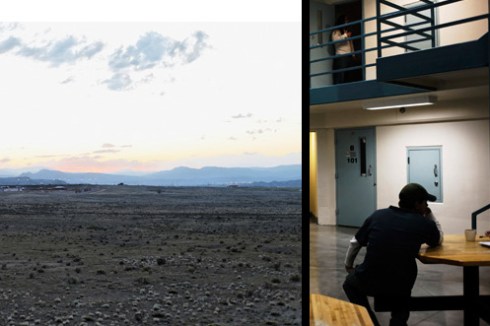
Prison Valley, a documentary by David Dufresne & Philippe Brault, is a haunting view of a one of America’s greatest distopias.
From the introduction: “Welcome to Cañon City, Colorado. A prison town where even those living on the outside live on the inside. A journey into what the future might hold.”
16% of the Cañon City population is inside prison; it is an economy based almost entirely upon incarceration.
Cañon City has a population of 36,000 and 13 prisons, one of which is Supermax, the new ‘Alcatraz’ of America. The new Supermax was described by former warden, Robert Hood, as “a clean version of hell.”
The introduction to the documentary can be a little off-putting at first. The dramatic voice-over deals in emotive-speak and apparent hyperbole. But then you realise that the presentation is not an exaggeration – that the voice-overs are only shocking because of the underlying immutable facts.
Perhaps, as outsiders, French filmmakers Dufresne & Brault are the perfect artists to bring focus upon the most forsaken branch of America’s prison industrial complex?
WEB DISTRIBUTION
As well as taking on old(ish) prison subject matter in a new way, Prison Valley is purposefully designed as a web based project and “Web Documentary”. To view the film beyond its introduction you must sign in with either your Twitter or Facebook social network accounts.
Once signed in the website will bounce you between a mixture of multimedia, interviews, photo-galleries, non-sequitur video clips and auxiliary documents.
The documentary canvases opinion from various characters who the filmmakers meet along the way. The entire project is punctuated with the use of DVD-special-featuresque snippets. You can even attend a memorial ceremony for dead correctional officers.
BLOG
Prison Valley blog here.

Central Juvenile Hall, Los Angeles, California 2009.
Richard Ross has pushed live the online component of his latest project Juvenile-In-Justice.
It seems as if this is a natural development from his project Architecture of Authority. For some, it would be quite worrying if Ross had studied oppressive architecture without following up with inquiry into the vulnerable lives within.
American youth is a vogue topic for photographers; Ross’ work (tactically or innocently) should not be excluded from any national narrative about US teenage experience.

Red Cliff Ascent, Enterprise, Utah 2008

Harrison County Juvenile Detention Center, Biloxi, Mississippi 2009.

Ventura Youth Correctional Facility, Ventura, California 2008
“To date, I have photographed Angel’s Flight (L.A.), group homes, foster homes, ICE juvenile holding, Los Prietos Boys Camp, LAPD, SFPD, EL Paso PD, Ventura Youth Correctional Facility, Santa Barbara Juvenile Correctional facility, Sexual Assault Response Team Examination Rooms, interview and exam rooms for sexually abused children, juvenile courtrooms, high schools, Children of the Night (Van Nuys), JHS, Montessori classrooms, Maryvale (a former orphanage), CPS interview rooms, El Paso Juvenile Courtrooms, half-way houses, reform schools, maximum security Giddings, TX, lock-down and nonlock-down shelters, SW Keys, ORR, ICE, DHS, and CBP to name a few. I have primarily focused on kids that are not the “Kids R Us” type of juvenile, but rather minors that become part of a system because they have failed, or their families have failed them, or their society has failed them. Earl Dunlap, the Director of Cooke County Detention Center, welcomed me to his facility with the words: “Welcome to the gates of hell.”
I am trying to get the broadest range of images and texts. I recently photographed a family that has two grown sons, yet took in two separated brothers and two separated sisters in foster care in order to reunite the siblings and start a second family. So there are some positive and quite inspirational portions of my research as well.”

Suicide Practice Dummy, Fairbanks Youth Facility, Fairbanks, Alaska 2010

New Beginnings Juvenile Rehabilitation Facility, Washington D.C. 2009
(via)

Do you remember last year when Olafur Eliasson installed his waterfalls in New York City? Well, 40 years ago Isamu Noguchi did this in Osaka. Just thought you should know.


Michael Shaw has been conscientiously restructuring BagNewsNotes over the past six months or so. Here’s how he describes the rebranded Bag:
• An almost hypnotizing archive featuring hundreds of ways to sort through our over 3000 image posts.
• A dedicated photojournalism section, BagNewsOriginals, steered by long-time BNN contributor, Alan Chin with a powerful lineup showcasing BAG’s distinguished contributor, Nina Berman, fresh off her Whitney Biennial success; World Press and Pulitzer Prize winner Tony Suau on the economy; and much, much more.
• A Salon section managed by the talented photographer and multimedia producer, Sandra Roa, formerly of the NYT Lens Blog, mixing audio slideshows and live chats, all focusing on key images of the day. We kick off on Wednesday with an audio slide show featuring Ashley Gilbertson’s look at the bedroom shrines of fallen US soldiers.
• Our mainstay news image analysis by BAG publisher Michael Shaw, with new contributors, including: acclaimed photojournalist Chris Hondros conducting exclusive interviews; leading visual academics Bob Hariman and John Lucaites deconstructing visual culture; and former White House photographer, Stephen Ferry, on media’s pictorial stereotyping of the third world.
_______________________________
The Bag is all about demystifying (political) imagery and helping people along with visual literacy. Yes, audiences are more savvy, more sophisticated, but there is still a distance to go.
The Bag is the most persistent contributor to this ongoing analysis. The importance of the Bag’s ever critical eye cannot be underestimated in a world that sinks deeper into the swell of images every day.
The new look by designer Naz Hamid of Weightshift is super navigable and I think it is funny (humorous) that the Bag has made use of the same font used by the New York Times’ arts and media blogs.


The font choice is a cheeky nod to the subtle echoes of form and type that run through our daily visual experiences! It’s as if the Bag is testing its own hypothesis from within the permanent elements of its own visual architecture. That, and it doesn’t hurt to have subliminal associations with the Grey Lady!
_______________________________
MY CONTRIBUTION?
Last year, Shaw contacted me and at the same time as describing Bag’s sweeping changes asked me if I’d come on-board as a contributor.
Writings on US prisons here on Prison Photography will be cross-posted to the Bag in order to bring images and issues of America’s prison industrial complex to a wider audience.
I’ve a got a couple of posts coming up this week so stay alert for those and for all that the Bag offers consequently.

 Prison Photography