
You are currently browsing the category archive for the ‘Activist Art’ category.
Found at the amazing Center for the Study of Political Graphics
Why bother wasting words when an effective graphic says it all?

Women in Prison Scott Boylston, Silkscreen, 2005
The production of this poster was donated to promote the work of Action Committee for Women in Prison.
“Curiosity was the initial spur. Surprise, shock and bewilderment soon took over. Rage propelled me along to the end.”
Jane Evelyn Atwood on photographing in women’s prisons.
This is the third and final installment in my series Women Behind Bars. The second part looked ta the writing of Vikki Law and the first looked at the journalism of Silja Talvi. It was Silja who recommended Jane Evelyn Atwood’s work.
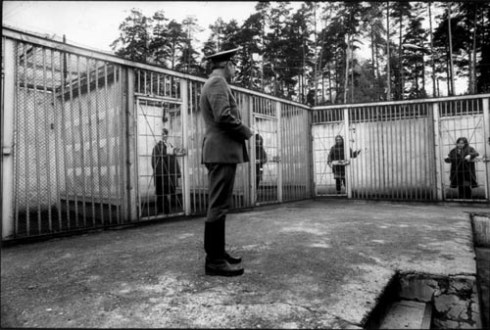
When discussing the work of a prison photographer, it is preferable to do so within the specifics of the region or nation they document. Prison Photography‘s key inquiry is how the photographer came to be in the restricted environment of a prison and these details differs from place to place. Such inquiry is complicated by Jane Evelyn Atwood‘s work because she visited over 40 prisons in twelve countries over a period of one decade. In some cases I know the location of a particular image and in others I don’t. I suggest you compensate for this by buying the book Too Much Time for yourself.
Above is a women’s penal colony in Perm, Russia. It holds over 1,000 women – the majority of who work forced hard labour. Here we see women who are in solitary confinement experiencing their yard privileges – half an hour in outside cages. Most women in the prison are there for assault, theft or lack of papers.
Below is a scene from a Czechoslovakian prison. The scars are not the result of genuine suicide attempts but of regular self-mutilation – a problem more common among female prison populations than male populations.

Another reason to pick up Atwood’s book would be that there isn’t much stuff out there on the web – and that which is is low resolution or small-size. You can see a small selection from Atwood’s Prison series at her website; small images at PoYI; and a really good selection of tear-sheets at Contact Press Images.
By far the best stuff on the web concerning Too Much Time is an Amnesty International site devoted to the project. It includes a powerful preface in which Atwood lays out her raison d’etre. Next Atwood provides a “world view” comparing the prison systems of France, Russia and the US (each a five minute audio). Then comes three specific photo-essays with audio (Motherhood, Vanessa’s Baby, The Shock Unit). Finally, Atwood provides six stories behind six photographs. The stories are many and the facts more astounding than the emotions.
While Atwood’s pictures present the many individual circumstances of the prisoners, Atwood has identified a common denominator; “Of the eighteen women I met in [my] first prison, all but one seemed to be incarcerated because of a man. They were doing time for something he had done, or for something they would never have done on their own.”
Atwood qualifies this, “One woman told me her husband forced to set the alarm to have sex with him three times a night. She endured it for years and finally killed the man that kept her hostage. Another woman’s husband was shot by her daughter after he had stabbed her in the arm as a “souvenir”, poured hot coffee on his wife’s head for not mixing his sugar, and urinated all over the living room after one of the children refused to come out the bathroom. The woman was serving time for “refusing to come to her husband’s aid.”

What is most impressive about Atwood’s work is that it predates photojournalism’s wider interest in prisons by a couple of decades. She had at first tried to gain entry into a French prison in the early eighties. Her failure is unsurprising given Jean Gaumy of Magnum was the very first photojournalist inside a French prison in 1976.
It is a scandal that the discussion over shackling women during labor and gynecological examination continues today. Atwood captured the brutality of it decades ago.

Atwood’s work veers consciously between two reality of the women’s situation – the environment and the body.
Many of her photos share a compositional austerity. The hard angles of institutions run according to ‘masculine mathematics’ (dictating sentencing and experience) are repeated. Atwood punctuates this stern reality with flourishes of femininity … and touch.

Some may think Atwood has over-reached herself with a global inquiry and I’d be sympathetic to the point if anyone else had come close to her commitment. Even considering each prison system in isolation, Atwood’s work can hold its own. Her work in Perm, Russia is particularly powerful as it orbits closely around the issue of uniform, identity and the complications it brought to bear directly on her documentary.
At the Amnesty site, Atwood brings up many interesting points of comparison. She identifies the US system as the most sterile with a legal mandate to treat female prisoners in the same manner as male prisoners. But she also says that if there is grievance or complaint to be settled, US prisoners have recourse to do so. Such allowances are not made in France.
On the other hand, children are excluded from all but a couple of US prisons. The security threat is cited as the reason: a child inside a prison is a constant vulnerable life and constant hostage target. The claim seems a little bogus when penal systems of other countries are brought into consideration.

Atwood was interviewed by Salon about the project. She has also worked on landmine victims and talked to Paris Voice about that. Here, she talks about Canon about her work in Haiti.

Jane Evelyn Atwood
Biography: Jane Evelyn Atwood was born in New York. She has lived in Paris since 1971. In 1976, with her first camera, Atwood began taking pictures of a group of street prostitutes in Paris. It was partly on the strength of these photographs that Atwood received the first W. Eugene Smith Award, in 1980, for another story she had just started work on: blind children. Prior to this, she had never published a photo.
In the ensuing years, Atwood has pursued a number of carefully chosen projects – among them an 18-month reportage of a Foreign Legion regiment, following the soldiers to Beirut and Chad; a four-and-a-half-month story on the first person with AIDS in France to allow himself to be photographed for publication (Atwood stayed with him until his death); and a four-year study of landmine victims that took her to Cambodia, Angola, Kosovo, Mozambique and Afghanistan.
Atwood is the author of six books. In addition, her work has been including the ‘A Day In The Life’ series. She has been exhibited worldwide in solo and group exhibitions. She has worked for LIFE Magazine, The New York Times Magazine, Stern, Géo, Paris Match, The Independent, The Telegraph, Libération, VSD, Marie-Claire and Elle. Atwood has worked on assignment for government ministries and international humanitarian organizations, including Doctors Without Borders, Handicap International and Action Against Hunger.
She has been awarded the Paris Match Grand Prix du Photojournalisme (1990), Hasselblad Foundation Grant (1994), Ernst Haas Award (1994), Leica’s Oskar Barnack Award (1997) and an Alfred Eisenstaedt Award (1998). In 2005, Atwood received the Charles Flint Kellogg Award in Arts and Letters from Bard College, joining a company of previous laureates including Edward Saïd, Isaac Bashevis Singer and E.L. Doctorow.
Klavdij Sluban and Jim Casper of LensCulture talked about Klavdij’s photography workshops in juvenile prisons across the world.
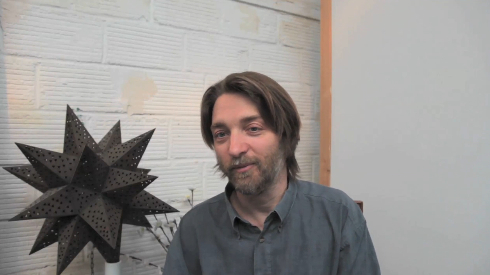
Early in the interview, Klavdij discloses his personal sadness that prisons exist. This emotion may be raw but it is not naive; Klavdij is balanced and realistic about what he can achieve with a camera in these specific distopias. He also says in seven words what I established this blog to say “Jails are a world to be discovered.”
He went to the prisons not as photographer, but as a concerned citizen. He realised if he were to go inside it would need to be with some reciprocity … so he took cameras and used them.
In terms of engagement and commitment to a population – the youth prison population of the world – Klavdij Sluban could and should be considered a ‘Concerned Photographer’. He deserves that loaded epithet.
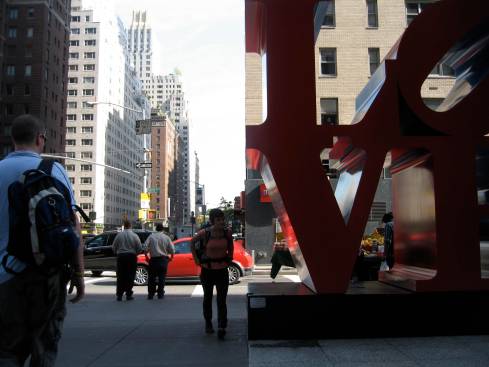
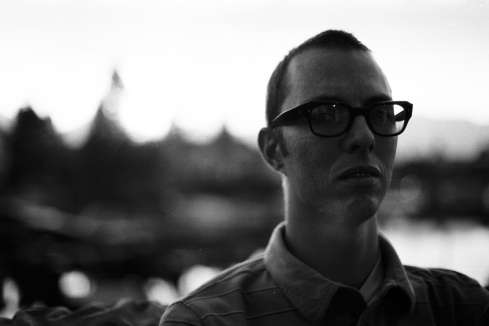
Had a fun time in New York last week. Stayed with Jack and Marisa. Below is not Jack. Below is Chris by Jack.
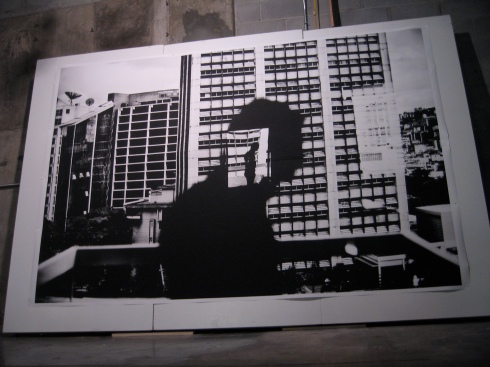
We went to Christopher Anderson’s book launch for Capitolio. It was great to see it after recent reviews, heated debates (check out comments) questions and wot not. I don’t think the selection of the images was the best.
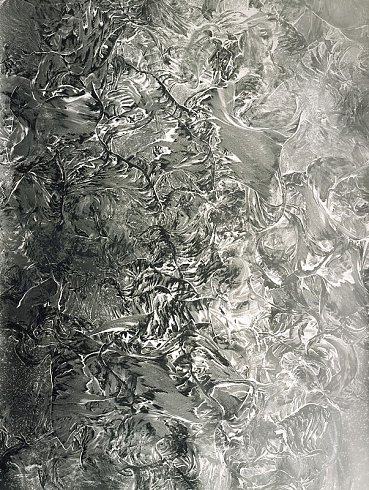
At the Metropolitan, Surface Tension: Photographs from the Permanent Collection was a pleasant whimsy into some mesmerizing works, notably Adam Fuss’ UNTITLED (1997) made by the metronome shimmers of snakes upon black dust upon white dust. Image Source: Cheim & Read
The Met’s photography department was putting together the final touches on Robert Frank’s The Americans which opened this week. It was all hands to the pump as evidenced by besuited Malcolm Daniel – who I spied carrying large, heavy object (post?) behind a partition and into the exhibition space.
Egg and Cheese Bagel.
Over at the Museum of Modern Art, I was pleased to see Russell Lee‘s work Bulletin Board in Post Office Showing a Large Collection of “Wanted Men” Signs, Ames, Iowa (1936). Who doesn’t love a mug shot?


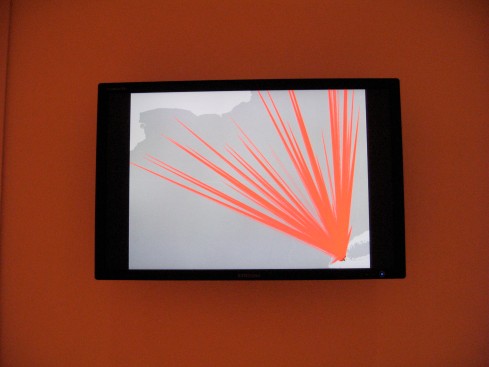
Bringing the practice of mapping of transgressions into the 21st century, the Spatial Design Lab from the Graduate School of Architecture, Planning and Preservation at Columbia University exhibited its Million Dollar Blocks Project (2006).

On Monday night I sat with Andrew Lichtenstein. We talked. Andrew recommended Brennan Linsley‘s work and was quite emphatic about the book ‘Concrete Mama‘. He also spoke highly of Max Kenner and the work at the Bard Prison Initiative
Tuesday, I met Emiliano Granado. We were first in contact over his San Quentin Giants pictures. We talked about many things including Trevor Paglen, Argentina, the Burke Gilman, and the Horticultural Society of New York, which recently lost Barbara Margolis who was an inspiring leader. Emiliano recommended Alessandra Sanguinetti‘s work.

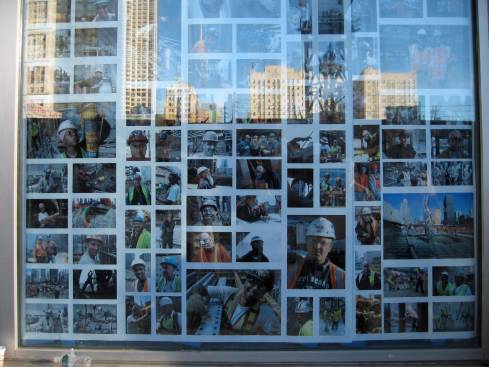
On Sunday, I’d been at the WTC construction site. There was some portraiture on display in a window. The space behind the window was closed but would usually be open. The photographs were easy on the eye.
On my last night I checked out Steven Hirsch’s Courthouse Confessions.
That’s Matt Kelley looking at Steven’s work. He’s coordinator for Change.org Criminal Justice, online communications for the Innocence Project and all together nice bloke. Matt’s double identity is twittered and can be followed here and here.
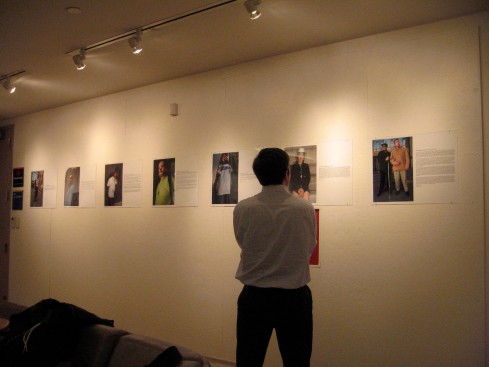
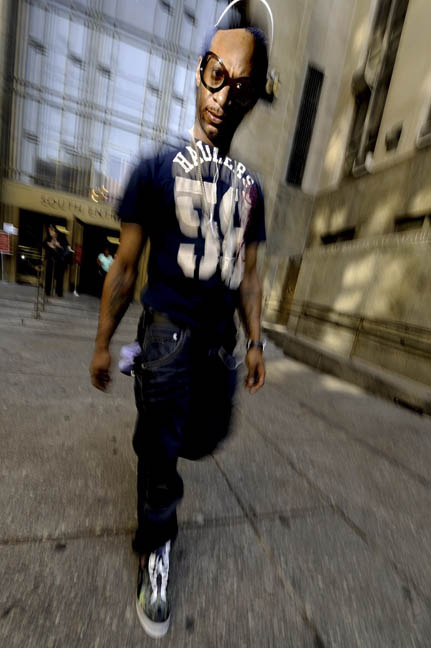
Hirsch takes street portraits of folk going to court, secures (in some ironic twist) a non-binding statement and then transcribes it verbatim to go with the portrait. Constantly moving the camera, Hirsch uses hard flash and distorted angles/zoom to depict these individuals as shape shifters; as anomalies. The fact Hirsch’s subjects (in most cases) seem alien to the logic of the courts – that any lessons arising from their cases are unlikely to effect sentencing laws in the future – should but be a source of disquiet for us as an audience.
One last thing. On Saturday, I saw John Baldessari sat outside a Grennwich Village coffeehouse, but I bottled saying anything. I’ve learnt that famous people abound in Manhattan and you see ’em everywhere.
Thanks to everyone who altered their orbits a little to coincide with mine.
People ask how photojournalists and documentary makers get access to prisons, so I ask the photographers I meet. For every photographer, circumstances and events are unique.

The Society of Professional Journalists details media prison access policy, contacts, visitation rules, forms and permitted equipment state-by-state. There is no home page for the data, so I’ll link you to the Virginia Dept. of Corrections guidelines.
Prisoners in Virgina will be needing more visits to fill their time as their right to receive books via charities has just been withdrawn. The feeble reasoning by the Virginia DoC:
Because Quest [the Books Behind Bars program organiser] sent books directly to offenders and utilized volunteers to send these books, there was nothing in place to stop someone from attempting to introduce contraband to an offender by secreting it in a book.
This is plainly an excuse. It is also an embarrassment. If a prison system cannot provide efficient (and secure) passage of educational materials to its wards, then is it a system we should have any respect for or trust in?
These broken systems should be in our view.
“These analyses [of the prison system] – coupled with what I had seen firsthand – made sense, steering me to work towards the dismantling, rather than the reform, of the prison system. Resistance Behind Bars should not be mistaken for a call for more humane or ‘gender responsive’ prisons.”
Vikki Law (Source)
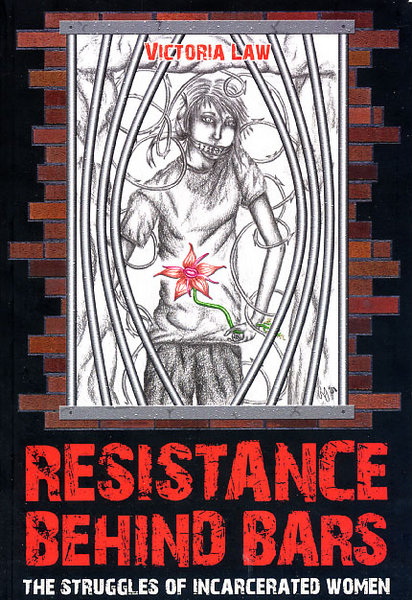
This is the second in a three part mini-series entitled Women Behind Bars, casting an eye over the work of writers and artists dealing with women’s struggle within the US prison system. The first installment featured journalist Silja Talvi’s work. Today we look at the activism of Vikki Law.
Speaking
“How many people know about the Attica prison riots?” asked Vikki Law. The majority of the audience raised hands. “How many of you have heard of the August Rebellion?” she then asked. No response. Point made.
The August Rebellion was staged in 1974 by women imprisoned at New York’s maximum-security prison at Bedford Hills. Protesting the brutal beating of a fellow prisoner, the women fought off guards, holding seven of them hostage, and took over sections of the prison.
Writing
Vikki Law wrote Resistance Behind Bars to counter the historical erasure of women’s prison resistance. The book challenges the reader to question why these instances and efforts have been ignored and why many assume that women do not organize to demand change. It fills the gap in the existing literature, which has focused mostly on the causes, conditions and effects of female imprisonment.
Law has worn many hats in the anti-prison movement. In 1996, she helped start Books Through Bars-New York City, a group that sends free books to prisoners nationwide. In 2000, she began concentrating on the needs and actions of women in prison, drawing attention to their issues by writing articles and giving public presentations. Since 2002, she has worked with women incarcerated nationwide to produce Tenacious: Art and Writings from Women in Prison and has facilitated having incarcerated women’s writings published in larger publications, such as Clamor magazine, the website “Women and Prison: A Site for Resistance” and the upcoming anthology Interrupted Lives.
Similar to Talvi’s work, her writing is uninfected with academese. Law’s focus is the self-organised activities of women prisoners such as forming peer education groups, clandestinely organizing ways for children to visit mothers in distant prisons and raising public awareness about their conditions.
Law will criticise writing that she deems unhelpful and misleading. For example she refutes author Virginia High Brislin’s work which stated “women inmates themselves have called very little attention to their situations,” and “are hardly ever involved in violent encounters with officials (i.e. riots), nor do they initiate litigation as often as do males in prison.”
Law urges us to acknowledge the existing patriarchy of society. The term feminism has become co-opted by predominantly white and privileged classes. The actions that would have previously fallen under the purview of feminism continue in pockets and without a top-down label. She states:
Once such case would be that is described below. Law takes the details from a letter written by the victim.
In the case of Barrilee Bannister, sentenced under Oregon’s mandatory sentencing law, she and seventy-eight other women were sent to a privatized, all-male prison in Arizona run by the Corrections Corporation of America (CCA). The approximately 1300 mile move completely cut the women off from family, friends and others whose outside support could have prevented their abuse. Only weeks after the women’s arrival, some were visited by a captain, who shared marijuana with them. He left it with them and then returned with other officers who announced that they were searching the cell for contraband. They promised that if the women performed a strip tease, they would not search the cell. “Two of the girls started stripping and the rest of us got pulled into it,” Bannister recalled. “From that day on, the officers would bring marijuana in, or other stuff we were not suppose[d] to have, and the prisoners would perform [strip] dances.” From there, the guards became more aggressive, raping several of the women. Bannister reported that she was not given food for four days until she agreed to perform oral sex on a guard. (Source)
Private prisons will forever provide opportunities for gross abuse of human rights, but this is obvious and a discussion for another time. Still, on this evidence, Law has a long road of resistance and a lot of public education to provide. I wish her well.
Photography
Law’s commitments don’t stop with the pen. She also wields a camera and has contributed significantly to the activist-photography community of NYC.

ABC No Rio through a 6-year-old’s Holga, 2006
In 1997, she organized a group of activist photographers to transform one of No Rio’s upstairs tenement apartments into a black-and-white photo darkroom for community use. Since then, she has remained actively involved in coordinating (and sometimes co-teaching) free photography classes for neighborhood youth. In addition, she has participated in and curated numerous exhibitions at No Rio’s gallery, many with themes addressing social and political issues such as incarceration, grassroots efforts to rebuild New Orleans, Zapatista organizing, police brutality and squatting.
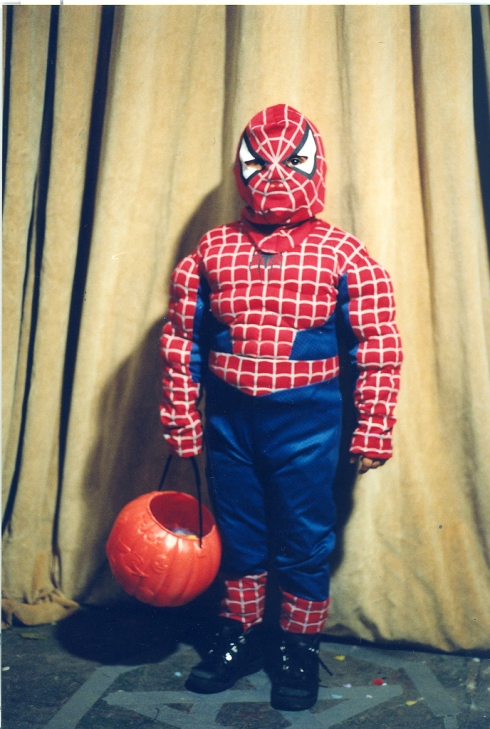
Every Halloween, Law also moonlights as a portraitist for ABC No Rio‘s free haunted house for kids. As she explains, “Over 400 kids from the neighborhood show up to shriek and scream their way through the first floor and backyard. Tipping my hat to Tom Warren’s “Portrait Studio” in the 1980s, I set up a portrait area to document some of the kids and their costumes.”
Below is Prison Photography‘s favourite.
Please read Vikki’s extended resume. Check out Vikki’s Flickr photostream. For a list of resources from The Action Committee for Women in Prison click here.
This is the first of three posts celebrating the work of journalists/academics/photographers bringing to popular conscience the abuse of women in the American prison system.
I have called this triplet mini-series Women Behind Bars and it was spurred by a couple of news stories this week. In New York state, protesters outside the Governors house drew a promise from David Paterson that he’d sign legislation banning the chaining of incarcerated women who are giving birth.
Also, a class action lawsuit is gearing up in Michigan, which seeks a $100million settlement for over 900 female inmates and former-inmates who suffered harassment, groping and rape between the years of 1993 and 2009.
Women Behind Bars as a name for this mini-series was co opted from the Silja J. Talvi‘s most recent book of the same title.
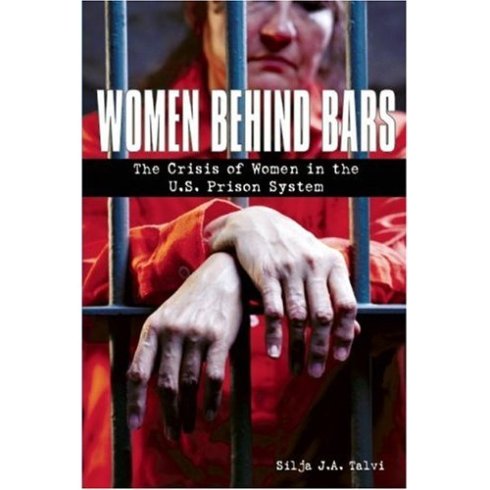
I had the pleasure of hearing Silja talk at the Seattle Public Library. Silja speaks as she writes – without jargon or polygonal argument. She keeps it simple; she is usually retelling the testimony of female prisoners she has visited and interviewed. No flourish required.
Beyond the physical and sexual harassment of female prisoners, Talvi asks us to reevaluate our understanding of psychological welfare as it is handled by the prison system. The 775% increase in the US female prison population since 1977 is – for want of a better word – criminal. It is double the rate of growth for the male prison population. Talvi is in no doubt that this increase is due for the most part to the war on drugs. Talvi also describes the constituencies entering US womens prisons.
Talvi’s work crystallises the fact that the massive incarceration of American women has not been a result of crime on the streets, but a result of criminalisation by writ of political assemblies. In the war on drugs, women are involved but surely we must analyse that involvement. Occupying residence, associating with family drug dealers are indirect misdemeanours that stand to be punished. When a society is blighted by drugs and the dealers are involved in the “war” on the street, usually it is women who hold the threads of family and community – and home – together … despite its faults and its drug use.
Talvi points to another remarkable trend,
There’s also the fact that women are less likely than men to snitch on loved ones. Prosecutors will come to them and say they will go to prison unless they give up the names of three higher-ups, but women usually either say they don’t know those people or will simply decline. Men will snitch and, unfortunately, they often get less time in prison than women who don’t.
The shocking statistics are simply an application of US culture that is too morally bankrupt & class divided to think of more imaginative forms of criminal justice than incarceration.
Prison is a violent, inhumane environment – the modern designations of built with violent offenders in mind. But what proportion of women prisoners are violent? Not nearly as many as our fear-gripped culture would presume.
The prison is a disciplinary tool that has needlessly subjugated women. It has been imposed and it has demolished poor communities.
When Talvi supports prison for violent murderers and rapists and then argues for its non-implementation for female ‘criminals’ she is entirely consistent. The prison has a place, but it is not in the persecution of non-violent females, it’s counter to the notion of justice and it flies in the face of social justice.
As This Is Not A Book Sale put it,
The book Women Behind Bars was produced as part of the Women Behind Bars Project which:
[Source]
Women Behind Bars. The Book: More and more women—mothers, grandmothers, wives, daughters, and sisters—are doing hard prison time all across the United States. Many of them are facing the prospect of years, decades, even lifetimes behind bars. Oddly, there’s been little public discussion about the dramatic increase of women in the prison system. What exactly is happening here, and why?
Bio: Silja J. A. Talvi is an award-winning journalist with credits in more than seventy-five publications nationwide, including The Nation, In These Times, and the Christian Science Monitor. She was honored as a recipient of the 2005 and 2006 PASS awards for criminal justice reporting by the National Council on Crime and Delinquency, a 2006 New American Media Award, and twelve regional SPJ awards for excellence in journalism. Talvi’s work has appeared in numerous anthologies, including Prison Nation: The Warehousing of America’s Poor, Body Outlaws, The W Effect, It’s So You, and Prison Profiteers. She lives in Seattle.
“There is beauty and there is truth and most truth in this present world is ugly.”
Momena Jalil
“In the central jail of the capital Dhaka, it is unbearable to live there. It is impossible to document it, cameras are not allowed inside.”
Momena Jalil

The prisoners sit on the floor of the common cell; this special newly opened women prison has much space. But in the central jail in the capital Dhaka this same amount of space is packed with women and their children.
I received an email yesterday from Diederik Meijer, editor of The Black Snapper, an online magazine that presents each day the work of a new photographer. The works are selected by guest curators and grouped under a weekly (geographical) theme.
I was happy Meijer contacted me.
This week, The Black Snapper is focusing on photographers from Bangladesh. Following Andrew Biraj, they’ve featured Momena Jalil a photographer whose work I’ve pointed out before. Prison Photography and The Black Snapper share admiration for the Bangladesh photographic community and its numerous talents putting work out internationally.
Momena Jalil’s project is obscured however; her photographs are only half the story of sorry conditions in Bangladesh’s prisons.
These are the images she was allowed to take … and this is a newly operating jail. She was not granted access to the older sites of incarceration. The scenario is quite bizarre. Jalil speculates that, in 2007, this prison was hastily finished so as to house two prominent female political leaders. Not all the buildings, such as the male or juvenile blocks, in the compound were completed or in use at the time of Jalil’s visit. The prison was opened amidst a choreographed national media campaign.
Jalil refers to the women in their prison provided white shari with blue stripes as “angels without wings”. Jalil suggests that the crimes accused and evidence gathered are neither properly articulated or adequately qualified. Who are we to judge these women when the system that cages them exposes itself to grave question?
Take the time to read Jalil‘s involved and emotive response to the womens prison and be sure to follow the high standard of work presented by The Black Snapper.
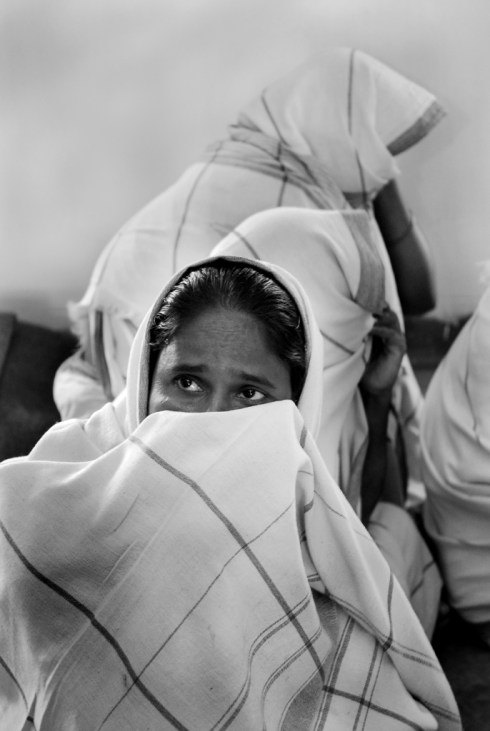
The eyes of Salma tell more than we can read or understand, perhaps there is complaint, plea, anguish, misplaced trust or betrayal? It is fact a she hides her lips but she kept her eyes open. It is sad we are illiterate to the language of eyes.
Photo & Captions: Momena Jalil

 Prison Photography