
You are currently browsing the category archive for the ‘Amateur’ category.
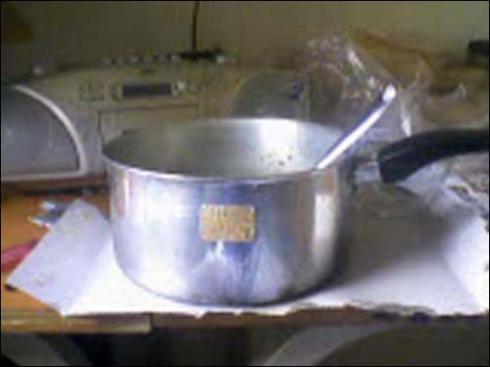
Photographer Mohamed Bourouissa asked a friend – known only as JC – detained in a French prison to share the banality of his confinement via cell phones pictures and over 300 SMS messages.
Bourouissa’s exhibition ‘Temps Mort’ (‘Time Out’ or ‘Dead Time’) which closed at the Galerie Kamel Mennour today featured nine images and an 18 minute film montage of the correspondence.
Earlier this year, Algerian-born Bourouissa gained significant attention in the US with his show Périphéries at Yossi Milo Gallery which depicted the lives of youth in the depressed banlieue neighbourhoods on the outskirts of Paris. (Reviews here and here.) ‘Temps Mort’ confirms Bourouissa’s commitment to the underprivileged in French society.
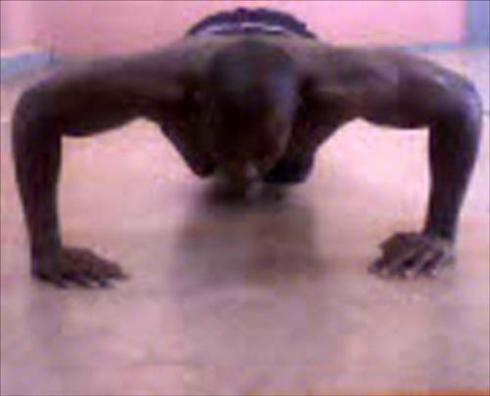

JC and Bourouissa worked together over a period of 6 months. Initially Bourouissa had to instruct JC closely describing the shots he was looking for. Bourouissa broke down the boundary between the imprisoned JC and himself as a free man by filming repeated actions outside the walls on his own camera phone – at one point in the film the JC’s steps on a jail corridor blur into Bourouissa’s steps through snow in the free world. (I concede this blog post cannot come close to describing the mood of the finished video.)
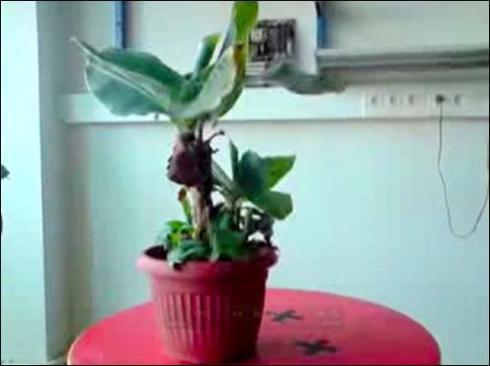
For exhibition, nine pixelated images were blown-up; the degraded resolution mocking the Parisian preoccupations with Impressionism and Pointilism. As Bourouissa’s press release explains, images were hung adjacent to prison newspapers “reconstructing a comprehensive representation of the prison world, and mentally filling in the blanks of the images, the spaces between the bed pan, radio, barred window, lamp, etc.” The viewer sees the abnormality of confined life.
We should bear in mind that in 2008, Bourouissa and JC were working against a national debate in France about the appalling state of their prison system. Again from the Temps Mort press release, “How not to express our outrage at the French prisons? Their infamous exercise cages, their areas of lawlessness, their unhealthy showers and four rolls of toilet paper monthly.”

Gleaning available information from poorly translated sources (1A, 1B, 2A, 2B, 3A, 3B, 4A, 4B), I am still not sure how the images were secured. Reviews suggest that cell phones are banned within French prisons – which I would expect to be the case – so the feat seems even more remarkable. (I have detailed a short-lived case of cell phone photography behind UK bars.)
Whatever, first impressions may offer, Temps Mort is not a lazy presentation of “vernacudigi” photos. In many of his projects Bourouissa wants to “make the illegal legal”. Just as with Peripheries he gives over much of the creative process to his subjects. Many images for Peripheries were staged simulations of actual events experienced previously by the photographer and subjects. After a period, Bourouissa gave JC very little direction and their output synchronised. Alone the photographs would fall short, but Bourouissa always intended to pair them with the film.
Of course we should not miss the obvious here. Low-res imagery is associated with the spontaneous capture of event, with protest, with skirmish, with citizen documentation and more often than not with the testimony of the individual against the (violent) uncertainties of the State in which they exist.
Low-res is about the privilege of witness beyond any inherent privilege of existence. Romantically, low-res photography is thought of as a tool for use against dominate conglomerate forces; practically low-res photography is the evidence of the effects of those forces.
Bourouissa presents the incarcerated masses as the disenfranchised and the dispossessed.
MOHAMED BOUROUISSA
A student at le Fresnoy, Mohamed Bourouissa graduated from the National School of Decorative Arts and also holds a DEA (M.A.) in Plastic Arts from the Sorbonne (2004). He recently benefited from a solo exhibition at the Finnish Museum of Photography in Helsinki and has participated in numerous group exhibitions, most notably at the New Museum in New York. In 2010, the artist will show his work at the Berlin Biennial and at Manifesta. Born in Blida, Algeria, in 1978. Lives and works in Paris. Represented by gallery Les Filles du Calvaire, Paris / Brussels. (Source)

via Vingt
“SnapScouts was designed and developed for children to use, before they form stereotypes of other people. They’re the perfect reporters, unbiased and unprejudiced by media concepts.”
“[SnapScouts] leverages modern technology to address the timeless threats to democracy and freedom.”

THIS is one of the best pieces of satire in a long time, at least I think, I hope, I know it is satire.
A NEW WAY OF EARNING BADGES
From SnapScouts:
Want to earn tons of cool badges and prizes while competing with you friends to see who can be the best American? Download the SnapScouts app for your Android phone (iPhone app coming soon) and get started patrolling your neighborhood.
It’s up to you to keep America safe! If you see something suspicious, Snap it! If you see someone who doesn’t belong, Snap it! Not sure if someone or something is suspicious? Snap it anyway!
All this is a great play off America’s worst paranoia and best humor. Good stuff!
The FAQ page is hilarious combining fears of soft drugs and illegal immigration with a contempt for foreign CCTV culture.
“My eight-year old caught the gardener smoking something suspicious. It wasn’t marijuana, but it turns out he was illegal!” – Phyllis Specter, 32, Idaho
and
“After only a three-month trial of SnapScouts in England, Indonesia, and Germany, we are proud to report over 600 crimes reported.”

Cutting a chair and stool. © Gary Walrath. Taken with Pentax ME super.
Two years ago, I found Gary Walrath‘s set of photos from a 1970s Logging Show at Oregon State Prison. They are so unique they don’t really fit into any recognisable discussion … still.
I have also repeatedly tried to contact Gary about the background to the series. No luck. So, I simply provide a couple of images, a link and some bemusement at the spectacle of axes and chainsaws within prison walls.
Gary is a busy amateur photographer and a seven times chainsaw World Champion, in the Un-limited Hotsaw Class. His weapon? The Iron Horse.
‘The Iron Horse – 90 hp 500cc Husqvarna Motorcycle Engine. Running Oregon 1/2 pitch chain on a 36″ custom made guide bar. The drive sprocket is 16 tooth. Over 8,000 RPM in the cut.’ (Source)
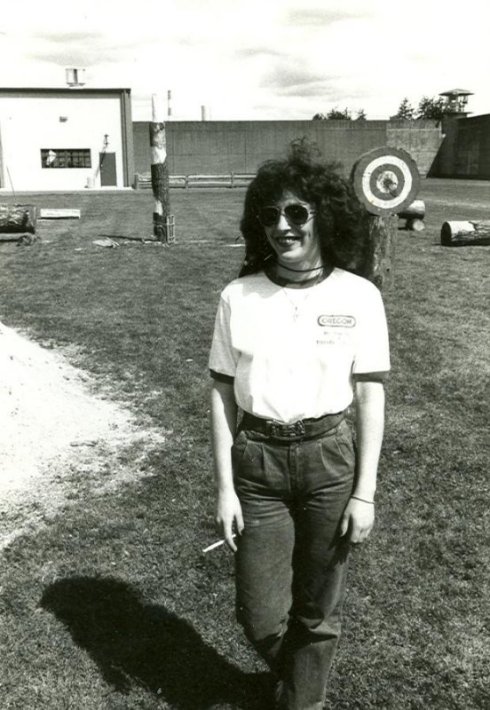
Ronda (she drove the prisoners nuts). © Gary Walrath. Taken with Pentax ME super.
Was it an inside act of rebellion?
I have absolutely no grounds on which to make an accusation, which is why I phrase it as a question.
But just looking at the foolish doctoring of images, especially the helicopter cockpit image, I wonder if the culprit intended to be caught? The color of the photoshopped image is just ludicrous, literally unbelievable, unless that is Martin Parr’s Gulf of Mexico!
To me, the reworking seems suspiciously blatant. Who is the “contract photographer” doing these pig-eared photoshoppings? And, is he/she a saboteur?

Original. © BP p.l.c.
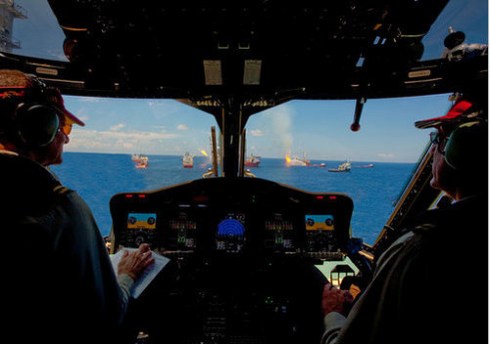
Botched photoshop. © BP p.l.c.
INTERNET MEME
Rather joyously, this image has become a meme. See the comments in the original and excellent Gawker article!
An Omar Broadway Film aired on HBO last month. Omar smuggled a video camera into Northern State Prison, New Jersey and documented for six months. The film was debuted at the 2008 Tribeca Film Festival.
There are many reasons I believe in prison reform, the wasted potential is one, the wasted dollars is an other, the systematic violence is the reason to which this film speaks. Shadow and Act review it here.
Below is a video interview with Douglas Tirola, one of the directors, about how the film got made.
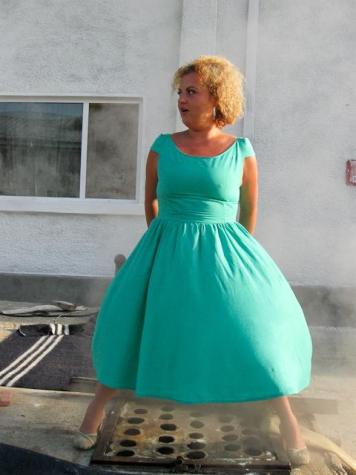
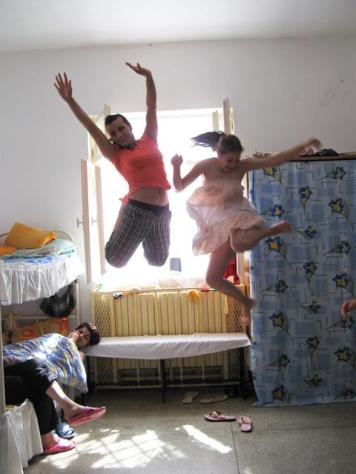
Fourteen female prisoners at Tirgsor Prison in Romania participated in a six-camera workshop led by Cosmin Bumbuţ.
The workshop was suggested by a Miss Raducanu (presumably the warden), and Cosmin Bumbuţ took up the initiative. Bumbuţ gained sponsorship from f64 and insisted that – after basic training – the women be left unsupervised with the cameras for the duration of the project.
Bumbut: “I received six Canon PowerShot cameras that I took with me to Tirgsor in July. The cameras worried me, they had so many buttons and the manual was so complex that I was skeptical that anyone could use them; I, for one, wasn’t able to. I felt very nervous.”


Over a two month period the group captured 14,000 images. 395 were chosen for the final exhibition and 95 can be seen in an online gallery at Punctum (Romanian language). Here is a Google translation.
I’ve picked out 12 images.
This is a marvelous project. I would like to see more photography used as rehabilitation in prisons. I have a colleague who uses video in an ethnological framework and the men really benefit from the novel educational approach.
This Romanian project is similar to the pinhole photography of the girls of Remann Hall here in Washington State.
Finally, it is worth saying that Bumbut was inspired by Klavdij Sluban‘s prison workshops which he has conducted across the globe.


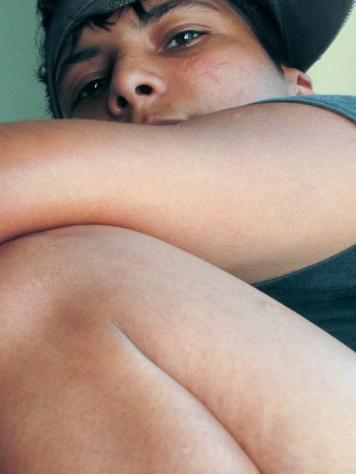


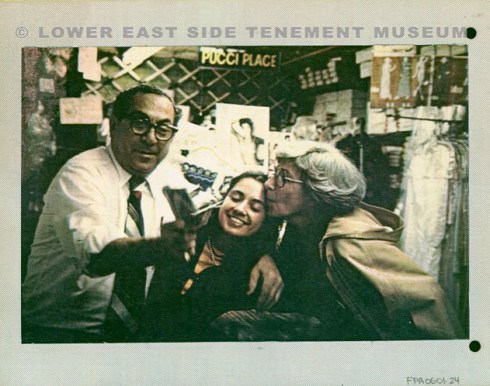
The Tenement Museum now has its photography archive online. What a treat! Go on, lose yourself …
(via)

 Prison Photography