
You are currently browsing the category archive for the ‘Documentary’ category.

PRINTED MATTERS
For the upcoming Cruel and Unusual exhibition, Hester Keijser and I opted for a newsprint catalogue. We did this for several reasons.
Firstly, the message behind the exhibition is one that calls for political thought and hopefully political change. Shifts in attitudes come about through public education; it made sense to distribute information as far and wide as was possible. Not everyone can afford a photobook/catalogue, but 4,000 free copies of a newspaper nullifies the issue. Some might call the newspaper medium democratic, but I just call the solution common sense. 
Secondly, we had a lot of photographers to feature. 32 pages of a tabloid-sized newspaper is a sizable amount of column inches with which to fairly deal with the many issues in the photographers’ works.
And third, Hester and I wanted to bring attention to the fact that [photo]bloggers continue to shape, react to, and distort new media economies. As we say in our curatorial statement:
“Cruel and Unusual looks at the utility of freelance online publishing. As bloggers with academic backgrounds, we happily invest time and intellectual capital in our research and writing. Our blogs and those of colleagues have become resources – almost contemporary libraries – that others utilize and perhaps even capitalise upon. For a host of reasons, printed journalism is in decline. Simultaneously, bloggers refine their messages unhindered. Related, but not necessarily causal, we want to acknowledge these two trends and the disruption at hand.”
We aren’t particularly worried about not knowing what the future holds, because for now we are propelled by opportunities to create things in the present.
SOME OTHER NEWSPRINT PHOTO PUBLICATIONS
Most people are probably aware of Alec Soth’s Last Days of W. President Bush was a constant source of partisan news stories, and Op-Ed’s on Bush were divided and divisive. Given that Bush was a leader who orbited world events without necessarily controlling them and given that he was a Commander-in-Chief whose war cabinet tried to warp media to its own message, Soth’s use of a newspaper is ironic and appropriate. Jeff Ladd noted that Soth’s subjects look worn out and exhausted as if reflecting the American psyche after eight years of Bush. A newspaper will soon yellow and show aging – perhaps Soth hoped his newspaper would be short lived like the memory of Bush and the reparations required following his presidency?
Recently, Harry Hardie at HERE has collaborated on two newsprint photo publications.
CAIRO DIVIDED (32 pages) sequences the photos of Jason Larkin with an authoritative essay (in both English and Arabic) by Jack Shenker about suburbanization around Egypt’s capital. Since January 25th of 2011, Egypt has not been out the news, and yet this project is not about revolution. It is however about poverty, wealth and class stratification and as such provides a good context for the revolution in Egypt. Excellent design with eye-opening photographs. Highly recommended. More info here.
Guy Martin’s The Missing is borne of a collaboration between Panos Pictures, HERE and Martin’s alma mater The University of Falmouth. Each of its 48 pages has a large image of a missing poster photographed by Guy Martin. The posters “adorned the walls of the courthouse and justice rooms on Benghazi’s seafront.” Martin estimates that in Libya, 30,000 men are missing after the 8 month conflict. As such, the quasi-legal vernacular documents he re-photographed in-situ were the making of “communal place of memory and mourning.” The newspaper acts as a bulletin existing somewhere between the makeshift and the permanent; between memory and knowing; and – as with those pictured – in ambiguous flux with time. More info here.
Shifting gears, Portrait Salon 11 is not about political events. It is, however, a political stand against institutional exclusion. In the tradition of the 1863 French Salon des Refuses, the London-based Portrait Salon is a curated showcase of photographs that were submitted but not selected for the prestigious Taylor Wessing Photographic Portrait Prize. The use of a newspaper is a mischievous challenge to the immobility of a gallery exhibition that chose 60 works from 6,000 submissions; the newspaper can move cheaply and in large quantities beyond gallery walls. Furthermore, the accompanying Portrait Salon exhibition projected portraits in order to include more photography and not be limited by physical space. The exhibition and newspaper were organised by Miranda Gavin, Wayne Ford and others. For purchase.
I’ve highlighted these projects and in each case tried to justify why the choice of newsprint was appropriate and theoretically consistent. I believe that the Cruel and Unusual newspaper is those things too.
CRUEL AND UNUSUAL: AVAILABLE ONLINE
A non-printable, non-downloadable, non-alterable screen-preview version is available online.
Starting February 18, the newspaper is also available for free in the Noorderlicht Photogallery and for sale in the webshop.
The exhibition is split into two sections: 1, a traditional presentation of 11 photographers, and 2, a heady mayhemic wall of work-prints, background material contact sheets from Prison Photography on the Road (PPOTR).
Similarly, the newspaper is divided into two sections. A 20 page PPOTR pullout is enveloped in 12 pages of descriptions of the photographers in the main part of the exhibition.
Below are the opening page and the back page of the PPOTR pullout. The portrait on the opening page was made by Tim Matsui who documented my workshop at Sing Sing Prison.

The back page is a list of 32 of our favourite international photography blogs with QR codes linking to their websites. This was our cheeky riff on the classifieds section of newspapers!

And below are two pairings of PDF pages and Hester’s photographs of the actual printed object. The paper is really beautiful … so Hester tells me; I’ve not held one yet! I would like to thank the designer Pierre Derks who worked with Hester and I. He has expertise, patience and put in some hard graft.


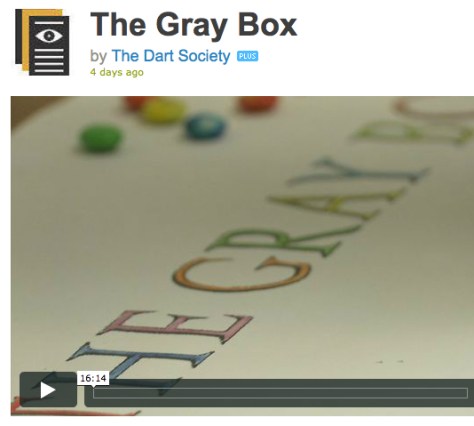
I feel I’ve tried and fallen short in elucidating the core of the matter as regards solitary confinement. When I watched The Gray Box, by freelance journalist Susan Greene and DAX Films, I knew it was something I had to share.
The Gray Box speaks as I never could; it has voices of experience. You’ll be awed by the psychological terror they describe and by the activities isolated prisoners employ to remain sane.
Of all the many battles at hand for prison reformers, it is felt that the campaign against the over-use of solitary confinement in American prisons is an issue that currently resonates enough with the public to effect some policy change.
The anti-Solitary bloc has simplified its message saying that solitary confinement does permanent damage to the mind of he or she imprisoned; a view backed up by medical science.
Publics are also more educated about isolation – and the manipulation/interrogation techniques associated with it – because Guantanamo prison has been regularly discussed in the media for over a decade.
Essentially, the knowledge that solitary destroys people is knowledge that anyone on the political spectrum can understand and oppose. From the hardcore secular ACLU to coalitions of churches, the voices in opposition to solitary confinement are wide and varied. Even so, we do still see some prisons such as Rikers Island which are bucking the trend and pushing for the to use of more solitary confinement.
Furthermore, the few actions of what we might refer to as prisoner resistance include calls to curtail the use of solitary confinement. (This is something Isaac Ontiveros covered when we discussed the California hunger strike).
Solitary confinement is not an issue I feel I’ve adequately discussed here on the blog. I’ve brought up it’s historical genesis; I’ve discussed isolation in and out of prisons; and I’ve referred you to stories about infamous U.S. prisoners such as Robert King and Leonard Peltier who served and are serving time in isolation.
Truly, if you want to know about the abusive use of solitary confinement in US prison’s follow James Ridgeway’s vital journalism at Solitary Watch.
Ridgeway, a voice you can rely on, says about the film and of Greene’s article The Gray Box: An Investigative Look at Solitary Confinement:
This is one of the most comprehensive articles ever written about solitary confinement in the United States, and is particularly noteworthy for including the voices of prisoners, obtained through correspondence with those buried in isolation. It is also passionate and personal.
JOURNALISTS
Susan Greene is a former-columnist at the Denver Post who often wrote about the widespread use of solitary in Colorado’s prisons and at the federal supermax, ADX Florence.
James Ridgeway was interviewed by the Dart Center and talked about the murky statistics and exchange of (mis)information about American prisoners in solitary.
Joseph Rodriguez alerted me to this film. Joseph’s own work Re-Entry in Los Angeles appears among the Spring 2012 Dart Society Reports.
The Dart Society Reports distributes journalism about trauma, violence and human rights.

DOC#: 312197
DOB: 11.25.1964
POB: North Kingston, RI
Sentence: 5 years
Work: Floor Worker
Pamela Winfield, Easter Bunny, Children’s Visiting Day, Louisiana Correctional Institute for Women, St. Gabriel, Louisiana. © Deborah Luster. Courtesy Jack Shainman Gallery.
ANNOUNCEMENT: CRUEL AND UNUSUAL
With a big lump of pride in my belly and knowledge of known unknowns, I am pleased to announce Cruel and Unusual, an exhibition of prison photography Hester Keijser and I are curating at Noorderlicht Gallery, Groningen, Holland.
Hester contacted me just before I set out on Prison Photography on the Road (PPOTR) and asked if I’d co-curate a show; she wanted to tap the prison photo landscape and tell Europeans about the mass-incarceration looming on the horizon should their governments repeat the bottom-line economics and unforgiving approach of American policy-makers.
Hester writes why she invited a curatorial novice like me to collaborate, here.
CURATORIAL DECISION MAKING
Just as I got out from behind the desk for PPOTR, to make in-person connections and audio recordings, so an exhibition is another new way for me to present photography of our hidden carceral spaces, and, in so doing, stoke the fires of the reform debates.
As you can imagine, we had scores of photographers from which to choose. Hester distilled some thoughts, guided me by the hand when necessary, and we plumped for eleven stellar photographers: Araminta de Clermont, Amy Elkins, Alyse Emdur, Christiane Feser, Jane Lindsay, Deborah Luster, Nathalie Mohadjer, Yana Payusova, Lizzie Sadin and Lori Waselchuk.

Anwar, from the series ‘Life After’ © Araminta de Clermont

Inmate volunteers at the Angola Prison Hospice massage a dying patients limbs. © Lori Waselchuk

From the series ‘Dungeon’. © Nathalie Mohadjer
The eleven photographers employ a variety of strategies in order to challenge prevailing stereotypes about crime and incarceration. Vernacular photography, found materials, alternative processes, painted photos, digital manipulations and straight black and white documentary will all be in evidence.
A TOUCH OF PPOTR
Alongside an orthodox(ish) presentation of the eleven main photographers, I wanted also to capture the chaos, interactions and visual excitement I saw in photographers’ studios, contact-sheets and home-towns while on the road.
Along one wall of the exhibition, we’re mounting a hectic presentation of work-prints, behind-the-scenes images and rough text culled from photographers archives. Photographers included are Scott Houston, Adam Shemper, Sye Williams, Jon Lowenstein, Joseph Rodriguez, Ara Oshagan, Jeff Barnet-Winsby, Lloyd Degrane, Harvey Finkle, Sean Kernan, Tim Gruber, Jenn Ackerman, and Steve Davis. Tim Matsui, Jack Jeffries and Frank McMains provide the b-roll.
This parlays nicely into the fact we’re producing a newspaper format catalogue … in a run of 3,000 copies!
The digital age has simultaneously brought about the decline of printed journalism and the rise of freelancers (bloggers) who publish their own content and worldview at will. Related, but not necessarily causal, we wanted to acknowledge these two trends and the disruption at hand.
Every which way I look at it, Cruel and Unusual is an experiment. It feels good to be trying something new and risking mistakes. Hopefully, our presentation does the subject matter justice.
DETAILS
‘Cruel and Unusual’
18 February – 1 April, 2012
Stichting Fotografie Noorderlicht
Akerkhof 12
9711 JB Groningen
Netherlands
Opening hours: Wed–Sun: 12–6pm
Admission: FREE
Telephone: +31 (0) 50 3182227
Email: info@noorderlicht.com
Opening reception: 17th February
Curators talk: 18th February

Installation shot, Gems, by Jane Lindsay. Bottle cap, resin.
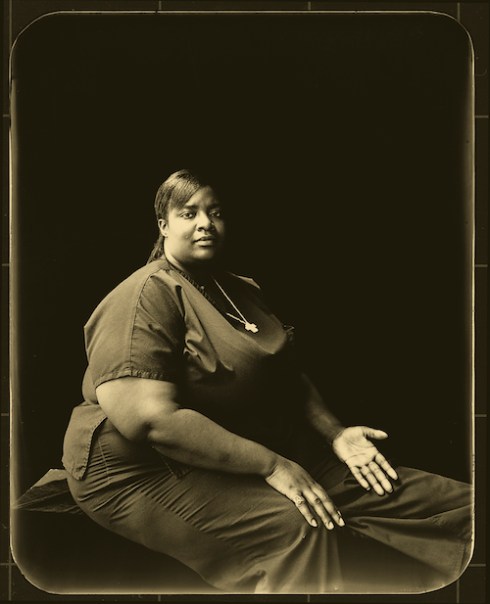
DOC: #335957
DOB: 8.23.1963
POB: Mississippi
Sentence: 4 years
Children: 3
Work: Housekeeping
Louisiana Correctional Institute for Women, St. Gabriel, Louisiana © Deborah Luster. Courtesy Jack Shainman Gallery.
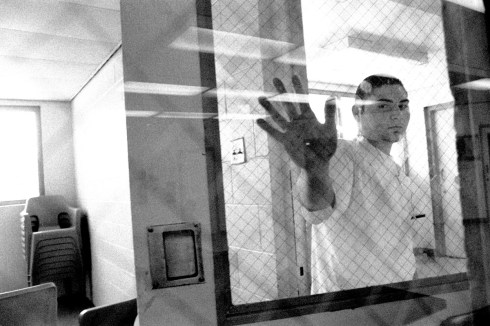
When Ara Oshagan was invited to shoot b-roll for a documentary film in the Los Angeles Central Juvenile Hall, he didn’t hesitate.
“I had lunch with Leslie [Neale, the filmmaker] on Monday, and on Tuesday I was inside with my camera,” says Oshagan. The film was Juvies.
As an Armenian emigre living in Los Angeles, Oshagan was aware of California’s bloated prison and jail systems, but had not thought about how he’d operate as a photographer within them. Previously, his approach was to spend years on his documentary projects often wandering and discovering. In Los Angeles Central Juvenile Hall, time was not a luxury … and neither was space. “I had to keep the film crew out the frame.”
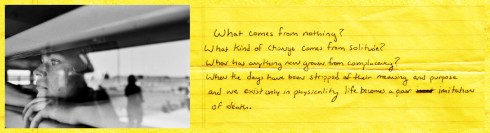
Over the 3 years of the project, Oshagan identified shortcomings in the ability of his photographs alone to describe the experience of the children. His solution? To pair images with poetry and prose of the six children he followed.
When the kids got bumped up into the adult system he followed them there too. “I wanted this work to be about this passage. The adult system is a complete change in culture,” says Oshagan. “The whole culture will take advantage of the younger kids coming in.”
Oshagan witnessed teenagers he knew as small boys, bulk-up in their first six months in the adult system. They told him how the first thing they learnt was how to make weapons to protect themselves.
What surprised both he and his subjects was the length of sentences children are routinely given. And, after they move up through the system, their chances of a secure, violent-free life diminish.
The real kicker? Oshagan concludes his own kids are not too dissimilar to those he photographed in lock up. It’s not too difficult to imagine one poor decision and a life taken over by years of incarceration.
Why does this matter? Well, not only are sentence-lengths for juveniles growing, in recent years many states (40 in total) have introduced laws to allow the trial of juveniles as adults.
How is our society poised for the conversation on the culpability of under-18s and our shared capacity to manage and then forgive?
To help the conversation, Oshagan is to shortly publish the photobook A Poor Imitation of Death. The title comes from one of the kids’ description of imprisonment.
LISTEN TO OUR CONVERSATION AT THE PRISON PHOTOGRAPHY PODBEAN PAGE
All images © Ara Oshagan




I hadn’t planned to interrupt my PPOTR coverage, but when something this important arises then to hell with convention.
You may be familiar with the name Jeffrey Stockbridge, and you’re probably well aware of his Taylor Wessing Portrait Prize shortlisted double-portrait of Tic Tac and Tootise.
Stockbridge has been photographing in Philadelphia for years with a focus on the Kensington Avenue neighbourhood, which Stockbridge describes:
Kensington Avenue is a hot spot for drugs and prostitution located in North Philadelphia. Populated by cheap bars, pawnshops, and check cashing businesses, the Avenue is also the major business corridor in the neighborhood.
Kensington Blues is not just another dip-your-toe-in-poverty photo project; Stockbridge has spent considerable time befriending many of his subjects. He gives them dignity, and with his designated website Kensington Blues, Stockbridge – through audio and transcription – gives each subject a voice.
I am quickly coming to value any photographer’s approach that, above all else, connects the subject to the photographer … and thus the subject to ourselves. Stockbridge’s Kensington Blues pays that attention to human connection.
BIOGRAPHY
Jeffrey Stockbridge is a photographer based in Philadelphia, Pennsylvania. In 2005, he placed runner up in the New York Times Magazine “Capture the Times” college photography contest. Stockbridge is well known for his projects documenting drugs, prostitution and urban blight in Philadelphia for which he has received several grants and awards. Stockbridge is a recipient of a Pennsylvania Council on the Arts Grant, Independence Foundation Fellowship in the Arts Grant and a Center For Emerging Visual Artists Fellowship. His work has been widely exhibited nationally and internationally. Selected exhibitions include The National Portrait Gallery in London, The Philadelphia Museum of Art, The Fleisher Art Memorial, The Delaware Art Museum, The Delaware Center for the Contemporary Arts and J. Cacciola Gallery. Stockbridge was recently awarded 3rd Prize in the 2010 Taylor-Wessing Photographic Portrait Prize at The National Portrait Gallery in London. Upcoming exhibitions include Galerie Huit Photography Open Salon 2011 in Arles, France and a solo exhibition of Stockbridge’s work is scheduled for July 2011 at The Wapping Project Bankside in London. (Source)

16 year old boy in King County Juvenile Detention Center, Seattle.
With a stack of cash and a full paid year of leave what choices would a photographer make?
Richard Ross decided to use his award-winning photography skills and decades of access-negotiating experience to visit and document America’s juvenile detention facilities. Now, by giving his images away for free, he’s passing on his good fortune and helping decision-makers build better policy.
Thanks to a years sabbatical from the University of California and the award of a Guggenheim fellowship, Ross was freed of time and money pressures and over a five-year period, visit more than 350 facilities in 30+ states and interviewed approximately 1,000 children. He hopes Juvenile-In-Justice will change the national debate.
Ross has partnered with the Anne E. Casey Foundation, but it’s not an exclusive relationship; he is open and willing to share his archive with any group working to improve transparency in the system and improve the confinement conditions for our nations incarcerated youth.
In our interview, Ross talks about some of the differences in management he observed across counties and states; describes the trauma experienced by many detained children; explains that sometimes the simplest solutions are best; and expounds on how we are quick to give-up on children who have – for the most part – not seen any benefits of our perceived social contract.
LISTEN TO OUR CONVERSATION ON THE PRISON PHOTOGRAPHY PODBEAN PAGE.
Visit the dedicated website Juvenile-In-Justice for regular updates and transcribed interviews with many of the children in Ross’ photographs.
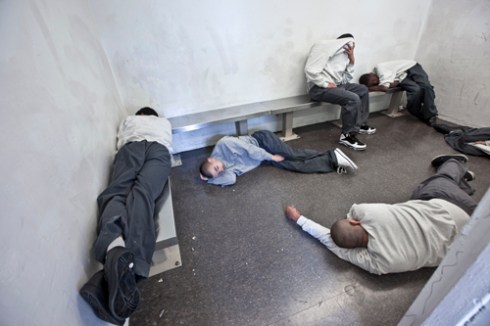
Los Padrinos Juvenile Hall. Downey, California.
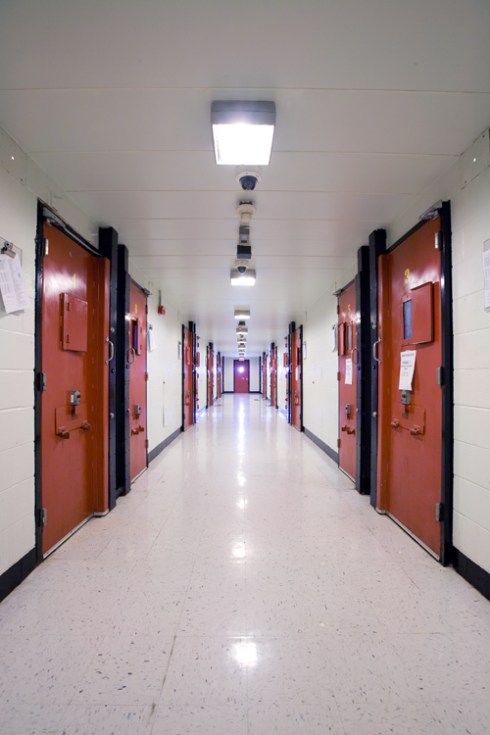
Giddings State School, Giddings, TX. Maximum security. Pictured: hallway of isolation cells, essentially maximum security within maximum security.

Orleans Parish Prison (OPP), New Orleans, Louisiana. The air-conditioning was not working when Ross visited and there was a fight the previous night. As a result T.V., cards and dominoes privilege have been taken away. The OPP, managed by Sheriff Marlin Gusman, houses about 23 juvenile boys. They live two to each cell. The cells at their narrowest measure 6-feet in width.
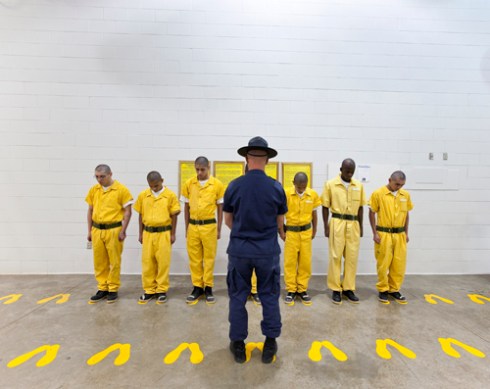
Orientation Training Phase (OTP), part of Youth Offender System (YOS) Facility in Pueblo, Colorado. OTP performs intake and assessment of convicted children. OTP operates like a boot camp. All of the children at OTP have juvenile sentences with adult sentences hanging, meaning that if they fail in the eyes of the authority they will have to serve their adult sentence. For example, a child could be there serving a two year juvenile sentence with 15 years hanging.

A twelve-year old in his cell where the window has been boarded up from the outside, at the Harrison County Juvenile Detention Center in Biloxi, Mississippi. The facility is operated by Mississippi Security Police, a private company. In 1982, a fire killed 27 prisoners. There is currently a lawsuit against the authorities which forced them to reduce their population. They must now maintain an 8:1 inmate to staff ratio.

Dorm room six of the Hale Ho’omalu Juvenile Hall in Honolulu, Hawaii. Built in the 1950s, the facility was under federal indictment until a replacement facility could be constructed and occupied in early 2010. This boy who has been in and out of foster care all his life, has been here at Hale Ho’omalu for one week. He committed residential burglary in 7th grade and has since repeatedly violated with petty actions like missing meetings or truancy. His father was deported to the Philippines and his mother is a drug-user. The only person who visits him is his YMCA drug counselor.
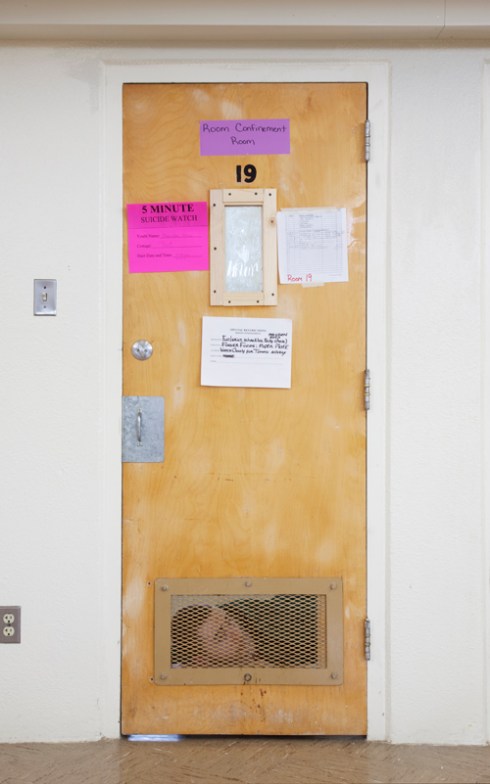

The Caldwell Southwest Idaho Juvenile Detention Center detains children between the ages of 11-17 years old. When Ross visited, six girls were in detention for the following offenses – two for runaway/curfew violations; lewd and licivious conduct, molestation abuse; controlled substance; trafficking methamphetamine; burglary and marijuana
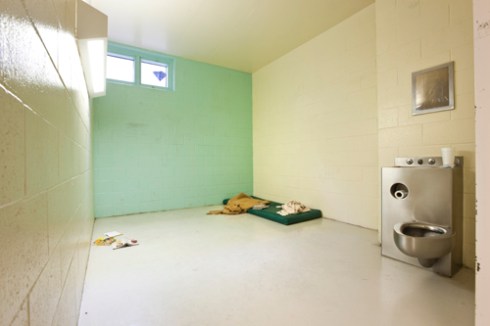
Under 24-hour observation, this 15 year old boy on the mental health wing of the King County Juvenile Detention Center, Seattle, WA is checked on every 15 minutes.

Restraint chair for self-abusive juveniles at the Mendota Juvenile Treatment Center in Madison, WI houses 29 children and is usually always at full capacity. The average stay for the emotionally and mentally disturbed juveniles, some of which are self-abusive or suicidal, is eight months. Children must be released at age 18, sometimes with no transition options available to them.

View of camera monitoring the isolation room at the St. Louis Detention Center, St. Louis, MO. The facility is run by the Department of Youth Services. When Ross visited only 35 of the 137 beds were occupied. The population had decreased significantly because of the embrace of the principles of the Juvenile Detention Alternatives Initiative and the leadership of Judge Edwards.

All images © Richard Ross
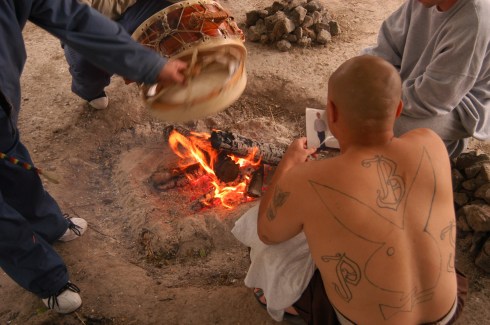
Wards tighten two drums over a fire in preparation for a Sweat Lodge Ceremony held each Thursday at the Heman G. Stark Youth Correctional Facility in Chino, CA.
In 2005, Berkeley-based photographer and videographer Jan Sturmann documented the young prisoners of the Heman G. Stark Correctional Facility in Chino, California during their Native American Sweat Lodge Ceremony.
For over 20 years Jimi Castillo, the prison contracted Native American Spiritual Leader, has presided over ceremonies that serve to awaken more fundamental truths about prayer and consciousness. The space created by Jimi doubles to as an arena to ease tensions, practice equality and resolved gang differences.
“I don’t differentiate between the races,” said Jimi Castillo, . “Anyone from the two-legged tribe is welcome to sweat with us.”
Jimi’s is a mentorship Sturmann admires.
For Sturmann, the issue of incarceration is not about punishment but about how institutions provide opportunities for personal and spiritual growth. Jimi provides a space devoid of the daily stresses of imprisonment. Jan hopes his photographs “can help build empathy” and understanding between populations either side of prison walls.
Sturmann was not just an outside observer. He was invited into the lodge to join the proceedings. He put his cameras down and crawled into the dark. The “transformation” he shared with Jimi and the young prisoners was profound – you can hear his emotion at 16m20secs in the interview.
LISTEN TO JAN STURMANN AND I DISCUSS HIS ASSIGNMENT ON THE PRISON PHOTOGRAPHY PODBEAN PAGE
All Images © Jan Sturmann http://www.albinocrow.com


An assistant to the Fire Tender brushes coal and ash off the glowing rock before it is placed into the Sweat Lodge. 56 rocks were heated for this ceremony, which Native American Spiritual Leader Jimi Castillo conducts each Thursday.
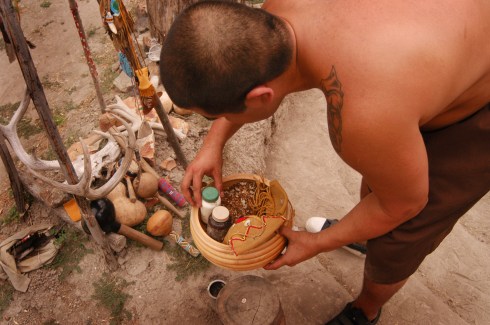

Wards offer each other comfort and support before entering the Sweat Lodge. No blood has ever been spilt in the Sweat Lodge area, and gang rivalries and personal disputes are often resolved during this time.

Fire Tender and ward, Jessy, distributes sacred tobacco to fellow participants, which they will toss onto the fire with a prayer, before entering the Sweat Lodge.

Since 1991, Native American Spiritual Leader Jimi Castillo has conducted this ceremony, which is open to all wards, irrespective of race.
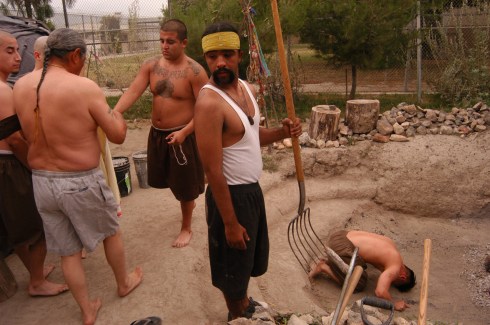
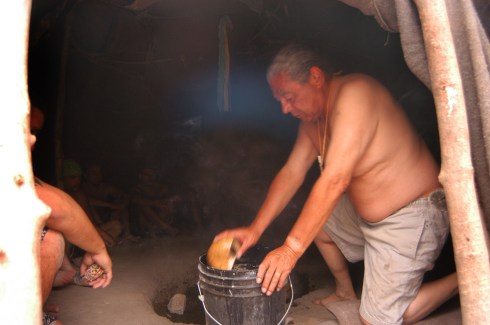
Native American Spiritual Leader Jimi Castillo welcomes a ward who prays before entering the Sweat Lodge.

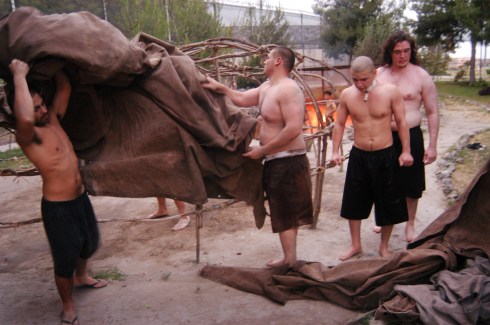
At the end of the ceremony wards pull tarps and blankets off the Sweat Lodge, which is made from bent willow saplings.
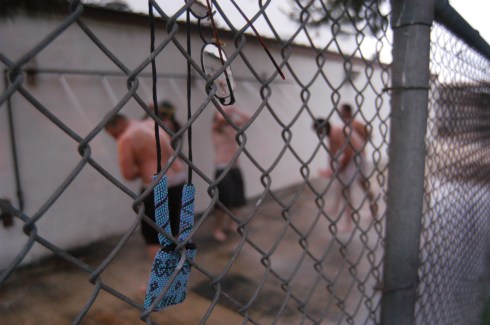
A beaded medicine bag hangs on a fence as wards shower after the Sweat Lodge Ceremony. Each bead is a sewn to the bag with a prayer.
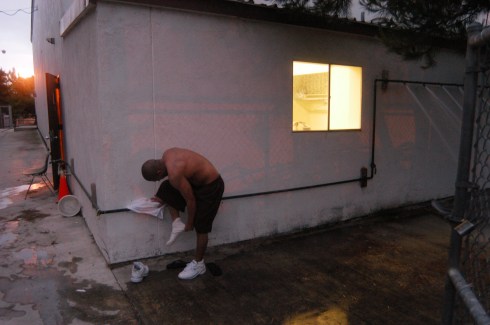
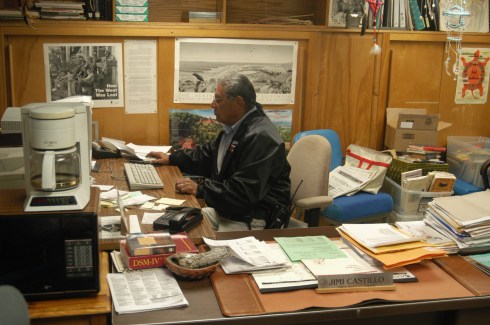
Jimi Castillo in his office in the Heman G. Stark Youth Correctional Facility.
All Images © Jan Sturmann http://www.albinocrow.com

David, DJ at the prison radio station holds a Polaroid of him and his wife. He said the picture was taken more than 15 years before, when he was 18 and she was 16 years old. During his hour as DJ he played mostly Gospel and Christian music at the Louisiana State Penitentiary at Angola, June 27, 2000.
Photographer, writer and psychotherapist Adam Shemper and I talk about his portraits and photographs from Louisiana State Penitentiary.
LISTEN TO OUR DISCUSSION AT THE PRISON PHOTOGRAPHY PODBEAN PAGE.
At the age of 24, Adam was challenged (almost dared) by a family friend to “experience something real.” The friend offered him an introduction to warden Burl Cain and the test to photograph within Angola Prison.
We all have difficulty putting our work out in the world, and Adam found that after his nine-month stint at Angola he had more questions than answers.
For many years the work remained unpublished and Adam’s own justifications for the work unsteady. We discuss the life-cycle of the photographs, the reactions of the prisoners to Shemper and his work, and generally, the responsibilities of photographers toward their subjects.
In photography, as in life, it is all about relationships and positive connections that benefit all parties.

Victor Jackson, cell block A, upper right, cell #4. He had ‘I Love U Mom,’ tattooed on the inside of his right forearm. Louisiana State Penitentiary in Angola, April 17, 2000.
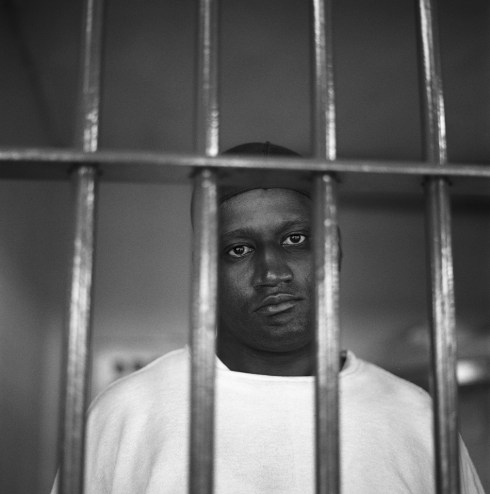
LaTroy Clark, cell block A, upper left, cell #6, Louisiana State Penitentiary in Angola, April 17, 2000

Don Jordan reads the Bible in his cell, Louisiana State Penitentiary in Angola, April 17, 2000
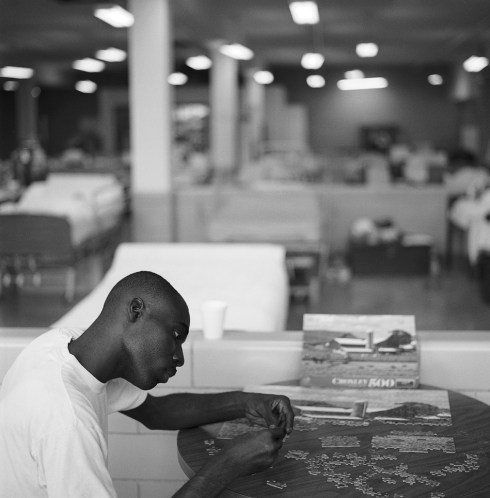
Jonathan Ennis puts a puzzle together of a farm scene in Ward 2 of the Louisiana State Penitentiary hospice at Angola, March 21, 2000.
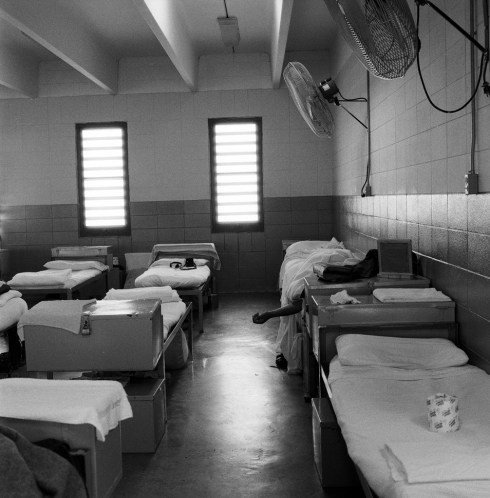
A man sleeping during the day in the main prison complex, camp F dormitory, Louisiana State Penitentiary in Angola, February 1, 2000.
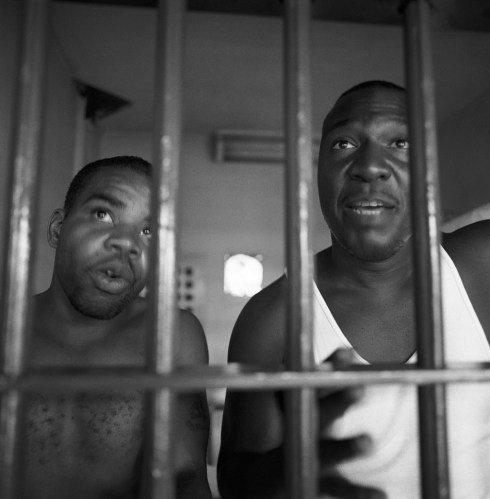
Henry Kimball and Terry Mays in cell block A, upper right section, cell #15, Louisiana State Penitentiary in Angola, September 6, 2000.

Brian Citrey, main prison, cell block A, upper right, Louisiana State Penitentiary in Angola, April 17, 2000

Nolan, a prison trustee, standing in front of the lake, where he often spends his days fishing. He caught catfish and shad on this day for the warden and his guests. Louisiana State Penitentiary in Angola, June 27, 2000.
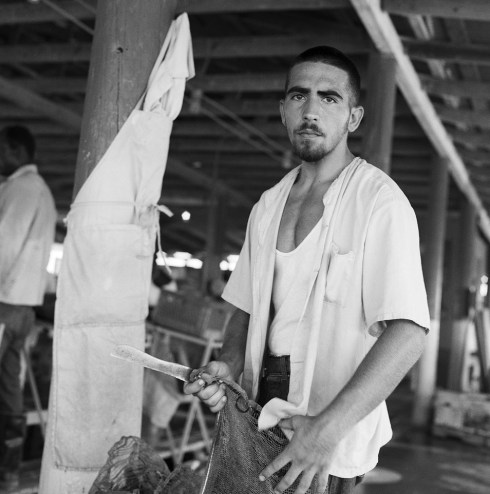
Man cuts open sacks of vegetables to sort through, Louisiana State Penitentiary in Angola, June 27, 2000

After chopping weeds in the fields, men wash up as they transition back to their cell blocks at the Louisiana State Penitentiary in Angola, April 17, 2000.
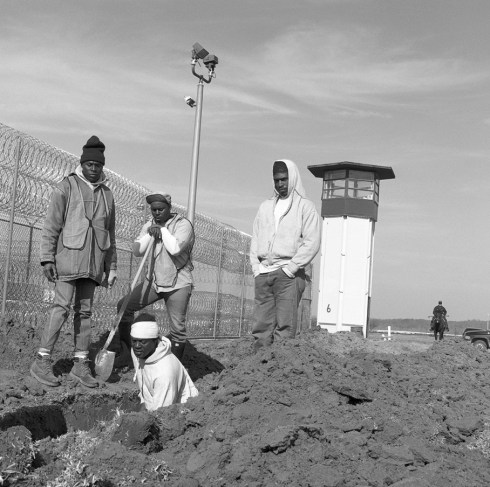
Men housed at prison camp C dig a ditch at the Louisiana State Penitentiary in Angola, January 31, 2000.
All images © Adam Shemper.
Images may not be reproduced elsewhere on the web or in print without sole permission of the photographer, Adam Shemper.

 Prison Photography