
You are currently browsing the category archive for the ‘Documentary’ category.
Yusuf Sayman‘s work looks at the struggles of reentry into society following incarceration. I have mentioned his work once before.
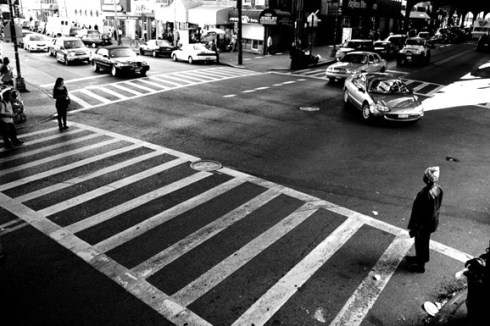
This picture plays literally with notions of ‘the road to be traveled’ and ‘obstacles to cross’, but it also depicts the loneliness of a new reality for Doris.
Doris spent 27 years in prison. Even amidst bustling streets her experience must quite solitary?
See feature at GOOD.
In “Free Again,” the photographer Yusuf Sayman chronicles the day-to-day challenges associated with the re-entry process that follows a long prison sentence. His subjects are Tarik, a man in his third week of freedom after a four-year prison sentence (which began when he was just 16), and Doris, who has just completed 27 years of incarceration. “In prison they get used to a very different set of rules and social behaviors,” says Sayman. “Doris said she never had to make decisions like what to wear. New-found freedoms as simple as shopping or taking the bus become very significant, very big deals.”

Sister Marina, Walton Prison. Copyright Liverpool Daily Post and Echo
About the photo: “I photographed Sister Marina visiting Walton Prison. Her smile and compassion were for all – she was there to comfort those who needed her faith, solace, prayers and hope.” Source.
___________________________________________________________
Stephen Shakeshaft is subject of a retrospective at the National Conservation Centre in Liverpool, England. Having photographed The Beatles, street urchins, dock-workers, Cilla Black’s mum, the Toxteth Riots, Willy Russell, Liverpool F.C. in European glory and the tragedy of the Hillsborough aftermath, Shakeshaft is knee-deep in the love, lore and history of the Merseyside region.
I’d argue Shakeshaft is to Liverpool as Anthony Friedkin is to California.
Shakeshaft started his career as a copy boy in 1962, running typed stories from the sub-editors’ desk to the print room for the Liverpool Daily Post and Echo. Later he was accepted as an apprentice, learning his trade and his art. He rose to become chief photographer and picture editor of both papers.

Kenny Daglish in bed with the European Cup. Copyright: Stephen Shakeshaft/ Liverpool Daily Post & Echo.
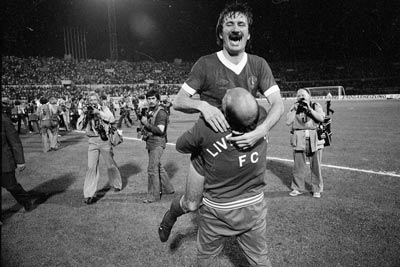
Celebrations after Liverpool won the European Cup Final in Rome, 1977. Copyright Liverpool Daily Post and Echo
All the information from the Liverpool Museum’s blog, associated videos from the exhibition and podcast.
Media articles and photos here, here, here and here.
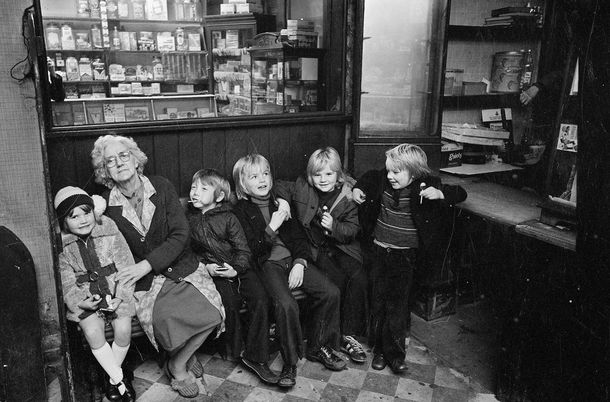
© Stephen Shakeshaft

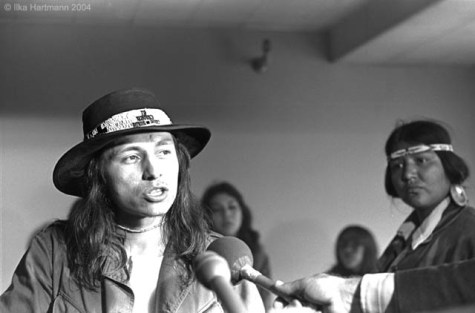
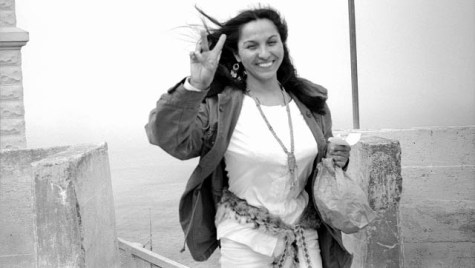
Belva Cottier and a young Chicano man during the Occupation of Alcatraz Island, May 31, 1970. Photo: © 2009 Ilka Hartmann
Today marks the fortieth anniversary of the start of the Indian Occupation of Alcatraz, an action that lasted over eighteen months until June 11th 1971.
Photographic documents of the time are surprisingly scant. Over the past few decades, Ilka Hartmann‘s work has appeared almost ubiquitously in publications about the Indian Occupation. We spoke by telephone about her experiences, the dearth of Native American photographers, the Black Panthers, Richard Nixon, the recent revival of academic research on the occupation and what she’ll be doing to mark the anniversary.
Your entire career has been devoted to social justice issues, particularly the fight for Native American rights. Did your interest begin with the Alcatraz occupation?
No, it began earlier. I came the U.S. in 1964 and that was during the human rights movement. I was a student at the time but I really wanted to go and work with the Native Americans on the reservations of Southern California. I was connected to the Indian community here through a friend who had emigrated to California earlier. I learnt very early about the conditions for American Indians. It reminded my of what I had learnt as a teenager about Nazi rule.
When the occupation began I wanted to go but I couldn’t because I was not Native American, but I waited until 1970.
Concurrently you were photographing the Black Panther movement – centered in Oakland – and the other counter culture movements of the late sixties in the Bay Area. How did they relate to one another?
They were all the same, each group struggling to advertise their conditions, the police brutality and the lack of educational and cultural institutions. I was involved in the fights for American Indians, African Americans, Chicano and Asian Americans in Berkeley. We were protesting as part of the Third World Strike. For me everything was connected and it was the same people who were speaking up later at Alcatraz.
My new book is actually about the relations between the different groups of the civil rights movement. There was a lot of solidarity between groups. The Black Panther Party understood this. Many people think that the Black Panthers were concentrated on their own politics but they understood solidarity and got a lot of help from non-Black people. If you look at my pictures of the Black Panther movement a lot of supporters were the white students of Berkeley. There is a saying, “The suffering of one, is the suffering of everybody”.
In the Bay Area people were so willing to help the Indians at Alcatraz and help in the Black Panther movement and they really felt things were going to change.
I was a student at UC Berkeley and stopped in February 1970. I went to Alcatraz in May of 1970. I had learnt to open my eyes and emotions at UC Berkeley through all the different groups we had.
How many times did you visit Alcatraz during the occupation? And how long did you stay each time?
I only went twice to the island. It is funny because I didn’t even know if my photographs would turn out. I had a camera that I’d borrowed from a friend with a 135 mm Pentax lens … and also a Leica that a friend have given me too. But I didn’t have a light-meter for the Leica so I didn’t know if the photographs I took in the fog would come out. It was so light. I was amazed that they came out. I also went over in a small boat that same year.
So I made contact sheets and tried to get them published which was a big problem because you had to really work on that. My first picture of the occupation was published in an underground paper called the Berkeley Barb then in June 1971 I was at KQED, a Northern California Television station, for an interview with an art editor. I had hitch-hiked there from the area north of San Francisco and I just opened my box of pictures to show him topics I was concerned about when over the intercom came an announcement “The Indians are being taken from Alcatraz.”
I saw some video guys run by, I grabbed my bag and camera and asked them if I could join them. They said, “Yes, ride with us and say you are with us.” We got into an old VW and drove around on the mainland to see the occupiers and that is how I got those shots of the removal. It was an incredible coincidence because I actually lived far from the city. It’s quite incredible. I only went two times during the occupation and then I got those shots afterward.

From then on I made contact with people and in that year I showed my pictures at an Indian Women’s conference, making very good friends with people in the American Indian movement. From then on I went to cultural events, powwows and so on and my pictures appeared in the underground press. I wrote articles and people contacted me for images. That’s how I made the connection.
So really you made no arrangements?
I didn’t make any arrangements. I followed everything from the first day in the papers and on that day in May … on May 30th the Indians asked all the journalists to go and I wanted to be there. That’s how it all started; they invited us there that day.
Did you realize at the time how profound an historical event it was?
Yes, I always felt how important it was. This was the first time they [Native Americans] spoke up. All over the world people wrote about it and the cause became known globally, and especially known in the United States. I believed in it … I still do.
What are your lasting memories of your time and work during the occupation?
It was a prison that had been closed so it was surrounded by barbed wire fence. Some of it had become loose and I took some pictures. The wire swung loose in the air and there was a sound across the island of the wind whispering over it. And if you looked out over the beautiful waters, you really got the sense – with the barbed wire – that the Indians were prisoners, as well as occupiers of the Bay. Prisoners of the Bay; which means prisoners of the World. In that sense I really had a strong feeling of the prison.
How did you react to the environment?
For me, strangely, the experience of going to Alcatraz has always been a very high and wonderful experience. It is hard for me to even explain. Of course I know it was a prison. On the tour of Alcatraz I got very upset, especially during the part when you’re taken downstairs to learn about the lesser known incarceration of Elders and also the cells for those people who didn’t want to go to war. So of course I know it is was a prison, yet when I go there I am struck by exuberance and hope about [Indian] people being able to make statements about their conditions.
I was a witness to that and wanted to be a conduit for those statements. There were no American Indian journalists, we were nearly all white. There was one Indian photographer, John Whitefox, who is now dead. But he lost his film. So we really saw it as our job, politically, as underground photographers and writers to cover what was part of the revolution and social upheaval.
Eldy Bratt, Alcatraz Island, May 1970. Photo: © 2009 Ilka Hartmann

Two Indian children play on abandoned Department of Justice equipment. Alcatraz Island, 1970. Photo: © 2009 Ilka Hartmann
San Francisco Bay has a strange history with islands, incarceration and subjugation. San Quentin was the focus of the Black Panther resistance – it is just ten miles north of the city. Angel Island was an immigrations station for Asians – it is known as the “Ellis Island of the West” and some Chinese migrants were kept there for years. And, then there’s Alcatraz. How do you reconcile all this?
It’s totally horrible to me. I come form Germany. Before I came I’d heard about Sing Sing on the river on the East coast. It was a horrible thought to me that they could put people in such prisons.
I drive past San Quentin most days, I have actually been inside and taken photographs. And of Angel Island – it is almost sarcastic to imprison people like that; it’s such a contradiction to the beauty of the Bay. It’s the hubris of human beings to do that to one another.
Of course there are people who should be in prison, like at San Quentin, but certainly the Chinese should not have been treated like that on Angel Island. The Indians and the anti-war demonstrators should absolutely not have been treated like that on Alcatraz. Actually the authorities were respectful to the antiwar demonstrators than they were to the Indians, but still both are an aberration of human nature to treat others like that. I don’t know what to do with murderers but I do know I am against the death penalty.
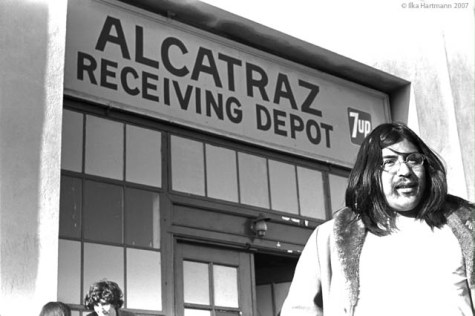
An Indian man arrives at Pier 40 on the mainland following the removal in June 1971. Indians of All Tribes operated a receiving facility on Pier 40, where donated materials were stored and where Indian people could wait for boats to transport them to Alcatraz Island. Photo: © 2009 Ilka Hartmann

"We will not give up". Indian occupiers moments after the removal from Alcatraz Island on June 11, 1971. Oohosis, a Cree from Canada (Left) and Peggy Lee Ellenwood, a Sioux from Wolf Point, Montana (Right). Photo © 2009 Ilka Hartmann
How do you see the situation for Native Americans today?
When I started there was said to be one million American Indians and now statistics say there are one and a half million. This is down to two things: first, the numbers have increased, but secondly more people identify as Native Americans where they had tried to hide it before due to racism and prejudice.
I went on one trip with a Native American Family for six weeks across the southwest and I kept asking if the Indians were going to survive and there was some doubt, but now people really think the culture is growing and there has been a notable revival. There advances being made dealing with treatments for alcoholism and returning to free practices of traditional worship. I know that the Omaha are talking of a Renaissance of the Omaha culture. My friend and historian, Dennis Hastings, who was also an occupier of Alcatraz, said to me ten years ago “It could still go either way. Half the Native peoples are debilitated with alcoholism and the other half are vibrant and healthy.”
Great afflictions still exist but there are many more Indians who are able to function in the Western aspects of society and traditional ways of life. When I entered the movement there was only one [Native American] PhD; now there are over a hundred. There is hope now.
What we felt came out of Alcatraz was the influence that it had on Nixon. Because he was a proponent of the war I always used to think of him in only negative ways but that is a learning experience too. It is a shock that someone responsible for the deaths of so many people in the world, of so many Vietnamese, could do something good. He signed the American Indian Religious Freedoms Act (1978). Edward Kennedy also worked a lot on these laws.
We believe the returns of lands such as Blue Lake/Taos Pueblos in New Mexico and lands in Washington followed on from the occupation of Alcatraz. There is a famous picture of Nixon with a group of Paiute American Indians. I believe a former high school sports coach of Nixon’s from San Clememnte was Native American and so we think this teacher influenced him.
As a result of Alcatraz, as well as the land takeovers, the consciousness has been raised among non-Indians and this was very important. People in the Bay Area were very supportive of the occupation, until the point where people were not responsible; it got messy the security got too strong and there were drugs and alcohol. Bad things did happen but in the beginning all that was important to expose to the world was written about, particularly by Tim Findley and all the writers working to get this into the underground press.
Until about 15 years when Troy R. Johnson and Adam Fortunate Eagle wrote and researched their books we didn’t understand everything that had happened – we just knew it was exhilarating. We now have the information of policy changes and the knowledge of people who went back to the reservations; leaders such as Wilma Mankiller who was the principle chief of the Cherokee for a long time. Dennis Hastings was the historian of the Omaha people and brought back the sacred star from Harvard University.
Many people have done things to allow a return to the Native culture and it is so strong now – both the urban and reservation culture. American Indians are making films about urban America – part of modern America but also within their Indian backgrounds. Things have changed enormously.
The benevolence of Richard Nixon is not something I’ve heard about before!
Yes, You can read more about it in our book.
What will you be doing for the 40th anniversary?
I’l be going to UC Berkeley. I’ve been working on an event with a young Native American man who is part of the Native American Studies Program which was established in 1970 as a result of the Third World Strikes. I walked and demonstrated at that time many times. I’m very happy to be returning. LaNada Boyer Means who was one of the leaders of the occupation will be present. We’ll be thinking of Richard Aoki, who was a prominent Asian American in the Black Panther movement, who died just a few months ago.
When these people would lead demonstrations, I would photograph it and then I’d rush to the lab, work through the night to get them printed the next day in the Daily Cal and then have to teach my classes and then take my seminars and it would go on like that for weeks.
So, a young man Richie Richards has organized a 40th Anniversary celebration at Berkeley. It includes events that will run all week, films, speakers, I’ll be showing my slides and then on Saturday we’re going to Alcatraz for a sunrise ceremony. Adam Fortunate Eagle, who wrote the Alcatraz Proclamation, will lead the ceremony on the Island.
In addition at San Francisco State where the 1969 student protests originated their will be a mural unveiled to mark the occasion. There have already been recognition ceremonies for ‘veterans’ of the occupation this week in Berkeley and starting tonight there are events for Native American High School students from all over the area in Berkeley also. Interest has really rekindled recently. The text books have really changed so much and I think that is excellent for younger generations.
And many more to come …
Thanks so much Ilka.
Thank you, Pete.
_________________________________________
For this interview I used Ilka’s portrait shots from the occupation. There are many more photographs to feast on here and here.
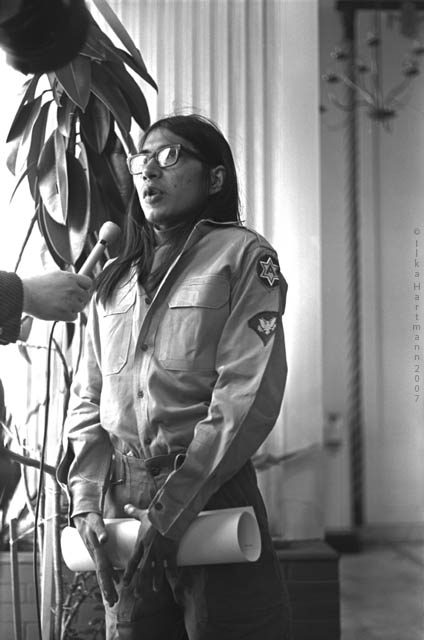
Overcoming exhaustion and disillusionment, young Alcatraz Occupier Atha Rider Whitemankiller (Cherokee) stands tall before the press at the Senator Hotel. His eloquent words about the purpose of the occupation - to publicize his people's plight and establish a land base for the Indians of the Bay Area - were the most quoted of the day. San Francisco, California. June 11th 1971. Photo Ilka Hartmann
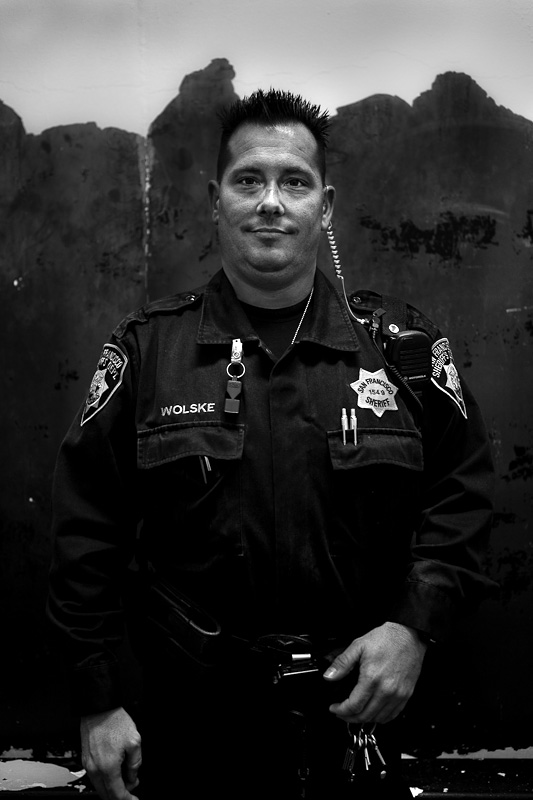
A few months ago Bob Gumpert and I sat down and talked at length about the reasons why photographers should endeavour to tell the stories of social movements, workers rights, crime, justice and injustice. The conversation rolled and rolled which partly explains why the edited interview hasn’t surfaced yet.
Bob’s activism emerged in the Labor Movement of the 1970s. He began documenting the criminal justice system by following police officers and public defenders in the San Francisco Bay Area. From there he traversed to tell the stories of people in the jail and probation systems.
This morning I received this email:
As some of you know, since 1994 I’ve been documenting the criminal justice system. There is now a website for the latest segment of “Lost Promise: The Criminal Justice System.”
“Take A Picture, Tell A Story” is where you can find portraits and recorded stories from the two major projects of my 35 years in documentary photography. In “Locked and Found” prisoners in the county jails of San Francisco tell stories of their circumstances, hopes and sorrows. In “Tales of Work” workers tell of their lives and their jobs.
Bob
So don’t wait for my interview to familiarise yourself with Bob’s work. Listen to the tales he’s recorded – they reflect the complexities that rattle about in an inevitably inflexible system that deals with hundreds of thousands of individuals.

A Developing Story is a new joint venture by Johnny Bennett, Phil Maguire and Benjamin Chesterton of duckrabbit.
In an email a few months ago, Ben said to me his interest lies in “getting under the skin of NGOs” and have them realise that they can deliver their stories and campaigns in far more effective ways. A Developing Story wants the stories told in Government & NGO international development campaigns to outlast the short term objectives of said campaigns.
A Developing Story proposes that the media of these campaigns is deposited in a common silo, accessible by all (usually under a Creative Commons license) so stories – once created – can tell themselves infinitum.
Given the primacy of Creative Commons and open-source content, Matt and Scott at DVAfoto needed clarification on A Developing Story‘s impact on the photographer (which was provided). I have fewer worries as I feel this venture is aimed at transforming media sharing practices among government funded and NGO initiatives rather than another pressure on the distribution and remuneration of individuals’ works.
I would anticipate that the payments made to photographers and journalists by media campaign management will continue and that photographers will take on assignments in the knowledge that their work can be used repeatedly for non-profit purposes.
That said, A Developing Story is very open to individual contributions. This is the most relaxed approach to collaboration I’ve witnessed!
So, as Ben asked, “Can You Help?”
In the past I have provided varied perspective on Guantanamo. I put together a rudimentary Directory of Visual Resources. I alerted readers to important coverage of exceptional events here and here (granted, all events related to Gitmo are out of the extraordinary) and I have provided reflection on Guantanamo through the lenses of Bronstein, Clark, Gilden, Linsley, Pellegrin, Toledano and Lieutenant Sarah Cleveland.
Ultimately, none of these posts come close to describing or making sense of that most nonsensical of places. And so to ACLU’s latest video. My good mate Stan (cheers pal) posted earlier today:
Elsewhere, a friend of Prison Photography alerted me to the online journal JumpCut. Julia Lesage has assembled the most comprehensive webpage of Guantanamo links I’ve ever come across. Some of the links are already 404, but I would encourage you to peruse – I have still not exhausted the many resources. Leasge also contributes to the Spring 2009 issue with a section on ‘Documenting Torture’.

Too Much Chocolate
When Jake Stangel put out a call to interview Damon Winter for Too Much Chocolate I didn’t hesitate. How often do you get to bend the ear of a Pulitzer Prize winning photographer?
Jake assured me that Damon was – is – “a super-nice guy” as well. I might argue that Damon is too nice; he carried, without complaint, a sinus-busting cold to deliver the interview.
Damon and I spoke about his assignments in Dallas, L.A. and New York, the Obama campaign coverage, making portraits, Dan Winters, Irving Penn and Bruce Gilden. Read the full interview here.
_____________________________________________________________
Angola Rodeo
Not without my own agenda, I also asked Damon about his experience down at the Angola Prison Rodeo:
PP: Why were you there?
DW: I had gone out for two trips. It was when I worked at the Dallas Morning News. The way I pitched it was that the prison was expanding the program to launch a spring rodeo. I wanted any excuse I could get to go down there and photograph. It sounded absolutely incredible.
DW: And the paper ended up not being that interested. They may have run a small little blurb about it, but I did it for my own interest. It was fascinating – a completely wild situation. Most of these guys came from the cities. Some had never even seen a cow let alone roped a horse.

PP: Describe the atmosphere.
DW: The closest thing to modern day gladiators – something you’d see in a Roman Coliseum. The crowd is chanting for blood, they want to see a violent spectacle where prison inmates are the subjects. It’s the same reason people go to see a horror movie or stare at a wreck on the highway. It is a very strange situation but they want to see blood.
PP: Do you think it helpful to the local community?
DW: There is no interaction between public and inmates. The public is there to observe and the inmates are there to entertain. The benefit the inmates gain is at a level very specific to their situation. They risk injury being in the ring with massive bulls, and their prize is something I think anyone in the free world would laugh at, you know? Maybe a couple hundred bucks. But it is substantial in their environment.
It speaks to the bleak situation that those guys are in that this would be enticing – to risk bodily harm for a couple of hundred dollars.
I don’t know how constructive it is for relations between prison and non-prison populations.
PP: Which is unusual because in any other state across the country, there is no interaction between the public and the incarcerated population.
DW: What’s your feeling?
PP: I think it builds a division at a local level, but it also feeds a national view that excludes the realities of prisons. The inmates are put out there to be observed, photographed and consumed. Such a presentation is not unpalatable to the American public. To the contrary, the public feels as though it gains from it. I think here unexamined (and abusive) interactions can be confused with relationships.
I think the wasteful and very boring reality of prisons in America is not going to make it into newspapers or media, but the rodeo does. It skews perception. I think the rodeo is problematic.
DW: I felt the event was dehumanizing. It was done in a manner so that the inmates are reduced to the level of the beasts they are competing against. It seems the field has been leveled between animals and inmates and the feeling that you get from that is that they themselves are like animals. They are not seen terribly differently from the way that the animals are seen.
PP: I am not sure that that sort of spectacle would take place outside of Louisiana, certainly outside the South. Granted, Angola’s warden Burl Cain jumps at the chance to get the cameras in at any opportunity.
DW: Yes, I saw The Farm, a documentary filmed at Angola.
PP: I think Cain’s administration paired with the history of the event creates a spectacle at the rodeo that goes unexamined.
PP: Cameras are common at Angola; documentary shorts on the football team and photo essays on the hospice. It is a complex that has 92% of its population.
DW: You should look at Mona Reeder’s work. She works at the Dallas Morning News. I think it was called The Bottom Line and she turned the stats into photo essays and one of the stats was the number of prisoners in juvenile facilities. She got some pretty good access. She received a R.F. Kennedy Award.
PP: I certainly will. Thanks Damon.
DW: Thank you.
_____________________________________________________________
Below are three of Damon’s photographs from Afghanistan which stopped me in my tracks. Unfortunately, I discovered them after the interview so didn’t get Damon’s take on them.

The images of the boys really affected me. We see so many images of bearded men, U.S. Marines in the dirt, explosions, women in burqas, etc, but it is the children of Afghanistan who will carry the violent legacy for the longest. What pictures reflect that fact?
It is an impossible task of any image to near ‘truth’ or reality, but these two pictures get very close to the sad reality of conflict and the impressionability of youth.


 Prison Photography