
You are currently browsing the category archive for the ‘Documentary’ category.

Guantanamo © Chris Maluszynski/Agence VU

Guantanamo Map http://www.cubafutour.de/Karte%20Guantanamo%20Provinz.jpg

Guantanamo Bay Tents. Courtesy of The Department of Defense Visual Information Center
I am very happy with the way Prison Photography is progressing. I have done interviews with some outstanding photographers and artists. I have offered opinion where I think there’s something to be said. The most satisfying work on the blog is that contributed by guest bloggers, comment-makers and interviewees. Photographers have contacted me and I have been eager to comment upon their work.
But, there is one audience I never anticipated – The Google Image Search Audience. I get many hits for searches on Guantanamo, Guantanamo video, Iraq prison, Abu Ghraib, Abu Ghraib Images of Prisoners, etc, etc – which is strange because these are topics that many people have grappled over with more proficiency and depth than I am likely to.
It is obvious that there is a need for fast access to images of America’s sites of torture and incarceration, namely Abu Ghraib and Guantanamo. I certainly don’t wish to fuse the two institutional histories so I shall deal only with Guantanamo Bay.
Louie Palu
Walrus Magazine. 8 of Palu’s photographs and accompanying article.
The Atlantic. 6 of Palu’s photographs.
Private galleries. Palu’s Photoshelter profile offers three separate galleries, but they’re password protected. Contact the photographer directly.
NPR Interview. Palu offered insight into his experience and impressions of Guantanamo.
Christopher Sims
Mother Jones. 15 images of daily life outside of the prison complex.
Civilian Arts Project. 25 images of a bizarrely serene Guantanamo Naval Base.
BBC, The Other Side of Guantanamo. Article about Sims’ series.
Daylight Magazine. 4 minute audio of Sims’ experiences on project.
Chris Maluszynski
Agence VU/Moment. Twenty-six images exhibited. Likely more on file at the agency.
Cesar Vera
Guantanamo Prison. 18 Black & White images. 3 Colour.
Joint Task Force (JTF)
Many of the photographs shown in the press over the last few years were taken by members of the Navy’s own Joint Task Force. When press photographers visited the JTF vetted all images before release.
Boston Globe. 30 Hi-Res images.
Repeat of above selection. 20 Hi-Res images selected.
JTF Photo Galleries. 22 months (July 2007 – May 2009). Hundreds of images. Official photography.
Miami Herald
Description of the 8 different camps at Guantanamo
Explanation of the Legal contexts: Key defendants, the judges, the defense and prosecution counsel.
Cursory look at Art influenced by Guantanamo
Magnum
Bruce Gilden. Guantanamo Bay. Enemy Combatant Camps, 2003
Paolo Pellegrin. Guantanamo Detainees, 2006
Stuart Franklin’s work Cuba, 2003, included images from Guantanamo and you’ll need to search the Magnum website for images.
McClatchy
An eight-month McClatchy investigation of the detention system created after the Sept. 11 terrorist attacks has found that the U.S. imprisoned innocent men, subjected them to abuse, stripped them of their legal rights and allowed Islamic militants to turn the prison camp at Guantanamo Bay, Cuba into a school for jihad.
Intro. Text and 11 minute video.
Photos. Detainees held at Guantanamo Bay
Photos. Faces of Guantanamo Detainees. Part one.
Photos. Faces of Guantanamo Detainees. Part two.
Photos. Detainees held in Afghanistan.
Eyeballing
Comprehensive overview of base using Google Maps, official photographs. Details structures, uses and topography of naval base.
Camp America, Camp Delta, Camp V and Administrative & Court building.
Camp X-ray and construction of later detention camps.
Associated Press
Images of facilities and interiors of various detention blocks and camps.
Stars & Stripes “The Independent News Source for the U.S. Military Community”
Work at Guantanamo
Education at Guantanamo
Recreation at Guantanamo
Artistic Turns
David Hicks. Virtual Guantanamo Cell
Penny Byrne. Porcelain Guantanamo Detainee Figurines
Gregor Schneider. 21 Cells, Bondi Beach, Australia
Legofesto. Guantanamo reconfigured with Lego men and Lego pieces and Wired Interview
Flickr – Protest Images
Amnesty International. Guantanamo Protests
Various Photographers. 100 Days to Close Guantanamo and End Torture.
James M. Thorne. Protest images.
Miscellaneous Media
Prisoners of War. 2004 article by the San Francisco Gray Panthers with images of US airforce transporting detainees and early 2003 images of Camp X-Ray.
BBC. Life in a Guantanamo Cell

Rendition. Photographer Unknown

© Cesar Vera

Guantanamo Bay Navel Base with a New Commander-in-Chief. Photographer Unknown. http://www.obamalouverture.com/f39/guantanamo-bay-switch-bush-photo-obama.html
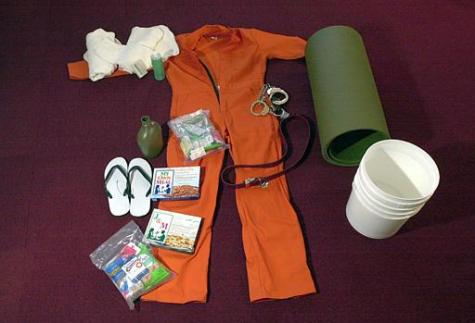
The standard issue of clothing, sleeping mat, food, sandles, canteen, soap, and buckets for detainees of Camp X-Ray is pictured in Camp X-Ray at the U.S. Navy Base at Guantanamo Bay, Cuba, on Wednesday, Feb. 20, 2002. © Tomas van Houtryve/AP Photo
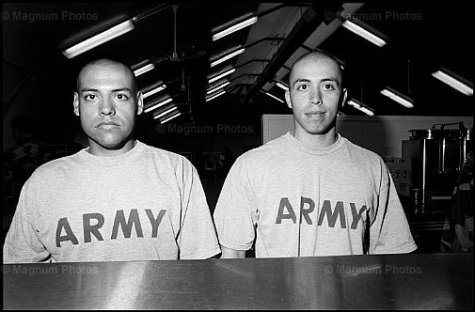
CUBA. Guantanamo Bay. 2003. Soldiers wait for their meals before a prayer breakfast at Camp America. Photo: Bruce Gilden/Magnum
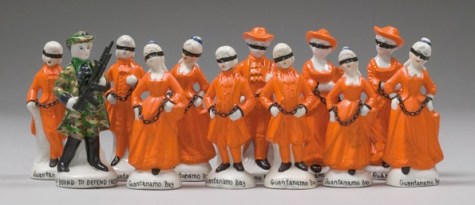
Penny Byrne Guantanamo Bay Souvenirs 2007, vintage figurines, metal chains, epoxy resin, plastic, re-touching medium, powder pigments, 14 x 32 x 10 cm.
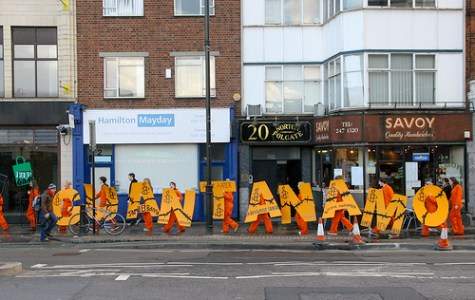
Photo: Jon McClean. http://www.flickr.com/photos/jonmclean/410055117/
IF YOU HAVE ANY RESOURCES TO SUGGEST,
PLEASE CONTACT ME AND I’LL ADD THEM TO THIS LIST.

Pastor Marcos Pereira da Silva and prisoner in Polinter Prison, Rio de Janeiro. © Gary Knight, VII Agency
Dispatches Mag out today with the theme Out of Poverty. It includes Gary Knight’s photo essay from Polinter Prison, Rio de Janeiro.
I have been waiting for Knight to publish these images. An internet-murmur a few weeks ago alerted me to his work in Brazil’s prisons. As I fleshed out the scenario at Polinter Prison those few weeks ago, I won’t go in to huge detail in this post.
In a nutshell, Pastor Marcos Pereira da Silva visits the critically overcrowded prison with his unique brand of evangelism. It starts with anthems of praise and ends up in wailing convulsions and the exorcism of spirits. He acts generally messianic and the prisoners (at least those pressed against the bars at the front of the cages) seem quite responsive.
Knight is uncomfortable with these enactions and so am I.
Click here or the image below and you’ll be directed to 9 minutes youtube footage of the said pastor doing his thing.

Still from video of Pastor Marcos Periera de Silva in Polinter Prison, Rio de Janeiro, Brazil.

A TB patient at Tomsk Regional Clinical Tuberculosis Hospital, Building #3. Photograph and caption © James Nachtwey/VII.
“Tuberculosis is a disease of poverty and stress“.
Merrill Goozner, The Center for Science in the Public Interest.
“Sixty percent of all new cases of tuberculosis have resulted from the rapid growth of the post-Communist prison archipelago”.
Proceedings of the National Academy of Sciences. Aug. 26th, 2008
Tuberculosis (TB) was under relative control in the former USSR. Soviets had lifestyles, nourishment and conditions of living that kept disease at bay. When communism fell, so did a civil order in many areas. The phalanx of activity that filled the vacuum involved new systems, new relationships, new businesses and new criminal opportunities.
The prisons filled in a society that needed to organize itself before it could organize it’s transgressors. The prison population swelled to 1.1 million (it is now down to little over 700,000). Post-communist prisons held malnourished, crowded populations with weak immune systems; they have been described as ‘Tuberculosis incubators‘.

Correctional Treatment Unit #1, a TB prison colony in Tomsk, Siberia. TB patient/prisoner gets a chest x-ray. Treatment is supervised by Partners in Health in partnership with the government TB program. James Nachtwey/VII
TB is best treated with various labour intensive methods known under the umbrella-term Directly Observed Therapys (DOTs). Due to TB’s many different strains – each with different drug resistancies – case by case treatments differ according to patient reactions to drugs. At the least, a patient must be observed and his/her drug regime modified over a 6 month period. For Multi-Drug-Resistant Tuberculosis (MDR-TB) the treatment can take as long as two years. And, MDR-TB & XDR-TB are increasingly common among prison and civilian populations of Tomsk and other Siberian urban centers. Unfortunately, closely monitored drug regimes are improbable in over-stretched and poorly funded state systems.
It wasn’t always so dire. The former Soviet provided a regular supply of drugs to abate disease amongst its prison population, but those supplies were interrupted in the fall of Communism – sporadic and incomplete treatments gave rise to multiple resistant strains of tuberculosis. To compound this the side effects of drugs were enough to discourage patients, and rarely, if ever, did courses of treatment go with a prisoner into his community following release.

TB patients smoke cigarettes in the smoking room of Tomsk Regional Clinical Tuberculosis Hospital, Building #1. James Nachtwey/VII
James Nachtwey‘s mega-promoted TED prize crusade addresses the spread of Extremely Drug Resistant Tuberculosis (XDR-TB), its mutant forms and human tolls. This excellent Guardian article notes Nachtwey has photographed the epidemic worldwide, from Siberian prisons to Cambodian clinics.
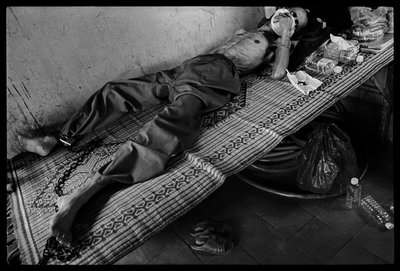
A prisoner who was convicted of murder was moved from prison to the TB ward of Battambang Provincial Hospital, Battambang, Cambodia when he was diagnosed with TB. He is coinfected with AIDS. James Nachtwey
Nachtwey stands with Sebastião Salgado in the “super-photographer” stakes. They both make the ugly beautiful.
Both Nachtwey and Salgado have inspired others to action and both believe firmly in the power of photography to change existences … even in a time when such sentiment is derided as old-fashioned, false idealism.
But, despite the odds, Nachtwey has succeeded in forcing his work into the conscience of millions. For some his work is an inspiration for social justice; but for others his work is a sub-conscious default to guilt, despondency and powerlessness to help others less fortunate.
James Nachtwey puts human faces to global suffering. And we are outraged. Or we feel we should be outraged.
I think Nachtwey wants us to believe in ourselves as agents of change. Nachtwey deliberately chose Tuberculosis – because while the situation is critical, it is not terminal and TB is theoretically entirely curable. Beating TB on a global scale is dependent on the behaviours of individuals and their communities.

Correctional Treatment Unit #1, a TB prison colony in Tomsk, Siberia. A prisoner proves to a nurse that he has swallowed his daily oral TB medication. The prisoners receive treatment through metal bars in order to give security to the nurses. Treatment is supervised by Partners in Health in partnership with the government TB program. © James Nachtwey/VII.
Nachtwey’s work extended beyond the prison walls in Tomsk and went into the public clinics (some images included here show those facilities); TB is no respecter of human walls or demarcations. Regional, economic poverty will spike rates of TB.
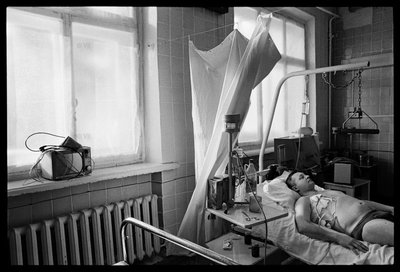
A TB patient has excess fluid drained from his chest a Tomsk Regional Clinical Tuberculosis Hospital, Building #1. James Nachtwey/VII
The worst thing we could do here would be to think that TB is a disease of other nations and other peoples. In Pathologies of Power (2004), Paul Farmer wrote about the New York prison system’s huge Tuberculosis epidemic of the mid-nineties, “By some estimate, it cost $1 billion to bring under control”. The strains that arose in the NYDoC have been directly related to the resistant strains of the former Soviet Union. Tuberculosis is latent within one third of the world’s population. Tuberculosis needs only the conditions for its growth.
Paul Farmer, of Mountains Beyond Mountains fame has taken the lead on combating TB, as well as other infectious diseases, amongst the world’s poorest populations. He worked with Partners in Health partly funded by a Soros Grant to “develop demonstration tuberculosis control projects which could become a model for replication throughout Russia.”
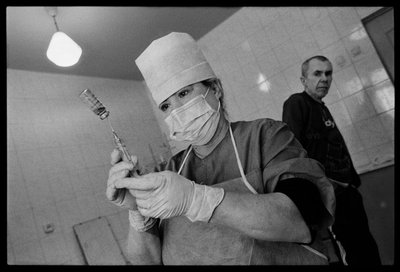
A nurse prepares a daily injection for TB patients at Tomsk Regional Clinical Tuberculosis Hospital, Building #3. James Nachtwey/VII
Prison Photography blog has focused twice previously on photographers’ responses to the USSR and its aftermath – the Gulag and the new prisons that arose. While Anna Shteynshleyger and Yana Payusova are working with very different issues, regions and populations they – along with Nachtwey’s work – remind us of the severe problems facing parts of modern Russian society. Unfortunately, and certainly in the case of Tuberculosis, these problems exist in other nations also. Nachtwey focused on TB because it was not – despite being a global problem – on the radar of most people. That sounds like something I’d say about prisons and prisoners’ rights.

Correctional Treatment Unit #1, a TB prison colony in Tomsk, Siberia. A patient/prisoner receives a daily medical injection. The prisoners receive treatment through metal bars in order to give security to the nurses. Treatment is supervised by Partners in Health in partnership with the government TB program. James Nachtwey/VII
For more information on XDR-TB read the Action – Advocacy to Stop TB Internationally website, and the Center for Disease Control & Prevention website. For the most accessible and recent article, read Merrill Goozner’s 2008 Scientific American article about Russian Tuberculosis strains which also includes a audio segment with a clear explanation of the situation.
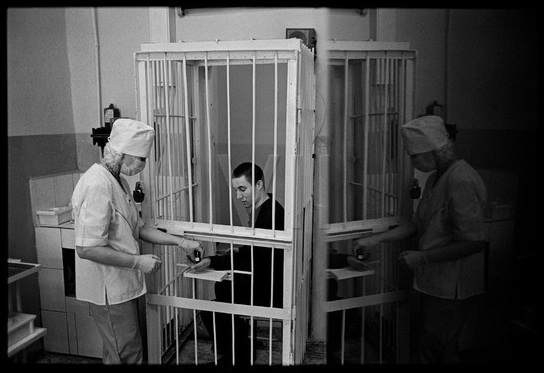
A TB patient/prisoner receives his daily oral medication at Correctional Treatment Unit #1, a TB prison colony in Tomsk, Siberia. © James Nachtwey/VII.
James Nachtwey built his reputation as a combat photographer.
He was always reluctant to be the focus of media attention but after 5 Capa Gold Medals for War Photography he couldn’t escape the curiosity of Christian Frei who made the extraordinary film War Photographer. Nachtwey comes across as an articulate, self-isolated journalist-force devoted to his craft and courteously distant to others; here is a clip.
Nachtwey has done interviews here, here and here. Read an interview about his 9/11 pictures, and associated videos on Digital Journalist. The images were published in TIME.
He worked in Rwanda for his book Inferno.
View his TED Prize acceptance speech and the consequent October 2008 launch of his XDR-TB project and Flickr pool.
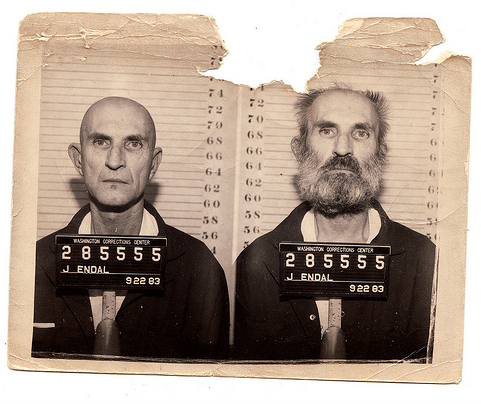
Torn Shorn, Misc. Set. Courtesy of Least Wanted aka Mark Michaelson. http://www.flickr.com/photos/leastwanted/sets/72157605201939008/
Another nod for Blake Andrews. Although not planned, it is welcome, as I think he tries keeps the blogophotosphere fresh, trying new stuff from his hideout in Portland.
Earlier this week I featured Blake’s Brief History of the U.S. Passport Photograph. An artist/collector with hundreds of Passport and ID Photographs, named Least Wanted, followed up with Blake to get the word out on his sprawling collection.
Also earlier this week, I put up a piece about the JUSTICE Art Installation in Bridewell Police Station, London. Coincidentally, one of the artists for the JUSTICE exhibition exhibition was Mark Michaelson, aka Least Wanted. It seems like a small-internet-triangle-of-providence presented itself this morning and it is up to me to draw the hypotenuese …

Head Gear, Misc. Set. Courtesy of Least Wanted aka Mark Michaelson. http://www.flickr.com/photos/leastwanted/sets/72157605201939008/
Least Wanted collects, groups and displays a huge collection of I.D. photos on Flickr. In addition to passport shots, it includes medical photographs, badge I.D. photos and other documentary ephemera. Prison Photography is interested in the majority of the collection: Mugshots.
Least Wanted’s sets are a mad enough curatorial project to keep me going for months. For now, I’ll just echo Blake’s sentiment and point you in the direction of Michaelson’s epic archive.

Austin Old Timer, Misc. Set. Courtesy of Least Wanted aka Mark Michaelson. http://www.flickr.com/photos/leastwanted/sets/72157605201939008/
The three images used in this article were drawn from Least Wanted’s misc. Set
“I’m not interested in the political side of it at all. I don’t deny it and know it filters into the work, but I’m just not approaching it from that perspective. I’m interested in exploring inner exile and profound beauty as redemptive and liberating. There is that famous Dostoyevsky quote that ‘Beauty will redeem the world.’”
Anna Shteynshleyger, in an email to Tim Davis. April 21st, 2005
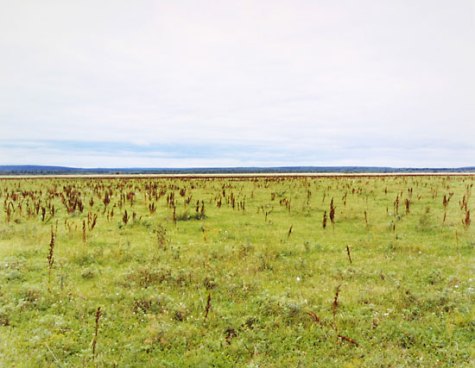
Perm (Grasses), 2001. © Anna Shteynshleyger
Guggenheim time again. Seven photographers were recipients of the big one. All of them are preoccupied with the passage of time. Thomas Joshua Cooper studies waves for a long time; Osamu James Nakagawa studies waves crashing in to cliffs for a long time; Suzanne Opton records the melancholy of veteran soldiers (a subject that will likely last a long time); Cheryle St. Onge makes reference to her Grandmother’s times; and Byron Wolfe has “for nearly twenty years held a deep and abiding interest in ideas about time, change, and the personal relationships one makes with a place.” Brian Ulrich‘s relation to time is that he is the hardest working man in the business and operates like there’s no time left. (I admit, that one’s a step too far).
Prison Photography‘s interest in the Guggenheim Awards for 2009 is specifically with Anna Shteynshleyger.
Siberia is Shteynshleyger’s visual record of the topography of prison labour camp sites and works. Critics and public are likely to know her more accessible work done at the Port Authority of unextraordinary people on escalators unextraordinarily unaware. Port Authority is an ordinary project; I cannot give it much time. Or perhaps Shteynshleyger’s versatility pulling the viewer from Port Authority‘s whim to the import and nonchalance of Siberia is too big of a conversion to devote the belief in both.
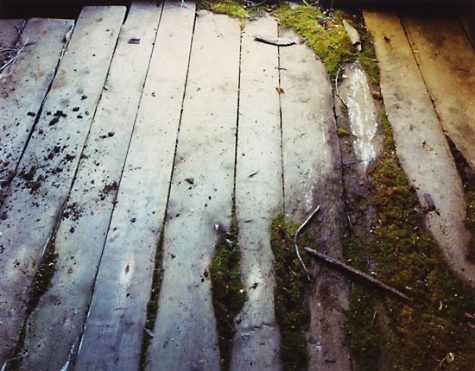
Kolyma (Floor), 2002. © Anna Shteynshleyger
With steady assurance Siberia deals with time, as it deals with the site, as it deals with the intelligence of the viewer. Too often a photographer rushes to the physical clue – the visual pointer – to drive home the importance of the political statement he or she intends to make. Shteynshleyger is not interested in explanation. Without the title on the wall and without the catalogue essay her pictures are simply a competent, nay beautiful, collection of large-format colour prints. They are mostly landscapes and, in truth, landscapes that could be from any continent on earth.

Perm (Bush), 2001. © Anna Shteynshleyger
Tim Davis wrote an excellent piece on Shteynshleyger’s Siberia citing ‘paintings of absense’ from art historical cannon, one-off expressions of ‘the sublime’ by genre painters, and the philosophy of modern cinema auteurs. Davis deliberately talks about as many things other than Shteynshleyger’s work in an attempt to position and thus explain Shteynshleyger’s work. It is a fine, fine judgement call;
Anna’s photographs of Siberia, a territory as suffused with suffering as any place on the planet, do not “bear witness” to anything. They are not documents of anyone’s journey. They are not war monuments; they are not apologies. Though her camera is pointing in the direction of historical sites of unremembered trauma, her pictures are not records of the locations of past crimes. They do not reckon with the past. They sidestep the inevitable failure of the photograph to stand for historical events. They are oblique and difficult, refusing any Spielbergian urge to heal through reliving previous horrors.
Some might argue Davis is wrong. That what he identifies as a resourceful, no-label, psuedo-documentary response to massive ideological violence is in fact a confusion of approach on Shteynshleyger’s part. But they would be wrong. William Meyer wrote a critique of Siberia beginning with the observation that many artists and photographers have sifted and surveyed Nazi concentration camps, and frequently (on the shoulders of other artists) have produced resonant work. The audience for art reflecting the holocaust and concentration camp trauma is well versed in the visual vocabulary of such. For Meyer, the Gulag is in a different position;
How many agitate on behalf of its victims? There are few memorials, few markers, few museums, few tourists. Out of sight, out of mind. But Ms. Shteynshleyger wants to show us.
Shteynshleyger is a pioneer and she is showing us how we can understand horror and how we can understand that horror passes. To me, it seems her images are as private as old men and women who hold silent testimony to past events. Just because something is understood doesn’t mean it should be said, and just because something is said does not make it understood.

Untitled (Tires), 2002. © Anna Shteynshleyger
It isn’t that Shteynshleyger’s work is evasive; it just seems she wants a rigorously curious audience as opposed to a docile one. She is quoted as saying;
… be it a metaphysical or cultural concern, whether it’s a critique or a celebration, art remains a practice rooted deeply in the material world. We make likenesses of what we see and transform our world in a very tangible way. Any situation can reveal a reality not apparent at first examination.
If Dostoyevsky is right and beauty is to redeem the world, beauty must either be apolitical or the most beautiful consensus-sealing political position never reached. Politics, in the common understanding of the term, can be a brutish and rude affair. If there is a message to take away from Shteynshleyger’s work it is, perhaps, that we should search for beauty more rigorously and pay more attention to understated, and dare I say it, apolitical positions.

Untitled (Perm Clouds), 2002 © Anna Shteynshleyger
_____________________________________________
Anna Shteynshleyger was born in Moscow, Russia in 1977. She came to the United States in 1992. Shteynshleyger received a BFA from the Maryland Institute College of Art (1999) and an MFA from Yale University (2001). In 2004 the Museum of Contemporary Art in Chicago mounted a solo exhibition of her Siberia pictures. In 2006, her (12×12 project) was exhibited at the Museum of Contemporary Art, Chicago and Art Basel Miami Beach at the Jacob Karpio gallery in Miami, FL. Other exhibitions have been mounted at Moti Hasson Gallery, NY; Murray Guy Gallery, NY; Lombard-Fried Fine Arts, NY; Artists Space, NY; Vedanta Gallery, Chicago; Thomas McCormick Gallery, Chicago; Zolla Lieberman Gallery, Chicago. Shteynshleyger’s work is in the permanent collections of the Museum of Contemporary Photography, Chicago; LaSalle Bank Photography Collection, Chicago; Yale University Libraries and the University of Maine Museum of Art. She is the recipient of an Illinois Art Council Finalist Award, Blair Dickinson Memorial Award and Guggenheim Fellowship. Shteynshleyger is currently an adjunct professor of photography at Columbia College Chicago and McHenry County College.

Coverage of aging prison populations will receive more column inches, online commentary, pixels and pingbacks in the coming years. Just as social security needs overhaul in the US and the pension age is to be raised in the UK, so too new means of fiscal policy are needed to cater for the elderly behind bars … on both sides of the pond.
Edmund Clark’s Still Life: Killing Time is a quiet meditation on the slowness, the fabric and the accoutrements of prison life for elderly inmates. It was two years in the making. This was a hard project to track down. It seems all of Edmund Clark’s promotion is done by others; by publishers, journos, gallerists and supporters. Clark has no website. Clark is as inconspicuous as his subjects.
Clark doesn’t do the commentary for the Guardian‘s Audio Slideshow (MUST SEE). In his absence, Erwin James does a great job of whispering the tragic, hard realities of the prison environment. I include and italicise Erwin’s comments below Clark’s photographs.
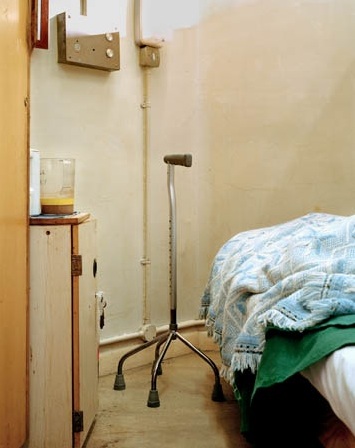
“It saddens me when I see these pictures, these tokens of disablement, the accoutrements of disability; a chair lift, a walking stick, a walking frame. I think that is when I struggle with the idea that these people should be in prison. If someone is demonstrably infirm, demonstrably not functioning well through age or ill health, a prison environment (which this clearly is) is not the appropriate environment.”
It’s worth noting some background to the series. Elderly prison populations only recently became serious noticeable enough for HM Prison Service to trial different modes of containment. The E-Wing of Kingston Prison, Portsmouth was the first experiment. In 2007, upon publication of the book, Erwin James explained;
The answer was Kingston’s E wing. For eight years, this was home to up to 25 elderly men serving life for murder, rape, child sex offences and other offences of violence. The men were aged from their late 50s to over 80. Many had been in prison for more than 10 years, and several for stretches of 30 years or more. E wing as a special facility for elderly prisoners no longer exists. The only other wing dedicated to infirm and disabled prisoners now is in Norwich prison, Norfolk.


“I think cell bars are a tough one. They offer a difficult vista. When you look through cell bars you are aware that the outside doesn’t belong to you. You’re disengaged. And when you see cell bars with a bit of colour like that – the flower and the card – it’s a bit incongruous. These old guys are still humans.”
But for James, as for myself, and particularly for Clark, this is not about sympathy or compassion for the convicted criminal. It has already been stated that these men are serious criminals. There surely must come a point though when an old man is not the physical threat he once was. Simon Norfolk – a photographer I personally consider one of Britain’s best – wrote for the foreword;
” … why are there bars on the window of a man who can’t walk without a frame. What kind of escape plan can be hatched by a man who can’t remember how to go to the toilet.”

“This picture for me epitomizes the absurdity, and moments of madness the prison system can have. We are keeping someone in prison, who has dementia. They have basic instruction about how to go to the toilet. If there were ever a case for somebody who needs not to be in prison, it would be for that person.”
The only statement I can find directly from Clark, the photographer, is worth meditation.
What you can see in the pictures is to what extent they are engaged with their routine, and on top of their regime and what sort of engagement they have with time. One man, who wore a long grey beard, coped with the passage of time, as far as I could see, by disengaging with it completely. He spent most of his time sitting in his chair … He just sat and disappeared within himself. After about a year I could go and talk to him, and this man was clever, he’d been a captain in the merchant navy and had sailed around the world. I asked him once what was the best place he’d been to and he lifted his head and said, ‘Sao Paulo, I loved Brazil …’ And then suddenly this life came out, his life was all there, hidden away. The bulldog clock on the book cover belonged to him, it was one of his prized possessions.
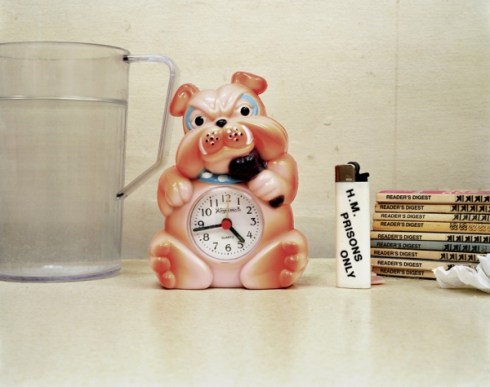
Apparently, Clark created this body of work spurred by reports from the USA about mandatory sentencing under “Three Strikes Laws” and the consequent swelling of America’s prison population. Clark engaged with Britain’s aging prison population in direct response to demographic disasters in American penal policy. Clark elaborates;
People subjected to it [Three Strikes Law] were swelling the ranks of the prison population, with the result that many men sentenced when young would spend the rest of their lives incarcerated. I wondered what the response in the UK was to those incarcerated for many years – the life prisoners, or ‘lifers’, who face an old age and growing infirmity in an institutional environment still ruled by the survival of the fittest.
Clark made his point by seeking out the UK’s first specialised prison facility for aged prisoners and then produced a body of work that is distinctly British. Photographs of Bond posters, a (British?) Bulldog, Red-top clippings of Diana & the Queen, and framed artwork of common birds to British gardens & allotments; these are not obvious clues to a global appreciation of prison culture. I conclude, Clark thinks globally, acts locally.
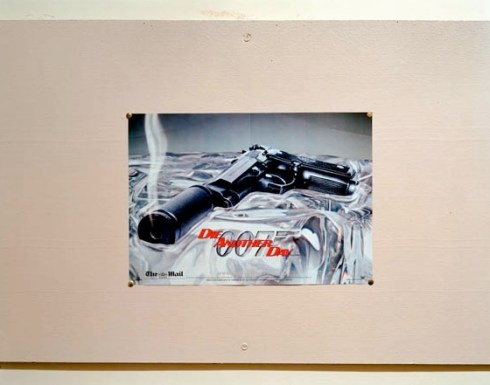
“If you are young and strong prison is manageable on the whole. If you feel weak or infirm or poorly it is a harder place to be and these photographs epitomize the frailty factor, the danger of getting old in prison or being old in prison … My feeling about prison is that it is not a place for old people. Prison is one environment for everybody regardless of your circumstances and so what happens is your survival depends on luck and natural resources. And if you’re old you’re not gonna have as much luck as the younger guys.”

“There’s a lot of people in the system who know that prison is not a place for old, infirm, disabled people. And its not. I’m not saying that they shouldn’t be separated from society, but I am talking about prison as we know it. The common interpretation of prison is landings, wings, cells, prison officers, dogs, security; that whole encapsulation of captivity. If you are infirm there needs to be another place. We are giving extra punishment to the weak people.”
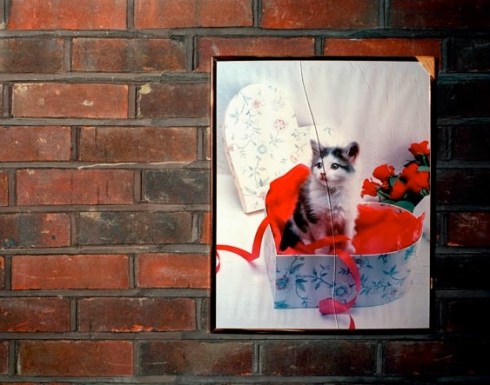

“There is an argument for separating the old folks from the main prison wing and that is what happened here. It was an experiment. E-Wing. The danger for me is that is becomes a place … you know, they talked of the fetid atmosphere; smelly and hot. The smell of old people. As a society we don’t have a lot of respect for old people.”
Clark’s unambiguous images of mobile aids and instructions for the senile are a clear call for change. His studies of prized-possessions and personal ordering of objects play on emotional responses to depicted vulnerabilities; Clark’s works conspire as a whole (43 images in total) to shape a convincing argument that we should all care about how our prison system accommodates different demographics. The elderly demographic is only growing, only advancing … with time.
As James’ words have served me so well throughout this article I shall close with his take on public opinion.
“I am pleased society is taking this on, because prison is a robust and hostile environment, and in fact the authorities refer to all prisons as hostile environments. That’s how they’re officially termed. That’s not because everyone who goes there are dangerous, but I think prison brings out the worst in a lot of people. It can bring out the best, but often it brings out the worst. And that’s not to say they are bad characters, it’s because people in prison are defensive and they are defensive because they are frightened.”

__________________________________________________________
All images copyright of Edmund Clark.
Still Life: Killing Time, by Edmund Clark, is published by Dewi Lewis, and avaiable at PhotoEye

Munkhbayar is the director of the women's prison just outside Ulaanbataar, her background is in Law. © Grace Gelder
Grace Gelder is building a portfolio with some impressive images. She graduated with an MA from Bolton University in International Photojournalism , Documentary & Travel Photography. I am chuffed to promote her work because Bolton is one of many mid-sized cities of England’s Northwest that has been the brunt of dismissive attitudes during my childhood and adolescence.
The University of Bolton is helping reshape those ill-informed attitudes and building a reputation for its photojournalism department. This is helped by its partnership with the Dalian College of Image Art, China. Which helps to explain how Gelder came to work on her far-flung series Professional Mongolian Women. Mongolia is just next door, right?
As the Metro puts it, Gelder “counteracts misconceptions of Mongolia as an under-developed country. Her series of striking colour portraits, each depicting one woman in her professional context, follows up a UN report last year that placed Mongolia first in a league table for women’s participation in the workforce.”
I think particularly with her portrait of Munkhbayar, Director of the women’s prison just outside Ulaanbataar, Gelder succeeds in quashing stereotypes that exist regarding Non-western nations, Mongolia itself, and women in those societies. I am just glad Gelder had a prison warden as one of her subjects; as to provide me an excuse to promote her well-informed work. I recommend reading Gelder’s own description of gender relations and equalities in Mongolia.
(Via PhotoMABlog)

 Prison Photography

Jacob Holdt’s America: Hitch-hiking, Poverty, Racism, Prisons, Death and Love
May 19, 2009 in Activist Art, Documentary, Historical | Tags: America, Anti-Racism, Comment, Death, Drugs Addiction, Inequality, Jacob Holdt, Love, Murder, Philosophy, Poverty, Prison, Prisons, Problems, Social, Violence | by petebrook | Leave a comment
Jacob Holdt presenting at the New York Photo Festival, 2009. Screen shot from WTJ? Video.
In 2008 it was Ballen. In 2009 it was Jacob Holdt; The highlight of the New York Photo Festival.
I have been a fan of Holdt’s work for a couple of years now. Longer than some and not a fraction as long as others. Holdt has lived across the globe as an activist against racism and a harbinger of love for nearly four decades.
In 2008, Jacob Holdt was nominated for the Deutsche Borse Prize eventually losing out to Esko Männikkö. It was a shrewd shortlisting by a notoriously urbane committee at Deutsche. Holdt’s life and productive trajectory is his own, and much like Ballen does not conform to any norms of expected photographic career paths.
Any nomination – any praise – is purely a recognition of Holdt’s philosophy, his “vagabond days”, his trust in fellow humans and his rejection of stereotypes, fear and pride. Holdt does not revere photography as others may, “Photography never interested me. Photography was for me only a tool for social change.”
© Jacob Holdt
I watched Holdt’s presentation without expectation. I was, in truth, very surprised by the number of times he referred to his subjects – his friends – spending time in prison. It seemed only death trumped incarceration in terms of frequency amongst his circle of friends.
Prison Meal on Toilet © Jacob Holdt. Through a “mysterious mistake” I got locked up in this California prison with my camera and had plenty of time to follow the daily life of my co-inmates. Food was served in their cells where the only table was their toilet.
Slide after slide: “I can’t remember the number of times I have helped him get out of prison” and, “He’s in prison, now” or “He’s doing well now. He was in prison, but now he is out, has a family, and is doing well.”
Holdt described his method of finding community. Upon arrival in a new place, he would visit the police station and ask where the highest homicide rate was. He’d go to the answer.
Violence was tied up with poverty, was tied up with drugs, was tied up with deprivation, was tied up with hurt, was tied up with punishment and was tied up with prison – usually long sentencing.
Holdt’s series straddles the massive prison expansion experiment of America that began in the 1980s. Also enveloped are the crack epidemics, the racial fragmentation of urban populations and the relocation of middle classes to the suburbs. Holdt’s photographs are the mirror to racial economic inequalities.
Dad in Prison © Jacob Holdt. Alphonso has often entertained my college students about how he and the other criminals in Baltimore planned to mug me when they first saw me in their ghetto. However, we became good friends, but some time later he got a 6 year prison term. Here are the daughters Alfrida and Joann seen when they told me about it at my return. Today Alphonso has found God with the help of these two daughters who are now both ministers.
Holdt doesn’t play the blame game. Just as institutions and corporations walked all over many African Americans in Philadelphia, Baltimore, New York, and states across the South, so too did people step on each other, “This is a photo of a man the night after he shot his own brother in the head.” The next night, he was out stealing again and soon after was convicted for another crime and served 16 years in prison.
Holdt only makes excuses for the failings of his friends insomuch as their mistakes are more likely – almost inevitable – set in the context of their life experience. He doesn’t jump in, drive-by, photo some ghetto-shots nor cadge some poverty-porn. Holdt involves himself directly and tries to open other avenues.
He and his team has lectured across the globe running anti-racism workshops. Holdt had ex-cons sell his anti-racism book on the streets when they were released from prisons without opportunity. He offered pushers the chance to sell his books instead of dope. Sometimes he saw the money and sometimes not, “But, it was never about the money” Holdt adds.
Prisoner cleaning up on Palm Beach. © Jacob Holdt
One of the most sobering facts of the talk was a double mention of Lowell Correctional Institution in Florida. It was the only facility referred to by name and twice Holdt named friends who’d spent time inside. Lowell is a women’s facility. The female prison population of America has quadrupled in the past 25 years. It is still expanding at a far faster rate than the male prison population. Women’s super-prisons are singularly an American phenomenon. Holdt dropped as an aside, “I have three friends with grandmothers in prisons.”
If he could help, he would. Holdt described a struggling young lady who he desperately wanted to get on staff of American Pictures, but in 1986 she was too strung out on crack. In 1994 he visited her in prison. In 2004 she was released. In 2007 she was still out and Holdt photographed her with her son.
He photographed mothers, lovers, father and sons behind bars. In one case, when the father was convicted the son turned to crime to keep enough money coming in to support the family. He soon joined his dad in prison.
Prison Kiss © Jacob Holdt. I was visiting the friend of this inmate when his wife suddenly came on a visit.
But when it would be expected that Holdt may be too deep inside the experience of the poor Black experience, he took the chance to live amid the poor White experience.
Poor whites at a Klan gathering in Alabama. © Jacob Holdt
In 2002, Holdt had the opportunity to live with the Ku Klux Klan. He became pals with the Grand Dragon and his family.
“I have spent my life photographing hurt people.” The KKK members were no different. The leader had been abused as a child, subject to incest and beatings. Holdt presumed this but it was confirmed around the time the leader was sent to prison for 130 years for murder.
Holdt moved in with Pamela, the leaders wife, to support her in her husbands absence. Also in his absence he brought the unlikeliest of people together.
Pamela with white friend (Jacob Holdt). © Jacob Holdt
Pamela with black friend. © Jacob Holdt
During this time and only through informal discussion did Holdt learn that the man was innocent – he had voluntarily gone to prison to spare his son, the real culprit, from conviction for a hate crime.
Holdt petitioned and won his release. The former Grand Dragon was unemployed upon release and went on to sell Holdt’s anti-racism book on the streets … just as the dope-dealers of Philly had 15 years earlier.
Holdt’s presentation confirmed to me that the prison is inextricably linked with the social history of America. But this should not be surprising in a society so violent. Holdt paints a portrait of America from the 70s through to today in which the poorest people (both Black and White) held the monopoly on violence, disease, depression, addiction and struggle.
When Holdt was in Africa he showed people there his images of African-Americans suffering. Africans thought the Black communities of America would fare better in Africa, “Why don’t they come back here?”
Two unemployed Vietnam veterans at wall on 3rd St. © Jacob Holdt
Given the situations he walked into, some may think Holdt is fortunate to still be alive but having armed himself with love he made his own luck … and friends.
Check out more on Jacob Holdt here and here. Here is an article in support of his hitch-hiking activity.
Holdt’s incredible 20,000 image archive American Pictures.
WTJ? 70 minute video of his NYPF presentation.