
You are currently browsing the category archive for the ‘Fine Art’ category.

First off, some disclosure. M. Scott Brauer is a close friend, but I have a lot of friends who produce stuff and it’s never a prerequisite for promotion.
I enjoy this project.
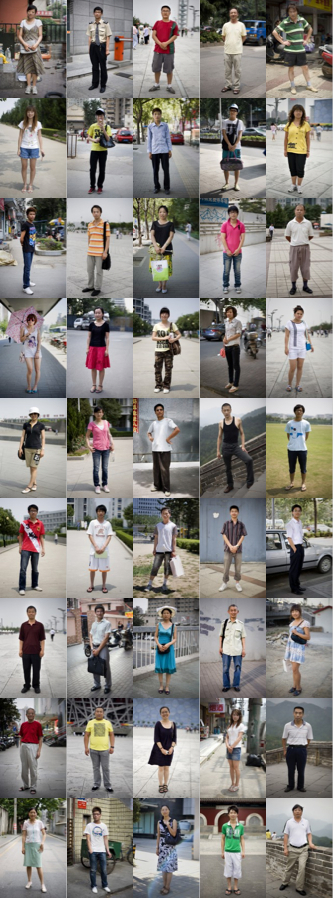
‘We Chinese‘ is several things. It is part break-up/part love-letter for Scott after relocating back to the States after years spent in China. It is a project to hum in the back of our minds whenever we think – or talk – about photography in China today. A nation of 1 billion can never be summed up by a single image or series, but good photography can provide firm foundations for thought.
Scott asked each subject two standard questions. The responses “range from prosaic to poetic, from rote to inspired, and from unemotional to patriotic.”
My favourite response is that of Wangbaoning, aged 20, who is unemployed but works for free as a building security officer. As compared to his assured fellow countrymen and women, his second answer is decidedly undecided.
What does China mean to you?: It stands for a unified China at this stage realizing hopes to be the master of its own affairs into the future.
What is your role in China’s future?: I haven’t really thought about it at this point, we’ll see, depends on motivation.
ALSO WORTH A LOOK
M. Scott Brauer’s Best Photographs of 2010
© Poulomi Basu
The border areas between India and Pakistan are dangerous and in many areas lawless.
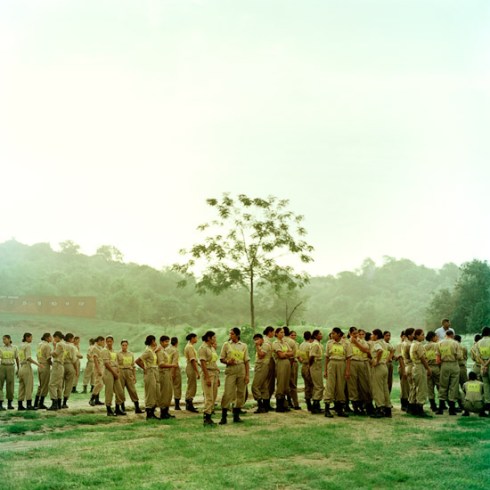
Indian women have very recently become part of the military response to arms dealing, drug smuggling and people trafficking.
“On September 2009, India’s first ever batch of women soldiers of The Border Security Armed Force were deployed in these infamous borders of Punjab, Jammu & Kashmir as the country’s first line of defence,” says Basu.
Poulomi Basu spent time with the young women (aged 17-25), both Hindus and Muslims, at boot camps, homes and on the front-line documenting their “transformation from women to soldiers.”
Basu believes these women are not only fighting their enemies but also the military tradition and the attitudes of a patriarchal society. Less than 1% of India’s 1.2 million armed forces are women.
To Conquer Her Land is about new forms of stress – related to combatant life – that has never existed for Indian women before in history. Basu says To Conquer Her Land wrestles with “intricate issues of conflict, psychological warfare, class, youth, gender, love, peace, the concept of home, an undefined idea of patriotism, and the strength of the mind.”
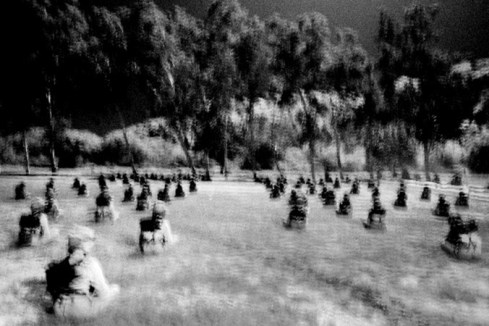
The series is a beguiling mix of fine art portraiture, B&W documentary images and PJ style theatre-of-war shots. The mixture can be quite disorienting; blurry B&W akin to Japanese art photography interrupted by delicate double and group portraits in colour. Basu even goes all Robert-Capa on us!
© Poulomi Basu
ALSO WORTH A LOOK
Photographer, Rachel Papo’s Serial #3817131 follows young Israeli girls through the mandatory military service.
Papo and Basu’s work have things in common, although Papo’s work is concerned with her own biography. Papo says, “Serial #3817131 represents my effort to come to terms with the experiences of being a soldier from the perspective of an adult. My service had been a period of utter loneliness, mixed with apathy and pensiveness, and at the time I was too young to understand it all. Through the camera’s lens, I tried to reconstruct facets of my military life, hopeful to reconcile matters that had been left unresolved.”

Jeremy Ramsden © Richard Nicholson
I was pleased as punch to feature Richard Nicholson‘s project Analog today on Wired’s Raw File.
When Nicholson began the project in 2006, there were 204 photo printing labs in and around London, printing images from film stock to paper. By 2009, only six remained.
Nicholson: “Each image was made in total darkness. I would switch off the lights, open the camera’s shutter, and then walk around the darkroom illuminating the scene with multiple bursts from a handheld flashgun.”
See the 12 image gallery and read our full interview: Photo Enlargers Loom Like Dinosaurs of the Film Age [Here’s a free tip. Click the view all button to see everything on one page.]
Considering the objects of extinction, it’s no surprise that there are many photographers composing photographic obituaries of the analog craft. Kindred projects to Nicholson’s Analog include Michel Campeau’s Darkroom, John Cyr’s Developer Trays and Robert Burley’s The Disappearance of Darkness.
IF YOU’RE IN LONDON
Analog — The Last One Out, Please Turn On the Light is on show at Riflemaker Gallery, 79 Beak St., Regent Street, London W1F 9SU, until March 11. E-mail: info@riflemaker.org.

© Maja Daniels
You may have noticed that I like to talk not only about prisons but also about other total institutions.
Maja Daniels‘ Into Oblivion photographed on a Protected Unit of a French geriatric care institution “attempts to create a discussion about our institutionalized, modern way of living as well as the use of confinement as an aspect of care.”
Many of the images in Daniels’ series feature patients at the door to the secured wing:
“Ruled according to the “principle of precaution”, residents in the unit can circulate freely within the secured area but due to a lack of activities and a limited presence of carers in the ward, the locked door becomes the centre of attention for the elders who question the obstruction and attempt to force it open. The daily struggle with the door, damaged due to repeated attempts to pick the lock, can last for hours.”

Cast of One Flew Over the Cuckoo’s Nest posing for their photograph on location at the Oregon State Hospital, Salem, Oregon, 1974. © MaryEllen Mark.
MARY ELLEN MARK
Mary Ellen Mark first went to Oregon State Hospital (OSH), Salem, OR in 1974 to photograph the cast and set of Milos Forman‘s 1975 adaptation of Ken Kesey’s novel One Flew Over the Cuckoo’s Nest. (Mark often shot on film sets).
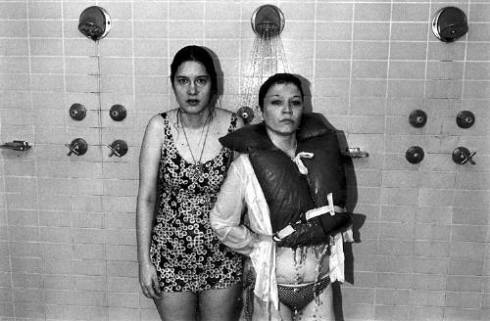
During the filming, Mark met the women of Ward 81. She promised to return and after over a year of negotiations with the hospital authorities and families of residents she was allowed to live on Ward 81 with writer Karen Folger for 36 days. American Suburb X has republished Folger’s essay for Mark’s book giving a familiar and surprising account of the routines and dreams of the women on Ward 81.
Mark’s book was a breakthrough. Granted, photographs of Oregon State Hospital existed previously, but Mark’s work was a pioneer intimate portrait of an American group outside of the dream, outside of the reality. LIFE magazine had covered an OSH camping trip before. Oregon Historic Photograph Collections have 14 images of OSH.

Horsing around. © Marl Ellen Mark, 1974
© Marl Ellen Mark, 1974

Mary Frances Peeking from Tub, 1976. © Mary Ellen Mark.
Mark’s Ward 81 was a personal call to action; she cared deeply about the residents and wanted to use photography to describe their lives. Mark contends in all interviews I have read that the treatment of patients was good and fair.
Prison Photography has touched upon institutions developing an “art” persona overtime through the work of several art photographer, specifically Stateville Prison, Joliet, Illinois. The architectural form of Stateville can be pinned as the common fascination that drew art photographers Gursky, Dubois, Goldberg and Leventi.
Alternatively, the preoccupations at Oregon State Hospital are varied. In some cases, the emergence of a new story to be told and in others an homage to past photographic action at the institution.
DAVID MAISEL
David Maisel‘s Library of Dust is a meditation on the cremains of former OSH patients. Until 2004, the urns were locked in a basement and not public knowledge. The patients died at the hospital between 1883 (the year the facility opened, when it was called the Oregon State Insane Asylum) and the 1970’s; their bodies have remained unclaimed by their families.
Over a period of twenty years the basement in which the urns were locked flooded repeatedly. Studio360 describes well the chemical reactions ongoing between the copper, elements within the ashes and substances afixed by flood water. Maisel’s studies are a “yearbook of the socially dispossessed.”
The Oregonian newspaper won the 2006 Pulitzer for Editorial Writing in its coverage of the forgotten remains and the sad scandal of silence. The story caught the attention of the nation and Maisel’s work toured the country to wide acclaim. Maisel talks about his work here and BLDGBLOG has the best text as entry point to the multiple layers in Library of Dust.
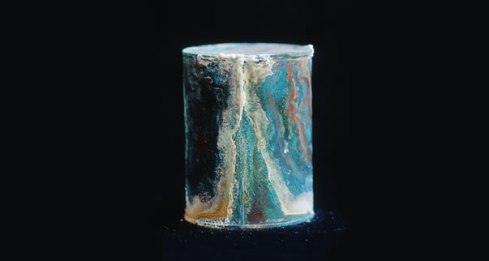
© David Maisel

© David Maisel
The Mental Health Association of Oregon summarises Maisel’s work well:
The tale behind the canisters is indeed deeply disturbing. They hold the remains of 5,121 people who languished in the psychiatric hospital in — many of them for their entire adult lives — for reasons that nowadays might require nothing more than a Zoloft prescription and some couch time. The patients’ conditions listed in hospital records include “worries about sex” and “worries about money” — “things everyone walks around with today,” Maisel says. When these patients died, their relatives either had no money for a burial or no interest in claiming the bodies.
Maisel positions the work within the taboos of “craziness”, “death” but also links Library of Dust to his earlier mineralogical studies. Interestingly, Maisel’s title was first uttered by a custodian of another state institution. Maisel explains:
On my first visit to the hospital, I am escorted to a decaying outbuilding, where a dusty room lined with simple pine shelves is lined three-deep with thousands of copper canisters.
Prisoners from the local penitentiary are brought in to clean the adjacent hallway, crematorium, and autopsy room. A young male prisoner in a blue uniform, with his feet planted firmly outside the doorway, leans his upper body into the room, scans the cremated remains, and whispers in a low tone, “The library of dust.” The title and thematic structure of the project result from this encounter.
While on site, Maisel also made some interior studies of the decaying fabric of the building. The series is Asylum. OSH was shuttered in 2005 and demolition began in 2008. A new facility is slated for completion in 2012.
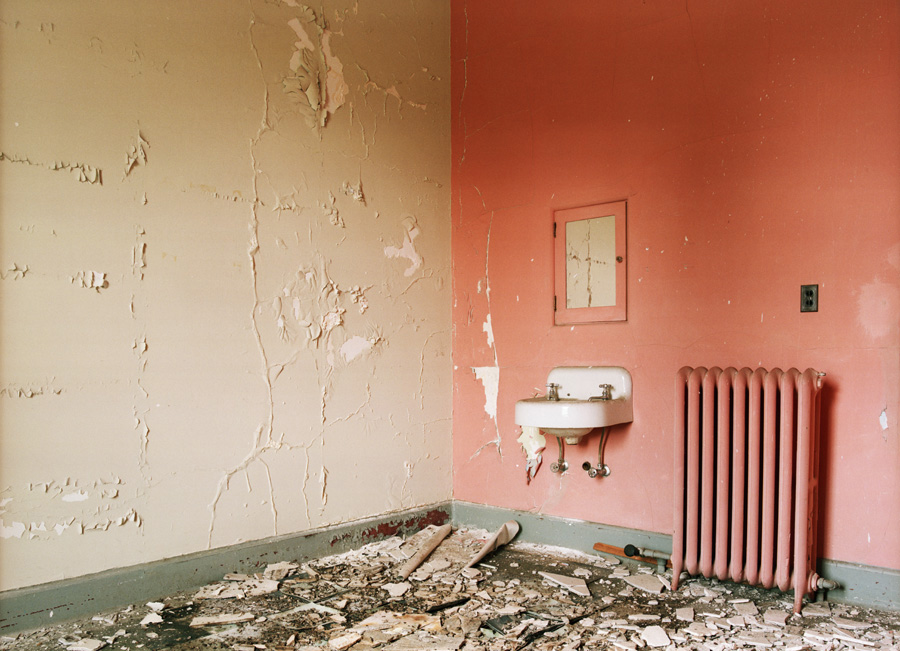
Asylum 2. Doctor’s Office, Ward 66, Abandoned portion of J Building. © David Maisel.

Asylum 3. © David Maisel

Asylum 7. Tubs, Ward 7, Abandoned portion of J Building. © David Maisel
Maisel’s studies of the interior are less complex or politicised as the poetics of Library of Dust. Nevertheless, bare these images in mind as you read on.
CHRISTOPHER PAYNE
Between 2002 and 2008, Chrsitopher Payne took on the largest photographic survey to date of America’s decaying psychiatric hospitals. For Asylum, Payne visited scores of old facilities and OSH was among them.
Interestingly Payne, photographed the storage room of cremains but didn’t extrapolate the stories into a memorial of politics as Maisel expertly did. And once, again the steep sided tiled bath tubs make a reappearance.
Oliver Sacks wrote the essay for Payne’s book. It is a ranging historical narrative of palatial institutions that could provide the best and the worst of care, but in most cases rarely prepared the patient for release back into society, “most residents were long-term.” The essay is accompanied by some wonderful historic postcards and generally Sacks tries to push us away from a narrative of “snake pits” and “hells of chaos” when thinking of psychiatric hospitals.
On Payne’s work, Sacks’ description is exactly how it appears, “[Payne’s photographs] pay tribute to a sort of public architecture that no longer exists. They focus both on the monumental and the mundane, the grand facades and the peeling paint.”
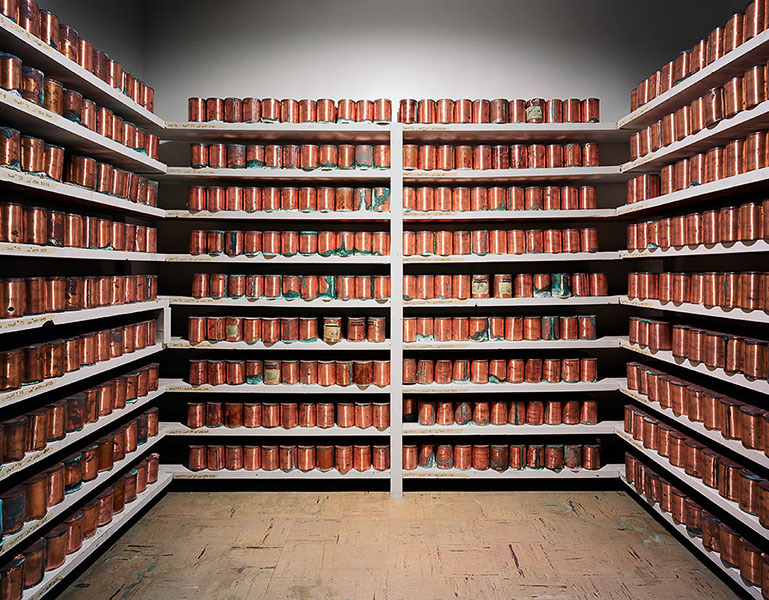
© Christopher Payne

© Christopher Payne
Peeling paint and broken down fixtures is a preoccupation of many a photographer. Architectural enthusiasts, disaster journalists and fine art photogs have all conspired to bring us the genre of “ruin porn” which continues to baffle and frustrate as much as it engages (but that discussion is for another time).
BILL DIODATO
This inquiry began when Bill Diodato contacted me with news of his book release. c/o Ward 81 is a conscious revisit to OSH; a closing of the circle of photographic practice put into motion by Mary Ellen Mark 30 years previous. Indeed, Mark provides the foreword:
‘It’s painful for me to look at these pictures. They evoke feelings of life and death. I can hear the sounds of women running through hallways and someone shouting, “Meds, meds, come and get your meds.” I can hear the crying of a woman being locked down in restraints. I can hear the music of the jukebox at the once-a-week dance with the women of Ward 81 and the men of Wards 82 and 83. Bill’s book brings me back to the haunted cell in which I slept in a deserted ward right next to Ward 81. I swear I heard people walking above me all night. This was so puzzling because the floor was not occupied. Bill’s images confirm the feeling that I always had—that Ward 81 was and still is inhabited by many ghosts. ‘ (Source)
Diodato states that this book is about the “demise of institutional services’ and it’s effect on women.” When Diodato visited both he and Warden Marvin Fickle knew he would be the last person to document the infamous closed-off Ward 81.
c/o Ward 81 is more focused than Payne’s one stop of many on his tour US psychiatric hospitals and it is more intentional than Maisel’s context-giving shots that rightly or wrongly have formed the backdrop to Library of Dust. Diodato is paying homage to the cultural impact of golden-age documentary photography as much as the site itself.
“The physical crumbling and decaying cells, represent the end of old, corrupt, poorly-run asylums and bring about a sense of closure for the women of Ward 81,” explained Diodato by email. But I can’t help think that’s a superimposition of idea upon the images. Mark’s refuted allegations poor treatment of patients in some interviews, yet talks of “hauntings” in the book intro quoted above. OSH did become known for substandard mental health care provision, but was it a constant of the institution, over all its years?
In addition to being a requiem to the occupants, residents and survivors of OSH, Diodato’s images are a requiem to public awareness.
The silenced and invisible lives of the population within OSH and similar facilities is a shameful past. Diodato’s images represent for me a breakdown in social responsibility for one another. How else can we explain OSH’s unclaimed remains for over 5,000 individuals? Families wrote their relatives out of family history just as the old asylums of the 19th and 20th century allowed the public to erase patients from the social fabric.

© Bill Diodato
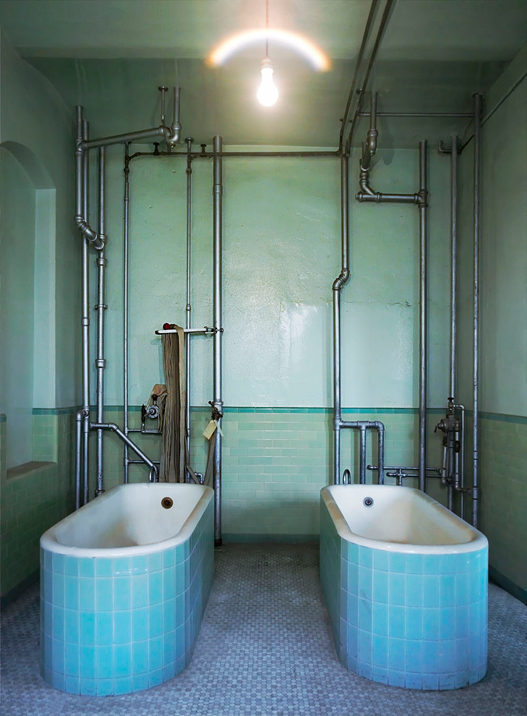
© Bill Diodato

© Bill Diodato
Oregon State Hospital was demolished in 2008. A new era and a new regime of treatment and control is to be established upon completion of the new proposed complex (below). What – if any – will be the photographer’s interaction with the new $458 million complex and its residents?

FURTHER READING
“Mary Ellen Mark – 25 Years” (1990) Pt. I and “Mary Ellen Mark – 25 Years” (1990) Pt. II
Interview: Mary Ellen Mark on Photography (Oregonian)
Interview: The Unfiltered Lens of Mary Ellen Mark

Mona Dancing with a Man, 1976. © Mary Ellen Mark.
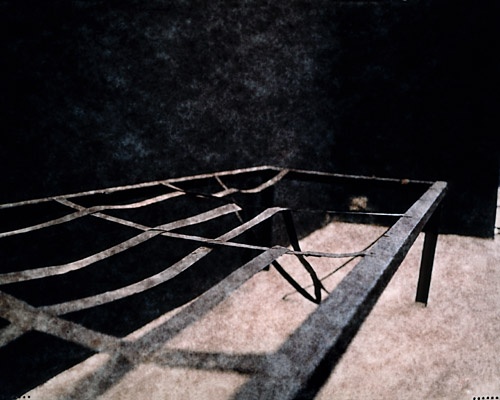
Cell for prisoners sentenced to death (by hanging), Acre/Israel, 2004. © Harri Palviranta
Harri Pälviranta‘s Prison Sheets portfolio includes work from prisons in St. Petersburg, Russia; Tartu, Estonia; Vilnius, Lithuenia; Berlin, Germany; Hämeenlinna, Finland; Jerusalem and Acre, Israel; and Gjirokastra, Albania. The series was undertaken between 1999 and 2005.
There are two common characteristics of the prisons – a) they incarcerated political prisoners and b) they were sites of torture for ideological ends.
Pälviranta’s laminated digital C-prints mounted on aluminium and photographed with 4×5 color negative film are not to my taste (although I do like the Kieferesque mood of the image above) but Pälviranta makes an important point about prison museums:
Because I don’t have an experience-based knowledge of these places, I understand these museum prisons as travel attractions, memorials or discursive constructions. […] Prisons are never passive or meaningless, even though they are empty. The violating practices these places were built on are not absent in our times. […] As architectural constructions they are combination of sacred and evil.
That is to say that prison museums are places for meditation and pathways to activism. As reflexive spaces, prison museums allow us the perspective to see the human rights abuses of today by focusing on the crimes of the past. Today, we’re fed “mitigating” (political) factors for the physical abuse of GWOT prisoners in our custody, but torture is torture. Time doesn’t change that.
——————————————————————————————
Previously on PP: Simulation and Memory: Prison Museums
Lots of lists of photobooks cropping up for different reasons.
PHONAR
To close out the remarkable efforts of Jonathan Worth’s experimental open-sourced, web-based, free Photography and Narrative (#PHONAR) course offered through Coventry University, the #PHONAR course closed with a bevvy of recommended readings.
The following photographers, writers, teachers and journalists made picks:
Alec Soth; Andy Adams; Cory Doctorow; Daniel Meadows; David Campbell; Edmund Clark; Fred Ritchin; Geoff Dyer; Gilles Peress; Grant Scott; Harry Hardie; Jeff Brouws; Joel Meyerowitz; John Edwin Mason; Jonathan Shaw; Jonathan Worth; Ken Schles; Larissa Leclair; Ludwig Haskins; Matt Johnston; Michael Hallett; Miki Johnson; Mikko Takkunen; Nathalie Belayche; Peter Dench; Pete Brook; Sean O’Hagan; Simon Roberts; Stephen Mayes; Steve Pyke; Todd Hido
As a contributor, I picked out three titles. Predictably, each dealt with photography in sites of incarceration:

Too Much Time – Jane Evelyn Atwood


Chris Verene‘s Family was a later addition.

It was a privilege to be asked to guest lecture on this pioneering educational model. Thanks to Jonathan, Matt Johnston @mjohnstonmedia (Chief Engineer) and students for their encouragement and engagement.
WAYNE FORD
The #PHONAR list was spurred by Wayne Ford’s Photobooks and Narrative list.
JOHN EDWIN MASON
Following the #PHONAR list, contributor John Edwin Mason extended his selections. Mason’s Photobooks and Narrative: My (Slightly Flawed) Phonar List has an African and African American emphasis.
ALEC SOTH
Tonight, Soth put forward his Top 10+ Photobooks of 2010. As ever, Soth is thorough, thoughtful and generous in response.
JEFF LADD
Jeff at 5B4 has picked out his 15 choices for Best Books of 2010. The comments section is lively and I don’t think being to conceptual (as Jeff is accused of) is a problem, even if it were a fair allegation.
SEAN O’HAGAN
Sean at the Guardian has selected 2010’s best photography books that you should put in someones stocking.
NIALL MCDIARMID
Niall has put together his Photobooks and Magazines of the Year.

 Prison Photography