
You are currently browsing the category archive for the ‘Fine Art’ category.
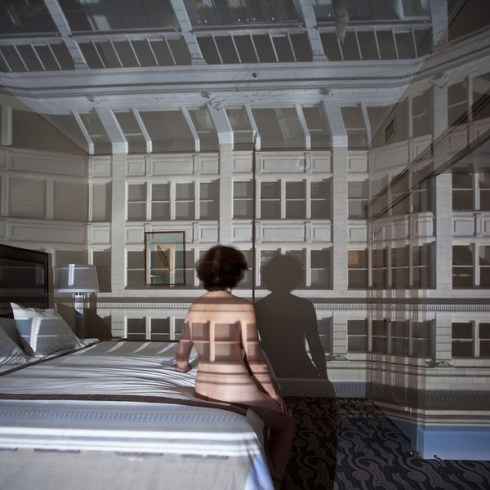
© Darius Kuzmickas
Darius Kuzmickas‘ work, found on Hey Hot Shot recalled Abelardo Morell‘s Camera Obscura works.
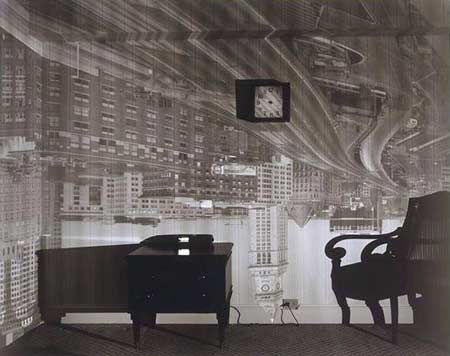
© Abelardo Morell
To paraphrase Morell, the best way to describe the camera to somebody is to put them in it.
Melanie McWhorter has really taken on the ongoing photobook discussion, archives, exposure, and championing and made it her own.
So far, she’s published three discussions about photography on newsprint. Wonderful stuff!
Newsprint and the Contemporary Photobook, Part 1: Alec Soth and Andrew Roth
Newsprint and the Contemporary Photobook, Part 2: Nicholas Gottlund and Grant Willing
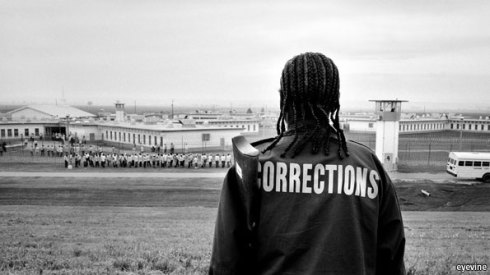
© Eyevine / Lori Waselchuk
Last weeks article, Rough Justice in America, by The Economist repeats many truths of America’s broken prison system we know already, here summarised:
“The system has three big flaws, say criminologists. First, it puts too many people away for too long. Second, it criminalises acts that need not be criminalised. Third, it is unpredictable. Many laws, especially federal ones, are so vaguely written that people cannot easily tell whether they have broken them.”
As expected the arguments made against mass incarceration here are on based on financial sustainability and fortunately such thinking is melding with the notion of social sustainability. The stories of George Norris and Michelle Collette form the anchor to the piece which posits that “Never in the civilised world have so many been locked up for so little.”
LORI WASELCHUK
I recognise the photographs as those of Lori Waselchuk whose work Grace Before Dying from the Angola Prison Hospice should not be missed. For it, Waselchuk won a Soros Documentary Photography Grant (2007), a Photolucida Critical Mass Top50 (2008). Here’s a great interview with her by Nicole Pasulka of the Morning News.
– – – –
Thanks to Joerg for the link

Nuclear Residues Repacking Glovebox, Building 440, Rocky Flats Nuclear Weapons Plant, 2002. © A.W. Thompson
A.W. Thompson‘s largest single project, “Incendiary Iconography” addresses Cold War-era nuclear sites in the United States that are in the process of public reclamation and/or transformation under the Defense Environmental Restoration Program.
The Rocky Flats Nuclear Weapons Plant sat at the foot of the Front Range of the Rocky Mountains overlooking the high plains of eastern Colorado. Boulder is ten miles to the north, Denver’s two million residents just 16 miles downwind and downstream to the east. The plant operated from 1952 to 1992, and since then the suburbs of Denver have extended to the border of what was a 25 square mile top-secret facility.
Thompson says, “The plant produced plutonium “pits,” for the nation’s nuclear weapons stockpile. A pit, or primary, is a plutonium fission bomb like the one dropped on Nagasaki, and is used to start the fusion reaction in a hydrogen bomb which has over 1000 times the power of a fission bomb. Plutonium is a man-made element which is highly toxic in addition to being radioactive.”
On June 6th, 1989, as part of an investigation into allegations of environmental crimes the Federal Bureau of Investigation, Environmental Protection Agency, and the Department of Energy’s Office of Inspector General raided The Rocky Flats Nuclear Weapons Plant. The raid led to the eventual decision to tear down Rocky Flats.
Again, Thompson, “In 1995 the U.S. Department of Energy labeled Rocky Flats the most dangerous weapons plant in the nation because of the health and safety risks it posed to the plant workers and the surrounding area. Although the search warrant documents were released in 1989, the full text of the grand jury investigation and findings remains sealed, despite efforts by members of the gagged grand jury to make them public. The former Rocky Flats Nuclear Weapons Plant site was officially designated a National Wildlife Refuge with the completion of decontamination and deconstruction activities in October 2005. The wildlife designation was chosen because it afforded the lowest level of cleanup standards. Debate continues among former workers and local citizens about the adequacy of the cleanup.”
“Rocky Flats was the only nuclear pit facility in the U.S. The Department of Energy announced plans to develop a new hydrogen bomb on March 2, 2007. Site location for a new multi-billion dollar pit facility is currently underway without significant public debate about the need, or the long-term financial, environmental, and security costs of a revived nuclear weapons production program, which many believe, will start a new nuclear arms race.”
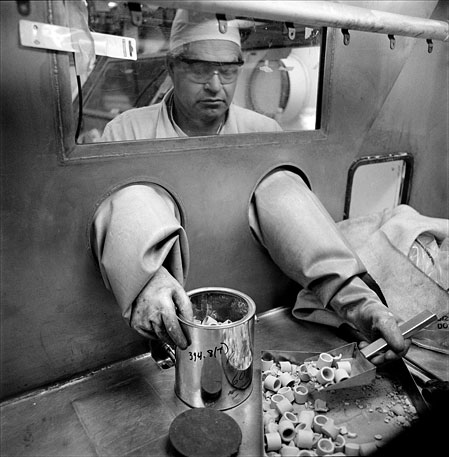
Characterizing Legacy Residues in Plutonium Building 771, Rocky Flats Nuclear Weapons Plant, 2001. © A.W.Thompson
BIOGRAPHY
Thompson (born in Colorado) is the Director of the School of Communications and an Associate Professor of Photography and Visual/Media studies at Grand Valley State University, Michigan. He earned his B.S. in Physics from the University of Dallas and his M.F.A. in Photography from Washington University in Saint Louis.
Thompson has lived and worked in Rome, Italy and across the Midwest as a freelance and commercial advertising photographer. His work is about “the meanings attributed to, or derived from, experiences of place and/or technology, and the relationship of art and science as ways of knowing.”

A bathroom inside the Maze Prison, near Lisburn, Northern Ireland, on Tuesday, April. 11, 2006.
Andrew McConnell‘s work The Last Colony from the Western Sahara has gained some traction recently, promoted at DVAFOTO and backed up by TPP.
McConnell is from Northern Ireland so I was not too surprised upon looking through his portfolio to find a series on the Maze prison.
I’ve seen a few projects from Maze Prison – the most well-known being that of Donovan Wylie – and yet a few of McConnell’s images really stood out.
STATEMENT
McConnell: “HM Maze Prison, also known as Long Kesh and the H-Blocks, held some of the most dangerous men in Europe during its 30 year operation. The prison closed in September 2000 after 428 prisoners had been released under the Good Friday Agreement. There are now plans to turn the abandoned site into a national football stadium.”
The bathroom image (above) is admittedly more powerful to me, having seen the bloodied-knuckle washing scenes in Steve McQueen’s powerful debut film Hunger.
Also, admittedly the image of the football (below) is more loaded given the now-defunct plans to convert the site into a national stadium.
In January 2009 plans to build the £300 million multi-purpose stadium were officially axed with politicians saying plans to start the construction of the stadium wouldn’t be reconsidered for another 3 to 4 years. (Source)

An old football lies in the exercise yard of the Maze Prison, July 18, 2006.
I had been under the impression every structure at the Maze had been demolished but apparently not:
Discussion is still ongoing as to the listed status of sections of the old prison. The hospital and part of the H-Blocks are currently listed buildings, and would remain as part of the proposed site redevelopment as a “conflict transformation centre” with support from republicans such as Martin McGuinness and opposition from unionists like Nigel Dodds who are against erecting a memorial to those who died during the hunger strike. (Source)
Which ties nicely back into the crucial question about McConnell’s photographs of the site. Are these photographs of memory, for memory, for memorial? What audience do they serve?
It seems to me that politics and emotions vary so wildly, that when a photographer (so soon after decommission) takes on a contested site such as this, his/her photographs are open to many different interpretations. The Maze and its history are fascinating, discussion-worthy topics, but is it the case here that the images are nothing more than notable ‘urban exploration‘?
Donovan Wylie dodged this suspicion by documenting over a five-year period the slow demolition of The Maze. Wylie has talked about wanting to create an archive of this transitional moment. However, if a photographer’s series is too brief (either within its own boundaries or by comparison to another practitioner’s series) then how is it justified or explained?
I don’t want to be dismissive here, as I think this is a problem many political-documentary photographers face – namely, their work may not adequately reflect or contain the disputed political landscape it references.
Perhaps we should read McConnell’s The Maze as undefinable and undecided, just as the former prison site remains?

The Cages of the Maze Prison, Northern Ireland, July 18, 2006.
Biography
Andrew McConnell was born in Northern Ireland in 1977 and began his career as a press photographer covering the closing stages of the conflict in his homeland and the transition to peace. He later worked in Asia and moved to Africa in 2007 to document the issues and stories of that continent which are widely overlooked by the international media.
His images have appeared appeared internationally in publications such as National Geographic Magazine, Newsweek, Time magazine, The New York Times, The Guardian, FT Magazine, L’Express, Vanity Fair (Italy), the Sunday Times Magazine, and Internazionale.
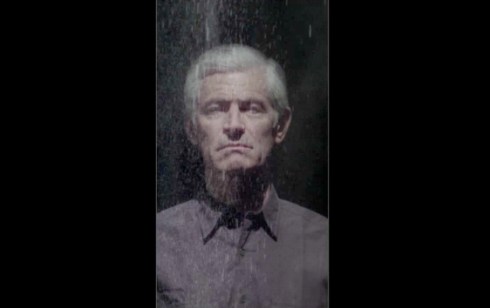
Screengrab. ‘James Nachtwey, a portrait of the artist’ (9 minutes). © Asa Mader
Get past the fact that Asa Mader is repeating Bill Viola’s tricks, my response to this installation video is that James Nachtwey is serious, and he is silent, and there’s some stuff falling to the ground around him.
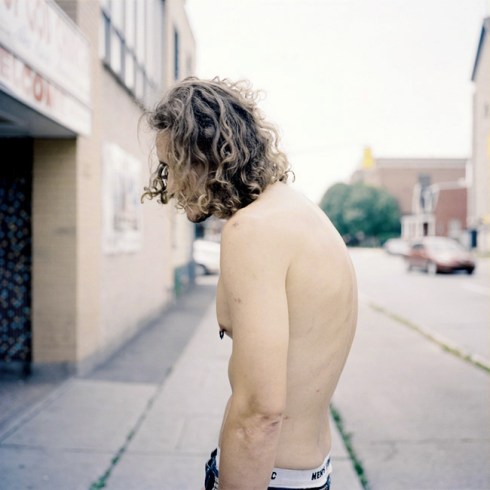
Joce, Ottawa, 2010 © Tony Fouhse.
Despite being four years deep in his project USER, Tony Fouhse is more confused than ever by what it all means.
I recommend you read his latest blog post. Fouhse talks about beginning his fourth and final year on the project, subjects who have died, and the gratitude of one of his subjects now she is clean.
The post is a reflection and it is as much for him as it is for us.
USER
I hope that you are all aware of his work photographing the crack addicts in Ottawa – not forgetting the interviews, the coverage, the love and the controversy that follows any project such as this that positions addicts as the subject of fine art.
So, I want to say a few things.
– Tony has been very open to discussion and criticism of his work. He will also defend his work with vigour, as often criticism leveled at his work is – in some guise – puritan criticism of photography in general.
– Tony’s subjects love his work; many go to the USER exhibition openings. Dawn was one of Tony’s subjects; her letter is included in Tony’s latest blog post: “I would like the picture so I can remind myself that I do not want to look that horrible or be that desperate again. I really do appreciate your work and all that you do. I have followed your work since I got clean. Please let me know if you have a copy of the picture.”
– Tony has shown real commitment to his process and the subjects. Yes, he is trying to construct a meaningful “complex sequence”, but that doesn’t mean he is manipulating his subjects, dropping in and out of their difficult lives. The best illustration of this is the map below. Every portrait over the past four years he has shot on this same corner. He knows all these men and women.

Portfolio at his website: http://tonyfoto.com
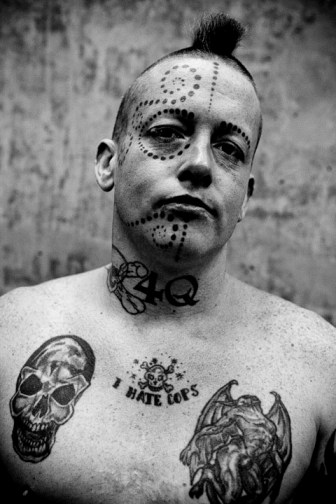
© Robert Gumpert
I’ve talked recently about photographers Bob Gumpert and Deborah Luster. A couple of months ago, upon my recommendation, Bob actually bought Luster’s monograph One Big Self.
The next day he emailed me to say that one of Luster’s sitters from Transylvania, Louisiana in May of 2001, he had photographed in San Francisco County Jail in February of 2009. Bob interviewed the man yesterday and posted the audio.
This is the first instance I’ve come across in which two independent photographers have photographed the same prisoner. I don’t know if it is significant or not?…

Page from Deborah Luster's 'One Big Self'

 Prison Photography