
You are currently browsing the category archive for the ‘Fine Art’ category.

New Orleans. In the collection of the Peter Sekear Estate.
Actually, Jacob Holdt was the new Peter Sekaer … we just never knew about Sekaer. Until now.
Sekaer
The New York Times reported today on Signs of Life at the High Museum of Art in Atlanta, a major survey of Peter Sekaer’s life and of his works. Sekaer died prematurely in 1950 at the age of 49, leaving stacks of unsorted photographs.
Curator, Julian Cox said of his work, “We wanted to uncover this hidden gem. Sekaer was like the passage of a meteor, very bright but fairly brief.”
Sekaer often took photographic trips with friend Walker Evans. Sekaer photographed high streets, impoverished neighbourhoods, markets and games. He photographed signs and billboards. From 1936-43 he worked on assignment for various government agencies including the FSA, the USHA and the REA. His task was to document the depressed country and thus Seaker photographed a lot of poor Americans.
Excepting the New Deal agencies, this focus and unexpected coverage was repeated 40 years later by another Dane.
Jacob Holdt‘s ongoing life’s work American Pictures* is equally committed to describing the hardships of the American South. Holdt met many people suffering in a discriminatory culture with discriminatory laws. (I wrote about Holdt following his autobiographical presentation at the 2009 New York Photography Festival.
Holdt (b.1947) is the geist of Sekaer.
It should be noted Holdt doesn’t call himself a photographer, rather a man who uses the camera as a tool in his activism. Sekaer was professional from 1936 onward.
DANISH INQUISITION
It would be foolish to attribute their curiosity and achievements to their Danish heritage, or to suggest that foreign eyes can see with more clarity the shortcomings of their host nation. Sekaer and Holdt likely were/are simply good people with a belief in stories to be told.
Sekaer was an anomaly for his time; an outspoken, moody Dane, with a German camera, asking folk about their lives. Sekaer’s daughter, Christina explains that it wasn’t just his eyes that made his photographs, Sekaer’s voice did too, “His accent helped people want to talk to him.”
Sixty years on, it’s nice to meet you Mr. Sekaer.
More images here.
Peter Sekaer (American, born Denmark, 1901–1950)
Born in Copenhagen, Denmark, in 1901, Peter Sekaer immigrated to the United States in 1918 at the age of seventeen. After successfully operating a printing business in New York City producing posters, advertisements and window displays, he enrolled in the Art Students League in 1929 to study painting. He soon became involved in the New York art scene, befriending, among others, the artist Ben Shahn and the photographer Walker Evans.
By 1934 Sekaer had left painting behind to study photography with Berenice Abbott at the New School for Social Research. Through his friendship with Walker Evans he secured contracts from 1936 to 1943 to work on assignment as a photographer for various government agencies that were created as part of President Roosevelt’s New Deal program. In 1945 Sekaer started his own commercial photography business, shooting advertisements and human interest stories for magazines.
In 1950, at age forty-nine, Sekaer suffered a fatal heart attack. His life’s work has been preserved by his wife, Elisabeth Sekaer Rothschild, and their younger daughter, Christina Sekaer.

'Family Shelling Pecans, Austin, Texas', 1939. G Peter Sekaer. Collection of the High Art Museum, Atlanta. Purchased with funds from Robert Yellowlees.
Signs of Life: Photographs by Peter Sekaer is the first major exhibition dedicated to the work of the Danish-born American photographer Peter Sekaer. Organized by the High, the exhibition runs June 5, 2010 through January 11, 2011. High Museum of Art, 1280 Peachtree Street, N.E. Atlanta, Georgia 30309.
– – –
*Conflating Holdt and Sekaer further, a 1999 exhibition at the Addison Gallery of American Art was titled ‘Peter Sekaer: American Pictures’. I don’t know if the curators knew of Holdt’s body of work.
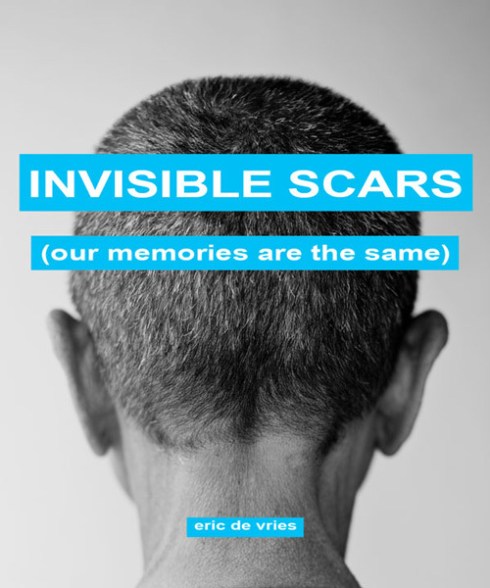
Invisible Scars is a portrait series of “the older generation in Cambodia that represents survivors of the Khmer Rouge regime in the 70s. Most of this group were forced to leave their village to undertake slave labour in the ricefields … The ones that survived returned to their homelands after the Khmer Rouge period in 1979. Some talk about what happened 35 years ago, others close their eyes or even turn away and continue what they were doing, taking care of their grandchildren.”
I am well aware of several photographers having dealt with the torture camps and prisons of Khmer Rouge ruled Cambodia (not least those of Nhem Ein, official prison photographer for the Tuol Sleng prison). I will return to these practitioners and history in time, but for now I’ll just alert you to this one project by Eric de Vries.
Thanks to Bob for the tip off.


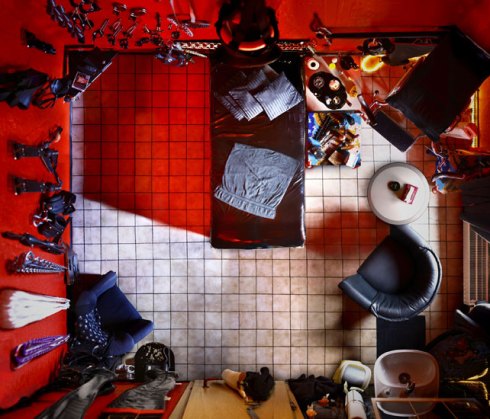
Last year, I interviewed Jurgen Chill about his project Zellen which adopted a birds eye (photo-composite) view of German prison cells.
For Chill’s series Bordelle, he repeated the technique for rooms of prostitution and bondage.
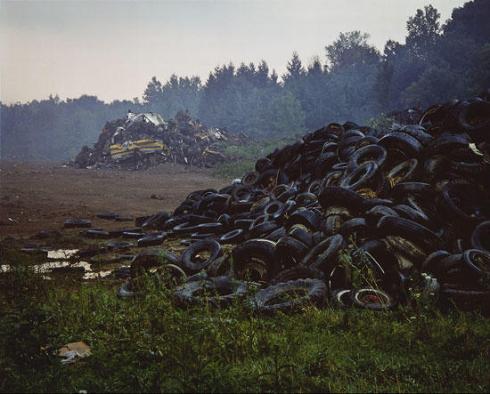
Robert Glenn Ketchum (b. 1947), CVNRA #705, 1988, Dye destruction print (Cibachrome), From the Ohio/Federal Lands project, Gift of Sue and Griff Hopkins, Amon Carter Museum, Fort Worth, Texas, P2001.8
This image came as quite a shock. I think of Robert Glenn Ketchum‘s work as New England fall colours, Hawaiian mists and Pacific Northwest greenery. Even when depicting a toxic river (below) Ketchum’s photographs have the ability to look bucolic and undisturbed (which is Ketchum’s clever conceit of ‘Overlooked in America: The Success and Failure of Federal Land Management’).
CVNRA #705 (above) is relatively early in Ketchum’s career and exists in contrast to all I presume and expect of his work. The photograph is part of Ketchum’s Ohio/Federal Lands project.
EXPECTING MISERY
In recent weeks, we have been presented with plenty of visual prompts for guilt and shame – here, Oil reaches the shores of Louisiana.
My attraction to CVNRA #705 has made it clear I expect doom and gloom. If the subject of photograph is catastrophic then it must be a politically worthwhile photograph, right?
Furthermore, when viewing destruction, the more literal the description, the better the image slots into my pessimistic view of man’s negligent environmental stewardship.
I just guess, people shortcut to images as means to prove a point, but images are usually props. Yet, it makes sense why people, press and politicos rely so readily on images; because images can be easily used for any number of (simplified) narratives*.
In most cases, images are all we have and in all cases images are inadequate.
The world is much larger than a single view, yet still, I value the contributions of conservation photographers and wouldn’t want a visual world without them. I just need to deal with my own preference for disaster.
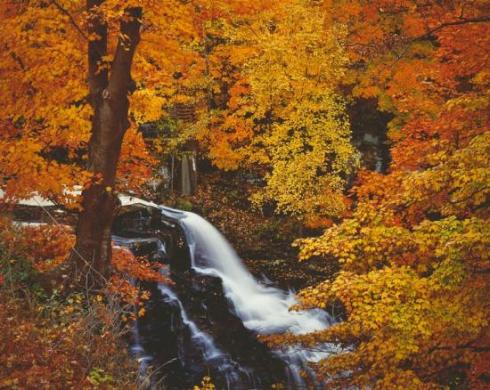
Robert Glenn Ketchum (b. 1947), CVNRA, #125 (a toxic waterfall in a national recreation area), 1986, from the project “Overlooked in America: The Success and Failure of Federal Land Management,” dye destruction print, gift of Advocacy Arts Foundation, ©1986 Robert Glenn Ketchum, P1996.22.3
* I don’t want to suggest that the destruction of the Gulf of Mexico is a simple matter made something it isn’t, but narratives may be. There are no positives. It is a straightforward disaster of huge proportion.

© Kevin Miyazaki
Last year, I met Kevin Miyazaki. I told him of my project at Prison Photography and he told me off his recent project Camp Home.
Before I deal specifically with Kevin’s personal project of insistent history, let me briefly set some context for thinking about photography as it relates to WWII Japanese internment. Kevin and I discussed the well known photographers who visited the internment camps in California – Clem Albers, Dorothea Lange and Ansel Adams.

“Richard Kobayashi, farmer with cabbages, Manzanar Relocation Center, California.” Ansel Adams, photographer. Photographic print, 1943. Reproduction numbers: LC-USZC4-5616 (color film copy transparency); LC-A35-4-M-31 (B&W film negative)
Adams’ was often criticised for his seemingly apolitical – almost bucolic – images of internees. The accusation was that Adams made the place look like a site of vacation and not of incarceration; this was a criticism I held too … until I met Kevin.
Kevin explained that Adams purposefully avoided depicting the internees as victims; Adams knew his (government-assigned) photographs would reach a large population, and into that population internees would eventually return. Adams’ intention was to protect, promote – even elevate – the dignity of his subjects.
One astonishing fact from this era, is that over two thirds of internees were American citizens.
Kevin and I also talked about Andrew Freeman, Mark Kirchner (both dealing with Manzanar) and the late and great Masumi Hayashi.

CAMP HOME
During WWII, at the age of thirteen, Miyazaki’s father was interned at Tule Lake in the Klamath Basin, CA, just shy of the Oregon border. Kevin work deals with the physical and domestic remains of that historical moment and movement:
“The barracks used to house Japanese and Japanese American internees were dispersed throughout the neighboring landscape following the war. Adapted into homes and outbuildings by returning veterans under a homesteading movement, many still stand on land surrounding the original camp site. In photographing these buildings, I explore family history, both my own and that of the current building owners – this is physical space where our unique American histories come together. Because photography was forbidden by internees, very few photographs of homelife were made by the families themselves. So my pictures act as evidence, though many years later, of a domestication rarely recorded during the initial life of the structures”, explains Miyazaki.
Well, I’d like to share with you a few Library of Congress images (1, 2, 3 & 4) I located on Flickr.

Japanese-American camp, war emergency evacuation, [Tule Lake Relocation Center, Newell, Calif. 1942 or 1943] 1 transparency : color. Collection: Library of Congress.
While looking at these Russell Lee attributed photographs consider these words about Miyazaki’s Camp Home by Karen Higa, Adjunct Senior Curator of Art at the Japanese American National Museum, wrote:
“President Franklin Roosevelt Delano Roosevelt ignored his own administration’s intelligence and in February 1942 issued Executive Order 9066, a presidential decree that paved the way for the largest mass movement of civilians in modern American history. Initially Japanese Americans were forbidden from living in western coastal regions; weeks later the US government began moving more that 110,000 civilians into temporary detention centers and finally to permanent camps. Over 700 government issued barracks were constructed o the dry lake bed at Tule Lake creating what amounted tot he largest population in a region of wind-swept sage brush.”
“The people that settled in Klamath after the war may not bear the specific responsibility of incarceration, but they share a generalized sense that something happened. their homes have a prior life worth recognizing.”

Japanese-American camp, war emergency evacuation, [Tule Lake Relocation Center, Newell, Calif. 1942 or 1943] 1 transparency : color. Original caption card speculated that this photo was part of a series taken by Russell Lee to document Japanese Americans in Malheur County, Ore. Re-identified as Tule Lake because of similarity to LC-USW36-789, which shows Abalone Mountain. Title from FSA or OWI agency caption. Photo shows eight women standing in front of a camp barber shop. Transfer from U.S. Office of War Information, 1944.

Japanese-American camp, war emergency evacuation, [Tule Lake Relocation Center, Newell, Calif. 1942 or 1943] 1 transparency : color. Original caption card speculated that this photo was part of a series taken by Russell Lee to document Japanese Americans in Malheur County, Ore. Re-identified as Tule Lake because of similarity to LC-USW36-789, which shows Abalone Mountain. Title from FSA or OWI agency caption. Photo shows eight women standing in front of a camp barber shop. Transfer from U.S. Office of War Information, 1944.

Japanese-American camp, war emergency evacuation, [Tule Lake Relocation Center, Newell, Calif. 1942 or 1943]. 1 transparency : color. Original caption card speculated that this photo was part of a series taken by Russell Lee to document Japanese Americans in Malheur County, Ore., and showed people transplanting celery. Re-identified as Tule Lake because of similarity to LC-USW36-789, which shows Abalone Mountain. Title from FSA or OWI agency caption. Transfer from U.S. Office of War Information, 1944. Repository: Library of Congress, Prints and Photographs Division, Washington, D.C. 20540 USA, hdl.loc.gov/loc.pnp/pp.print Part Of: Farm Security Administration – Office of War Information Collection 12002-55 (DLC) 93845501.
ELSEWHERES
It’s uncanny how the internet works sometimes. This image was the subject of some debate over at the Oregon State University Flickr Commons archive. Unsurprisingly, Kevin’s work was noted and praised there too.

KEVIN
As well as an excuse to wade through the various photographic approaches to Tule Lake internment camp, this post was to bring attention to Kevin’s ongoing contributions to the photo community. Kevin extends his teaching beyond his Milwaukee classroom and does us all a service by listing the interviews he serves up his class, on the class blog. Last week, Flak Photo called out for some more suggestions to the pile.
Kevin also launched collect.give last year which offers choice prints by respected photographers for prices no-one can quibble. All proceeds to good causes.
– – –
Kevin J. Miyazaki (b. 1966, USA) is a freelance editorial and fine art photographer based in Milwaukee, Wisconsin. He began his career on the staff of The Cincinnati Enquirer, and later became the photography director at Cincinnati Magazine. He went on to become the photographer at Milwaukee Magazine. His publication credits include, Time, Newsweek, Forbes, Fortune, National Geographic Traveler and numerous others. He is represented by Redux Pictures.

Gary King, Computer Technician, Disabled. “Over the last eight years, these two plates are the only family memories I have left. Only by the Grace of God have I been able to hang onto them. They’re hand painted. I believe that both of these plates were done by my dad’s mom. The one I especially wanted to hang onto was especially done for me. It was stolen when the storage unit got busted into.”
– – –
Daylight Magazine granted us sneak preview of Susan Mullally‘s upcoming book What I Keep: Photographs of the New Face of Homelessness and Poverty, by way of Elin o’Hara Slavick’s introduction.
o’Hara Slavick says:
“Susan Mullally’s unforgettable color photographs of people who gather together in their “Church under the Bridge of I-35″ make visible something we usually choose not to see. There is a young woman holding a photograph of her sweet baby girl with whom she cannot live because she does not have a place to live. There is a picture of an African-American woman holding her Junior High School diploma. This is the first time the woman has ever shown it to anyone. There is an unemployed carpenter who collects any stuffed animal that he finds so he can give them to the children he encounters during his homeless days.”
and,
“Mullally respects her subjects, many of whose lives are constantly disrupted by serious challenges such as homelessness, incarceration, drug addiction, alcoholism, mental illness and poverty. Mullally simply asks each person what he or she keeps and why it is valued and she makes a color photograph of them holding that object of subjective value.”
– – –
What I Keep: Photographs of the New Face of Homelessness and Poverty, Susan Mullally is published by Baylor University Press and due for release Summer, 2010
If you are in Seattle this Friday, think about dropping in at the Books To Prisoners‘ Art Auction; CREATIVE RELEASE.
Heck, if you turn up with a paperback dictionary you get in for free. I have some inside information that the quality of art is high. Loads of lithographs and a bunch of Just Seeds prison-specific prints!


 Prison Photography