
You are currently browsing the category archive for the ‘Fine Art’ category.
The governator wants to outsource California’s prisons to Mexico. Arnie went totally off script and blurted out an idea not even Matthew Cate, Secretary for the California Department of Corrections could, or would, back up.
Schwarzenegger suggested that outsourcing would save California $1billion/year, but couldn’t state from where he got the figure.
The idea is a non-starter for so many reasons. I know Arnie is desperate for solutions but he must at least be expected to stay within the realms of reality, no?
In a loose tangential thread, I have been impressed recently by the works of Livia Corona and Alejandro Cartagena.
Corona and Cartagena both train their lenses on suburbia, not prisons (although the psychologies of the two architectures may converge?)
On the evidence of their photographs the construction industry in Mexico is booming, even if it is ugly.

© Livia Corona. From the series, 'Two Million Homes for Mexico'

© Alejandro Cartagena. From the series, 'Fragmented Cities'
Thanks to Katie DeGraff for the tip off on Arnie’s madness
Every so often commentaries converge as such that I’m compelled to connect the smallish number of dots. I have done it once before here.
So, recently:
SUSAN MEISELAS SPEAKS ON DOCUMENTARY PHOTOGRAPHY’S ROLE

In ‘Expanding the Circle’, Meiselas talks frankly about the approaches and collaborations necessary to reach a wider audience,
“With whom can I partner – if that seems appropriate – for the work to have an additional life. [It] could be a life of advocacy or a life tied to an issue in a particular way, whether it is targetted at policy makers or to a public. You have to keep documenting at the same time asking those questions. All the while one must continue to document and seek opportunities to create possibilities for engagement.”
Meiselas is a curator for the Moving Walls project. The exhibition features work by former Open Society fellows and prison photographers Joseph Rodriguez, Steve Liss and Andrew Lichtenstein.
It is fair to say that the Open Society’s Documentary Photography Project has a propensity for prison photography projects. The 17th round of Moving Walls fellows has just been announced, and of the seven recipients, two document the lives of the incarcerated.
Lori Waselchuk for her work at Angola’s prison hospice and Ara Oshagan for his coverage of juvenile detention in California.

© Lori Waselchuk

© Ara Oshagan
One last note on cages. Meiselas’ selection includes images from Eugene Richard’s Procession of Them produced as a book in 2008, see spreads here and listen to Richards speak on the project as part of Columbia University’s “Photography as Advocacy?” series (2006).
One task of prison photographers is to emote the isolation and hardness of incarceration. It is a difficult task. Richards, while not looking at prisons per se is a master of conveying the barbarity of the cage and the helplessness of the caged. And besides, in today’s discourses that prefer not to distinguish institutional forms, the mental health asylums of Richard’s work are prisons.
Macoleta, Steinmetz, prison weapon & prison tool typologies
James Pomerantz highlighted the work of Antonio Vega Macotela who began investigating the concept of time as that controlled by outside forces and ended up clocking over 500 hours in the Santa Martha Acatitla Jail, Mexico. Read the essay, it’s an eye-opener!

© Antonio Vega Macotela
This reminded me of Marc Steinmetz‘s work from Germany from a few years ago, which I mentioned last year.
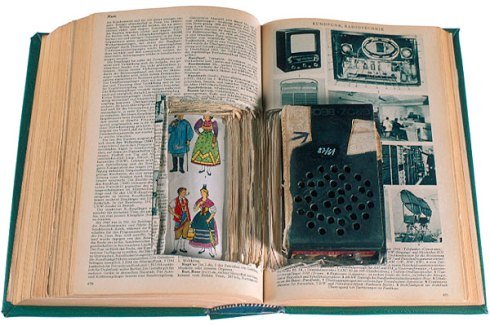
© Marc Steinmetz
PRISONER DATABASES AND MOST-WANTED GALLERIES
iheartphotograph highlighted the institutional mugshots presented online by the Florida Department of Corrections.

This is the first example I am aware of that a state DoC has provided a publicly accessible online search of full profiles and photographs of housed inmates.
No details are excluded; vital stats, aliases, crime, date of crime, body marks, date of release.
I suppose this is the voyeuristic bridge between DOC internal databases and the ever-refreshing scrolling “news” galleries of persons recently booked. The adoption of police mugshots as “news” also came out of Florida, so there is obviously research to be done there into Florida’s culture and visual rhetoric of criminal justice.
In both these cases, the public is being drawn in – by a limited amount of information – to the mechanics of regional sheriffdom.
Most wanted lists, such as that in California that just got a flashy website overhaul, carry some logic in that they inform a public about a potential menace at large. I expect there’d be a public outcry if this service was removed. Accepting that logic, though, it is curious as to why criminal justice agencies would provide mugshots of booked and detained persons.
All told, the availability of state prisoners’ photo IDs makes sense if you consider such databases as deliberate tactic. The databases become other arms in the apparatus of the panopticon; the visage of the prisoner is policed online by the gaze of unlimited number of people, as readily as it is policed by the prison guards’ gaze within the walls.
While mugshots have commonly been released at intervals to the media, particularly of infamous prisoners, never before has a photo-database of society’s transgressors been so accessible and searchable by the public.
We have become nodes in a network of observation and discipline.
The net has widened, and this previously exclusive net is now consolidating with the internet …

What do I want from this year? I want to continue the fun I have researching. I want a rip-roaring online symposium on race, diversity and photography. I want to be continually surprised by the things I discover. I want to deliver juxtapositions that make one pause. I want to do more interviews with photographers. I want to talk to more people in prison education. I want to change one persons view and then move on from there.
Covering Photography is the type of site I love to stumble across. Much like PhotoEphemera it is a site of tangential but significant importance to the role of photography in wider culture.
There are four books in the archive that feature prison photography. I have talked before about Cornell Capa‘s commitment to prison issues. Danny Lyon‘s career as a journalist is indelibly tied to American prisons. Arthur Tress and especially Charles Gatewood are not known for their prison photography.
I have bunched book covers with hand-picked works of each photographer as a playful convergence to kick off the new year.
ARTHUR TRESS

Halloween © Arthur Tress

Link
CORNELL CAPA

Russian and American soldiers, part of the Allied occupation forces, at a multinational party, Berlin 1945. © Cornell Capa/Magnum
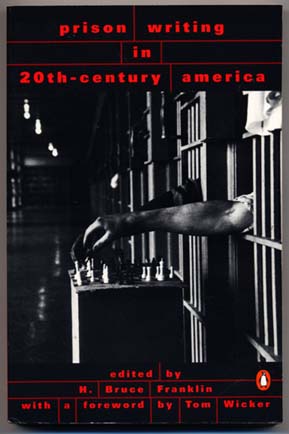
Link
DANNY LYON
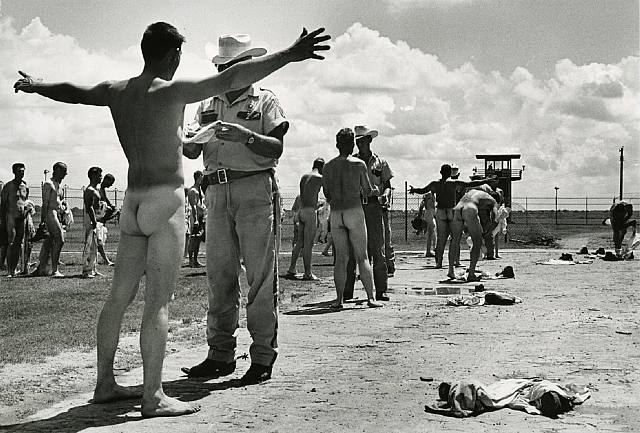
Texas Prison, Ramsey Unit © Danny Lyon

Link
CHARLES GATEWOOD

Wall Street © Charles Gatewood
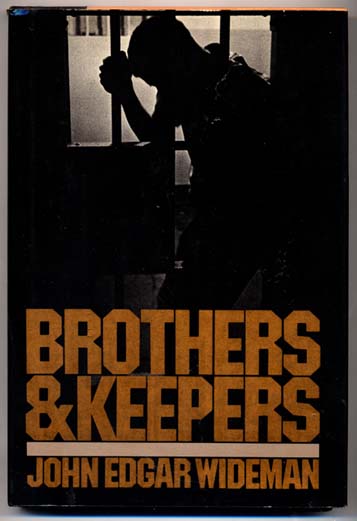
Link
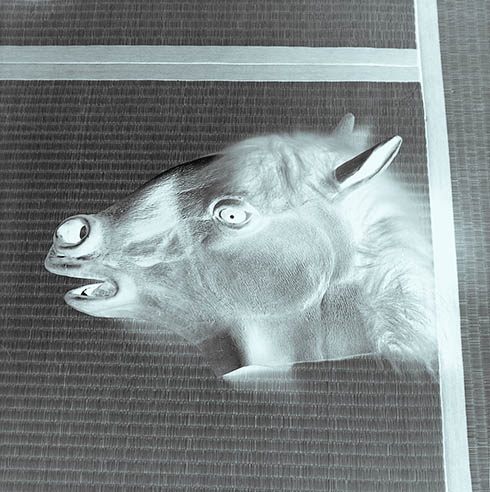
Horsehead © James Luckett
After I conveyed some fascination for the cold and unknown profession of forensic photography, friend and photographer, James Luckett contacted me to tell me that he used to work in a lab specialising in the production of prints for various legal companies and civic departments.
While not prison photography, James dealt with the photography of crimes and accidents. The negatives he worked on could eventually send people to, or spares them of, prison. Equally, his prints as evidence likely helped secure millions in lawsuit damages.
James’ writing is dry, candid and the toll that this line of work eventually took should be enough for anyone to pause for thought. Highly recommended reading.
The image above is not from the lab. It is negative version of one of James’ own.
You should follow James’ idiosyncratic blog, consumptive. It has some of the best curated links of any blog out there. He doesn’t waste your time. Here’s a great portrait of how James may have looked when he worked at the lab. He’s got shorter hair now and might not thank me for pointing this one out! James’ Flickr stream is worth a look too.

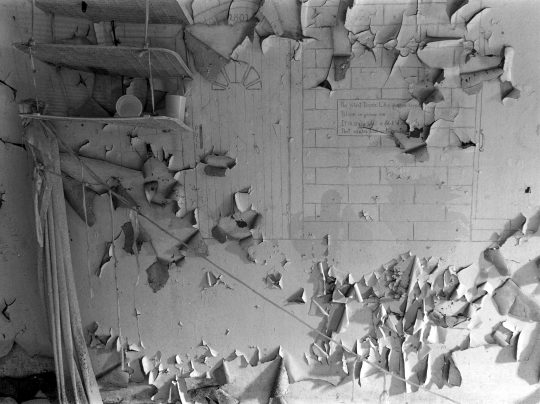
In 2005, Powerhouse Books published Thomas Roma‘s book In Prison Air: The Cells of Holmesburg Prison.
Arguably, the introduction by John Szarkowski is more interesting – or at least more complex – than Roma’s images. Szarkowski tackles head on the common question that looms over photographic studies of prisons:
“Roma’s book is in fact an odd and possibly perverse work, designed for who knows what audience. There are probably a few aging sociologists, still completing their works on what prisoners write on their walls, to whom the book might be useful (although it might be faulted on the basis of a lack of systematic rigor), and there might be another small but dedicated segment of our population that is interested in thinking about what life in prison might be like – not in terms of dramatic narrative, as with Cagney, Bogart, Robinson, etc., but rather (I am tempted to say) in terms of the aesthetics of incarceration.”
“But that is only a quick, superficial and comfortably middle-class response; and on second thought it is surely wrong.”
“Perhaps it might be more useful to ask why a photographer of high talent and conspicuous achievement might decide to make a book of photographs looking into empty prison cells. This is the same photographer who gave us the great, free-spirited dogs of Brooklyn, and the great open pastures of Sicily; and it is not unreasonable to ask why a photographer dedicated (or half-dedicated) to the cause of freedom should make this extended, serious, hermetic effort to produce a book of photographs concerning the very essence of subjugation.”
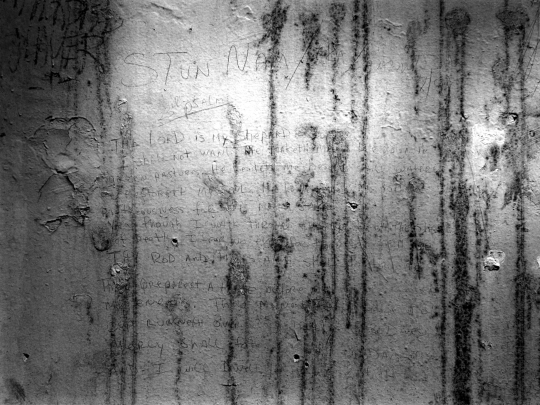
Szarkwoski then meanders through speculations about the photographs as a warning – even preparation – for forthcoming and unknown (possibly increasing) uses of incarceration:
“We might therefore, to be on the safe side, consider whether their evidence might help us prepare us for our possible future.”
To hammer the point home, Szarkowski lists common human preoccupations:
“According to their wall drawings and other graffiti, it would seem that the principled interests of Roma’s inmates were God, sex, time and to a lesser degree, art, the last being perhaps merely a method of dealing with the first three. These issues have been historically important to men in and out of prison.”
Szarkowski flourishes the introduction with reference to Conrad and Kafka and ends on an unfinished train of thought about medical experimentation on humans. Relevant, but not finished.
All in all, it is a bizarre essay. Szarkowski seems to grapple with the fact he has no connection to the content nor anchor with which to investigate and make sense of Roma’s work. But maybe that is the point he’s [un]intentionally making about photographs of prisons and of places one’s never been?
Talk about instructing your audience.
Today, Aline features Mark Laita‘s diptychs; (somewhat) obvious pairings of rich/poor, winner/victim. The couplet of astronaut/alien abductee is unexpected and clever.

I am always reluctant to use violent as an adjective to describe prisoners. I know that most prisoners are not in their nature violent. Most of the time, hard appearances are necessary as a front to aggression that may or may not exist.
In this instance, the counter-portrait of cheerleaders compels me to use violent as an adjective. Regardless of it’s uniform, “the group” is a menace. After spending just a minute with this diptych, I feel quite on edge. The two quintets both wield the tools of their activity and confront the camera. Aggressive.
Psychologically, it’s a dead heat. But culturally, for me at least, the cheerleaders are more sinister.
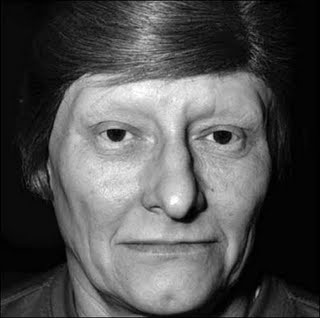
© Philippe Bazin
Last month, Melinda Hawtin contacted me about her interest and graduate research into the representations of prisons in French contemporary photography.
My position in the world is a little more comfortable knowing that another human has the niche commitment to prison photography!
Hawtin’s geography-specific project is even more narrowly defined as mine. She humbly referred to her blog as “yet a vessel for my (mostly) unresearched musings but I am hoping that in time it will take on a more coherent form”. Martin’s posts are far more than her modesty suggests – they are important introductions to academics, works and points of analysis.
Hawtin introduced me to the work of Philippe Bazin, whose series Détenus is a straight photographic study of French prisoners. Hawtin is discomforted somewhat by Bazin’s sentimentalisation of prisoners, “it seems strange and rather naive that artists like Bazin are so keen to portray the humanity of inmates. I’m not suggesting that they demonise them instead but monochrome, close-up images of prisoners could be seen to be over-romanticising the prisoner”.

© Philippe Bazin
My take? Intimate shots do not automatically translate to sentimentalisation or captures of “true” humanity. It is always hazardous to prescribe the reaction of an audience to a photographic style. I would step back (possibly cowardly) and suggest that Bazin’s portraits are worthwhile simply because they differ in tone from the vast majority of other photographic studies of prisoners.
Hawtin and I swapped resources and names including the excellent Visa pour L’Image web documentary winner, Jean Gaumy and Lizzie Sadin, whose photography focuses on juveniles in prisons across the globe, including her own nation of France.
Investigations into the portrayal of French prisoners could not be more timely:
I’ll be sure to check in with Hawtin’s blog regularly.

Sister Marina, Walton Prison. Copyright Liverpool Daily Post and Echo
About the photo: “I photographed Sister Marina visiting Walton Prison. Her smile and compassion were for all – she was there to comfort those who needed her faith, solace, prayers and hope.” Source.
___________________________________________________________
Stephen Shakeshaft is subject of a retrospective at the National Conservation Centre in Liverpool, England. Having photographed The Beatles, street urchins, dock-workers, Cilla Black’s mum, the Toxteth Riots, Willy Russell, Liverpool F.C. in European glory and the tragedy of the Hillsborough aftermath, Shakeshaft is knee-deep in the love, lore and history of the Merseyside region.
I’d argue Shakeshaft is to Liverpool as Anthony Friedkin is to California.
Shakeshaft started his career as a copy boy in 1962, running typed stories from the sub-editors’ desk to the print room for the Liverpool Daily Post and Echo. Later he was accepted as an apprentice, learning his trade and his art. He rose to become chief photographer and picture editor of both papers.

Kenny Daglish in bed with the European Cup. Copyright: Stephen Shakeshaft/ Liverpool Daily Post & Echo.
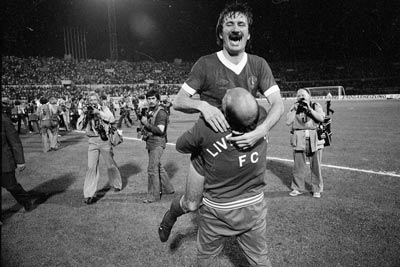
Celebrations after Liverpool won the European Cup Final in Rome, 1977. Copyright Liverpool Daily Post and Echo
All the information from the Liverpool Museum’s blog, associated videos from the exhibition and podcast.
Media articles and photos here, here, here and here.
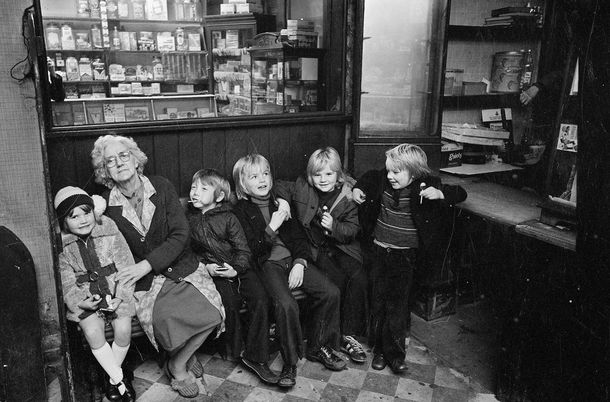
© Stephen Shakeshaft

 Prison Photography