
You are currently browsing the category archive for the ‘Fine Art’ category.
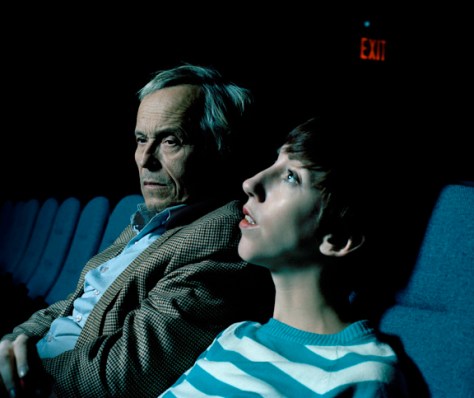
Tina Schula, from the 'Ratline' series
Harlan Erskine contacted me this weekend.
At the moment there are some MFA exhibitions at the blockbuster schools. Before you read this look over Daniel Shea’s neat run down of SVA, Columbia & Yale photography grads.
As concerns Harlan’s graduating class at the SVA, here’s five picks:
Carlos Alvarez Montero for his street portraits, but more so for his meld of youth, friends & skating.
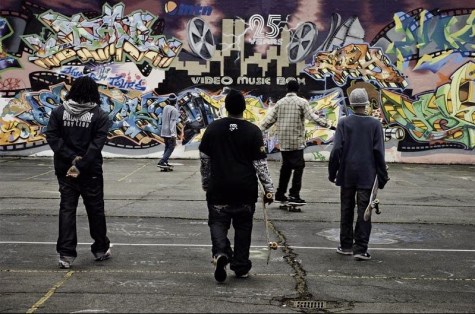
Carlos Alvarez Montero, from the 'Harlem Shuffle' series
Maureen R. Drennan for her sophisticated restraint down at a marijuana farm.

Maureen R. Drennan
Jessica Bruah because I think she takes a lot of shots and edits well. You don’t just “come across” the subjects Bruah photographs.

Jessica Bruah
Scott Houston for a harsh, harsh and close view of meth and people … together. And for proof in the argument that captions are essential; providing caring and careful context for image.

Scott Houston
Tina Schula gets a double shout out for two weird series. Ratlines (very top) is creepy & suspenseful. Oskar’s Sister (below) is playful, offensive & menacing.
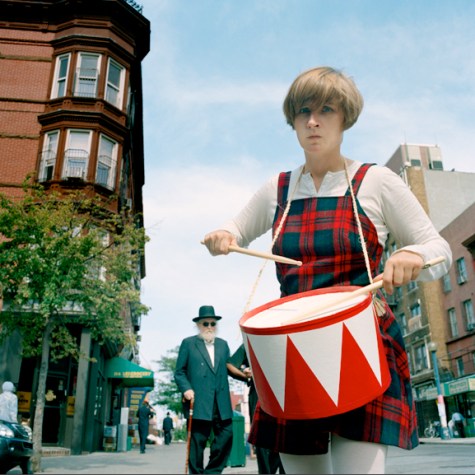
Tina Schula, from the 'Oskar's Sister' series
I recently came across this 1982 Time Magazine cover. It immediately reminded me of Juergen Chill’s Zellen series that I blogged about some months ago.
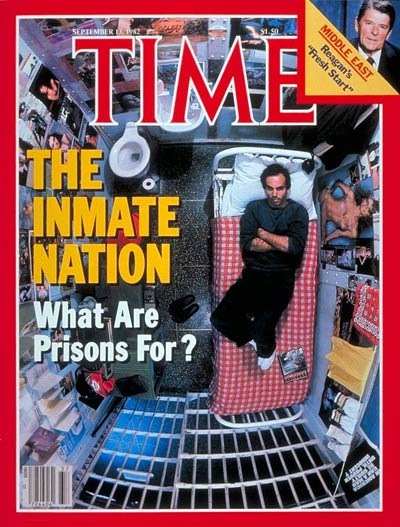
Time Magazine Cover, September 1982
The early eighties signal the end of innocence for America’s criminal justice system. Reagan ushered in an era of extreme punitive sentencing and the most rapid prison expansion of any democratic society ever. That said, you’d hope that with 27 years experience under our belts we’d have some firm answers for the 1982 journalist, huh?

© Juergen Chill
View all Monday Convergences

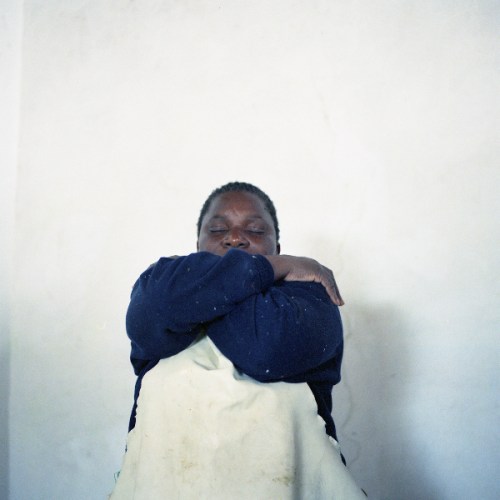
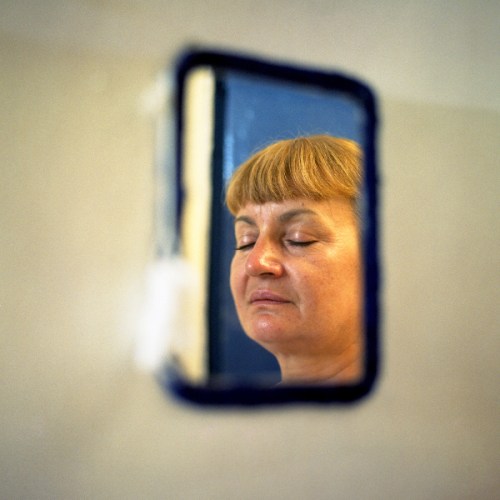
I wouldn’t describe Melania Comoretto‘s portfolio Women in Prison as portraiture; it’s bigger, it’s emotional landscape.
Comoretto’s work tinged with sadness, possibly even resignation. Their circumstance may have dulled outward looking expectancy.
This work stands out, for me personally, as one of the finest photographic documents of women prisoners, globally. Women in Prison is charming and disarming. These are women whose words would likely shock us and yet they seem to know the weight of their own stories and captive futures. The reticence of Comoretto’s subjects, paired with the arresting gaze (when given), is a triumph.
Q&A
Where is this prison?
I photographed in two Italian prisons in Rebibbia and Trapani.
Why did you do a project there?
I wanted to investigate and understand how women could express their femininity and take care of their body in a situation of extreme marginalization.
The starting idea was to reflect the mental and psychological labyrinths and internal prisons that prevent human beings from living their lives freely. I asked myself, “What could be the extreme expression of this idea?” The answer; Prison.
What were the women’s lives like? Was their prison experience positive or negative?
The way the women live in prison depend on the prison in itself and how it is organised. It also depends on the personality and psychological attitude of the woman.
Most of them fall into depression; others react in a very active way. The body is the mirror of that. The more a women fall into depression the more she forget to take care of her body, that was the reason why I decided to focus on bodies and femininity.
Where are the women now?
Most of the women are still in Rebibbia and Trapani prisons. I shot this series of photos only in the last 10 months.

Were the women good portrait subjects? Did they want to be photographed?
They were very willing to speak and to be portrayed! They liked to spent time with me. They rarely have the chance to speak with someone who wants to listen deeply their stories.
Did they see your photograph prints?
I sent them each contact sheets.
In Italy what is society’s attitude toward prisoners and, specifically, female prisoners?
Unfortunately, in every city and country of the world, the social attitude towards prisoners is not very open-minded. They [societies] focus on the fact that prisoners are guilty and rarely on the fact that (in the majority of cases) that they had no chance because their lives started in very tragic conditions. Without any help it is very difficult for prisoners to change their destiny.
What was your experience on the project?
I understand how in some situations life does not leave you many chances to change.
Can the camera be a tool for rehabilitation?
I deeply believe it is. I don’t know if photography could be a tool of rehabilitation for the women. For me it was and is … so maybe [the camera] could be for them and for many other people. It prevents me from destroying myself and I believe it could have the same advantage for many other people!




David Simonton contacted me and shared his long term project at the former Polk Youth Center in Raleigh. After thoughtful discussions David and I decided upon a pairing of articles.
In this post, Part One, David talks about the background to the project and his objectives in the work.
I also chose a selection of David’s prints to showcase and offer comment. At the bottom is a thumbnail-pop-out-gallery with all the pictures in one place.
…and, in a few weeks, Part Two will dissect the atypically rich and varied visual-history of the Polk Youth Center.
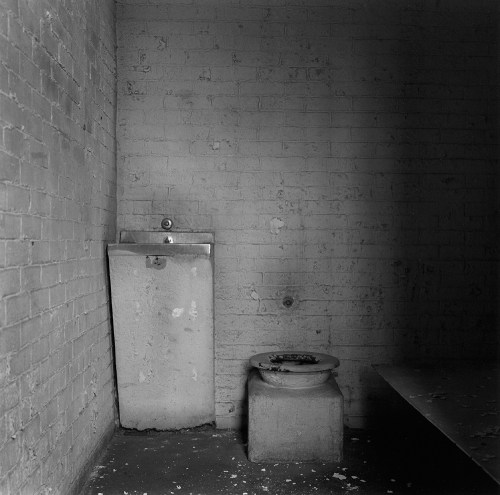
David Simonton’s Commentary (PP’s Subheaders)
Photographing Disused Architectures of Citizen Management
In the late-1980’s I was one of a number of photographers working on Ellis Island, the former Immigration Station in New York Harbor, documenting the progress of the restoration of the facility (reopened to the public in 1990).
The project was called “The Ellis Island Project: Documentation/Interpretation.” I was living in New Jersey at the time, and traveled to the island to photograph twice a week for nine months. During this period I was also pursuing my personal projects.

Opportunist Photographer
In 1989, I moved to North Carolina
The “Old” Polk Youth Center/Prison, Raleigh which has a long and storied history, closed in 1997 when a modern facility (which the “Old Polk,” most assuredly, was NOT) opened in Butner, NC. The inmates were transferred to Butner in November of that same year.
Living nearby, I could hardly resist the opportunity to photograph there. So before any “No Trespassing” signs were posted, I went and photographed the site. The doors (cell doors, some of them) to many of the buildings were wide open!
“Old” Polk Youth Center – a euphemism if ever there was one – was located on land directly adjacent to the North Carolina Museum of Art in West Raleigh, near the State Fairgrounds.
The prison buildings were razed in 2003. But before that occurred, the prison was essentially abandoned until the land (along with the buildings on it) was transferred to the museum.
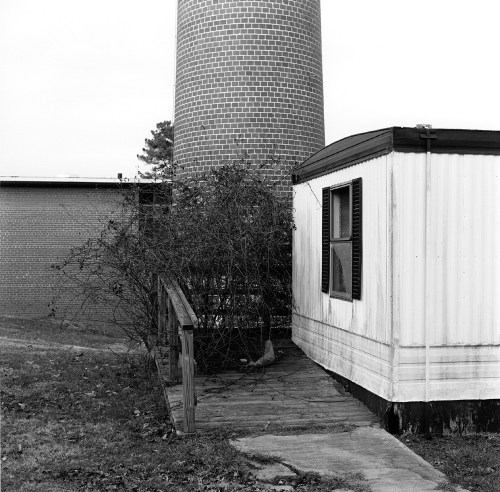
Official Photographer
During the mid-nineties, I exhibited my personal, interpretive work from Ellis Island – 90 images – at a gallery in Raleigh. Huston Paschal, a curator at the state art museum, attended the exhibition.
Unaware that I had already photographed there, Huston Paschal invited me to document the site, which was now in the museum’s hands. In late-2000 the invitation was formalized with a commission. I continued working on the project (even after the commission had lapsed) until the buildings came down, the ground leveled and grass planted.
My involvement was always with an empty site, when the prison was closed and inmates transferred. I photographed a long-abandoned facility: empty buildings, empty cellblocks and overgrown grounds.

Simonton: “Art for art’s sake”
As an art photographer (an unfortunate, nearly pretentious-sounding term, even if it’s the category my work falls into), my goal is to make interesting pictures; interesting in-and-of themselves, so that THEY are worth looking at, repeatedly.
What’s depicted is not unimportant, but it’s of secondary importance; this is my approach to my own picture making. The fact that my “subject” was a prison is happenstance – I photograph all kinds of abandoned structures. I also photograph the smalls town North Carolina (day and night) and photograph landscapes. An interesting photograph is always my intent, even when what it depicts is not itself inherently interesting … or beautiful.

Art and Documentary converge.
The Polk project was a “documentary” project, but not in the strict sense of it being wholly objective. My pictures describe the place I saw, and, if not the place I “saw”, then the place I thought and felt.
The project is not a comprehensive cataloging of the site either; rather, the pictures reflect my response to it during the passage of several years. They inform history by showing the place as it was in those waning years, after being – at long last – set aside as a relic; finally to be torn down and planted over and – with still more time – forgotten.
Polk Youth Center was located in a heavily populated area, which was not the case when it was built. Improvements were rarely made because, why spend money on any improvements if the facility was about to be moved or closed? – as were the recurrent promises for decades.
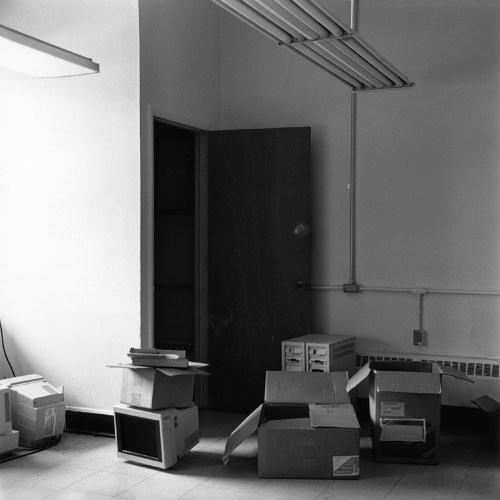
Institutional Narratives
I was not aware of the prison or the prison sites history until after I had completed my work; which may be just as well, since it was difficult enough to find beauty in such a physically “unbeautiful” place.
Had I been mindful of the ugly history of the old Polk Youth Center – riots, rape and other forms of violence in its final years, – I may have had a harder time photographing.

Prison Photography’s Commentary
Simonton’s three years at Polk yielded a varied portfolio. In editing the selection (from 100+ images to these 16) images distinguished themselves for very different reasons. If the lens wasn’t pointed at something crumbling, it was pointing at something overgrown and grown over.
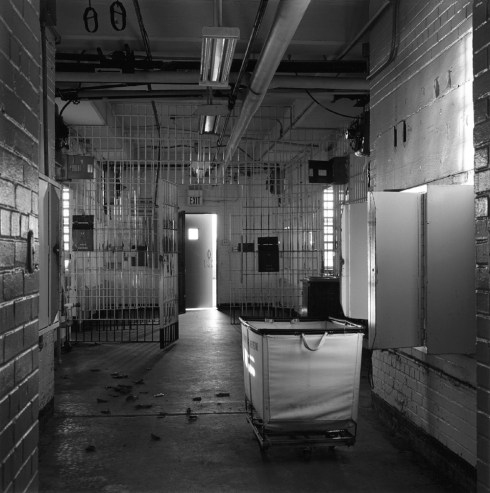
Some images (Steep Steps) are flattened and exposed matter-of-factly, whereas others (Laundry Bin) luxuriate in silvery sheen.
I choose one pairing here of the same view in different season; Simonton took many pairings so to secure the evidence of time in his series. Apparently, the chimney was a signature of Raleigh’s landscape.


It is in the different states of dilapidation that one finds a visual allusions. Simonton’s photograph of the teeth counterpoise the dental ephemera in Edmund Clark’s photography of a functioning geriatric UK prison wing. When given the opportunity, Simonton ties the fragility of the body to the decay of the site.
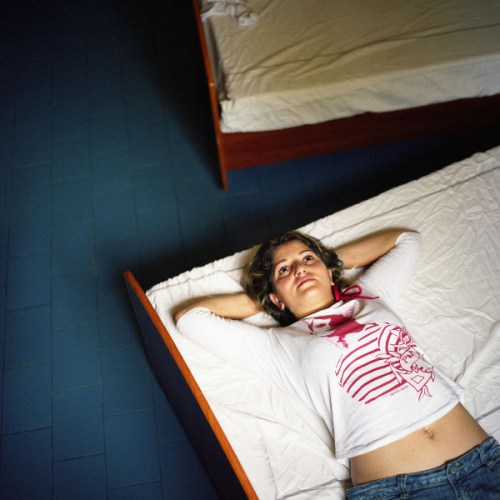
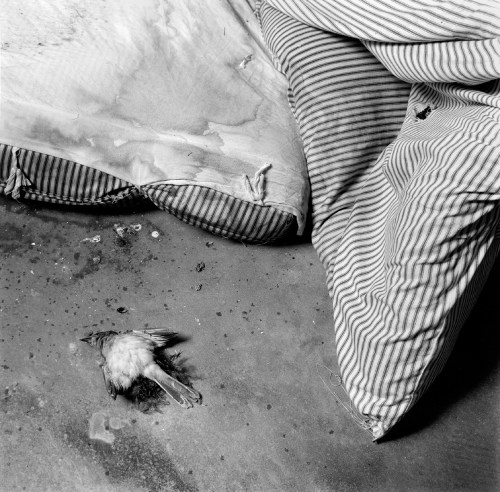
Other recalls. Simonton’s cavernous grimed up cells, the expired bird, the textural friction between hard concrete and friable life are not too dissimilar to Roger Ballen. The reflected dormitory of cacophonous bed frames is a Moholy-Nagy-informed dark-fantasia march of welded steel.
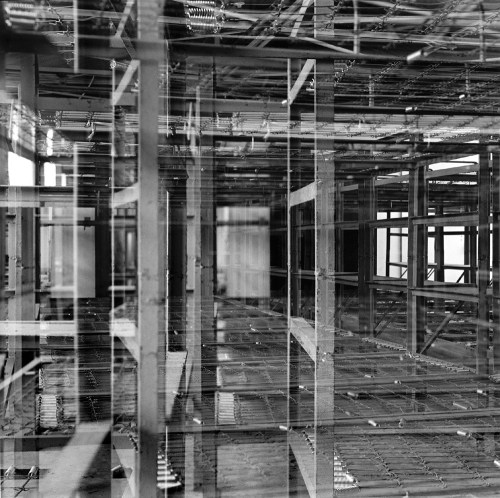
Only a few of Simonton’s images describe the site as one of incarceration. Few of the normal visual clues are available; no visible bars on windows, no holding cages. This could as easily be a disused YMCA or summer camp.
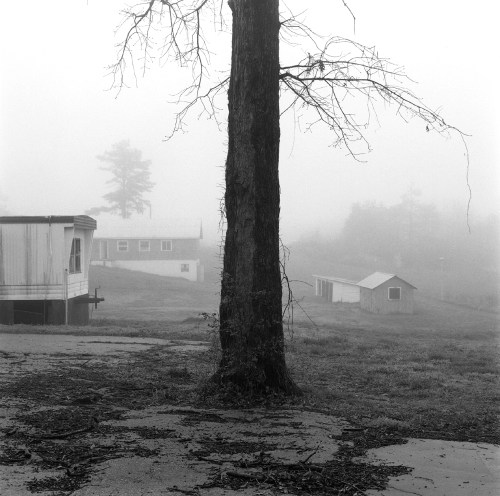
For Prison Photography, the real interest in Simonton’s work comes when it is positioned in a wider context of the site. David provided me with background info and some press clippings which whetted my appetite. Further research was rewarded with an unusual series of photographic manoeuvers sequentially on this site through its various guises. All of this I will cover in Part Two.
Closure & Erasure
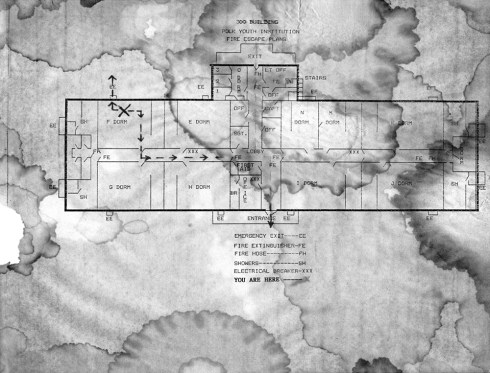
The photo of the evacuation plan below touches upon that procedural rigour that has cycled at the site of the former Youth Polk Center. The image at the very bottom (as well as being Simonton’s favourite) is a fine accompaniment to the evacuation plan.
Both images bear evidence of water blistering, bubbling and staining its way through materials. These evocations are “Art for Art’s sake” but they are also poetic closures, historical records and proof that in the absence of human interference erasure sets in rapidly.

David Simonton has been a photographer for 40 years and has been photographing North Carolina for the past 20 years. An adjunct instructor of photography at Peace College in Raleigh, David often chooses to focus on the more rural parts of the state. His series “Photographs from North Carolina” features black-and-white photographs from the 345 North Carolina towns he has visited. He has completed commissions for the North Carolina Museum of Art and the United Arts Council of Raleigh and Wake County. He has had work in solo and group exhibitions throughout the United States, and his photographs are in the permanent collection of the North Carolina Museum of Art. David was awarded a visual artist fellowship from the North Carolina Arts Council in 2001. (via)


View other images at David Simonton’s website. Indyweek have written on his work previously.
Thank you to David Simonton for reaching out. Thanks for the time spent over questions and for your collaboration. Pleasure working with you.
Photography in prisons and jails isn’t always edgy nor riven with fraught emotion. Sometimes it can be quite ordinary. In fact, given the utter boredom of most prison facilities it would be good to see a photo essay that communicated effectively vacuous time and psychological space.
…but, I digress. Hetherington, over at the venerable What’s The Jackanory?, indulged in some “shameless self promotion” of his magazine work at North Branch Correctional Institution. Within the Wired article, Prisoners Run Gangs, Plan Escapes and Even Order Hits With Smuggled Cellphones, Hetherington’s images include a cell-tableaux, sniffing dog and bagged phone. I am more interested in the non-published images Hetherington provides in his post; they’re crisp, pared down images of inmate and interior.
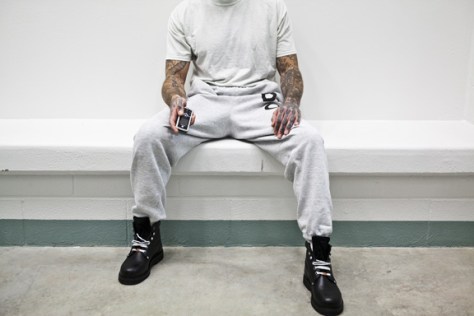
Andrew Hetherington for Wired
It got me thinking about how the environmental fabric – along with the representation – of American prisons has changed.
When (documentary) photographers first began accessing prisons – Danny Lyon, Conversations with the Dead (1971), Jacob Holdt; Taro Yamasaki, Inside Jackson Prison (1981) – the conditions were poor. And prisons were only one response to criminal behaviour and social contract.
Even latterly, Ken Light shot the black & white, in-your-face and sweaty Texas Death Row (1994) and in doing so romanticised historicised American prisons as definitively dirty sites of “the other”. By the 1990s, though, the US had implemented long term custodial sentences as the primary “solution” to crime. The phase-out of Federal parole beginning with Reagan and culminating with Clinton bloated the Federal Bureau of Prison (BOP) population, alone, from 40,000 to 200,000.
So two trends intersected: Prison populations swelled resulting in overcrowding and economically efficient facilities were rapidly being built. The mass construction of new warehouses prisons altered the spatial experience of confinement and the nature of interpersonal interaction within. Cell tiers were replaced by AdSeg wings.
The BOP has a reputation for housing the hardened criminal and specialises in high security facilities. Additionally, from the late 1980s states were building their own new high security and supermax prisons. This new penological architecture replaced 40 foot brick walls and watch towers with razor wire and motion sensors.
Prison environments are sparse. Problems with dark corners & damp have been replaced with the psychotrauma of constant fluorescent light. Problems with stashed contraband have been replaced with an absence of surfaces to set down objects. Denim uniforms have been replaced by sweat outfits. The penological management of gangs & group violence has been replaced with the pharmacological management of locked-up basket cases.
One former inmate of the Federal Supermax facility in Florence, Arizona (ADX) has described it as the “Perfection of Isolation.”

Correctional Officer Jose Sandoval inspects one of the more than 2,000 cell phones confiscated from inmates at Calfornia State Prison in Vacaville, California. Rich Pedroncelli / AP
Telephoning a way out Isolation
“Cell phones,” says James Gondles, executive director of the American Correctional Association, “are now one of our top security threats.” (Wired, July, 2009)
I posited in the past that cell phones were just one part of the prison economy and their commodity status was in direct reaction to the cost of corporate-managed prison payphone systems – in essence a racket in response to a racket. However. having read the Wired article it is clear how much of a serious security threat cell phones pose to prison authorities.
The majority of tactics for isolation, perfected over the past 30 years by prison administrations, are rendered immediately obsolete,
With a wireless handset, an inmate can slip through walls and locked doors at will and maintain a digital presence in the outside world. Prisoners are using voice calls, text messages, email, and handheld Web browsers to taunt their victims, intimidate witnesses, run gangs, and organize escapes—including at least one incident in Tennessee in which a guard was killed. An Indiana inmate doing 40 years for arson made harassing calls to a 23-year-old woman he’d never met and phoned in bomb threats to the state fair for extra laughs.
So what’s the answer? Debate exists over the value and legality of jamming all signals around prisons but a High School in Spokane, WA proved localised signal-jamming a bad idea when it interfered with the local Sheriff’s radio signals.
We should also bear in mind that ‘The 1934 Communications Act prohibits anyone except the federal government from interfering with radio transmissions, which now include cell calls.’ (Wired)
Criminalize Smuggling but Not Talking
TIME does a good job of breaking down the stats and describing the evolution of the problem. It is obvious that authorities are going to make strategic response to a growing trend but prison authorities must not compromise the already limited opportunities for inmates to talk with friends and family. Close family ties and contact are key to reducing recidivism and giving former prisoners the best means to integrate back into society.
And of course, inmates aren’t the only ones caught up in the illicit trade of cell phones in prisons. One California prison guard admittedly to making over $100,000 in a year through smuggling and selling cell phones!
On that note, I offer you a CDCR sanctioned news VT.
As so very often, the spark of thought was ignited by the Change.org Criminal Justice blog.
A few things emerging today to which I’d like to doff my cap.
Lenscratch
Aline Smithson at Lenscratch, rumoured to be in Santa Fe (Good Luck, Aline), celebrated all Lori Waselchuk’s documentary work; Waterlines, one project of many projects wrapped up in Louisiana, and Grace Before Dying community portrait of the Prison Hospice at the Louisiana State Penitentiary (Angola).

Lock Down Visit. Lori Waselchuk
Lori, a member of the New Orleans Photo Alliance, launched her project Grace Before Dying April 3rd at the Louisiana State Prison Museum in conjunction with the Louisiana-Mississippi Hospice and Palliative Care Organization (LMHPCO), the Louisiana State Prison Museum, and helped along with a Distribution Grant from the Documentary Photography Project of the Open Society Institute and Moonshine Studio.
The issues of age and health in prisons – together and in isolation – have been reasonably well covered. But, Waselchuk succeeds where so many others fail (with the exception of Edmund Clark) in really communicating the infirmity and vulnerability of the inmates
Fraction offered a good summary, as does Waselchuk’s Alma Mater. Critical Mass has the best gallery of Grace Before Dying
Bint PhotoBooks on Internet
Bint PhotoBooks on Internet got to grips with Martin Roemers‘ Relics of the Cold War which includes a Valencia orange room within a Stasi Prison. Roemers goes tête-à-tête with the Fuchs brothers in the communist-archaeology-photo genre.

Germany, East Berlin. Visitor-room in former Stasi prison Hohenschoenhausen. Political prisoners were held in this prison. Martin Roemers
Unrelated to prisons, I am also a fan of Roemers’ Lourdes Pilgrims series.
Subjectify
Subjectify grapples with the latent appropriation of images since the 2004 release of Abu Ghraib photographs.
much has been written about the ways in which war photography often echoes iconic religious imagery. but i have been wondering how, in turn, the iconography of the new war and torture photography is also influencing fine art photographers today?
Subjectify offers Jessica Somer‘s work ‘Origin’ from the Bend So Not to Break series as a case in point. I drew some interest along with disbelief and derision when I skirted the issue regarding Ballen and the torture aesthetic.

Origin. Jessica Somers
I believe artists biggest problem is to work away from viewers natural tendency to superimpose meaning so easily. I think Somers is safe. She’s got a style that stands on its own – it doesn’t get drowned out by media noise or green gloves.
AN Other
Yusuf Sayman‘s work on individuals going through Re-entry programs after long term prison sentences presented itself in the Independent‘s bizarre and confused “Britain’s Best Crime Photography” competition.
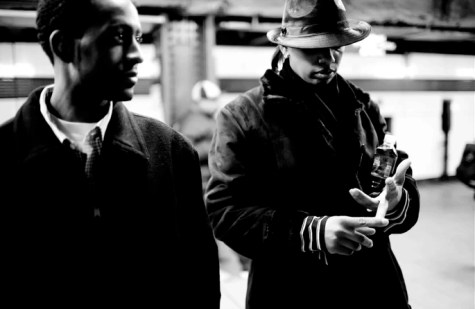
Starlene from the Free Again: Starlene series. Yusuf Sayman
Starlene Patterson is one of three former prisoners, Sayman has collaborated with after prison release for the Free Again series. Starlene is at college to qualify as a Social worker. “People need help.”
Starlene has written a book, Up Against the Wall. She says, “My book has a message. There’s a lot of young people who need guidance and they my not have that. If my book can help one [of those children] than I’ve achieved.”
Non-prison related I like Sayman’s Henry’s World series.
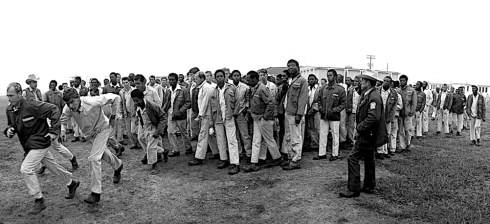
Credit: Bruce Jackson
NY Times LENS Blog
Here, there and everywhere people are celebrating the New York Times’ LENS Blog as a messianic gift for the photophile. I was therefore happy to see that less than two weeks in LENS is featuring Bruce Jackson’s wide angle documentary work from Arkansas Prison in the early 1970s
Bruce Jackson should be a familiar name as it was he that rescued, scanned and shared the enigmatic Arkansas Prison Mugshot series, Mirrors.
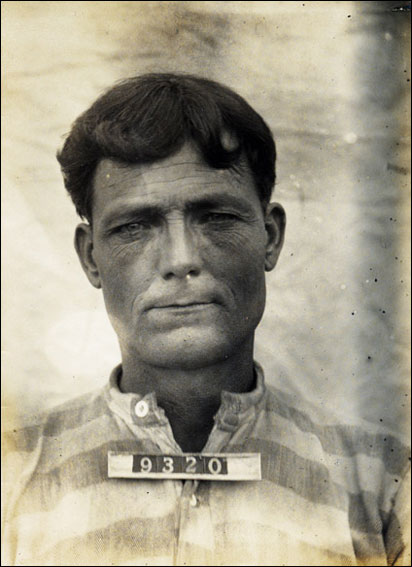
Found and presented by Bruce Jackson. Arkansas State Prisoner Portrait
June 100 Eyes Issue
Over at 100 Eyes, Andy Levin from insists that “Whatever ones perspective, be it victim, civil rights activist or cop, there is one shared idea – something needs to change.”
The June edition of 100 Eyes, titled, America Behind Bars features the work of Dominic Bracco, Jerome Brunet, Darcy Padilla, Jenn Ackerman and Tim Gruber – all very talented and committed photographers.
As editor, Andy Levin, concludes, the genre of prison photography (or to be less aggrandizing) simply the practice of photography within sites of incarceration is often a difficult and thankless task;
The photographers who have contributed to “America Behind Bars” have worked against overwhelming odds to bring back powerful images of American prisons. One can’t simply walk into a prison with a camera. This kind of photography requires long negotiations and often a warden who has the vision and concern to allow a photographer into his jail.
Wonderful exposure for the most pressing of social issues in America today.
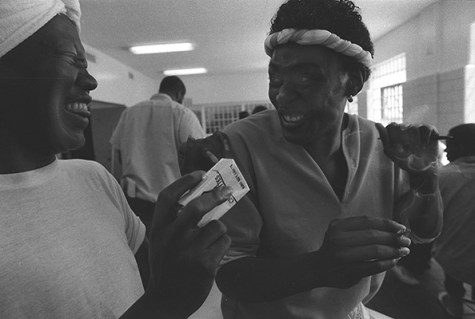
Darcy Padilla. From AIDS in Prison Series.
Prison Photography began its project in September 2008 with a celebration of Darcy Padilla’s portrait of former San Quentin Public Communications Officer, Vernell Crittendon.
In February, I was gob-smacked by Jerome Brunet’s Riding Shotgun with Texas Sheriffs.

Guantanamo © Chris Maluszynski/Agence VU

Guantanamo Map http://www.cubafutour.de/Karte%20Guantanamo%20Provinz.jpg

Guantanamo Bay Tents. Courtesy of The Department of Defense Visual Information Center
I am very happy with the way Prison Photography is progressing. I have done interviews with some outstanding photographers and artists. I have offered opinion where I think there’s something to be said. The most satisfying work on the blog is that contributed by guest bloggers, comment-makers and interviewees. Photographers have contacted me and I have been eager to comment upon their work.
But, there is one audience I never anticipated – The Google Image Search Audience. I get many hits for searches on Guantanamo, Guantanamo video, Iraq prison, Abu Ghraib, Abu Ghraib Images of Prisoners, etc, etc – which is strange because these are topics that many people have grappled over with more proficiency and depth than I am likely to.
It is obvious that there is a need for fast access to images of America’s sites of torture and incarceration, namely Abu Ghraib and Guantanamo. I certainly don’t wish to fuse the two institutional histories so I shall deal only with Guantanamo Bay.
Louie Palu
Walrus Magazine. 8 of Palu’s photographs and accompanying article.
The Atlantic. 6 of Palu’s photographs.
Private galleries. Palu’s Photoshelter profile offers three separate galleries, but they’re password protected. Contact the photographer directly.
NPR Interview. Palu offered insight into his experience and impressions of Guantanamo.
Christopher Sims
Mother Jones. 15 images of daily life outside of the prison complex.
Civilian Arts Project. 25 images of a bizarrely serene Guantanamo Naval Base.
BBC, The Other Side of Guantanamo. Article about Sims’ series.
Daylight Magazine. 4 minute audio of Sims’ experiences on project.
Chris Maluszynski
Agence VU/Moment. Twenty-six images exhibited. Likely more on file at the agency.
Cesar Vera
Guantanamo Prison. 18 Black & White images. 3 Colour.
Joint Task Force (JTF)
Many of the photographs shown in the press over the last few years were taken by members of the Navy’s own Joint Task Force. When press photographers visited the JTF vetted all images before release.
Boston Globe. 30 Hi-Res images.
Repeat of above selection. 20 Hi-Res images selected.
JTF Photo Galleries. 22 months (July 2007 – May 2009). Hundreds of images. Official photography.
Miami Herald
Description of the 8 different camps at Guantanamo
Explanation of the Legal contexts: Key defendants, the judges, the defense and prosecution counsel.
Cursory look at Art influenced by Guantanamo
Magnum
Bruce Gilden. Guantanamo Bay. Enemy Combatant Camps, 2003
Paolo Pellegrin. Guantanamo Detainees, 2006
Stuart Franklin’s work Cuba, 2003, included images from Guantanamo and you’ll need to search the Magnum website for images.
McClatchy
An eight-month McClatchy investigation of the detention system created after the Sept. 11 terrorist attacks has found that the U.S. imprisoned innocent men, subjected them to abuse, stripped them of their legal rights and allowed Islamic militants to turn the prison camp at Guantanamo Bay, Cuba into a school for jihad.
Intro. Text and 11 minute video.
Photos. Detainees held at Guantanamo Bay
Photos. Faces of Guantanamo Detainees. Part one.
Photos. Faces of Guantanamo Detainees. Part two.
Photos. Detainees held in Afghanistan.
Eyeballing
Comprehensive overview of base using Google Maps, official photographs. Details structures, uses and topography of naval base.
Camp America, Camp Delta, Camp V and Administrative & Court building.
Camp X-ray and construction of later detention camps.
Associated Press
Images of facilities and interiors of various detention blocks and camps.
Stars & Stripes “The Independent News Source for the U.S. Military Community”
Work at Guantanamo
Education at Guantanamo
Recreation at Guantanamo
Artistic Turns
David Hicks. Virtual Guantanamo Cell
Penny Byrne. Porcelain Guantanamo Detainee Figurines
Gregor Schneider. 21 Cells, Bondi Beach, Australia
Legofesto. Guantanamo reconfigured with Lego men and Lego pieces and Wired Interview
Flickr – Protest Images
Amnesty International. Guantanamo Protests
Various Photographers. 100 Days to Close Guantanamo and End Torture.
James M. Thorne. Protest images.
Miscellaneous Media
Prisoners of War. 2004 article by the San Francisco Gray Panthers with images of US airforce transporting detainees and early 2003 images of Camp X-Ray.
BBC. Life in a Guantanamo Cell

Rendition. Photographer Unknown
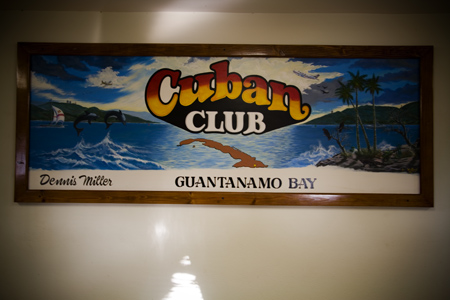
© Cesar Vera

Guantanamo Bay Navel Base with a New Commander-in-Chief. Photographer Unknown. http://www.obamalouverture.com/f39/guantanamo-bay-switch-bush-photo-obama.html
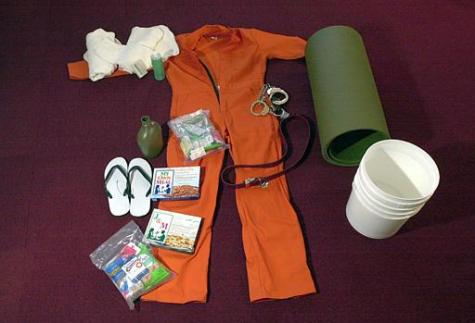
The standard issue of clothing, sleeping mat, food, sandles, canteen, soap, and buckets for detainees of Camp X-Ray is pictured in Camp X-Ray at the U.S. Navy Base at Guantanamo Bay, Cuba, on Wednesday, Feb. 20, 2002. © Tomas van Houtryve/AP Photo
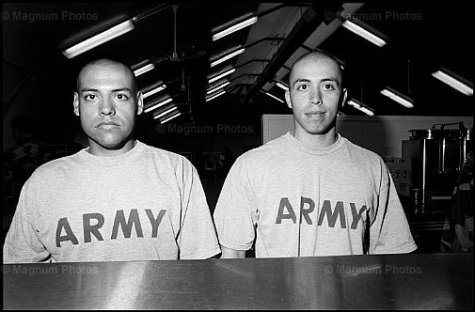
CUBA. Guantanamo Bay. 2003. Soldiers wait for their meals before a prayer breakfast at Camp America. Photo: Bruce Gilden/Magnum
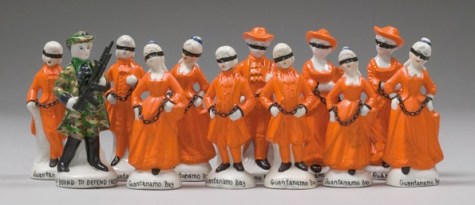
Penny Byrne Guantanamo Bay Souvenirs 2007, vintage figurines, metal chains, epoxy resin, plastic, re-touching medium, powder pigments, 14 x 32 x 10 cm.
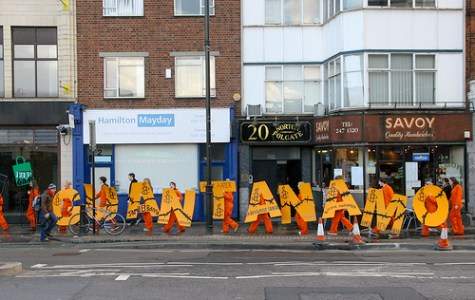
Photo: Jon McClean. http://www.flickr.com/photos/jonmclean/410055117/
IF YOU HAVE ANY RESOURCES TO SUGGEST,
PLEASE CONTACT ME AND I’LL ADD THEM TO THIS LIST.

 Prison Photography
