
You are currently browsing the category archive for the ‘Historical’ category.

A bathroom inside the Maze Prison, near Lisburn, Northern Ireland, on Tuesday, April. 11, 2006.
Andrew McConnell‘s work The Last Colony from the Western Sahara has gained some traction recently, promoted at DVAFOTO and backed up by TPP.
McConnell is from Northern Ireland so I was not too surprised upon looking through his portfolio to find a series on the Maze prison.
I’ve seen a few projects from Maze Prison – the most well-known being that of Donovan Wylie – and yet a few of McConnell’s images really stood out.
STATEMENT
McConnell: “HM Maze Prison, also known as Long Kesh and the H-Blocks, held some of the most dangerous men in Europe during its 30 year operation. The prison closed in September 2000 after 428 prisoners had been released under the Good Friday Agreement. There are now plans to turn the abandoned site into a national football stadium.”
The bathroom image (above) is admittedly more powerful to me, having seen the bloodied-knuckle washing scenes in Steve McQueen’s powerful debut film Hunger.
Also, admittedly the image of the football (below) is more loaded given the now-defunct plans to convert the site into a national stadium.
In January 2009 plans to build the £300 million multi-purpose stadium were officially axed with politicians saying plans to start the construction of the stadium wouldn’t be reconsidered for another 3 to 4 years. (Source)

An old football lies in the exercise yard of the Maze Prison, July 18, 2006.
I had been under the impression every structure at the Maze had been demolished but apparently not:
Discussion is still ongoing as to the listed status of sections of the old prison. The hospital and part of the H-Blocks are currently listed buildings, and would remain as part of the proposed site redevelopment as a “conflict transformation centre” with support from republicans such as Martin McGuinness and opposition from unionists like Nigel Dodds who are against erecting a memorial to those who died during the hunger strike. (Source)
Which ties nicely back into the crucial question about McConnell’s photographs of the site. Are these photographs of memory, for memory, for memorial? What audience do they serve?
It seems to me that politics and emotions vary so wildly, that when a photographer (so soon after decommission) takes on a contested site such as this, his/her photographs are open to many different interpretations. The Maze and its history are fascinating, discussion-worthy topics, but is it the case here that the images are nothing more than notable ‘urban exploration‘?
Donovan Wylie dodged this suspicion by documenting over a five-year period the slow demolition of The Maze. Wylie has talked about wanting to create an archive of this transitional moment. However, if a photographer’s series is too brief (either within its own boundaries or by comparison to another practitioner’s series) then how is it justified or explained?
I don’t want to be dismissive here, as I think this is a problem many political-documentary photographers face – namely, their work may not adequately reflect or contain the disputed political landscape it references.
Perhaps we should read McConnell’s The Maze as undefinable and undecided, just as the former prison site remains?

The Cages of the Maze Prison, Northern Ireland, July 18, 2006.
Biography
Andrew McConnell was born in Northern Ireland in 1977 and began his career as a press photographer covering the closing stages of the conflict in his homeland and the transition to peace. He later worked in Asia and moved to Africa in 2007 to document the issues and stories of that continent which are widely overlooked by the international media.
His images have appeared appeared internationally in publications such as National Geographic Magazine, Newsweek, Time magazine, The New York Times, The Guardian, FT Magazine, L’Express, Vanity Fair (Italy), the Sunday Times Magazine, and Internazionale.
I am toying with the idea of listing my 100 favourite (online) digital photography archives, but museums, universities, historical societies and Flickr keep moving the goal posts. I see a new archive virtually every week.
If I stop to think what all this digitsation means, I suspect I’ll miss the boat on just enjoying the documents of times past.
The National Library of Scotland has just joined Flickr Commons, and this set of Edinburgh’s South Side probably pushes out one of the entries on a Flickr Commons top-ten article I penned last year.
It’s good that the drive toward digitisation and the “competition” (as I’ve defined it) is ongoing among these archives.

THE SKINNY
“The National Library of Scotland joined the Flickr Commons on July 13, 2010, with over 2,000 photographs, focusing on a collection of official British photography from the First World War. A smaller but equally rich set is chosen from a survey of the South Side of Edinburgh in 1929, photographed by Alfred Henry Rushbrook. And along with the letter ordering the massacre at Glencoe, is the last letter of Mary, Queen of Scots.”
(via)
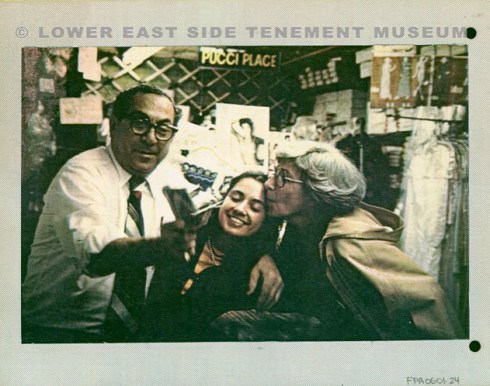
The Tenement Museum now has its photography archive online. What a treat! Go on, lose yourself …
(via)

Spread from Toppled
Toppled by Florian Göttke
Two weeks ago, Foto8’s Guy Lane reviewed Toppled by Florian Göttke. The review is what it is – a description of Göttke’s “(mainly) pictorial study of the destruction, desecration and mutation of many of Iraq’s plentiful statues of its former dictator.”
Lane’s conclusion points to the significance of Göttke’s study:
“Perhaps this might all appear somewhat peripheral, an iconographical diversion from the real business – invasion, subjugation, and expropriation – of Occupation. But from amongst Göttke’s collated written testimonies and reports, it is possible to sense something of the importance that was attached to the Coalition’s iconoclasm. For example, a BBC account of British activities in Basra concluded that ‘the statue of Saddam is in ruins. It is the key target of the whole raid.’ Meanwhile, in Baghdad a US army captain was ordered to delay destroying a statue until a Fox TV crew arrived. Most famously, the Firdous Square episode appears to have been – to a degree – choreographed for the benefit of the foreign media based in the overlooking Palestine Hotel. ‘American and British press officers were indeed actively looking for the opportunity to capture the symbolic action of toppling statues and have the media transmit these to the world,’ writes Göttke. As such, Toppled’s events and pictures correspond tellingly and damningly to the Retort group’s analysis of our ‘new age of war’.”
Would I buy the book? Probably not. The book is a concept. I understand the concept. And, the images are essentially props to the concept (illustrations of the new biographies of statues, of things).
Besides, I can get my fill elsewhere. The best (most ridiculous) image – James Gandolfini meets the Butcher of Baghdad – is on the accompanying Toppled website.
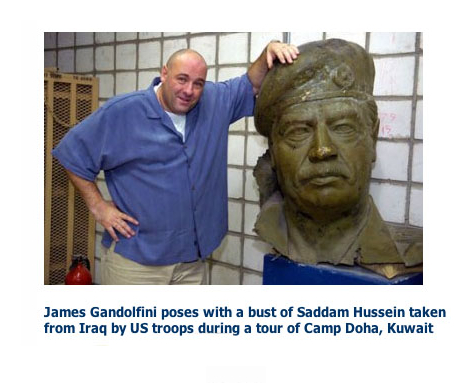
SADDAM’S PERSONAL PHOTO ALBUM
Göttke’s work leaves me wondering how Saddam’s personal photo-album fits in?
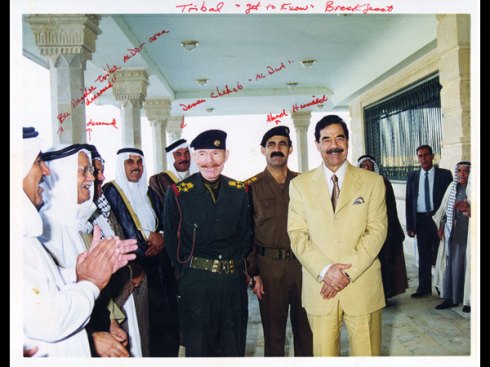
Similarly, these images were found and taken during the invasion of Iraq: “On the night of June 18, 2003, the soldiers in the 1-22 Infantry stormed a farm in Tikrit, Iraq, hoping to find a fugitive Saddam Hussein. They didn’t find their target, but they did find a consolation prize: Saddam’s family photo album […] When he returned from Iraq, Lt. Col. Steve Russell, the commander of the 1-22 Infantry, donated the album to the National Infantry Museum at Fort Benning, Ga.” (Source)
This is a reversal, no? Not the effigies of megalomania, but personal snapshots. Not public monstrosities but flimsy two-dimensional depictions. Would these have got pissed on and slapped with sandals? Would they have been torn up/burned up had Lt. Col. Steve Russell not slipped them into his luggage?
Also, to describe the collection (for media publication) as the dictator’s “personal album” is one thing, but to what extent were these Saddam’s photo-memories? Are these really the contents of an album he valued? Are we even glad that Saddam’s images still exist?
One final thought, how do we distinguish between the staging of Saddam’s images to the staging of the images in Göttke’s survey?
JAMAL PENJWENY
On a less-grander scale, Jamal Penjweny is attempting (with his Iraqi subjects) to make sense of the spectre of Saddam. The series is called Saddam is Here. It’s not great photography but I don’t think this type of playful exploration needs to be.
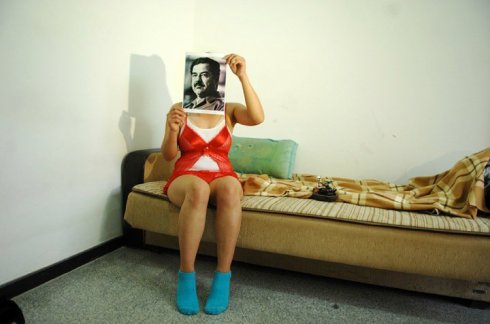
© Jamal Penjweny

"New Orleans, Louisiana," 1965, by Leonard Freed. © Leonard Freed / Magnum Photos, Inc. Courtesy the J. Paul Getty Museum, Los Angeles.
Kristina Feliciano interviewed Brett Abbott, curator of photography at the Getty, about their summer show Engaged Observers
Abbott succeeds in saying not a lot (it is a brief interview). Abbott lists the exhibit’s famous photographers and recounts the Getty mantra on commitment financial muscle to support acquire documentary photography.
That said, his analysis of Leonard Freed’s image (below) is pause for thought.
KF. What are some of your personal favorites of the photos on view in the show?
BA: Leonard Freed’s picture of two men passing one another on the street in Washington D.C.: Freed’s protagonists face off, their noses nearly touching on the two dimensional surface of the print. The older white gentleman occupies a commanding presence in the center of the photograph, but it is the African American on the right who is in focus. Within the context of Freed’s larger project on racial tension in America in the 1960s, they can be seen as representing basic and opposing forces of the civil rights movement: white and black, the old generation and the new, center stage and marginalized, present and future. Indeed, the two play out this dialectic beneath a balcony clearly marked as belonging to the house where Lincoln died.
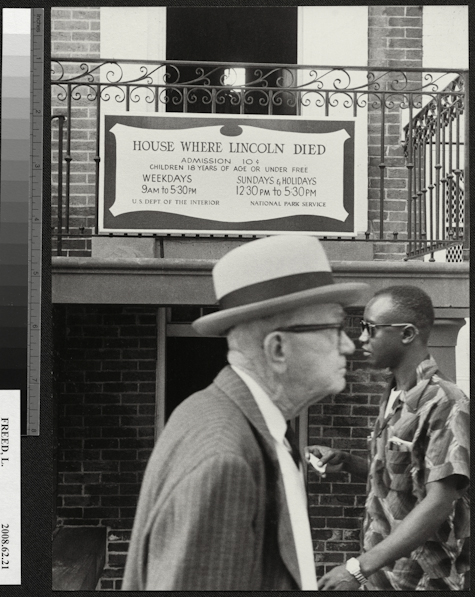
"Washington, D.C., 1963" Leonard Freed (American, 1929 – 2006) © Leonard Freed / Magnum Photos, Inc. Courtesy of The J. Paul Getty Museum, Los Angeles
BLACK AND WHITE IN AMERICA
Leonard Freed observed race in America throughout the sixties; this work eventually taking him to the prisons of Louisiana. Before we get to that, here’s how Magnum describes Freed’s best known work:
In 1962 Leonard Freed went to Berlin to shoot the wall being erected. There he saw an African American soldier standing in front of the wall and it struck him; that at home in the US, African Americans were struggling for civil rights, and here in Germany an African American soldier was ready to defend the USA. This prompted a lengthy examination by Freed of the plight of the African Americans at home in the United States. Freed traveled to New York, Washington, D.C. and all throughout the South, capturing images of a segregated and racially-entrenched society. The photos taken at that time were then published in 1968 in “Black in White America“.
The images below are from prisons within the same state, Louisiana.
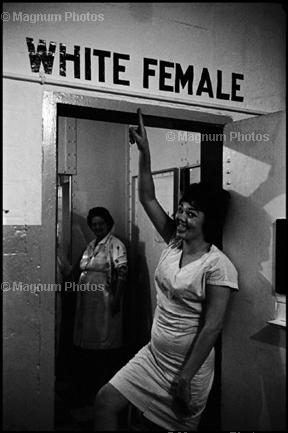
New Orleans, Louisiana. 1963. City prison. Image Reference: NYC21690 © Leonard Freed/Magnum Photos
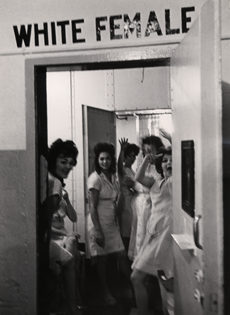
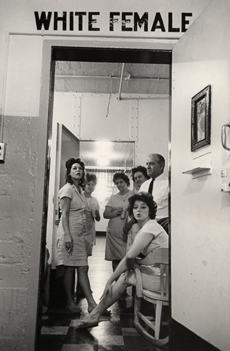
Freed’s documents of the New Orlean’s City Prison are galling. The mood and theatre played out by these women (inmates? nurses? orderlies?) in the “white female quarters” as compared to the claustrophobia and groping along the “colored tier” is confusing, appalling.
I am at pains to know what scene Freed is capturing here in the “white female” section.
The screengrab (below) is taken from the first of two online videos – here and here – in which Freed talks about contact sheets; money and its’ substitute; motivations; and of course, race.
Freed discusses his experience on the “colored tier” from 4:36 to 6:00.

Screengrab. Source: http://www.youtube.com/watch?v=SDVJlmE18zY
The attitude of the guards is beyond disgusting, “If we desegregate this place there will be blood. Mixing white men with animals. Can’t make us do that.”
If we take Freed at his word, and there is no reason not to, the portrait he paints of Angola was a place where Black men were willingly left to stew; a place where overcrowding was used as a disciplinary tactic, and a place in which racism was the unifying policy. Foul, totally foul.
YESTERYEAR / TODAY
That Freed should have visited a prison in the South as part of his survey on race in America was logical, for perhaps in prisons – more than anywhere else – the least tolerant and most simple interpretations on race existed.
Even today, prisons perpetuate cycles of poverty in minority groups. Furthermore, prison facilities only harden the tensions and misgivings between different racial groups of the prison population.
Freed went to Louisiana, but prisons across the South during the sixties were much of a muchness; they were borne from the same structures that had informed slavery. Robert Perkinson is perhaps the best historian to map this institutional-metamorphoses. In it’s basic premise, his recent book Texas Tough, can apply to prison management not only in Texas, but right across the South.
I highly recommend Marie Gottschalk’s review of Perkinson’s book which summarises his key positions, and is shocking enough in and of itself.
– – – – – – – – – – – –
ENGAGED OBSERVERS
PhotoInduced just reviewed Engaged Observers.
NPR ran a gallery pertaining specifically to the Engaged Observers exhibition.
FREED
Bruce Silverstein and Lee Gallery present Freed’s works online.
Happy Birthday America.
Precisely because “The Land of the Free” is a term now inseparable from rhetoric and politicking from any and all quarters, I’ll keep this brief.
America, like every nation on this earth, is and continues to be a work in progress. “Freedom” is a relative term, and if photographers in America do some things well, one of them is to remind us that by law (until very recently) some were freer than others.
I am always happy to promote socially-conscious photography that deals with racial injustices of the past and our need to address those injustices still. Furthermore, there are many good photographers who are working on inequalities today, based not in law, but in attitudes. Again, we are all works in progress, right?
WENDEL WHITE
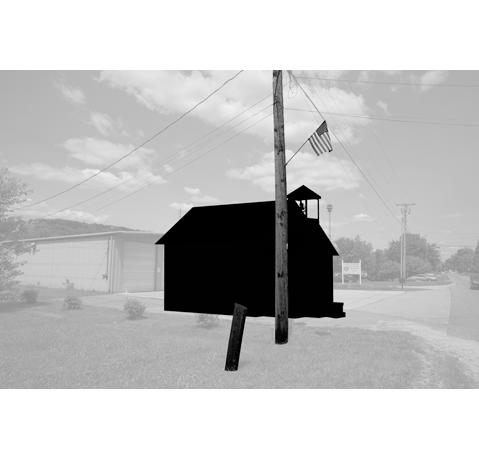
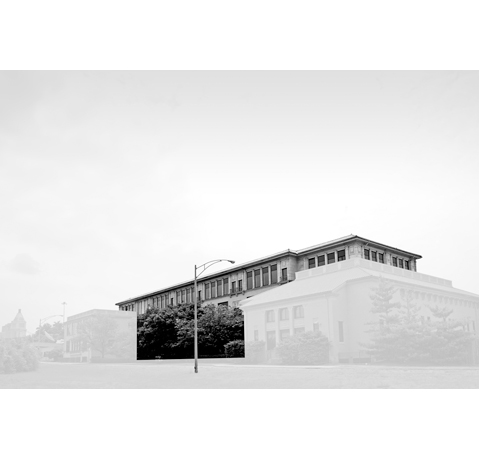
Wendel White‘s Schools For The Colored depicts the landscape and architecture of historically segregated schools in northern states.

I enjoy reading interviews, but I enjoy more listening to a photographer speak while their photographs scroll.
I also love being able to mount a knowledge of British photography of the second half of the 20th century; an activity that is not quite the fabrication of nostalgia, but I’ll admit it is close (I was born in the eighties … just).
Reading this was like finding the solution to a problem I never knew existed.
There exist hundreds of catalogues detailing photographs exhibited in the Victorian era and shortly after – such examples being Photographs Exhibited in Britain 1839-1865 and Exhibitions of the Royal Photographic Society 1870-1915. These catalogues (and now databases that mirror the information of the catalogues) provide information to photographs, but crucially no photographic image. It is presumed these photographs exist somewhere.
Likely some of these AWOL photographs are in private ownership, universities and museums. The recent digitisation of many of these types of collections has transformed the photographs into newly-available data for comparison against the catalogues of descriptions.
CRUNCHING DATA
Professor Stephen Brown and Professor Robert John, of De Montfort University, UK, are investigating a form of computational intelligence known as fuzzy logic to see if it can be used to match catalogue entries to images online.
According to Professor John, the software can “make decisions much more quickly than humans and it is not restricted to a simple ‘match’/’no match’ answer.”
Professor Brown describes example issues the software hopes to negotiate:
“Some of the records in the catalogues are rather vague. For instance, you might have the name, but the only address given is ‘London’. If a photograph is then found with the same name but the photographer’s address is given as ‘Blackheath’ then is that the same person? It could well be but further examination is needed. Some photos were exhibited more than once over different years, and that’s fine as long as the same details are recorded for both, but very often this isn’t the case. It wasn’t uncommon for a photographer to sell or loan prints to other people who then exhibit that work under their own name, not claiming to be the photographer, just the exhibitor. There might be a photo floating around online that is listed under the photographer’s name, while we only have the exhibitor’s details.”
The programme is still to be tested, but if successful (the article doesn’t explain how “success” is determined) the intention is to apply the programme to other online collections and potentially reunite more records with their long-lost photographs.
– – – –
If you are not reading the British Photographic History blog, you should – it covers aspects of photographic history and archiving that don’t get covered elsewhere with regular updates on museums, new archives and storage developments for UK prints and paper collections. I have particularly appreciated Michael Pritchard‘s articles.
– – – –
This story has absolutely nothing to do with the Super Furry Animals, I just wanted to take the opportunity to recommend the Furries’ album FUZZY LOGIC.
S.F.A. are Welsh wizards of rock.


 Prison Photography