
You are currently browsing the category archive for the ‘Institutional’ category.

David Adler has been collecting prisoner made portraiture since 2006.
Adler’s work is very similar to Alyse Emdur‘s Prison Landscapes (readers will know Emdur is a favourite of mine.) But in fact, Adler and Emdur approach the visual culture and the act of collecting the photos very differently. I’ll be publishing an interview with Adler shortly, but to summarise, Emdur is thinking about social justice whereas Adler is thinking about the economics of the system. Both consider the painted backdrops as significant contributions to American artistic production.
Adler thinks of his work as a theoretically infinite, open-source project, that anyone could take on. Conversely, Emdur considers her presentations as collaboration with each of her subjects.
More to come.
Meanwhile, if you’re in NYC, Adler’s exhibition Prisoner Fantasies: Photos from the Inside is showing at the Clocktower Gallery in Lower Manhattan, until the end of August. Also, you can read a brief interview with Adler, by Harry Cheadle for VICE.

[Yes, the visual similarity between this post and the last was intentional.]
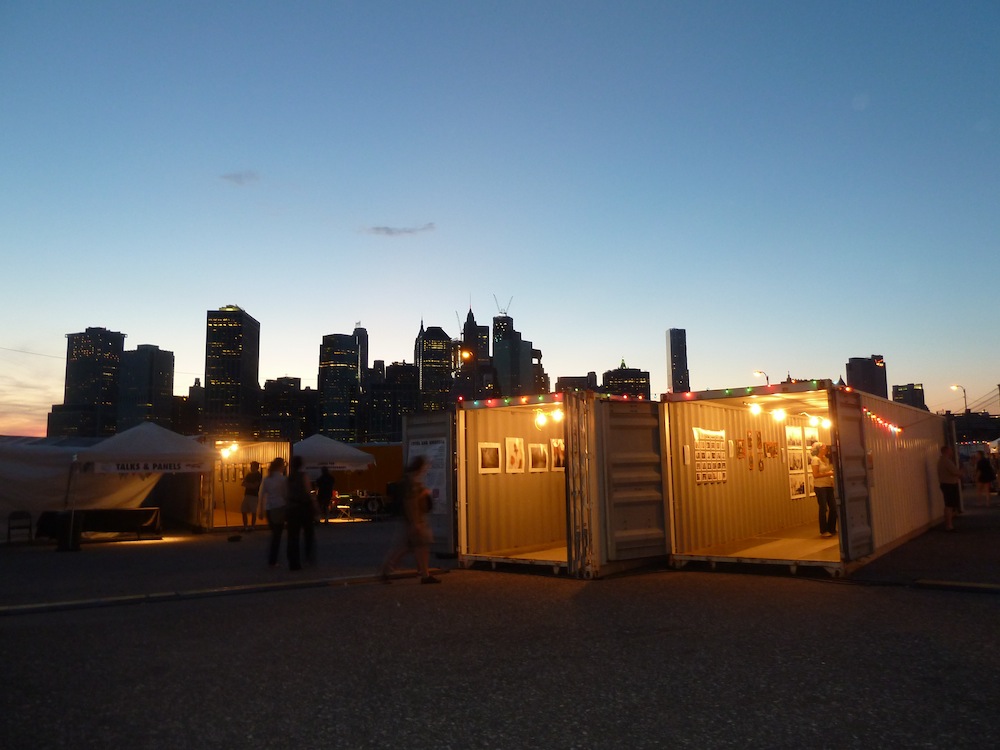
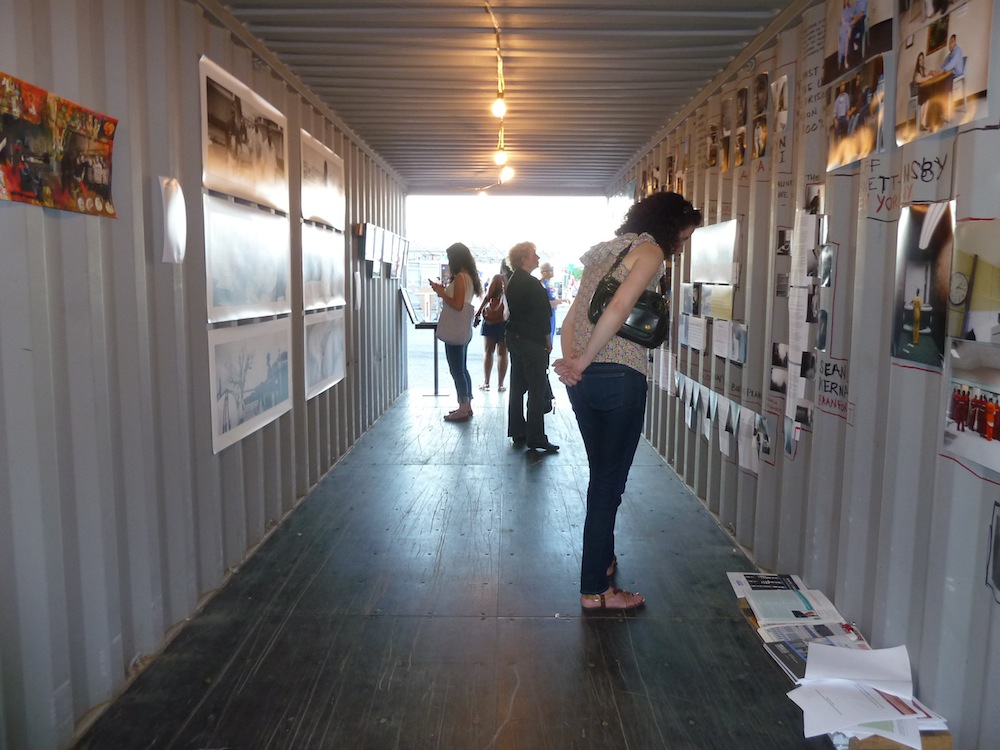
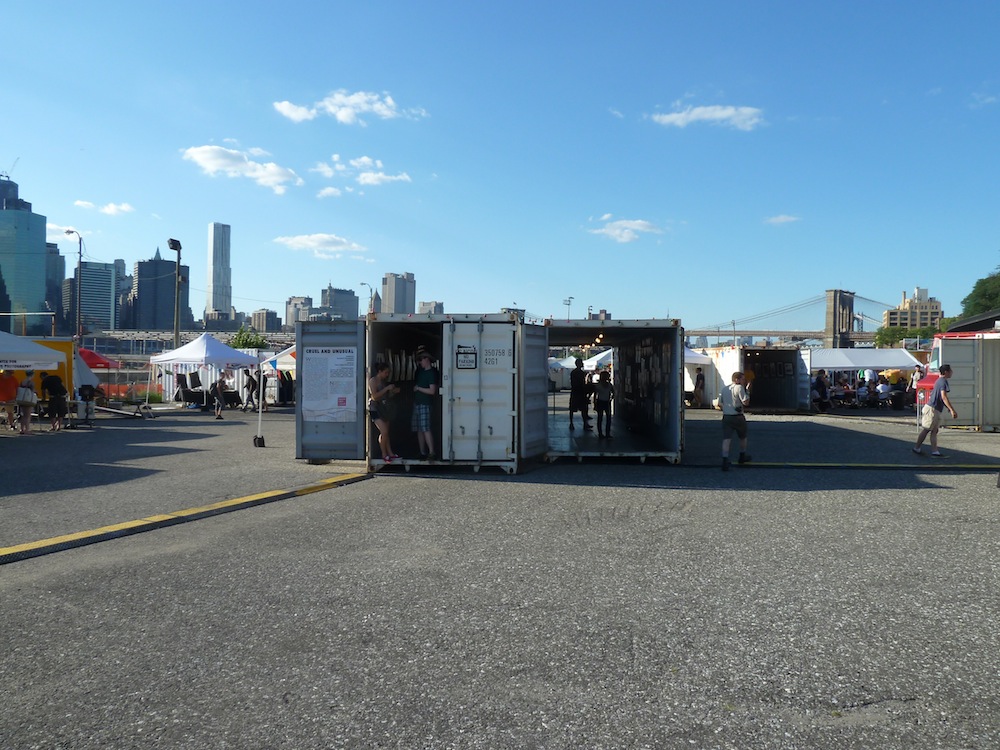
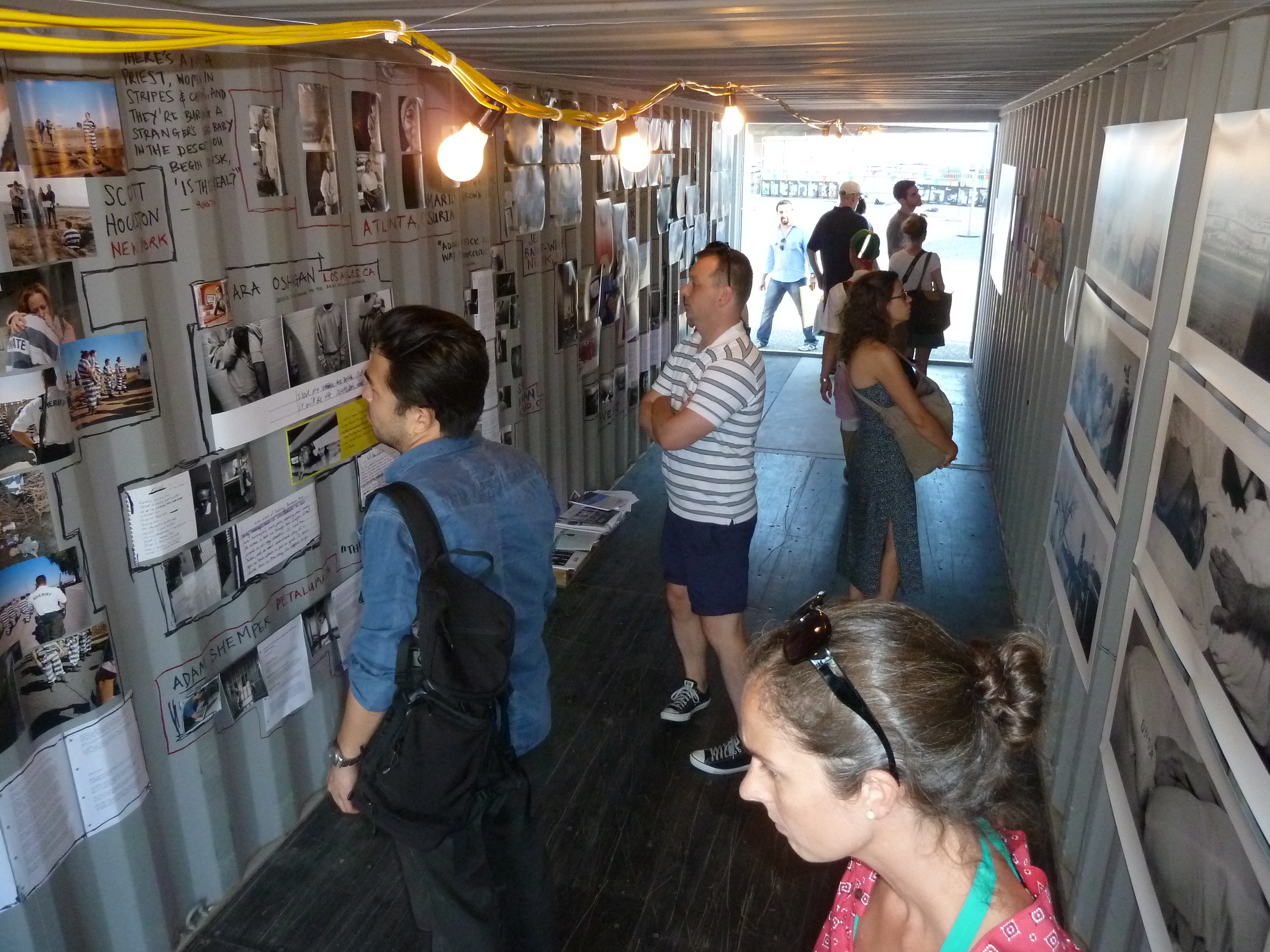
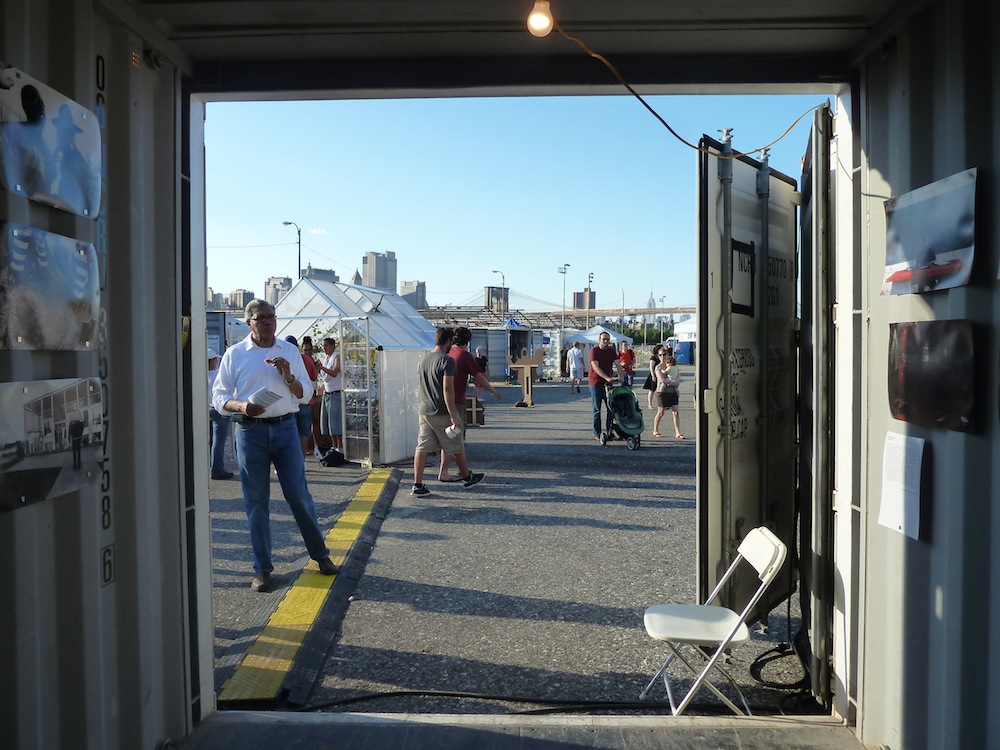
This is a super quick post and a bit of an image dump (I’ve been asked for installation shots.)
We are half way through Photoville and my thoughts are not coalesced yet. Of the event so far, highlights have been Josh Lehrer’s Becoming Visible: portraits of homeless, transgendered teens; Sim Chi Yin’s Rat Tribe for which he transformed the container to mimic a basement Beijing dwelling; and Russell Frederick’s Dying Breed: Photos of Bedford Stuyvesant.
More to find and more to percolate.
As I reported last week, we got off to a slow start. Customs and FedEx conspired to give us all anxiety-disorders by only releasing the artwork at 8am Friday morning. Huge playdits to organisers Sam and Laura for hounding FedEx while I sailed through Wednesday and Thursday with a C’est la vie attitude. Customs never said what the problem was but we presume it was Jane Lindsay’s bottle caps filled with resin.
We had 6 hours for install and it ended up taking 8; I was still sweating about and showing off my chest-wig as the public moseyed through that first (Friday) evening.
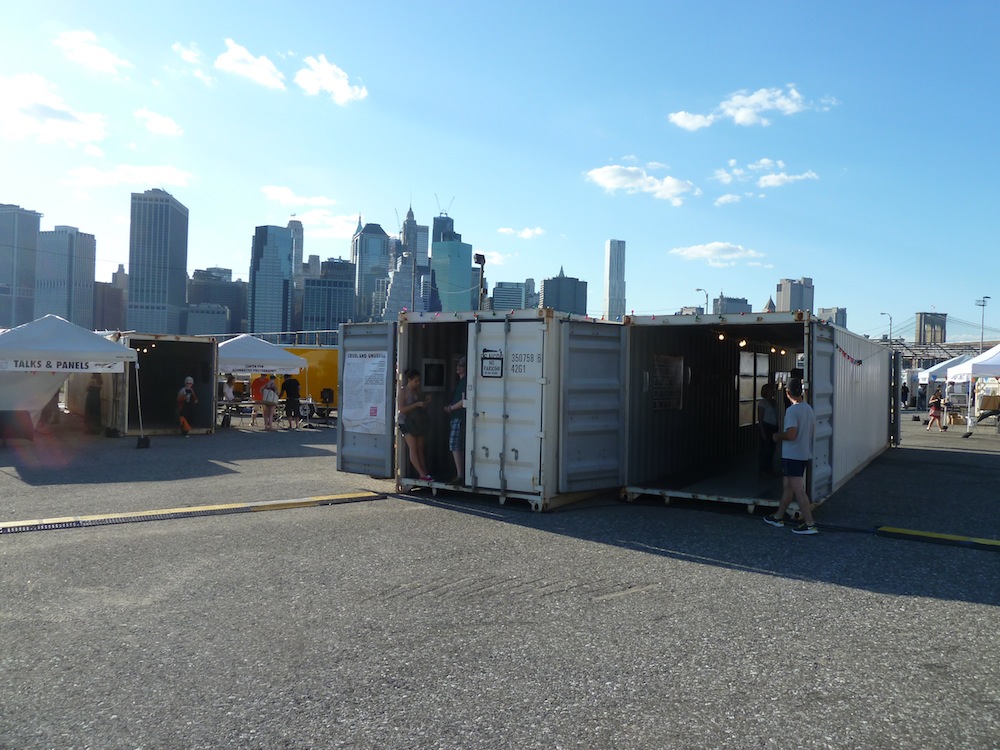
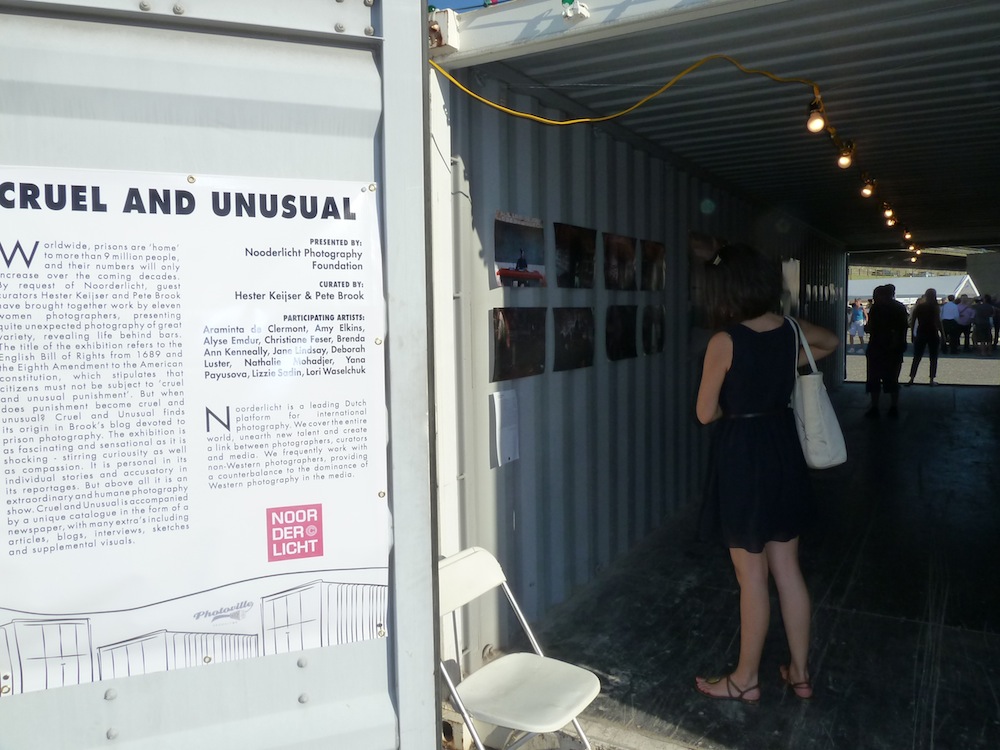
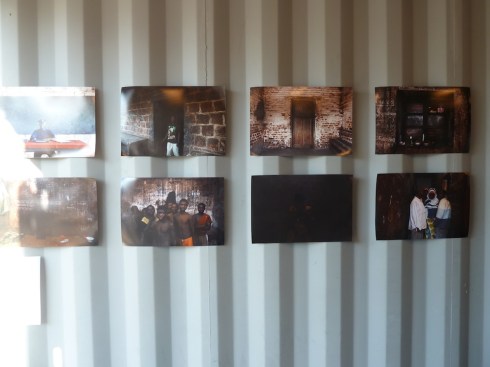
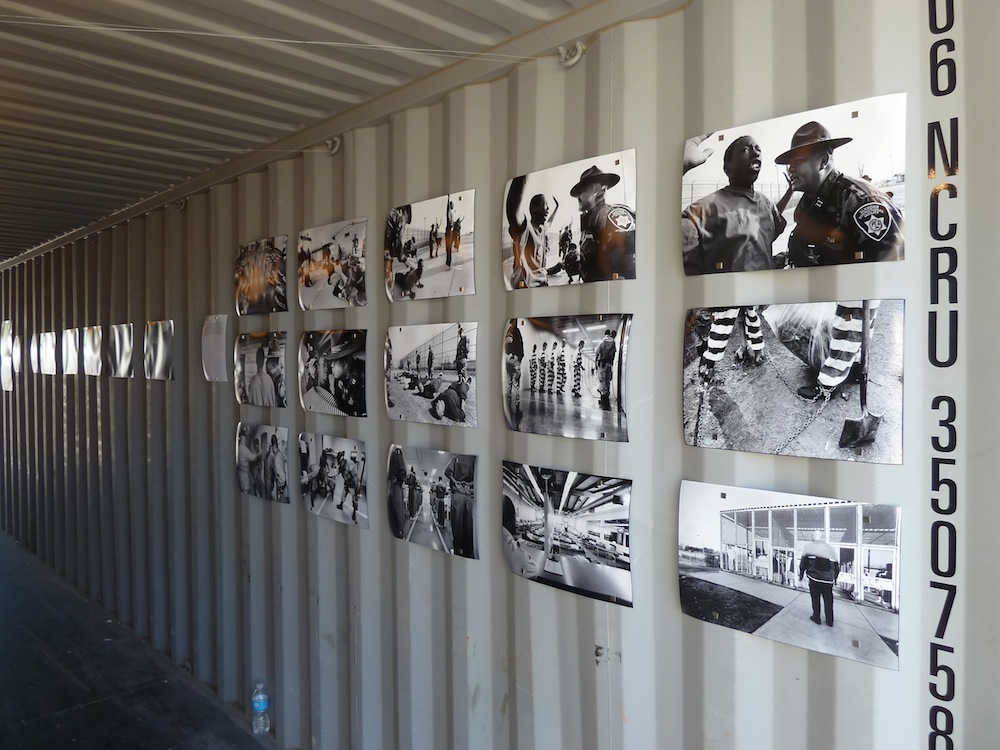
Further thanks have to go to Wally, Trevor and Lee for hanging the work of the 11 named photographers across one and a half containers – Alyse Emdur, Amy Elkins, Araminta de Clermont, Brenda Ann Kenneally, Christiane Feser, Jane Lindsay, Natalie Mohadjer, Deborah Luster, Lizzie Sadin, Yana Payusova and Lori Waselchuk.
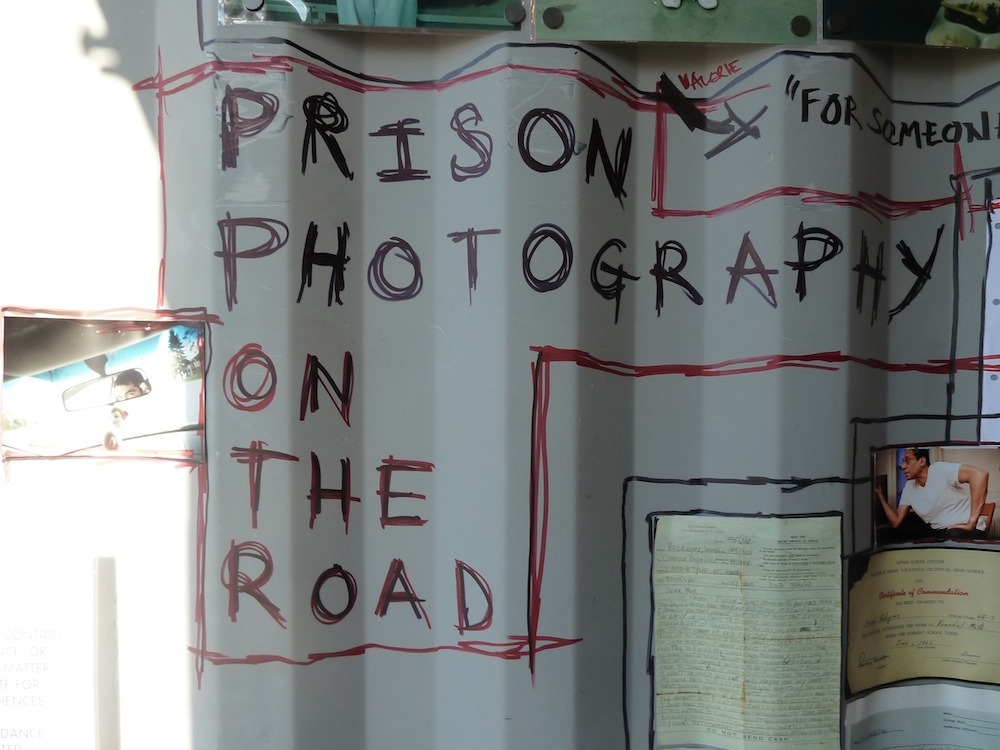
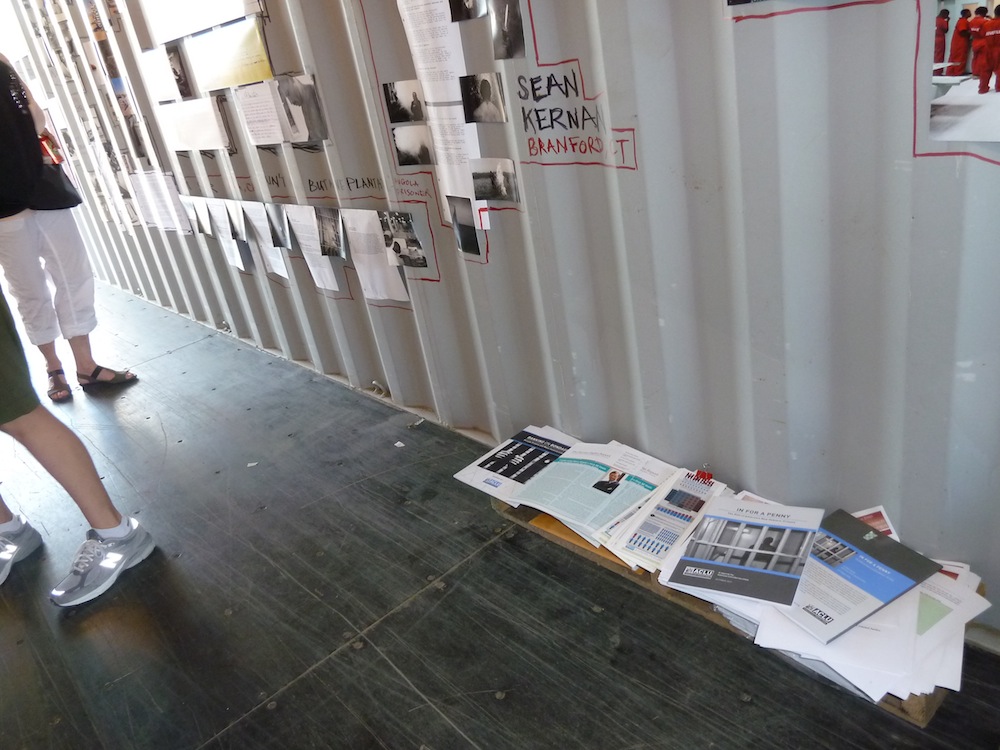
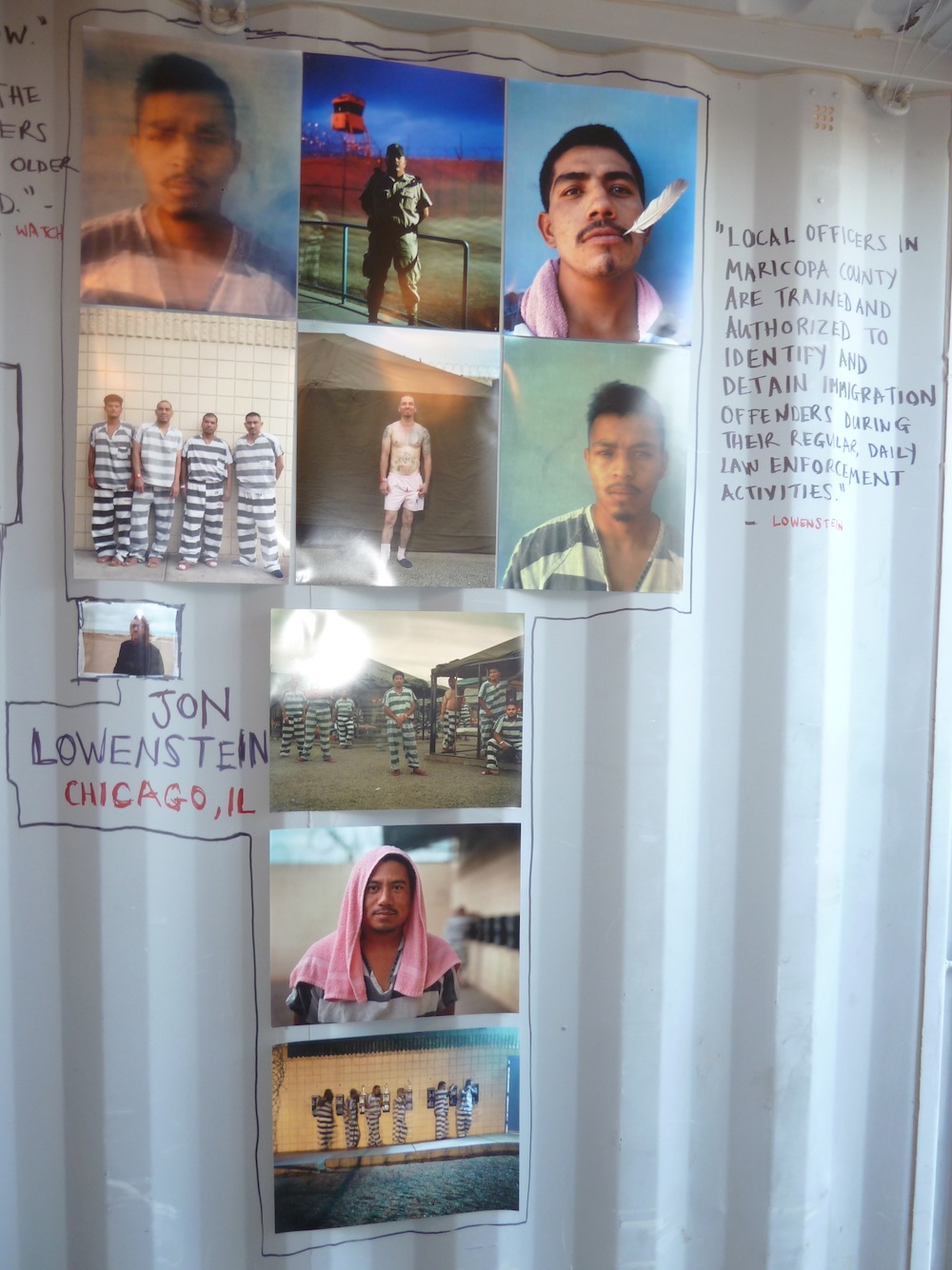
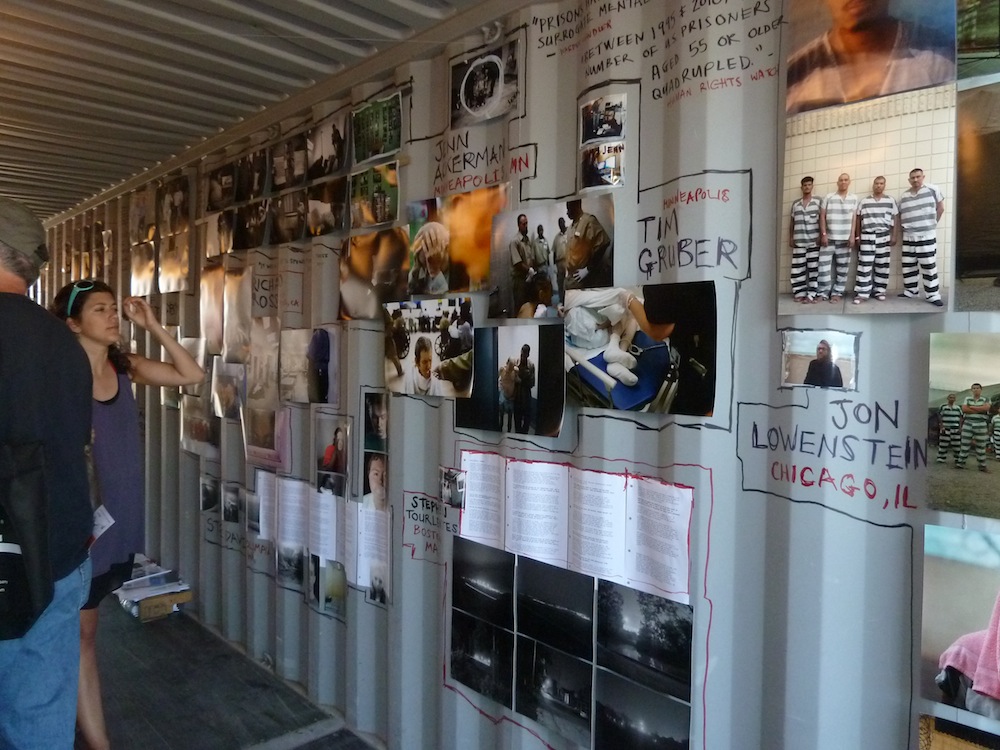
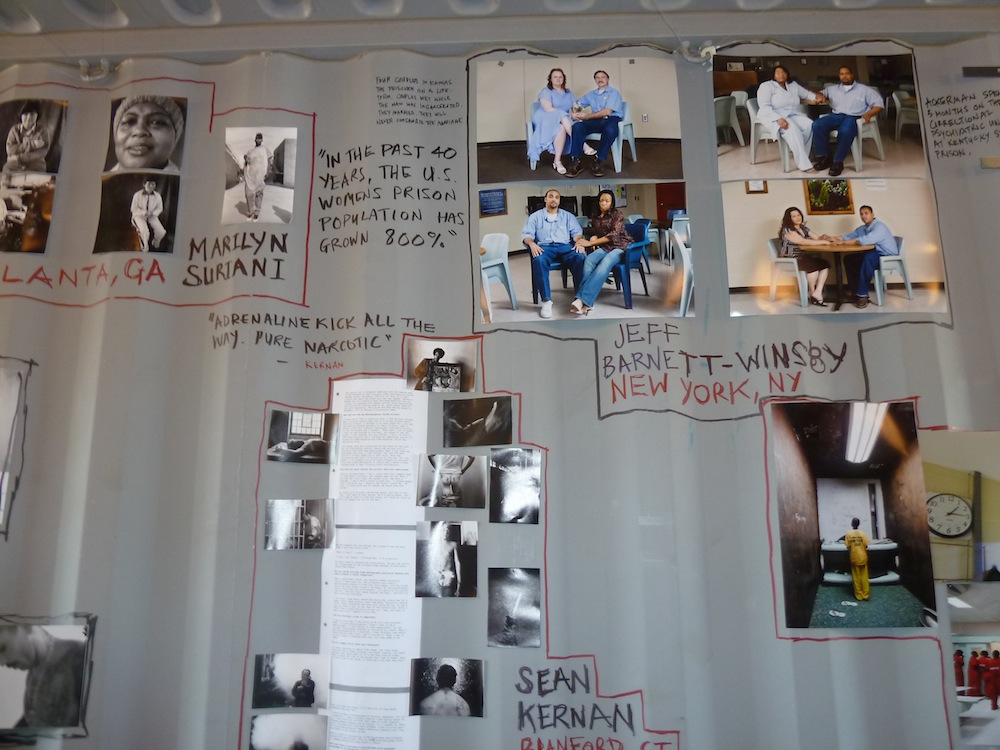
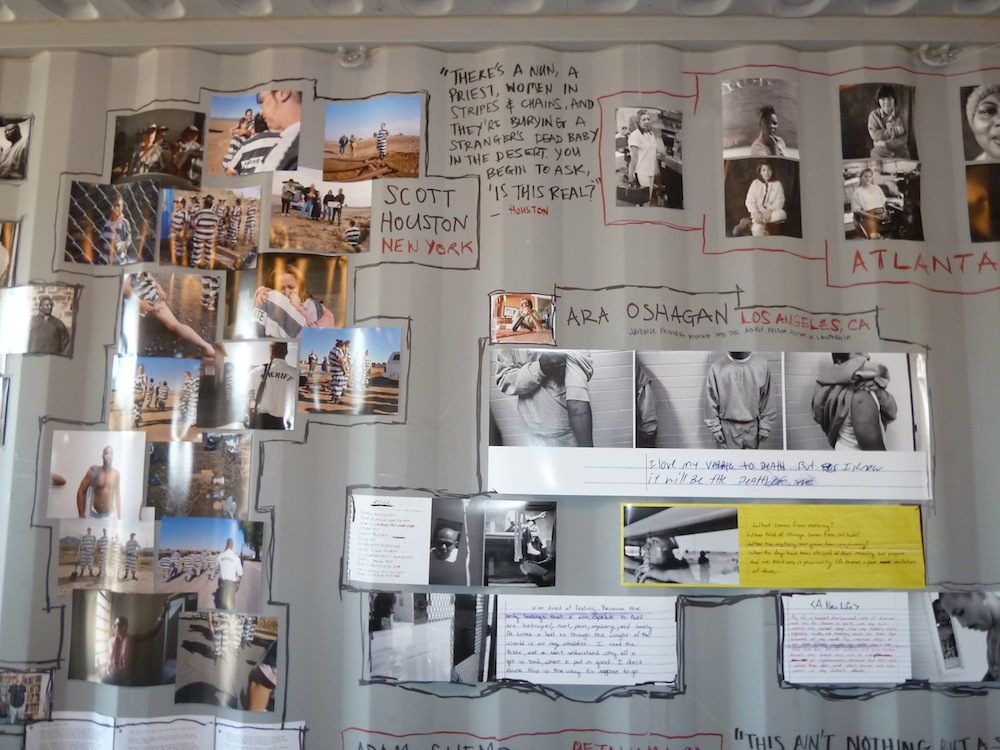
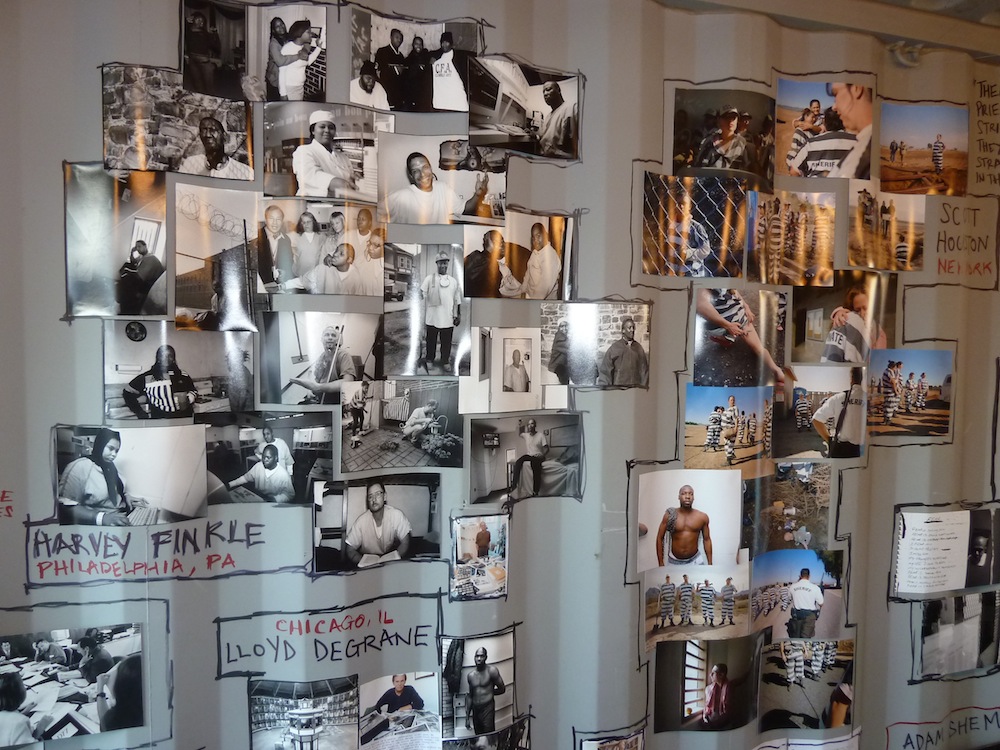
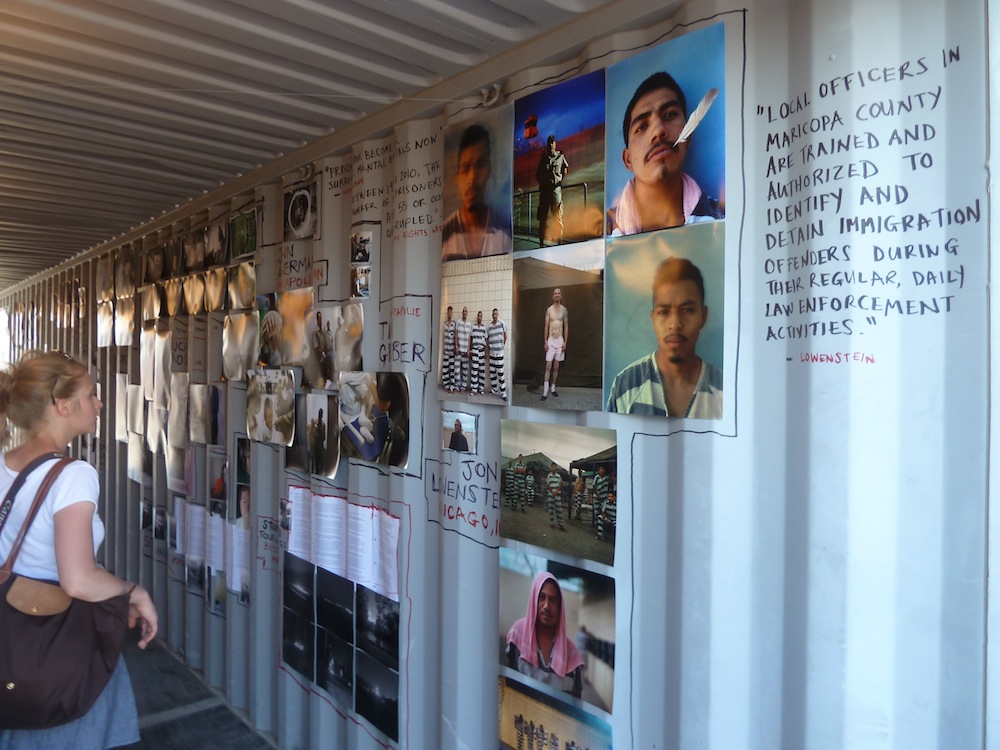
I took care of the other half a container; the PPOTR wall. I scrawled quotes and stats freely on the corrugated surface. Whenever I had downtime last weekend, I’d return to the container and scribble some more.
The PPOTR wall contains images by 17 photographers – Jenn Ackerman, Jeff Barnett-Winsby, Steve Davis, Lloyd Degrane, Harvey Finkle, Tim Gruber, Scott Houston, Sean Kernan, Jon Lowenstein, Ara Oshagan, Joseph Rodriguez, Richard Ross, Adam Shemper, Marilyn Suriani, Stephen Tourlentes, and Sye Williams.
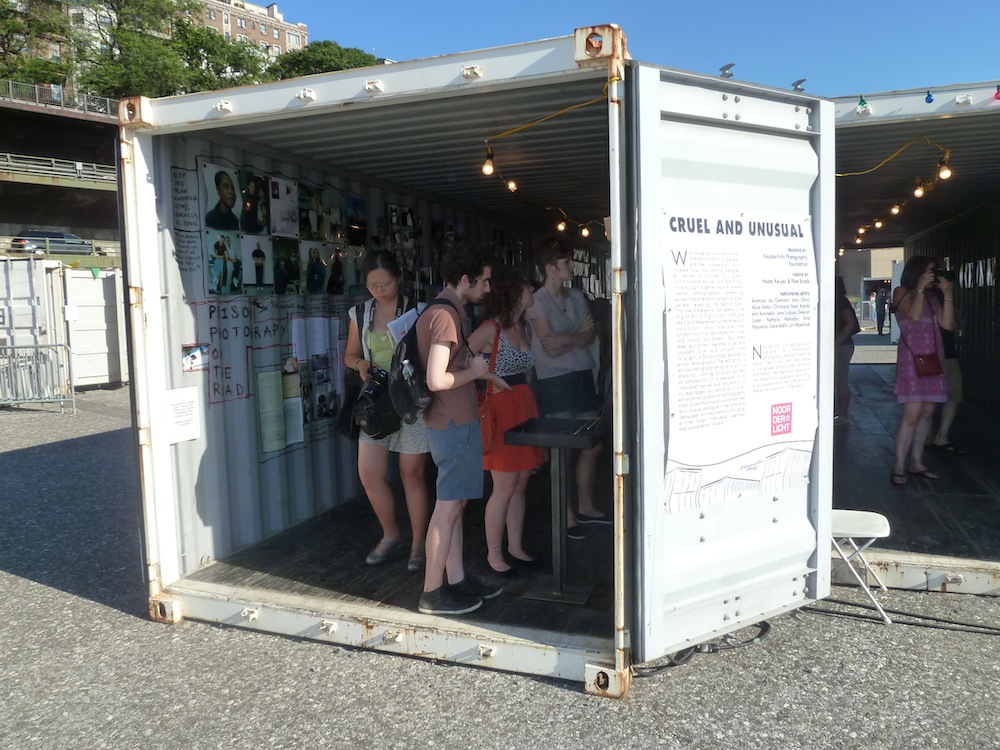
I’d like to Thank Deborah Luster, Yana Payusova and Lori Waslechuk for joining me for Saturday’s panel discussion. They were happy to share stories from their experiences shooting in Russian and Louisianan prisons and they parried my challenge as regards the utility of this type of photography with varied and solid positions.
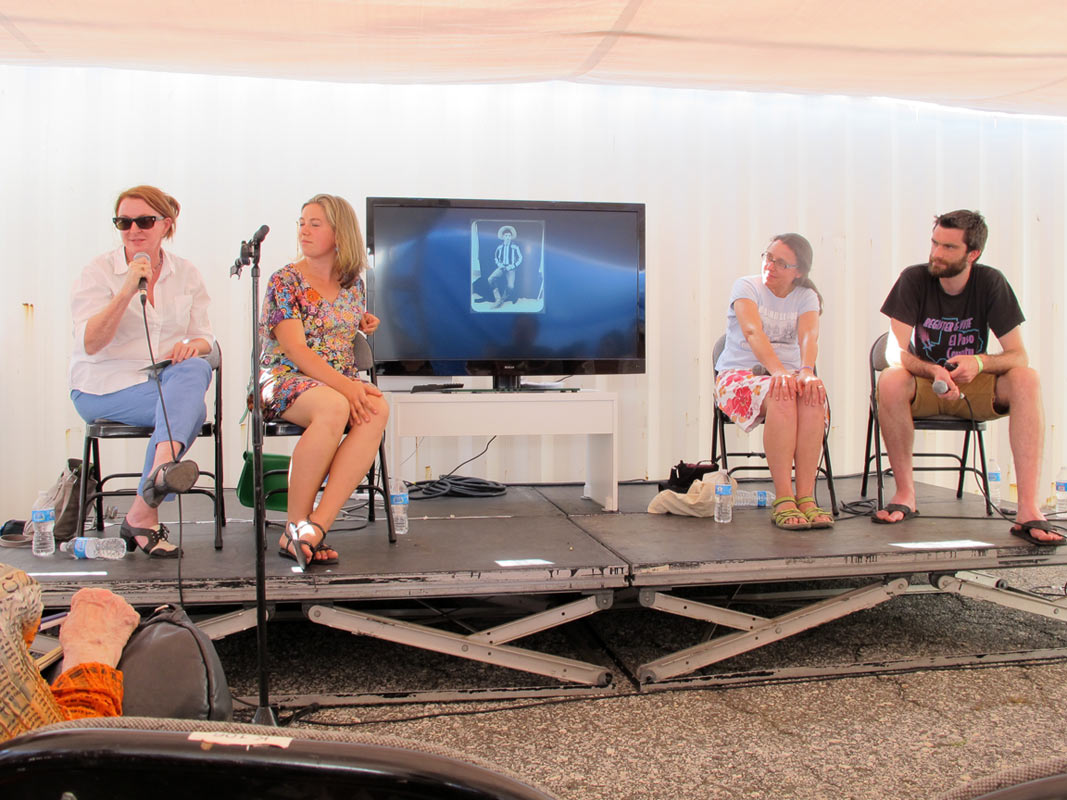
Left to right: Deborah Luster, Yana Payusova, Lori Waslechuk, me. Credit: Graham MacIndoe
Did I mention the massive thunderstorms on Friday afternoon with forks of light cracking down on the skyscrapers of Manhattan? It was great. Then there was the party that was on, wasn’t on, on again. I went for felafel, came back, had a cheeky wine. Hung out with Bryan Formhals and Michael Shaw.
On Saturday evening, Susan Meiselas raised a glass to the Magnum Emergency Fund fellows. Wyatt Gallery was there, as were Amy, Yukiko, Lauren from the Open Society Institute’s Documentary Photography Project. I saw Peter Van Agtmael later and I’m banking on him for better installation shots. Also had the opportunity to finally talk to Chandra McCormick. I had tried to speak with Chandra during PPOTR. She and her partner Keith Calhoun photographed in Angola Prison before it became common to do so.
Photoville is a relaxed place to bump into people you want to bump into. The general vibe is that it is accessible, fun, pedestrian and at the same time maintains a high standard of work. Photoville is off to a good, solid, smile-making start.
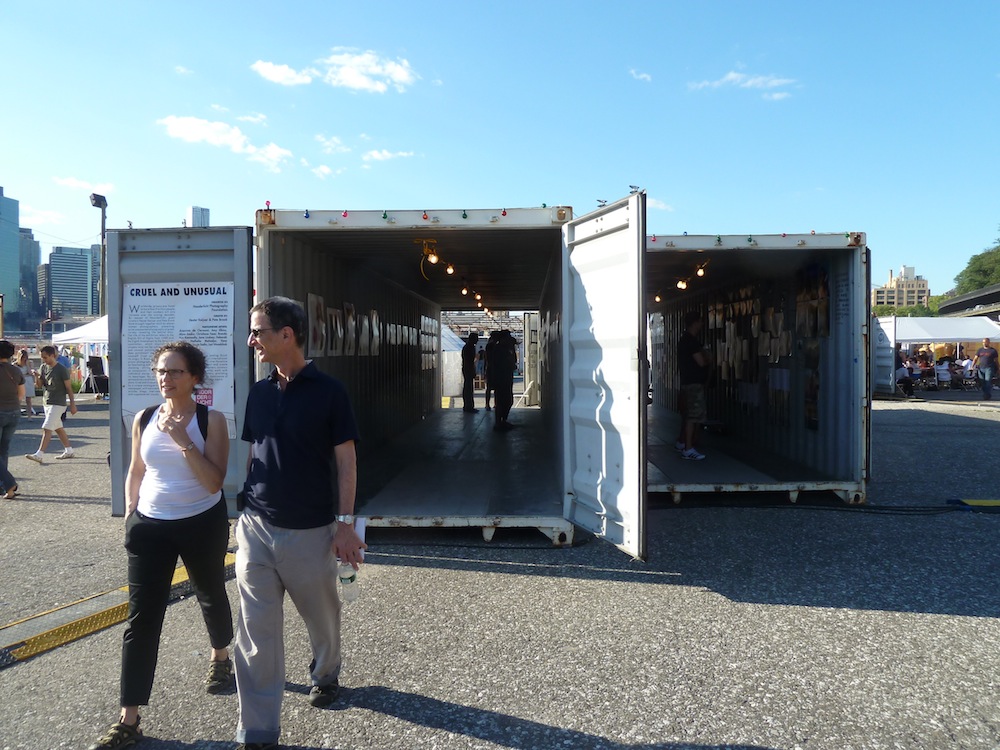
I suppose the only other news is that I delayed my return flight so I remain here in NYC. The arrangements I made for deinstall fell through, so I’ve decided to take care of it myself.
In the meantime, I’m sprinting (or biking) around the city hobnobbing with people, making interviews and panicking about how journo-blogger disclosures should be written in an age of small and borderline incestuous photo-maker-media-networks.
I’ll add to that worry of over-familiarity more at the PDN The Curator Remix party this evening.
Tomorrow, very much looking forward to Lorie Novak’s panel discussion “Community Collaborations” as I’m wrestling with ideas and best practices for potential photography workshops in prison. I also plan to be at the Daylight Photographs Not Taken panel discussion.
Enjoy the pics.
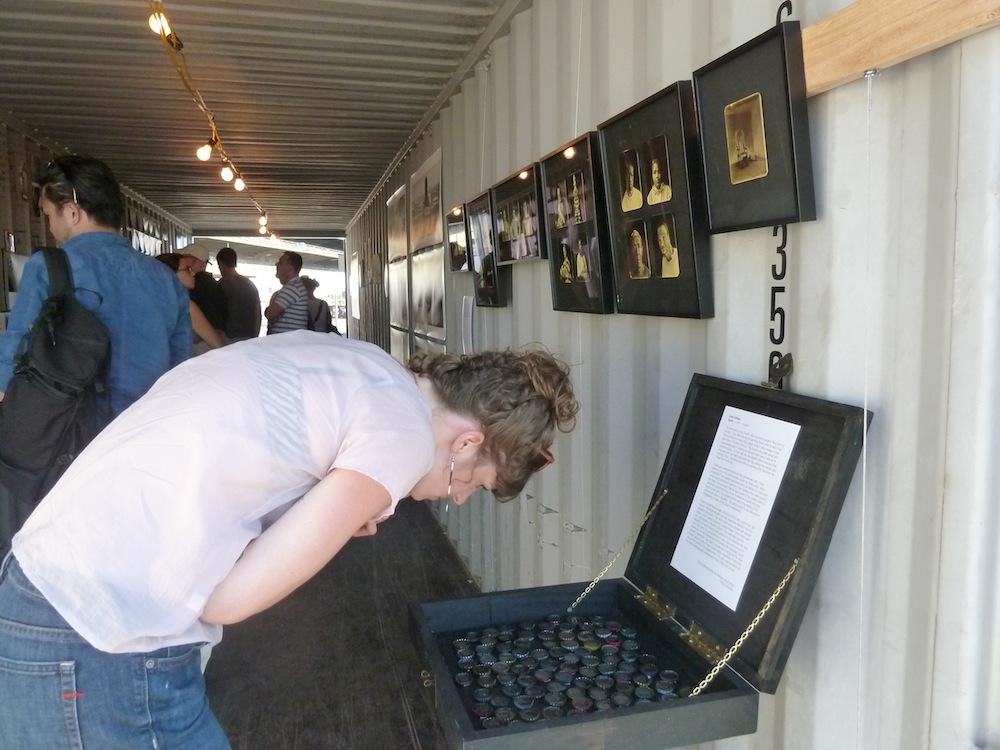
Jane Lindsay’s bottle caps. (That’s Lou Reed’s NYPH pedestal).
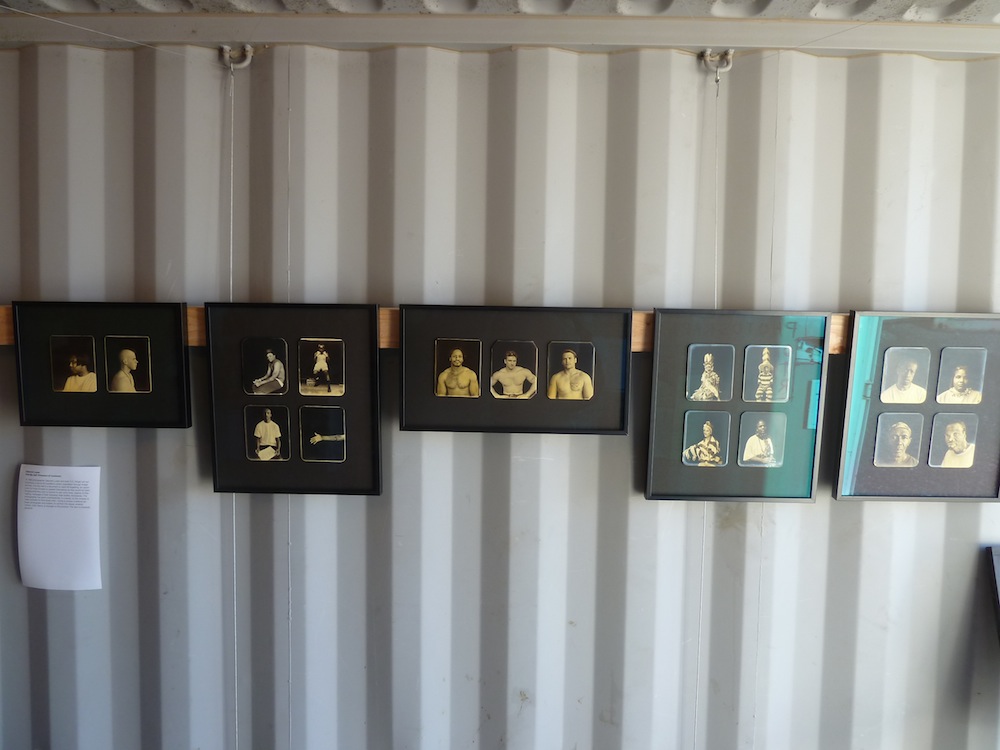
Deborah Luster’s One Big Self
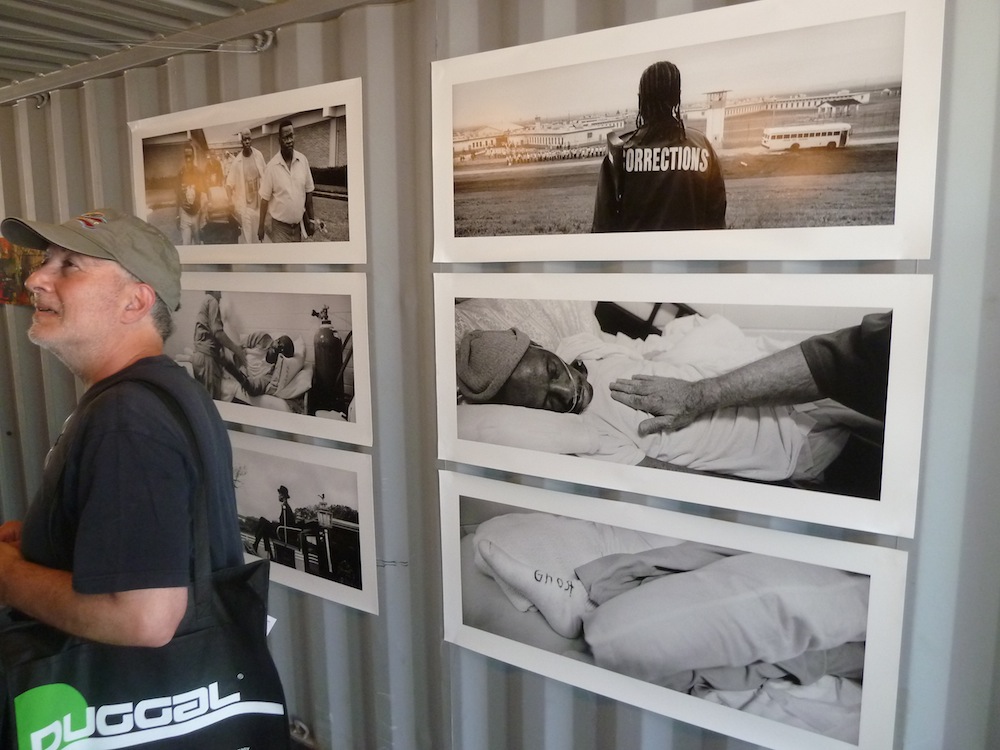
Lori Waselchuk’s Grace Before Dying
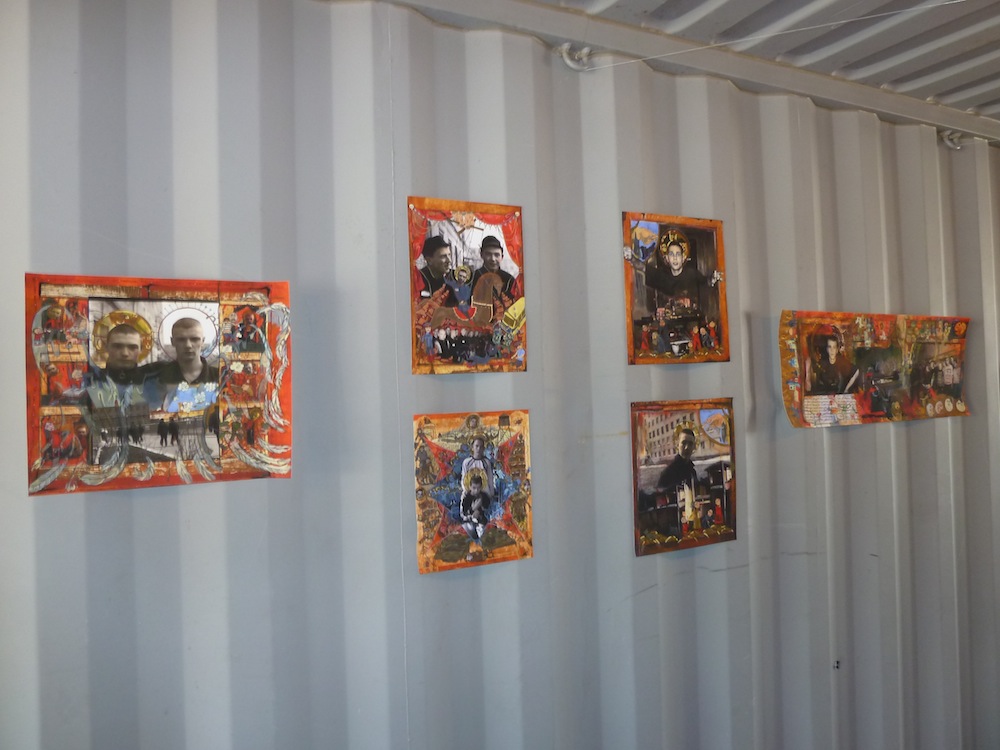
Yana Payusova’s Prisons
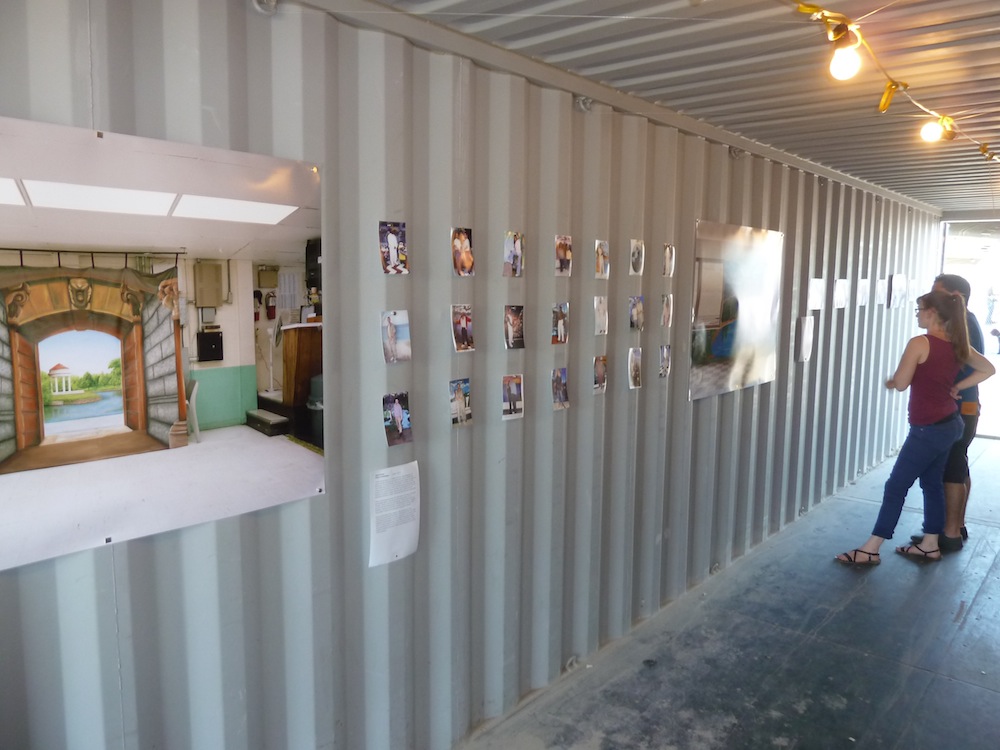
Alyse Emdur’s Prison Landscapes
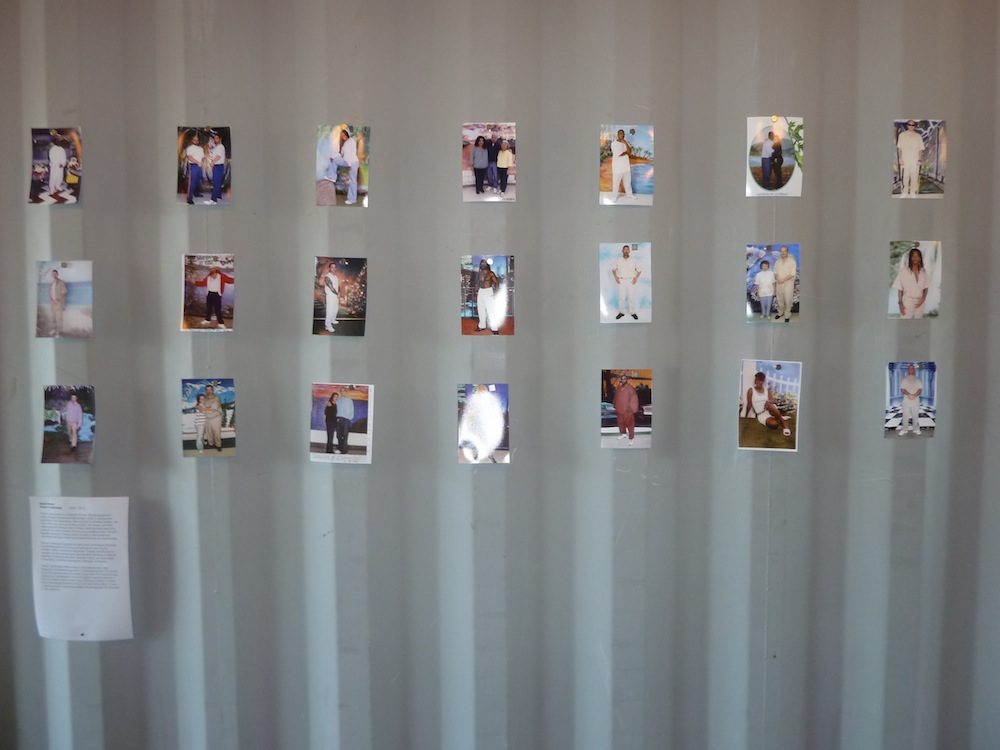
Alyse Emdur’s Prison Landscapes
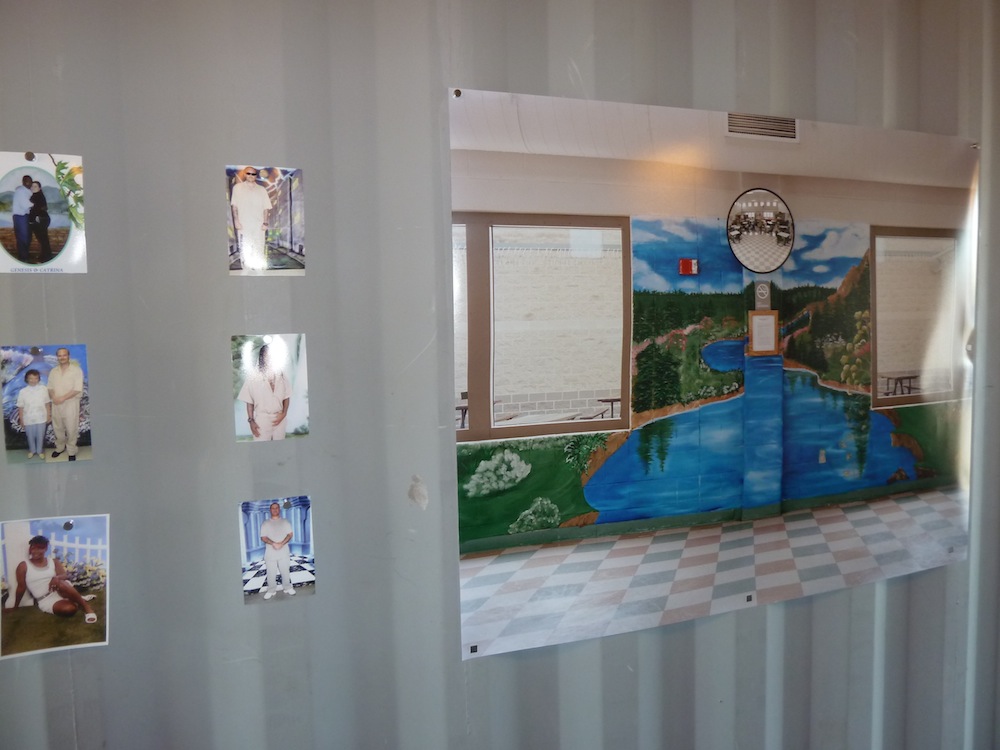
Alyse Emdur’s Prison Landscapes
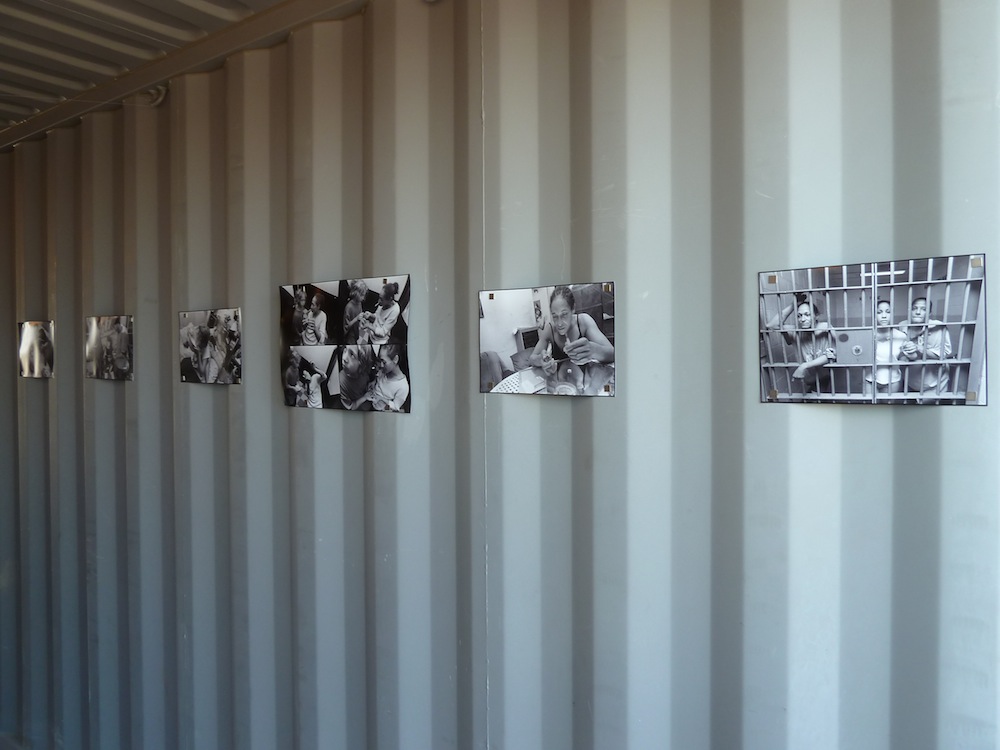
Brenda Ann Kenneally’s Andy and Tata
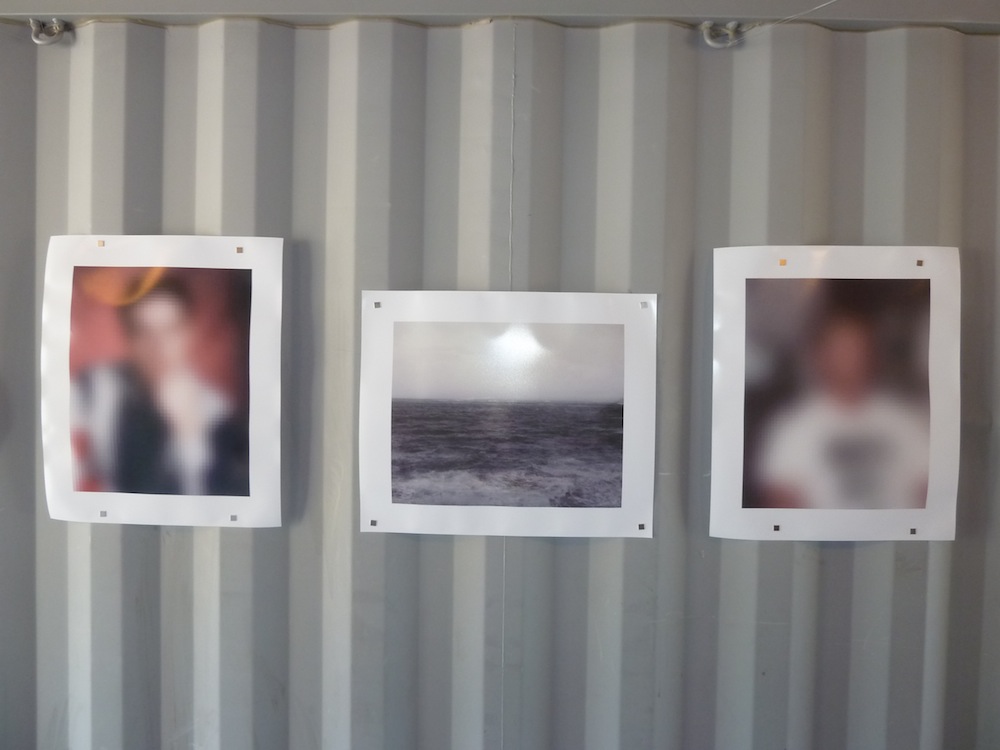
Amy Elkins
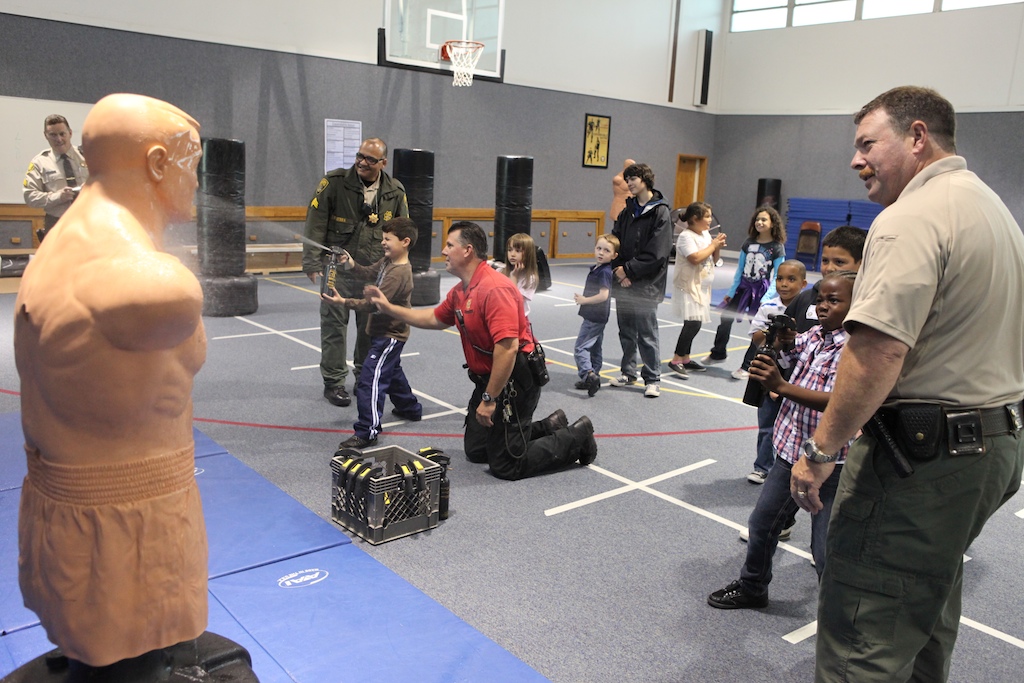
I stumbled across the California Department of Corrections‘ Flickr stream tonight. There are lots of sets to explore including some photo-galleries from various prisons of Bring Your Kids To Work Day.
Click on any image to see it larger.
I have always wondered if the prison system took part in Bring Your Kids To Work Day, and if so, how? Thanks to these clumsy attempts at community PR (clumsiness quite typical of large state agencies, I would say) we now know.
Children practicing fire abatement at California Correctional Centre; learning CPR at California Institute for Women; doing first aid at North Kern State Prison; riding the bus at Deuel Vocational Institute; and dressing up with the SERT team at Folsom.
Most of the photographs I have featured are from the Correctional Training Center, Galt, CA. Here’s head count – Hands Up Kids!
Third from bottom is a single image from San Quentin Prison’s Bring Your Kids To Work Day, and the final two images are from Avenal State Prison.
I’m a little speechless. You?
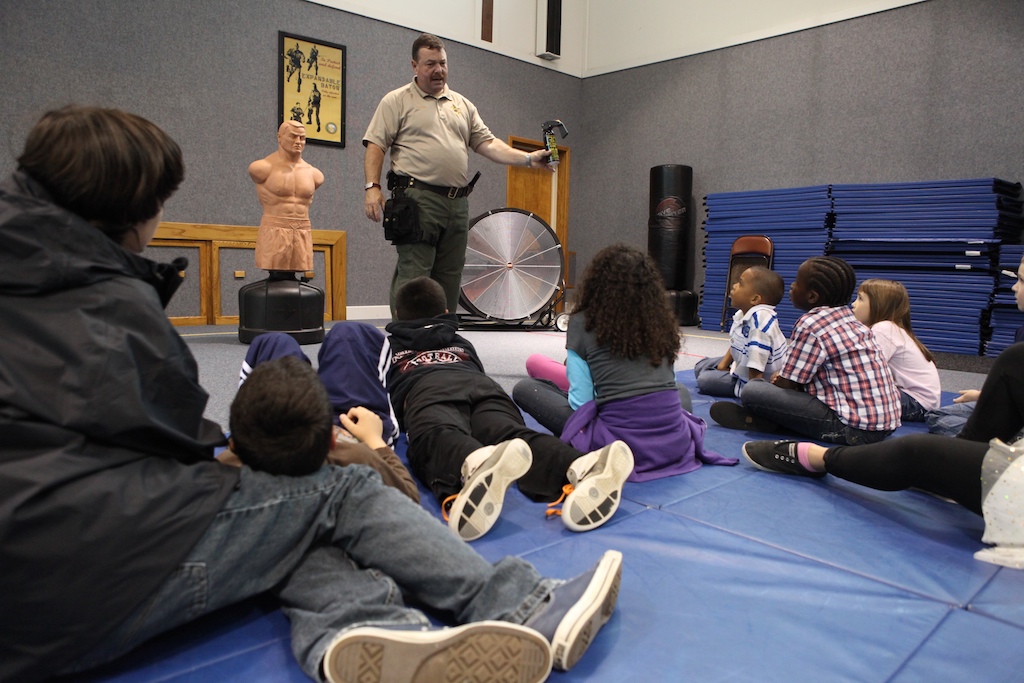






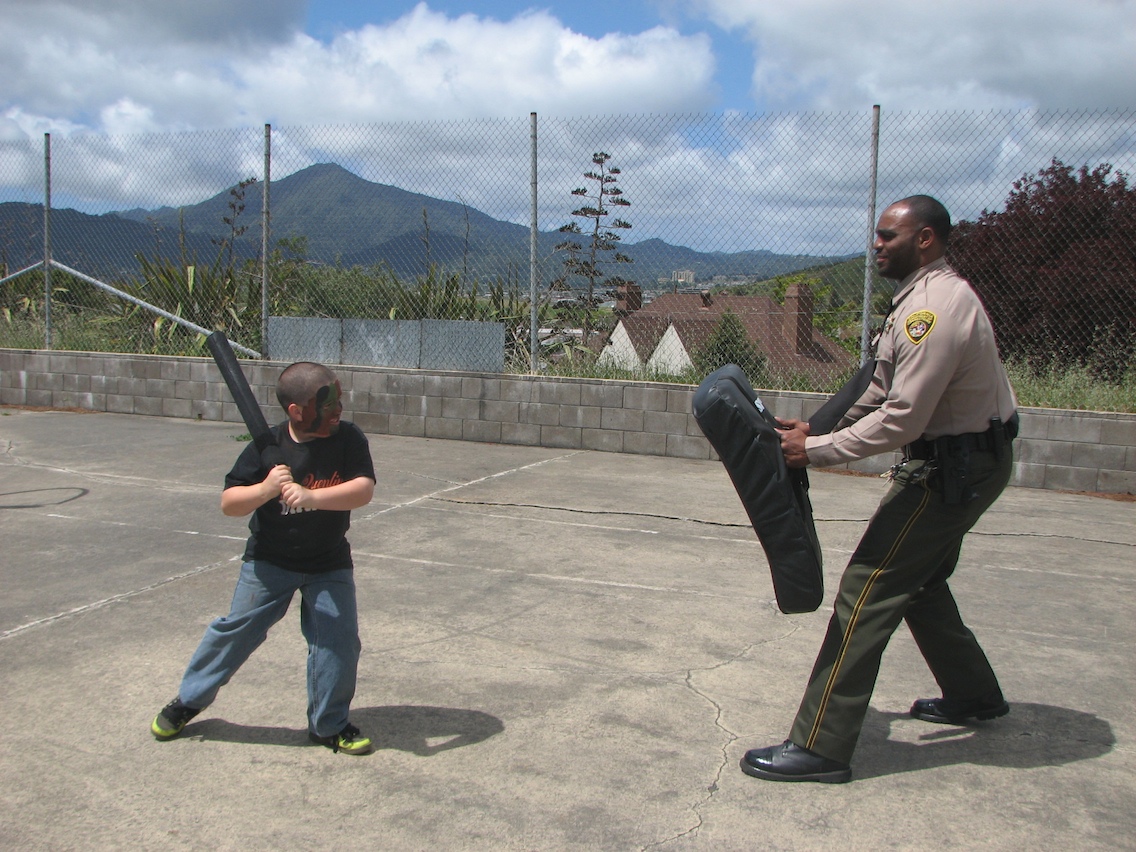
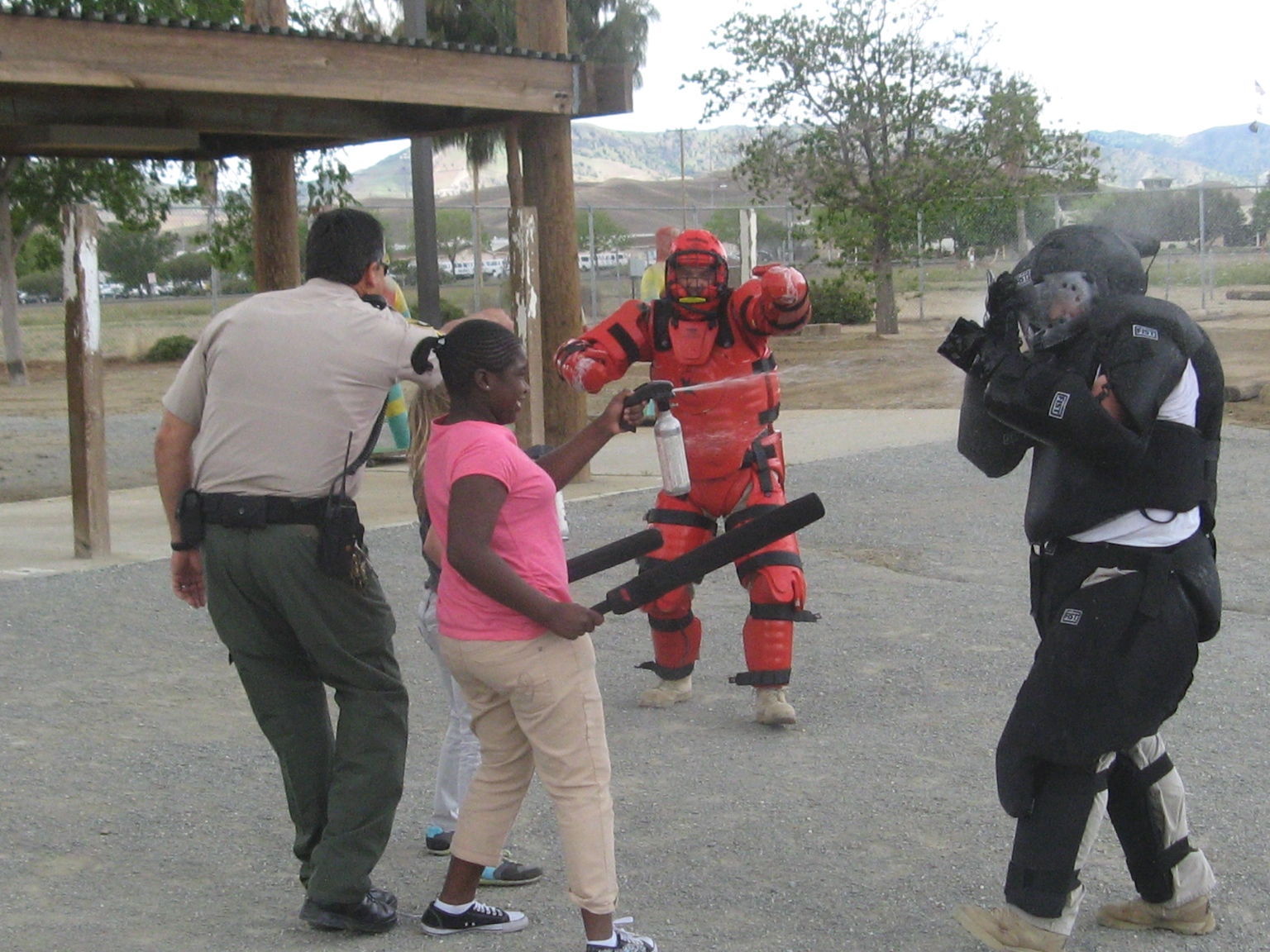

All images: Courtesy of the California Department of Corrections
Yesterday, we were talking about Google Street View. So, the segue to today’s topic is pretty seamless.
There’s been plenty of reporting on the prison robots designed and now being trialled in South Korea. This simple breakdown of info on these over-sized dehumidifiers is as good of a place to start than anywhere.
Lets be honest, these storm-trooping bread-makers are weird but they’re a pretty clumsy use of technology. Yesterday, I deleted my Linked In account, at the weekend I was talking about nuclear war initiated by software viruses (a la Stuxnet). I mean to say that, if we’re thinking about technologies, digital footprints and code-based (non-physical) manifestations of monitoring and interaction are far more pervasive, instant, destabilising and effective ways to intervene in – and disrupt – the world. These stupid, pearly-white ionisers on wheels deserve nothing but mockery.
No matter how good their 3-D cameras and behaviour analysis softwares are, the damn thing still turns its back like a human prison guard. Why doesn’t it employ 360 degrees imaging?
The thing looks ridiculous. It will never work. Prisoners will take the first opportunity to kick the shit out of it … and so they should. In such a scenario, would disciplinary sanctions against a prisoner for vandalising a robot be dealt with in the same way the authority might punish a prisoner for an assault on a prison guard?
The isolation of solitary confinement destroys people; the threat and the psychological isolation of prisoners damages people; unhealthy and inhumane relations with gang-affiliated prisoners and/or stressed, possibly abusive or indifferent, officers damages people. If we expect prisoners to rehabilitate themselves we need to prepare them for reentry into majority society, not subject them to sci-fi distopia surveillance for the sake of saving a buck.
This is market economics gone mad. A product with a cost and with a projected cost-saving. At nearly a million bones a pop I hope they’re dismantled very rapidly by any prisoner class that encounters them. It wouldn’t be vandalism it’d be a service to humanity.

Video still from a surveillance camera in Richmond Heights Jail, St. Louis, Missouri. Anna Brown has just been carried into the cell and laid on the floor. She is dying.
Over on BagNewsNotes, Karen Hull has written a brief but poignant piece about the death of Anna Brown, a young, Black homeless woman. In particular, Hull considers the role surveillance cameras have played in the investigation into Brown’s death.
In September, 2011, Brown died in a jail cell in St. Louis, Missouri. She had visited three hospitals earlier in the evening complaining of pain in her legs but she was turned away by each of them. When she protested and insisted she needed treatment she was arrested and booked into jail. 15 minutes after they closed the door she was found dead. Brown had not used drugs, yet an officer later casually remarked and assumed she had.
Hull:
Race, health care, and surveillance culture come simultaneously into play here. That the healthcare system can be reckoned as something other than a force for good is balanced by the good of a typical “evil”: surveillance. Without surveillance film, it’s possible the death of this young woman would have gone unnoticed. […] as much controversy as there is surrounding CCTV, rest assured that in the future, we will increasingly witness via surveillance.
The footage was attained by the St. Louis Dispatch via a sunshine request.
Full surveillance video of Anna Brown’s demise here. MSNBC provides the backstory.
NOT UNIQUE
Unfortunately, the mistake of authorities to think of a distressed woman as manic instead of in need of urgent medical attention is not unprecedented. In 2009, Cayne Miceli suffering an asthma attack was dragged away from a New Orlean’s hospital and put into a five point restraint in the Orleans Parish Prison. She was disruptive, fearful and loud, but the medical staff at the jail should have known the immediate threat to her life. She died of hypoxic brain injury, cardiac arrest and asthma, brought on by the horizontal position of her restraint.

Jim Linderman just posted some original 1950s mugshots from Brooklyn, NY on Dull Tool Dim Bulb (one of my favourite photography blogs).
Of the images he says:
“Given attitudes, practices and institutional racism from 50 plus years ago, these sharp-dressers might have been just walking to work.”
Possibly, but we will probably never know the circumstances of their arrests.
I am fascinated by the tilted heads of many of the detained men and women. I read a hell of a lot of knowing defiance in the way many of the subjects gaze to the camera. It’s as if they are simultaneously acknowledging the photograph as a component in the apparatus of police power and the primary record of that unequal power. As such, they don’t hide or shrink but confront the photographic act.
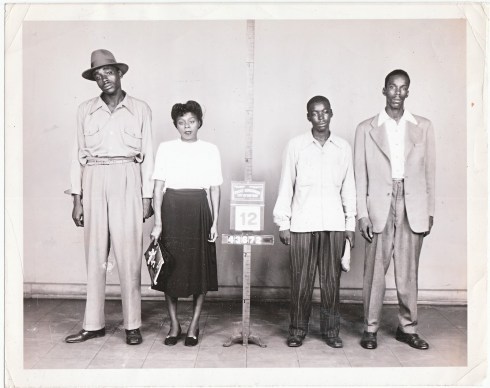
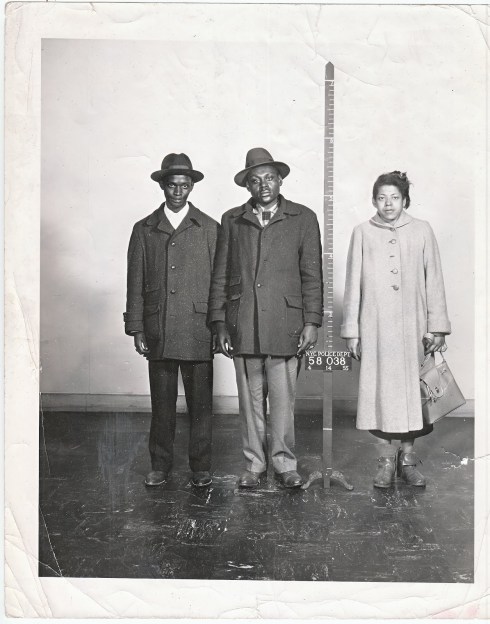
All photos: Group of Original Mug Shot Photographs, New York City 1949 – 1955 Collection Jim Linderman

PRINTED MATTERS
For the upcoming Cruel and Unusual exhibition, Hester Keijser and I opted for a newsprint catalogue. We did this for several reasons.
Firstly, the message behind the exhibition is one that calls for political thought and hopefully political change. Shifts in attitudes come about through public education; it made sense to distribute information as far and wide as was possible. Not everyone can afford a photobook/catalogue, but 4,000 free copies of a newspaper nullifies the issue. Some might call the newspaper medium democratic, but I just call the solution common sense. 
Secondly, we had a lot of photographers to feature. 32 pages of a tabloid-sized newspaper is a sizable amount of column inches with which to fairly deal with the many issues in the photographers’ works.
And third, Hester and I wanted to bring attention to the fact that [photo]bloggers continue to shape, react to, and distort new media economies. As we say in our curatorial statement:
“Cruel and Unusual looks at the utility of freelance online publishing. As bloggers with academic backgrounds, we happily invest time and intellectual capital in our research and writing. Our blogs and those of colleagues have become resources – almost contemporary libraries – that others utilize and perhaps even capitalise upon. For a host of reasons, printed journalism is in decline. Simultaneously, bloggers refine their messages unhindered. Related, but not necessarily causal, we want to acknowledge these two trends and the disruption at hand.”
We aren’t particularly worried about not knowing what the future holds, because for now we are propelled by opportunities to create things in the present.
SOME OTHER NEWSPRINT PHOTO PUBLICATIONS
Most people are probably aware of Alec Soth’s Last Days of W. President Bush was a constant source of partisan news stories, and Op-Ed’s on Bush were divided and divisive. Given that Bush was a leader who orbited world events without necessarily controlling them and given that he was a Commander-in-Chief whose war cabinet tried to warp media to its own message, Soth’s use of a newspaper is ironic and appropriate. Jeff Ladd noted that Soth’s subjects look worn out and exhausted as if reflecting the American psyche after eight years of Bush. A newspaper will soon yellow and show aging – perhaps Soth hoped his newspaper would be short lived like the memory of Bush and the reparations required following his presidency?
Recently, Harry Hardie at HERE has collaborated on two newsprint photo publications.
CAIRO DIVIDED (32 pages) sequences the photos of Jason Larkin with an authoritative essay (in both English and Arabic) by Jack Shenker about suburbanization around Egypt’s capital. Since January 25th of 2011, Egypt has not been out the news, and yet this project is not about revolution. It is however about poverty, wealth and class stratification and as such provides a good context for the revolution in Egypt. Excellent design with eye-opening photographs. Highly recommended. More info here.
Guy Martin’s The Missing is borne of a collaboration between Panos Pictures, HERE and Martin’s alma mater The University of Falmouth. Each of its 48 pages has a large image of a missing poster photographed by Guy Martin. The posters “adorned the walls of the courthouse and justice rooms on Benghazi’s seafront.” Martin estimates that in Libya, 30,000 men are missing after the 8 month conflict. As such, the quasi-legal vernacular documents he re-photographed in-situ were the making of “communal place of memory and mourning.” The newspaper acts as a bulletin existing somewhere between the makeshift and the permanent; between memory and knowing; and – as with those pictured – in ambiguous flux with time. More info here.
Shifting gears, Portrait Salon 11 is not about political events. It is, however, a political stand against institutional exclusion. In the tradition of the 1863 French Salon des Refuses, the London-based Portrait Salon is a curated showcase of photographs that were submitted but not selected for the prestigious Taylor Wessing Photographic Portrait Prize. The use of a newspaper is a mischievous challenge to the immobility of a gallery exhibition that chose 60 works from 6,000 submissions; the newspaper can move cheaply and in large quantities beyond gallery walls. Furthermore, the accompanying Portrait Salon exhibition projected portraits in order to include more photography and not be limited by physical space. The exhibition and newspaper were organised by Miranda Gavin, Wayne Ford and others. For purchase.
I’ve highlighted these projects and in each case tried to justify why the choice of newsprint was appropriate and theoretically consistent. I believe that the Cruel and Unusual newspaper is those things too.
CRUEL AND UNUSUAL: AVAILABLE ONLINE
A non-printable, non-downloadable, non-alterable screen-preview version is available online.
Starting February 18, the newspaper is also available for free in the Noorderlicht Photogallery and for sale in the webshop.
The exhibition is split into two sections: 1, a traditional presentation of 11 photographers, and 2, a heady mayhemic wall of work-prints, background material contact sheets from Prison Photography on the Road (PPOTR).
Similarly, the newspaper is divided into two sections. A 20 page PPOTR pullout is enveloped in 12 pages of descriptions of the photographers in the main part of the exhibition.
Below are the opening page and the back page of the PPOTR pullout. The portrait on the opening page was made by Tim Matsui who documented my workshop at Sing Sing Prison.

The back page is a list of 32 of our favourite international photography blogs with QR codes linking to their websites. This was our cheeky riff on the classifieds section of newspapers!

And below are two pairings of PDF pages and Hester’s photographs of the actual printed object. The paper is really beautiful … so Hester tells me; I’ve not held one yet! I would like to thank the designer Pierre Derks who worked with Hester and I. He has expertise, patience and put in some hard graft.


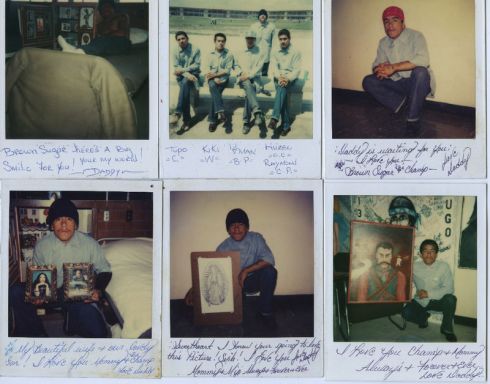
In the past when I have discussed prison Polaroids, I have said they are perhaps one of the more significant subsets of American vernacular photography, and that they are not easily found online and that, due to their absence, our perception of prisons and prison life continues to be skewed.
Well, times change and that position now deserves correction. I have noticed a few collections coming online recently. Not least the Polaroids from Susanville Prison on the These Americans website. (Also, check out the new PRISON subsection of the site.)
Online, I have identified some increase in the number of contemporary prison visiting room portraits and, as in the case of These Americans, collections of older, scanned images.
I would suppose that many Facebook users have scanned visiting room portraits and added them to profiles but, only visible to friends, those social network image files have not been reproduced for public consumption or commentary. We might think of Facebook photos and albums as digital versions of the mantlepiece, i.e. seen only by close friends and family.
ONGOING FOCUS
“Prisoner-complicit” portraits (for want of a better term) are taking up a lot of my thoughts currently.
Yesterday, I had a workshop with the #PICBOD students at Coventry University, in which I assigned readings on Alyse Emdur’s visiting room portrait collection, prison cell phones as contraband, prison cell phone imagery as cultural product, a new Tumblr In Duplo that compares publicly available mugshots with publicly available Facebook profile pictures, and the racket that underpins the posting and removal of mugshots to the searchable web.
Particularly with cell-block-cell-phone images, we should anticipate a glut of prisoner-complicit photos in which prisoners – to a greater degree – self represent.
We should realise that this is the first time in modern history that prisoners have presented themselves to the internet and thus permanently to the digital networks of the globe. My hunch is that this may be significant, but really, it’s too early to tell.
We can note that in this video, most of the images seem to originate from the same cell phone camera in the same prison. We might surmise there is no epidemic of illicit and smuggled images yet. To further this inquiry, I hope to get some information from the maker of said video.
In the mean time, I’ve been in touch with Doug Rickard who administers These Americans as well as the wonder-site American Suburb X. I asked him about his recently published Susanville Prison Polaroids:
Any idea who took them? (any marks/prison-stamps on verso?)
Probably a visitor or another inmate? I have a set (10 or so) of the main inmate (“Johnny”) that you see in many of the “Susanville” single poses, posed with “Brown Sugar” (his girlfriend/wife) and his son “Champ”, a boy that grows from 1-3 years old in the various pictures (see below).
What years do you think they span?
I can only find one date, 10-24-80. You would think that they were 90’s, but for sure, it says 80.
What makes this collection so fascinating to me is that the operator(s) appears to have had free reign of cells, tiers and the yard to make these single and group portraits. One of the PICBOD students at Coventry today wondered where their supply of Polaroid film came and then to where the images were eventually dispersed outside the prison.
We could only conclude that this prisoner and his group of friends had special privileges and access. From all of my research into (vernacular) prison photography – specifically prisoner-made photography – this sort of arrangement/privilege does not exist in American prisons today.
MORE ON THESE AMERICANS
http://www.theseamericans.com/media/minnesota-mugshots/
http://www.theseamericans.com/prison/last-prisoners-leave-alcatraz-1963/
http://www.theseamericans.com/prison/visiting-hours/
http://www.theseamericans.com/prison/prison-collection-%e2%80%9cjoliet-state-prison%e2%80%9d-1963/
http://www.theseamericans.com/prison/florida-collection-jack-spottswood-sunbeam-prison-camp-1950/
http://www.theseamericans.com/prison/california-collection-san-quentin-prison-1925-1935/
http://www.theseamericans.com/prison/polaroid-collection-mcneil-island-prison-wa-1970s/
– – – – – – – – – – – – –
Thanks to Peg Amison for the tip.

 Prison Photography